


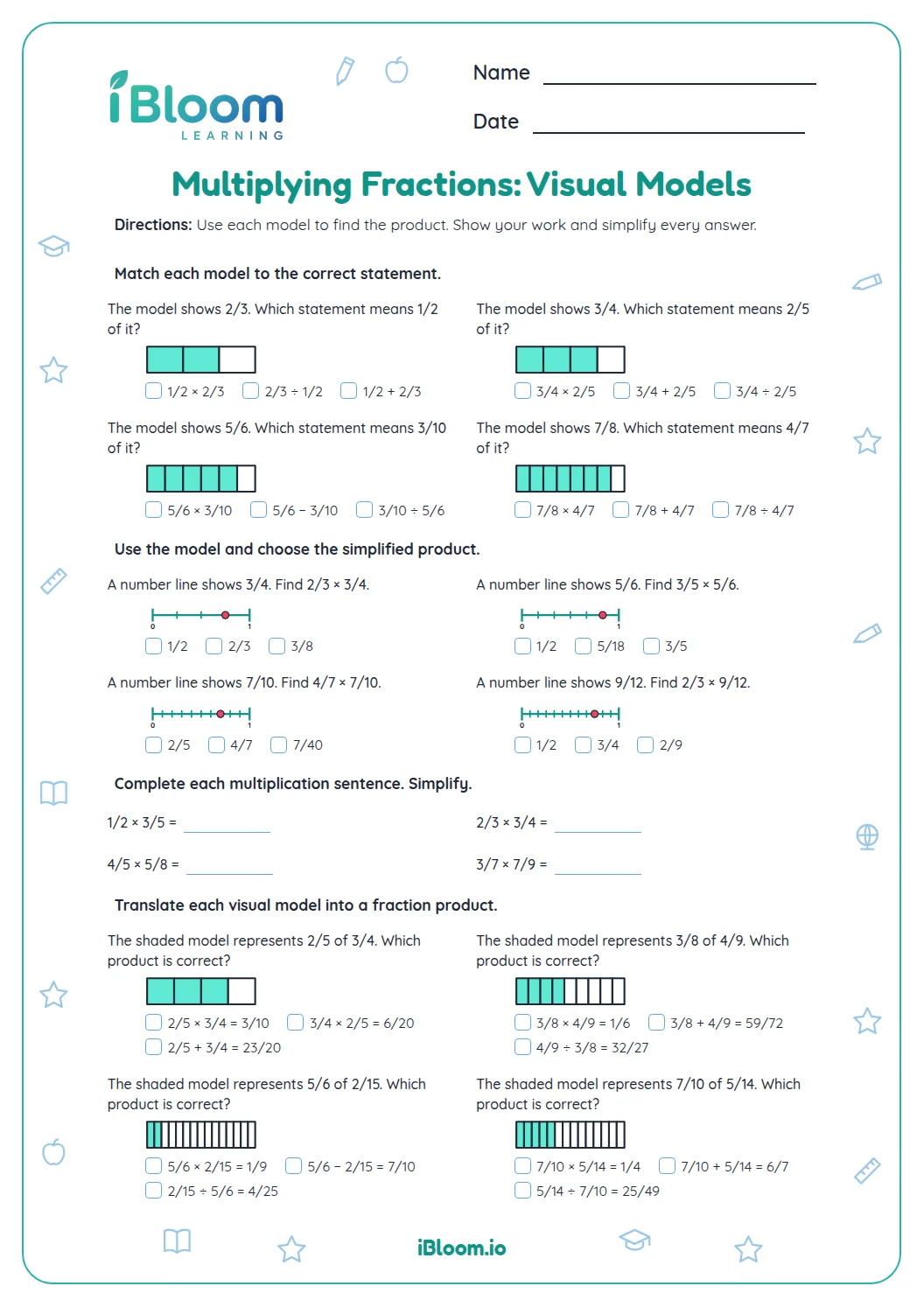
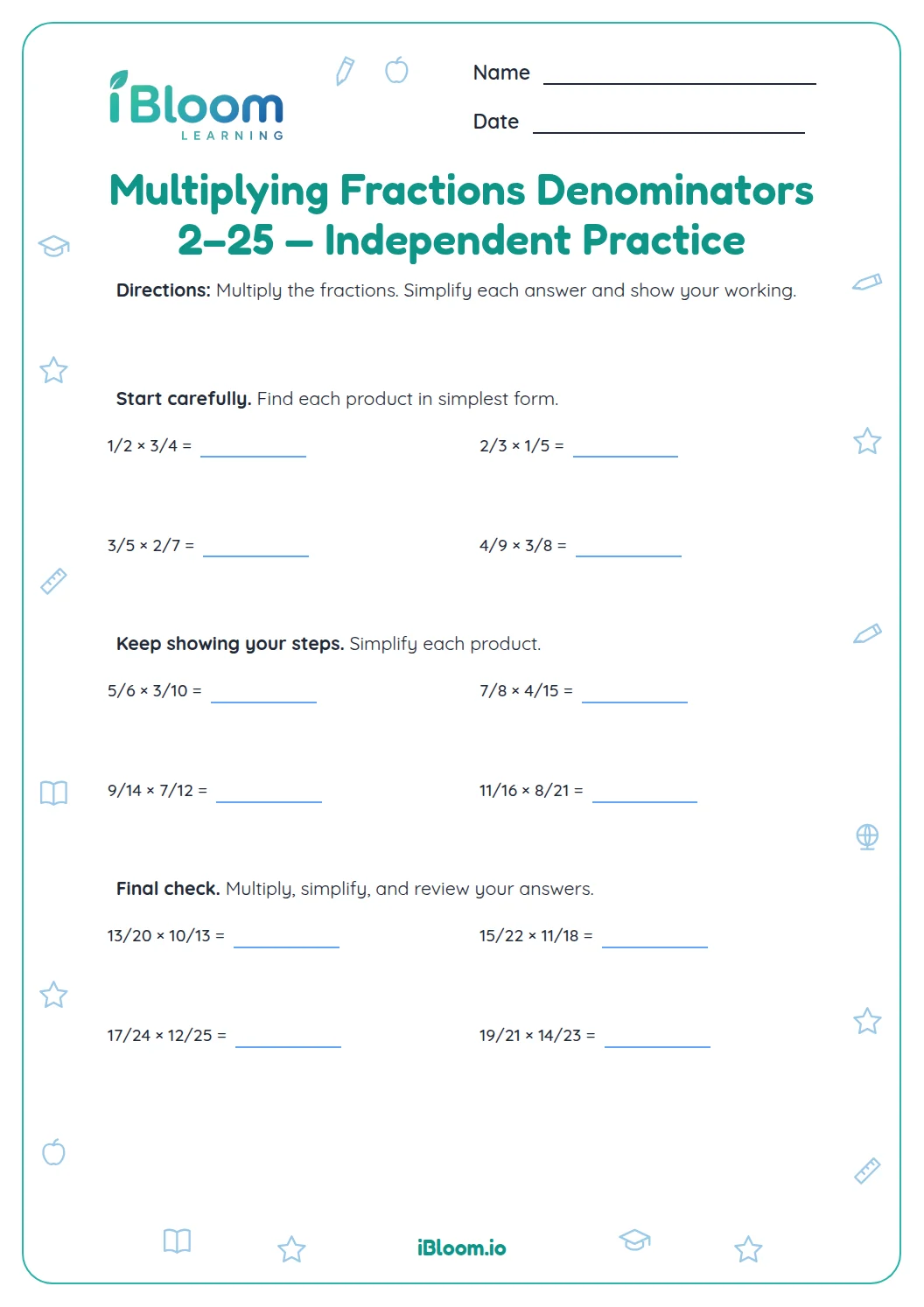
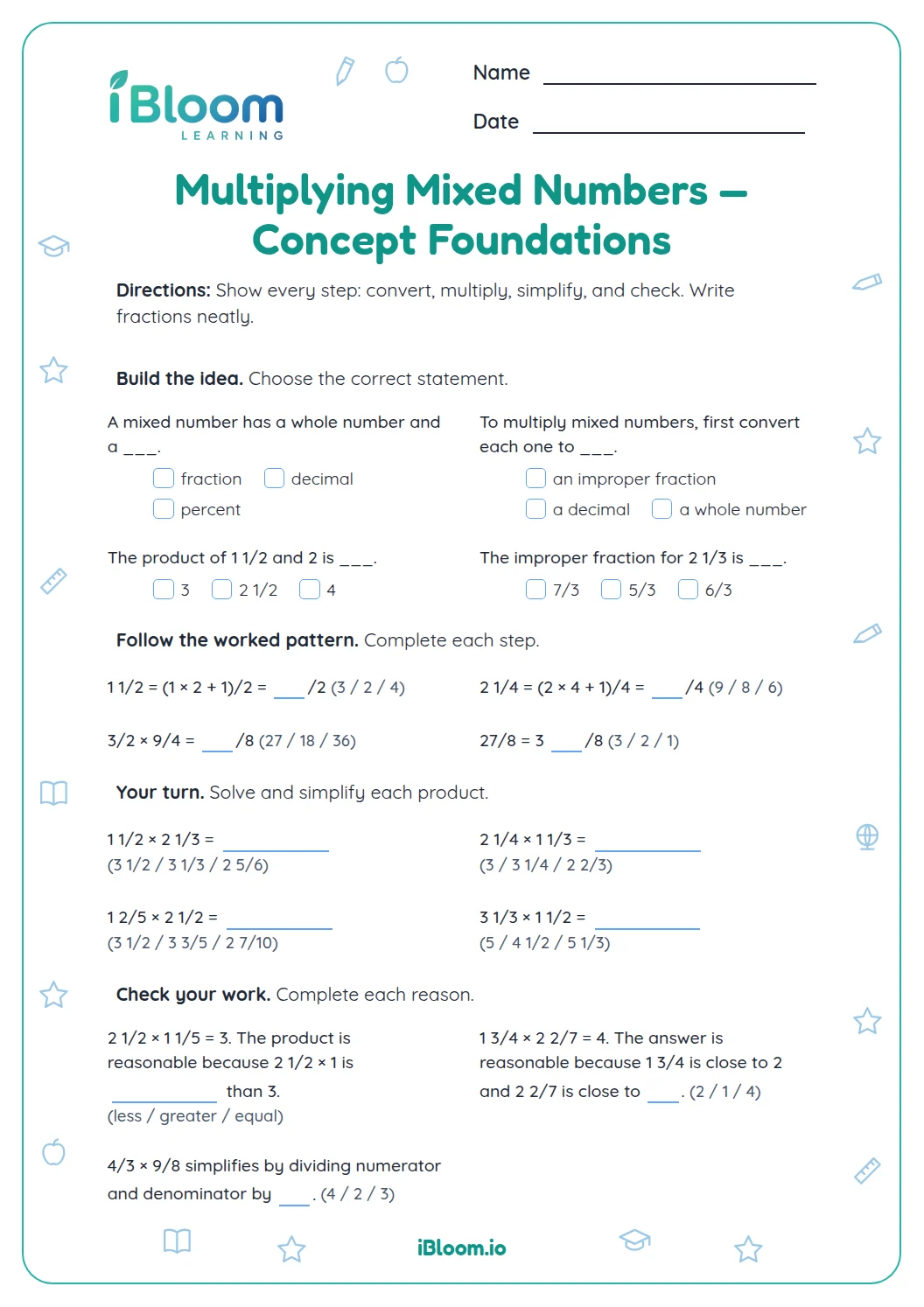

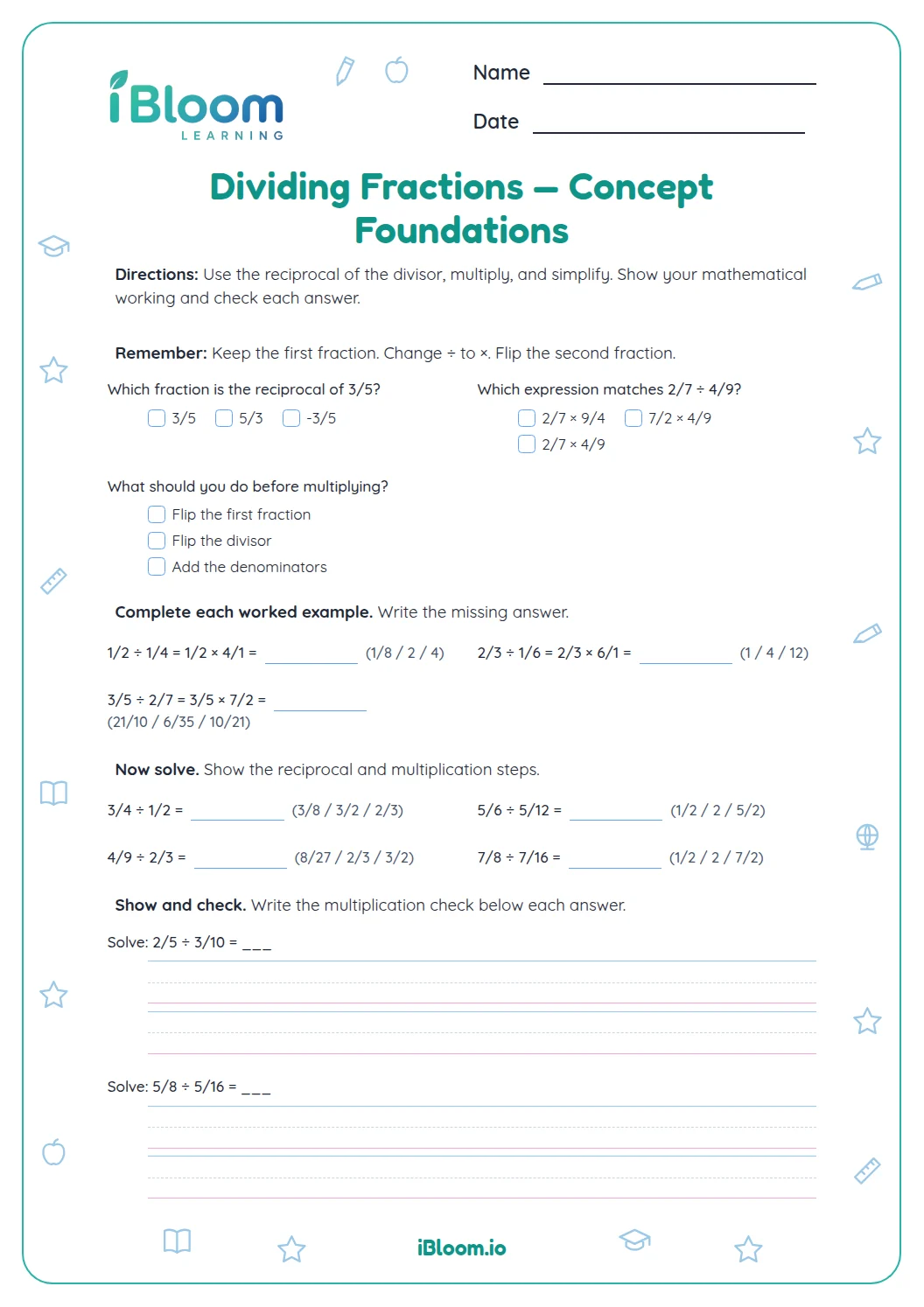


About this worksheet
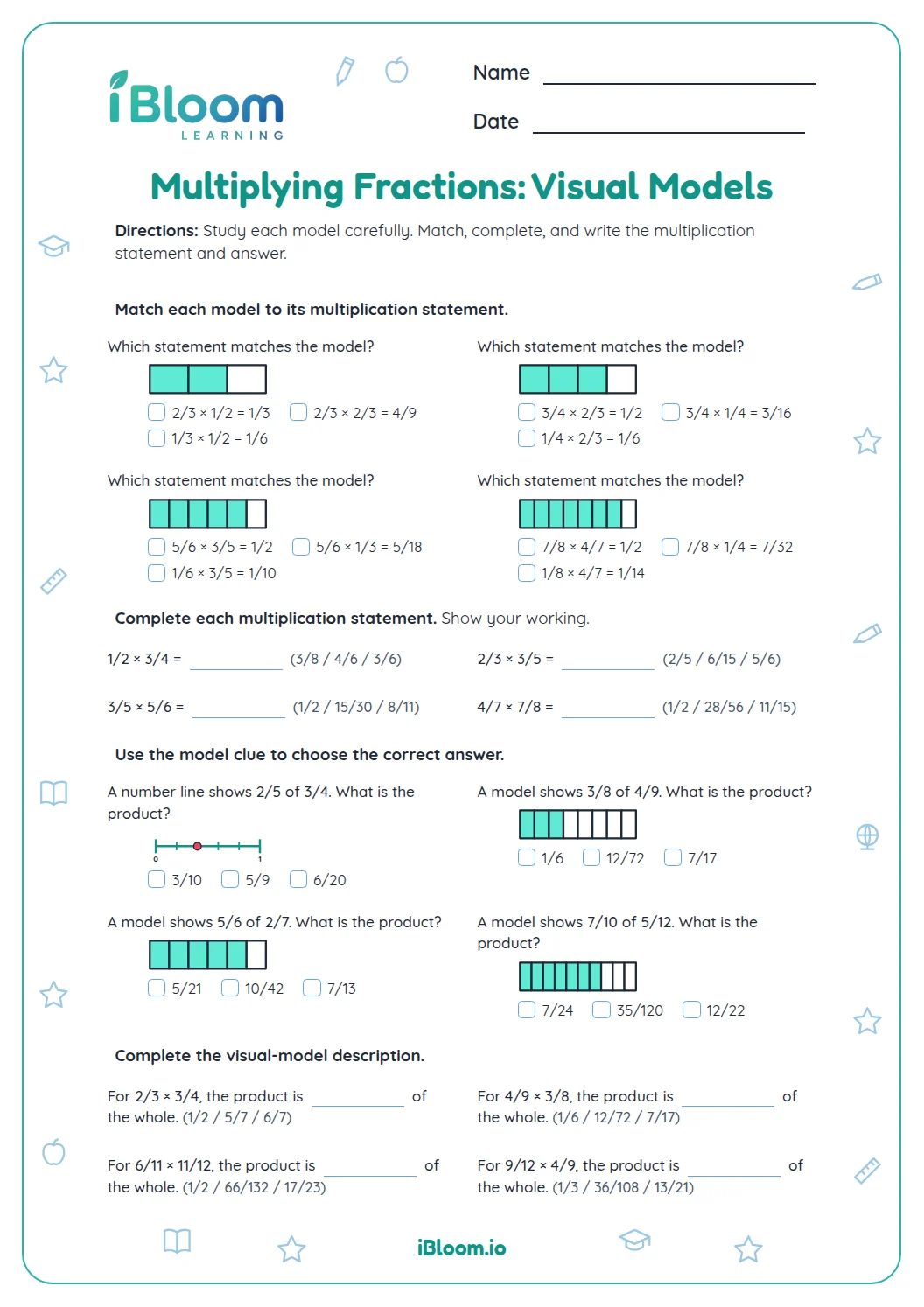
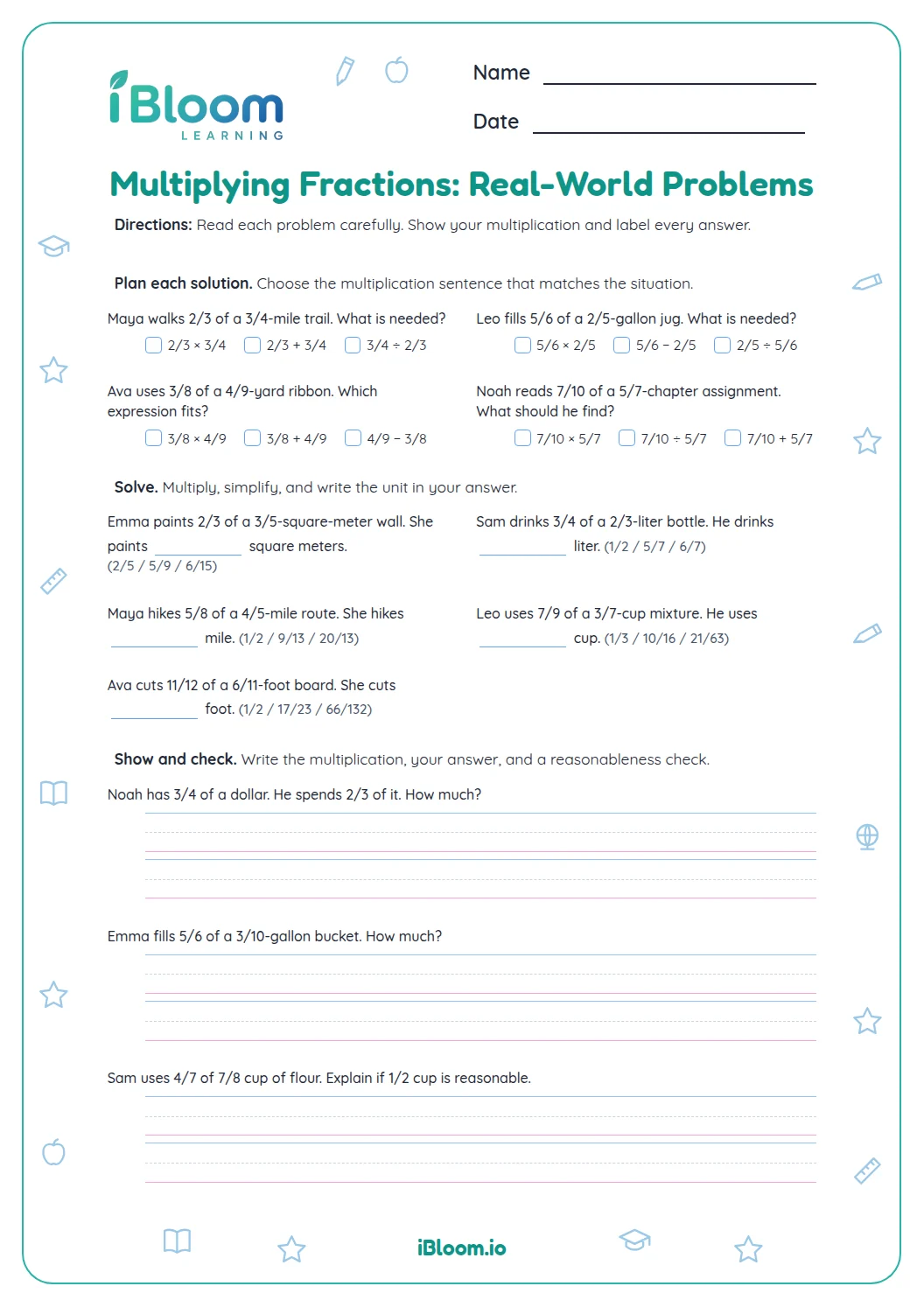
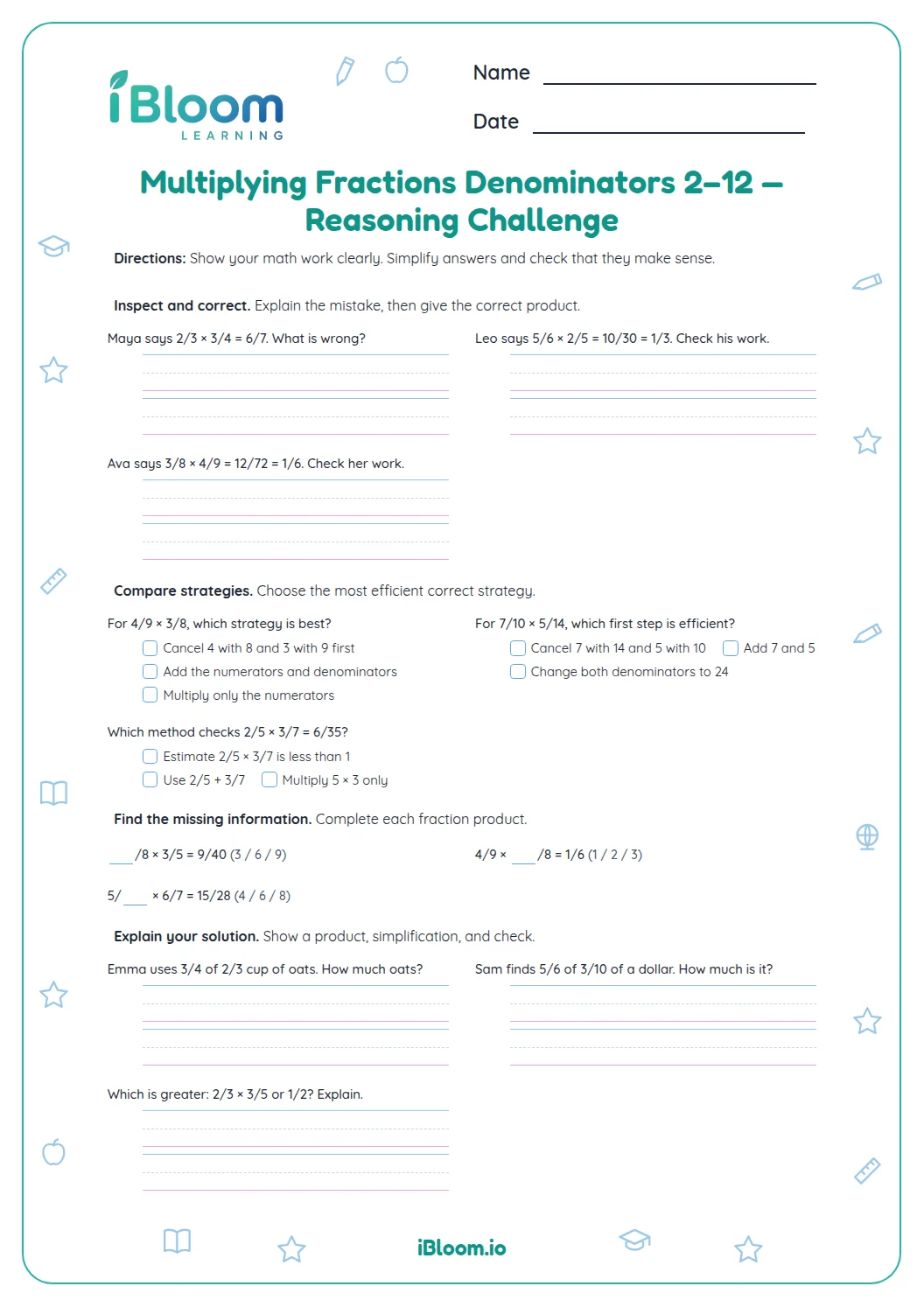
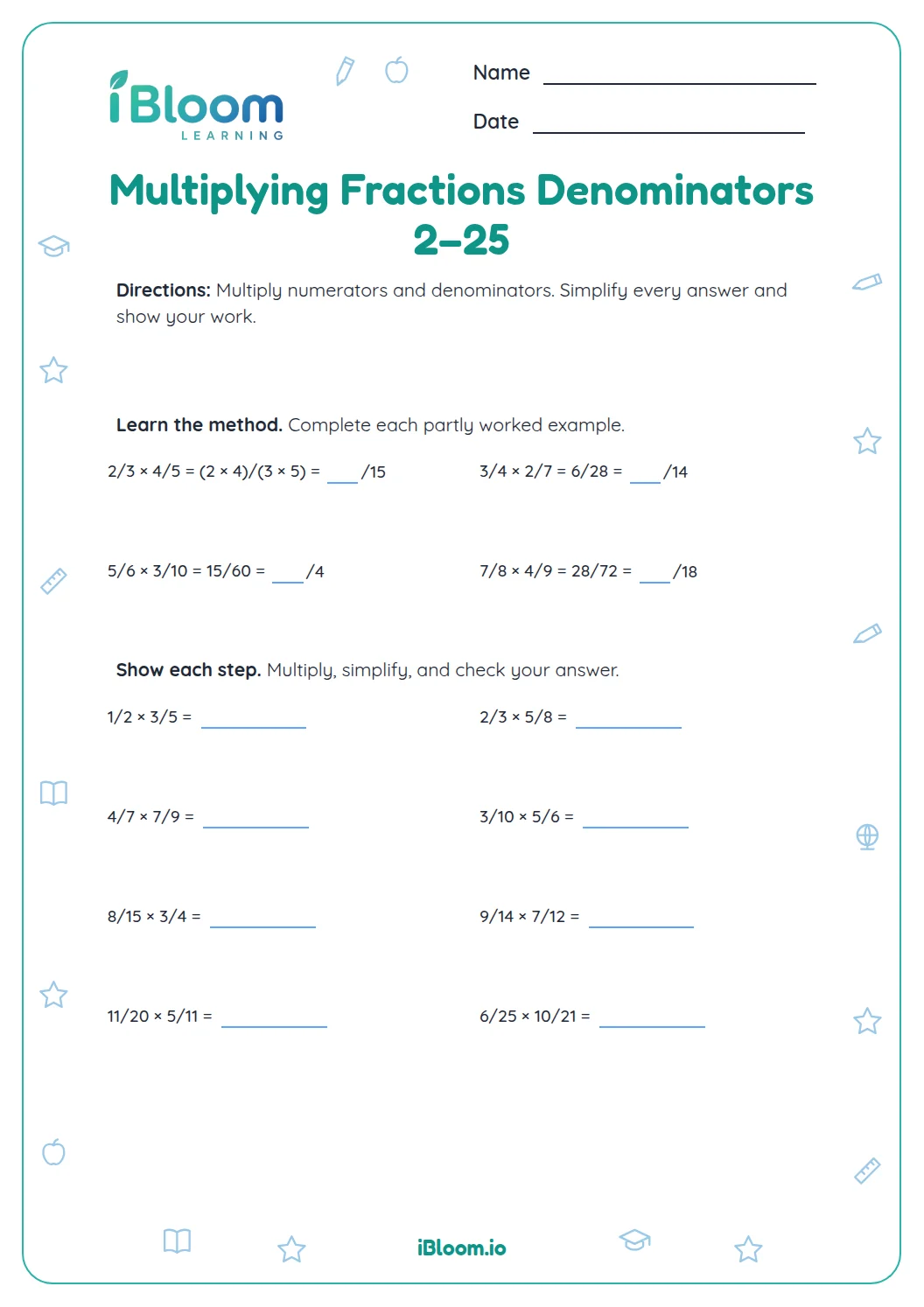
This Grade 6 printable builds fraction multiplication fluency with 16 problems. Part A pairs fractions with denominators from 2 through 12 and asks students to simplify each product. Part B multiplies a fraction by a whole number, expressing the answer as an integer or simplified improper fraction. The answer key shows simplified products. The work practices Common Core 5.NF.B.4, applying multiplication to fractions and interpreting a product.
Aligned to 5.NF.B.4
What happens when you multiply two fractions?
Multiply the top numbers to get the product numerator and the bottom numbers to get the product denominator. Then divide both by a common factor to write the result in simplest form.
How do you simplify the product?
A product can be equivalent to the one you first calculate. Simplifying makes the final fraction easier to read.
- 12/3 × 3/4 = (2 × 3)/(3 × 4) = 6/12 = 1/2
- 2Both 6 and 12 divide by 6, so the product in simplest form is 1/2.
How does a whole-number factor fit?
Write the whole number over 1, or multiply it by the fraction numerator and keep the denominator. For example, 3/5 × 4 gives 12/5, which is 2 2/5 as a mixed number.
How to use this worksheet
- 1Multiply the numerators to make the product numerator.
- 2Multiply the denominators to make the product denominator.
- 3Reduce the fraction to simplest form.
- 4For a whole-number factor, write it over 1 before multiplying.
- 5Check that no common factor remains in the final numerator and denominator.
Common mistakes and quick fixes
The mistake
Adding the numerators and denominators.
The fix
Use multiplication in both places: top by top and bottom by bottom.
The mistake
Forgetting to simplify.
The fix
Check whether numerator and denominator share a factor.
The mistake
Multiplying a fraction by a whole number without changing the numerator.
The fix
Treat the whole number as a factor: 3/5 × 4 = 12/5.
Common Core alignment
This page practices products of fractions and whole numbers using multiplication and equivalent fractions.
Multiply fractions and interpret a fraction product.
On this sheet: Students multiply fraction factors, including whole-number factors, and simplify the resulting product.
Show the official wordingHide the official wording
Apply and extend previous understandings of multiplication to multiply a fraction or whole number by a fraction.
What to practice next
Make more practice
Further reading
Questions parents and teachers ask
How many fraction problems are on the worksheet?
There are 16 problems in two parts. The first 12 multiply two fractions with denominators from 2 through 12. The final four multiply a fraction by a whole number. Each answer in the key is simplified. Students can use the first part to practice reducing products.
How do you multiply two fractions?
Multiply the numerators to get the new numerator and multiply the denominators to get the new denominator. For example, 2/3 × 3/4 = 6/12, which simplifies to 1/2. The worksheet includes products that can be reduced. Students can use equivalent fractions to check that the reduced result has the same value.
Should students simplify every answer?
Yes. The directions ask students to multiply and simplify, and the key gives each product in simplest form. For instance, 4/9 × 3/8 = 12/72, which reduces to 1/6. Look for a common factor in the numerator and denominator before finishing.
How do you multiply a fraction by a whole number?
Treat the whole number as a fraction with denominator 1. For example, 2/3 × 3 is 2/3 × 3/1, or 6/3, which equals 2. Part B practices this form and includes both whole-number and improper-fraction results. The final answers may be whole numbers or improper fractions.
Can a fraction product be greater than 1?
Yes. A product can be greater than 1 when the factors are large enough. For example, 5/6 × 2 = 10/6 = 5/3. The answer key keeps this result as a simplified improper fraction, which is an equivalent exact answer.