




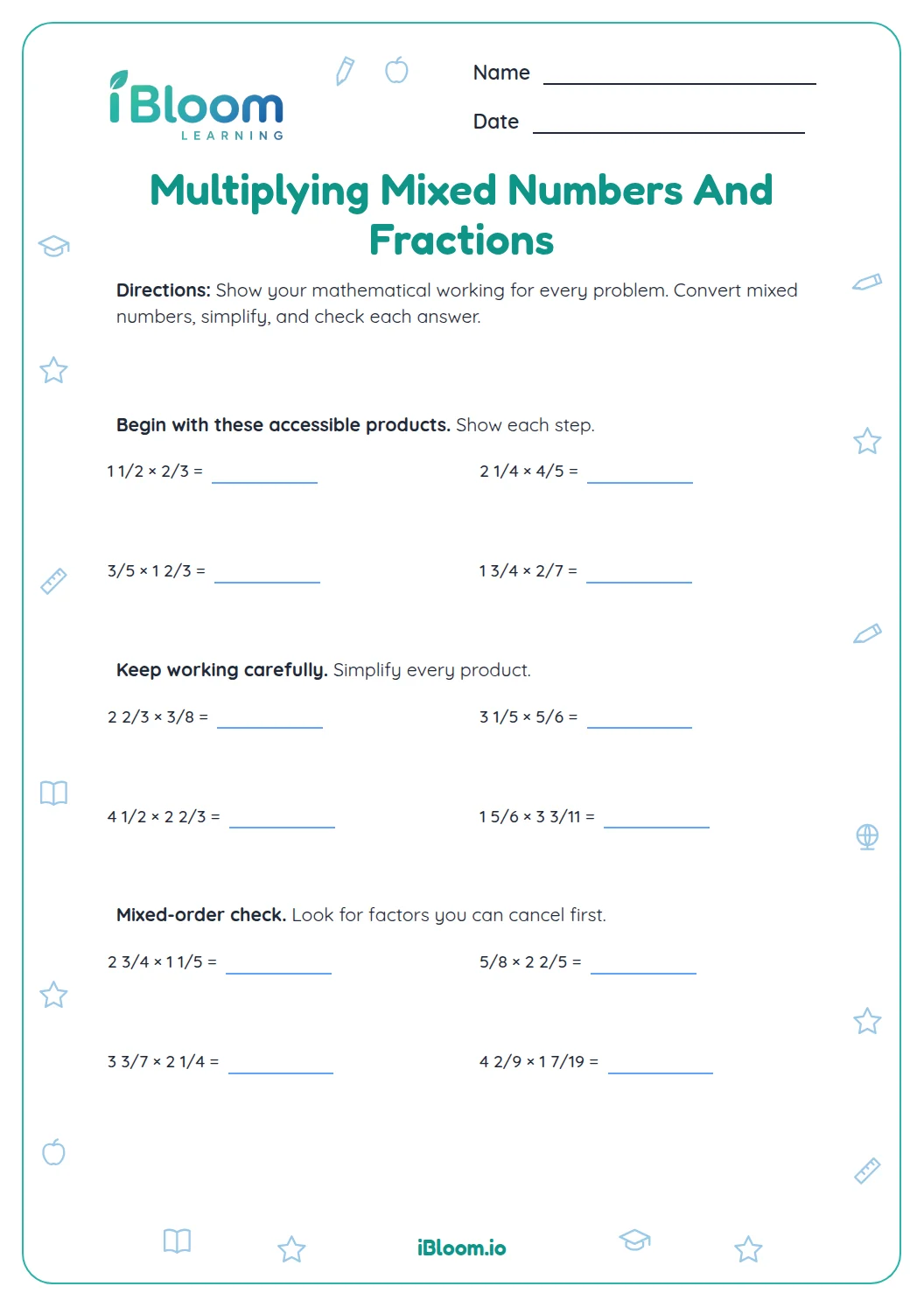


About this worksheet
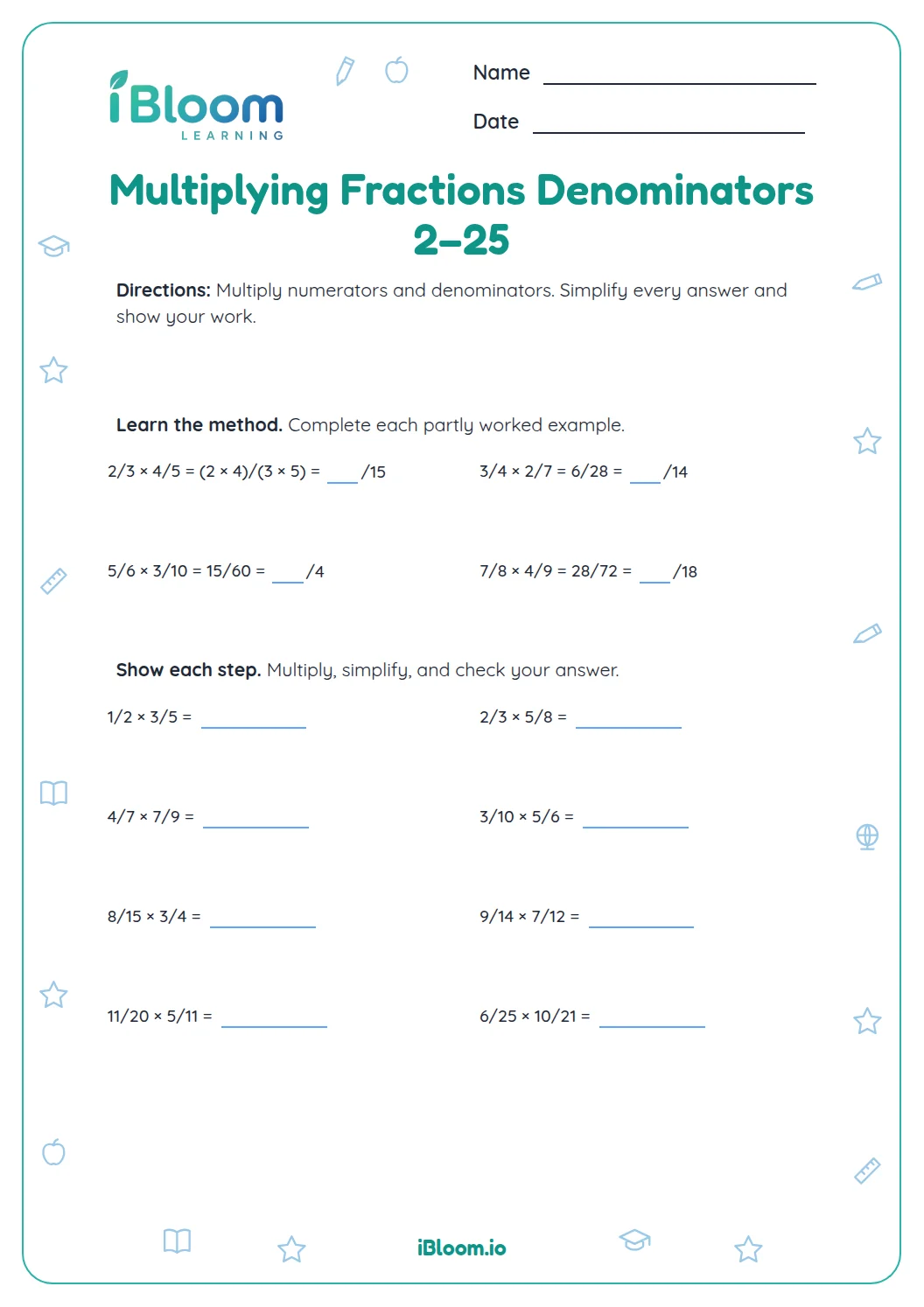
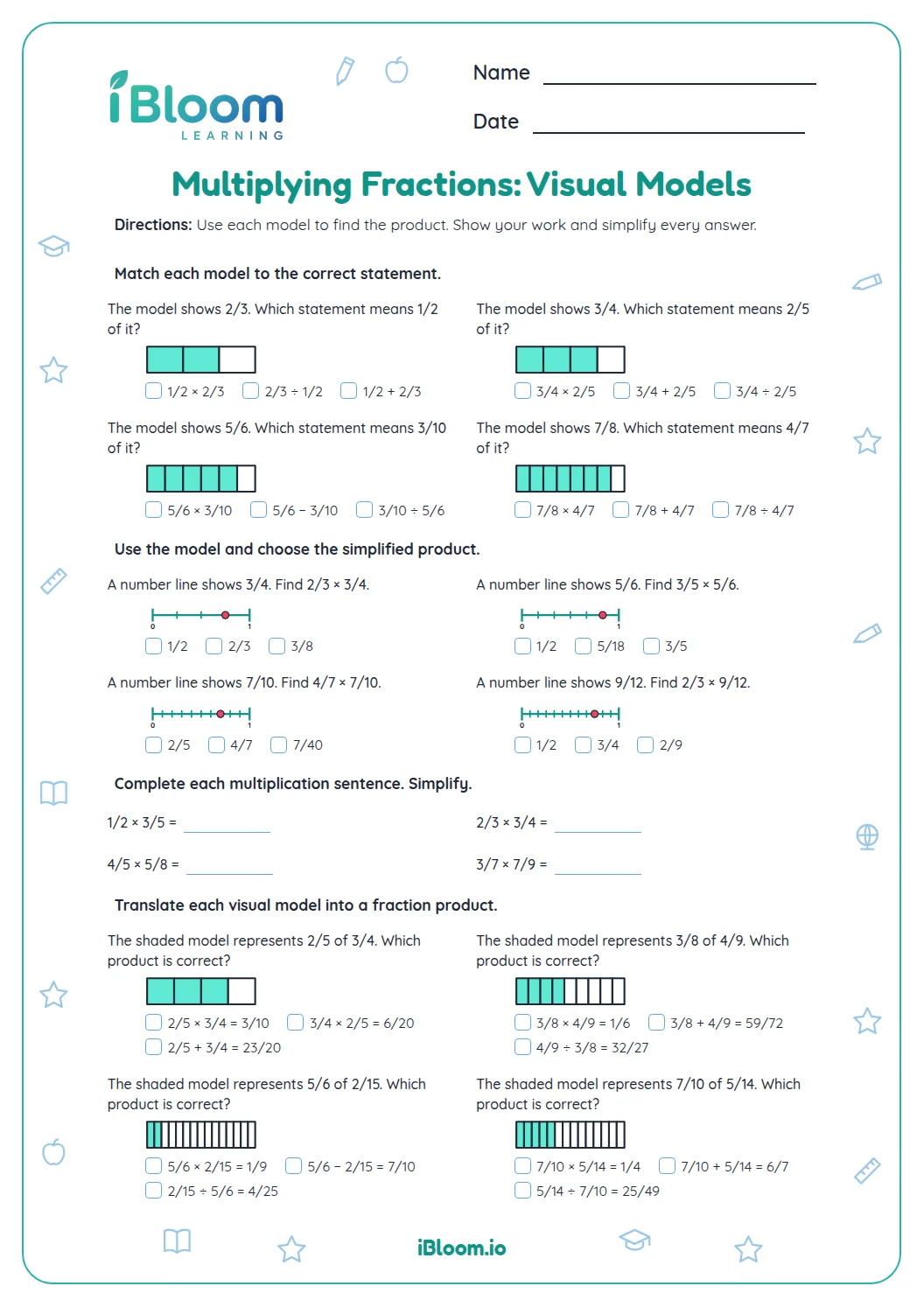
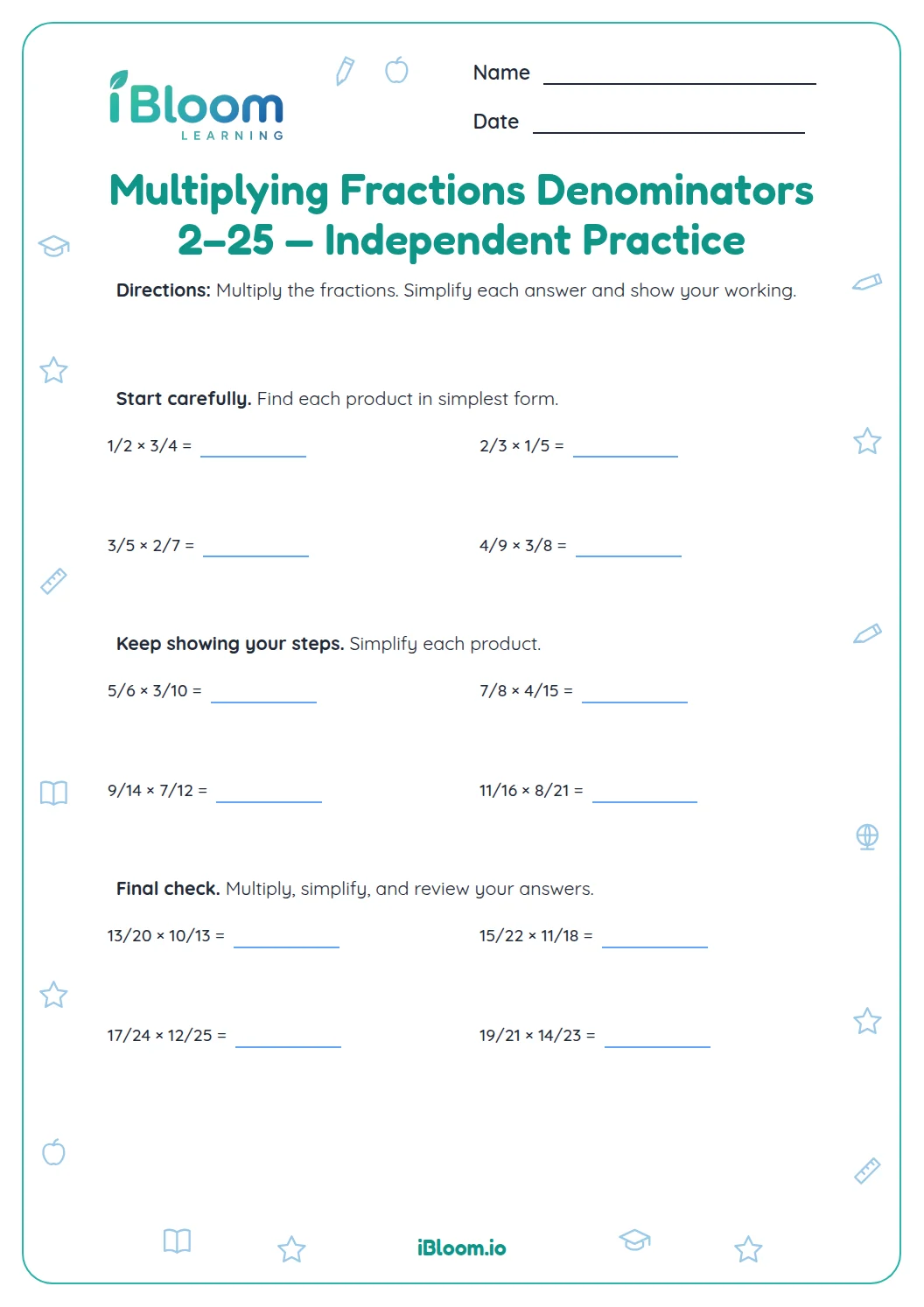
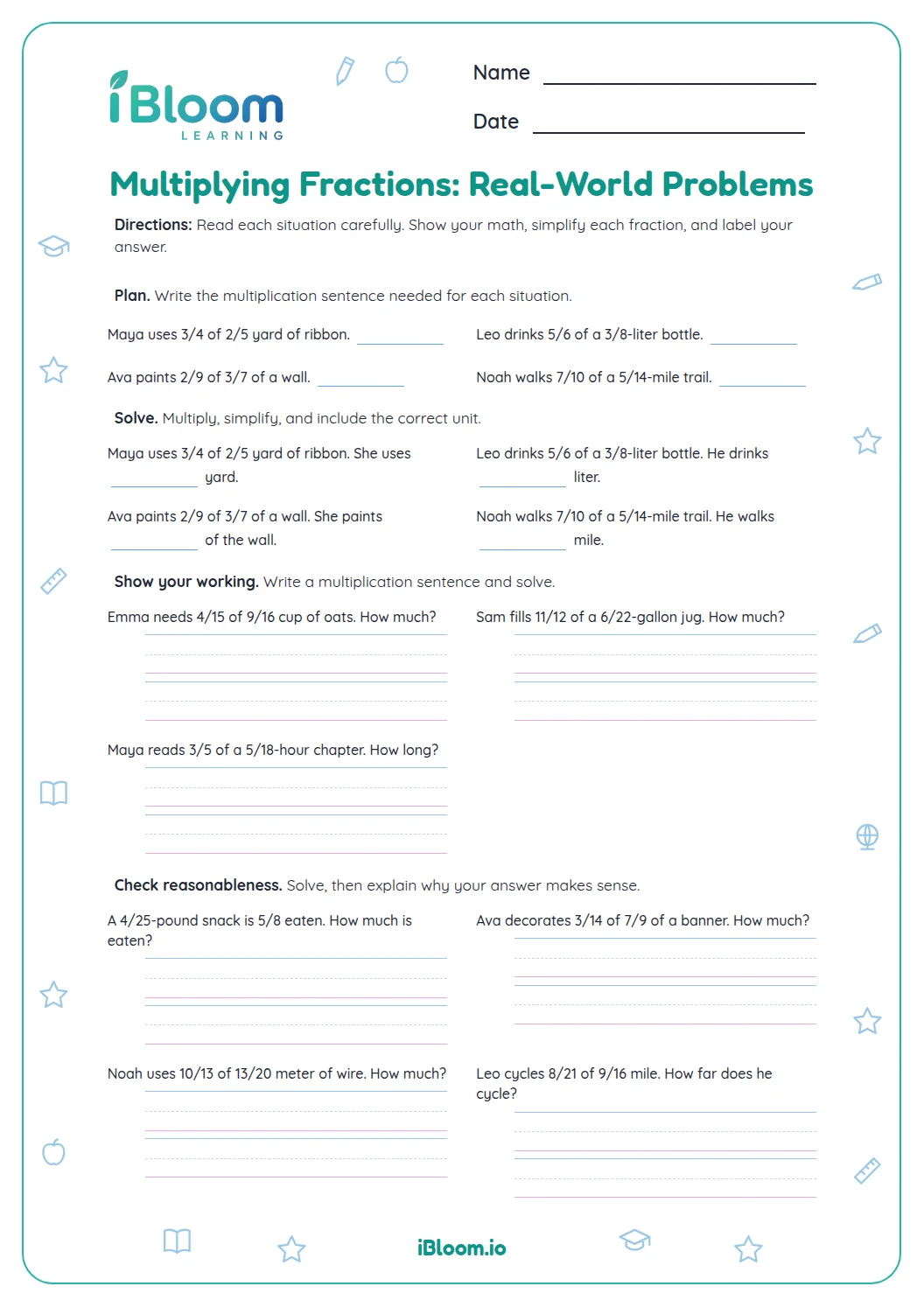
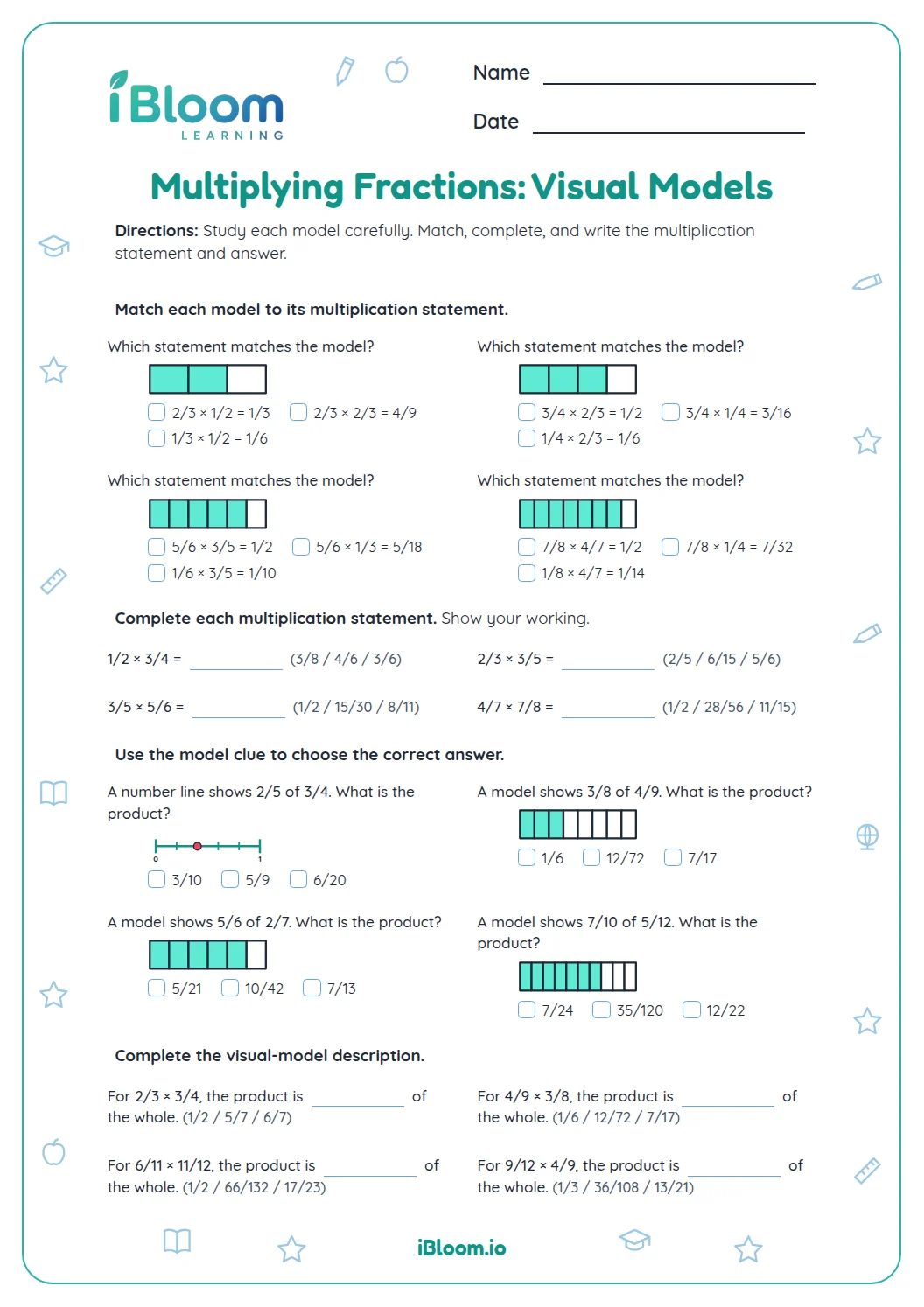
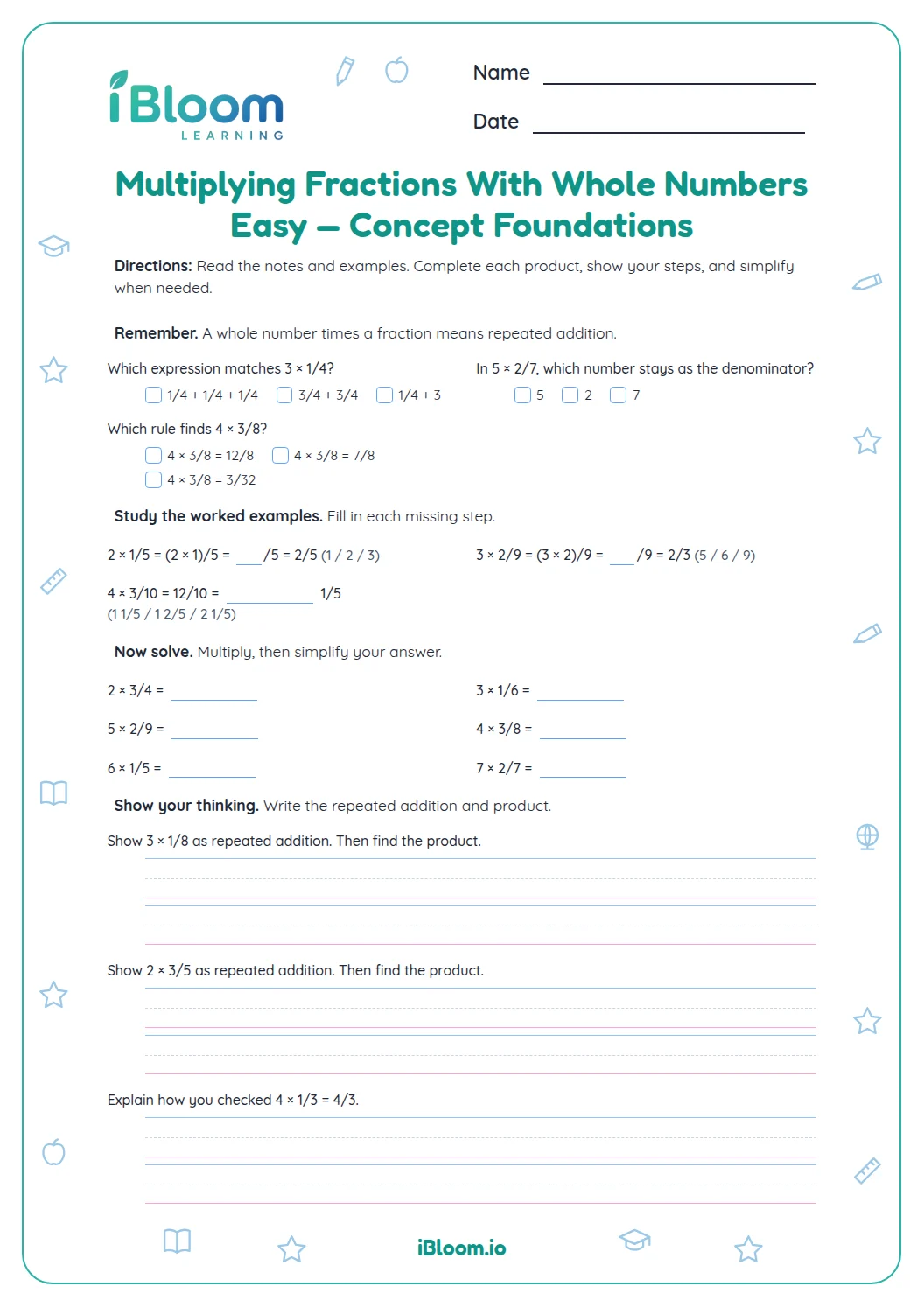
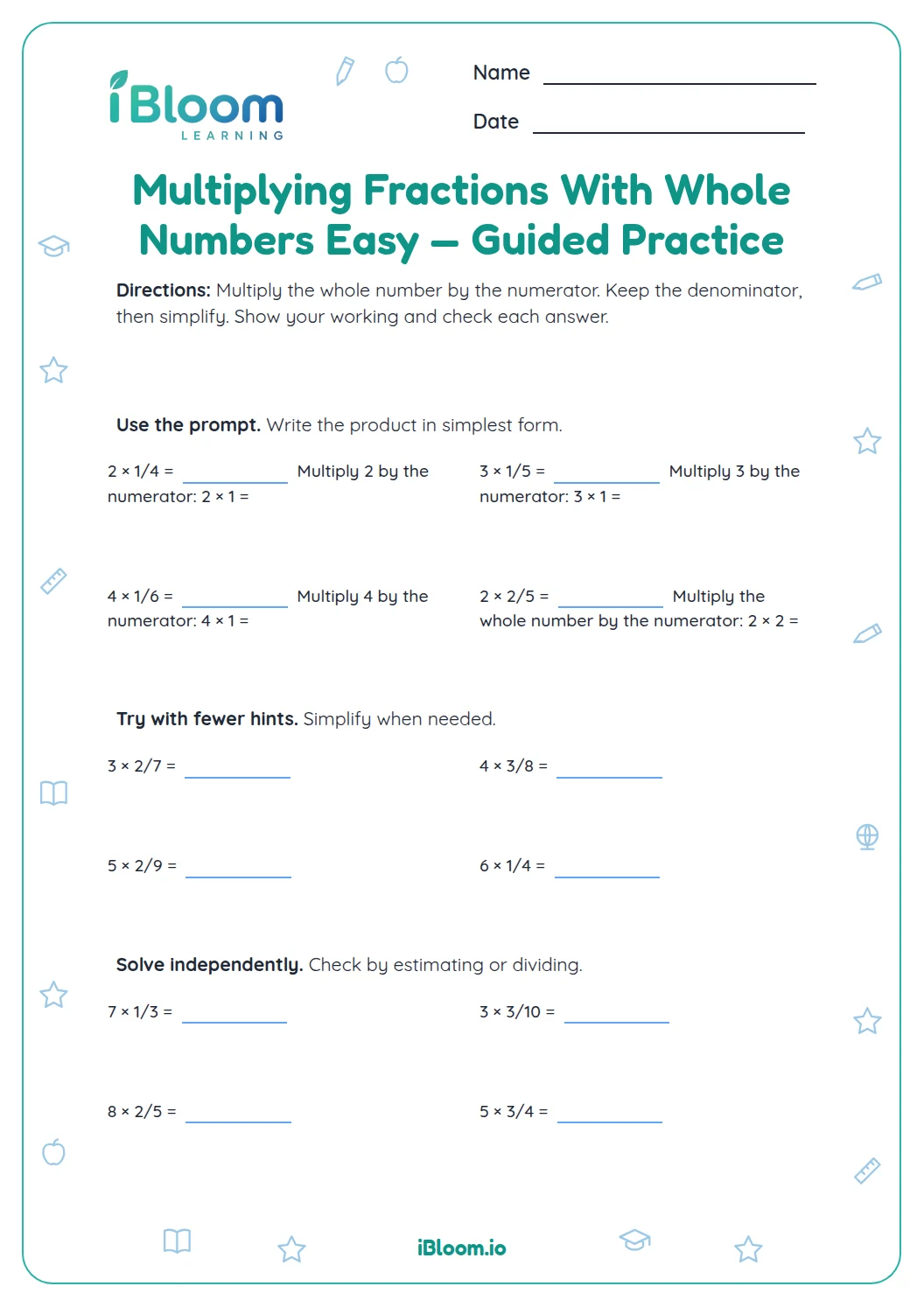
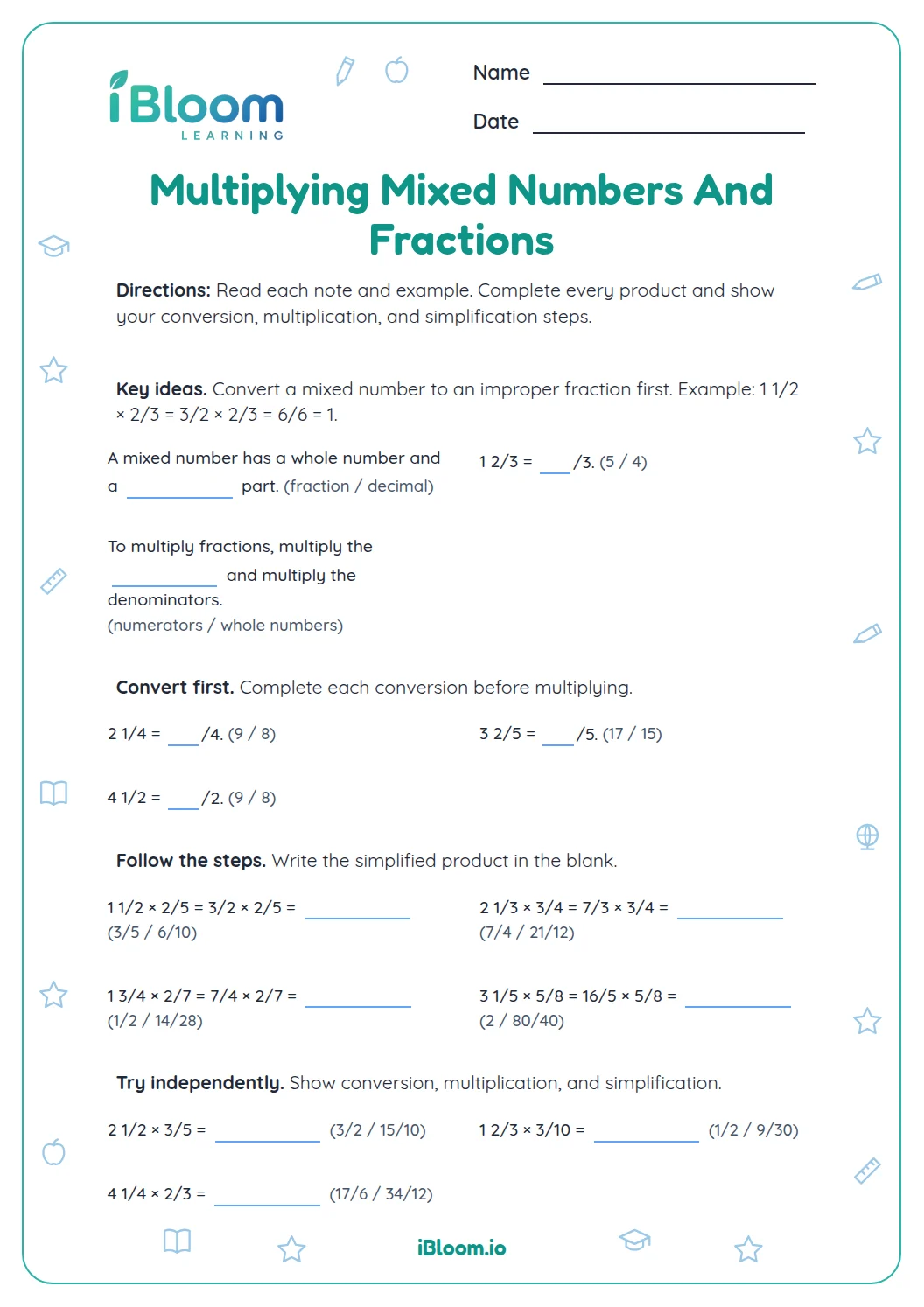
This free printable Grade 6 worksheet provides guided practice multiplying fractions whose denominators range from 2 through 25. Sixteen products begin with familiar factors and continue through larger denominators, followed by three short equivalent-fraction bonus questions. Each product is reduced to simplest form. The multiplication practice connects to CCSS 5.NF.B.4. A separate answer key is included.
Aligned to 5.NF.B.4
What are the steps for multiplying fractions?
Multiply the numerators together and the denominators together. The product may then be reduced by dividing both parts by a common factor. Check that the simplified fraction has no common factor greater than 1.
For question 1, 1/2 × 3/4 gives 3/8. The numerator product is 1 × 3 = 3, and the denominator product is 2 × 4 = 8. Since 3 and 8 share no factor greater than 1, 3/8 is already simplified.
- 11/2 × 3/4
- 2(1 × 3)/(2 × 4) = 3/8
- 33/8 is in simplest form.
When should I simplify the product?
You can simplify after multiplying, as these problems do. Look for a number that divides both the numerator and denominator evenly. For example, 6/15 can be reduced by dividing both parts by 3 to get 2/5.
How does the worksheet build practice?
The 16 multiplication problems use denominators from 2 through 25. Three brief bonus questions at the end revisit equivalent fractions.
- Parts A–C: multiply and simplify 16 products
- Part D: complete 3 equivalent fractions
- Separate answer key
How can I use this worksheet?
- 1Write the numerator product above the denominator product.
- 2Check whether the new numerator and denominator share a factor.
- 3Divide both by the same factor when simplifying.
- 4Keep the product equivalent while reducing it.
- 5Compare the final answer with the answer key.
Common mistakes and quick fixes
The mistake
Adding the numerators and denominators.
The fix
Multiply top by top and bottom by bottom.
The mistake
Changing only the denominator when reducing.
The fix
Divide both numerator and denominator by the same factor.
The mistake
Stopping at an equivalent but reducible fraction.
The fix
Check for a common factor greater than 1.
Common Core alignment
This worksheet practices multiplying fraction factors and simplifying their products.
Apply multiplication understanding to products of fractions.
On this sheet: Every problem multiplies two fraction factors and simplifies the resulting fraction.
Show the official wordingHide the official wording
Apply and extend previous understandings of multiplication to multiply a fraction or whole number by a fraction.
What to practice next
Make more practice
Further reading
Questions parents and teachers ask
What is the rule for multiplying fractions?
Multiply the top numbers together and the bottom numbers together. For example, 1/2 × 3/4 equals 3/8. After multiplying, check whether the numerator and denominator share a factor so you can write the answer in simplest form. The numerator and denominator are multiplied separately.
Do the denominators have to match?
No. Fraction multiplication does not require matching denominators. Multiply each numerator with the other numerator and each denominator with the other denominator, then simplify. The worksheet intentionally varies denominators from 2 through 25 for practice with different factor pairs.
Why simplify a fraction product?
Simplifying writes the same fraction in its most reduced form. For instance, 6/15 and 2/5 name the same amount, but 2/5 is simpler because 2 and 5 have no common factor greater than 1. Reducing both parts keeps the fraction equivalent.
How can I check a simplified answer?
Multiply the original numerators and denominators to check the product, then confirm that no whole number greater than 1 divides both resulting parts. You can also multiply the simplified numerator and denominator by the same factor to see whether they recover the unsimplified product.
Which denominators are used?
The problems use denominator values throughout the range 2 to 25. Some factors can be reduced before multiplying, but the answer key shows the simplified result so learners can compare their final form. Denominator values extend across the stated range.
Is there a separate answer key?
Yes. A separate key lists the simplified product for all 16 questions. Learners can use it after completing the work to check both the multiplication and the final reduction. Review the final fraction in simplest form. Compare the numerator and denominator factors.