




About this worksheet
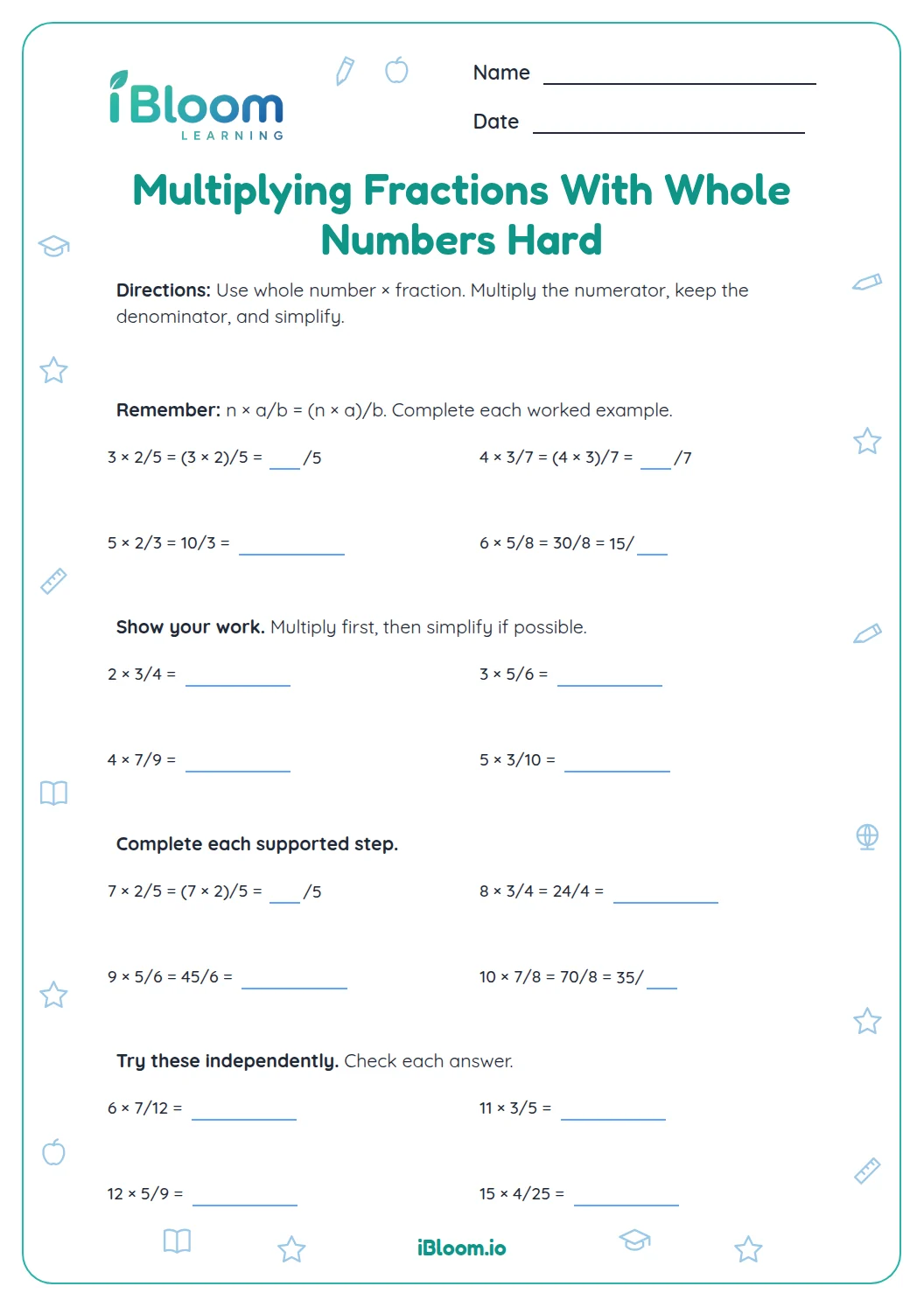
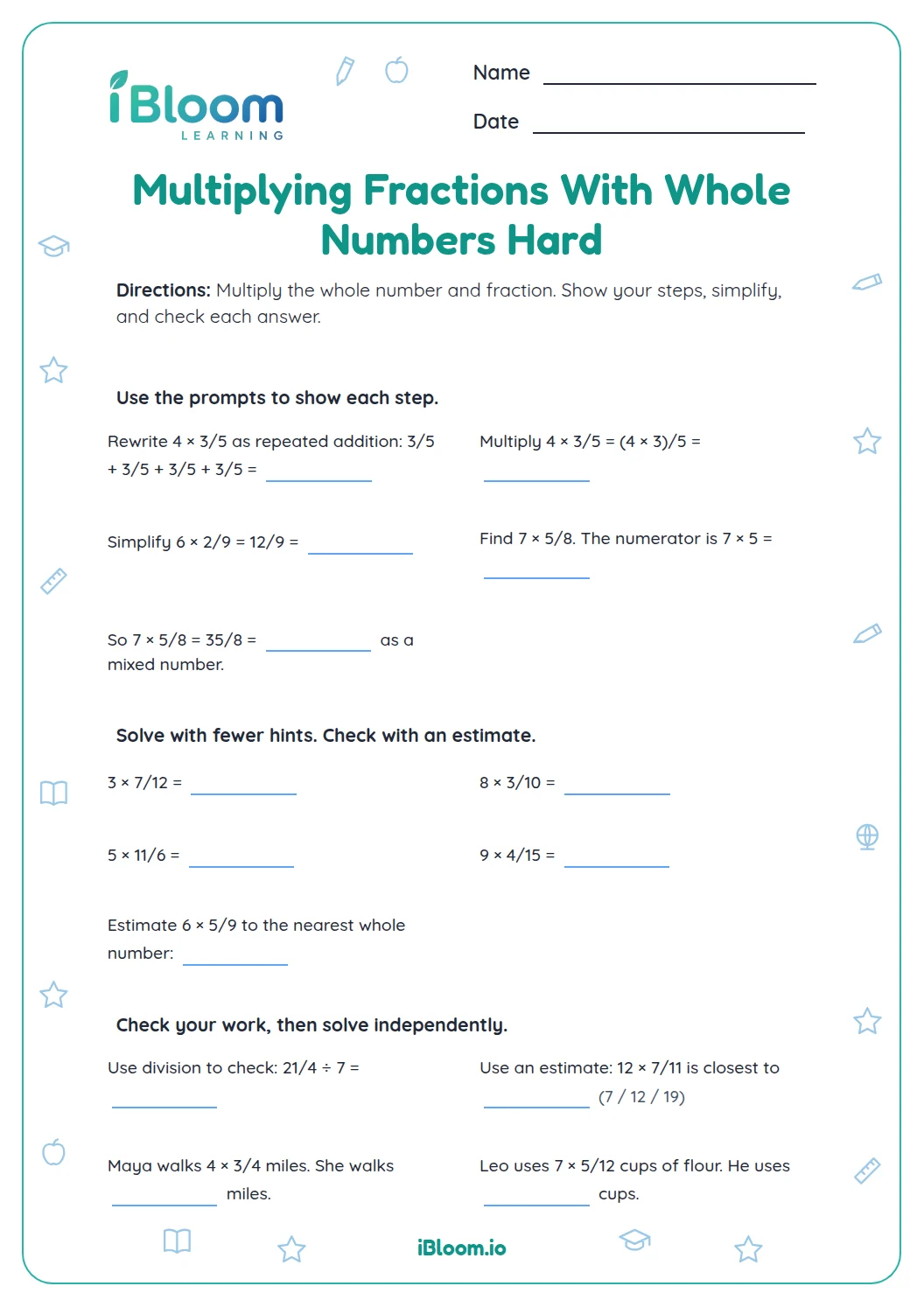
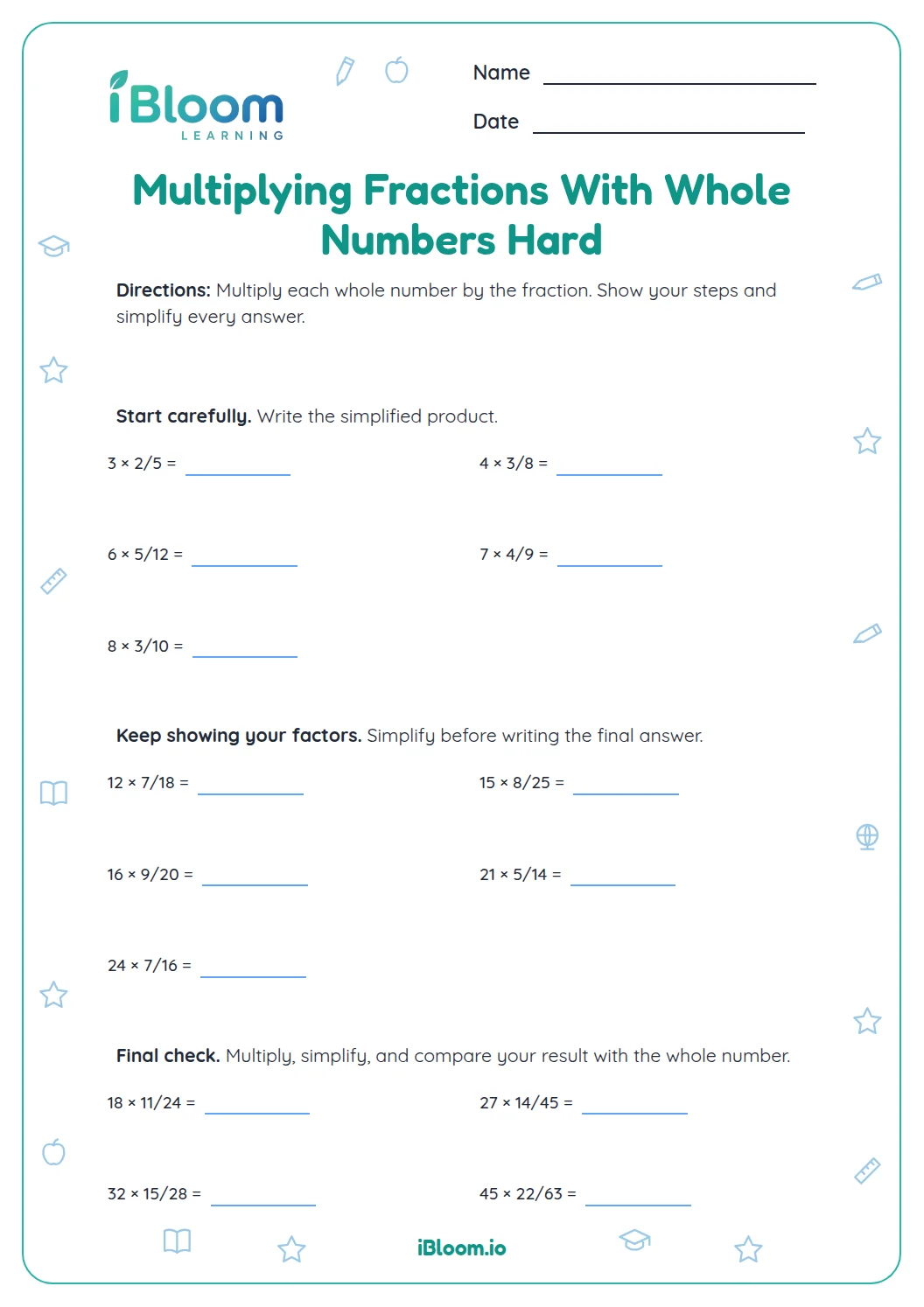
This Grade 6 independent practice page reviews multiplying fractions by whole numbers. Students solve direct products, simplify improper fractions and explain equal groups, and use multiplication in short situations. It supports CCSS 5.NF.B.4.a, which describes a whole-number multiple of a fraction as equal parts of a partition. Fifteen questions progress from calculation to models and application, with a separate answer key.
Aligned to 5.NF.B.4.a
How do you multiply a fraction by a whole number?
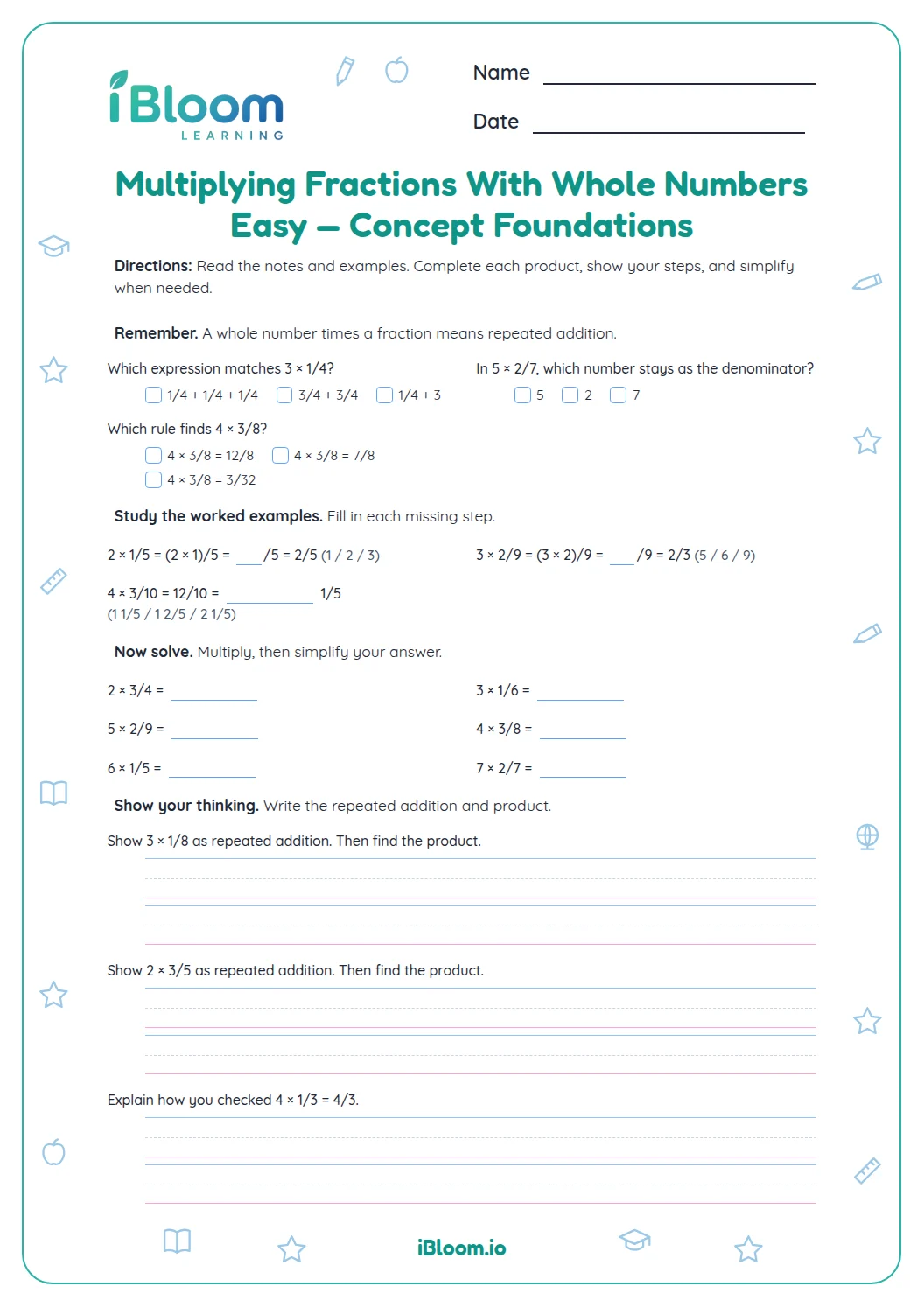
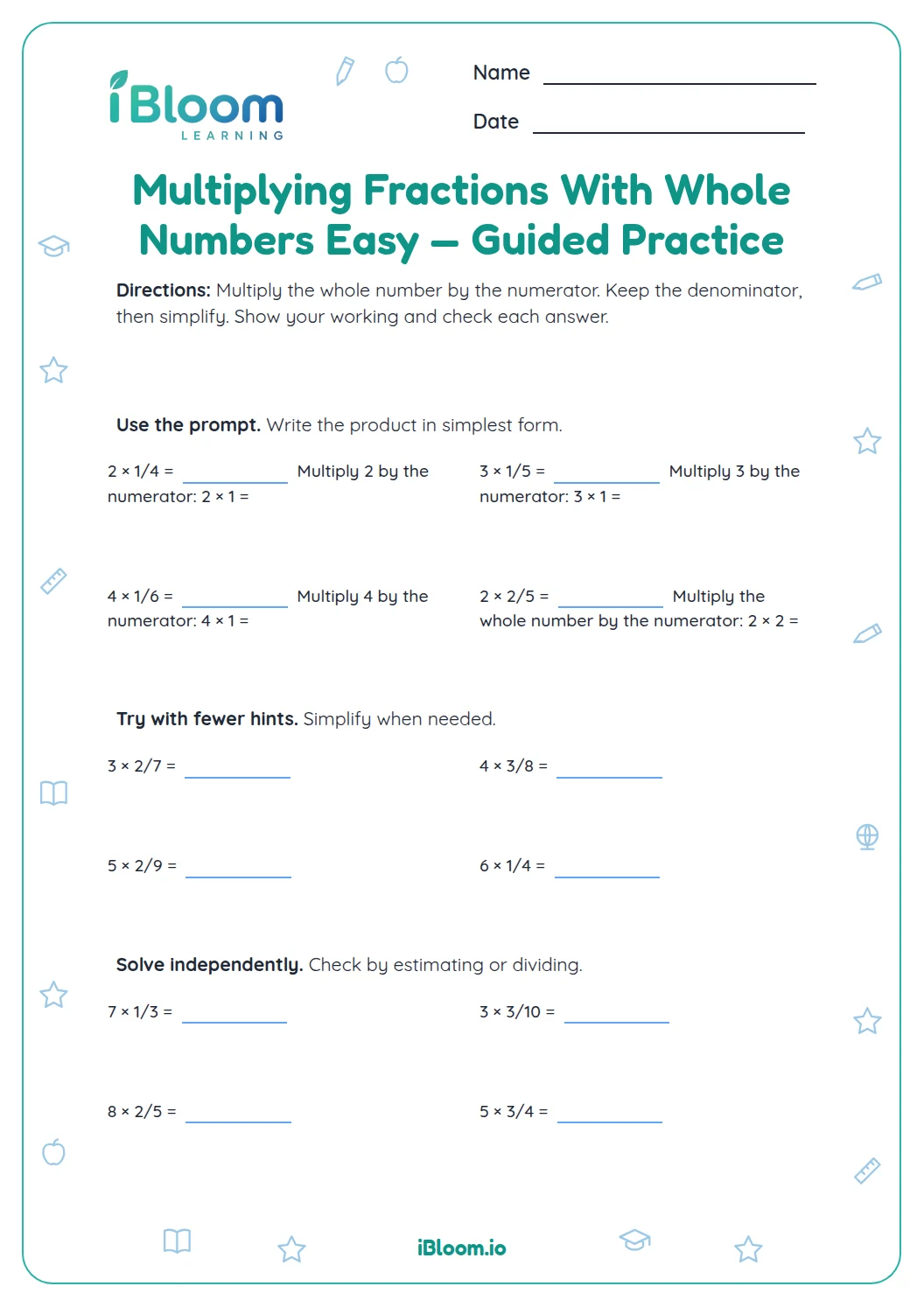
Multiply the whole number by the fraction’s numerator and keep the denominator. Then simplify if the numerator and denominator share a factor. For example, 4 × 3/8 = 12/8 = 3/2.
- 14 × 3/8
- 2Multiply 4 × 3 = 12; keep denominator 8
- 312/8 simplifies to 3/2, or 1 1/2
How can repeated groups create more than one whole?
A whole number tells how many groups to combine. For example, five groups of 2/3 make ten thirds, or 10/3. Products greater than one whole are expected when enough fractional groups are combined.
- 15 × 2/3
- 2Multiply 5 × 2 = 10; keep denominator 3
- 3The product is 10/3, or 3 1/3
How can students check a product?
Estimate the size before computing. Three groups of 3/4 should total a little more than 2, and the exact product is 9/4. Check that the denominator still names the size of each part.
How to use this worksheet
- 1Write the whole number as a factor of the numerator.
- 2Multiply the whole number by the numerator.
- 3Keep the original denominator.
- 4Simplify the fraction or write an equivalent mixed number.
- 5Estimate whether the product should be less than, equal to, or greater than one whole.
Common mistakes and quick fixes
The mistake
Multiplying the denominator by the whole number
The fix
For 5 × 2/3, multiply 5 by 2 and keep denominator 3: 10/3.
The mistake
Dropping the denominator after multiplying
The fix
The denominator still tells the size of each part. Keep it until simplifying.
The mistake
Stopping before simplifying when asked for simplest form
The fix
Find a common factor of numerator and denominator; 12/8 reduces to 3/2.
Common Core alignment
This practice connects the skill to the grade-level work named in these standards.
Interpret whole-number groups of a fraction as equal parts of the whole number.
On this sheet: Visual and symbolic questions show a fraction multiplied by a whole number.
Show the official wordingHide the official wording
Interpret the product (a/b) × q as a parts of a partition of q into b equal parts; equivalently, as the result of a sequence of operations a × q ÷ b. For example, use a visual fraction model to show (2/3) × 4 = 8/3, and create a story context for this equation. Do the same with (2/3) × (4/5) = 8/15. (In general, a/b × c/d = ac/bd).
What to practice next
Make more practice
Further reading
Questions parents and teachers ask
Can a fraction times a whole number be greater than one?
Yes. The product counts all the fractional parts in the groups. Five groups of 2/3 make 10 thirds, or 10/3, which is 3 1/3. A result greater than one whole is expected when enough fractional groups are combined. A product can exceed one when the numerator groups add up to more than one whole.
Why does the denominator stay the same?
The denominator names the size of each fractional part. Combining groups of thirds still gives thirds; only the number of thirds changes. For example, 5 × 2/3 is 10 thirds, or 10/3. That is why the denominator stays 3. The denominator names the size of each equal part; multiplying adds more parts of that same size.
When should a product be simplified?
Simplify when the numerator and denominator have a common factor greater than one. For example, 4 × 3/8 = 12/8, and dividing both parts by 4 gives 3/2. An improper fraction may also be written as a mixed number. Reduce when the numerator and denominator share a factor, as 6/8 simplifies to 3/4.
What should students notice about the products?
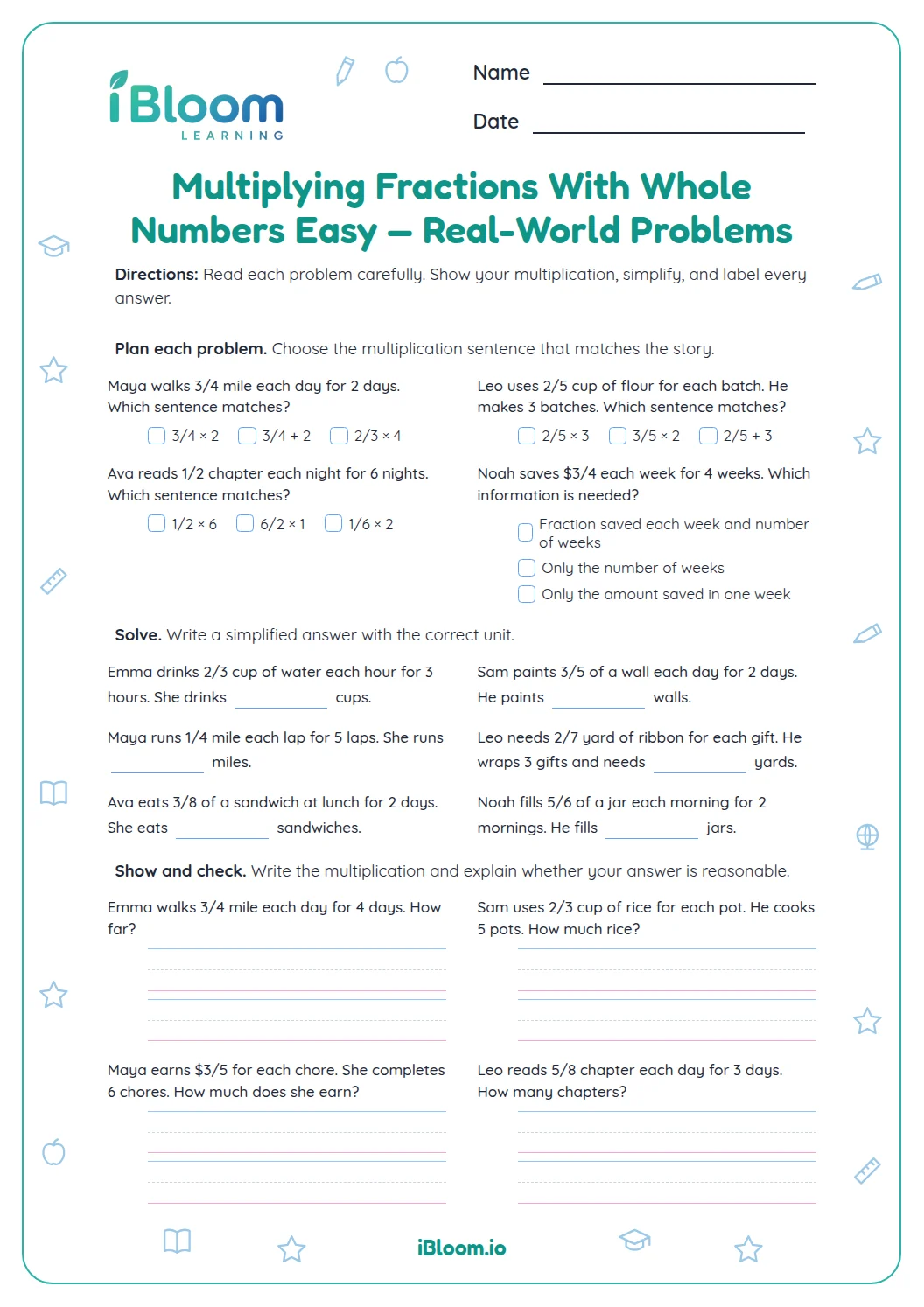
The questions show that a fraction times a whole number can be less than one, equal more than one, or simplify to a mixed number. Students count the total fractional parts, keep the denominator, and compare the exact answer with an estimate.
What comes after multiplying a fraction by a whole number?
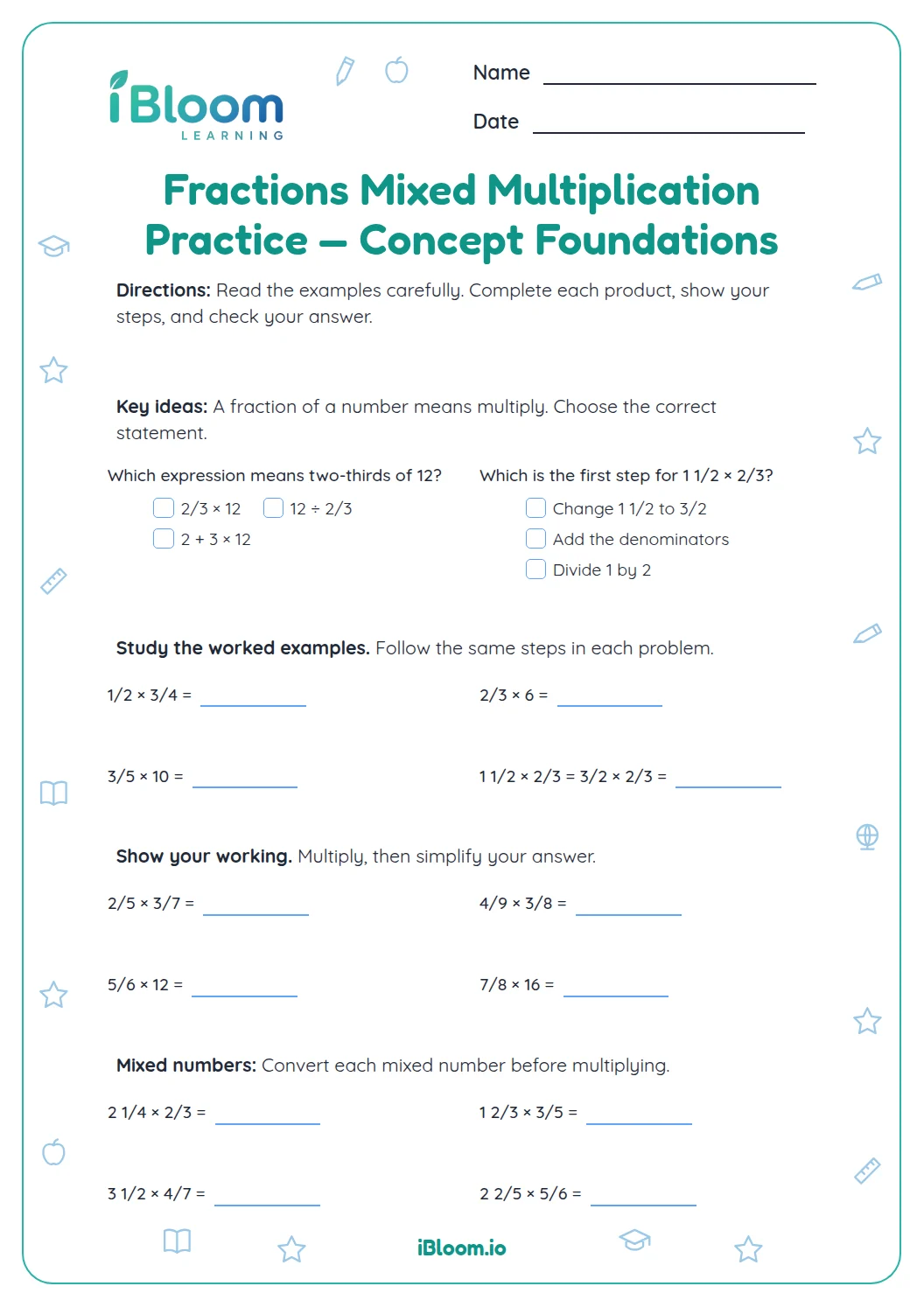
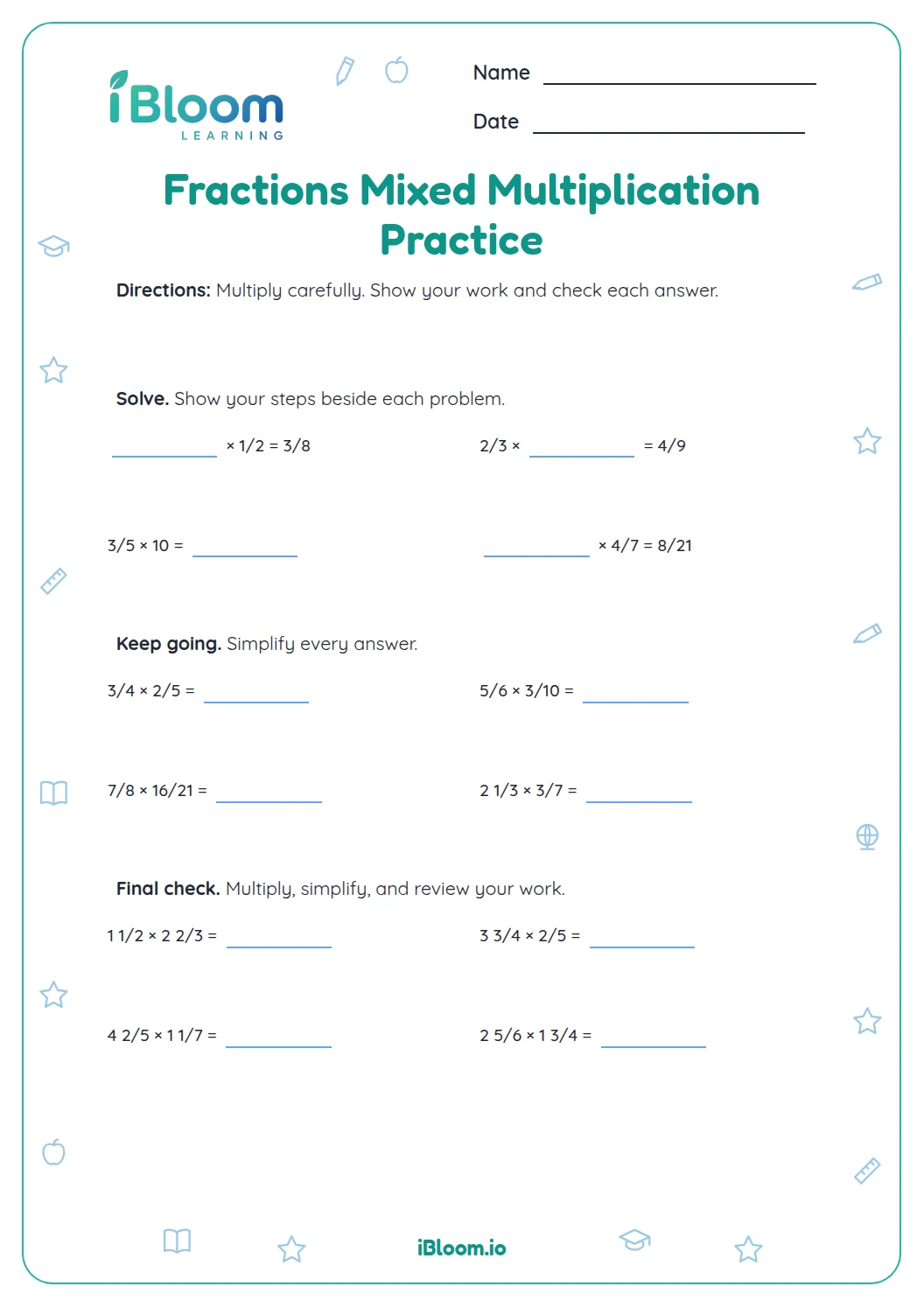
Once the student is comfortable multiplying and simplifying, try products with less familiar numerators and denominators, then mixed numbers. The related worksheets in this collection extend practice to new factor types and multiplication situations. Students can refer back to these examples as they work.