






About this worksheet
This Grade 6 worksheet practices multiplying fractions by whole numbers. Students check sample claims, calculate and compare products, then apply equal groups to short quantity problems. Most items use a compact answer line, with room for working where it helps. A separate answer key supports checking.
Aligned to 5.NF.B.4
What changes when a fraction is multiplied by a whole number?
Check a claimed product by multiplying the numerator by the whole number. In question 2, four groups of 3/8 make 12/8, or 3/2, so Leo is correct.
- 14 × 3/8
- 2(4 × 3)/8 = 12/8
- 312/8 = 3/2
When can a product be simplified?
When the whole number and denominator share a factor, simplify first or simplify the product afterward. Either route must keep the same value.
How do the word problems use multiplication?
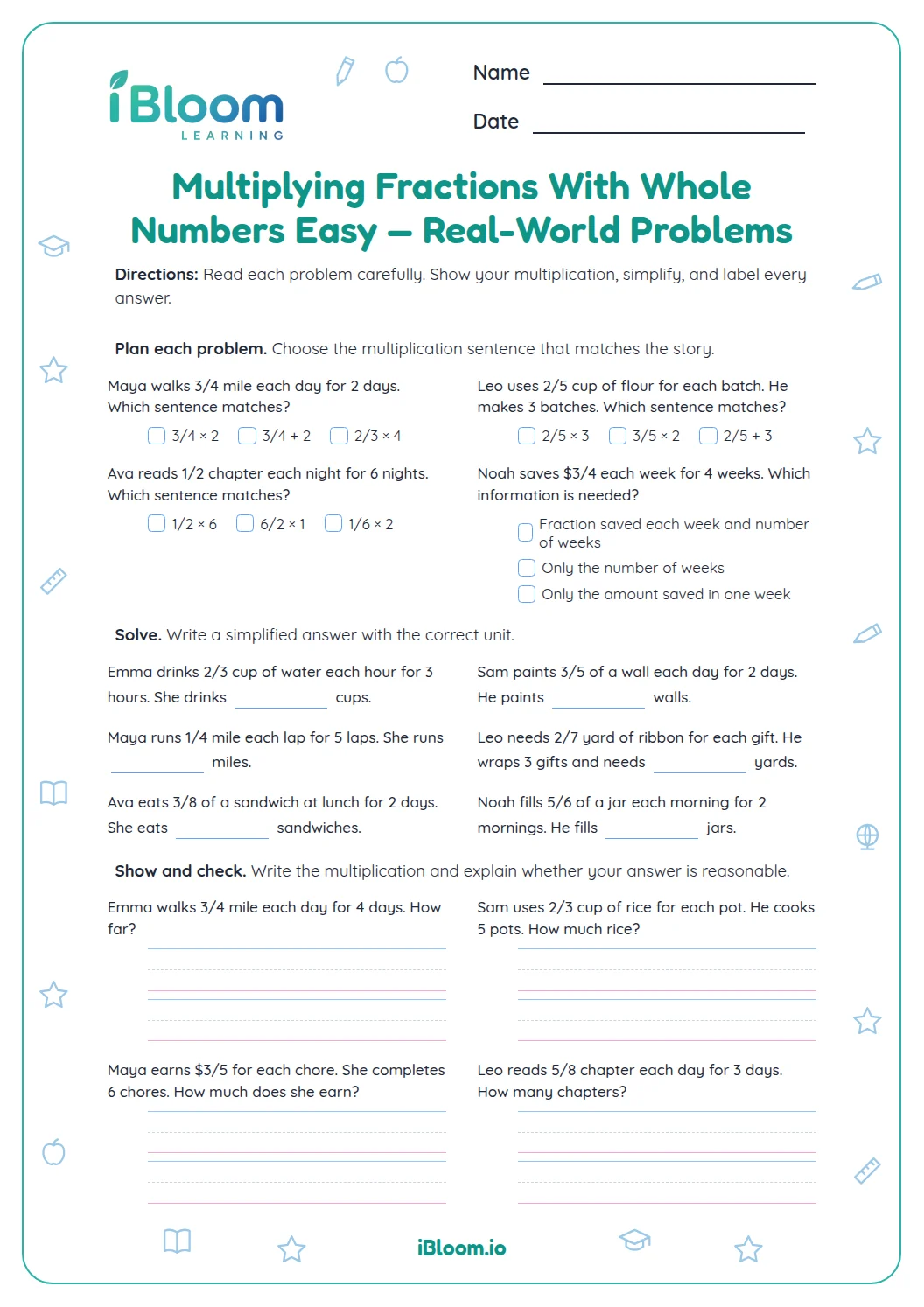
The contexts describe repeated equal groups. For question 10, seven pieces at 2/5 meter each make 7 × 2/5 = 14/5 meters. Keep the unit with the product.
How to use this worksheet
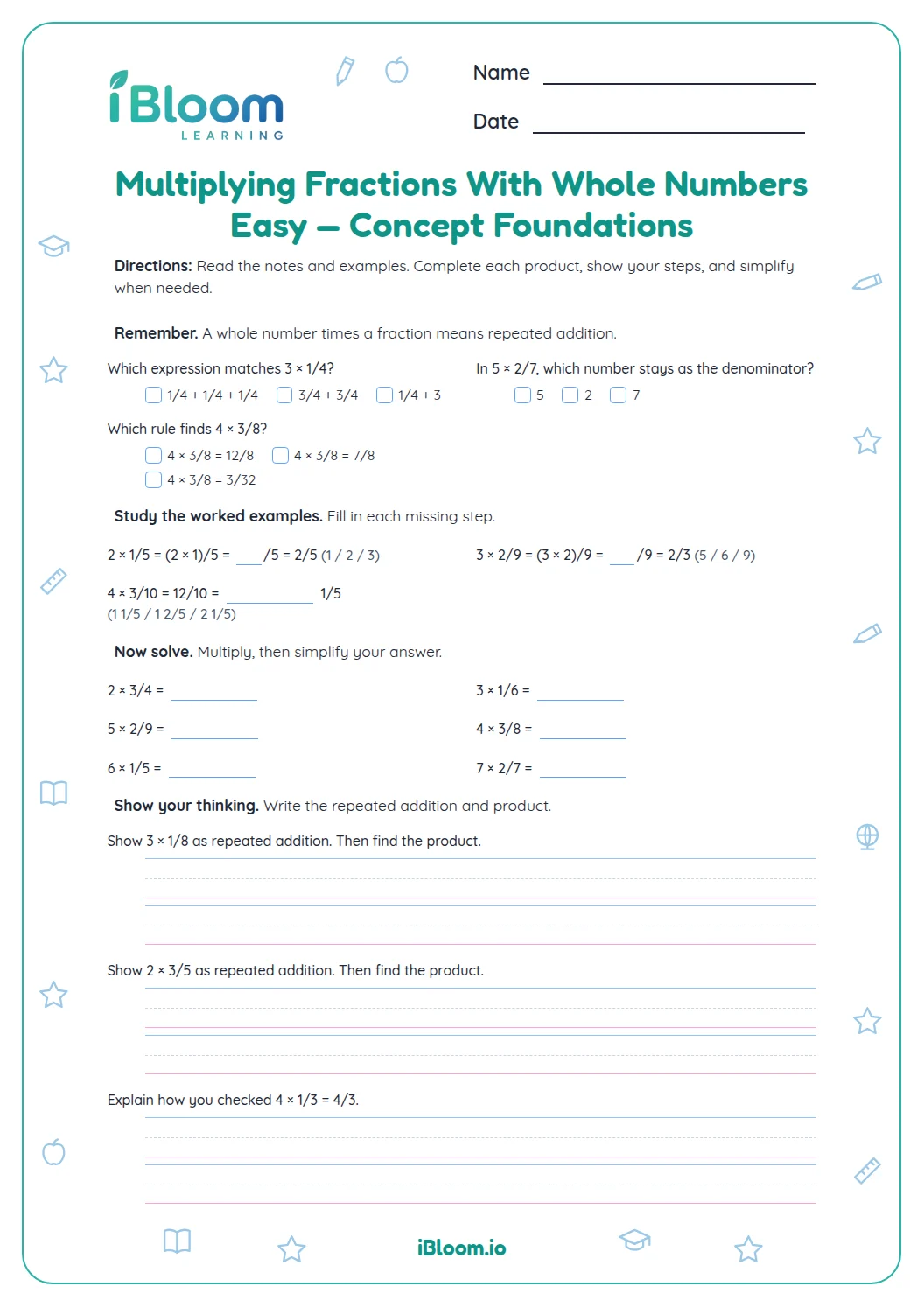
- 1Rewrite the whole number as a factor beside the fraction.
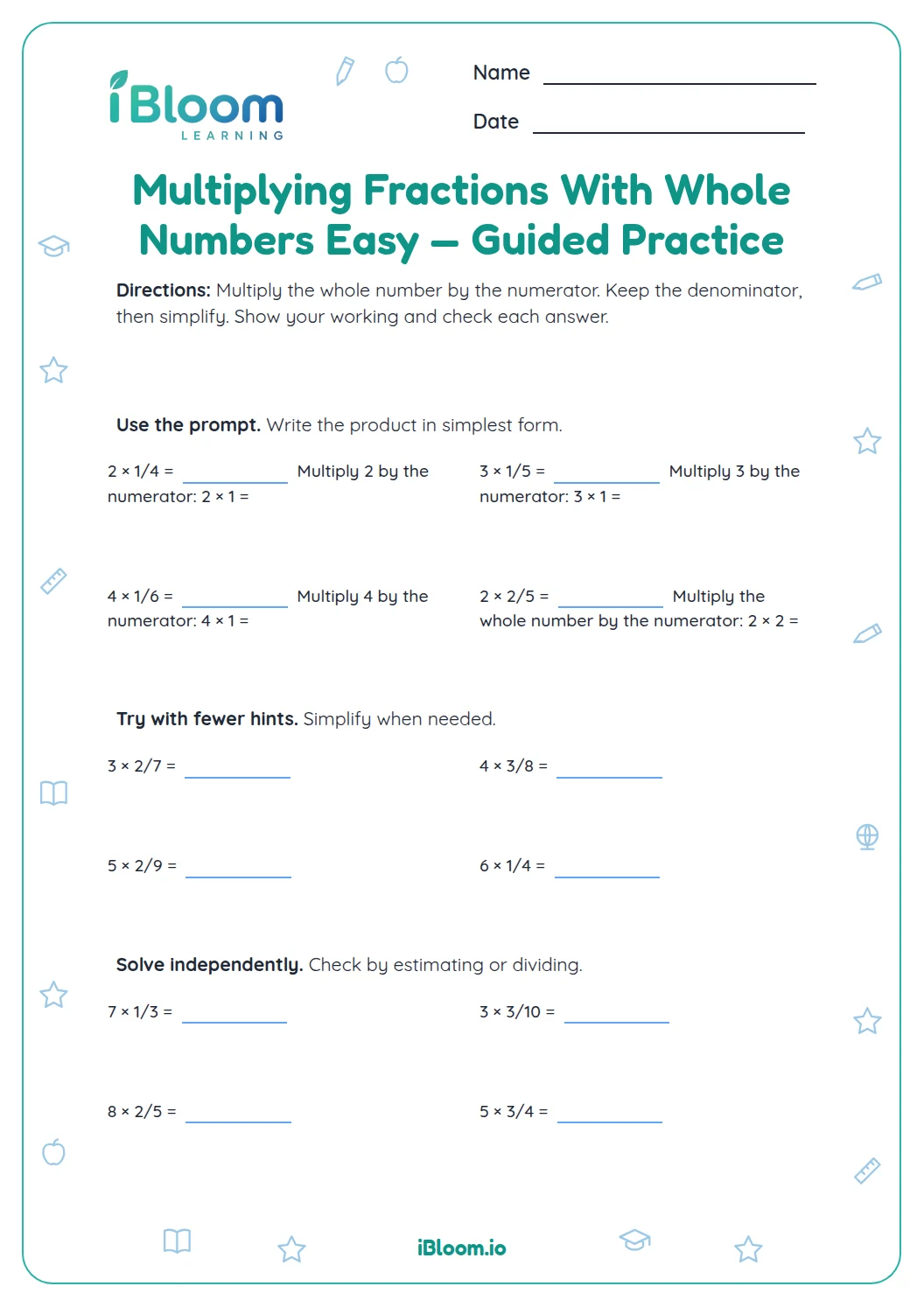
- 2Multiply the numerator by the whole number.
- 3Keep the denominator because the piece size has not changed.
- 4Simplify the fraction or write an improper fraction as a mixed number.
- 5For a story, include the unit and check that the product is larger than one group.
Common mistakes and quick fixes
The mistake
Multiplying the denominator by the whole number too.
The fix
Keep the denominator; only the count of equal pieces changes.
The mistake
Leaving 12/5 as though it were a proper fraction.
The fix
Divide 12 by 5 to write 2 2/5, or leave it as an equivalent improper fraction if requested.
The mistake
Dropping the unit in a word problem.
The fix
Use the unit named in the question, such as yards or cups.
Common Core alignment
Multiply a fraction or whole number by a fraction.
On this sheet: Each computation treats multiplication by a whole number as repeated equal groups of a fraction.
Show the official wordingHide the official wording
Apply and extend previous understandings of multiplication to multiply a fraction or whole number by a fraction.
What to practice next
Make more practice
Further reading
Questions parents and teachers ask
Why does the denominator stay the same?
A fraction multiplied by a whole number means repeated equal groups. For 3/5 × 4, four groups of three fifths make 12/5, or 2 2/5. Multiply the numerator and leave the denominator unchanged because the pieces are still fifths.
Should an answer be a mixed number or an improper fraction?
Both forms name the same value unless a prompt asks for a particular form. The key simplifies products and uses a mixed number when useful, such as 15/8 = 1 7/8; students can convert between forms to check.
How can a student simplify before multiplying?
Question 8 compares ways to evaluate 8 × 3/4. Since eight groups of three fourths equal 24/4, the product is 6. Simplifying 8 × 3/4 to 2 × 3 is an efficient way to reach the same answer.
What is the answer to the ribbon problem?
The ribbon problem asks for four lengths of 2/3 yard each. Multiply 4 × 2/3 = 8/3 yards, or 2 2/3 yards. Keep yards in the answer because the question measures each ribbon in yards. This is one of five equal-group applications.
Is there an answer key?
Yes. The separate key lists answers for the claim checks, products, strategy comparisons and equal-group problems. For the final recipe question, multiply six groups of 3/5 cup to get 18/5 cups. Check by adding six copies of 3/5.