





About this worksheet
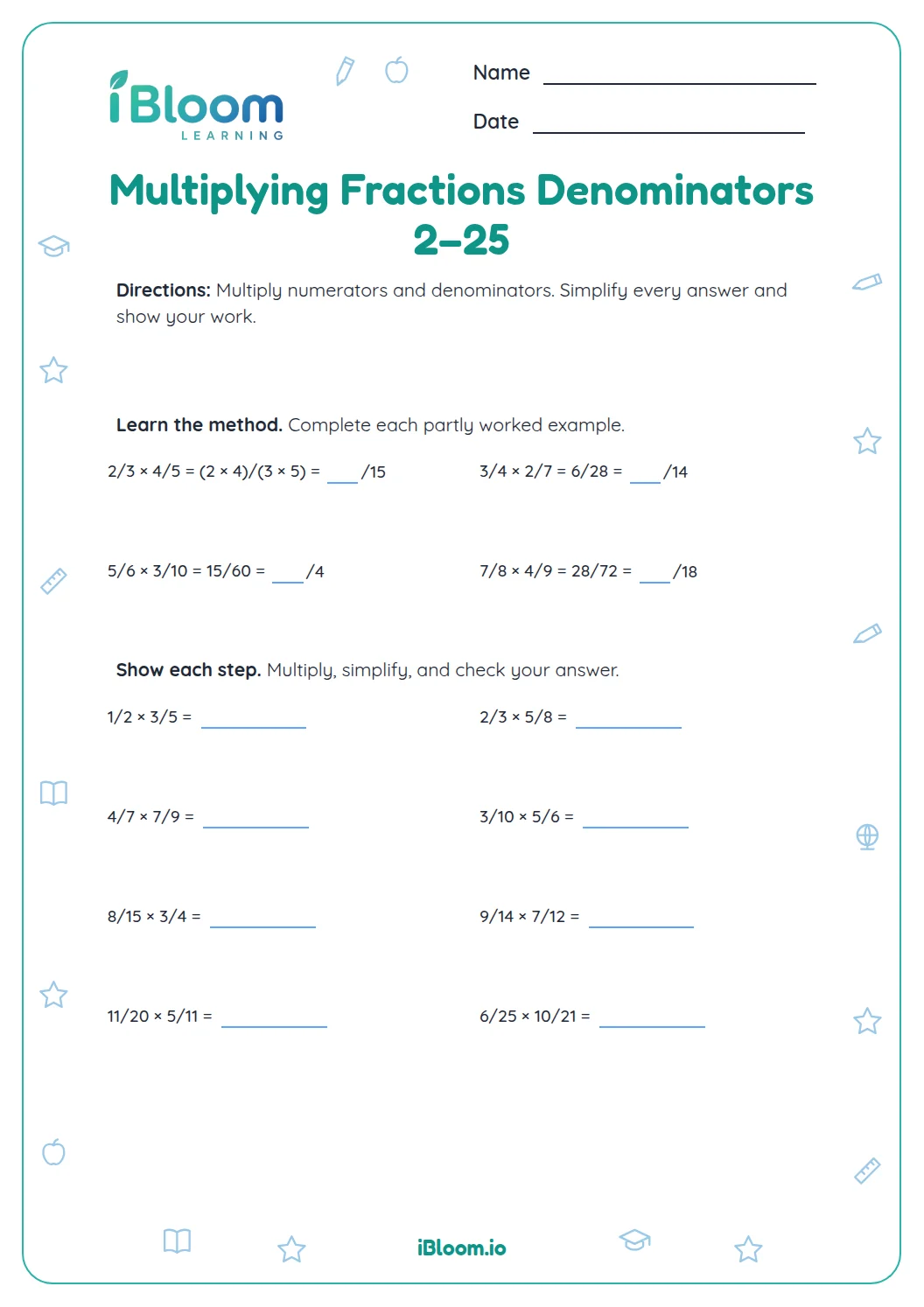
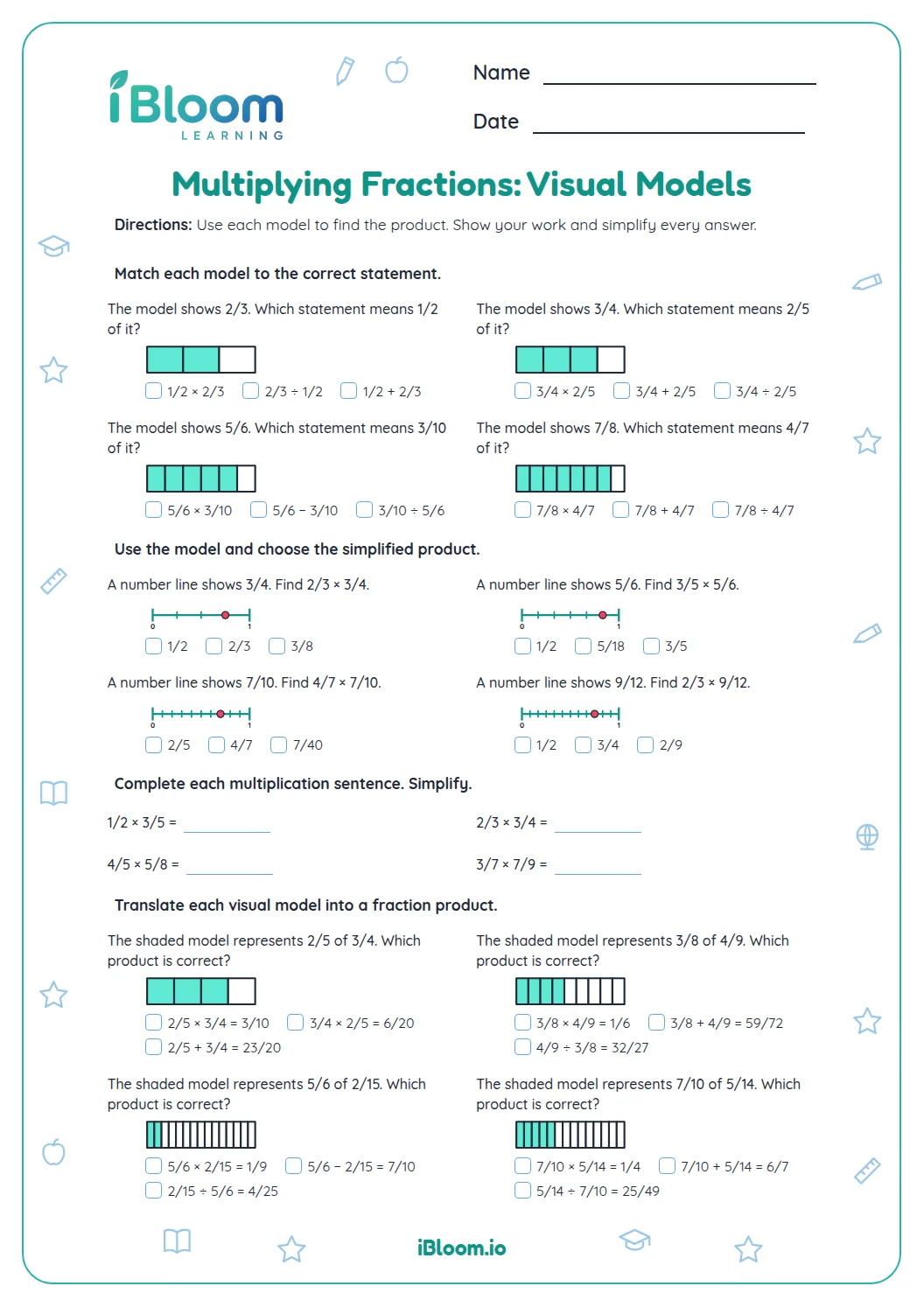
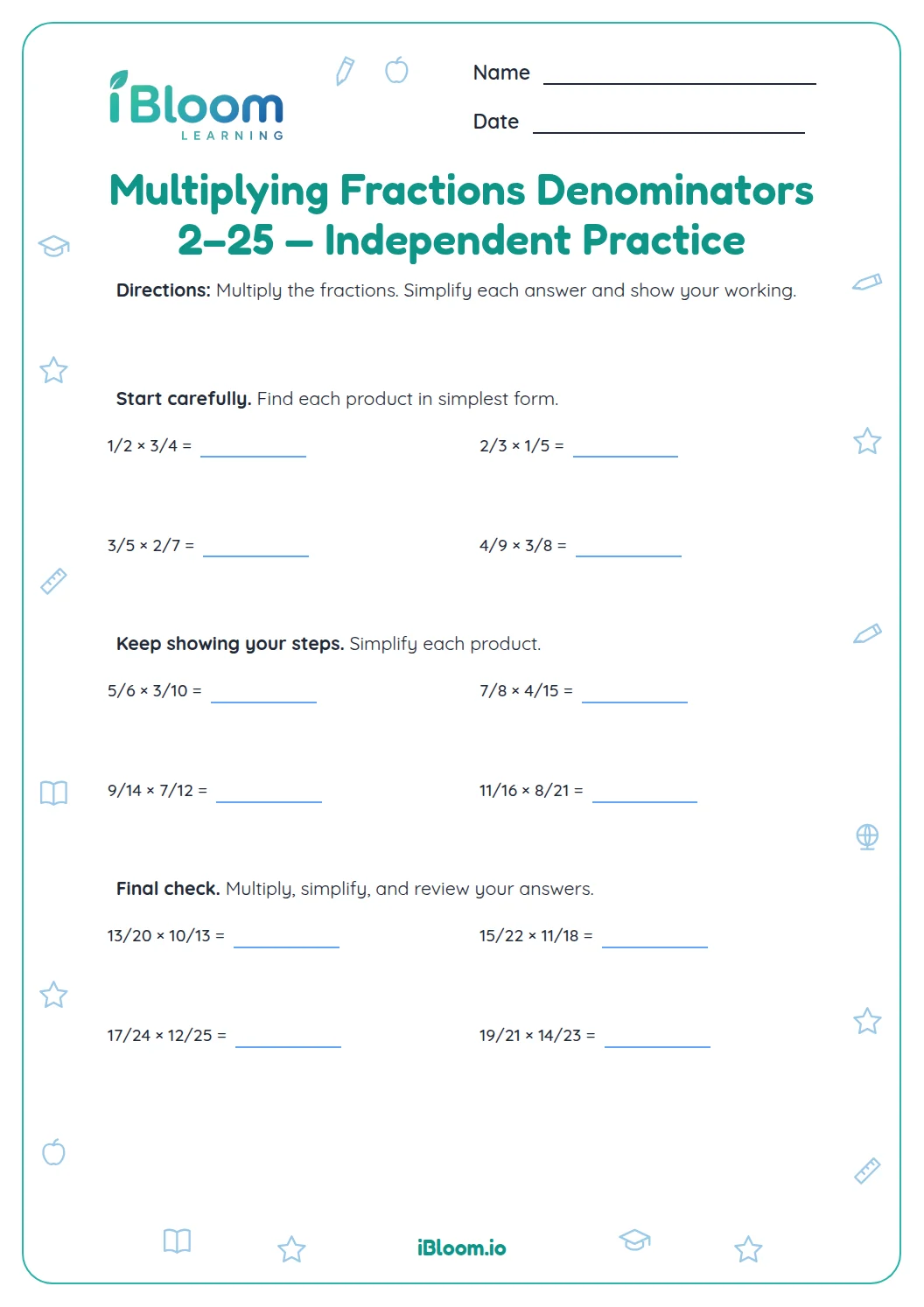
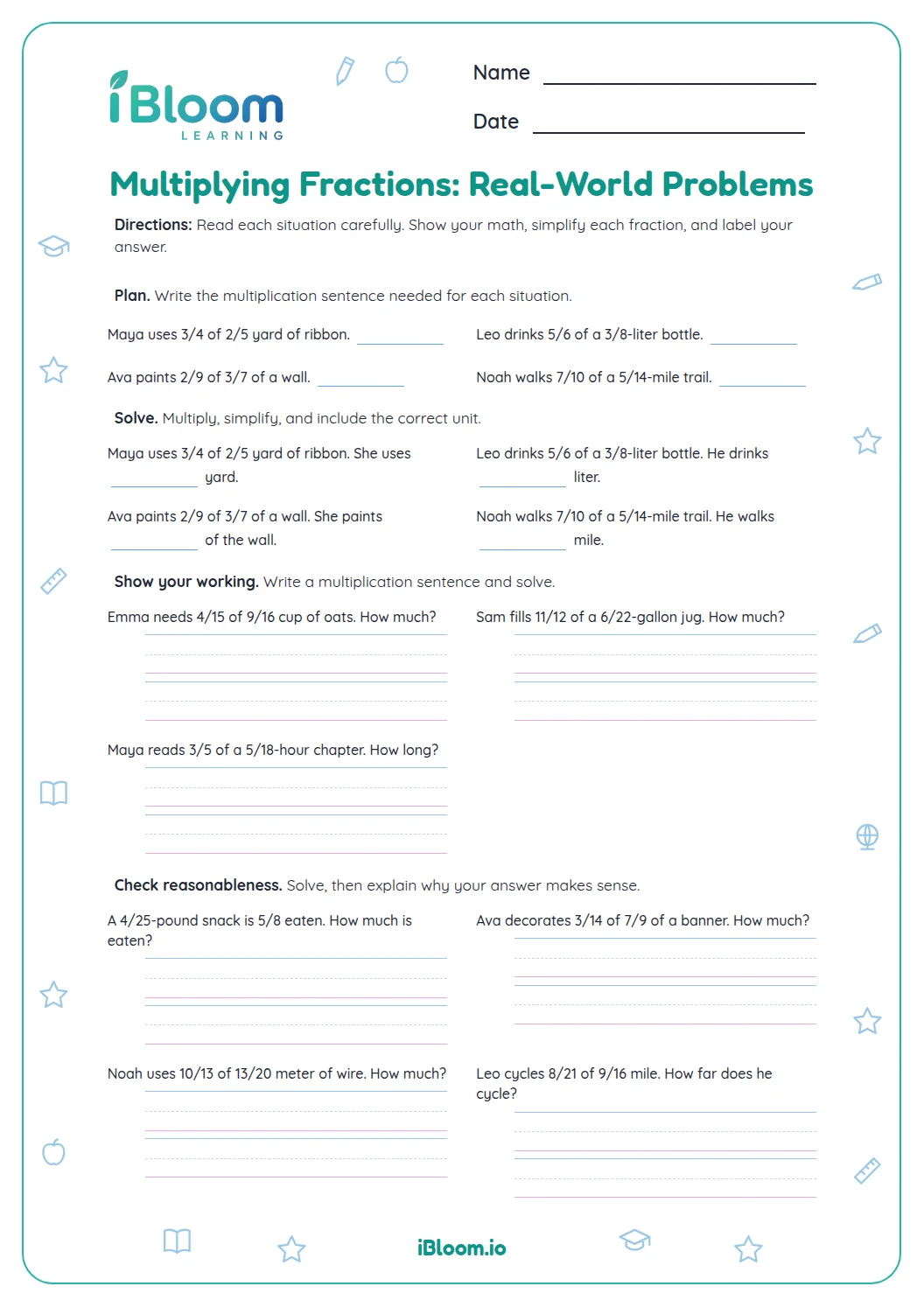
This free Grade 6 worksheet asks students to think about fraction multiplication before and after calculating. Its 16 questions use factor denominators from 2 through 25. Part A compares products with a factor without multiplying; Part B asks for seven products and one missing factor. Part C includes an error to explain and a size argument, and Part D applies multiplication to juice and seeds. The work practices Common Core 5.NF.B.4 and 5.NF.B.5a. A separate key gives exact answers and explanations for checking the reasoning.
Aligned to 5.NF.B.4 and 5.NF.B.5a
How can students compare products without multiplying?
Choose the factor the question names, then inspect the other factor. Multiplication by a positive fraction below 1 produces less than the named positive factor; multiplication by 1 preserves it; multiplication by a fraction above 1 produces more. Part A includes all three cases.
Question 4 names the second factor, 2/3. Students must inspect 9/10 to decide that the product is less than 2/3, rather than automatically comparing with the first fraction.
How can students simplify before multiplying?
Divide a numerator and a denominator in the product by the same common factor. This keeps the value unchanged while reducing the numbers to multiply. Students can also multiply first and simplify afterward; both approaches should lead to the same simplest fraction.
- 16/7 × 14/15
- 2Divide 14 and 7 by 7; divide 6 and 15 by 3.
- 32/1 × 2/5 = 4/5
- 4The product is less than 6/7 because 14/15 is less than 1.
What makes this a reasoning challenge?
Students must connect answers to reasons: why a product changes size, why adding denominators fails, and which missing factor makes an equation true. For question 8, substituting 3/5 gives 11/12 × 3/5 = 33/60 = 11/20.
The last two questions use a fraction of a measured amount. Taking 2/5 of 1/2 liter means multiplying the two fractions. The product, 1/5 liter, is the amount of juice poured.
How to use this worksheet
- 1Complete Part A using factor sizes only; ask which factor was compared with 1.
- 2In Part B, look for common factors before multiplying numerators and denominators.
- 3Check the missing factor by putting it back into the equation.
- 4For Part C, correct Mia’s denominator error, then explain why multiplying by 5/4 increases 7/10.
- 5Translate each final story into a fraction multiplication sentence and keep the measurement unit.
- 6Use the key to check simplified values and the mathematical meaning of each explanation.
Mistakes to check and how to help
The mistake
Adding denominators to get 6/8 for 2/3 × 3/5.
The fix
Multiply both numerators and both denominators: 6/15 simplifies to 2/5.
The mistake
Assuming multiplication always makes a number larger.
The fix
Compare the other factor with 1; taking 3/5 of a positive amount gives only part of it.
The mistake
Canceling two numbers that are both numerators.
The fix
Only divide a numerator and a denominator by the same nonzero common factor.
Common Core alignment
Multiply fractions, complete a product equation and apply products to measured amounts.
On this sheet: Parts B–D use fraction products in calculations, an error analysis and measurement contexts.
Show the official wordingHide the official wording
Apply and extend previous understandings of multiplication to multiply a fraction or whole number by a fraction.
Compare a product with one positive factor by comparing the other factor with 1.
On this sheet: Part A and question 14 require size reasoning without finding the product.
Show the official wordingHide the official wording
Comparing the size of a product to the size of one factor on the basis of the size of the other factor, without performing the indicated multiplication.
What to practice next
Make more practice
Further reading
Questions parents and teachers ask
What makes the questions harder than routine multiplication?
The sheet asks students to justify answers as well as calculate them. Four questions require product comparisons without multiplying, one hides a factor, and two require written reasoning. The final problems ask students to interpret a fraction of a measured amount and attach the correct unit.
Are the denominators limited to 2 through 25?
Yes, the fractions supplied as factors have denominators from 2 through 25, including 12, 16, 18, 20, 21 and 25. This is the range used for the factors. Students multiply and simplify to find products, checking the size of each answer against the original fractions.
Must students simplify before multiplying?
No, students may multiply first and simplify afterward. For 6/7 × 14/15, that gives 84/105, which reduces to 4/5. Simplifying across the product first keeps the arithmetic smaller. Ask students to explain why dividing a numerator and denominator by the same factor preserves the value.
How can students find the missing factor in question 8?
They can reason backward or divide the product by the known factor. Dividing 11/20 by 11/12 gives 3/5. To check, substitute 3/5 into the original equation: 11/12 × 3/5 gives 33/60, which simplifies to 11/20. The check confirms that the factor fits the equation.
How should I check the written explanations?
Check the mathematical idea rather than requiring the exact words on the key. Question 13 needs multiplication of denominators and the corrected product, 2/5. Question 14 needs the fact that 5/4 is greater than 1, so multiplying a positive amount by it makes that amount larger.