





About this worksheet
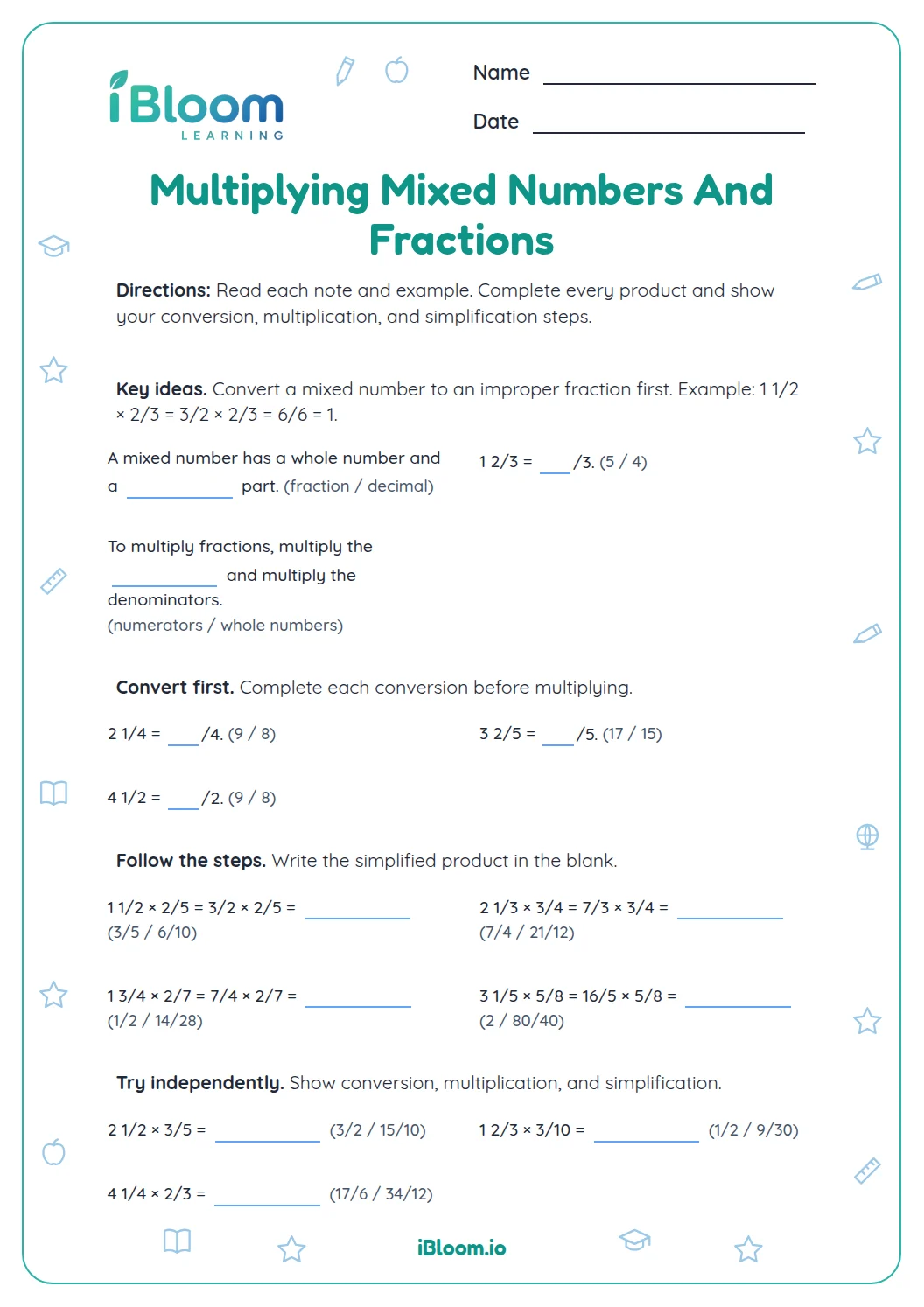
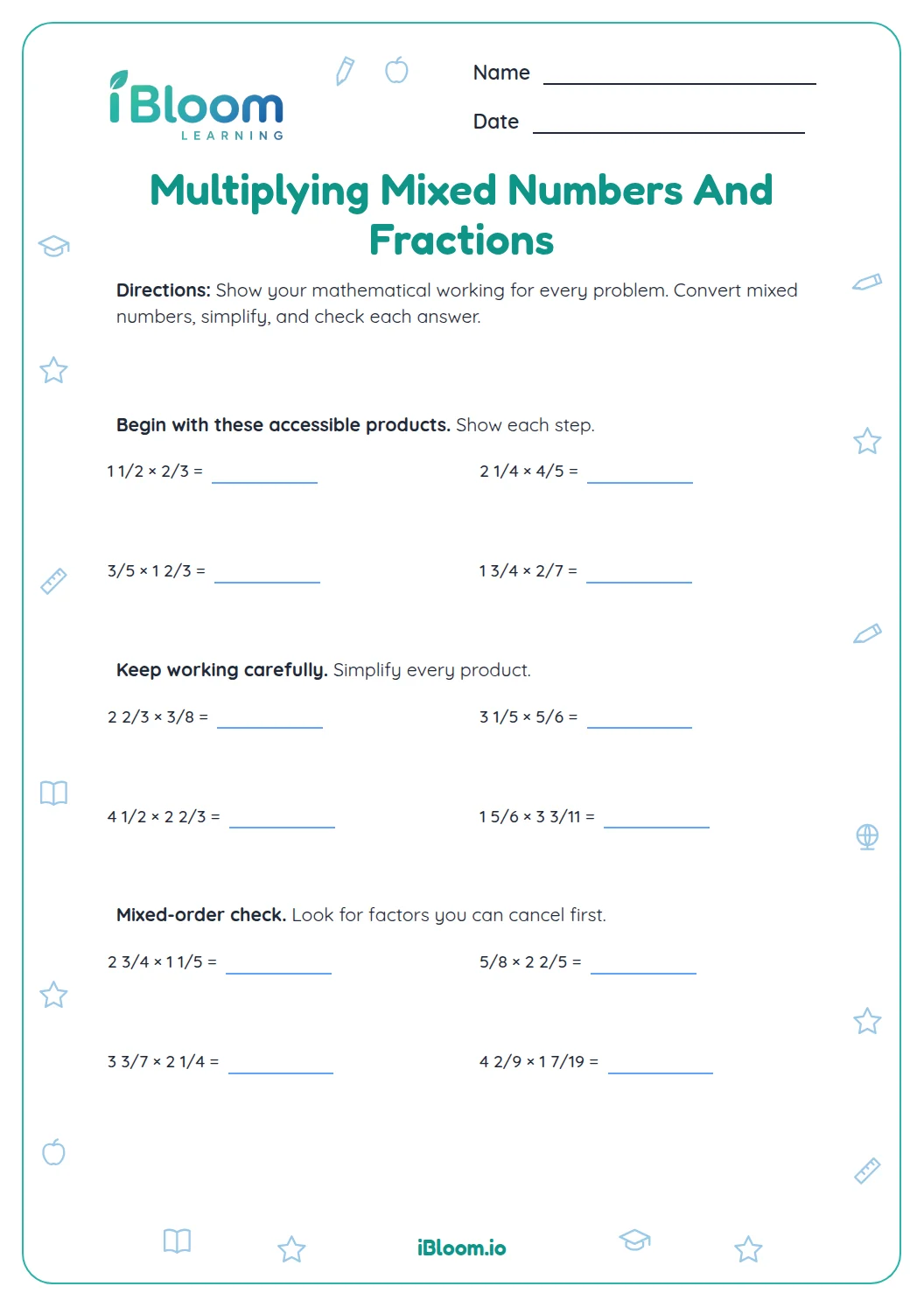
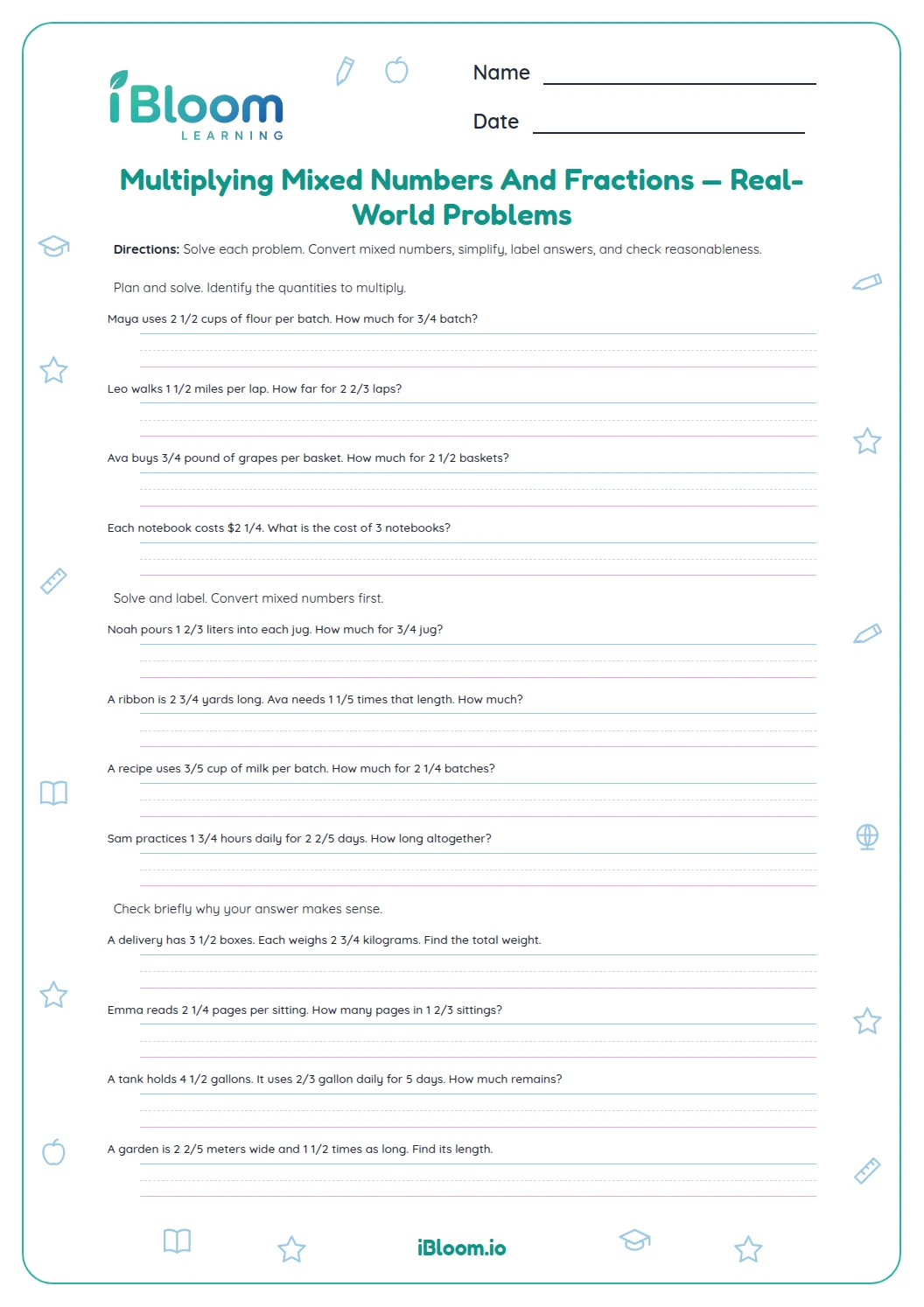
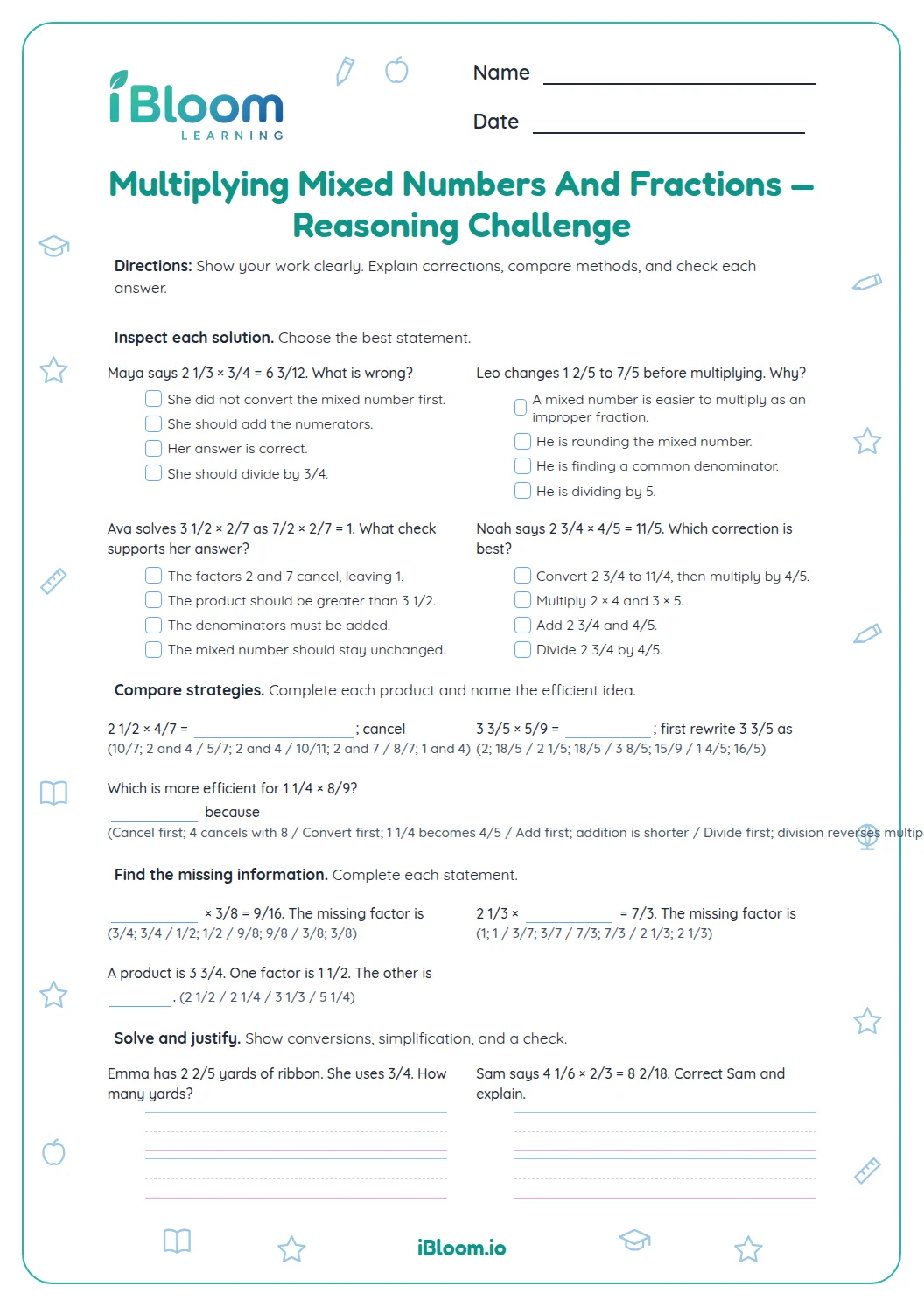
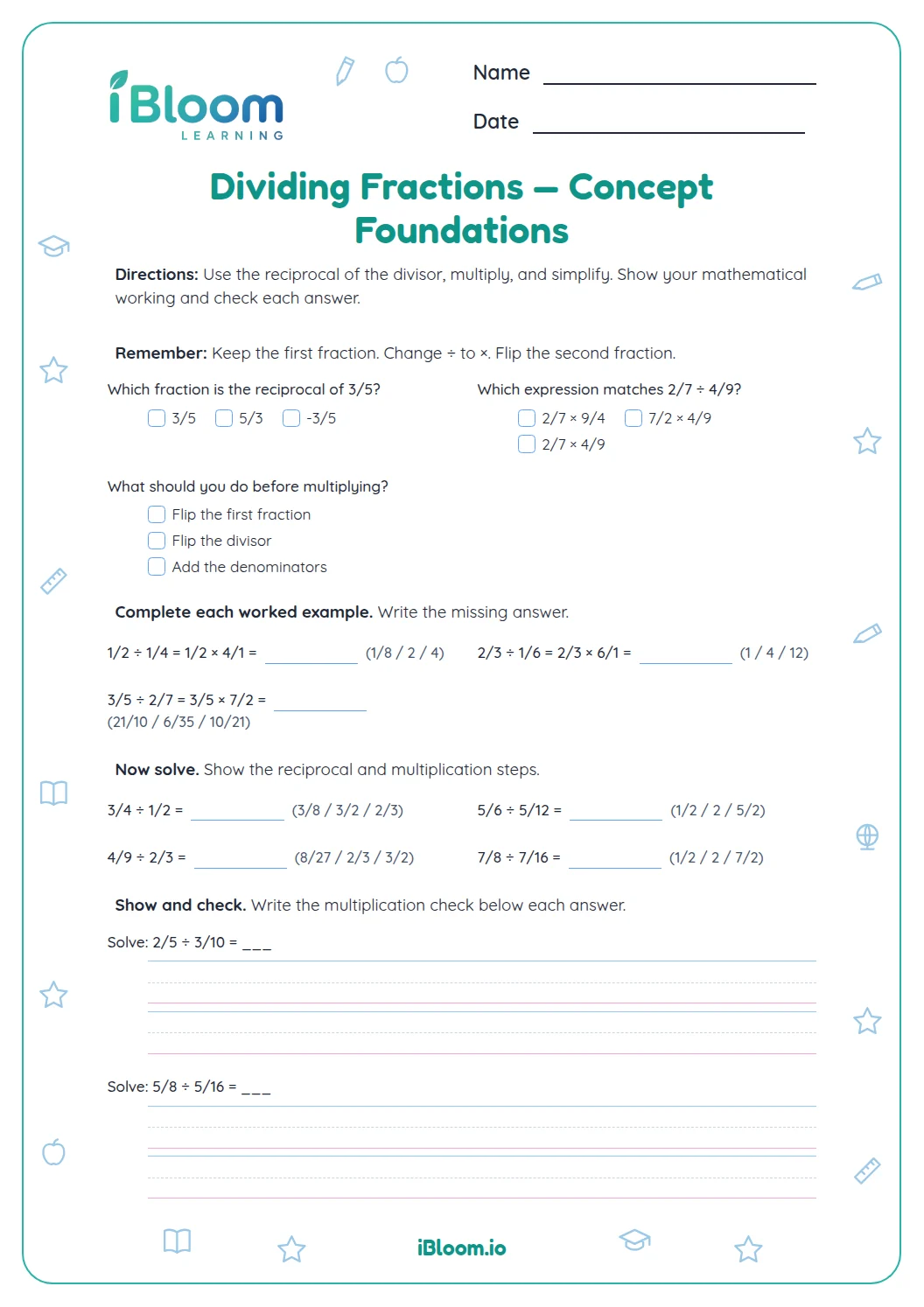
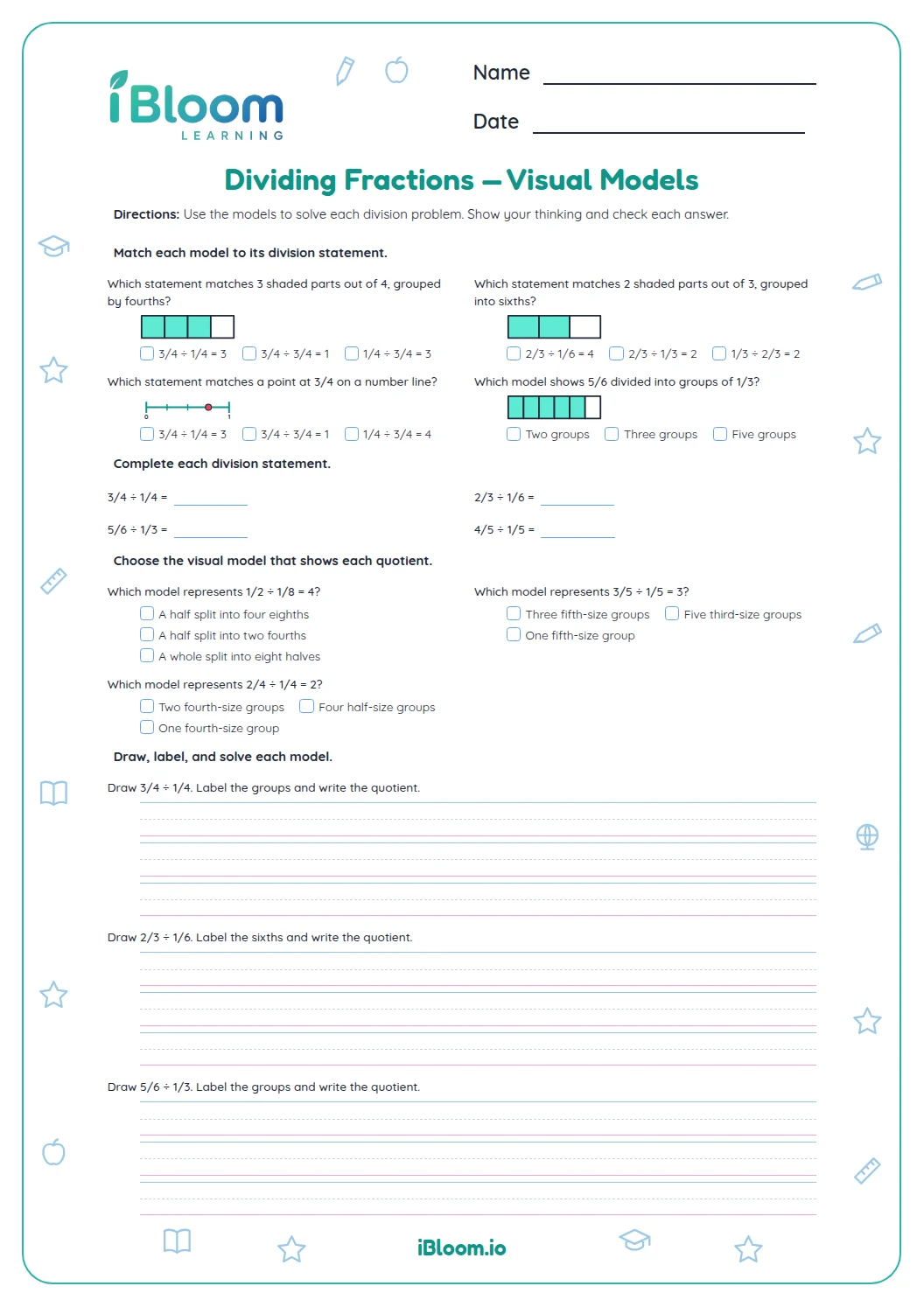
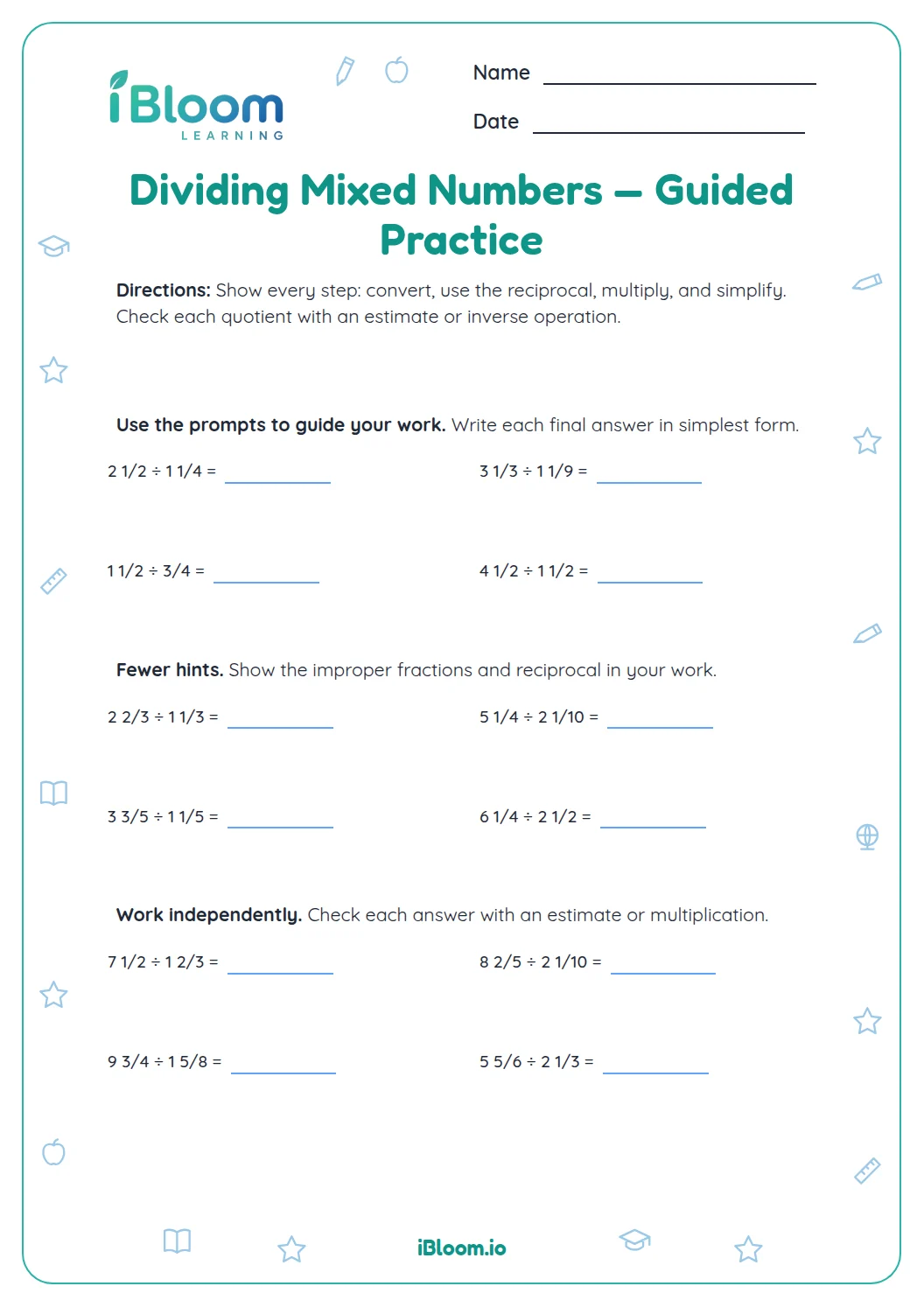
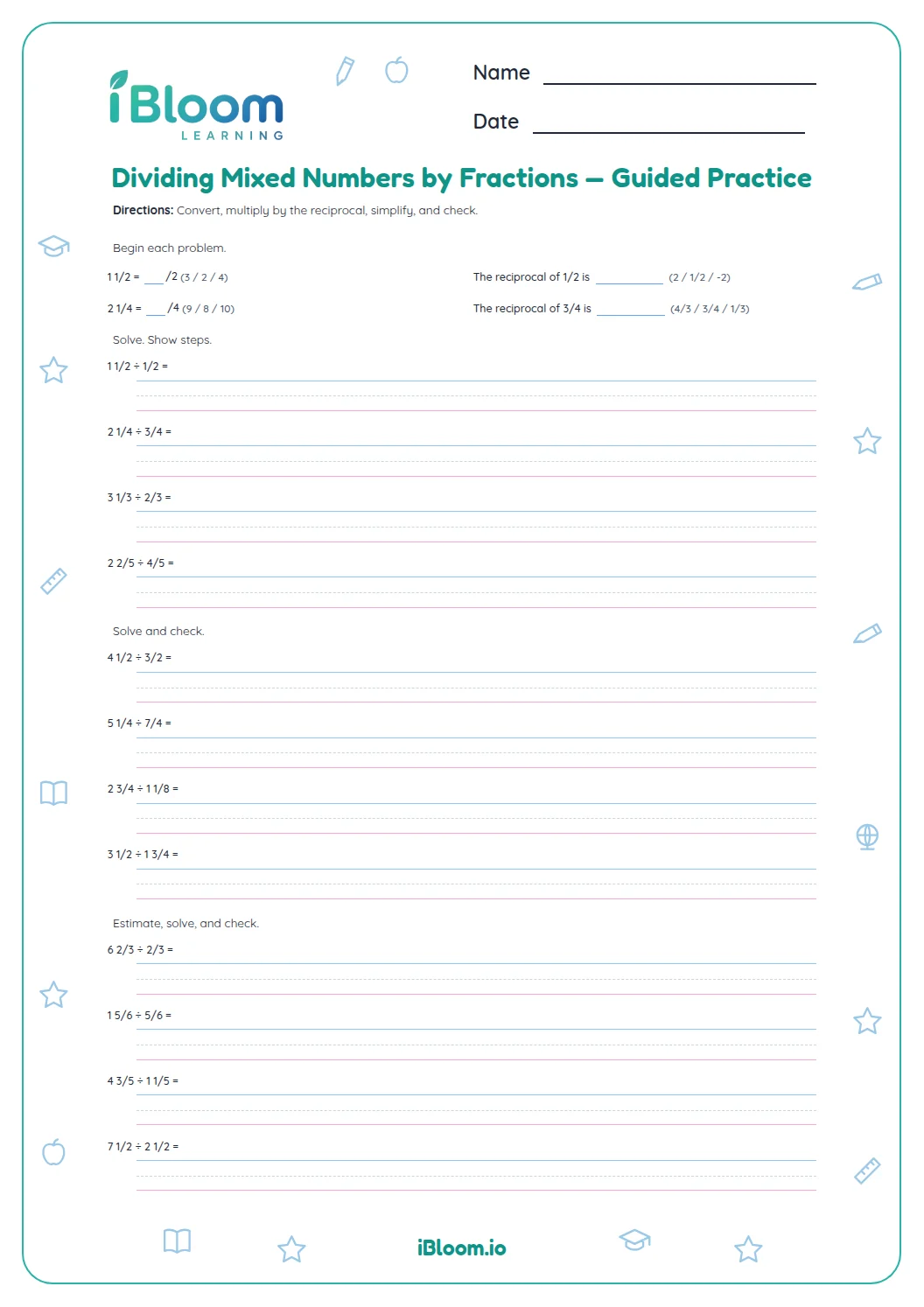
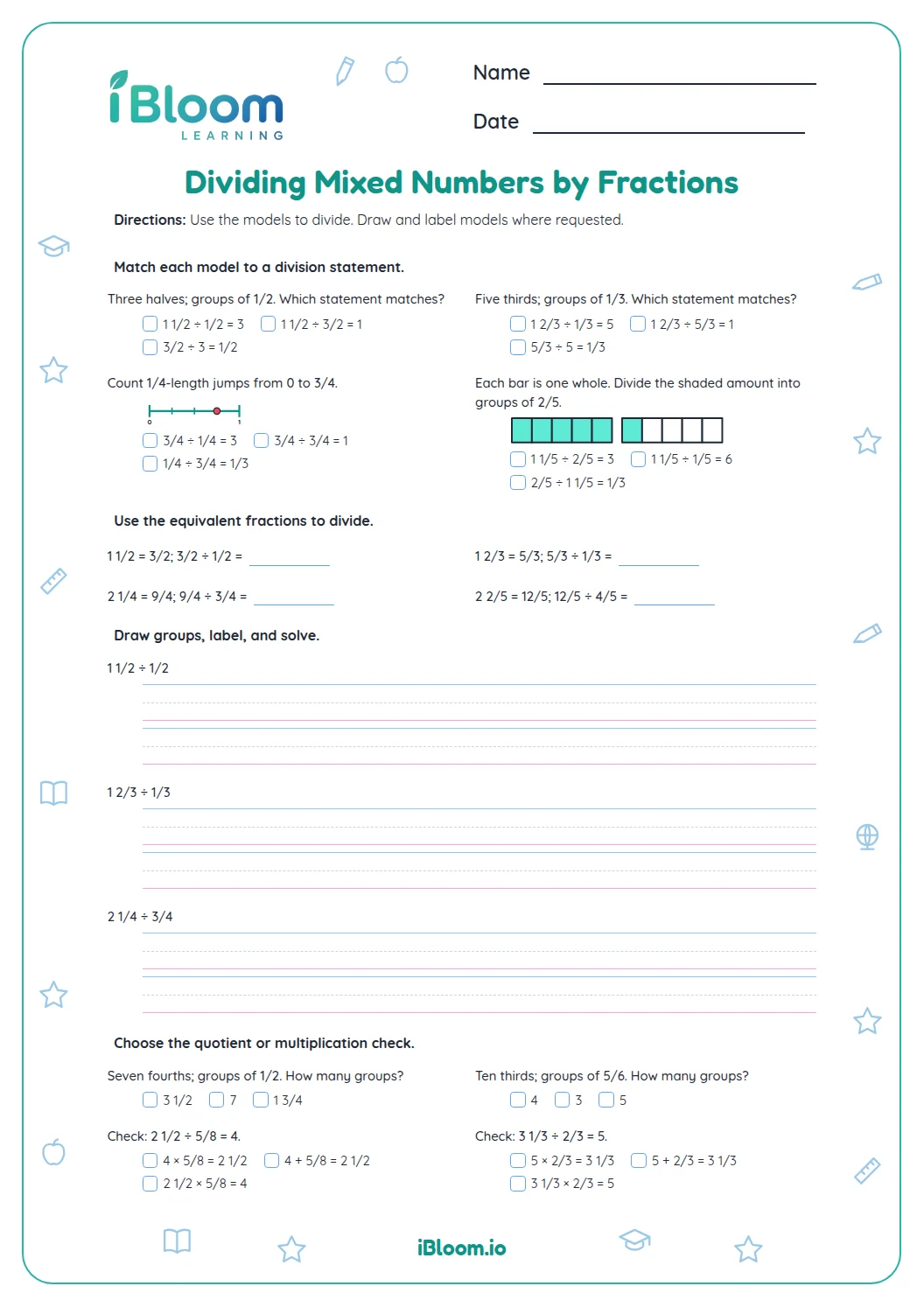
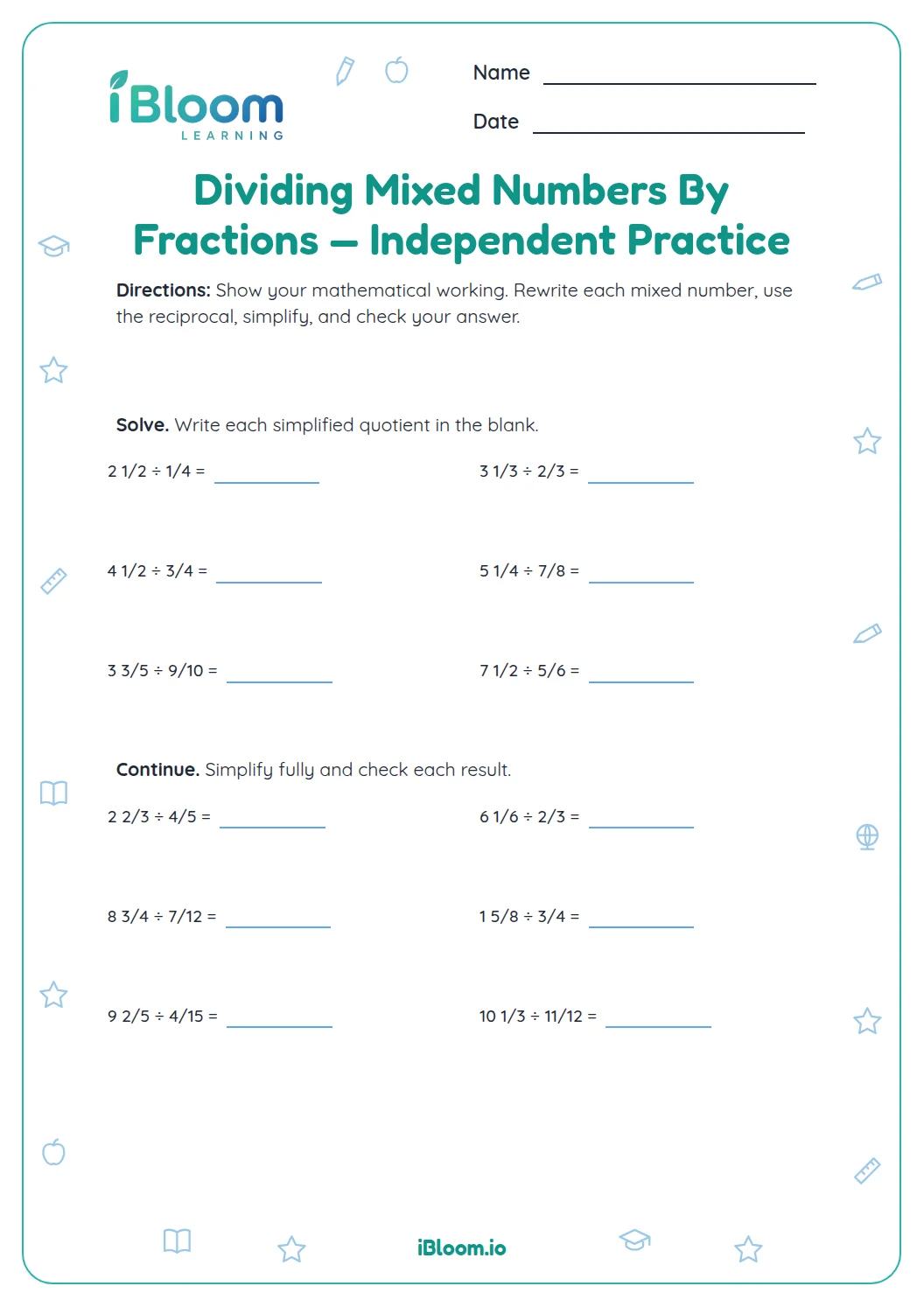
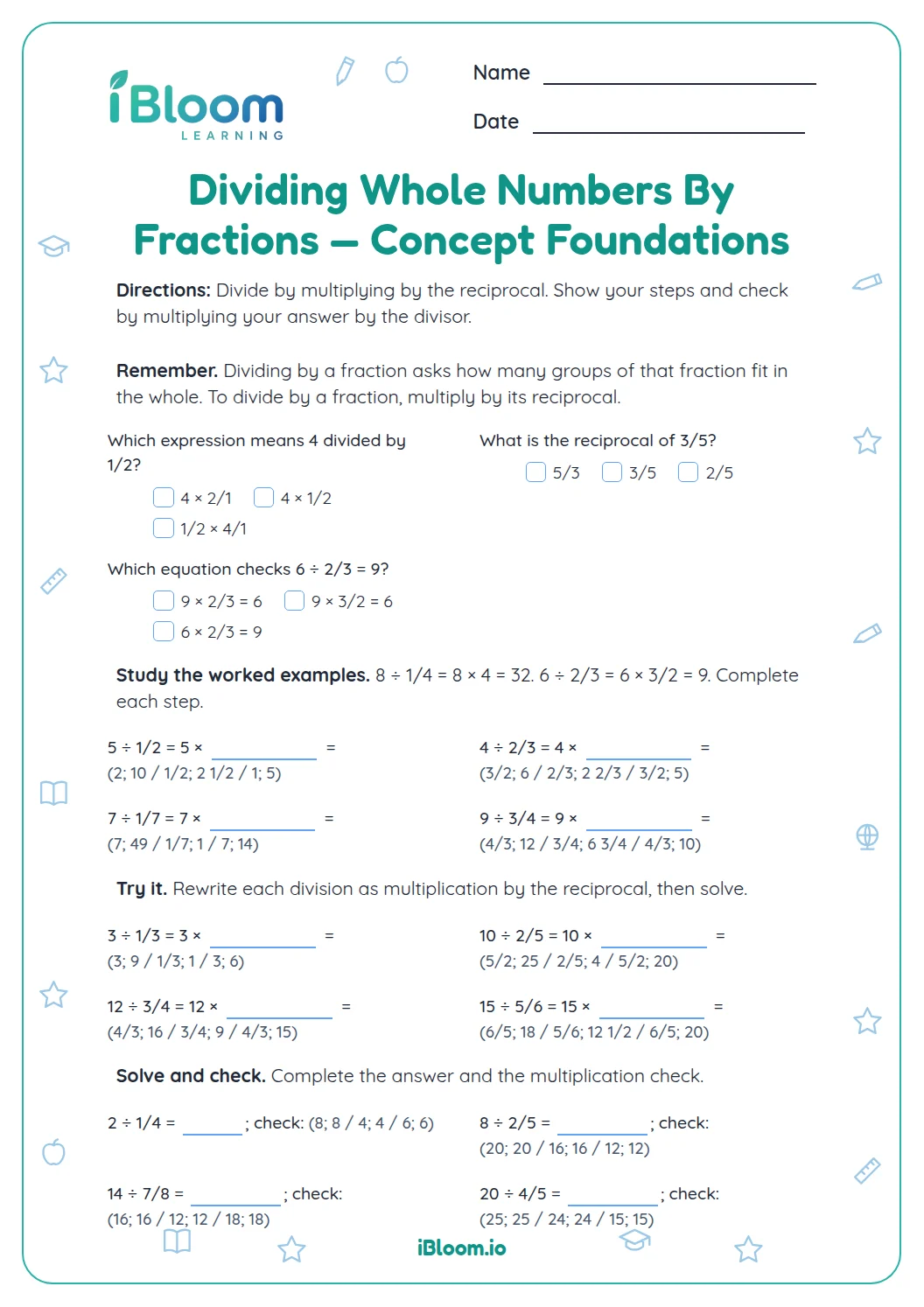
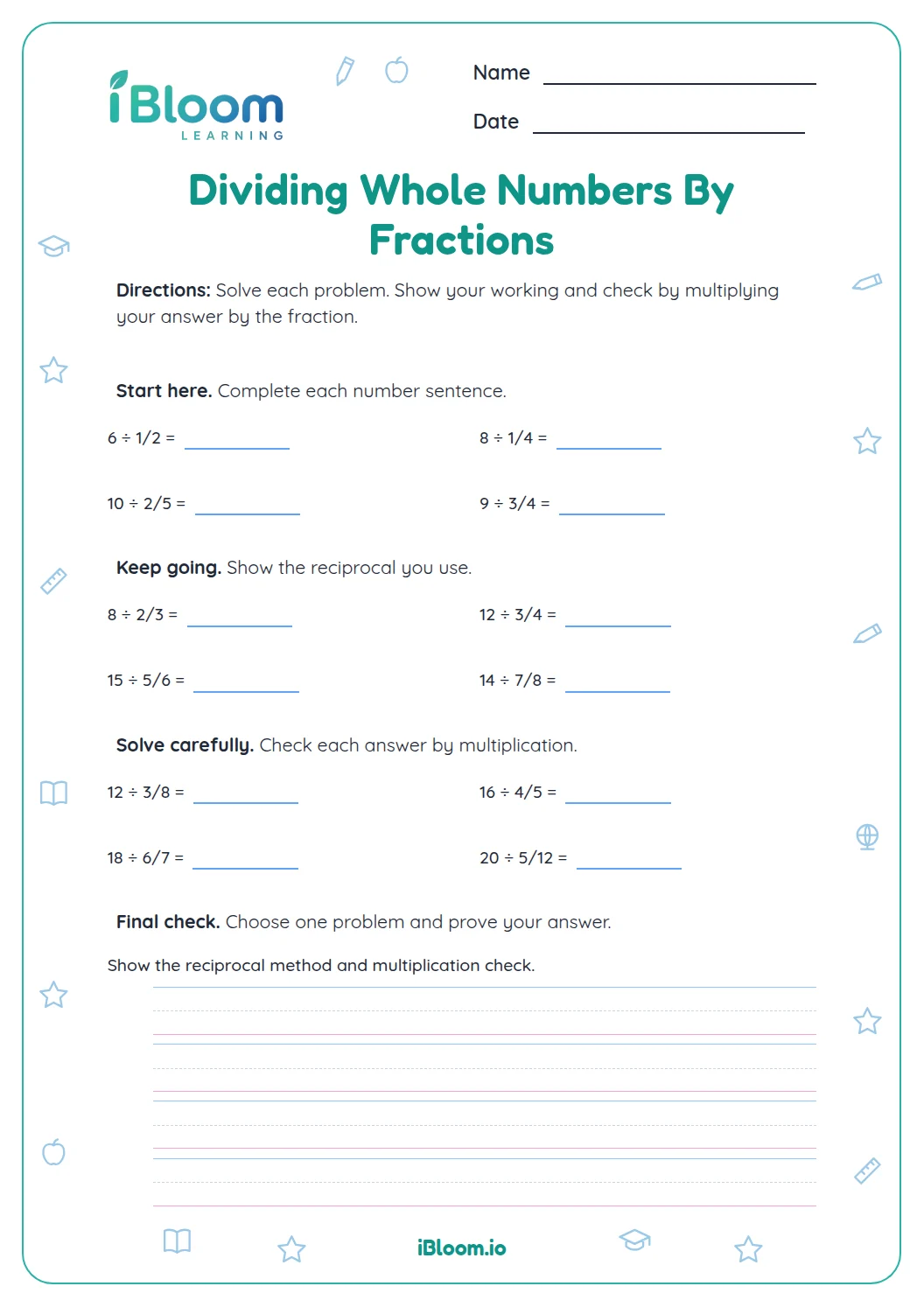
This Grade 6 worksheet practices multiplying fractions and mixed numbers. The first part begins by reading a shaded fraction model, then uses bar or square fraction drawings beside products. The second part continues with simplified products, with a drawing alongside each question. Students use the shaded fraction as a visual cue while multiplying the factors; a separate answer key shows the results.
Aligned to 5.NF.B.4
How do the fraction drawings support multiplication?
Each shaded bar represents the first factor in its product; a fully shaded bar shows a whole. Read the factor from the drawing, then multiply it by the other written factor. The drawing supports the first factor, while the student calculates and simplifies the product.
- Question 1 asks for the fraction shown
- Questions 2–7 pair products with factor models
- Questions 8–14 extend the same multiplication and simplification work
How can you multiply a fraction by a mixed number?
Rename a mixed number as an improper fraction, multiply numerators and denominators, then simplify. Canceling common factors before multiplying can keep the numbers smaller.
- 11/4 × 1 2/3
- 2Rename 1 2/3 as 5/3. Then 1/4 × 5/3 = 5/12.
When is a product fully simplified?
A fraction is simplified when its numerator and denominator have no common factor greater than 1. If the numerator is at least as large as the denominator, convert the improper fraction to a mixed number when that makes the answer clearer.
Multiply and simplify
- 1Read the first factor shown by the shaded model.
- 2Rename any mixed number as an improper fraction.
- 3Multiply the numerators and multiply the denominators.
- 4Simplify by canceling common factors or reducing the product.
- 5Write an improper product as a mixed number when appropriate.
- 6Check that the answer matches the scale of the factors.
Common fraction-product slips
The mistake
Adding denominators when multiplying.
The fix
Multiply numerator by numerator and denominator by denominator.
The mistake
Multiplying by the whole-number part but ignoring the fraction part.
The fix
Convert the entire mixed number to an improper fraction first.
The mistake
Leaving a reducible fraction such as 6/8.
The fix
Divide numerator and denominator by their greatest common factor.
Common Core alignment
The products use fraction multiplication and visual reasoning about fraction factors.
Interpret and compute products of fractions using visual fraction models.
On this sheet: Students multiply fractions and mixed numbers and use shaded fraction models to interpret factors.
Show the official wordingHide the official wording
Apply and extend previous understandings of multiplication to multiply a fraction or whole number by a fraction.
What to practice next
Make more practice
Further reading
Questions parents and teachers ask
What do the shaded models represent?
Each bar or square shows a fraction factor, with shaded parts representing the numerator and equal parts representing the denominator. Some bars also include a fully shaded whole. Students use that representation to recognize a factor before computing the product.
How do students multiply a mixed number by a fraction?
First convert the mixed number to an improper fraction. Multiply the two numerators and the two denominators, then simplify. For example, 1 2/3 becomes 5/3, so one fourth times 1 2/3 is 5/12. Ask the student to point to the matching question or passage detail as they explain the choice.
Are all questions drawn as models?
Question 1 asks students to read a shaded bar. The multiplication questions also include a bar or square model of a factor, alongside the written product. Students use the drawing together with the numbers to find each product. Ask the student to point to the matching question or passage detail as they explain the choice.
Should answers be simplified?
Yes. The worksheet directions ask students to simplify each product. If the product is greater than one, a mixed number can make the final value easier to read; the answer key gives the simplified form. Ask the student to point to the matching question or passage detail as they explain the choice.
What should students check if an answer seems too large?
Compare the factors and estimate the product. Multiplying by a proper fraction reduces a positive amount, while multiplying by a mixed number greater than one increases it. Then recheck the mixed-number conversion and the multiplication. Ask the student to point to the matching question or passage detail as they explain the choice.