




About this worksheet
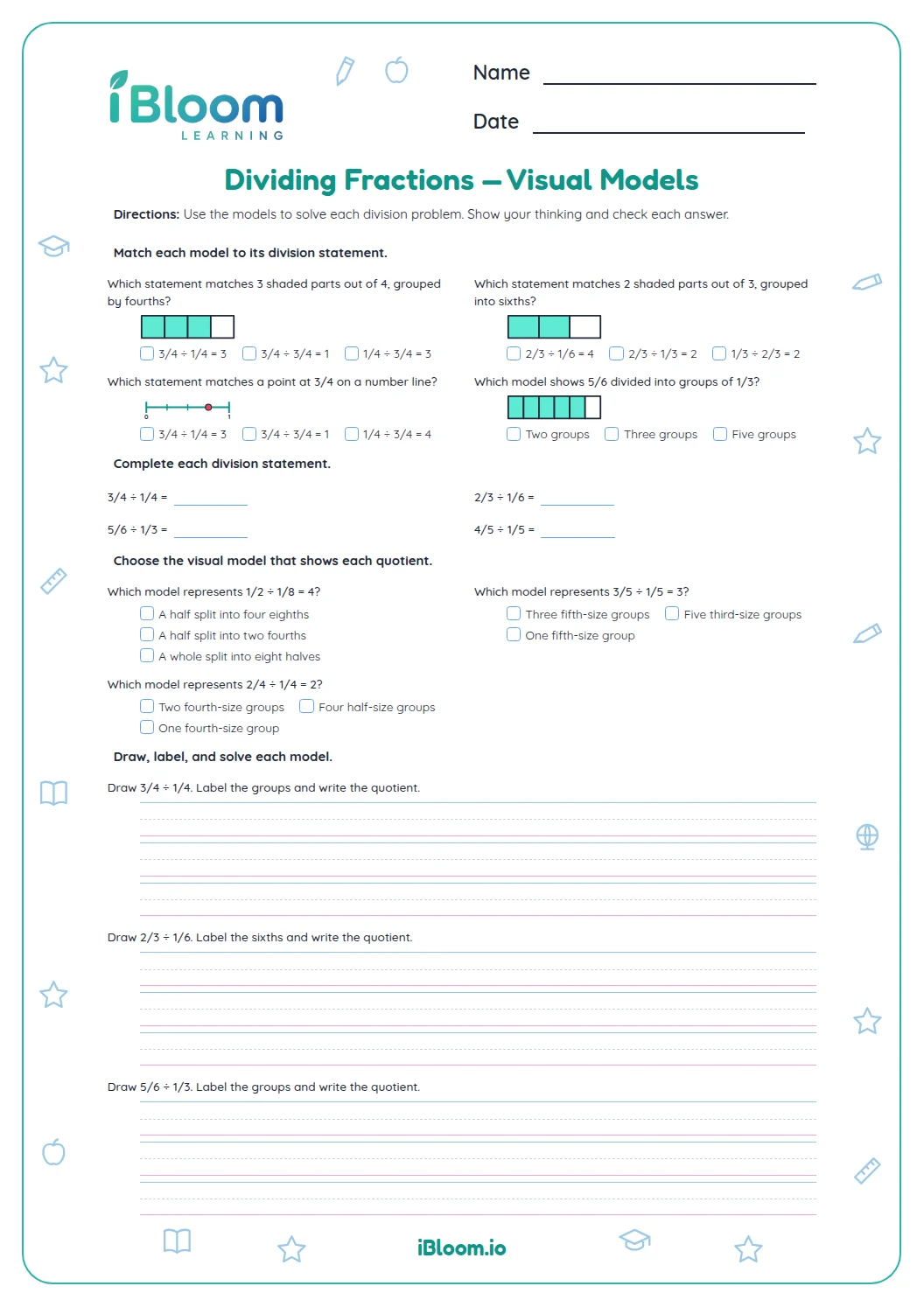
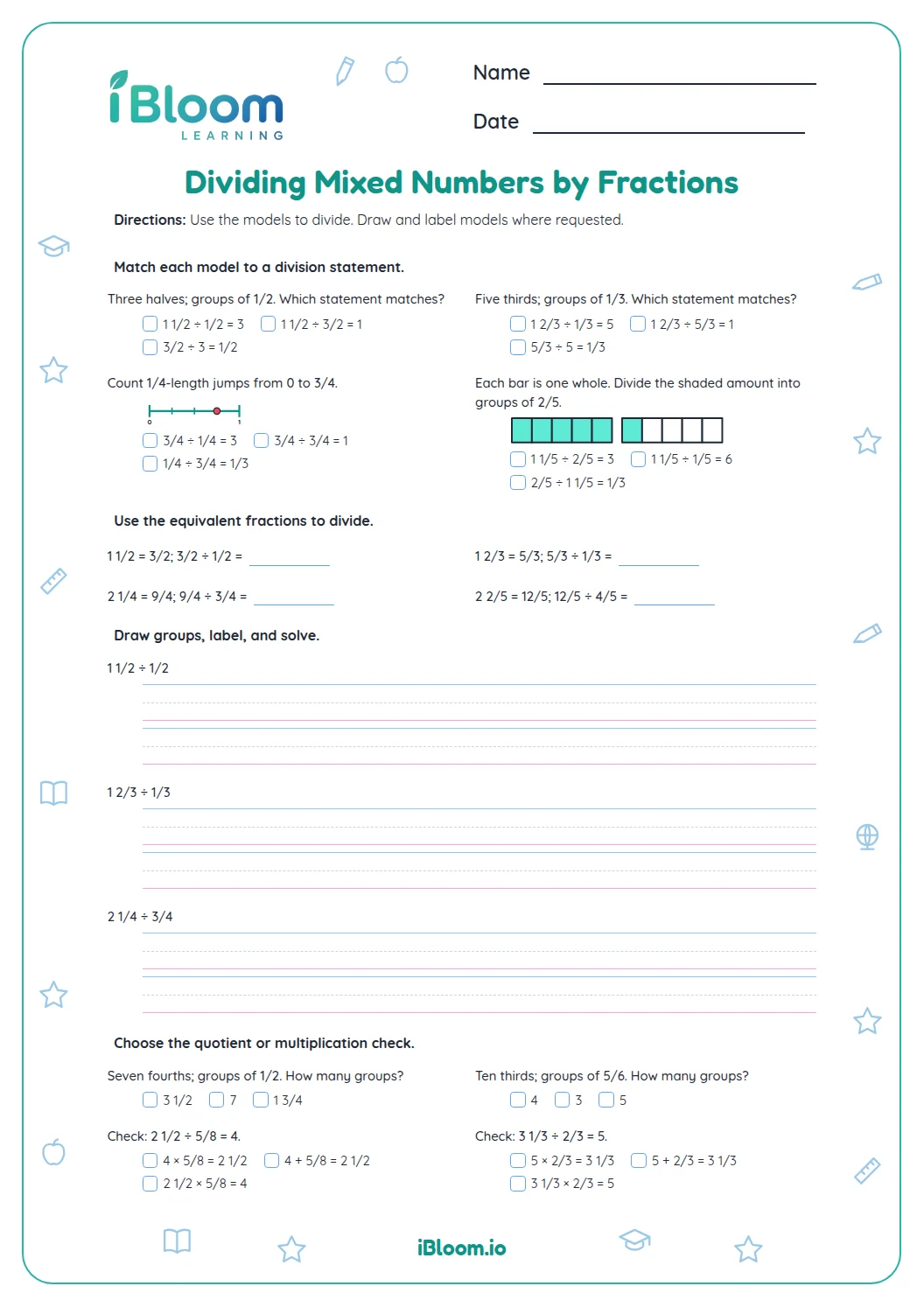
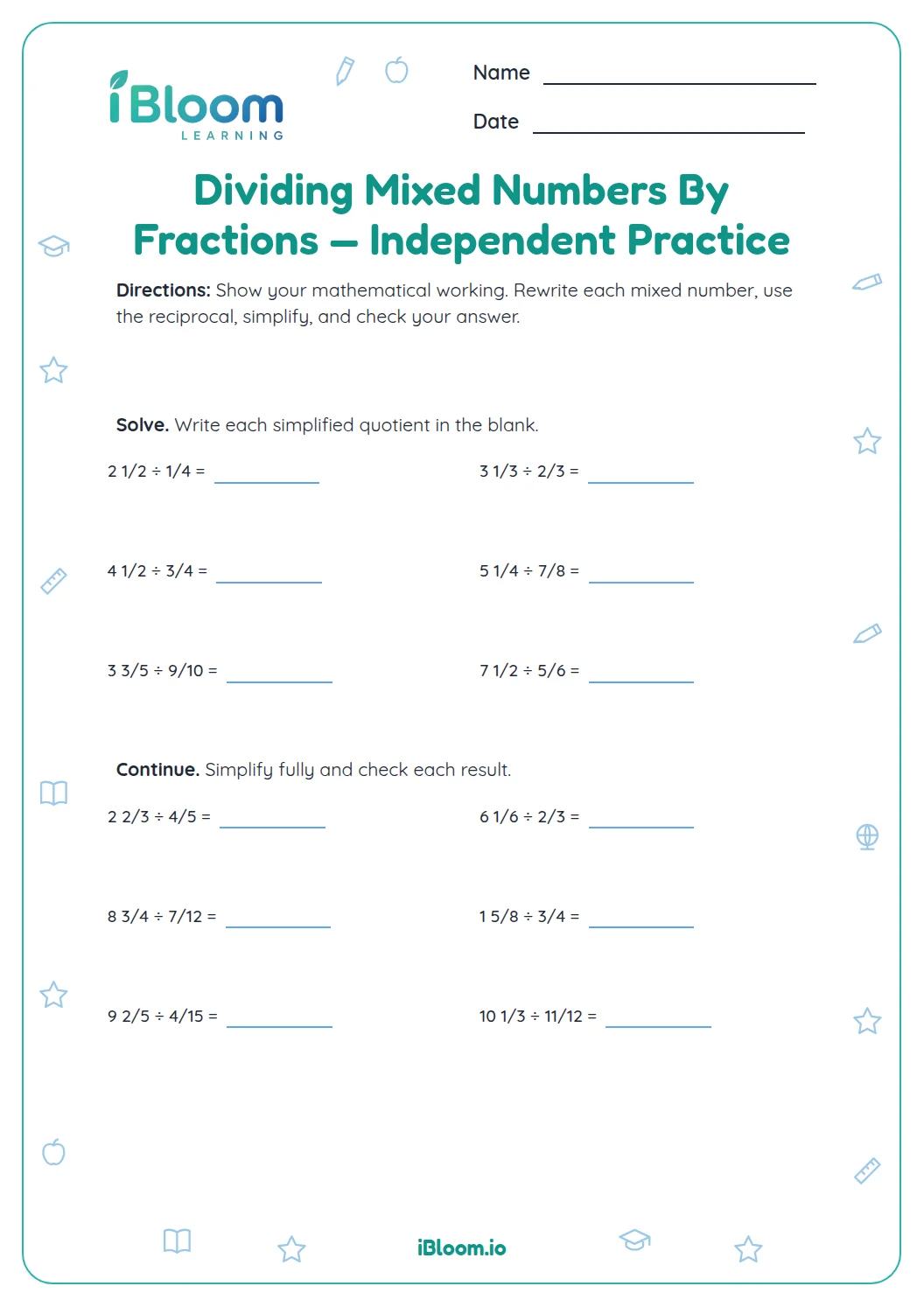
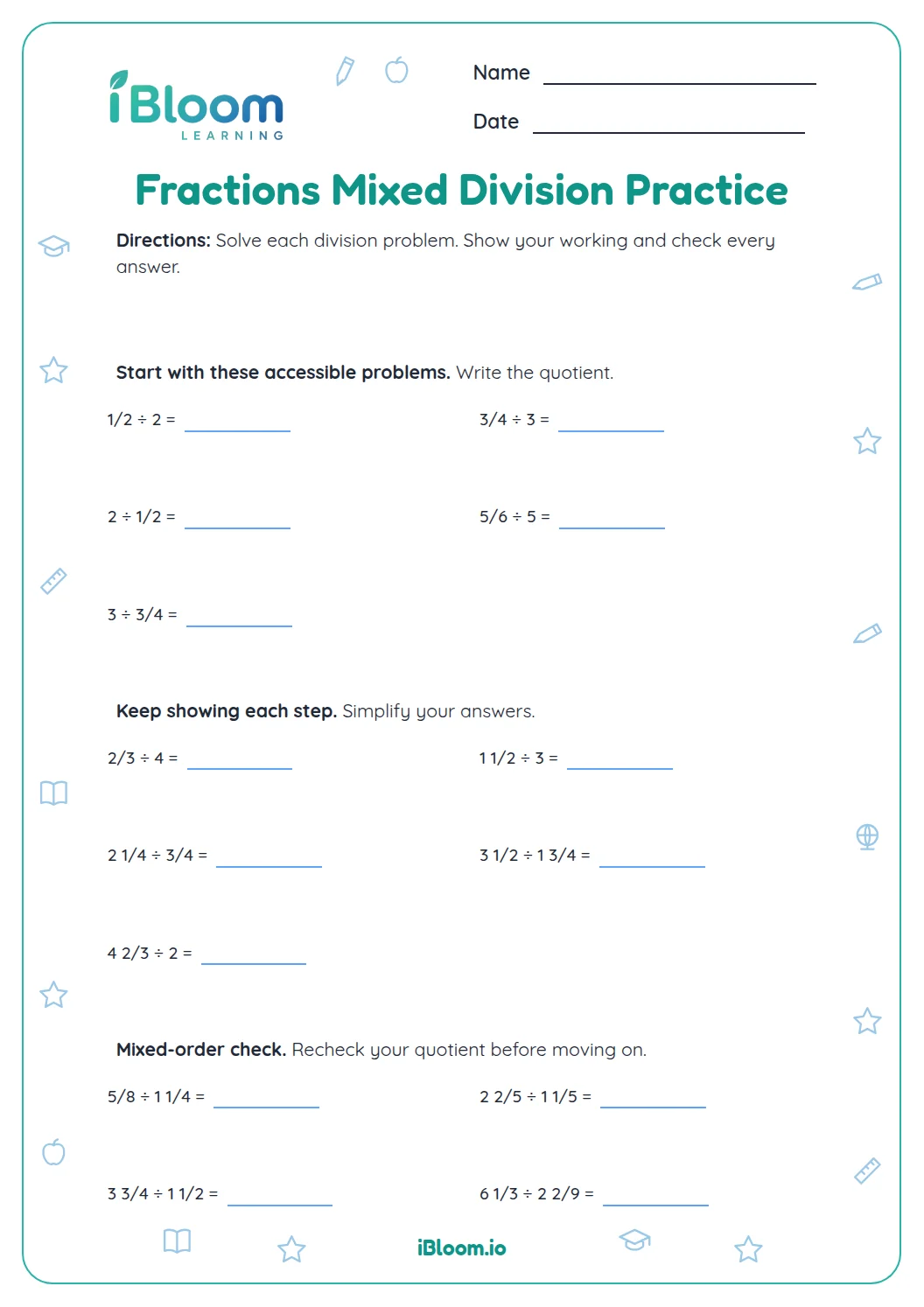
This free Grade 6 worksheet uses fraction bars and number lines to make whole-number division by fractions visible. Part A has six bar models: students count unit-fraction parts, then group parts for divisors such as 2/3 and 3/4. Part B gives two measurement stories with number lines. Part C connects division to multiplication by a reciprocal in four equations. These twelve questions practice Common Core 6.NS.A.1. One quotient includes a partial group, 2 ÷ 3/4 = 2 2/3. A separate answer key gives every quotient and reciprocal.
Aligned to 6.NS.A.1
What does the quotient count in a visual model?
The model represents the starting whole number. Each bar in Part A is one whole; each number line in Part B runs from zero to the total. The divisor tells how much belongs in one group. The quotient counts those groups.
The first two questions use unit fractions, so each small bar part is already one group. For 2 ÷ 1/2, the two bars contain four halves altogether. The next four bar questions require groups of two or three small parts.
How do students divide by a fraction such as 3/4?
Question 4 has three bars divided into fourths. To solve 3 ÷ 3/4, group three fourth-size parts at a time. There are twelve parts altogether, so four groups fit. A group may continue from the end of one bar into the next.
Students can label parts with matching letters to show each group. A multiplication check connects the count to the original amount: four groups of 3/4 make 3. Part C then asks for the reciprocal in four equivalent multiplication equations.
- 13 ÷ 3/4
- 2Three bars contain 12 fourth-size parts.
- 3Each 3/4 group uses 3 parts.
- 412 ÷ 3 = 4 groups
- 5Check: 4 × 3/4 = 3
What does the partial group in question 6 mean?
For 2 ÷ 3/4, two bars contain eight fourth-size parts. Two full groups use six parts, leaving two parts. A full group needs three parts, so the remaining two make 2/3 of a group. The answer is 2 2/3.
The leftover amount is 1/2 of a whole, but the question counts groups of size 3/4. Keeping those units separate explains why the fractional part of the quotient is 2/3. Part B applies grouping to ribbon pieces and juice servings, with a blank for each count.
How to use this worksheet
- 1Identify the total amount and the size of each small part.
- 2For questions 1 and 2, count the parts across all the bars.
- 3For questions 3–6, use the divisor’s numerator to group the small parts.
- 4In question 6, compare the leftover parts with the number needed for a full group.
- 5Use the two number lines in Part B to count pieces and servings; check by multiplying.
- 6Complete Part C by turning each divisor upside down; keep the starting whole number unchanged.
Mistakes to notice and fix
The mistake
Counting tick marks instead of spaces on the number lines.
The fix
For question 7, start at zero and count six half-yard spaces. Zero is the starting point, not a piece.
The mistake
Counting fourths separately when dividing by 3/4.
The fix
In question 4, group three fourth-size bar parts at a time, then count those groups.
The mistake
Writing 2 1/2 for 2 ÷ 3/4 because 1/2 of a whole is left.
The fix
Compare the two leftover fourths with the three fourths in one group: the remainder is 2/3 of a group.
Common Core alignment
Use fraction bars and number lines to count fraction-size groups in whole numbers.
On this sheet: Students group bar parts, interpret a partial group, solve two number-line stories, and complete reciprocal equations.
Show the official wordingHide the official wording
Interpret and compute quotients of fractions, and solve word problems involving division of fractions by fractions, e.g., by using visual fraction models and equations to represent the problem. For example, create a story context for (2/3) ÷ (3/4) and use a visual fraction model to show the quotient; use the relationship between multiplication and division to explain that (2/3) ÷ (3/4) = 8/9 because 3/4 of 8/9 is 2/3. (In general, (a/b) ÷ (c/d) = ad/bc.) How much chocolate will each person get if 3 people share 1/2 lb of chocolate equally? How many 3/4-cup servings are in 2/3 of a cup of yogurt? How wide is a rectangular strip of land with length 3/4 mi and area 1/2 square mi?
What to practice next
Make more practice
Further reading
Questions parents and teachers ask
Which questions include a visual model?
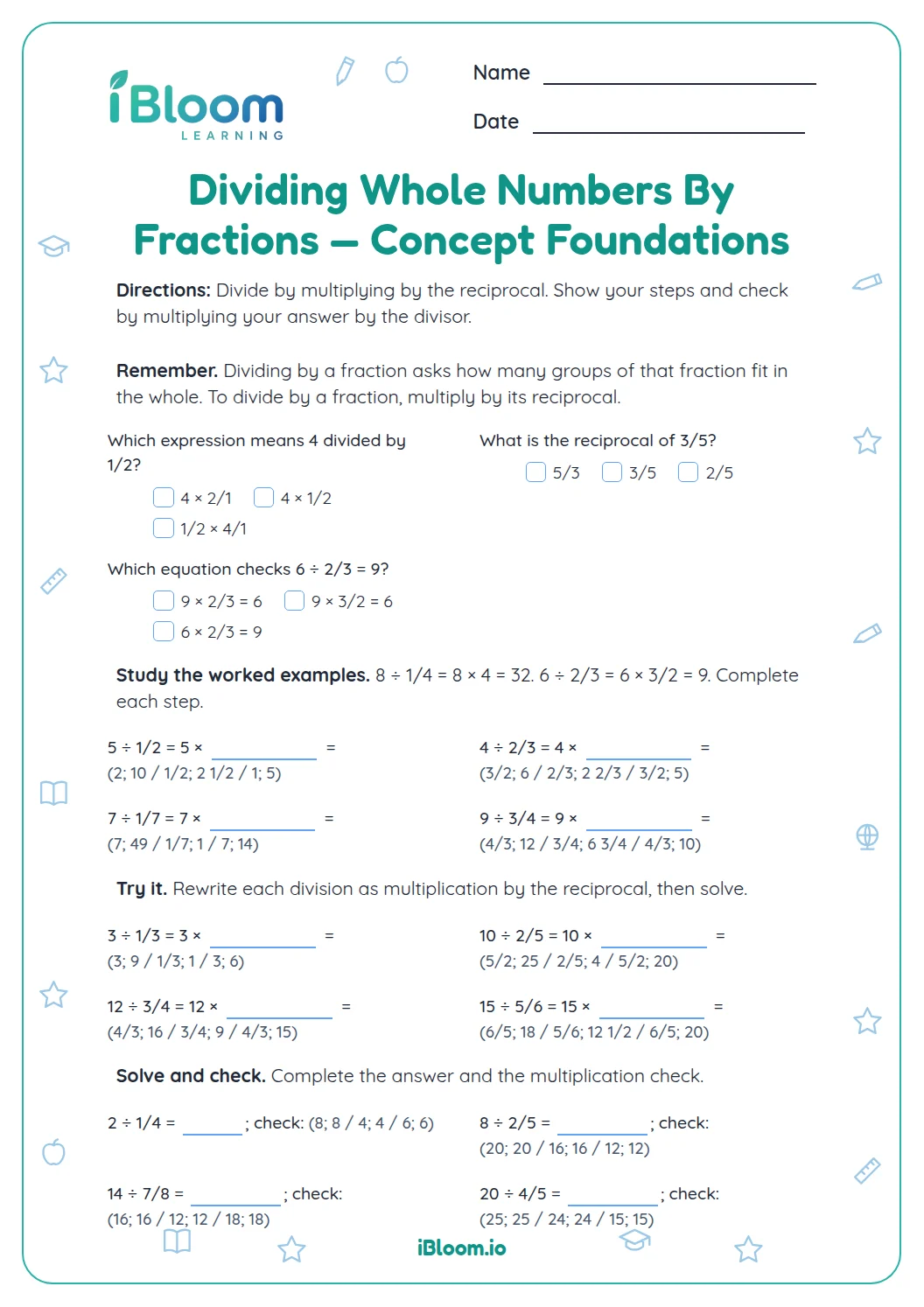
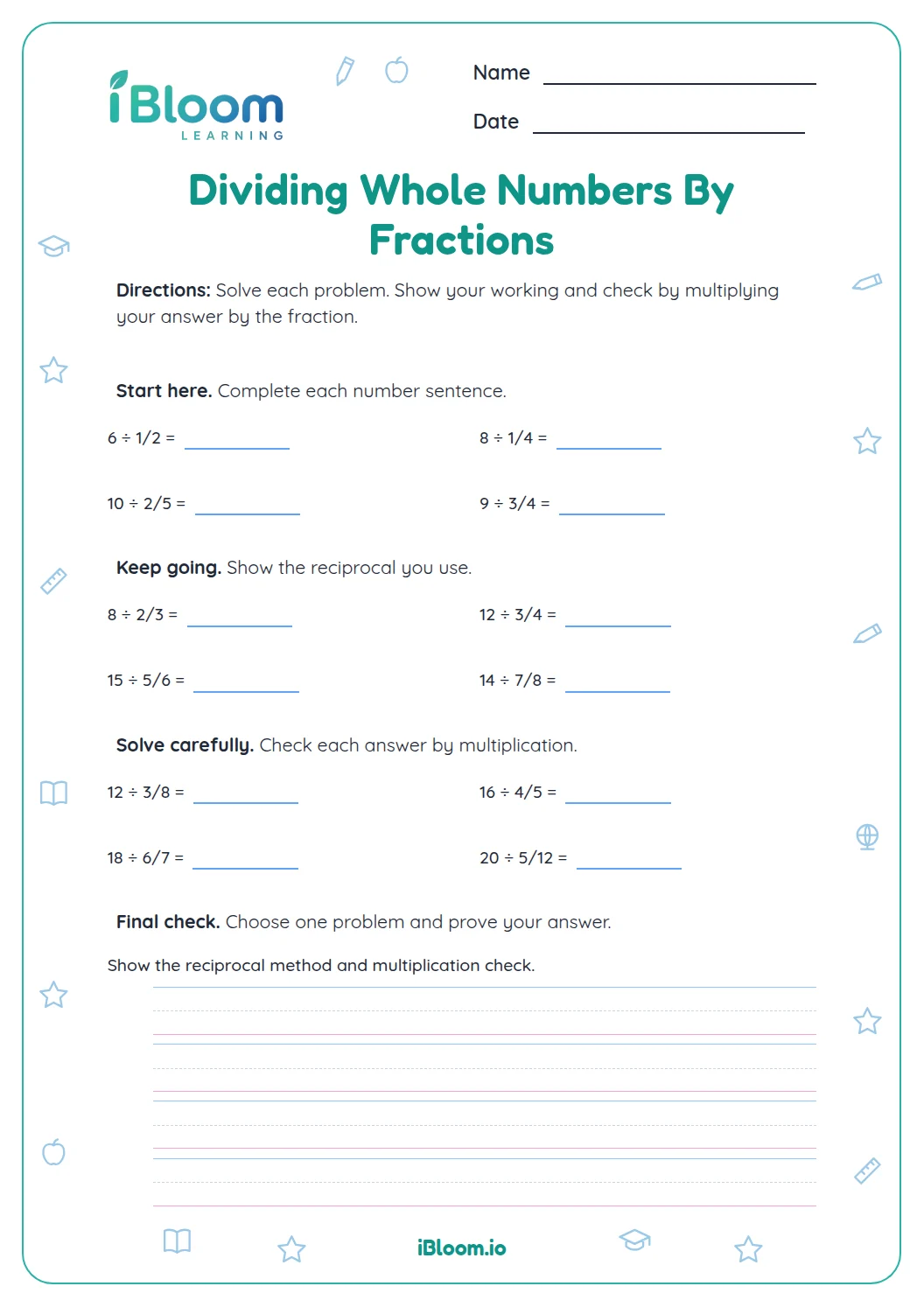
The first eight questions include a visual model. Six use fraction bars, and two use number lines for measurement stories about ribbon and juice. The last four questions ask students to complete equivalent multiplication equations with reciprocals, connecting the grouping work to a calculation rule.
Why can the quotient be greater than the starting number?
Each divisor on this sheet is less than one, so more than one group fits in each whole. For example, two halves fit in one whole and four halves fit in two wholes. Thus 2 ÷ 1/2 equals 4, which counts groups rather than the total length.
Why is 2 ÷ 3/4 equal to 2 2/3?
Two full groups of 3/4 use six of the eight fourths in 2. The remaining two fourths make two thirds of another three-fourth group. That gives 2 2/3 groups altogether. Multiply 2 2/3 by 3/4 to check that the groups combine to make 2.
Should students use the reciprocal rule here?
Yes. Part C asks students to write the reciprocal in four multiplication equations. Complete the models first, then connect the methods: the bars for 3 ÷ 3/4 contain four groups, while 3 × 4/3 also gives 4. The divisor changes to its reciprocal; the starting whole number stays unchanged.
How should students answer the word problems?
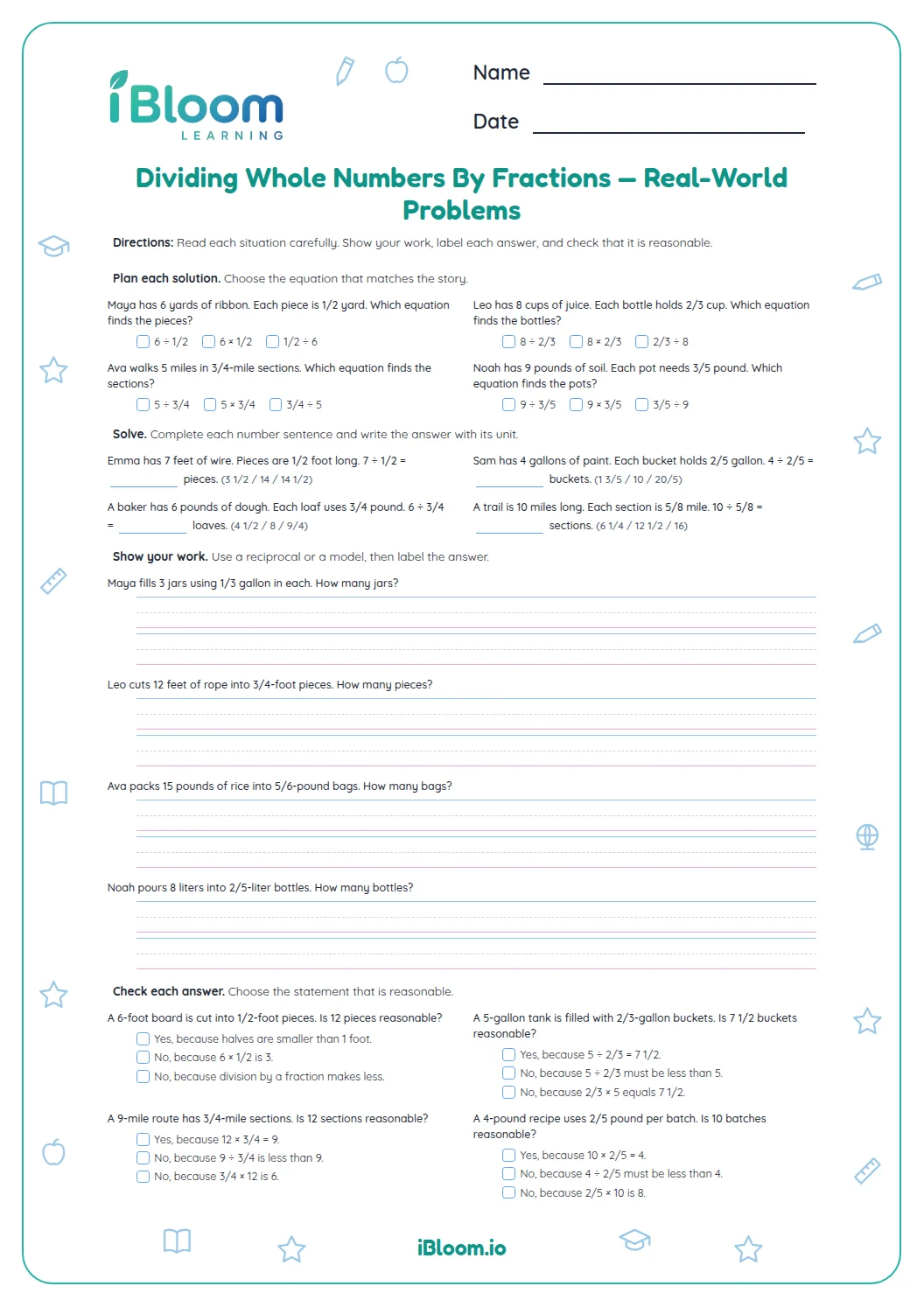
Students should write the number of pieces or servings in each blank. The ribbon story gives 3 ÷ 1/2 = 6 pieces. The juice story gives 4 ÷ 2/3 = 6 servings. Ask students to mark the groups on each number line and explain their count aloud.