






About this worksheet
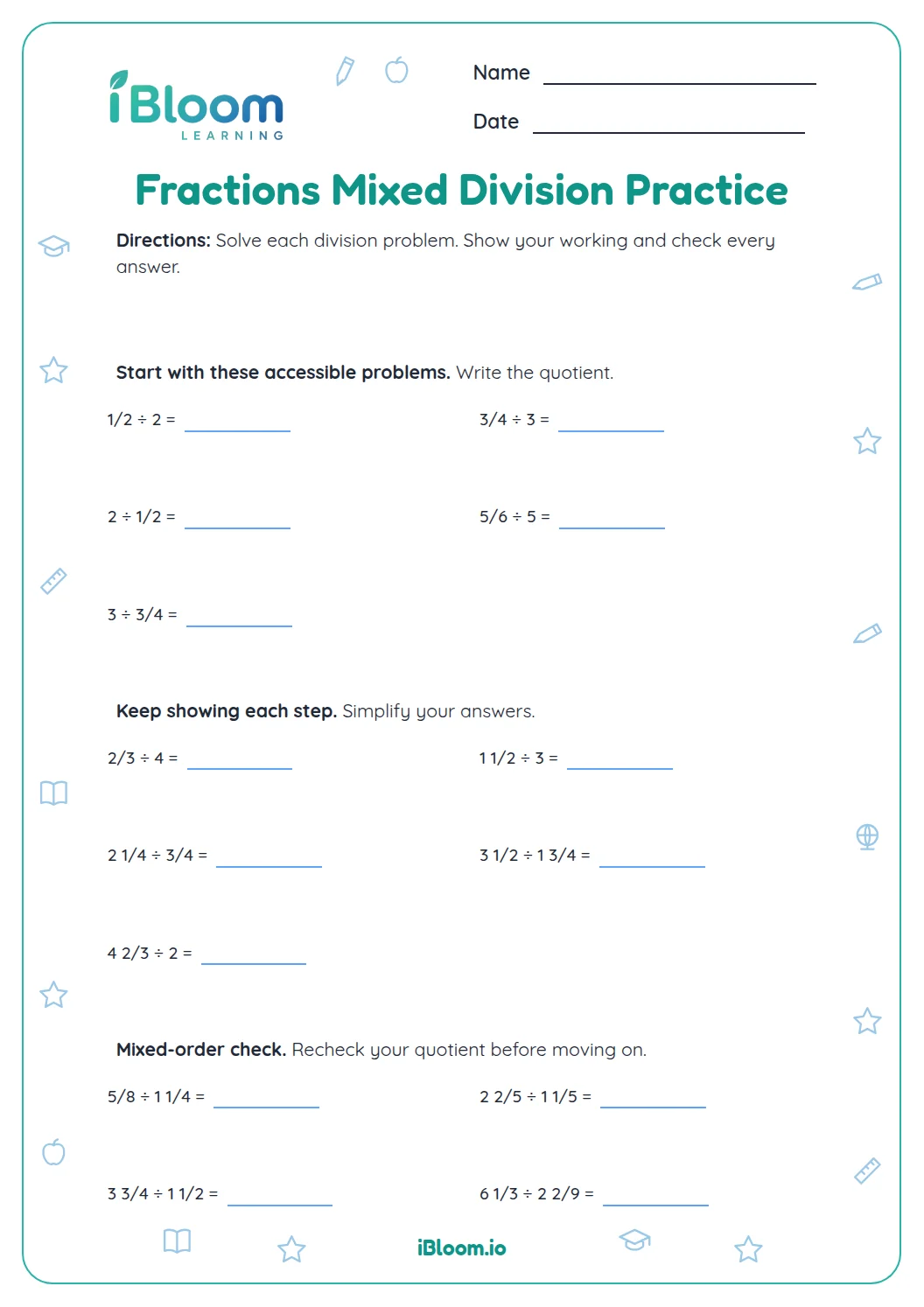
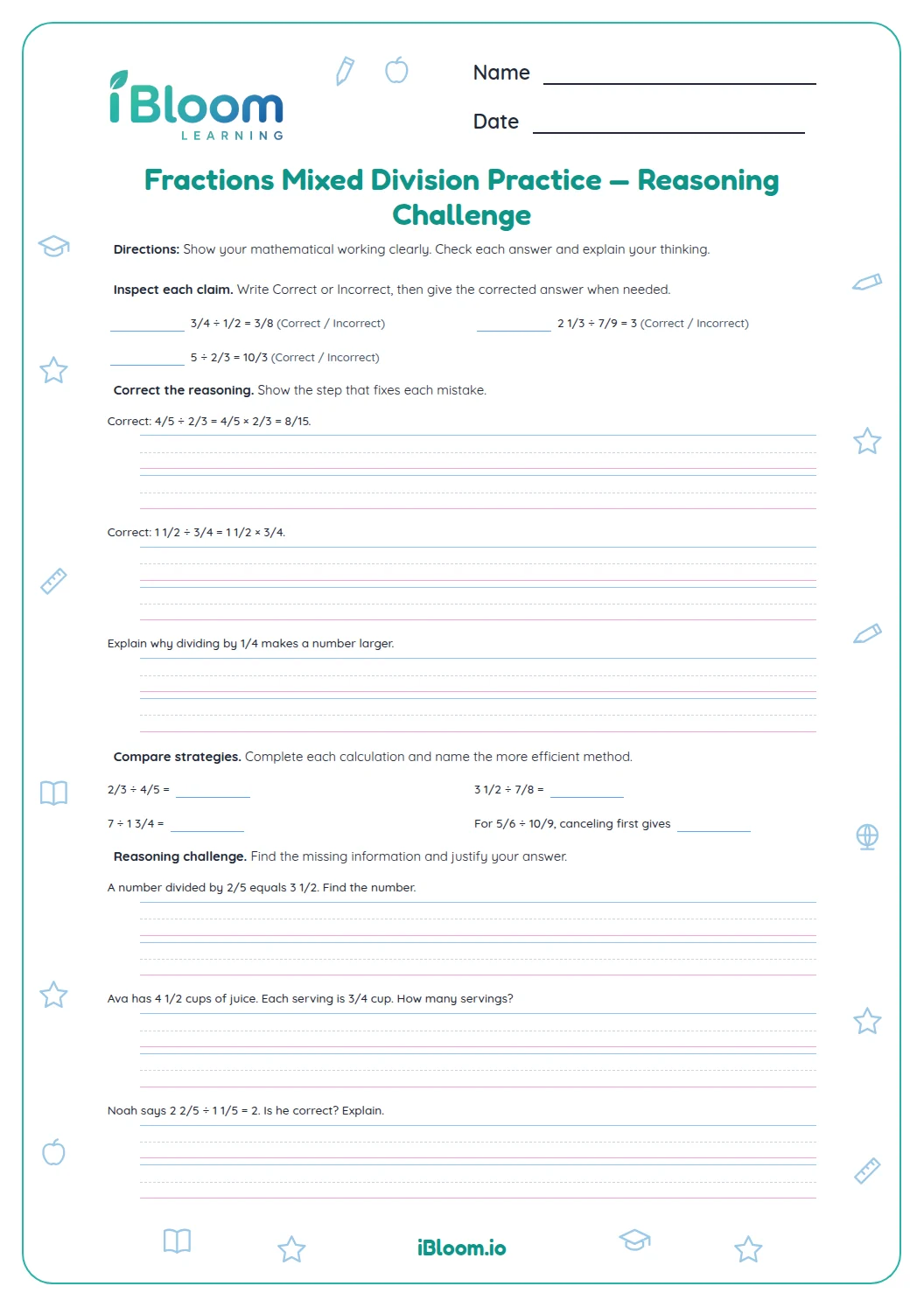
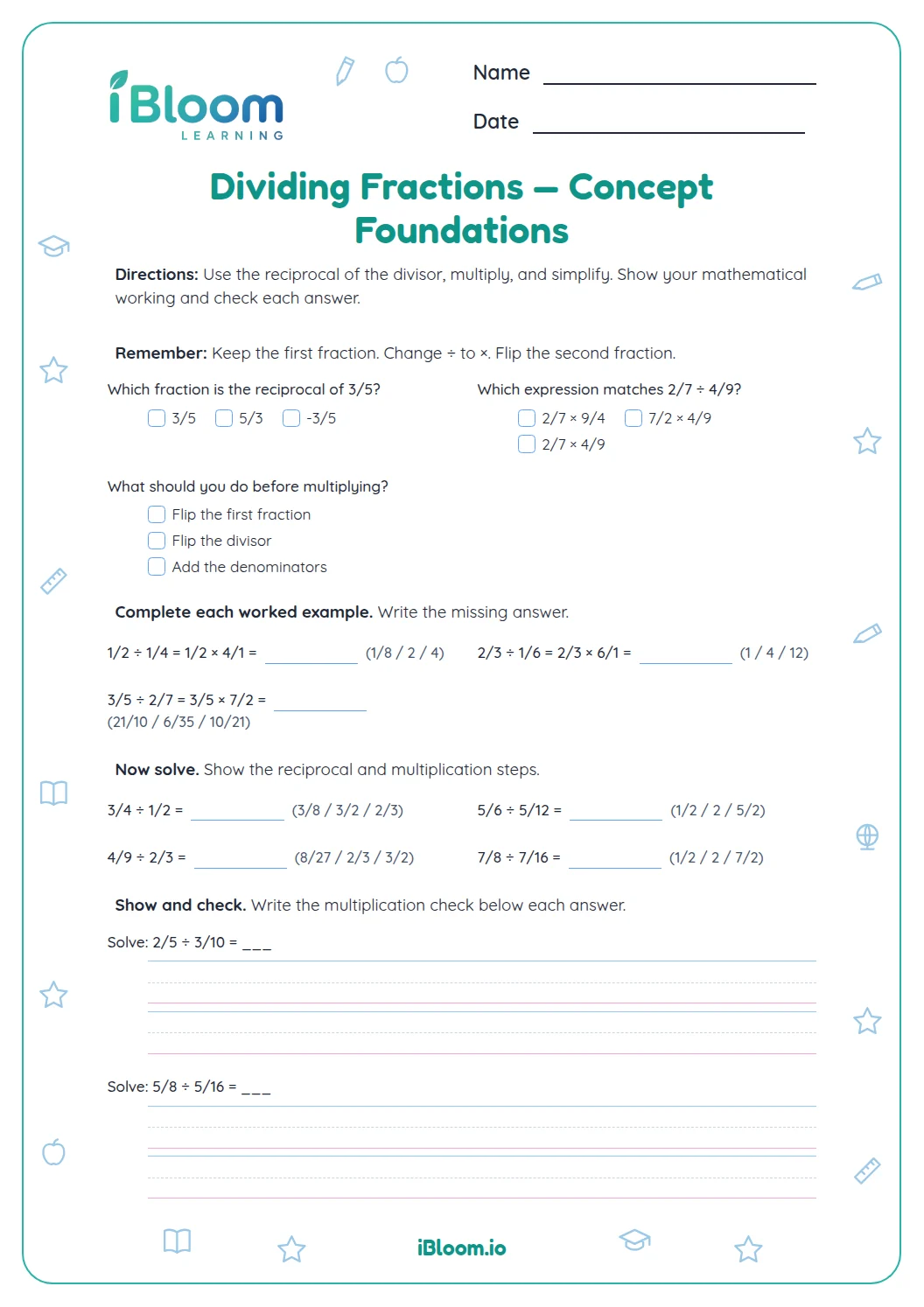
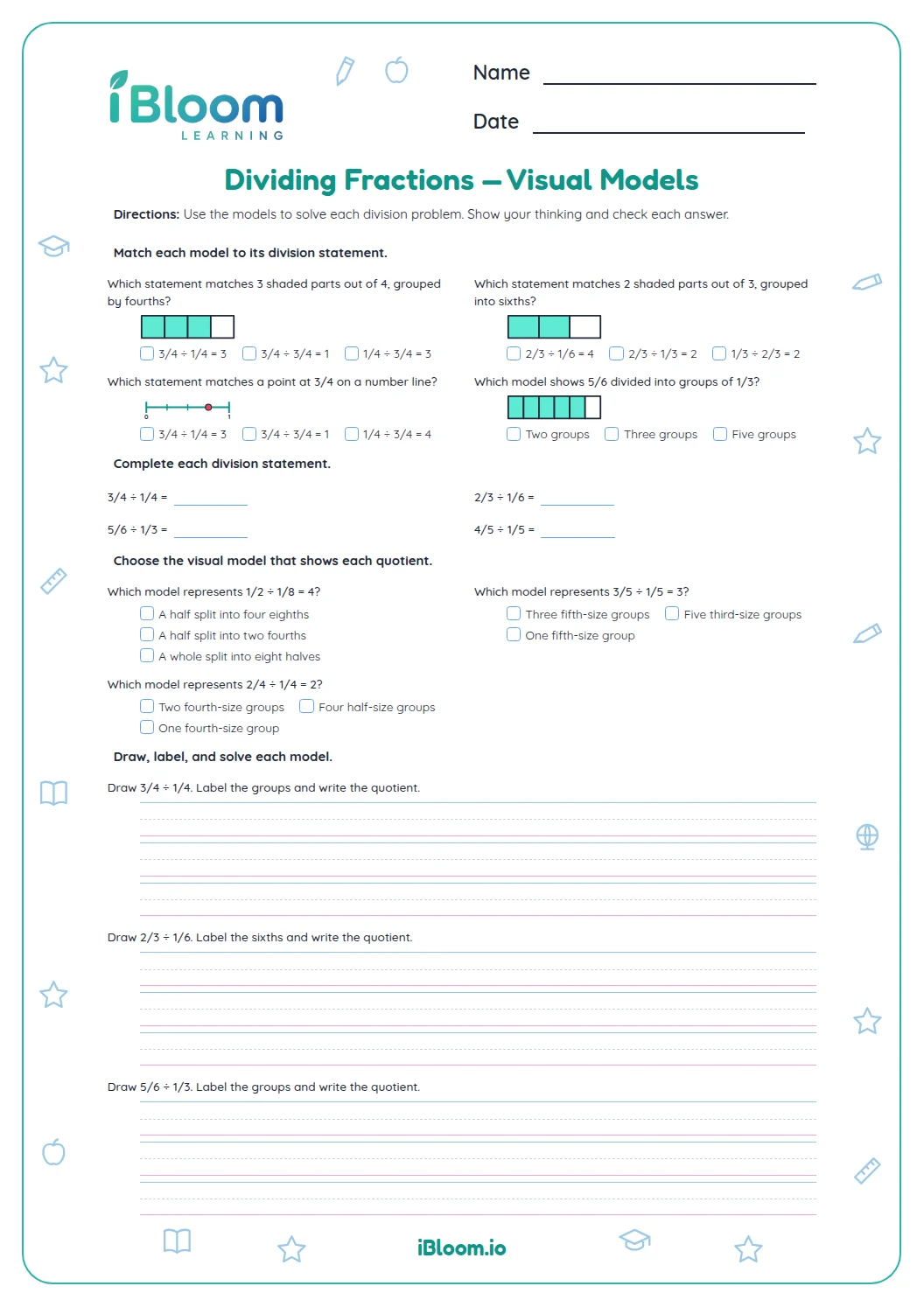
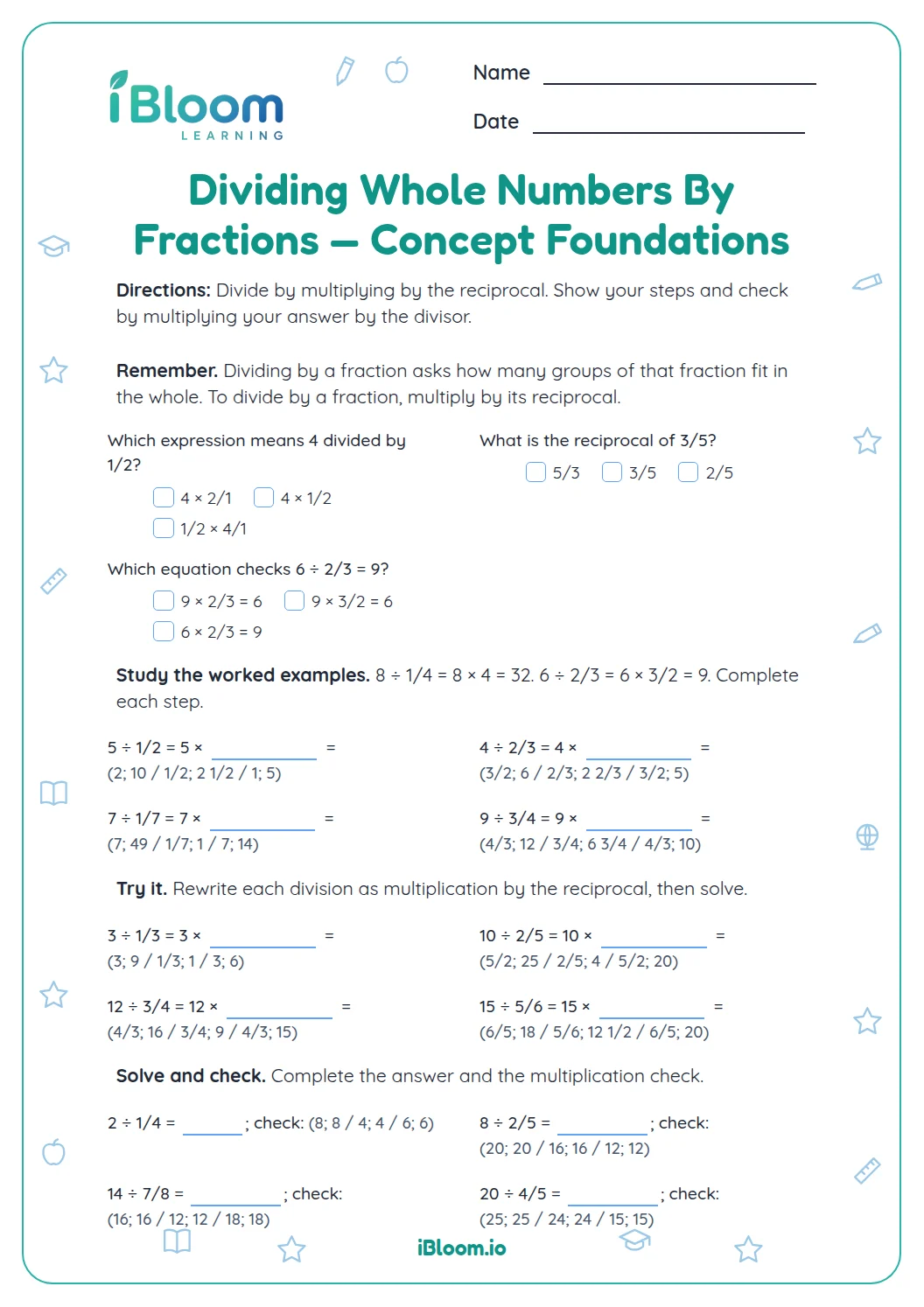
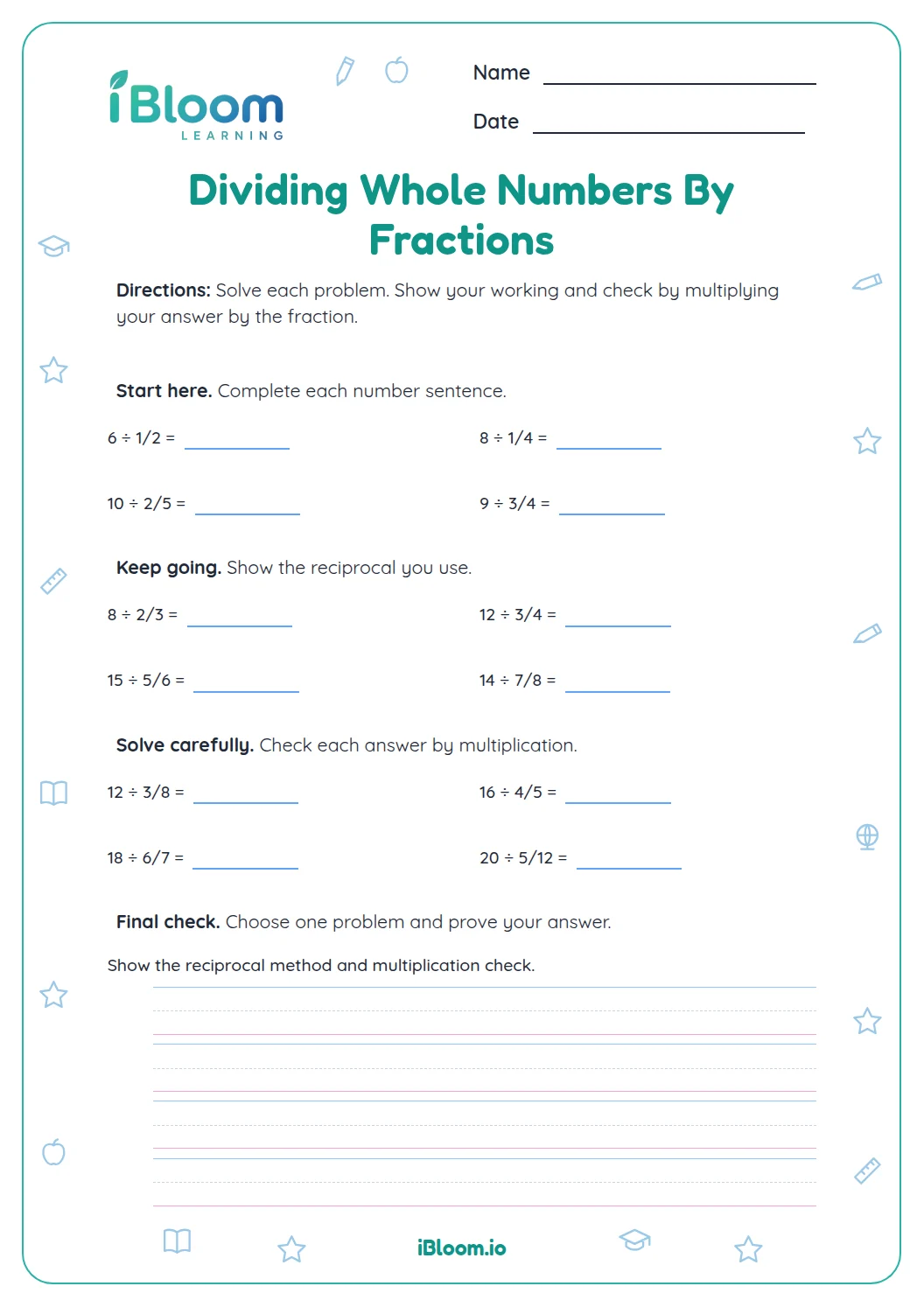
This Grade 6 worksheet builds from fraction quotients to real situations and explanations. Students solve five division expressions, write equations for five sharing or measurement problems, and explain five ideas using multiplication. Questions use familiar denominators and ask students to simplify. The answer key includes concise models for open responses. The page aligns with Common Core 6.NS.A.1, which asks students to interpret and compute fraction quotients and solve related word problems.
Aligned to 6.NS.A.1
What does a fraction quotient tell us?
Division can ask how many groups of a given size fit in an amount, or how much each group receives. The first five items ask students to calculate and simplify quotients, including answers greater than one.
- 13/4 ÷ 1/2 = 1 1/2
- 2Check: 1/2 × 1 1/2 = 3/4.
How do word problems show fraction division?
A fixed piece size suggests measuring how many pieces fit in the total. A fixed number of people sharing an amount suggests dividing into equal groups. Writing an equation makes the relationship clear before calculating.
How can multiplication check a quotient?
If a ÷ b = c, then b × c should equal a. This relationship helps catch an inverted fraction or incorrect simplification. The final part asks students to explain the connection and correct a common mix-up.
How to use this worksheet
- 1Identify the dividend and divisor in each expression.
- 2Ask how many divisor-sized groups fit the amount.
- 3For each story, write a division equation first.
- 4Simplify the quotient when possible.
- 5Check by multiplying divisor by quotient.
Common mistakes and quick fixes
The mistake
Multiplying the fractions instead of dividing.
The fix
Ask what the quotient means, then check divisor × quotient = dividend.
The mistake
Assuming a quotient must be below one.
The fix
Compare the dividend and divisor; several groups may fit in the amount.
The mistake
Simplifying only one part of a fraction.
The fix
Reduce numerator and denominator by the same factor, then verify.
Common Core alignment
The page interprets and computes fraction quotients and applies division to measurement and sharing.
Interpret and calculate fraction quotients, then check them with multiplication.
On this sheet: Students compute fraction quotients and solve sharing and measurement problems.
Show the official wordingHide the official wording
Interpret and compute quotients of fractions, and solve word problems involving division of fractions by fractions, e.g., by using visual fraction models and equations to represent the problem. For example, create a story context for (2/3) ÷ (3/4) and use a visual fraction model to show the quotient; use the relationship between multiplication and division to explain that (2/3) ÷ (3/4) = 8/9 because 3/4 of 8/9 is 2/3. (In general, (a/b) ÷ (c/d) = ad/bc.) How much chocolate will each person get if 3 people share 1/2 lb of chocolate equally? How many 3/4-cup servings are in 2/3 of a cup of yogurt? How wide is a rectangular strip of land with length 3/4 mi and area 1/2 square mi?.
What to practice next
Make more practice
Further reading
Questions parents and teachers ask
What does 3/4 ÷ 1/2 mean?
It asks how many groups of one-half fit in three-fourths, or what number multiplied by one-half gives three-fourths. The answer is one and one-half. The check is 1/2 × 1 1/2 = 3/4, connecting the quotient to the original amount.
Why are some answers greater than one?
A quotient can exceed one when the dividend is larger than the divisor. One-half fits into three-fourths one and one-half times. The result counts groups or shares and does not have to be a fraction below one, as students can verify by multiplying the quotient by the divisor.
How should students start a word problem?
Identify the total amount and the size of each group or piece. Write a division equation with the total as the dividend and the group size as the divisor. Solve, then check that multiplying the group size by the number of groups returns the total.
Why does the key include sample explanations?
Some questions ask students to explain a relationship or create a story, so wording can vary. The key shows one accurate response and the main idea to look for. Accept another explanation when its math is correct and it addresses the prompt.
What is a useful check for fraction division?
Multiply the divisor by the quotient. The product should equal the dividend. For example, 4/5 × 5/6 simplifies to 2/3, so it checks 2/3 ÷ 4/5 = 5/6. This check can reveal an inverted fraction or simplification error and works for each problem on the page.
What practice can follow this page?
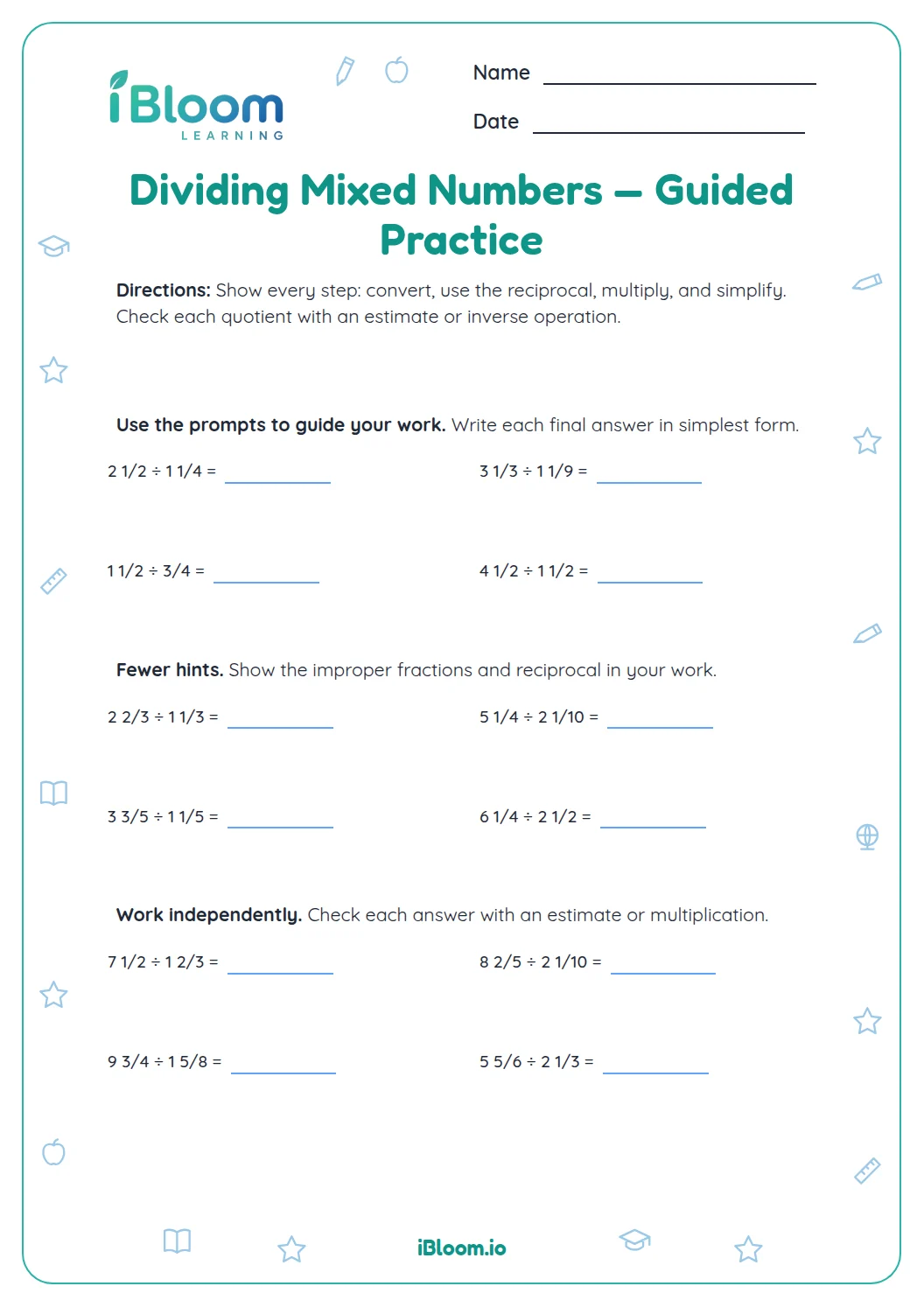
Students can move to division with whole numbers and fractions, then to mixed numbers. The linked pages keep the idea of interpreting a quotient while changing the values involved. Fraction and division generators can also make more review problems.