






About this worksheet
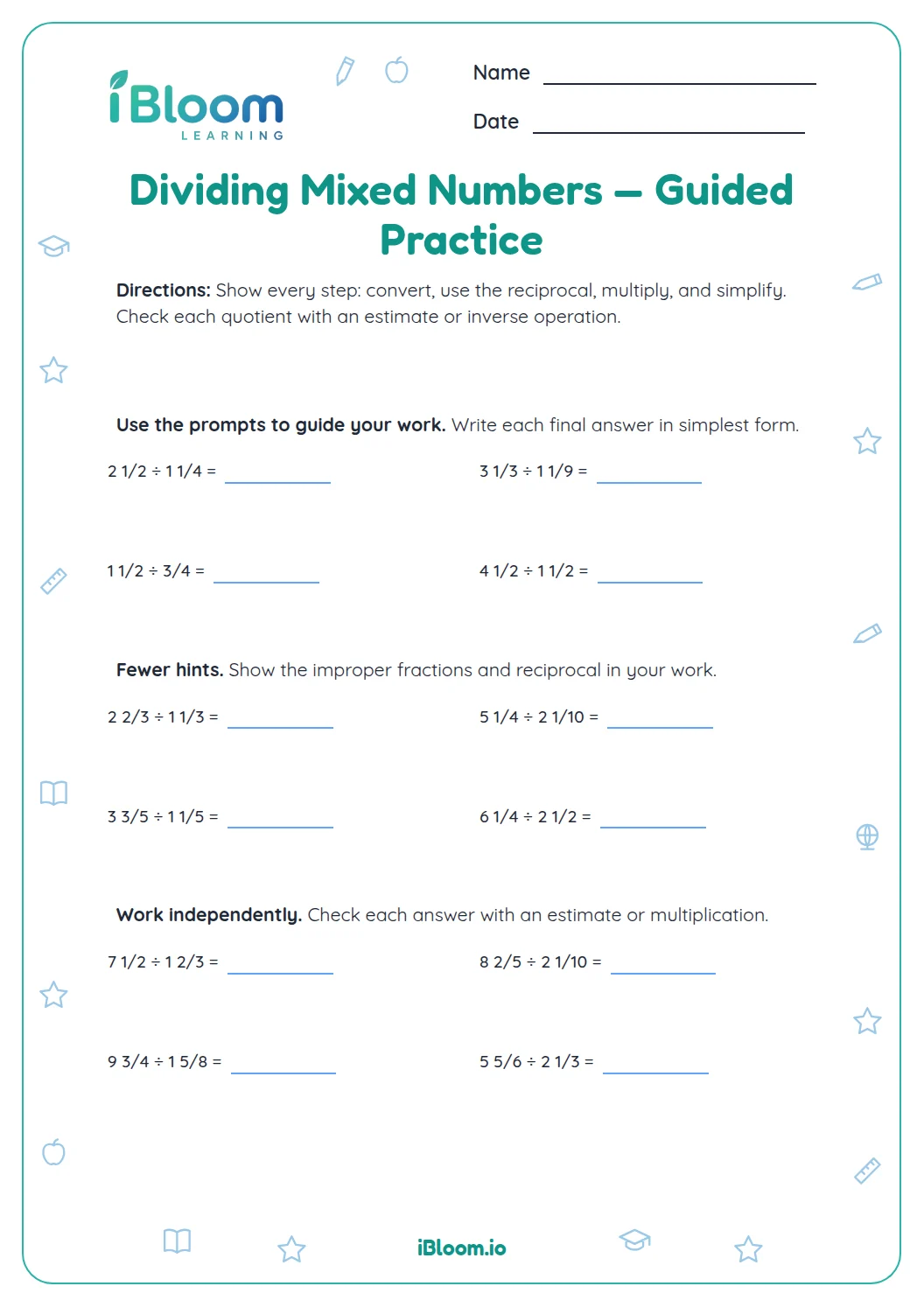
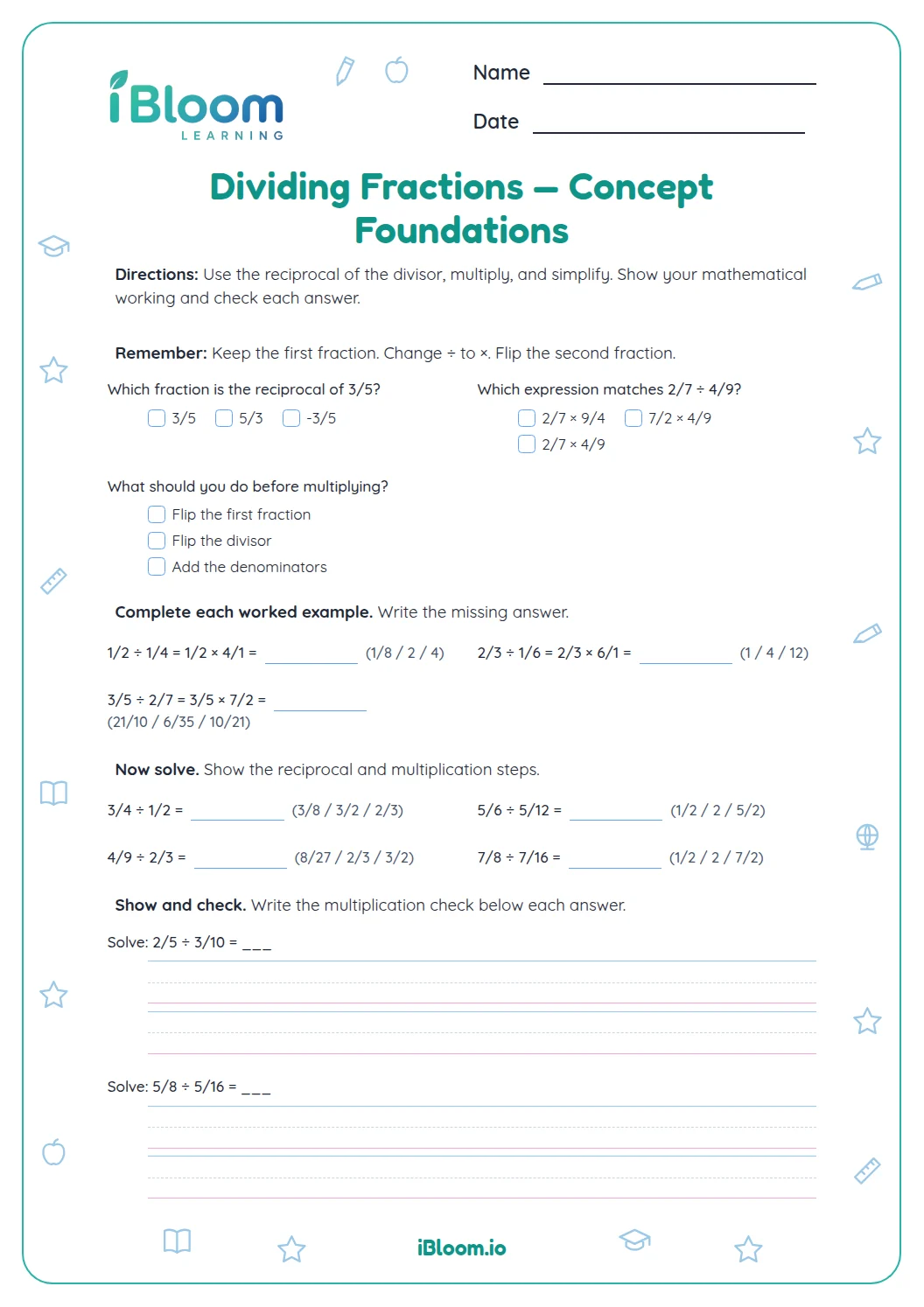
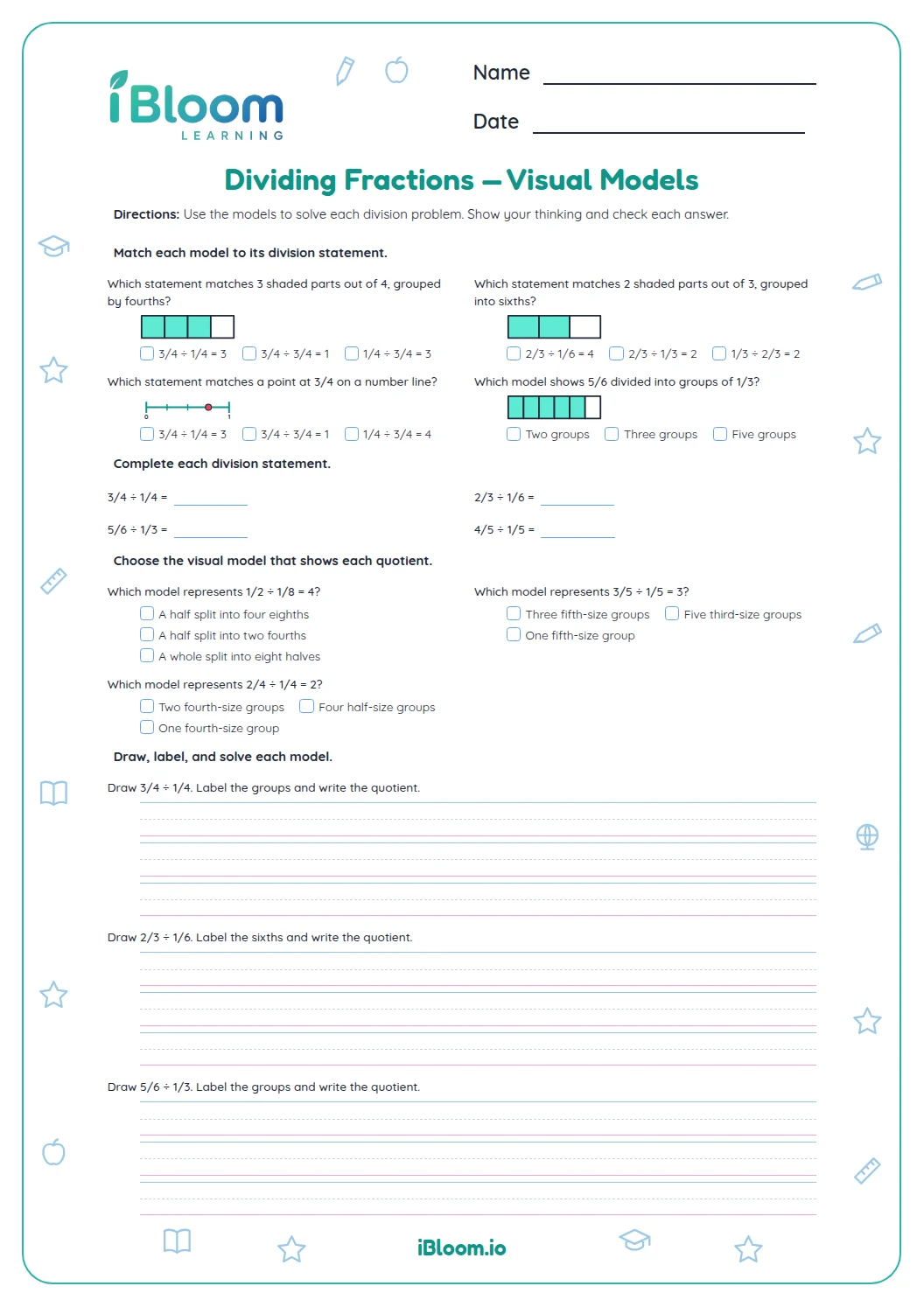
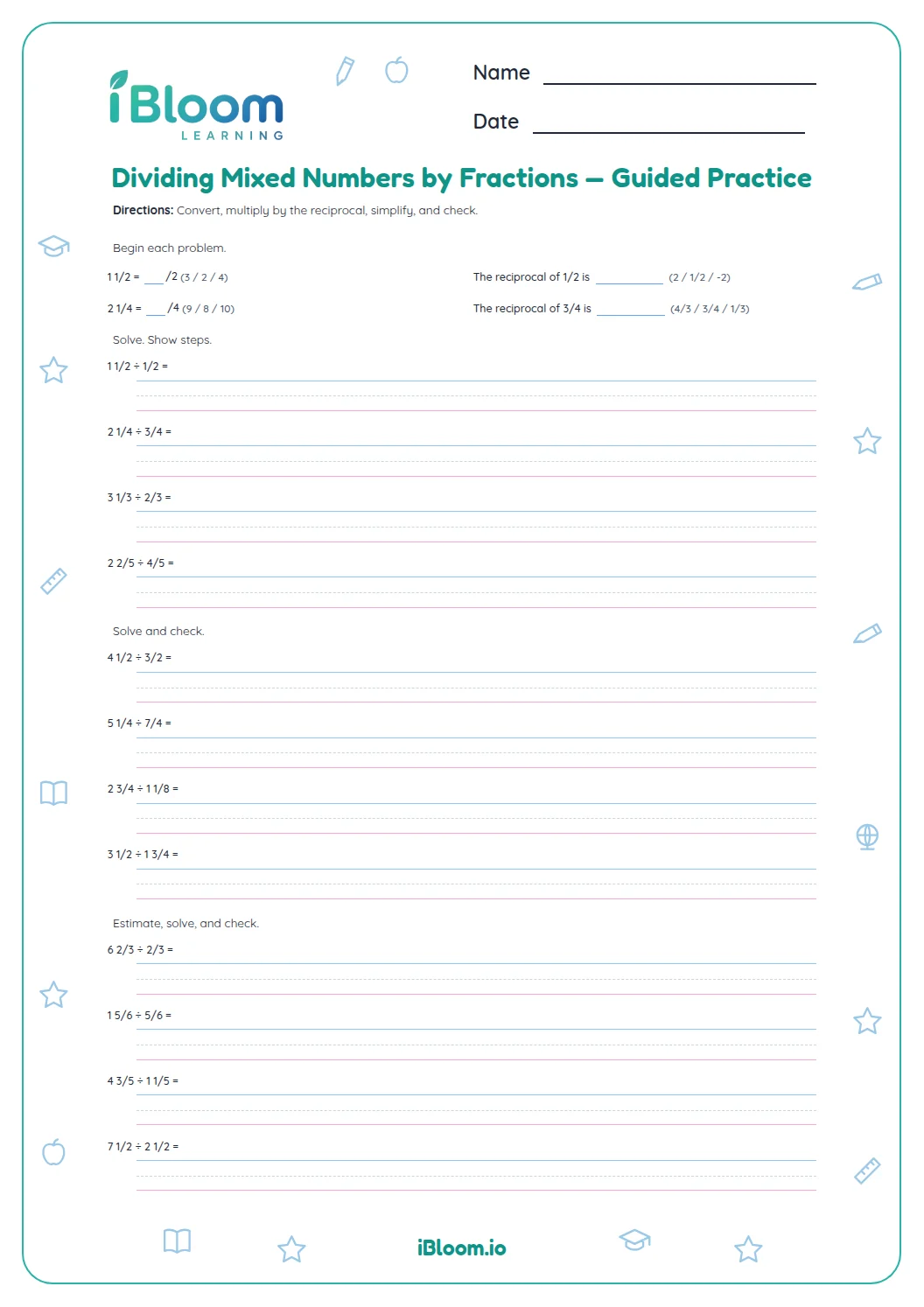
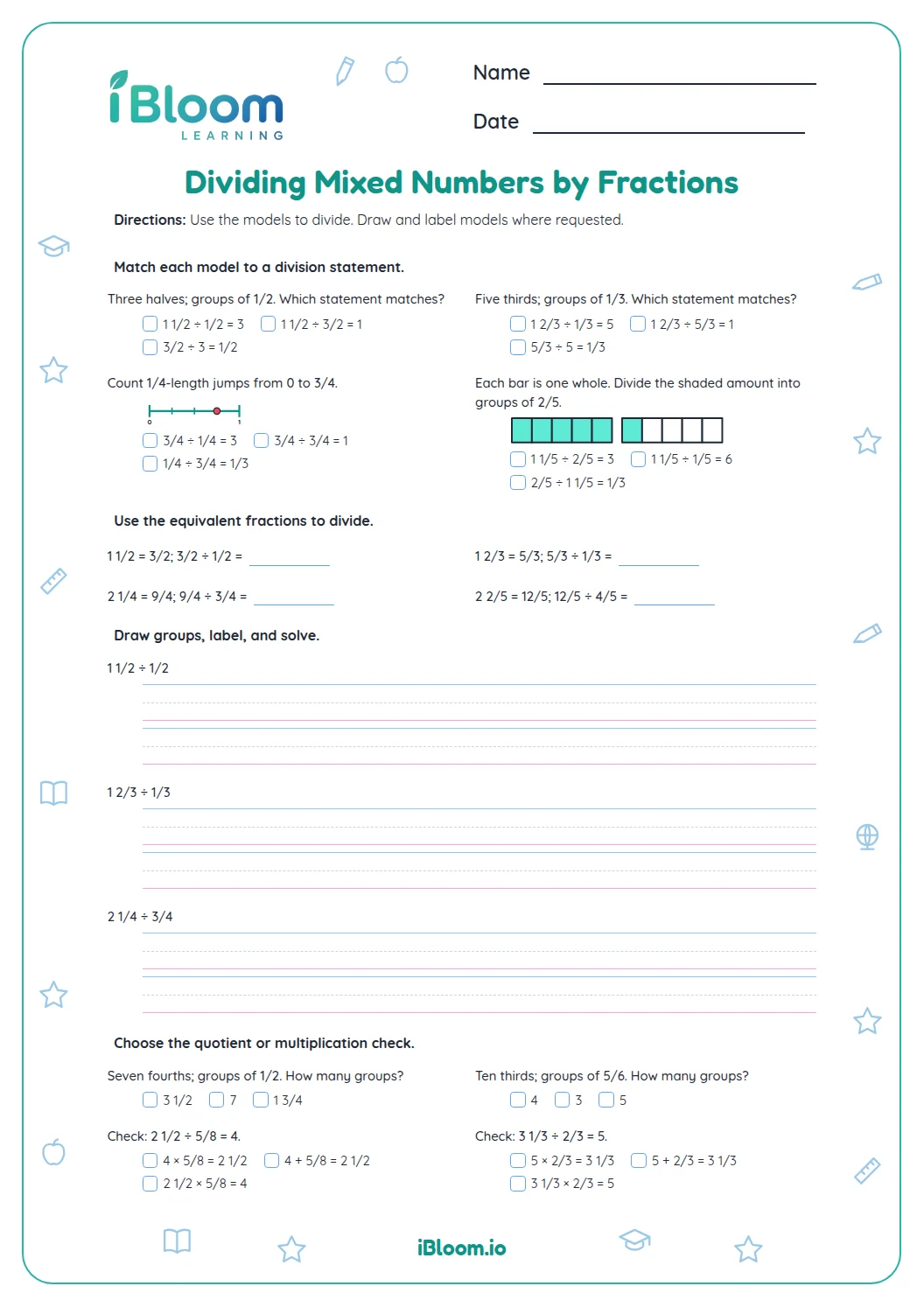
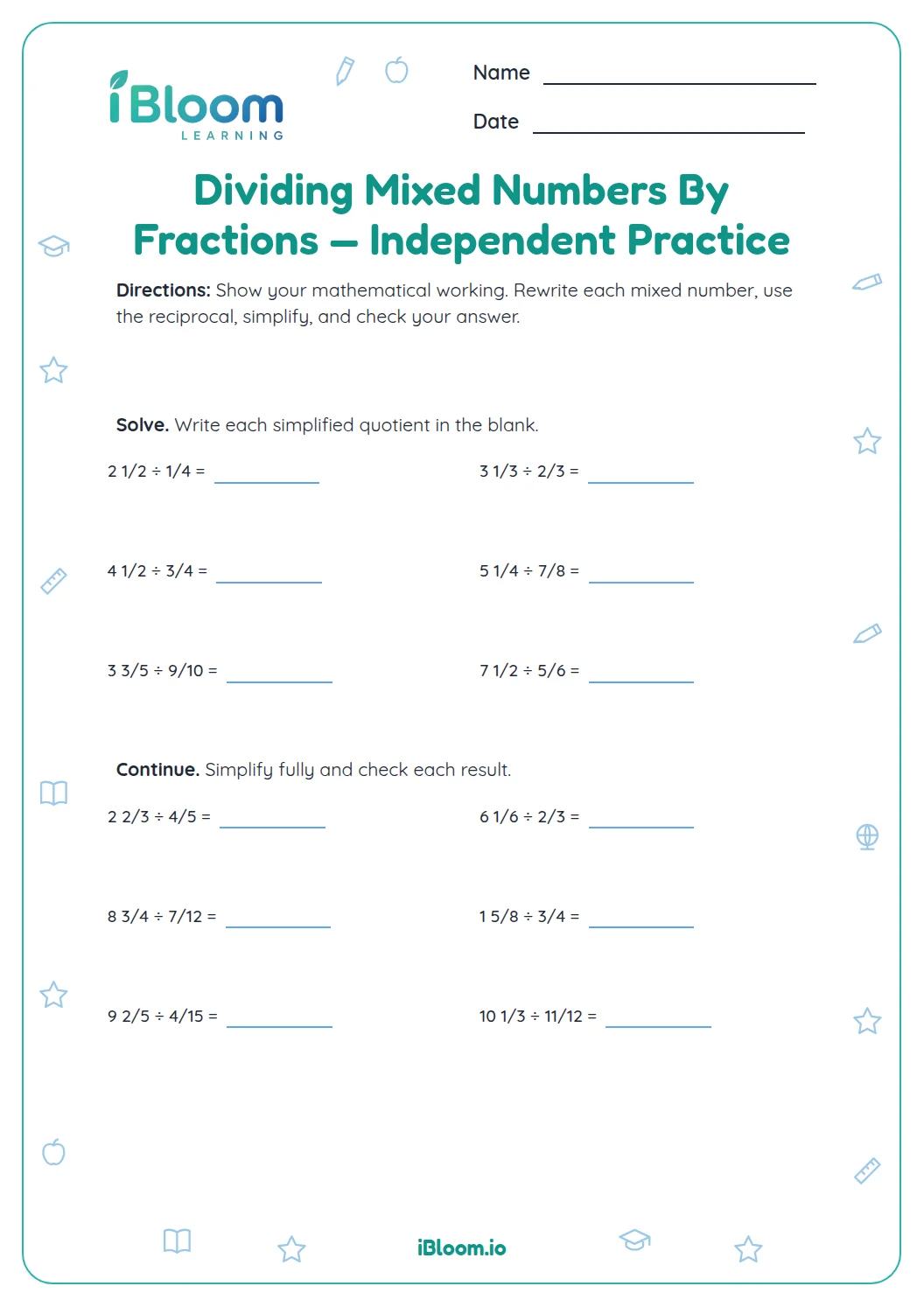
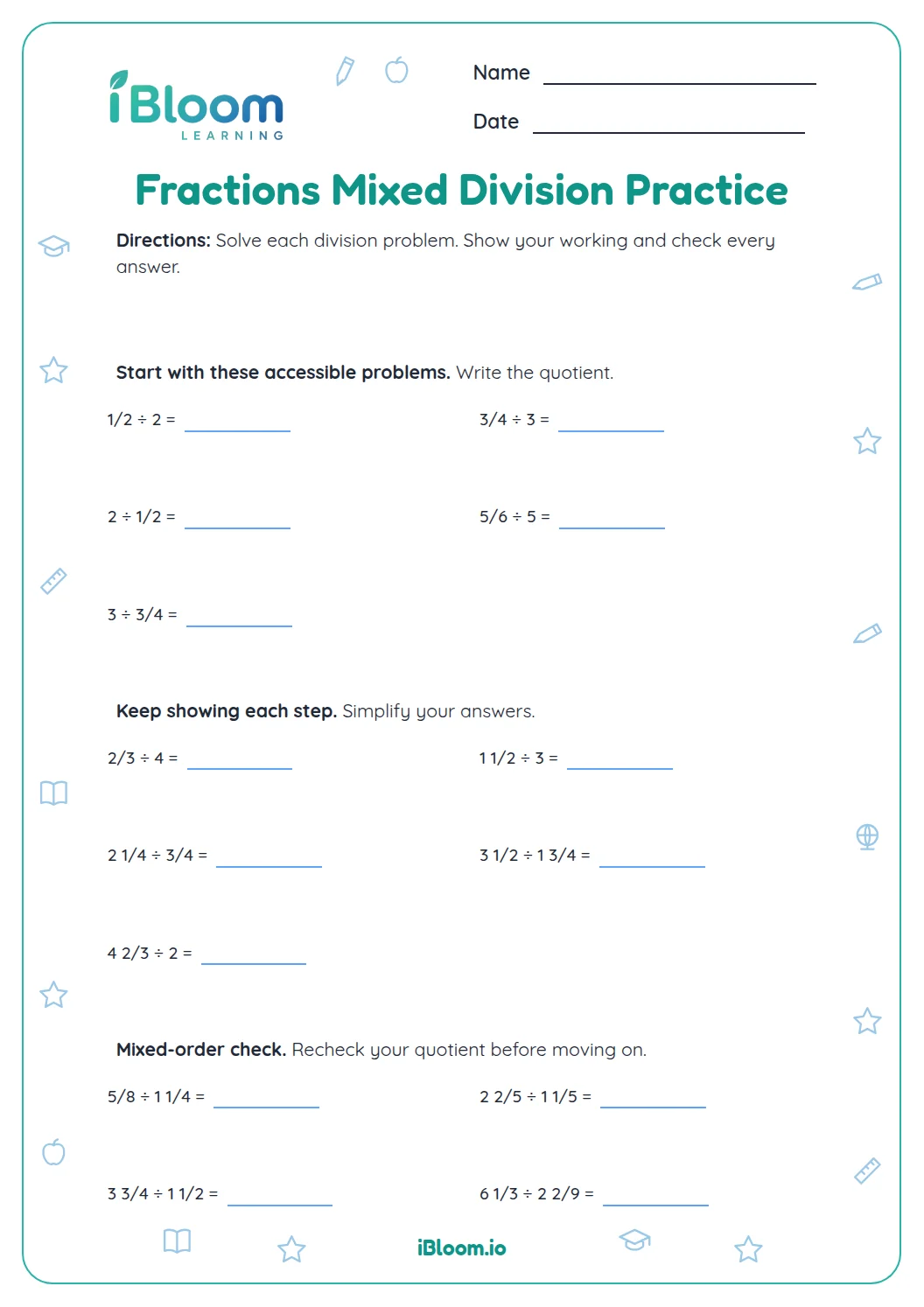
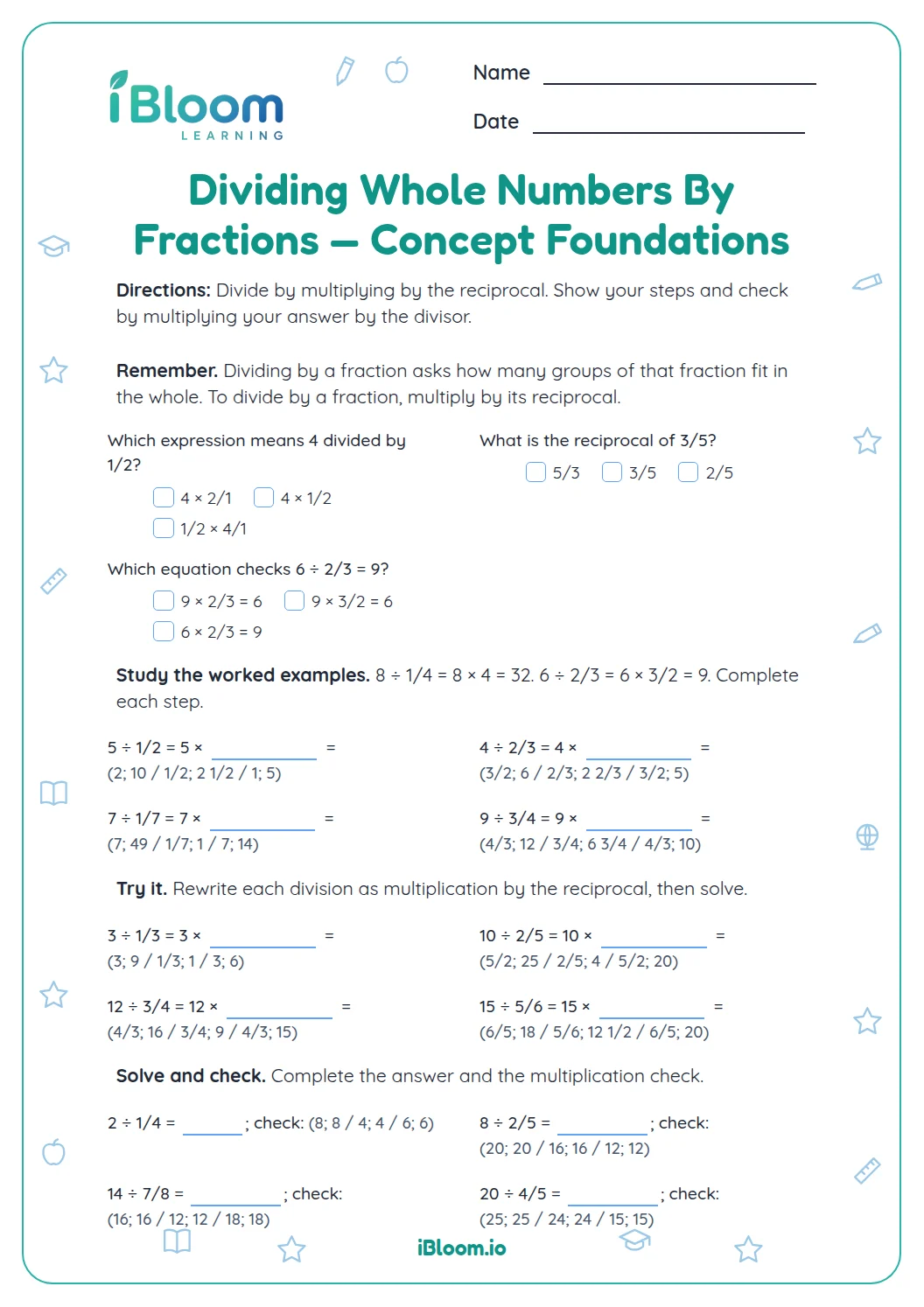
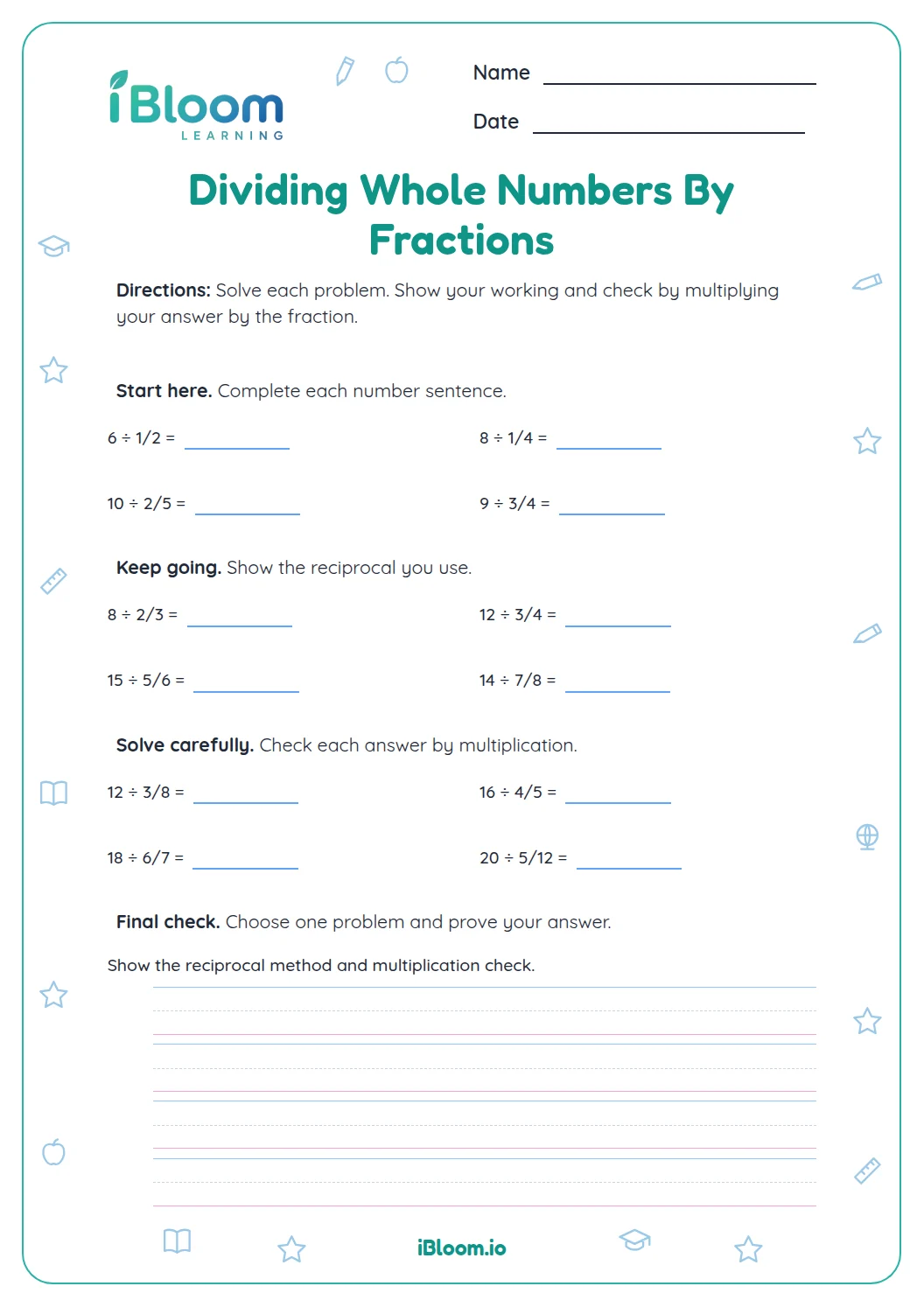
This Grade 6 printable focuses on dividing mixed numbers and fractions with visual fraction bars. Learners consider how many divisor-sized groups fit into each shaded amount, then calculate to check the quotient. The 16 problems target fraction-division reasoning with visual models and equations, and a separate answer key supports review.
Aligned to 6.NS.A.1
How does a model show the number of groups?
A division quotient answers “how many groups of this size fit?” The bar shows the dividend as equal fractional pieces. Compare those pieces with the divisor to count complete groups. If the pieces do not line up directly, rename the mixed number with an equivalent fraction.
- 11 1/2 ÷ 3/4
- 21 1/2 = 6/4
- 36 fourths ÷ 3 fourths = 2 groups
- 4Answer: 2
How can equivalent fractions check a quotient?
Rename a mixed number as an improper fraction, then multiply by the reciprocal of the divisor. For 2 1/4 ÷ 3/4, rewrite 2 1/4 as 9/4. Then 9/4 × 4/3 = 3. Check that three groups of 3/4 total 9/4.
What does this visual practice include?
The 16 questions pair each quotient with a model of the starting quantity. The model supports the reasoning; the written calculation provides a second way to verify the result.
- Part A: use shaded bars to reason about mixed-number quotients
- Each prompt asks for one quotient
- The answer key lists all 14 results
How to use this worksheet
- 1Name the dividend and divisor in each prompt.
- 2Read the whole and fractional parts in the bar.
- 3Think how many divisor-sized groups fit.
- 4Use equivalent fractions to compute the quotient.
- 5Check by multiplying the quotient by the divisor.
Common mistakes and quick fixes
The mistake
Dividing only the whole-number parts.
The fix
Rename the entire mixed number as an improper fraction.
The mistake
Assuming division always makes a smaller number.
The fix
Ask how many fractional groups fit in the starting amount.
The mistake
Forgetting to check the quotient.
The fix
Multiply the quotient by the divisor and compare with the dividend.
Common Core alignment
These visual models support computing fraction quotients.
Interpret and compute quotients of fractions using models and equations.
On this sheet: Each problem pairs a shaded fraction bar with division by a fractional divisor.
Show the official wordingHide the official wording
Interpret and compute quotients of fractions, and solve word problems involving division of fractions by fractions, e.g., by using visual fraction models and equations to represent the problem.
What to practice next
Make more practice
Further reading
Questions parents and teachers ask
How does the fraction bar help with division?
The shaded bar makes the dividend visible as equal parts and any complete wholes. Compare the shaded amount with the size of one divisor group to determine how many groups fit. Then use an equation or equivalent fractions to confirm the quotient.
How many problems are included?
This sheet contains 16 visual-model problems. Each one shows a shaded mixed number or fraction bar and asks for a quotient. The separate answer key gives the quotient for every item. Have the learner explain the choice aloud and point to the matching words or model as a quick check.
What is the answer to 1 1/2 divided by 3/4?
The quotient is 2 because 1 1/2 equals 6/4, and six fourths make two groups of three fourths. The bar’s one whole and one half combine to show six fourths in all. Have the learner explain the choice aloud and point to the matching words or model as a quick check.
Why can a quotient be greater than the starting amount?
A quotient counts how many groups of a given size fit. When the divisor is a fraction smaller than one, several groups may fit into one whole. For example, one and a half contains two groups of three fourths. Have the learner explain the choice aloud and point to the matching words or model as a quick check.
Can learners use equivalent fractions to check?
Yes. Rewrite the mixed number as an improper fraction with a denominator that works with the divisor. For 1 1/2 ÷ 3/4, use 6/4 ÷ 3/4; the numerator ratio 6 ÷ 3 gives two groups. Have the learner explain the choice aloud and point to the matching words or model as a quick check.
Is the answer key included?
Yes. A second printable page lists all 14 quotients. Learners can compare a computed answer with the key after trying to count or partition the groups in each fraction bar. Have the learner explain the choice aloud and point to the matching words or model as a quick check.