




About this worksheet
This free Grade 6 worksheet guides students through dividing whole numbers by fractions. Two number lines establish the meaning of the quotient: how many groups of the given fractional size fit in the total. Four reciprocal blanks lead into five calculations, a multiplication check, and two measurement problems. Students practice Common Core 6.NS.A.1 by connecting visual groups, equations, and contexts. Some quotients are mixed numbers, so the work includes simplifying and interpreting an answer. A separate key gives every result.
Aligned to 6.NS.A.1
What do the number-line spaces mean?
In Part A, each space between neighboring ticks is one group. The first line runs from 0 to 3 in halves, giving six spaces. The second runs from 0 to 4 in groups of two thirds, also giving six spaces.
Count spaces rather than tick marks. The starting tick at zero marks the beginning of the first group; it is not a completed group.
How do students move from groups to reciprocals?
Part B keeps the whole number unchanged and asks for only the fraction that replaces division. Swapping the numerator and denominator gives the reciprocal. Students then use that operation themselves in Part C.
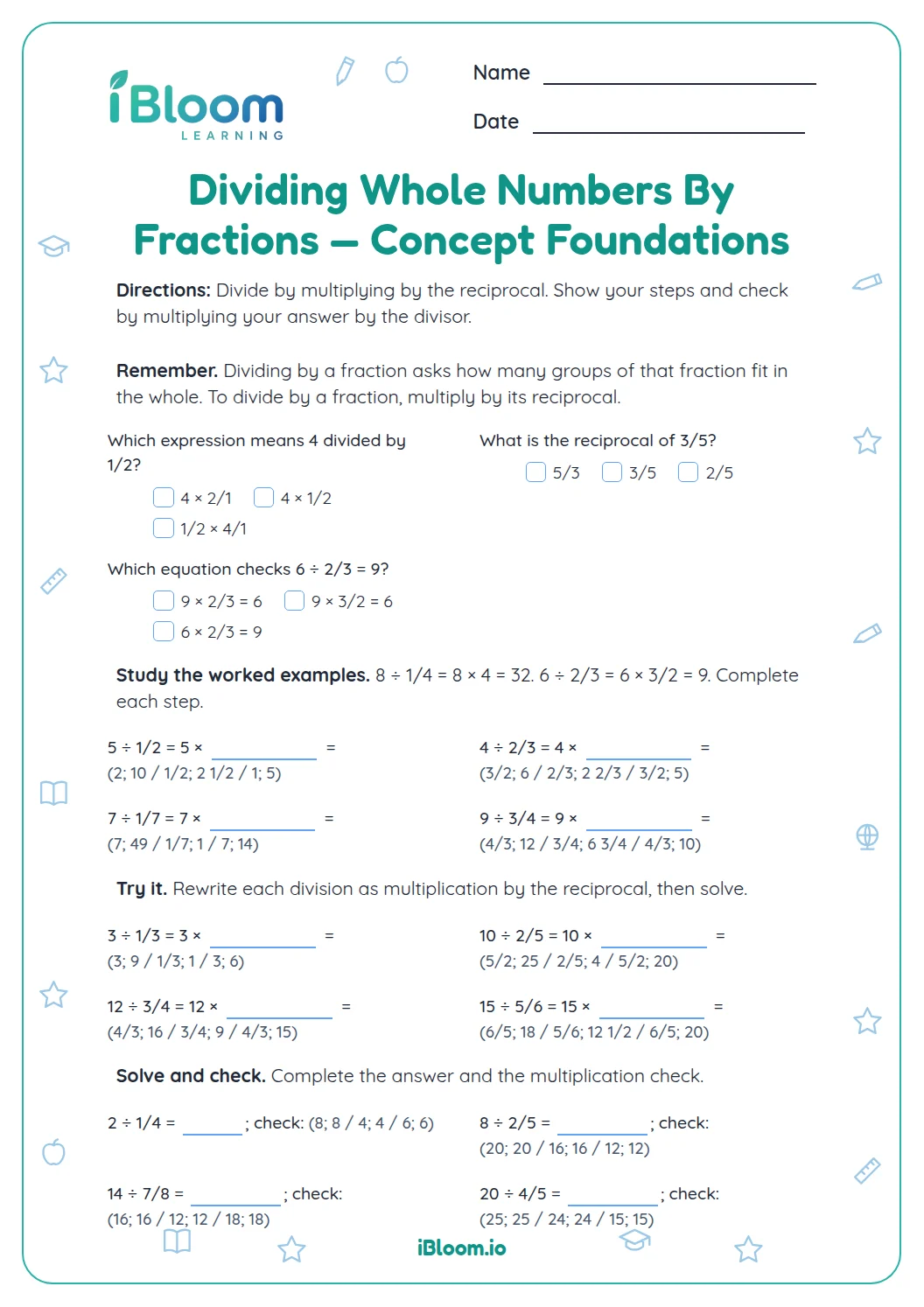
- 1Question 3: 4 ÷ 2/3 = 4 × ___.
- 2The reciprocal of 2/3 is 3/2, so the blank is 3/2.
- 34 × 3/2 = 12/2 = 6, matching the second number line.
How should students interpret a mixed-number quotient?
For 3 ÷ 2/5, the result is 7 1/2. Three wholes contain fifteen fifths, enough for seven groups of two fifths and one fifth left. That last fifth is half of a two-fifths group.
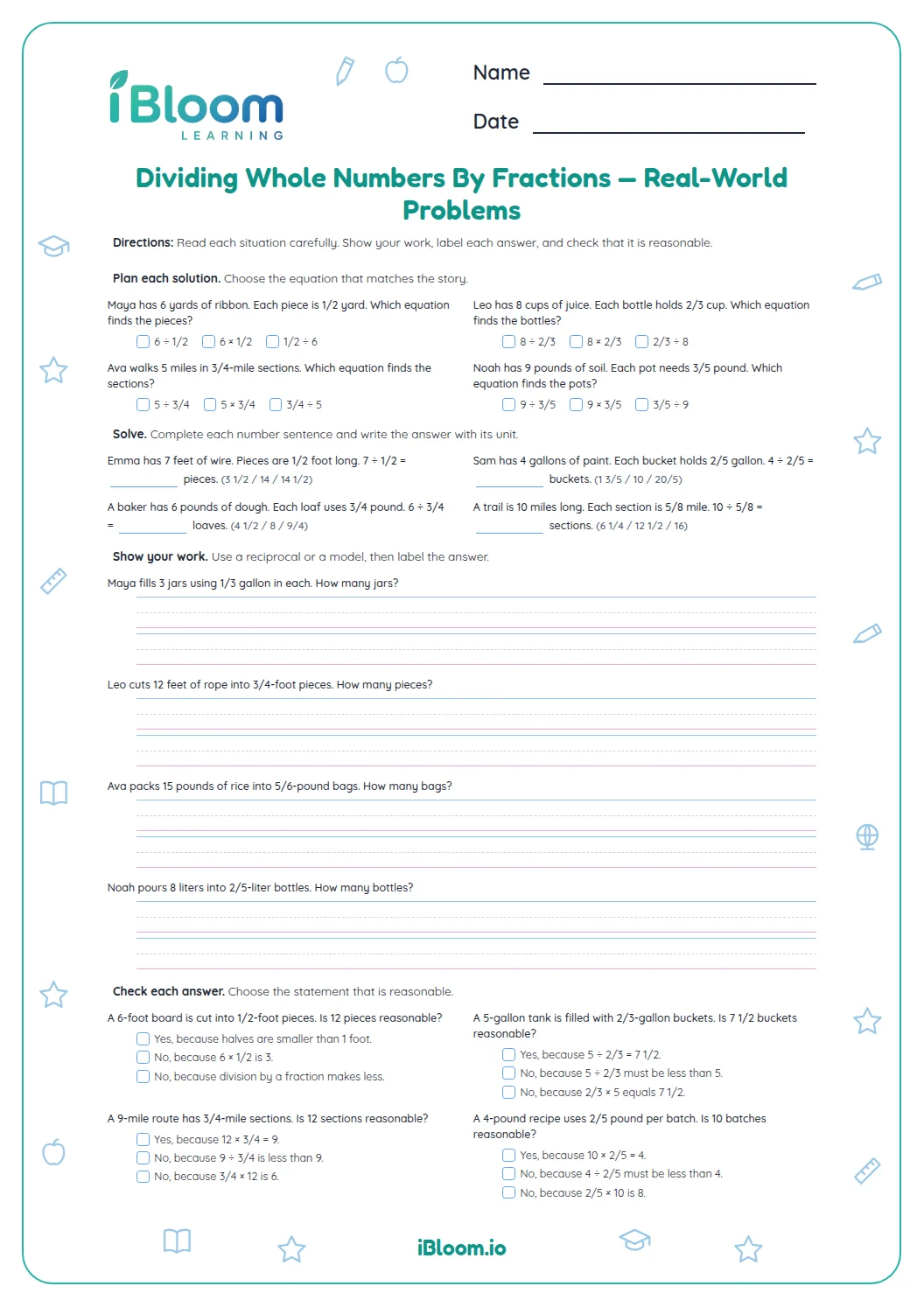
The ribbon and juice problems in Part D have whole-number answers. Students should include pieces or bottles with the result, then multiply the group count by its size to check the original length or volume. Part B also includes a multiplication check for a quotient.
How to use this worksheet
- 1Count the spaces on both number lines and state the size of each jump.
- 2Fill each reciprocal blank in Part B, then use its multiplication check.
- 3Rewrite each Part C division as multiplication before calculating.
- 4Simplify improper fractions and write mixed-number answers when needed.
- 5For each Part D problem, identify the total, group size, and requested unit.
- 6Multiply the quotient by the divisor to check that the product is the starting whole number.
Mistakes to discuss and fix
The mistake
Counting seven tick marks as seven jumps from 0 to 3.
The fix
Count the six spaces between ticks; each space covers one half.
The mistake
Flipping the whole number as well as the divisor.
The fix
Keep 4 unchanged in 4 ÷ 2/3; replace division by multiplication by 3/2.
The mistake
Calling the last fifth in 3 ÷ 2/5 one fifth of a group.
The fix
A full group is two fifths, so the remaining one fifth is half of one group.
Common Core alignment
Use equal jumps and reciprocals to divide whole numbers by fractions.
On this sheet: Number lines model group size; equations and measurement problems ask how many fractional groups fit.
Show the official wordingHide the official wording
Interpret and compute quotients of fractions, and solve word problems involving division of fractions by fractions, e.g., by using visual fraction models and equations to represent the problem.
What to practice next
Make more practice
Further reading
Questions parents and teachers ask
Why can the answer be larger than the whole number?
Each divisor on this sheet is less than one, so more than one group fits in each whole. For example, two half-length groups fit in one unit. Six such groups fit in three units, which is why the first number line represents 3 ÷ 1/2 = 6.
What belongs in the blanks in Part B?
The blanks contain reciprocals, not the final quotients. For 4 ÷ 2/3 = 4 × ___, students write 3/2. They can then multiply mentally to check the result, but the requested missing factor is the fraction that turns the division expression into an equivalent multiplication expression.
Must all answers be whole numbers?
No, Part C includes two mixed-number quotients. For 3 ÷ 2/5, the answer is 7 1/2; for 5 ÷ 3/4, it is 6 2/3. Interpret each fractional part as part of a group of the divisor’s size, then check by multiplying back.
How does the ribbon problem connect to the number line?
Both ask how many groups of two thirds fit into four wholes. The line uses abstract units, while the ribbon problem uses yards and asks for a count of pieces. In each case, six groups fit exactly because six times two thirds equals four.
How can I help without giving the reciprocal immediately?
Ask how many unit-fraction pieces are in the total, then how many pieces form one group. For four divided by two thirds, four wholes contain twelve thirds. Two thirds form each group, so twelve thirds make six groups. This reasoning explains the multiplication by three halves.