




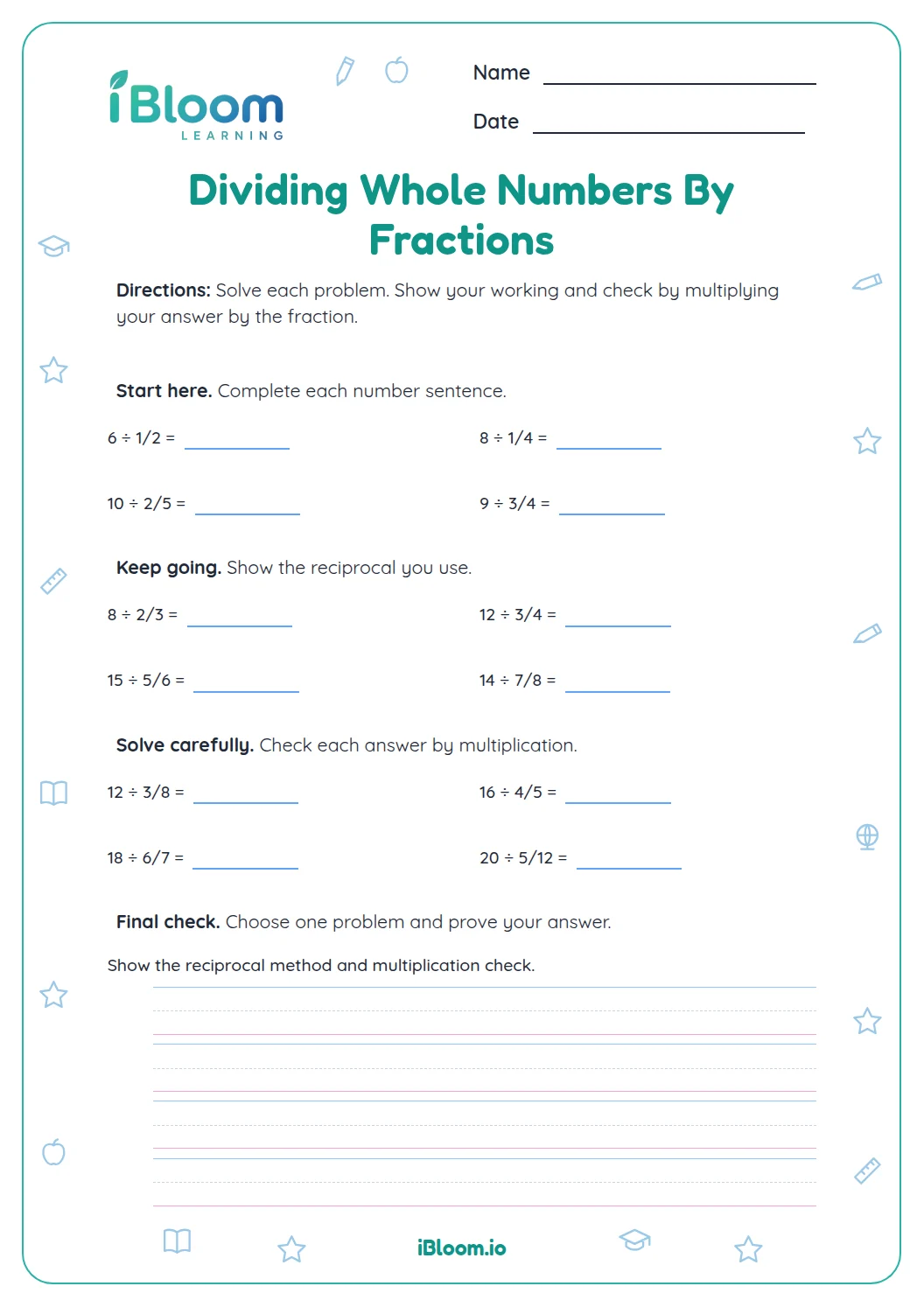

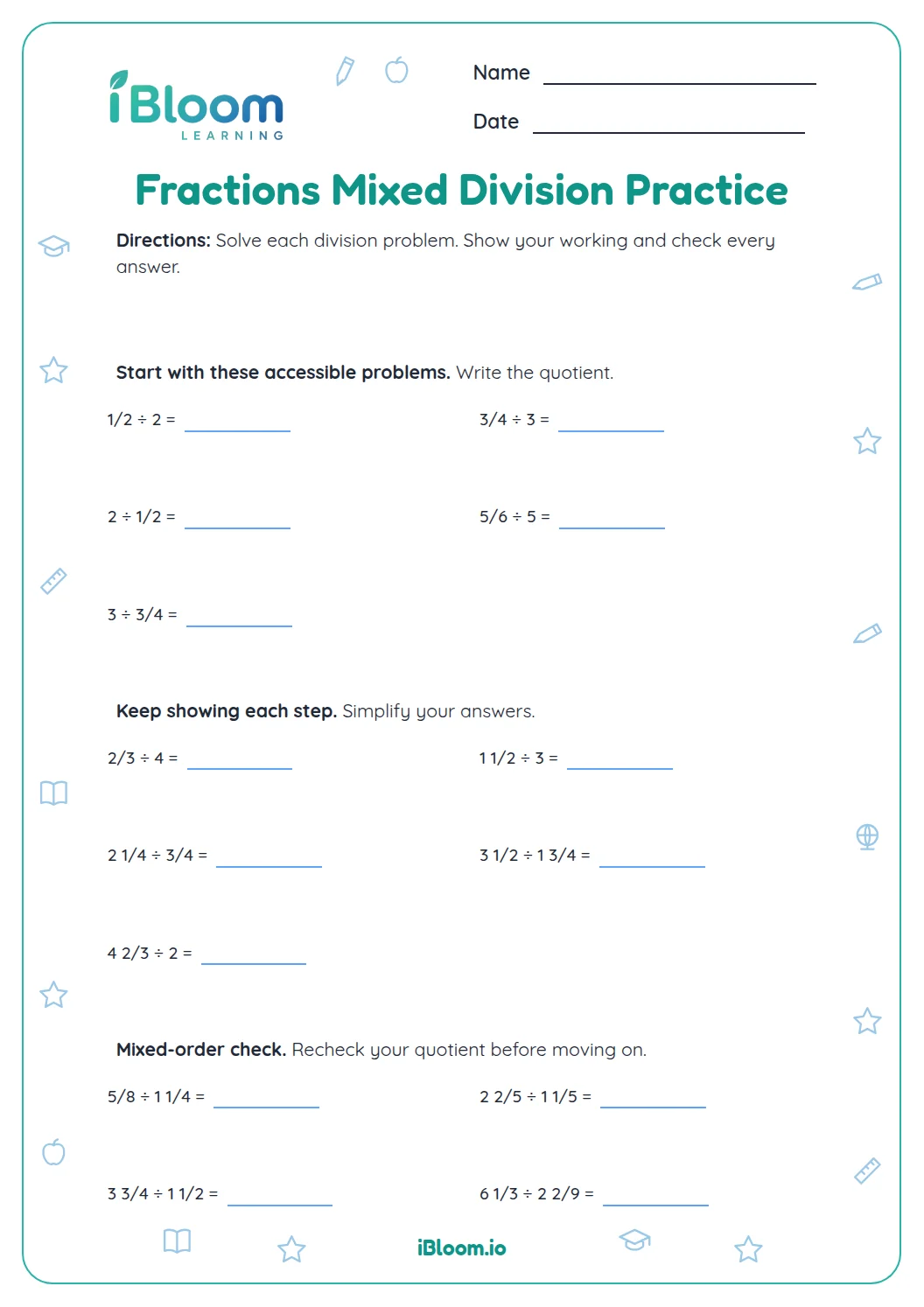
About this worksheet
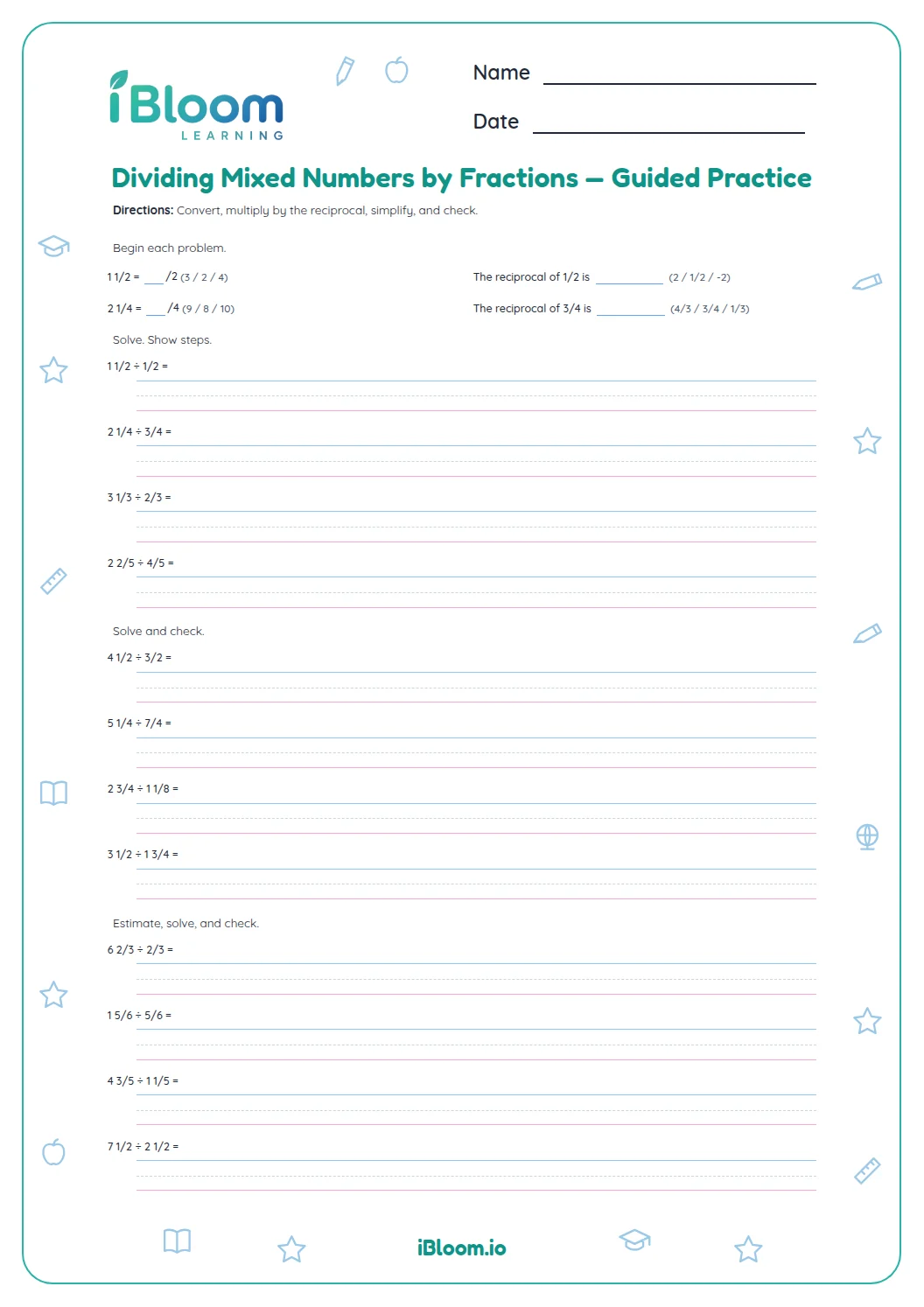
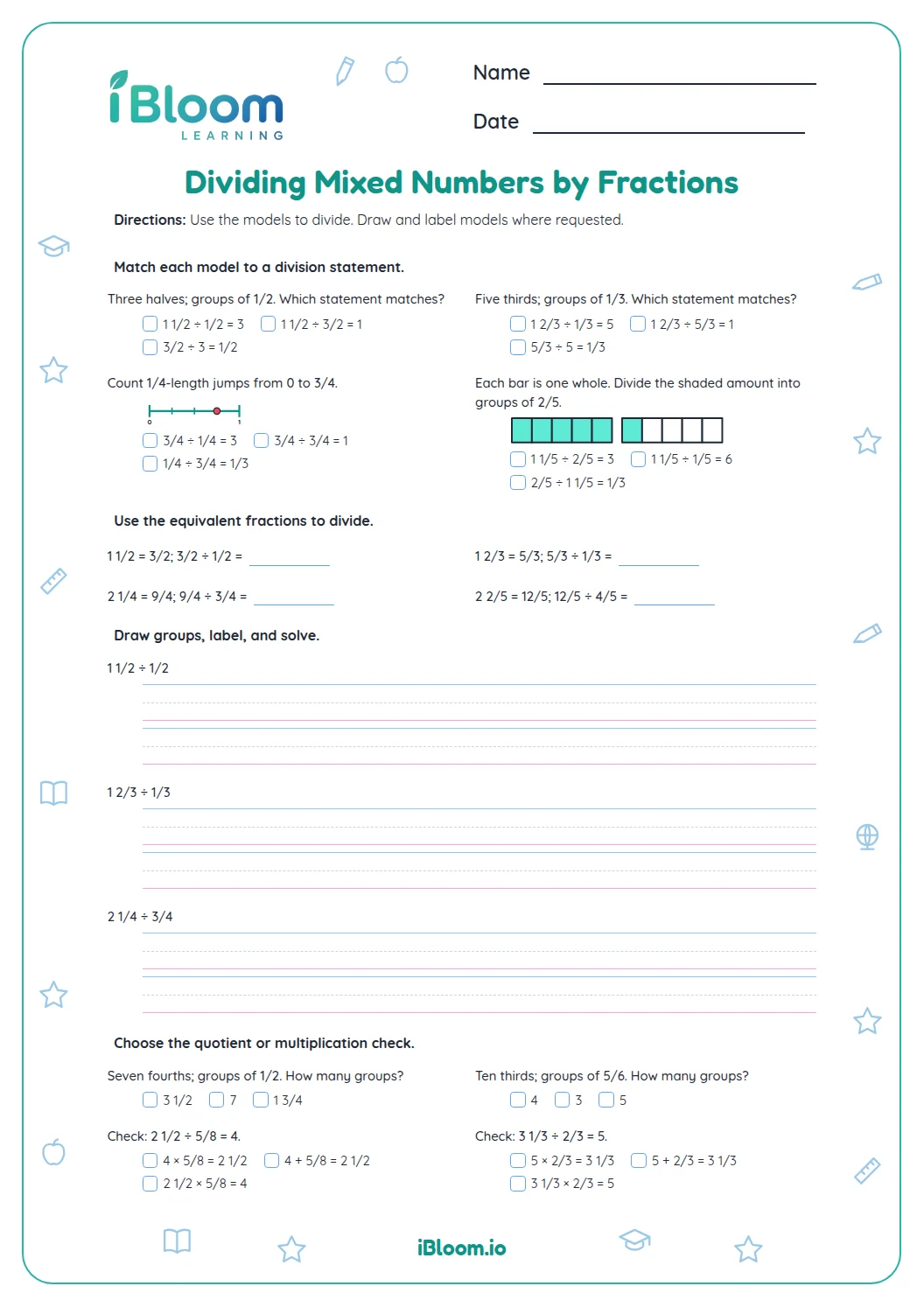
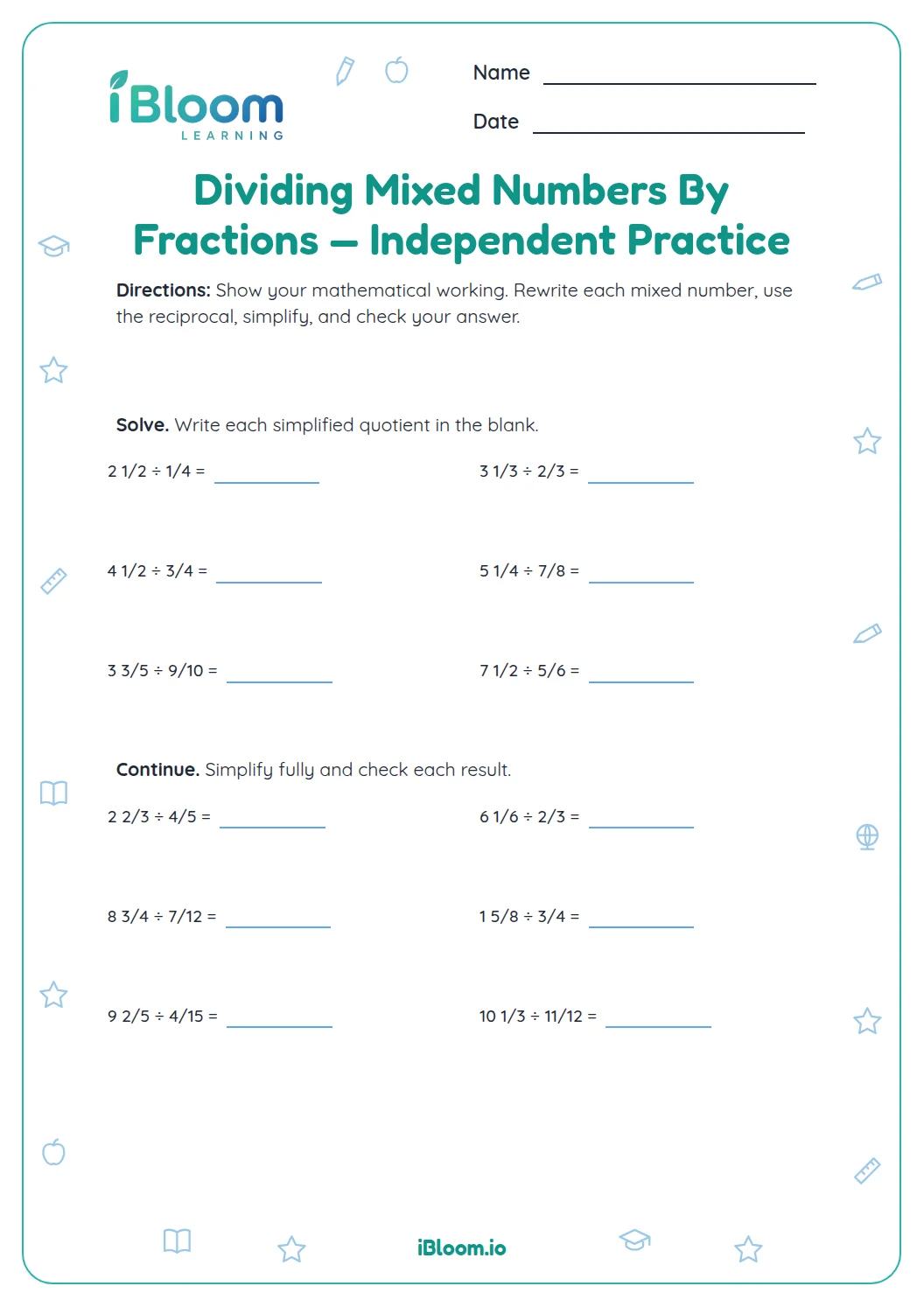
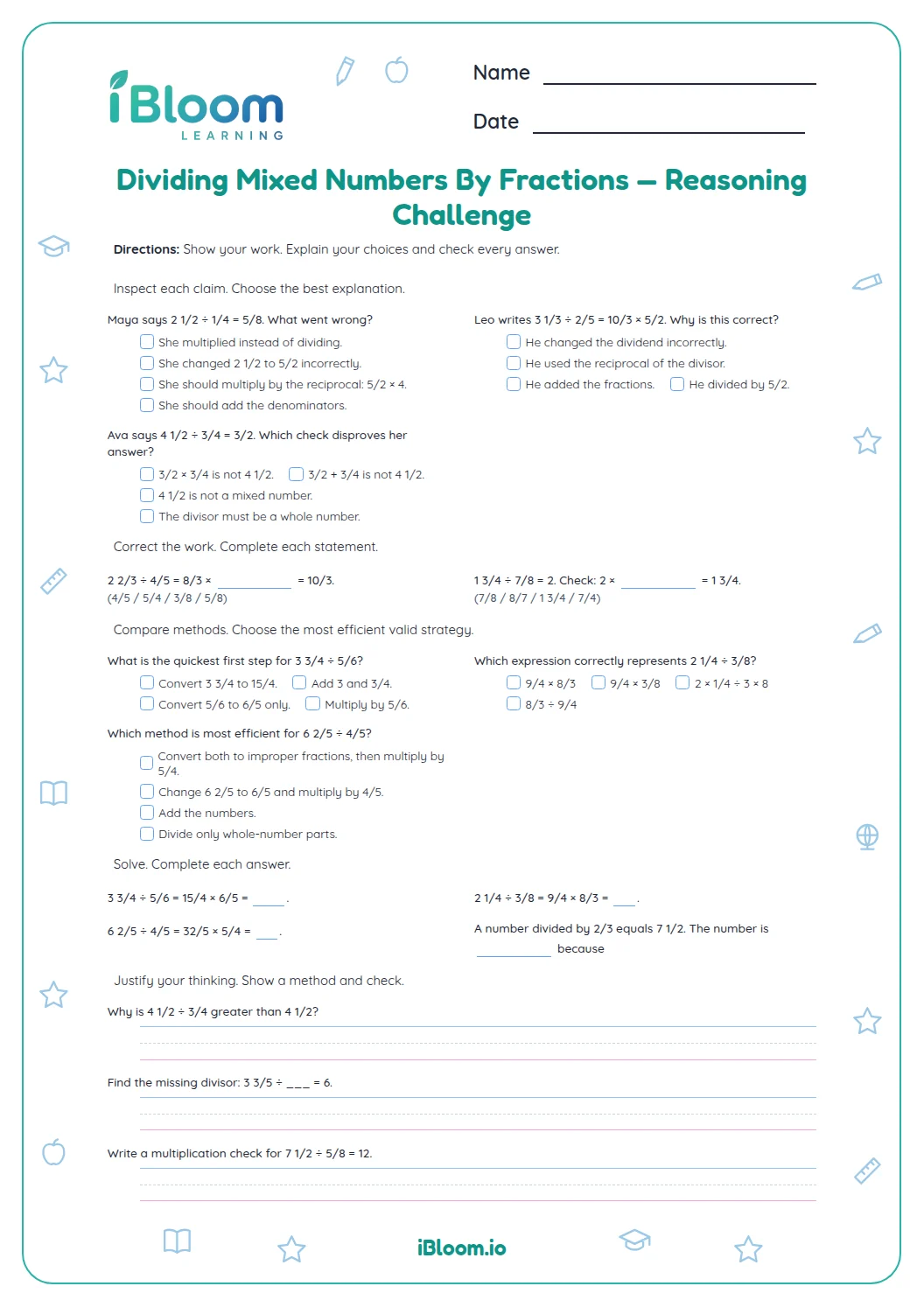
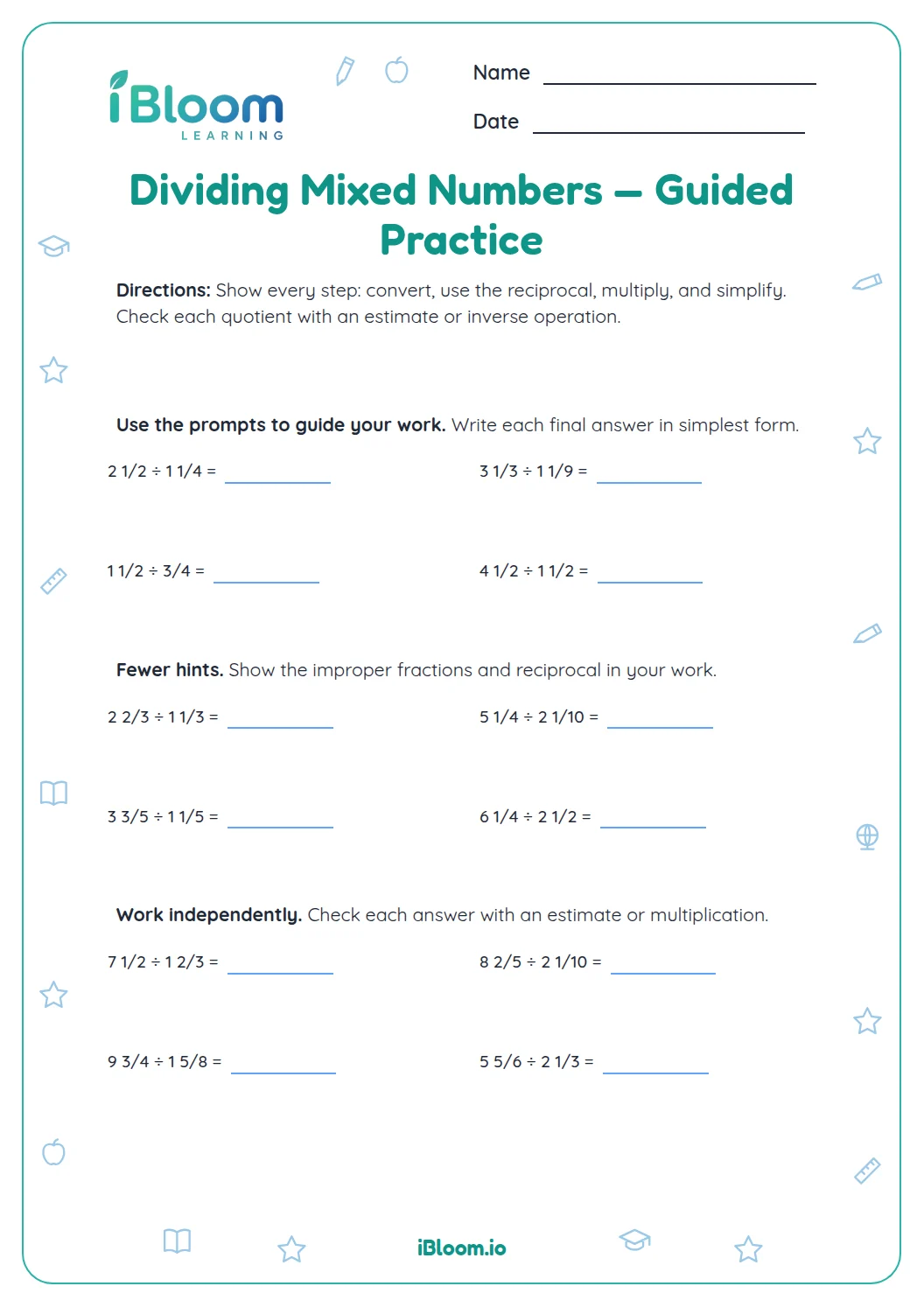
This Grade 6 worksheet builds a routine for dividing a mixed number by a fraction: rename the mixed number, multiply by the reciprocal, simplify, and check. Students solve calculations, then apply quotient reasoning to measurement and recipe contexts. It contains 15 questions and a separate answer key. The work aligns with CCSS 6.NS.A.1 on computing and interpreting fraction quotients.
Aligned to 6.NS.A.1
How do you divide a mixed number by a fraction?
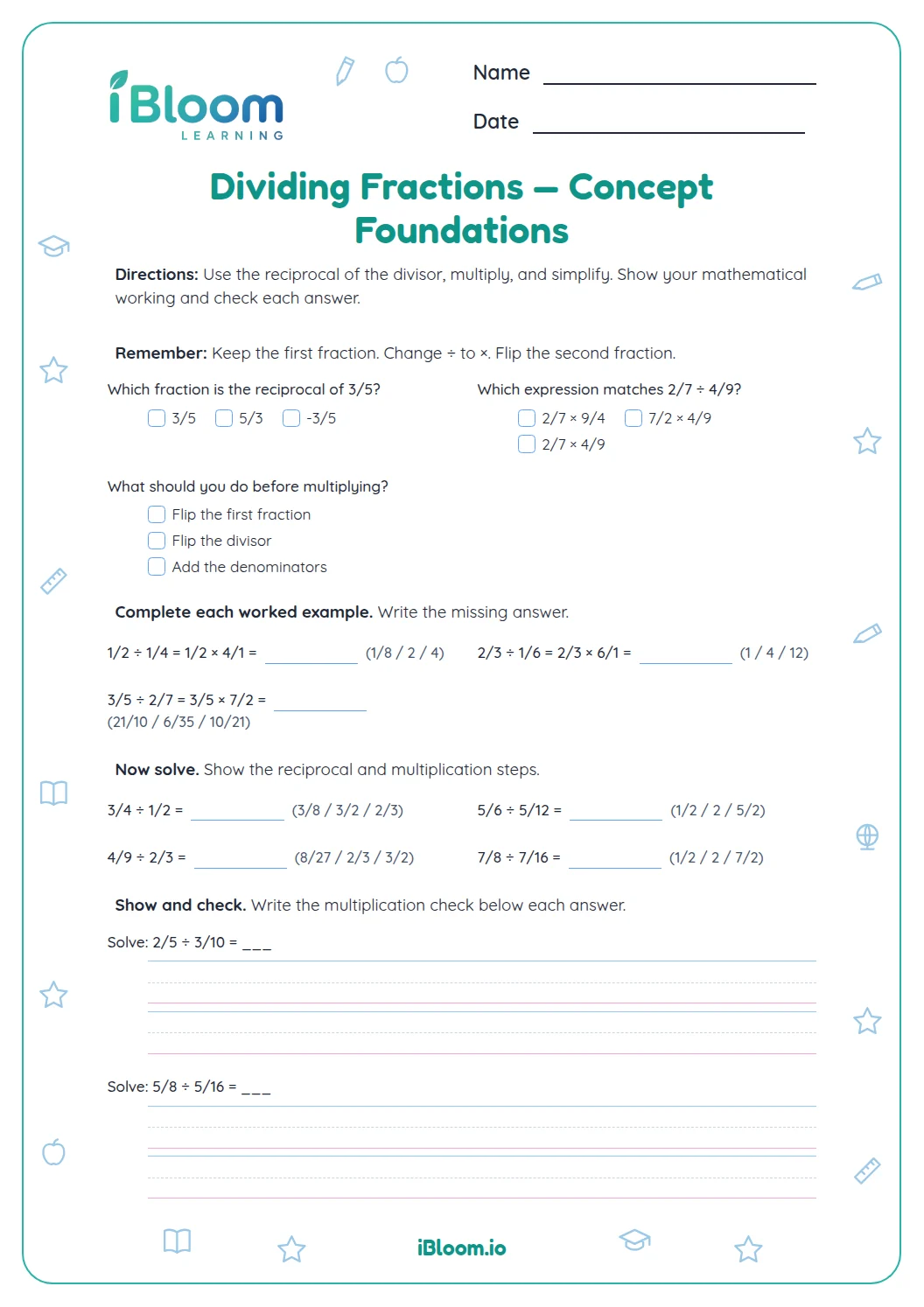
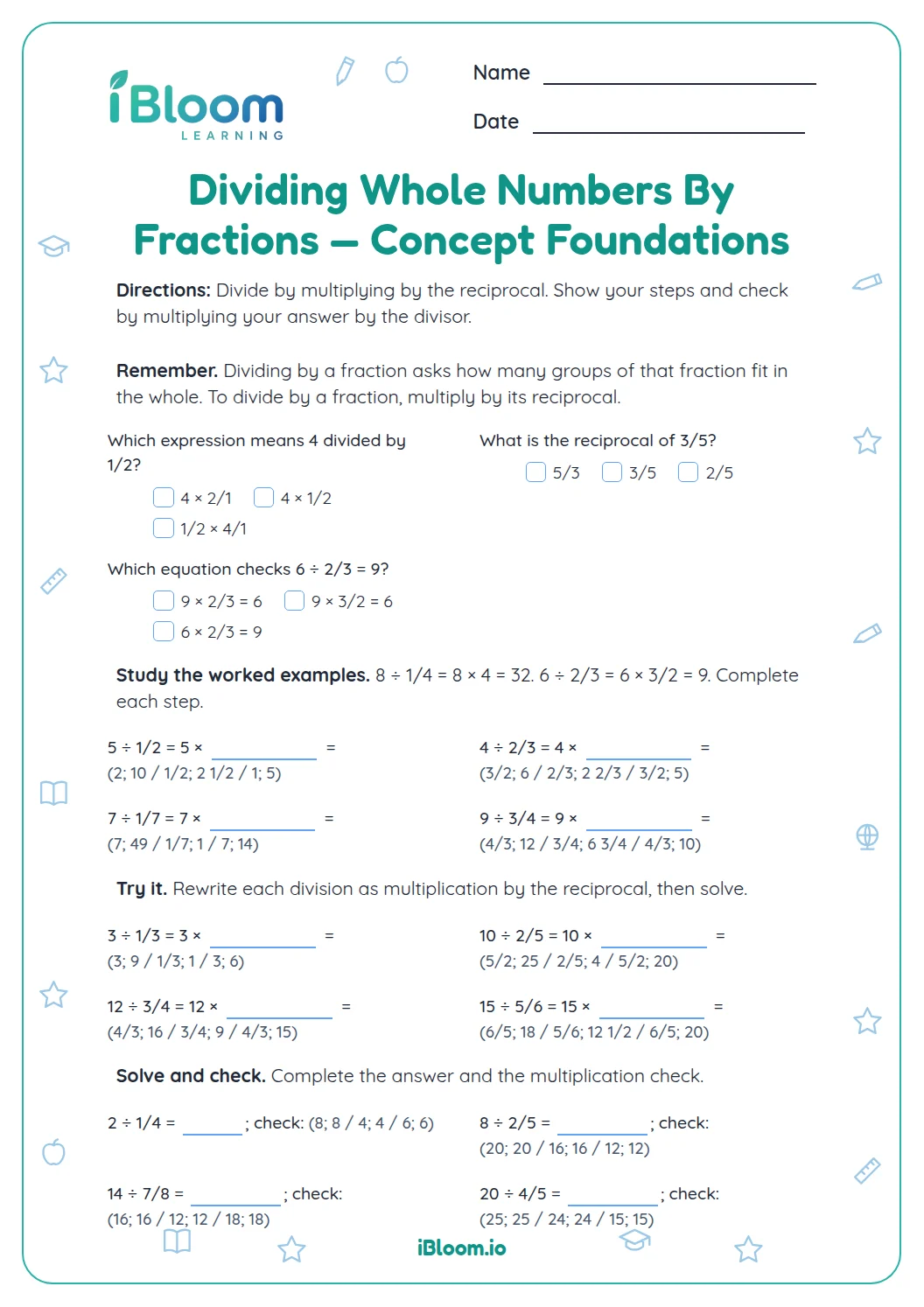
First rename the mixed number as an improper fraction. Then keep the dividend, change division to multiplication, and flip the divisor. Reduce the product if possible.
- 12 1/2 ÷ 1/2
- 25/2 × 2/1 = 10/2
- 310/2 = 5
How can you check a fraction quotient?
Use multiplication: quotient × divisor should equal the original mixed number. For question 4, 3 × 4/5 = 12/5, which is 2 2/5. The check confirms the quotient.
What does the quotient mean in a story?
When a 2 1/4-liter jug is poured into 3/4-liter cups, division asks how many cup-size groups fit. The answer is 3 cups. The story problems connect the reciprocal method to this equal-groups meaning.
A steady method for fraction division
- 1Convert the mixed number to an improper fraction.
- 2Write the divisor’s reciprocal carefully.
- 3Change division to multiplication and multiply numerators and denominators.
- 4Simplify the quotient and check by multiplication.
- 5In a story problem, attach the correct unit to the number of groups.
Fraction-division errors to watch
The mistake
Changing 2 1/2 into 2/5.
The fix
Multiply the whole number by the denominator, then add the numerator: 2 × 2 + 1 = 5, so 5/2.
The mistake
Flipping the dividend instead of the divisor.
The fix
Keep the first fraction; take the reciprocal only of the number after ÷.
The mistake
Stopping at an unsimplified quotient.
The fix
Reduce the product and use quotient × divisor to check.
Common Core alignment
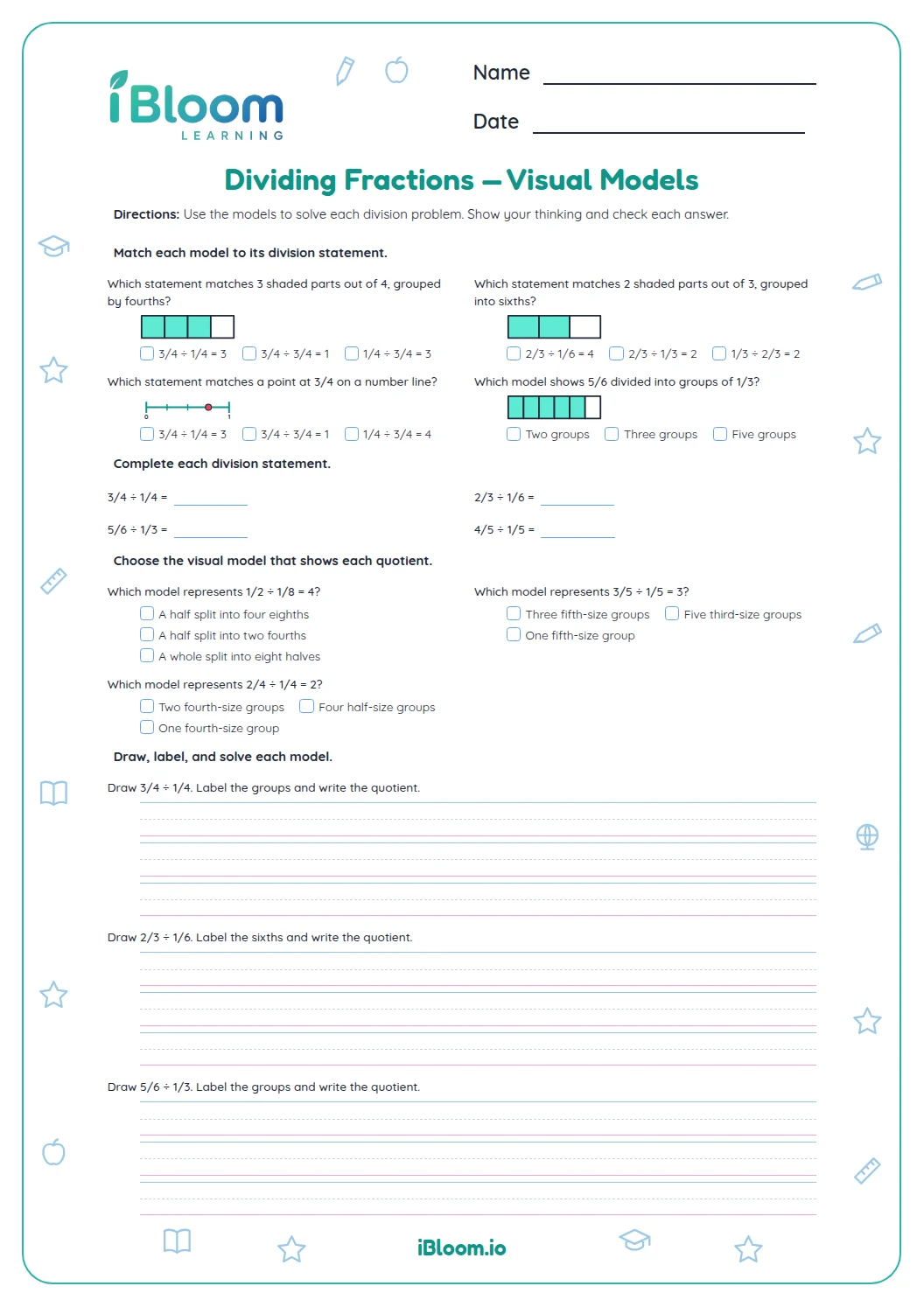
The practice connects fraction calculations with equal-group situations.
Interpret and compute fraction quotients, including in word problems.
On this sheet: Every item divides a mixed number by a fraction and several model quotient situations.
Show the official wordingHide the official wording
Interpret and compute quotients of fractions, and solve word problems involving division of fractions by fractions, e.g., by using visual fraction models and equations to represent the problem.
What to practice next
Make more practice
Further reading
Questions parents and teachers ask
Why change division to multiplication?
Multiplying by the divisor’s reciprocal gives the same quotient as dividing by that fraction. The routine is to keep the dividend, change ÷ to ×, and flip only the divisor. The first eight questions give students practice using that sequence.
How do I rename 2 1/2 as an improper fraction?
Two wholes contain four halves, and one additional half makes five halves total. So 2 1/2 = 5/2. Question 9 checks this common first step by asking students to select the correct improper fraction. The conversion also gives an equivalent fraction greater than one, which is easier to multiply by the reciprocal in the next step.
What does 2 1/2 ÷ 1/2 equal?
It equals 5 because five half-size pieces fit in two and one-half wholes. The calculation is 5/2 × 2/1 = 10/2 = 5. This grouping meaning helps students check whether the quotient makes sense. The problem asks how many such parts fit.
How can multiplication check the answer?
Multiply the quotient by the divisor. For 2 2/5 ÷ 4/5 = 3, check 3 × 4/5 = 12/5, or 2 2/5. The product returns the starting amount and confirms the answer. This is an efficient way to confirm the result.
Are there real-world questions?
Yes. Students find how many cups can be filled from a jug, how many ribbon pieces can be cut, and how many recipe batches can be made. Each story asks how many groups of the fractional size fit into a mixed-number amount.