




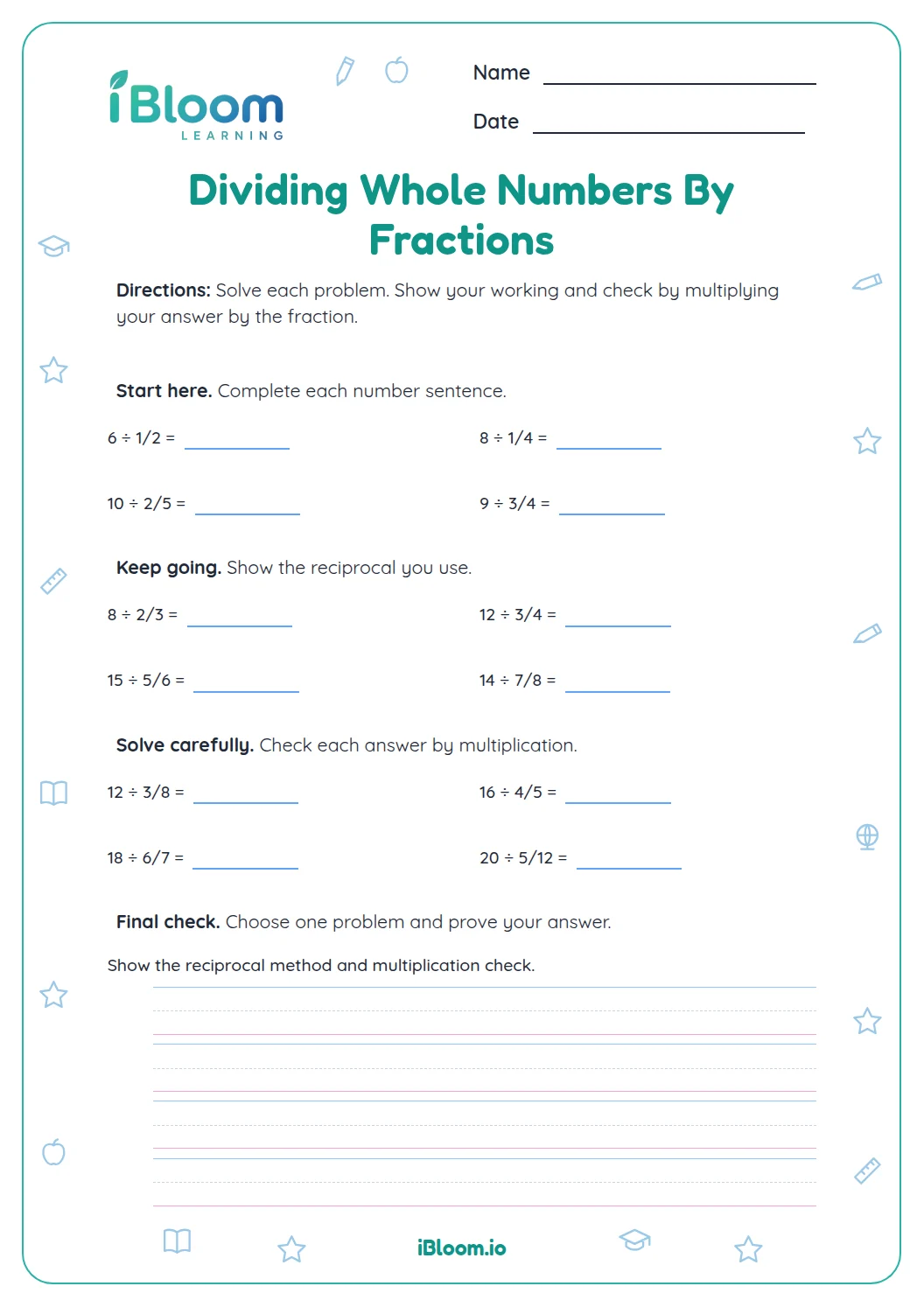
About this worksheet
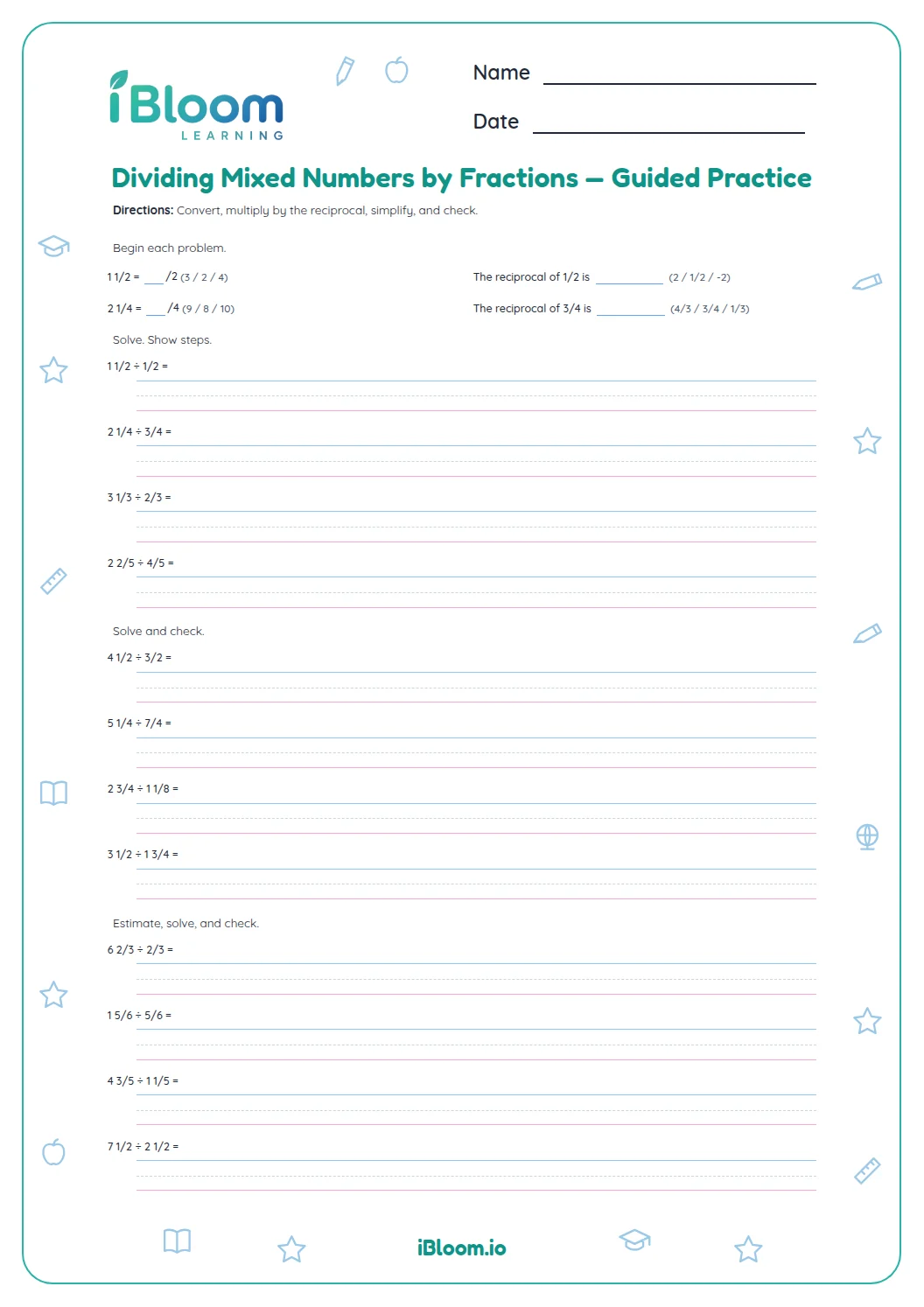
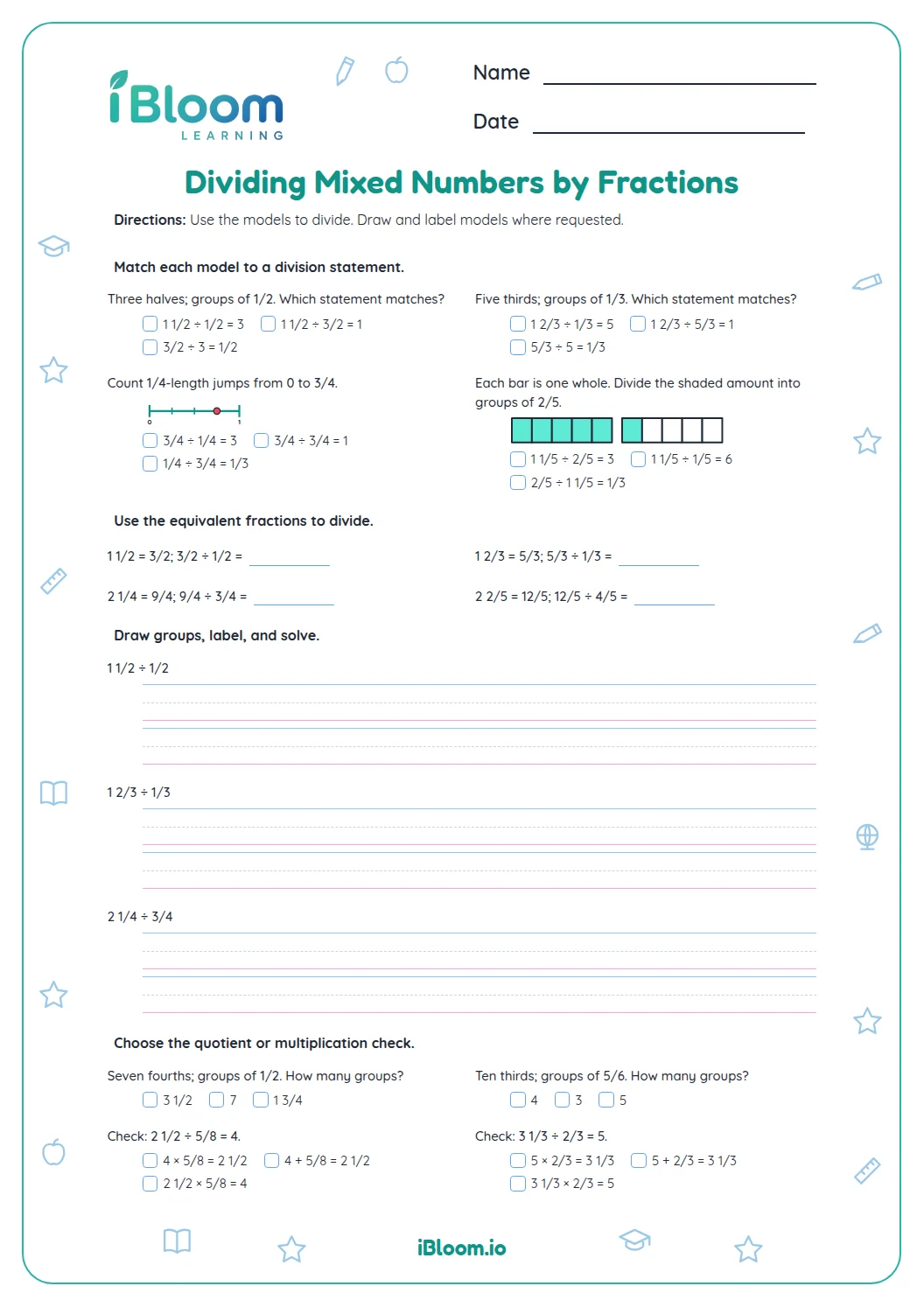
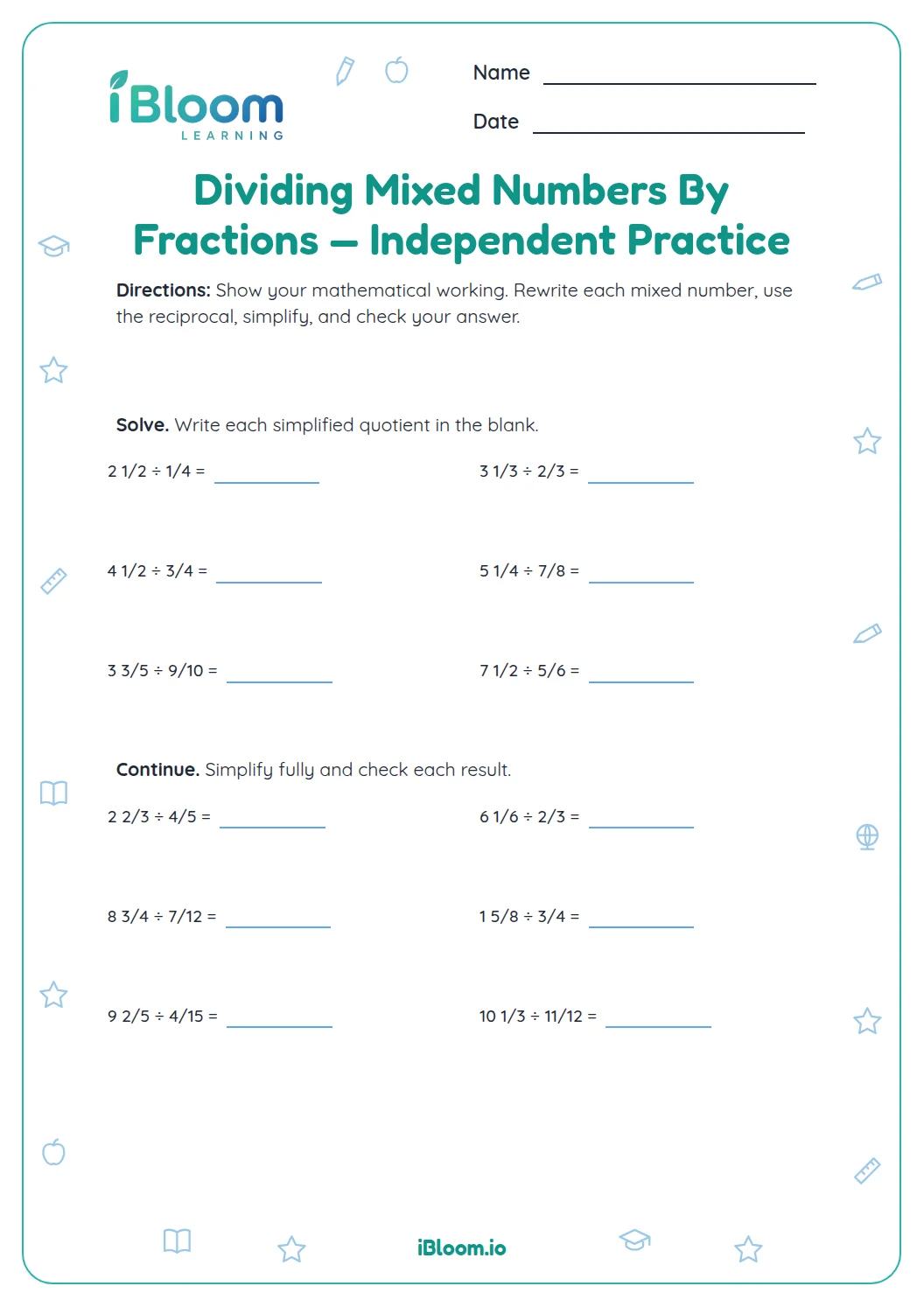
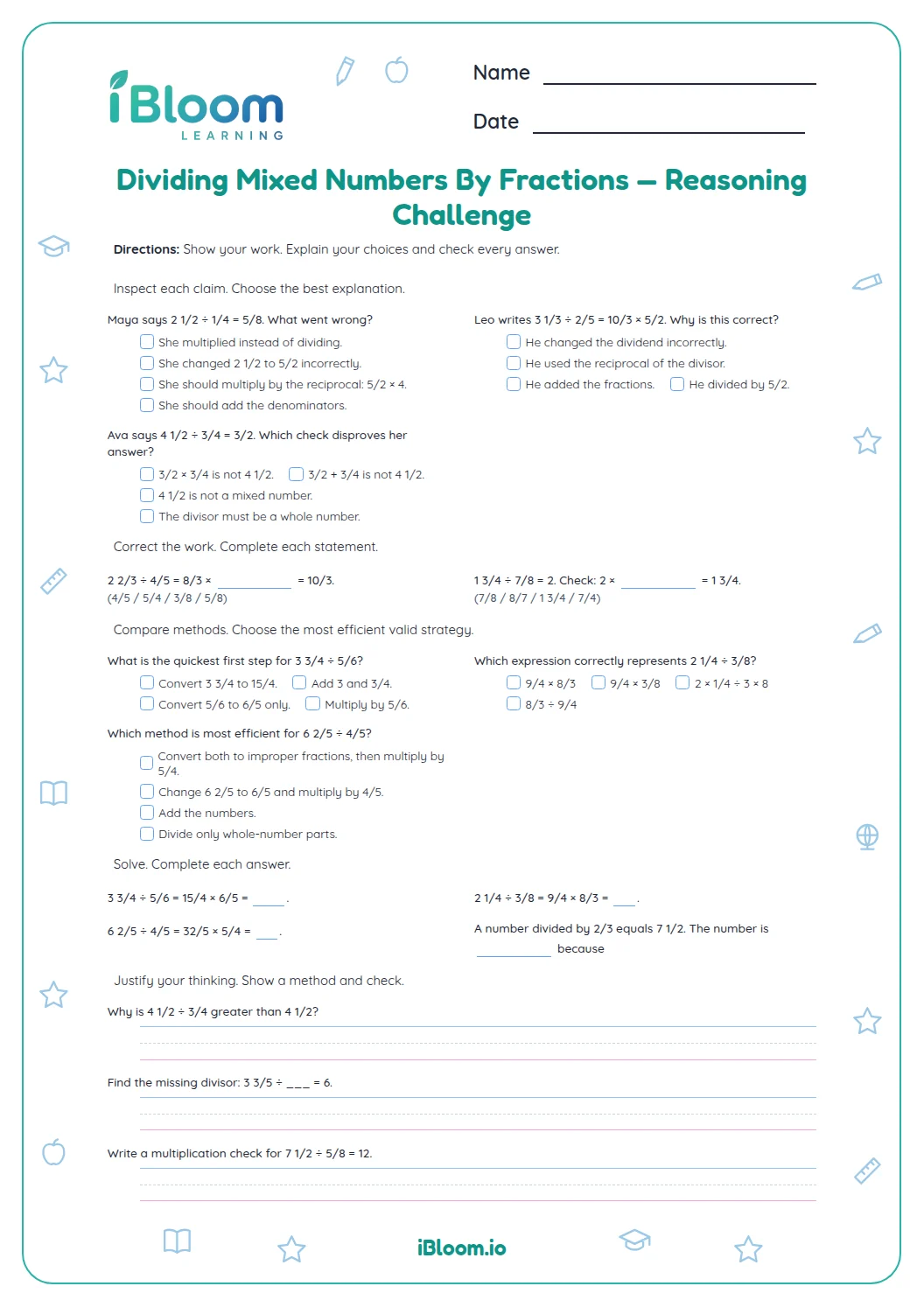
This Grade 6 printable practices dividing mixed numbers by fractions. Students solve ribbon, juice, walking, and clay problems; compute quotients; estimate two answers; and use multiplication to check. For example, 6 1/4 ÷ 5/8 = 10 because 10 groups of 5/8 make 6 1/4. The answer key includes the quotient and check equations.
Aligned to 6.NS.A.1
What situations does the worksheet use?
The first four questions ask how many fractional-size pieces or portions fit in a mixed-number amount. Five number sentences then focus on calculating quotients. Two estimation questions and five additional quotient prompts connect the procedure to reasonable answers and multiplication.
For question 1, 6 1/4 ÷ 5/8 asks how many 5/8-foot pieces fit into 6 1/4 feet. The quotient is 10, and 10 × 5/8 returns 6 1/4.
- Four real-world grouping problems
- Five quotient calculations
- Two estimates and five additional quotients
How can multiplication check a quotient?
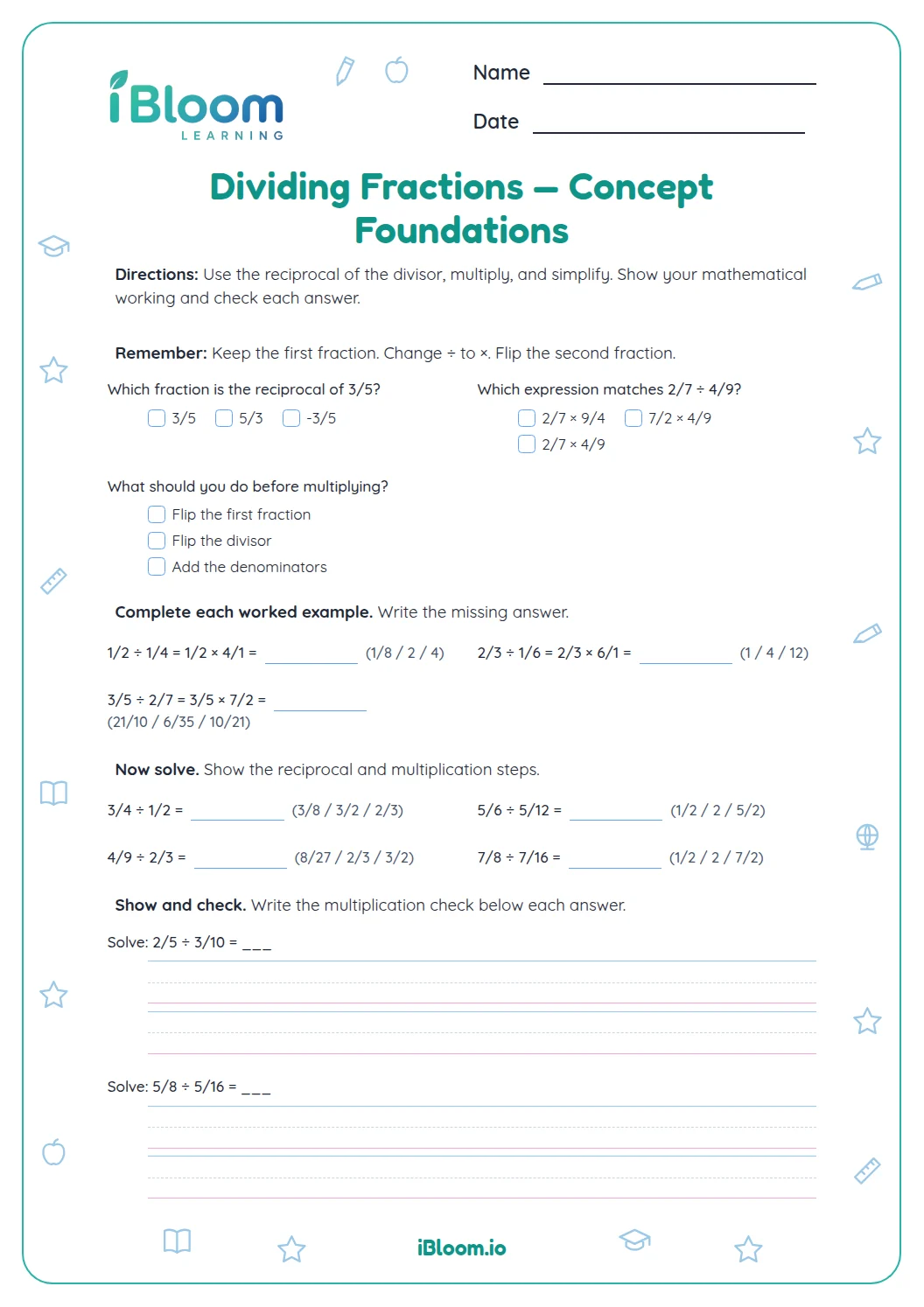
If a mixed-number amount is divided into groups of a fraction, multiply the number of groups by the group size. The product should equal the starting amount. This inverse check can reveal a reciprocal or simplification error.
Why estimate before calculating?
An estimate helps identify an answer that is far too small or large. If 6 1/4 is divided into groups of 5/8, the quotient should be around ten because ten groups of 5/8 make 6 1/4.
How to use this worksheet
- 1Read each story and identify the total amount and group size.
- 2Write the division equation before calculating.
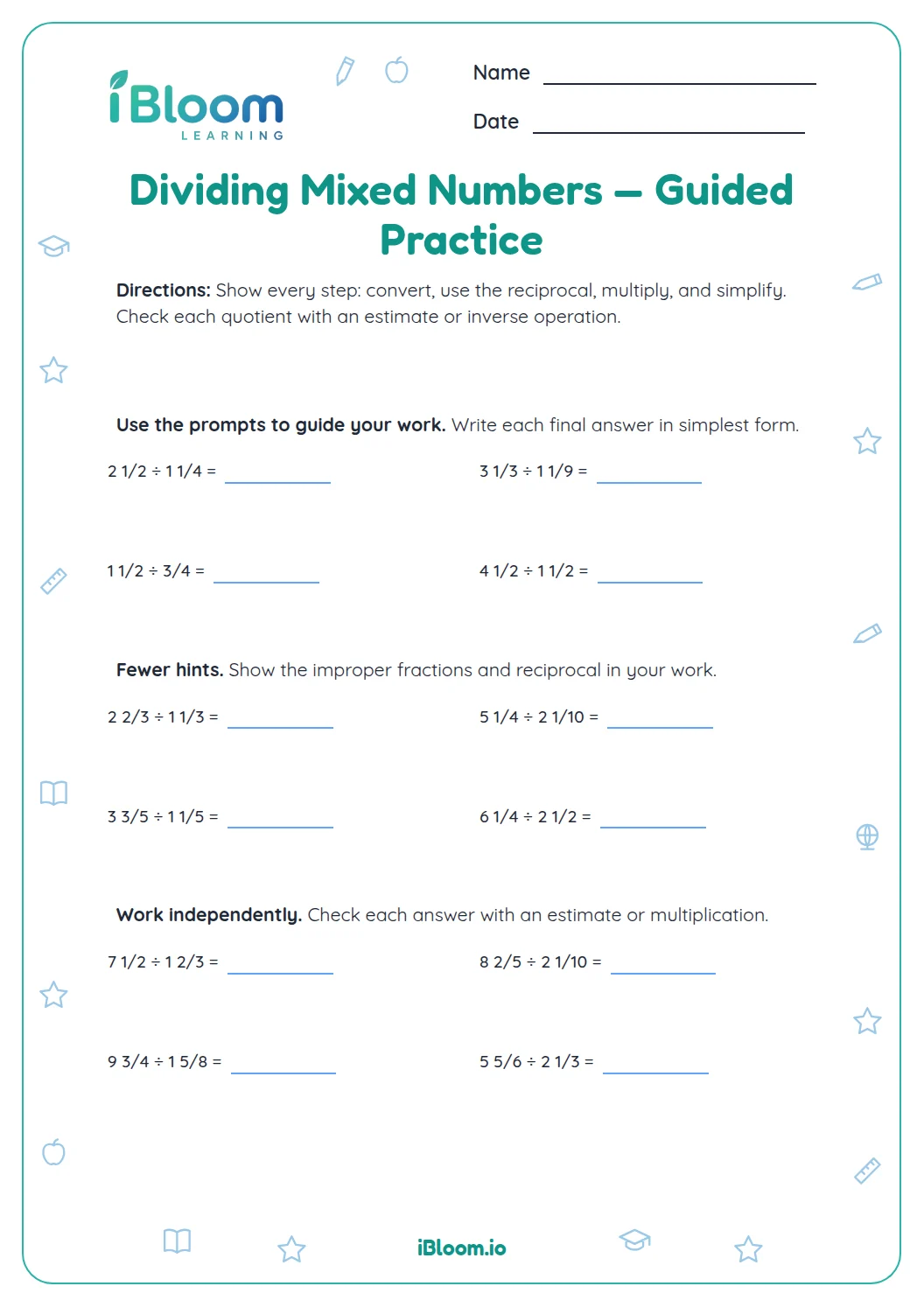
- 3Rename a mixed number as an improper fraction.
- 4Multiply by the reciprocal and simplify.
- 5Estimate the size, then check by multiplication.
Common mistakes and quick fixes
The mistake
Using the divisor instead of its reciprocal.
The fix
Rewrite division as multiplication by the reciprocal.
The mistake
Forgetting to convert the mixed number.
The fix
Change the mixed number to an improper fraction first.
The mistake
Reporting a quotient without its unit or meaning.
The fix
State what the number of groups counts, such as pieces or servings.
Common Core alignment
This worksheet practices the following mathematical ideas.
Compute fraction quotients and solve real-world division problems.
On this sheet: Each context and computation divides a mixed number by a fraction and uses the quotient as a number of groups.
Show the official wordingHide the official wording
Interpret and compute quotients of fractions, and solve word problems involving division of fractions by fractions, e.g., by using visual fraction models and equations to represent the problem. For example, create a story context for (2/3) ÷ (3/4) and use a visual fraction model to show the quotient; use the relationship between multiplication and division to explain that (2/3) ÷ (3/4) = 8/9 because 3/4 of 8/9 is 2/3. (In general, (a/b) ÷ (c/d) = ad/bc.) How much chocolate will each person get if 3 people share 1/2 lb of chocolate equally? How many 3/4-cup servings are in 2/3 of a cup of yogurt? How wide is a rectangular strip of land with length 3/4 mi and area 1/2 square mi?.
What to practice next
Make more practice
Further reading
Questions parents and teachers ask
How do you divide a mixed number by a fraction?
Convert the mixed number to an improper fraction, keep the first fraction, and multiply by the reciprocal of the divisor. Simplify the result if possible. For example, 6 1/4 becomes 25/4, and 25/4 ÷ 5/8 becomes 25/4 × 8/5 = 10.
What does the quotient mean in a word problem?
The quotient tells how many groups of the stated fractional size fit in the total amount. In the ribbon problem, 6 1/4 feet divided into pieces of 5/8 foot gives 10 pieces. Include the unit or object being counted when writing a contextual answer.
How many questions are on the page?
There are 16 questions in four parts: four real-world grouping problems, five quotient calculations, two estimates, and five additional quotient sentences. The situations use feet, liters, miles, pounds, and cups. A separate answer key lists each quotient and both estimates.
Why does the worksheet ask for estimates?
An estimate gives a quick sense of the quotient’s size before exact calculation. Since 6 1/4 is close to 6 and 5/8 is a little more than 1/2, the answer should be around ten groups. This can help catch a misplaced reciprocal or arithmetic slip.
How can multiplication verify a division answer?
Multiply the quotient by the divisor. In the first problem, 10 pieces times 5/8 foot per piece equals 50/8 feet, or 6 1/4 feet. That product matches the starting amount, confirming that the quotient represents the right number of equal groups.
Does the answer key show work?
Yes. The separate answer key lists all 16 quotients and marks the reasonable estimate in each of the two estimate questions. For story problems, students should include what the quotient counts, such as pieces or cups, so the number has a clear meaning.