






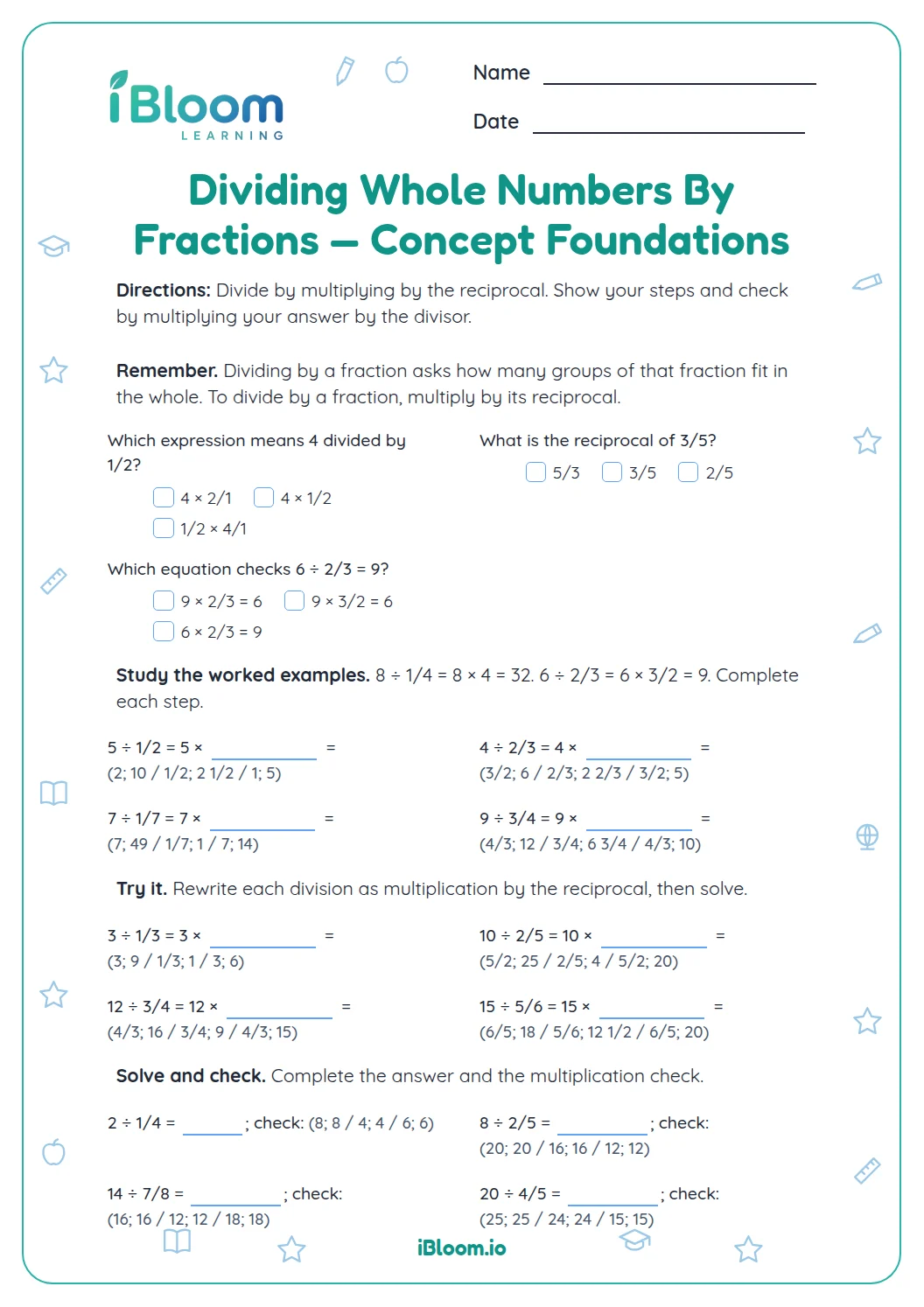
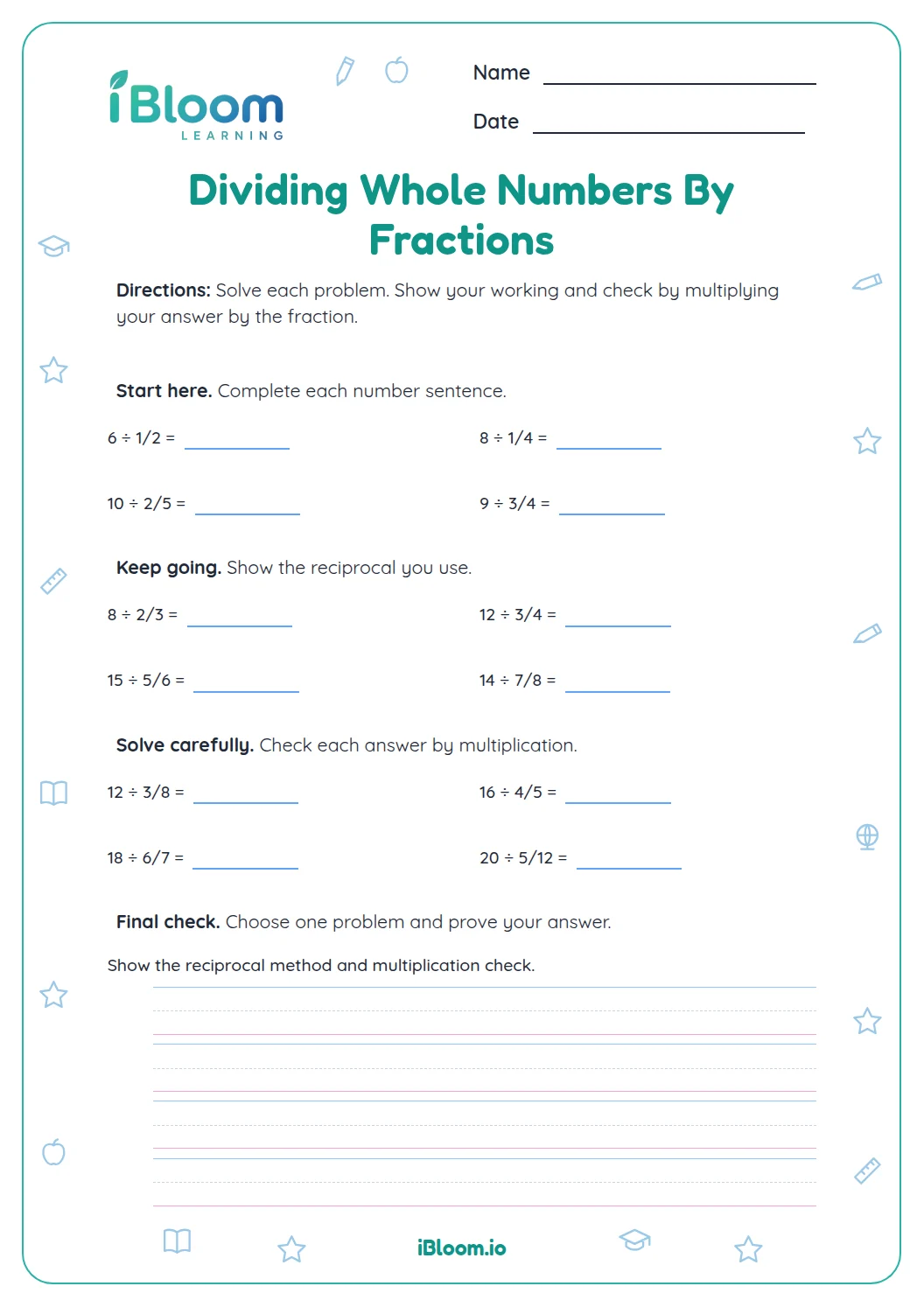
About this worksheet
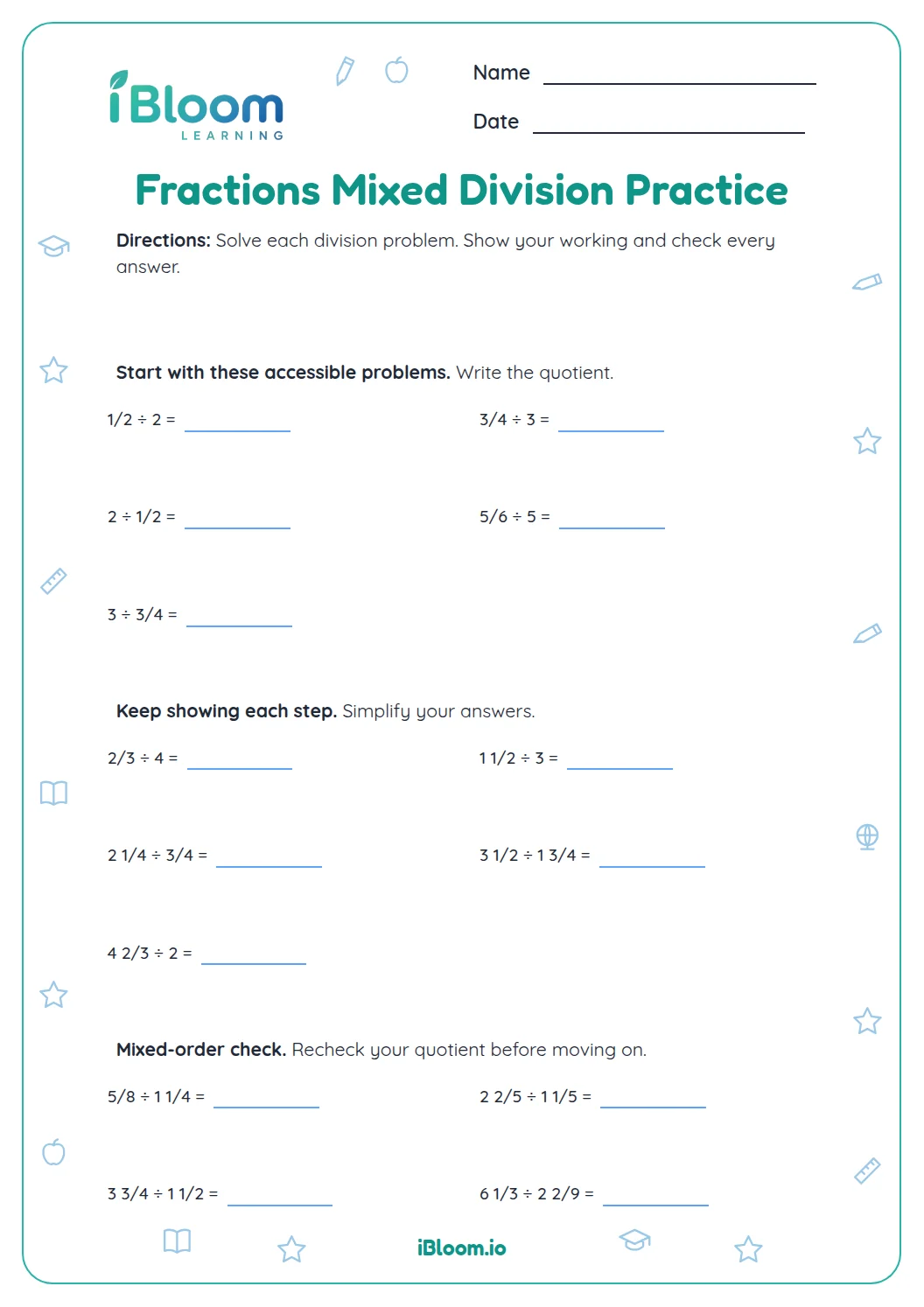
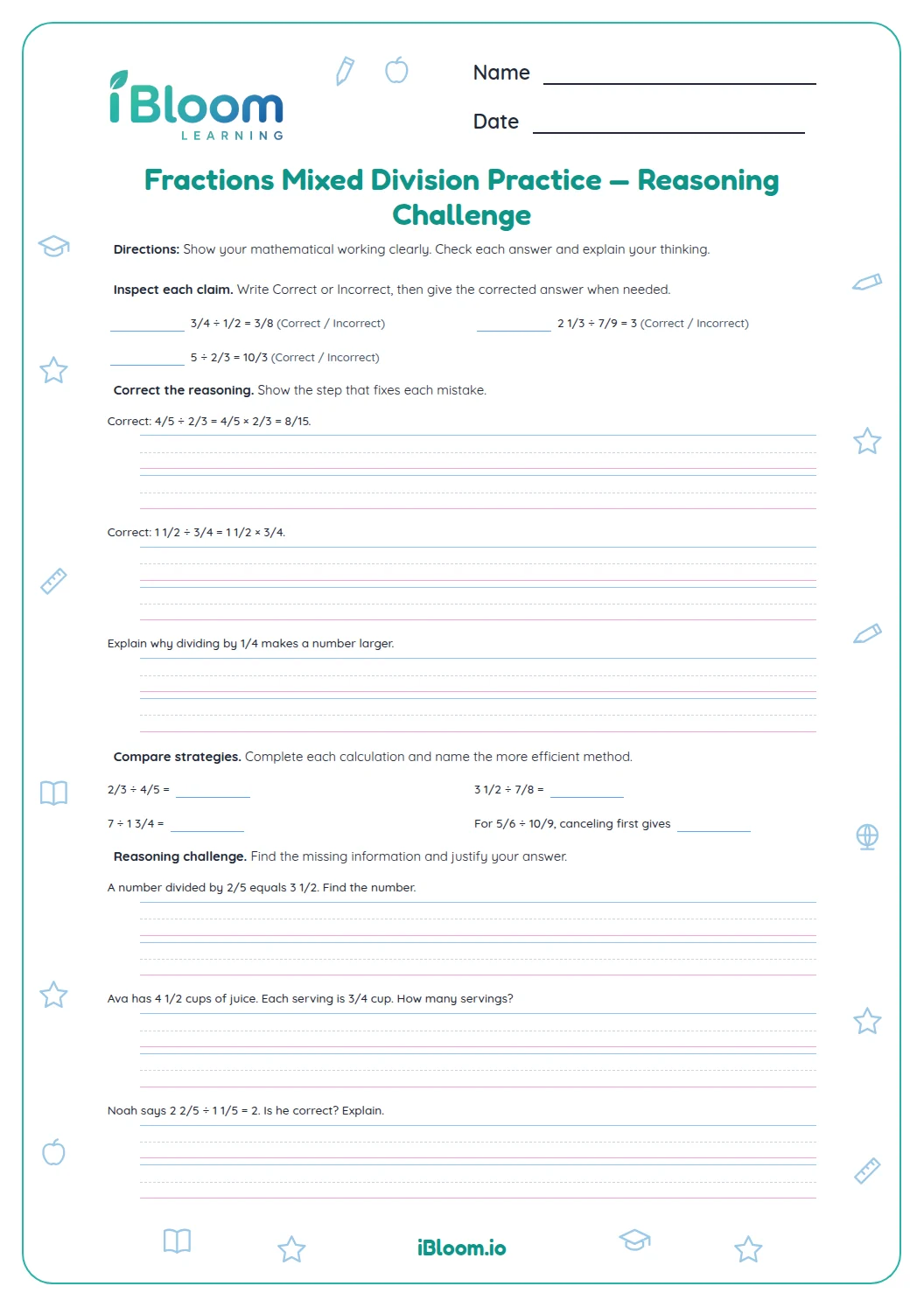
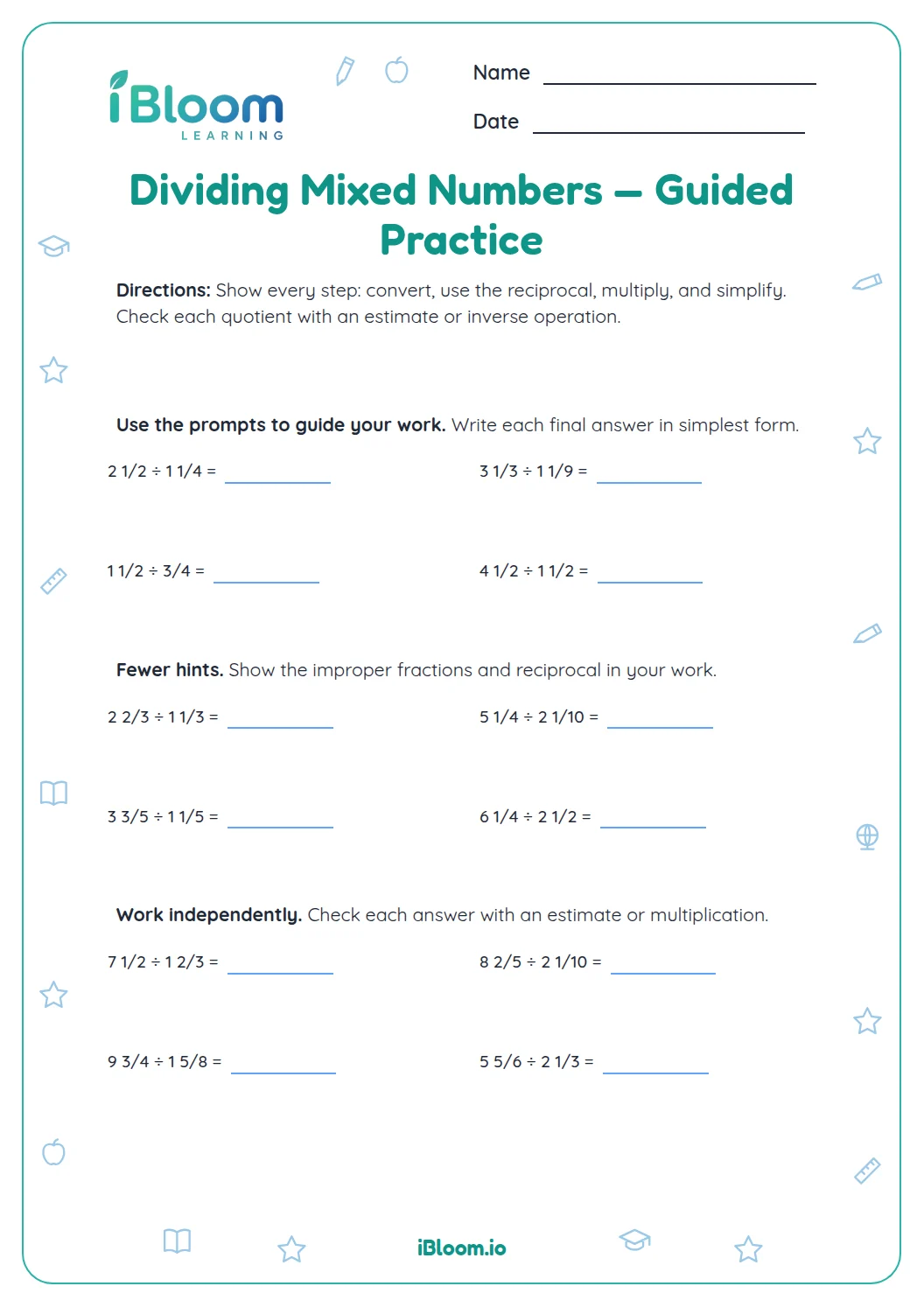
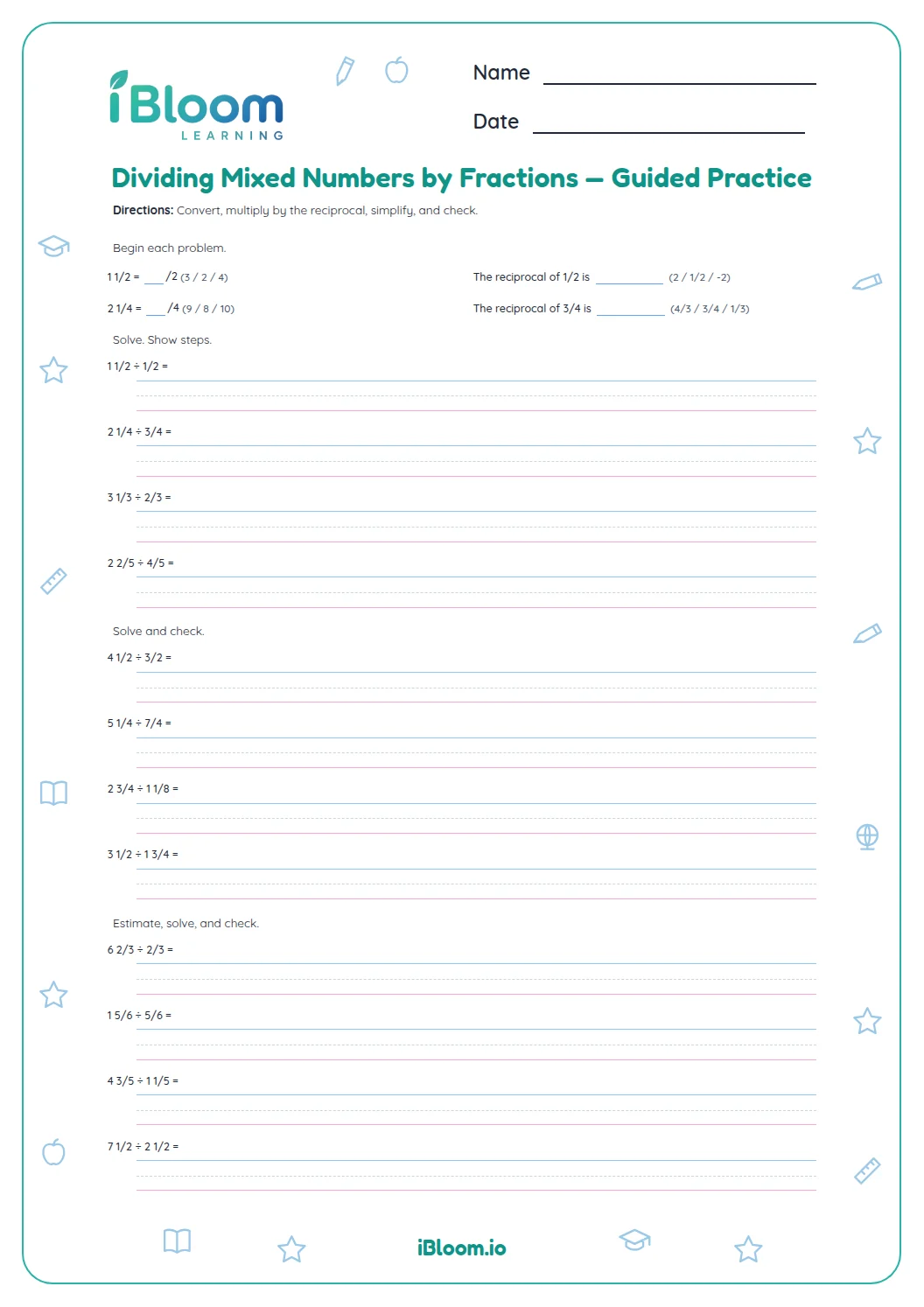
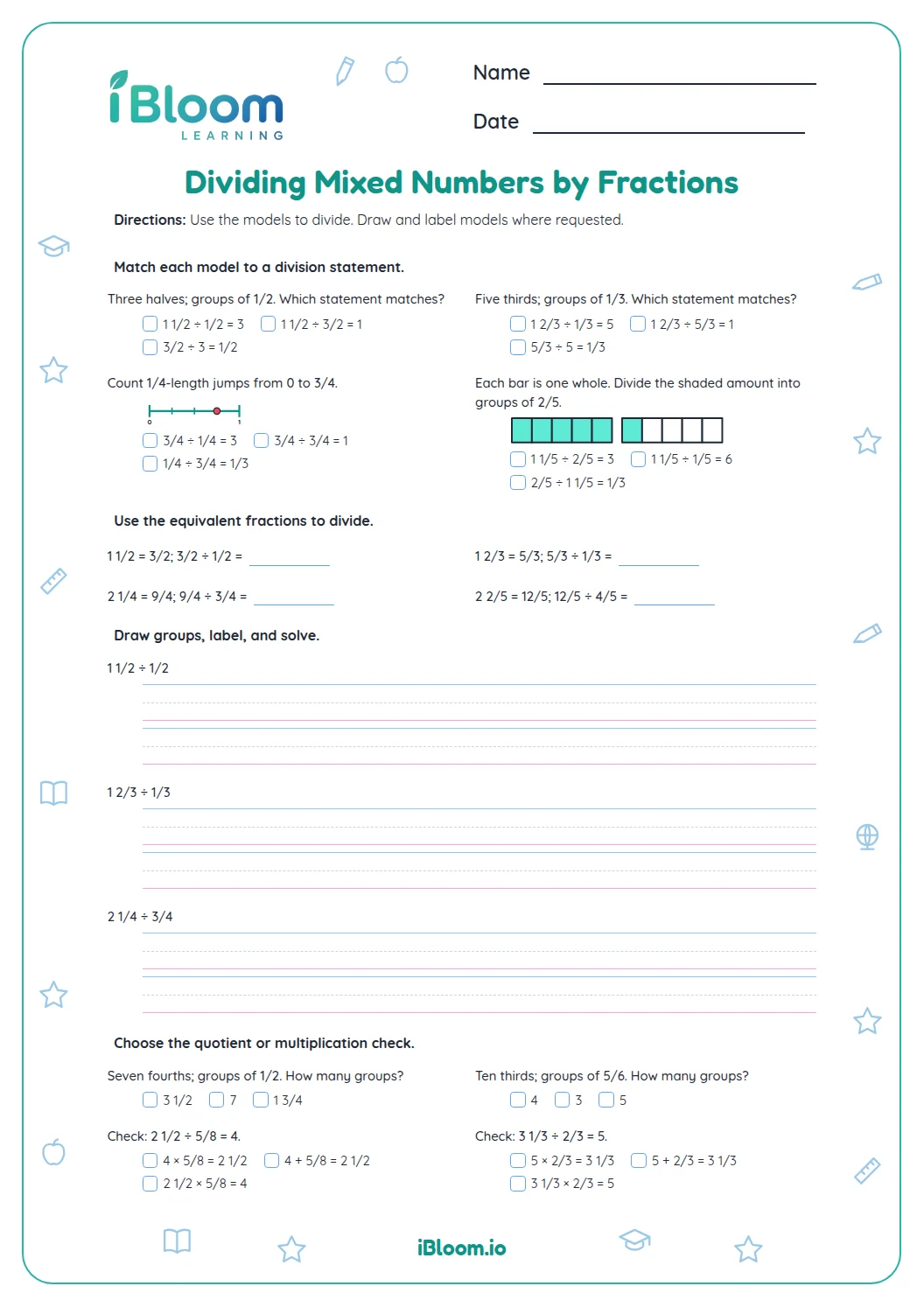
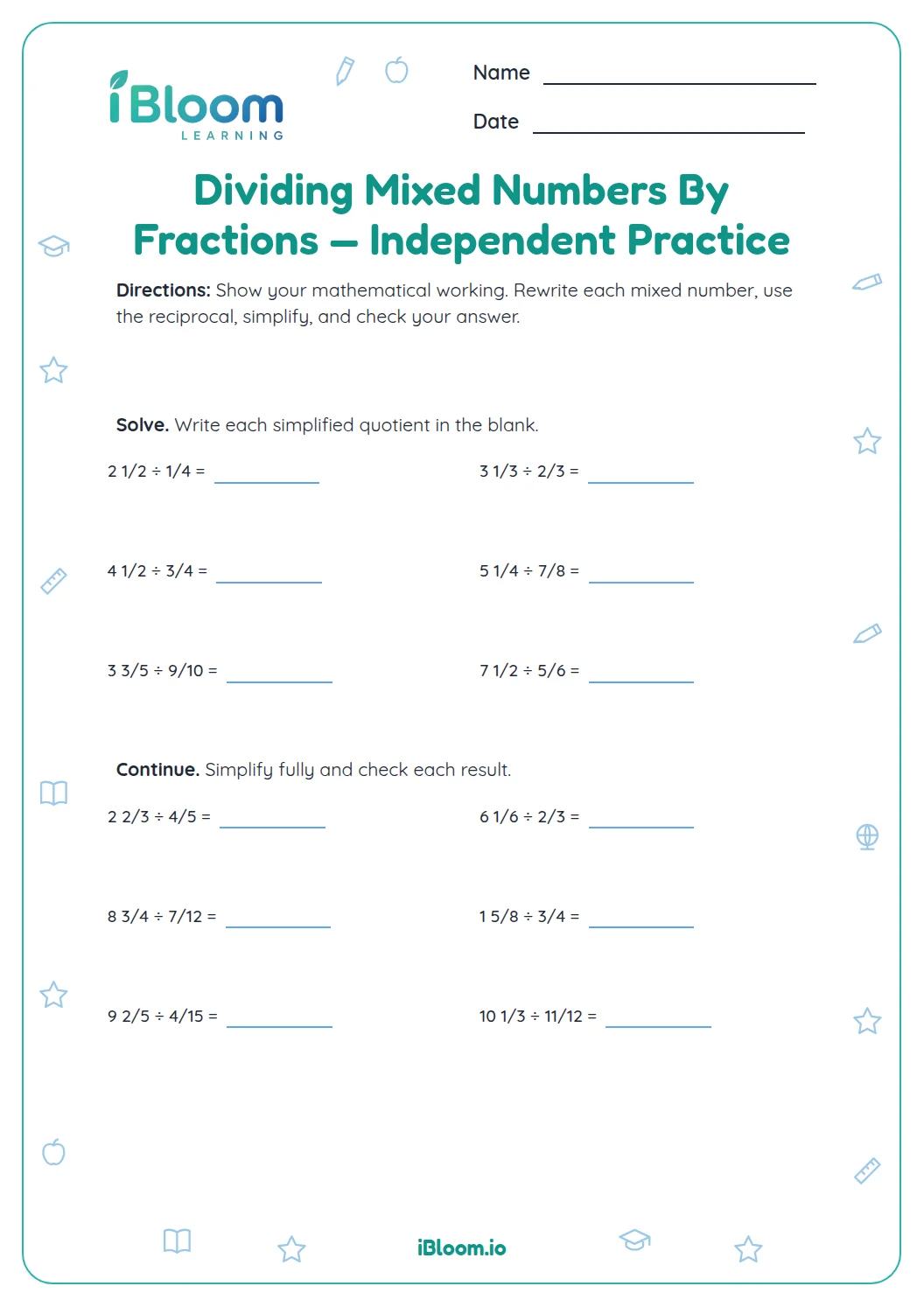
This printable gives Grade 6 learners visual and equation practice dividing fractions and mixed numbers. The 14 questions begin with four “how many pieces fit?” items, then move to fraction quotients, mixed-number quotients, and two serving or measurement stories. The first 12 questions include shaded bars for the dividend, giving a visual reference as learners use the reciprocal strategy. A separate answer key is included. The work practices CCSS 6.NS.A.1 by interpreting and computing fraction quotients in equations and contexts.
Aligned to 6.NS.A.1
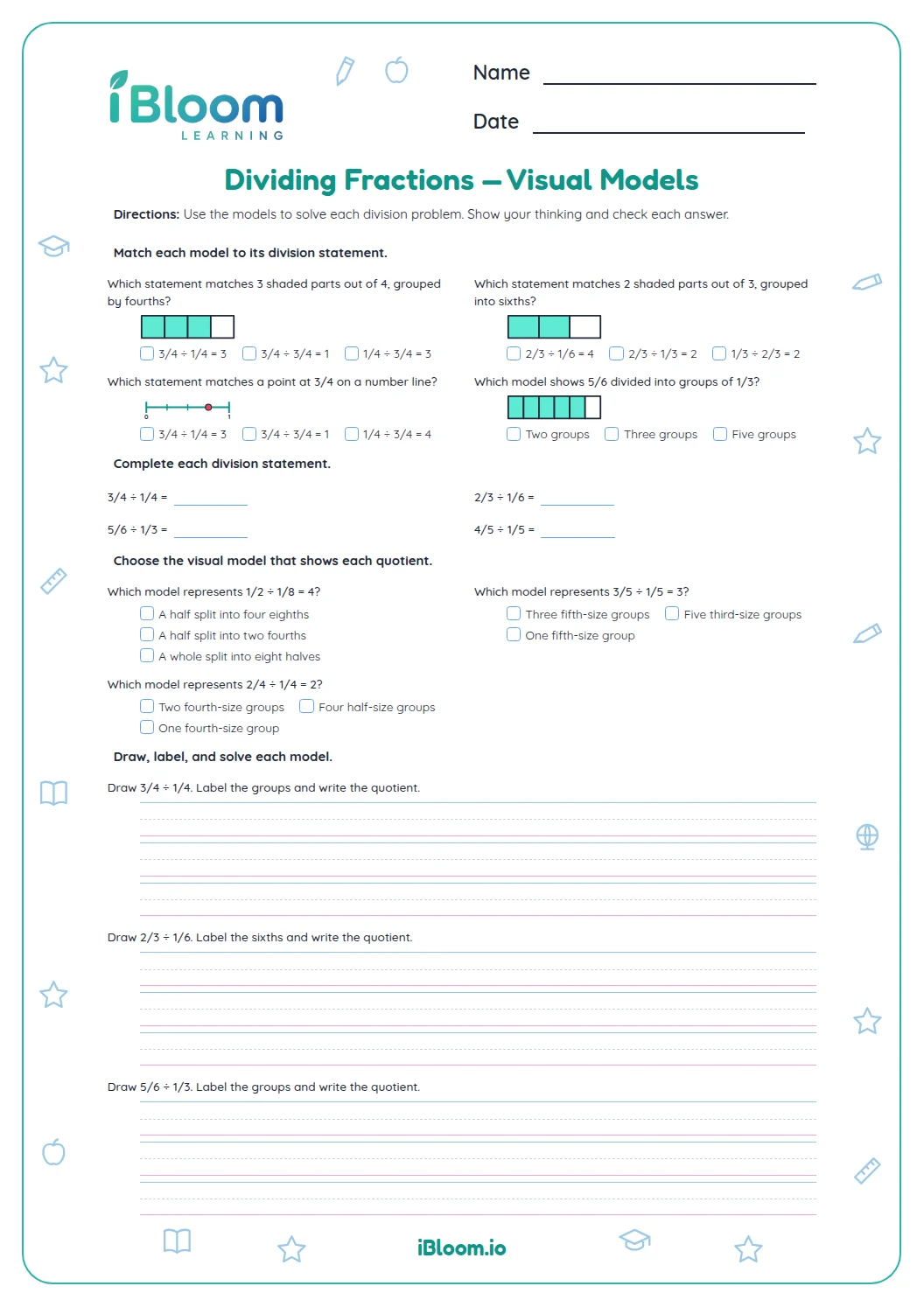
What do the shaded bars show?
Each bar shows the dividend, the amount being divided. The divisor tells how large each group or piece is. For example, question 1 asks how many fourth-size pieces fit into the three shaded fourths.
- 13/4 ÷ 1/2
- 2Multiply by the reciprocal: 3/4 × 2/1
- 36/4 = 3/2
- 4As a mixed number: 1 1/2
- Part A: four model-based piece questions
- Part B: eight fraction and mixed-number quotients
- Part C: two measurement stories
How does the reciprocal strategy work?
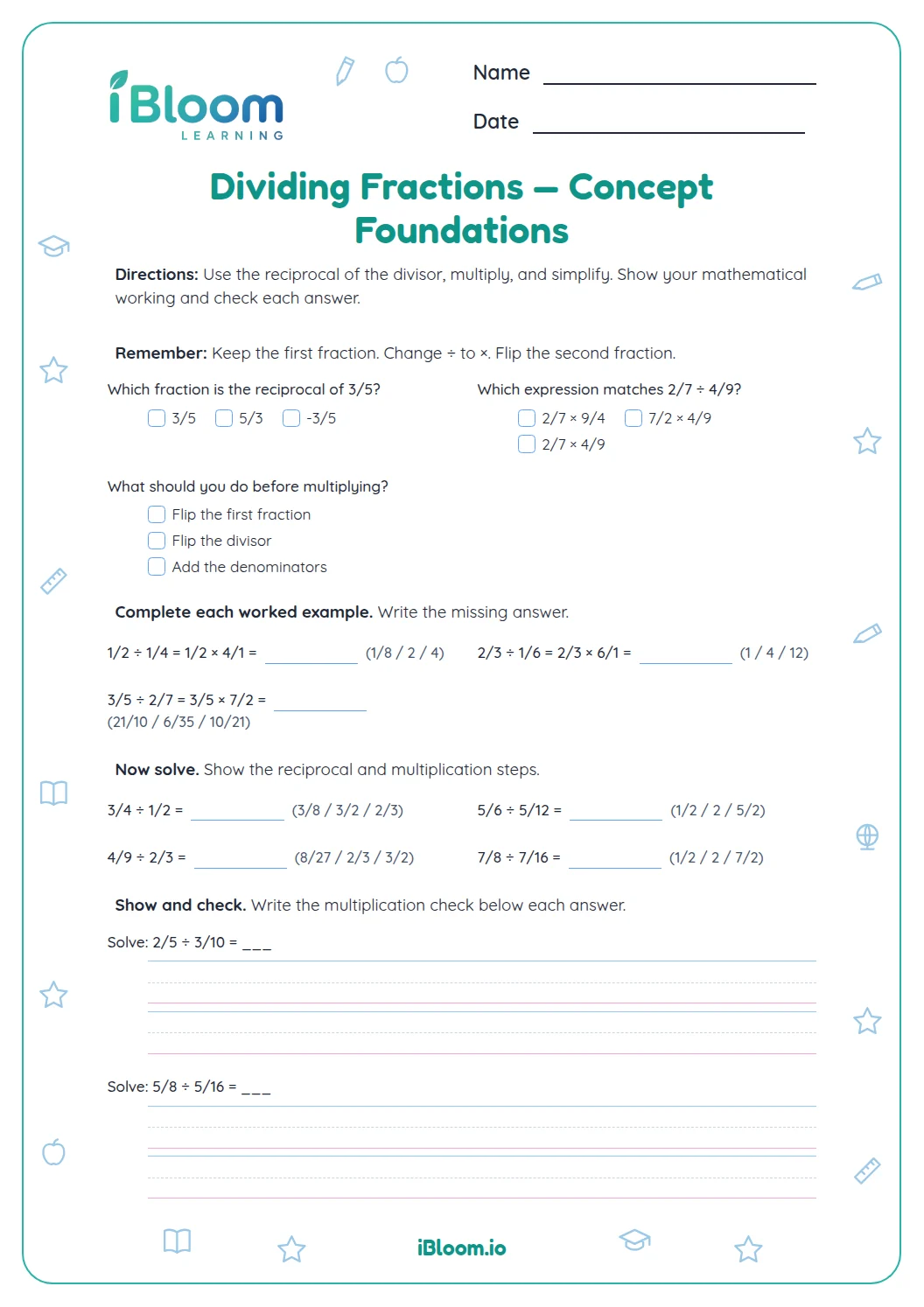
Keep the first fraction, change division to multiplication, and flip the second fraction. Multiply the numerators and denominators, then simplify or write an improper fraction as a mixed number. The model can help you judge whether the quotient is reasonable.
How do the story problems use division?
Both stories ask how many equal-size portions fit into a total amount. Divide the total ribbon length or batch size by the length or volume of one portion, and label the quotient as pieces or servings.
How to use this worksheet
- 1Read the shaded bar as the dividend before calculating.
- 2Copy the divisor carefully; it is the amount in one group.
- 3Keep the first fraction, change ÷ to ×, and flip the second fraction.
- 4Multiply across and simplify the quotient.
- 5Check the size of the answer against the shaded amount and divisor.
Check these common slips
The mistake
Flipping the dividend instead of the divisor.
The fix
Keep the first fraction as written; take the reciprocal of the second fraction only.
The mistake
Multiplying instead of changing division to multiplication by a reciprocal.
The fix
Write the reciprocal step explicitly before multiplying.
The mistake
Dropping the whole-number part of a mixed-number quotient.
The fix
Convert a mixed number to an improper fraction before dividing, then simplify the result.
Curriculum alignment
This worksheet practices the standard below through its printed problems.
Compute quotients of fractions and solve fraction-division problems.
On this sheet: The models represent dividend amounts; the equations and stories ask learners to find quotients of fractions and mixed numbers.
Show the official wordingHide the official wording
Interpret and compute quotients of fractions, and solve word problems involving division of fractions by fractions.
What to practice next
Make more practice
Further reading
Questions parents and teachers ask
How do you divide one fraction by another?
Keep the first fraction, change the division sign to multiplication, and use the reciprocal of the second fraction. For question 6, 3/4 ÷ 1/2 becomes 3/4 × 2/1, which equals 6/4 or 1 1/2. Then check whether that quotient makes sense for the amounts. Learners can simplify the final quotient or express an improper fraction as a mixed number.
What do the shaded models represent?
Each shaded bar represents the dividend, or amount being split. It does not directly draw the size of every group. Read the divisor in the question, then use it to decide how many groups of that size fit into the shaded amount.
Does the sheet include mixed numbers?
Yes. Questions 9 through 12 divide mixed numbers or divide a mixed number by a fraction. Convert each mixed number to an improper fraction first, use the reciprocal strategy, and simplify. The two final story problems also apply fraction division to measurements and servings.
What standard does this worksheet practice?
CCSS 6.NS.A.1 asks students to interpret and compute quotients of fractions and solve division word problems. The sheet practices this with fraction equations, shaded dividend models, mixed numbers, and two situations involving equal-size pieces or servings. The two contexts ask learners to interpret a quotient in a measurement situation.
How many questions and pages are included?
There are 14 questions on two worksheet pages. The first 12 include shaded fraction bars; the last two are word problems with room to write an equation. A separate two-page answer key gives the quotients for checking. Each model is a dividend bar, and the last two prompts provide room to show an equation.
Should answers be simplified?
Yes. Write a quotient in simplest form, using a mixed number when it is greater than one if that is the clearest form. For example, 3/2 is also 1 1/2. The key uses simplified results so learners can compare equivalent forms.