




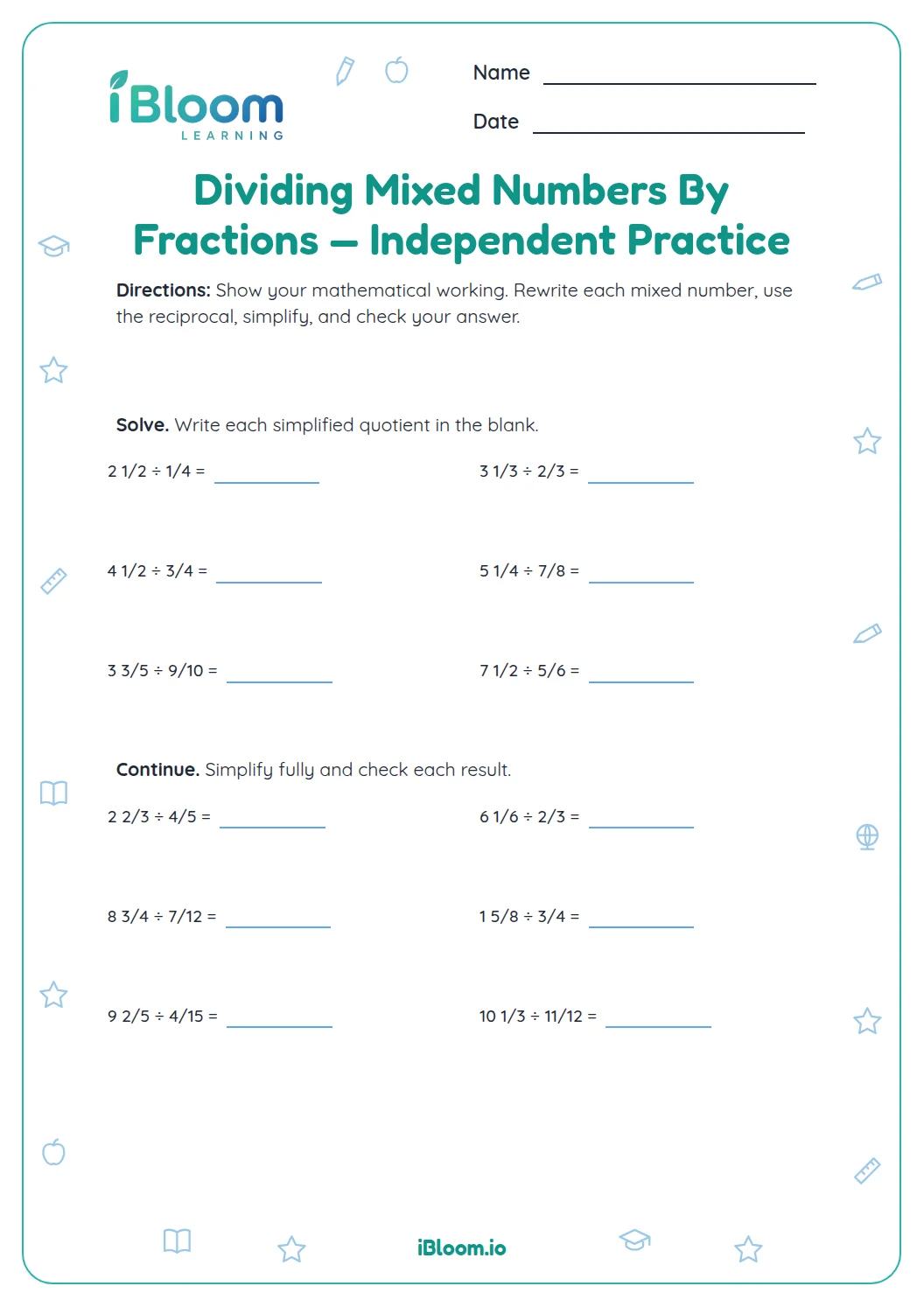
About this worksheet
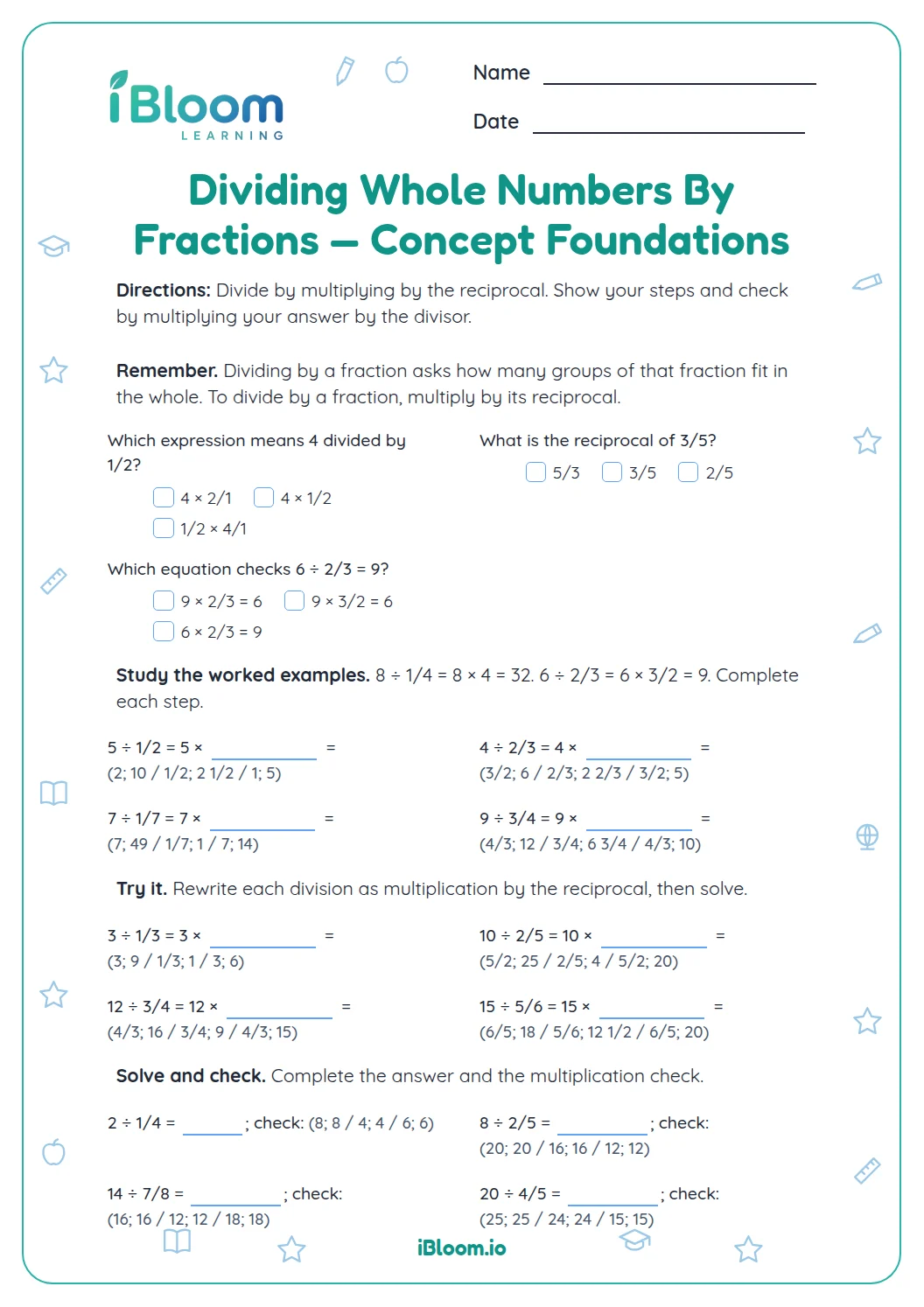
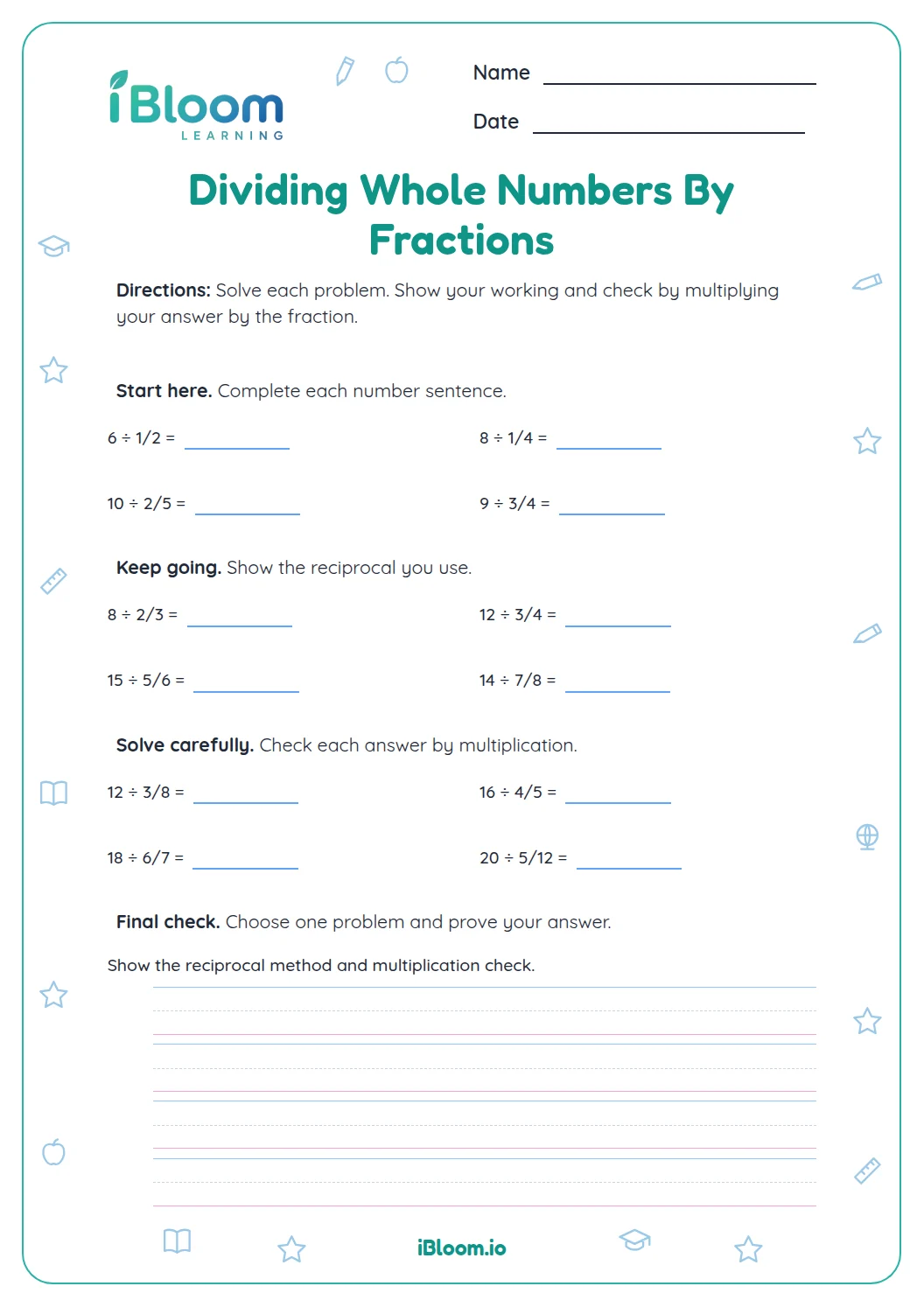
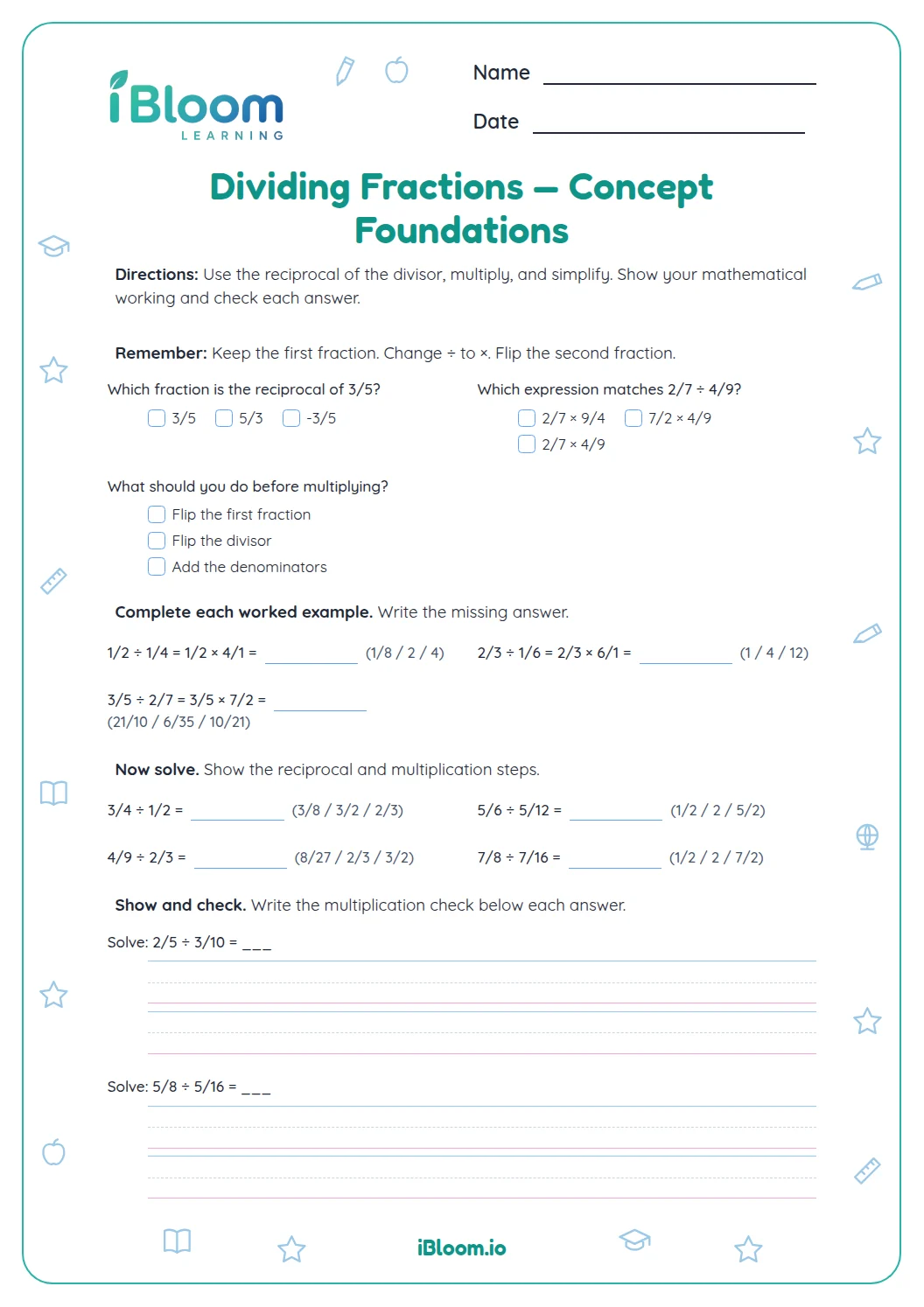
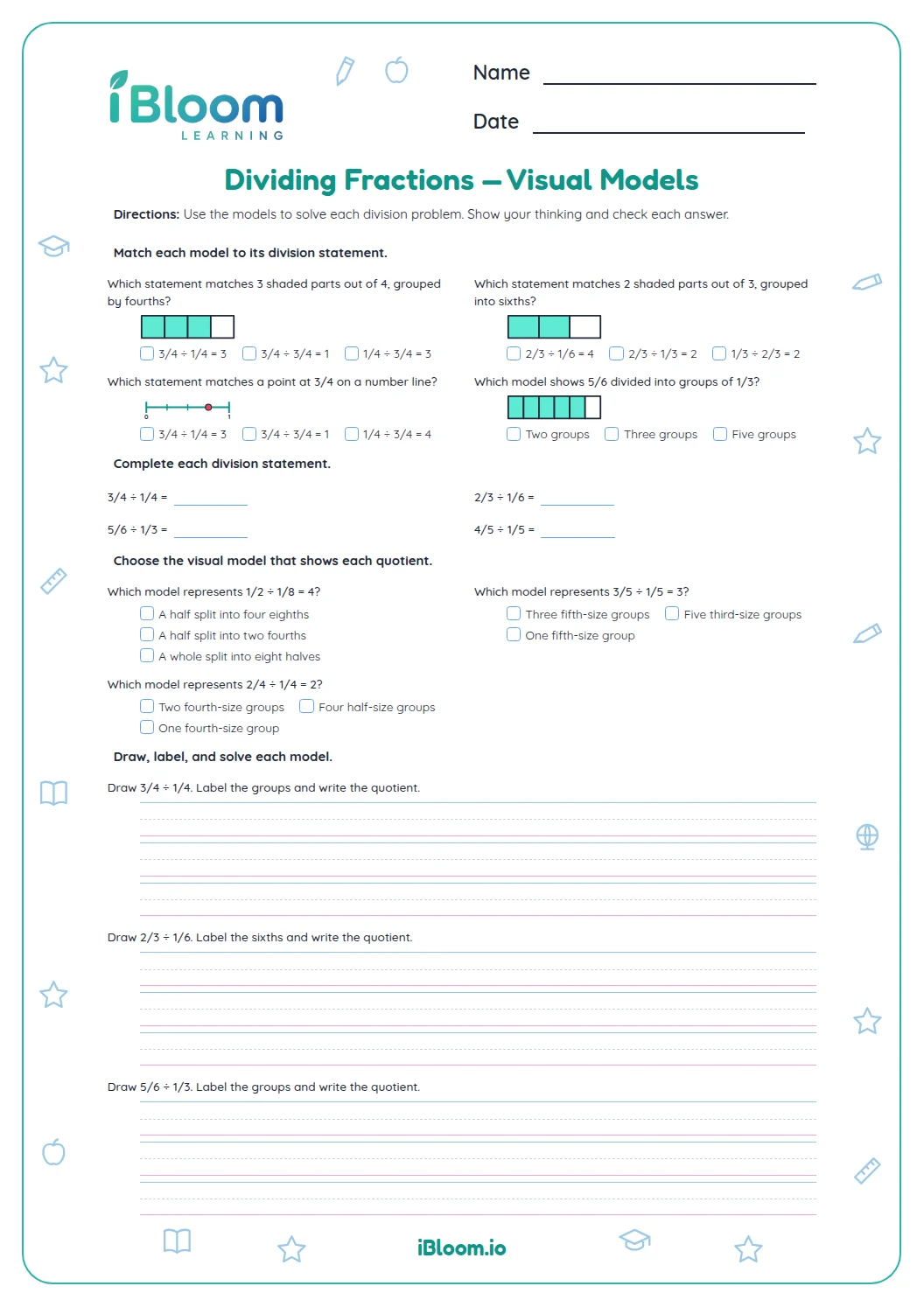
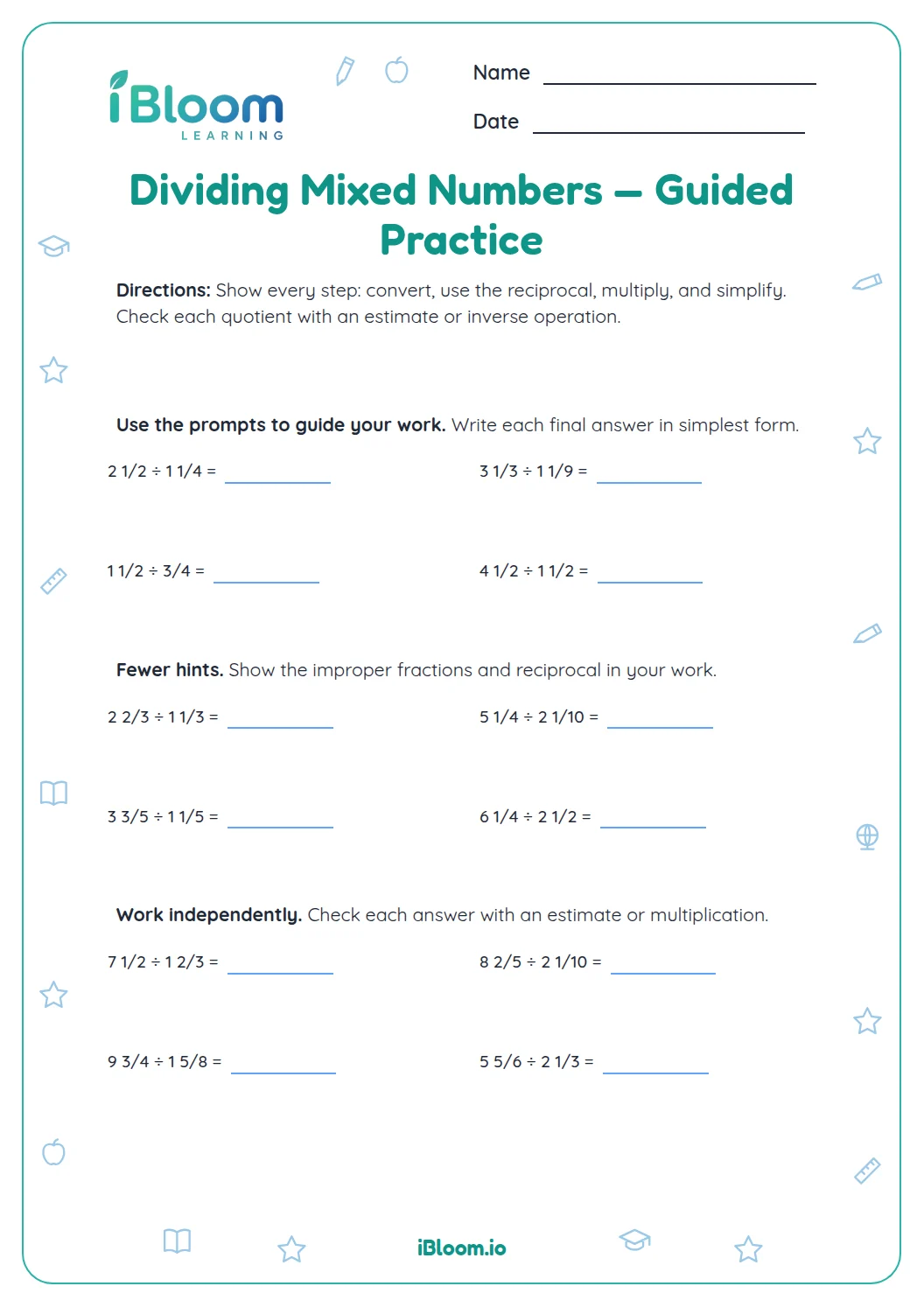
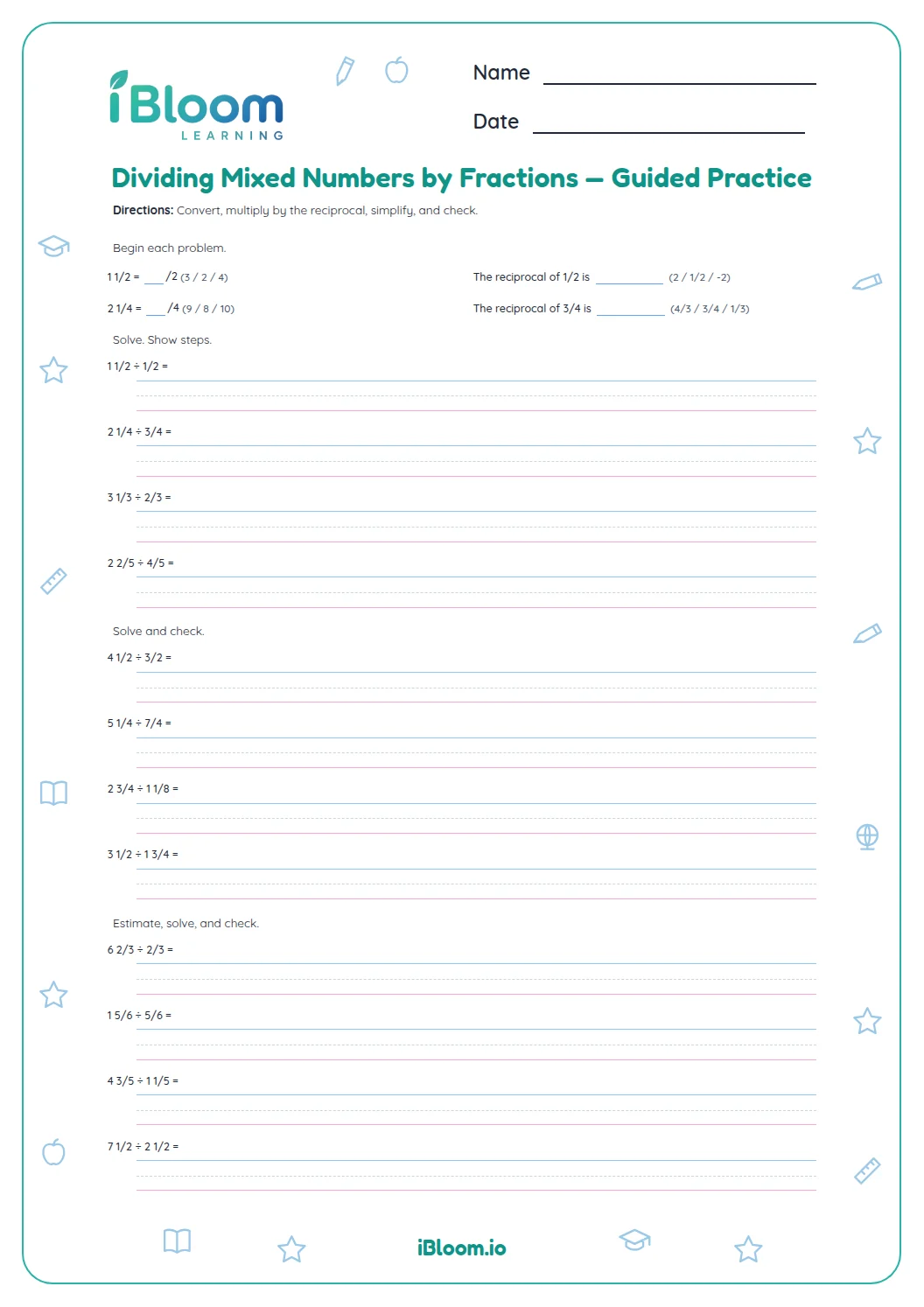
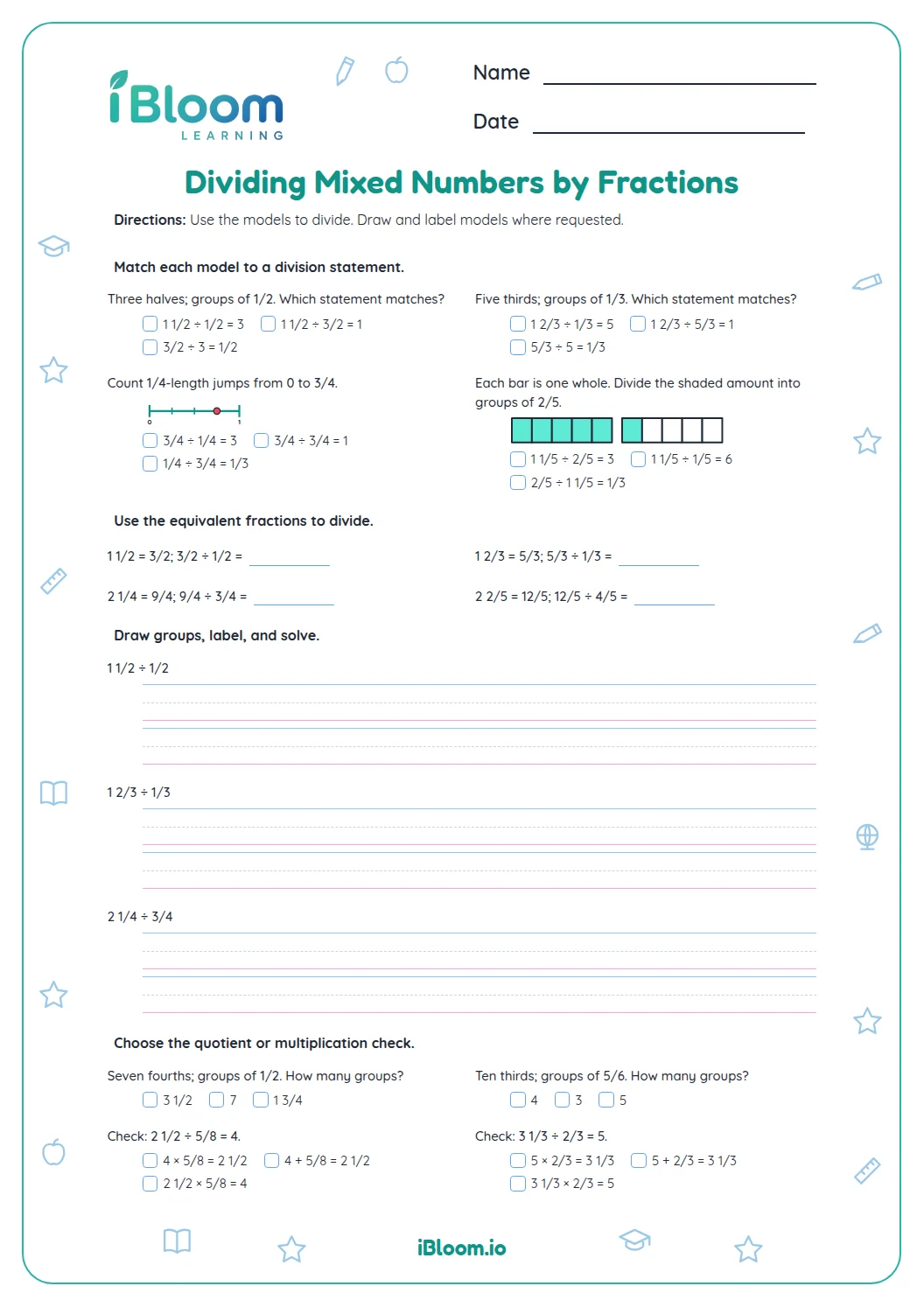
This Grade 6 worksheet has 14 questions on dividing whole numbers by fractions. Learners calculate unit-fraction and non-unit-fraction quotients, compare a quotient with its dividend, and apply the skill to ribbon and recipe contexts. Written reasoning asks learners to connect the quotient to the number of fractional groups.
Aligned to 6.NS.A.1
Why can a quotient be larger than the starting whole number?
When the divisor is less than one, each group is smaller than a whole, so more groups can fit in the dividend. For example, 4 ÷ 1/2 = 8 because eight halves make four wholes.
This Grade 6 worksheet has 14 questions on dividing whole numbers by fractions. Learners calculate unit-fraction and non-unit-fraction quotients, compare a quotient with its dividend, and apply the skill to ribbon and recipe contexts. Written reasoning asks learners to connect the quotient to the number of fractional groups.
Why multiply by the reciprocal?
A quotient asks how many groups of the divisor fit into the dividend. If each group is less than one whole, more than one group can fit in each whole.
For example, 3 ÷ 1/4 asks how many fourths are in 3. There are 4 fourths in each whole, so 3 × 4 = 12 fourths.
- 14 ÷ 2/3 = 4 × 3/2
- 24 × 3/2 = 6
- 3Six groups of 2/3 make 4.
How can I check a quotient?
Multiply the quotient by the divisor. The product should return to the starting whole number. For 4 ÷ 2/3 = 6, check 6 × 2/3 = 4.
What questions are on the sheet?
The worksheet contains 14 questions in 4 parts. The answer key is on a separate page.
- Calculate quotients with unit fractions.
- Simplify quotients with non-unit fractions.
- Compare and explain quotient size.
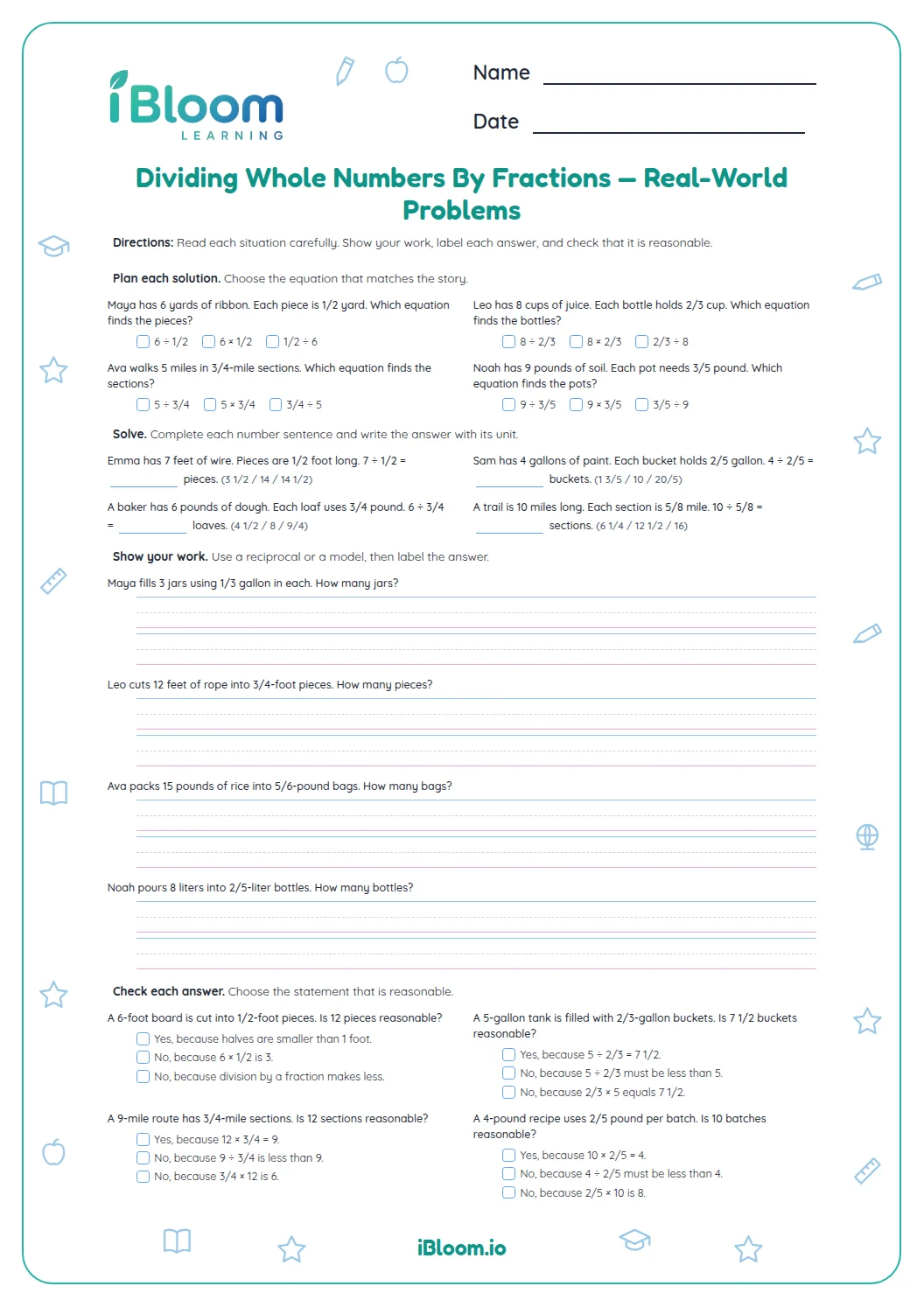
- Solve ribbon and recipe problems.
How to use this worksheet
- 1Read the one-sentence directions and complete each part in order.
- 2Pause at the end of each part to check how you reached an answer.
- 3Use the separate answer key to review answers and revisit any missed item.
- 4For open responses, compare your idea with the sample and explain your thinking.
Common slips to check
The mistake
Multiplying by the same fraction instead of its reciprocal.
The fix
Flip the divisor, then multiply by the reciprocal.
The mistake
Forgetting to simplify a quotient.
The fix
Reduce the fraction or write an equivalent mixed number.
The mistake
Assuming division always makes a number smaller.
The fix
Ask how many fractional-size groups fit in the whole-number amount.
Curriculum alignment
Interpret and compute fraction quotients and solve division word problems.
On this sheet:
Show the official wordingHide the official wording
Interpret and compute quotients of fractions, and solve word problems involving division of fractions by fractions, e.g., by using visual fraction models and equations to represent the problem. For example, create a story context for (2/3) ÷ (3/4) and use a visual fraction model to show the quotient; use the relationship between multiplication and division to explain that (2/3) ÷ (3/4) = 8/9 because 3/4 of 8/9 is 2/3. (In general, (a/b) ÷ (c/d) = ad/bc.) How much chocolate will each person get if 3 people share 1/2 lb of chocolate equally? How many 3/4-cup servings are in 2/3 of a cup of yogurt? How wide is a rectangular strip of land with length 3/4 mi and area 1/2 square mi?.
What to practice next
Make more practice
Further reading
Questions parents and teachers ask
Why can dividing by a fraction give a larger number?
The quotient counts how many groups of the divisor fit into the whole number. A fraction smaller than one makes small groups, so more groups fit. For example, 4 divided by one-half asks how many half-size groups fit in 4, which is 8.
How do you divide a whole number by a fraction?
Keep the dividend, then multiply by the reciprocal of the divisor. For 4 ÷ 2/3, compute 4 × 3/2 = 6. Check by multiplying the quotient by the divisor: 6 × 2/3 = 4, the starting dividend. This inverse relationship checks the result.
How can a learner check a fraction division answer?
Multiply the quotient by the divisor. The product should return to the starting whole number. For example, 4 ÷ 2/3 = 6, and 6 × 2/3 = 4. This check can reveal an incorrect reciprocal, multiplication step, or simplification.
What kinds of problems are on this reasoning page?
The page starts with unit-fraction quotients and moves to non-unit fractions. Later questions compare quotient size, ask for short explanations, and use ribbon and recipe situations to show what a quotient counts. Each context asks learners to interpret their computed answer.