



About this worksheet
Practice writing mixed numbers with tenths as decimals. Read two marked number lines, choose equivalent forms, convert values in both directions, and compare decimals. The 14 compact questions and separate answer key fit the two-page target.
Aligned to 4.NF.C.6
How do tenths appear in decimals?
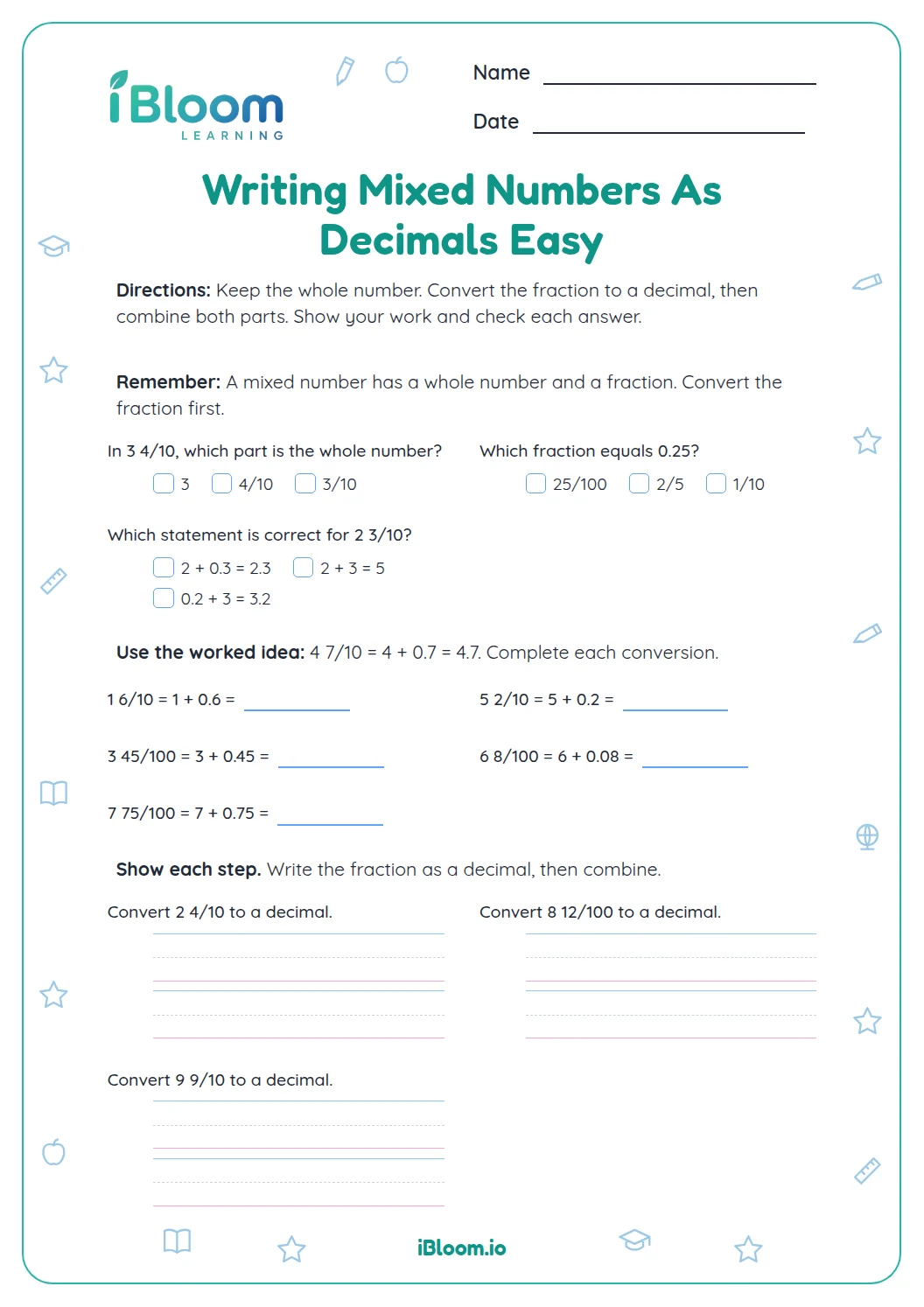
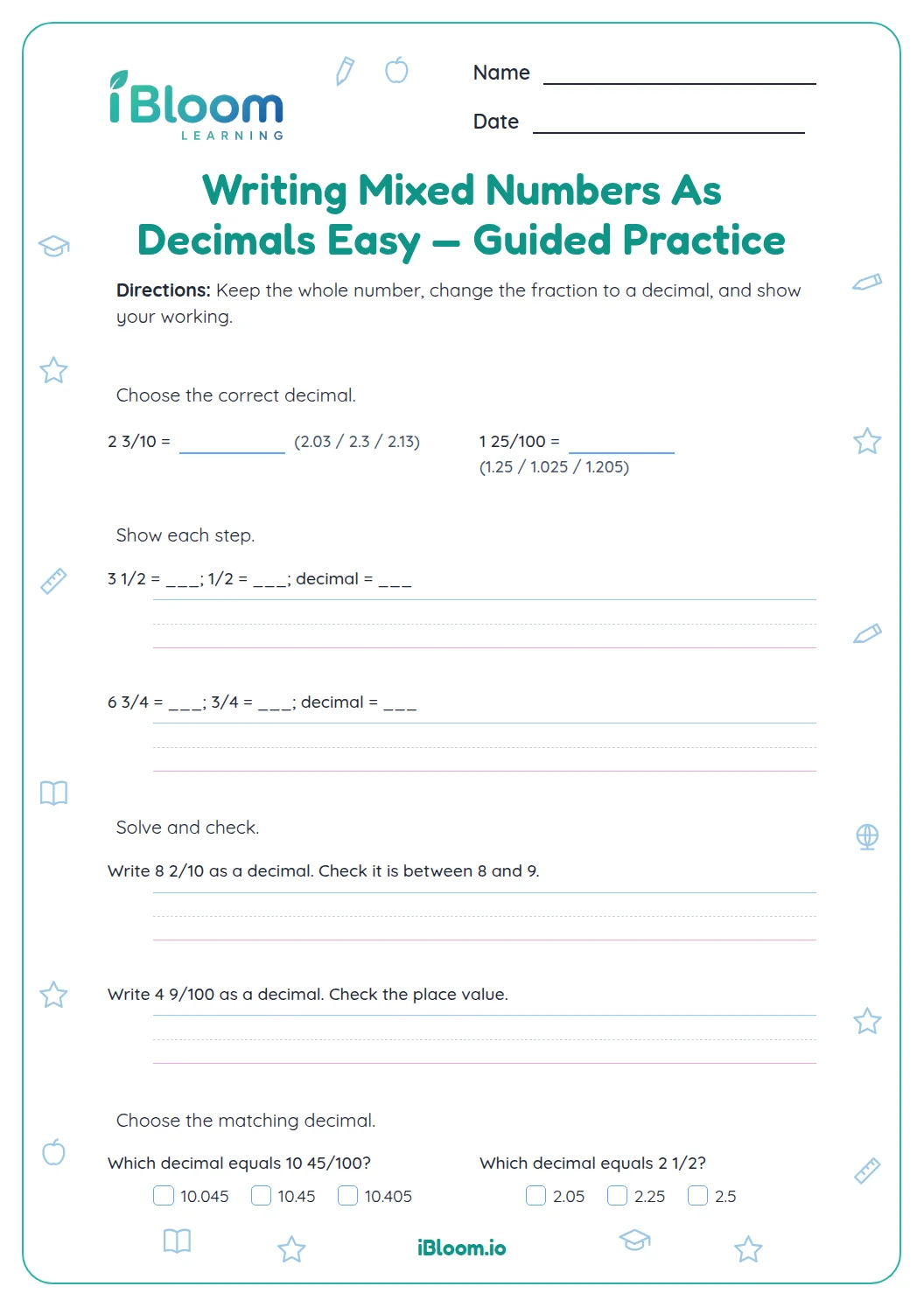
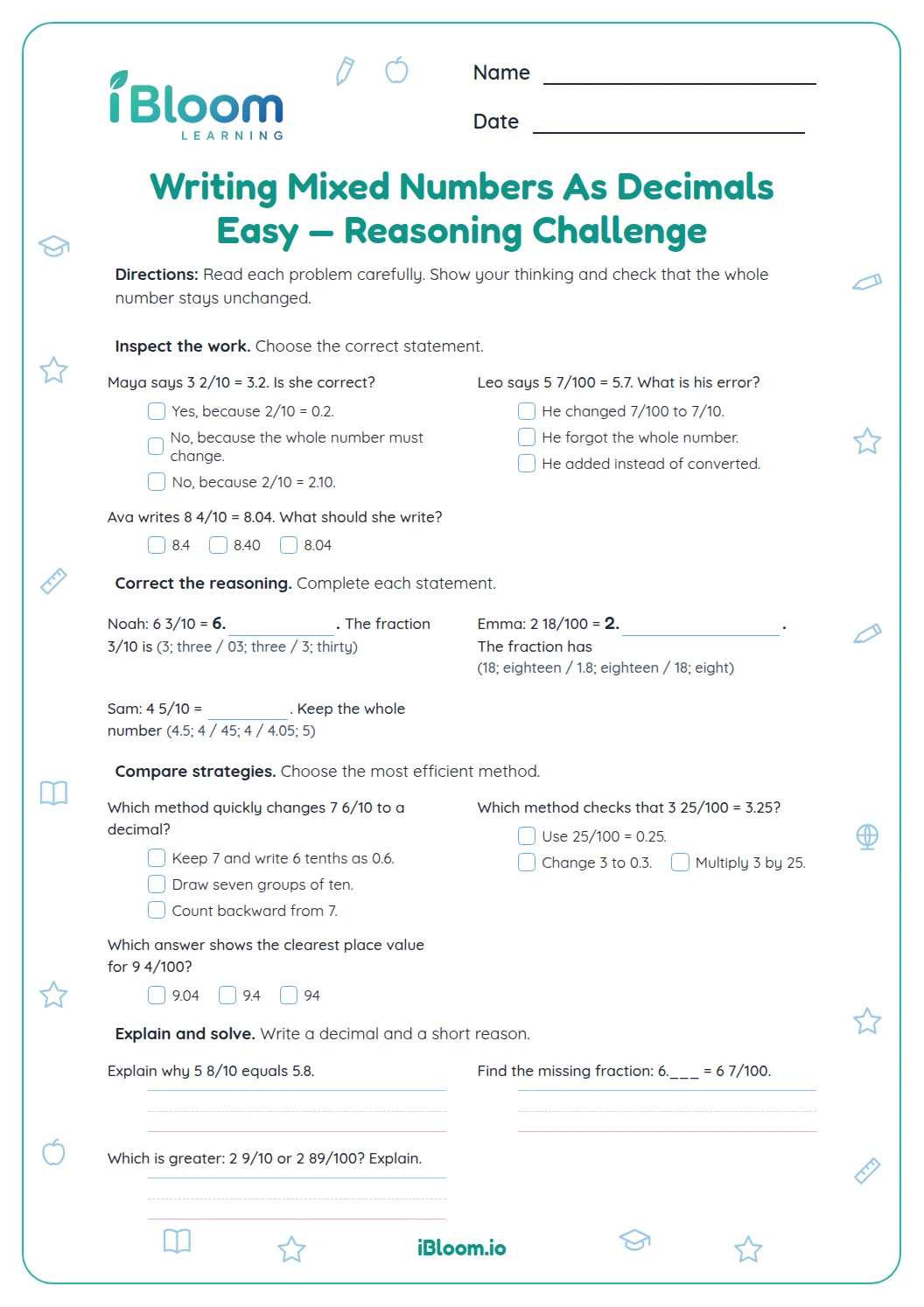
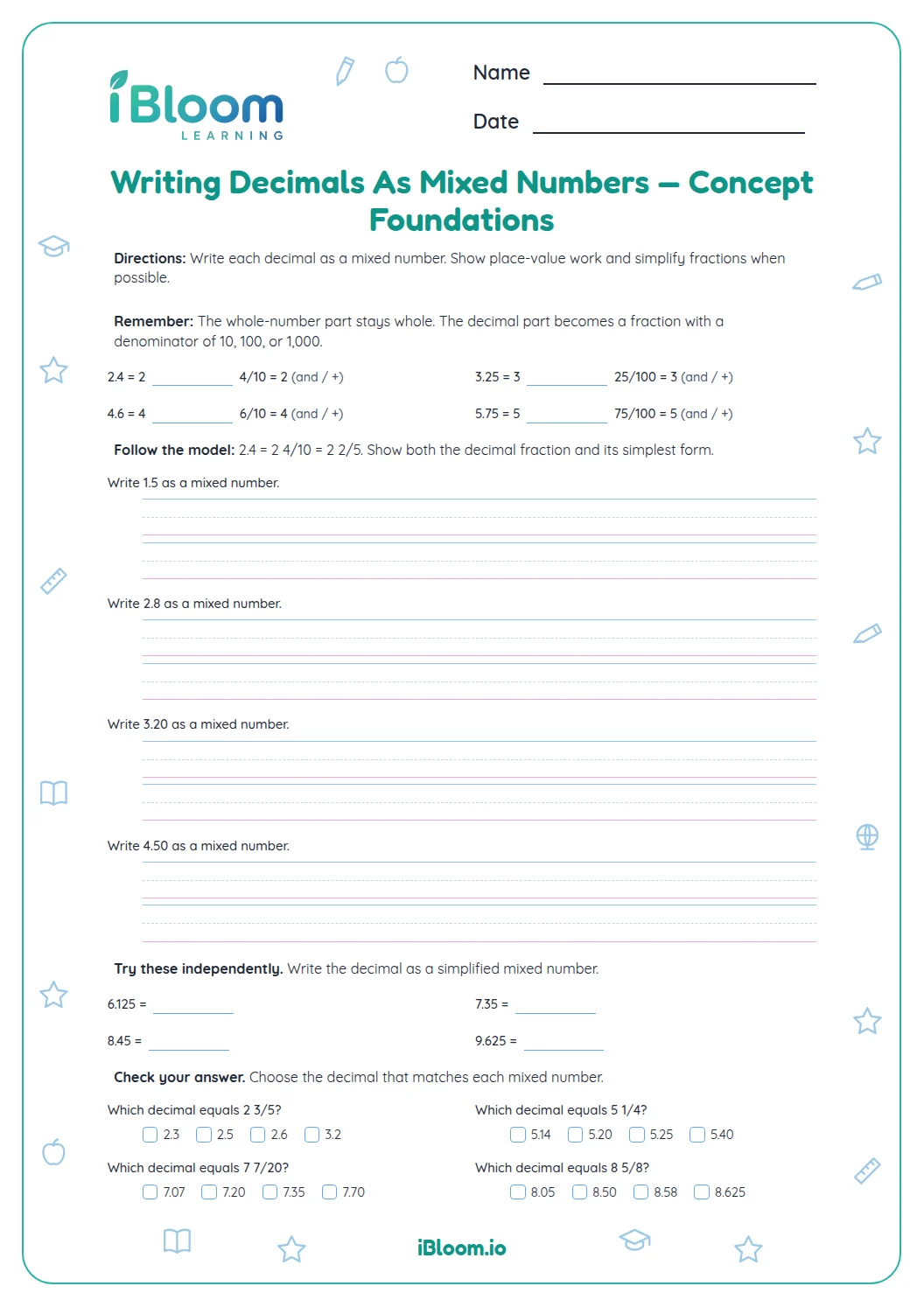
A fraction with denominator 10 names tenths, so its numerator becomes the first digit after the decimal point. Keep the whole-number part before the point: 2 4/10 = 2.4.
How do number lines show mixed numbers?
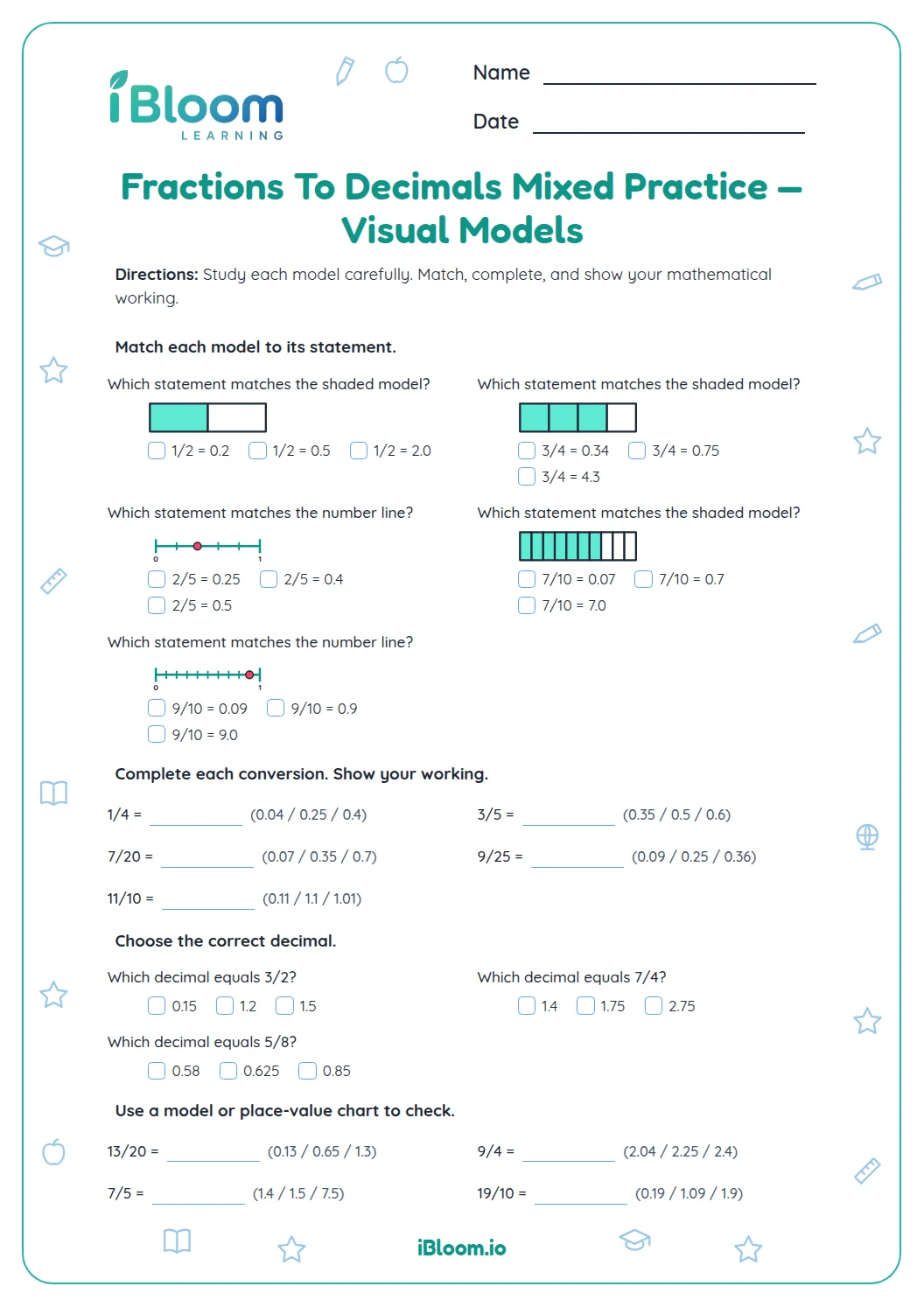
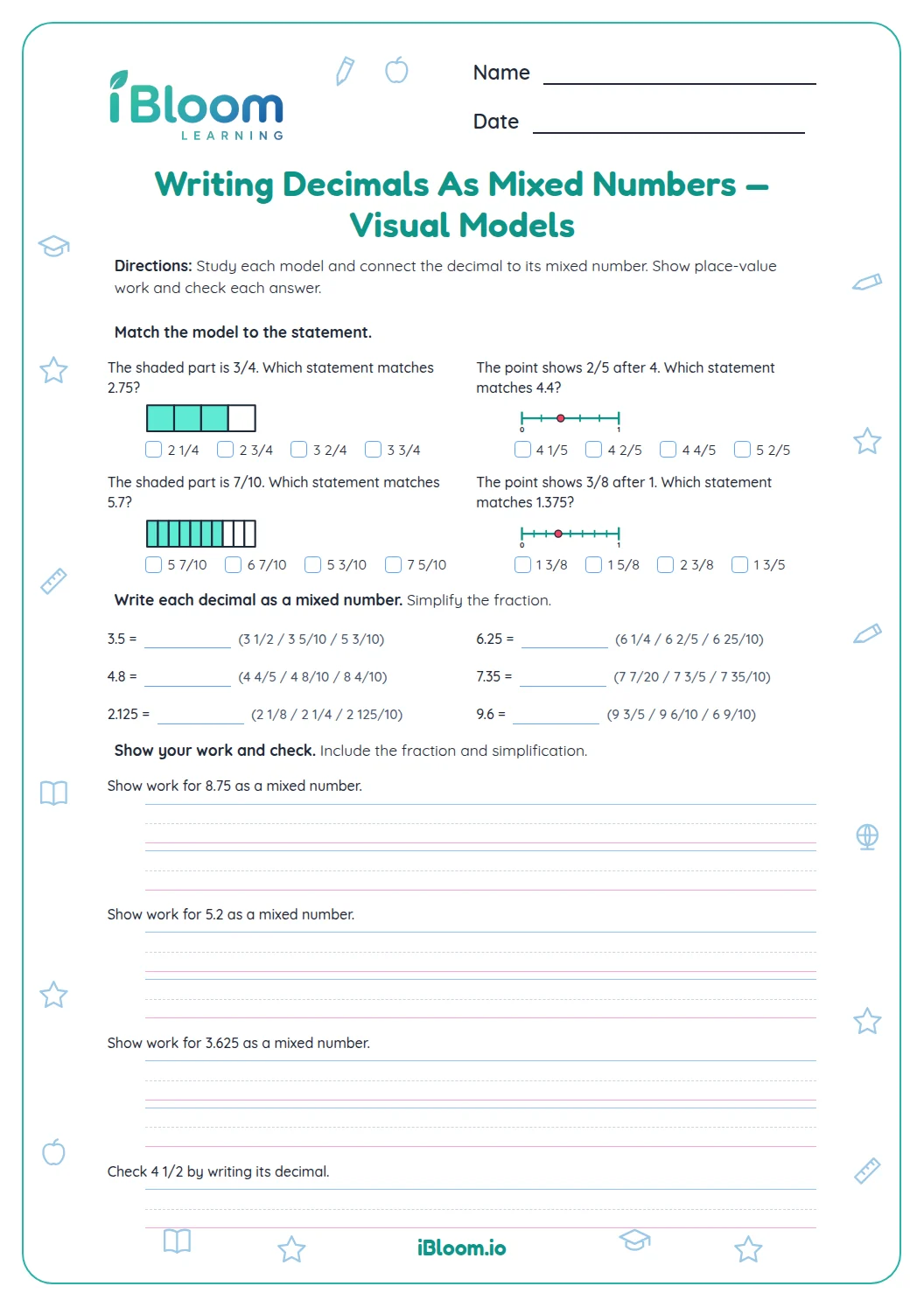
Each line spans one whole and is divided into tenths. Start at the whole-number tick and count to the marked point; the number of tenths gives the decimal digit.
How do you compare decimal values?
Line up the decimal points and compare place values from left to right. For question 14, 3 6/10 is 3.60, which is greater than 3.58.
What is on the practice sheet?
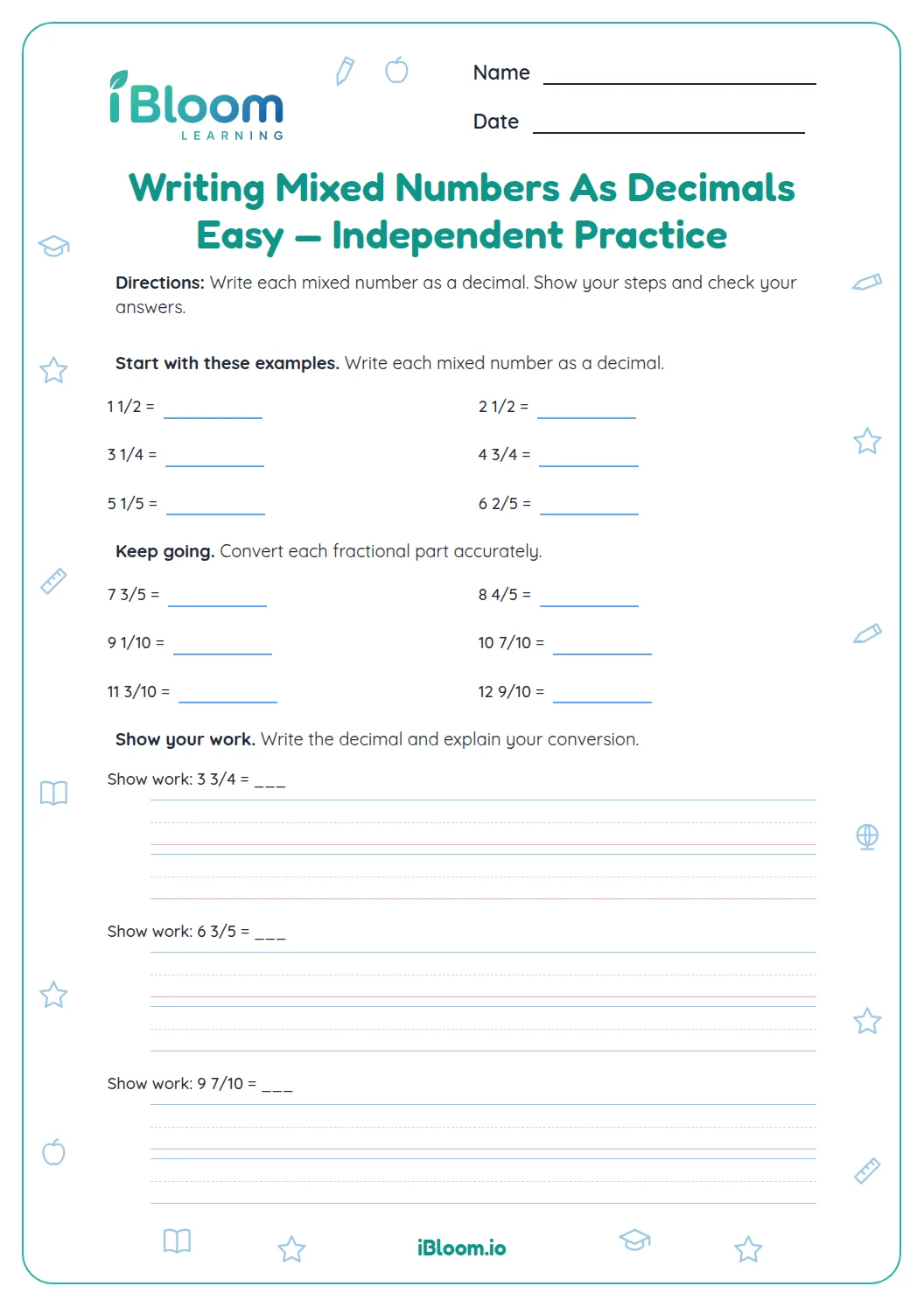
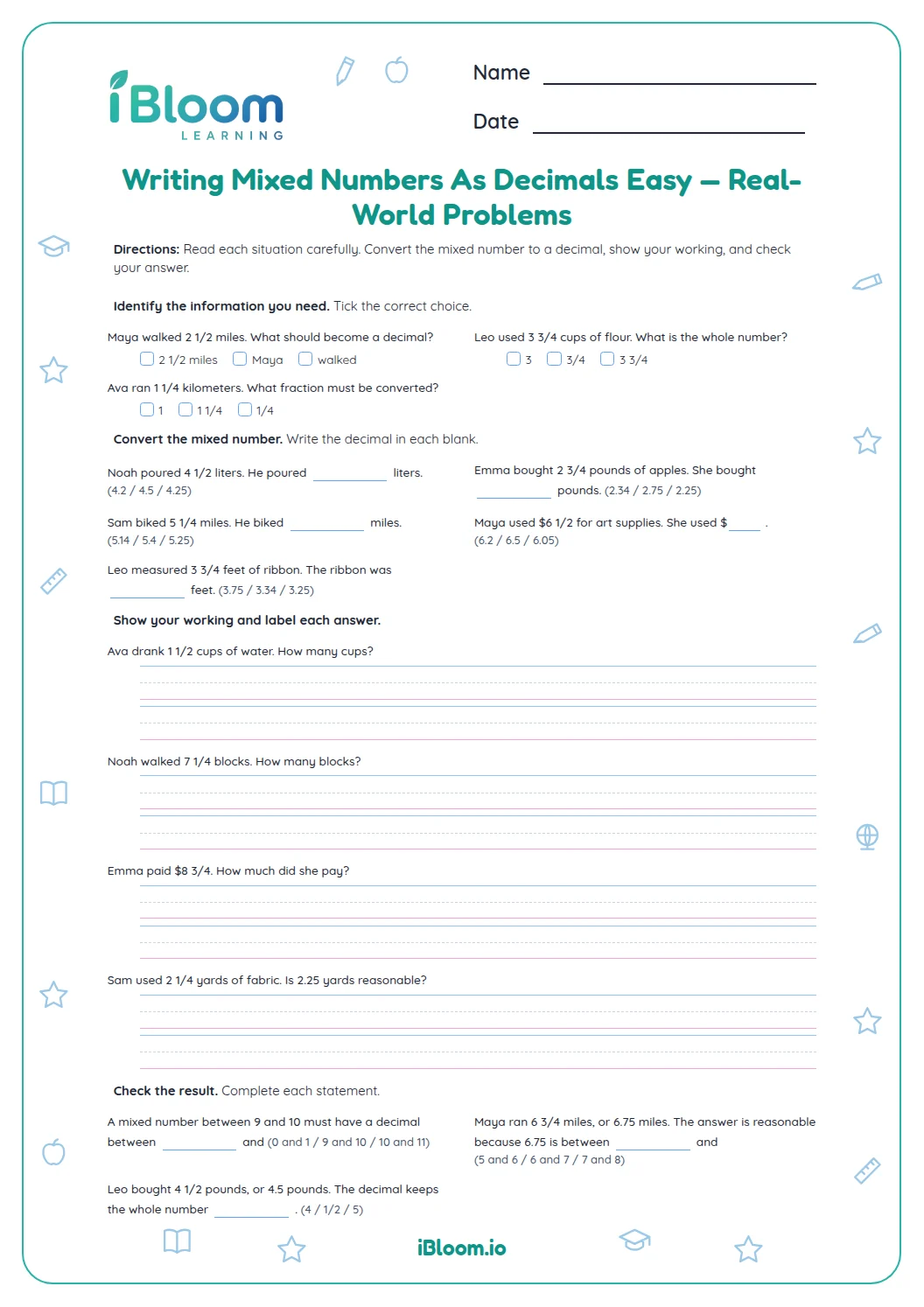
Questions 1 and 2 read tenths number lines. The remaining questions convert mixed numbers, recognize equivalent forms, and compare two decimal values. The separate key has all 14 answers.
A routine for each conversion
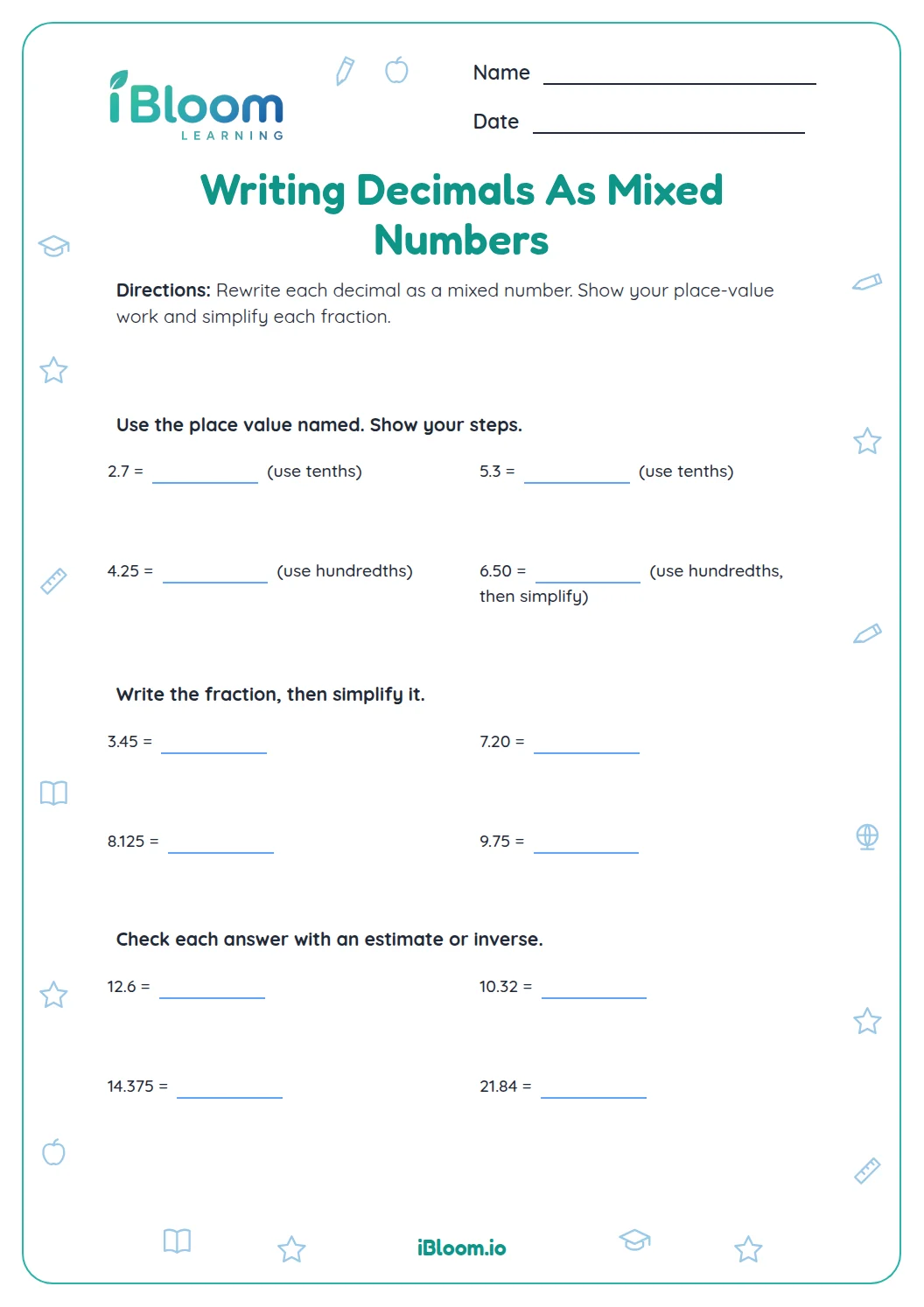
- 1Read the denominator to identify tenths or hundredths.
- 2Write the whole-number part before the decimal point.
- 3Put tenths in the first decimal place and hundredths in the second.
- 4Use a zero placeholder when the tenths digit is zero.
- 5Compare decimals by lining up decimal points.
Common decimal mix-ups
The mistake
Writing 3 8/100 as 3.8.
The fix
Say “eight hundredths” and write 0 in the tenths place: 3.08.
The mistake
Dropping the whole-number part.
The fix
Copy the whole number to the left of the decimal point before converting the fraction.
The mistake
Comparing 3.6 and 3.58 by digit count.
The fix
Rewrite 3.6 as 3.60, then compare hundredths.
Curriculum alignment
Write fractions with denominators 10 or 100 in decimal notation.
On this sheet: Questions convert tenths and hundredths between fraction and decimal notation.
Show the official wordingHide the official wording
Use decimal notation for fractions with denominators 10 or 100.
What to practice next
Make more practice
Further reading
Questions parents and teachers ask
How do you convert tenths to decimals?
A fraction with denominator 10 names tenths, so its numerator becomes the first digit after the decimal point. For example, 4 6/10 is 4.6. Count the whole number separately, then write the tenths digit in the tenths place. This page uses that idea in its model questions.
Why is 3 8/100 written as 3.08?
Eight hundredths belongs in the second decimal place. The tenths place is empty, so write a zero there: 3.08. Writing 3.8 would mean 3 and 8 tenths, a larger value. Compare place names before placing the digits in the decimal.
What do the shaded models show?
A fully shaded strip represents one whole. The shaded parts of the next strip show tenths of another whole. Count complete wholes first, then name the tenths digit. The worksheet uses strips divided into ten equal parts to show mixed numbers.
What does question 14 ask learners to compare?
It asks whether 3 6/10 is less than, equal to, or greater than 3.58. Write 3 6/10 as 3.6, or 3.60, and compare hundredths: 60 hundredths is greater than 58 hundredths. Therefore, the correct comparison symbol is greater than.
Which Common Core standard is practiced?
CCSS 4.NF.C.6 connects fractions with denominators 10 or 100 to decimal notation. The conversion questions use tenths and hundredths, including mixed numbers, to practice that connection. The shaded models make the place values visible as learners read and write decimals.