



About this worksheet
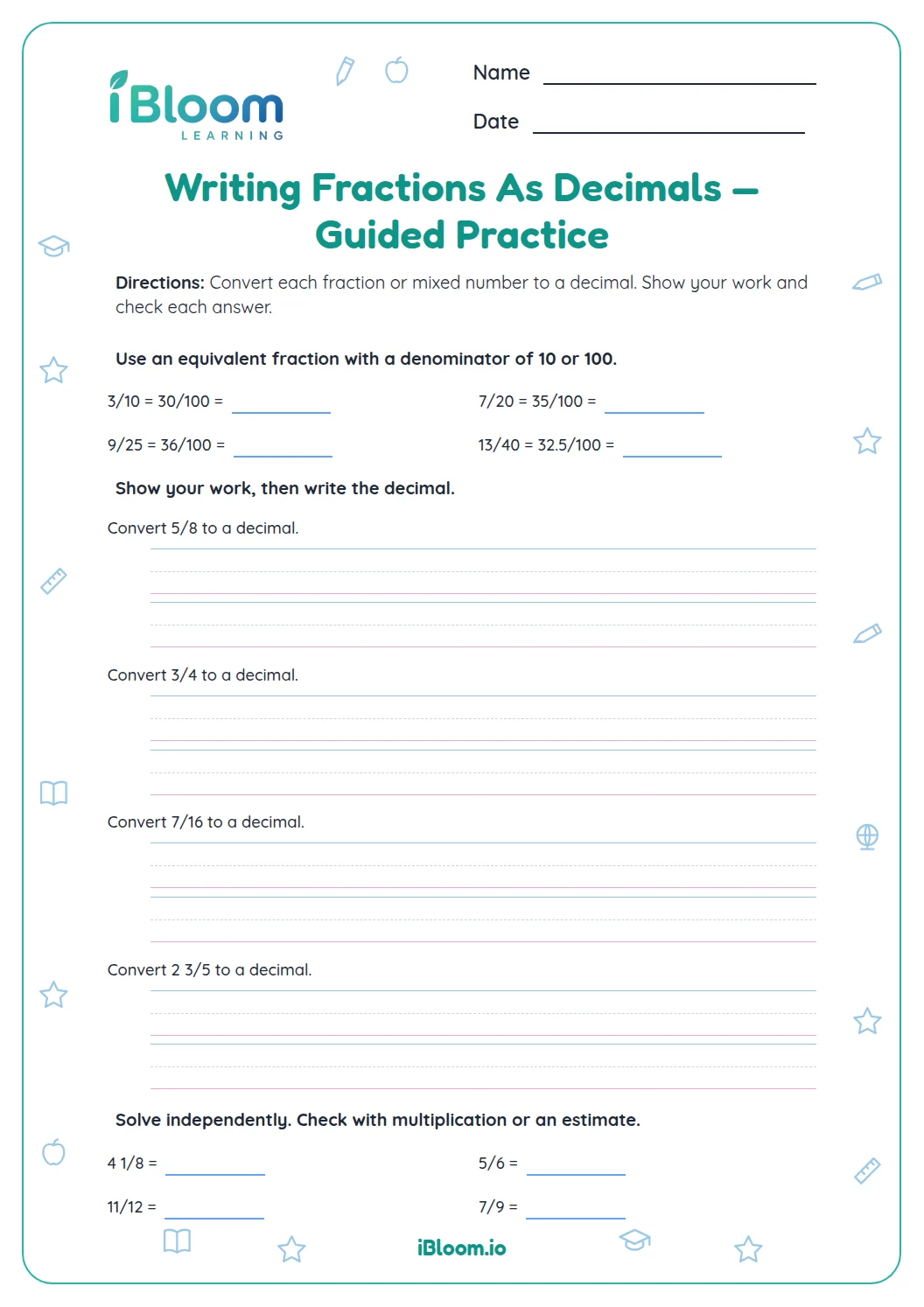
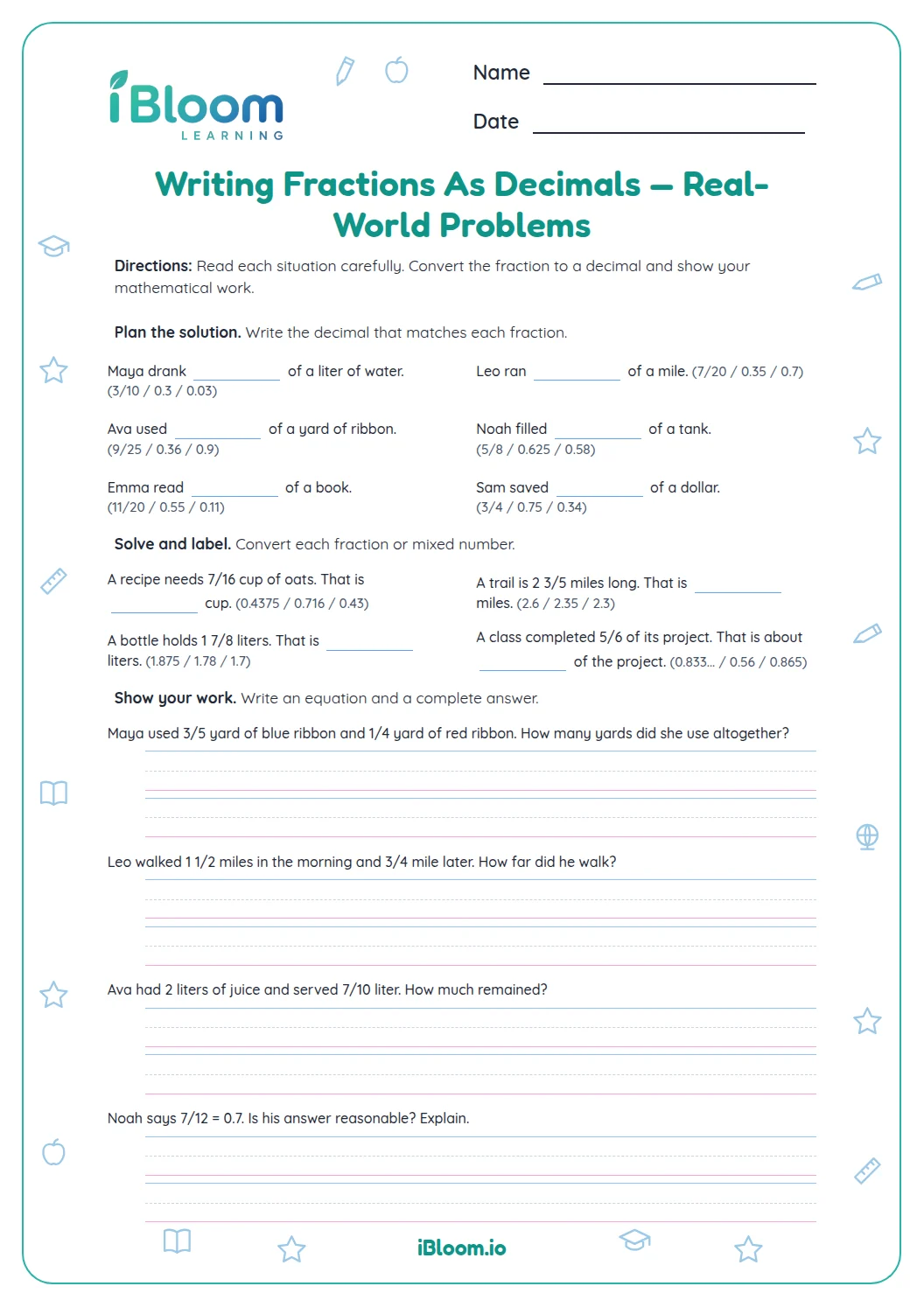
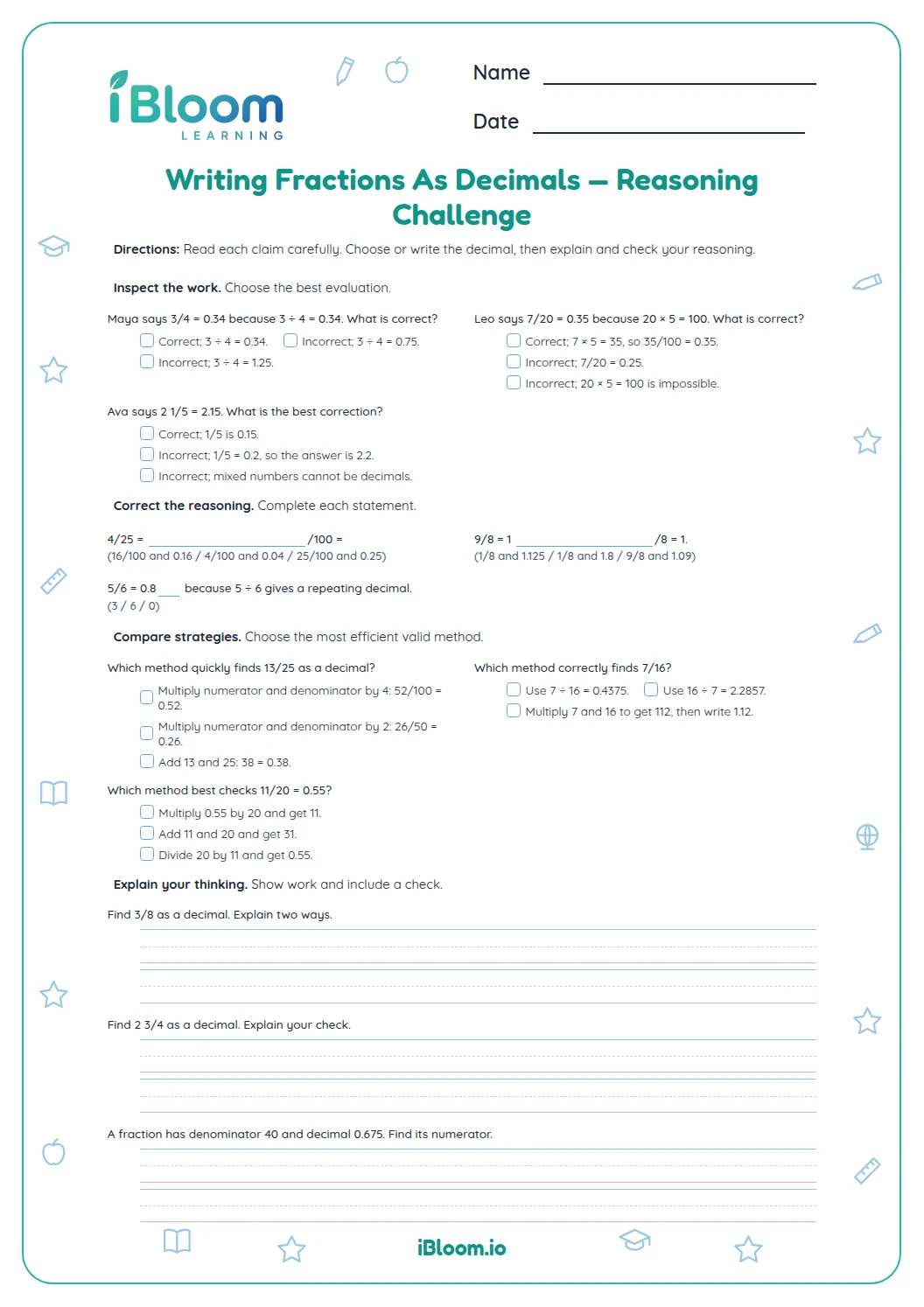
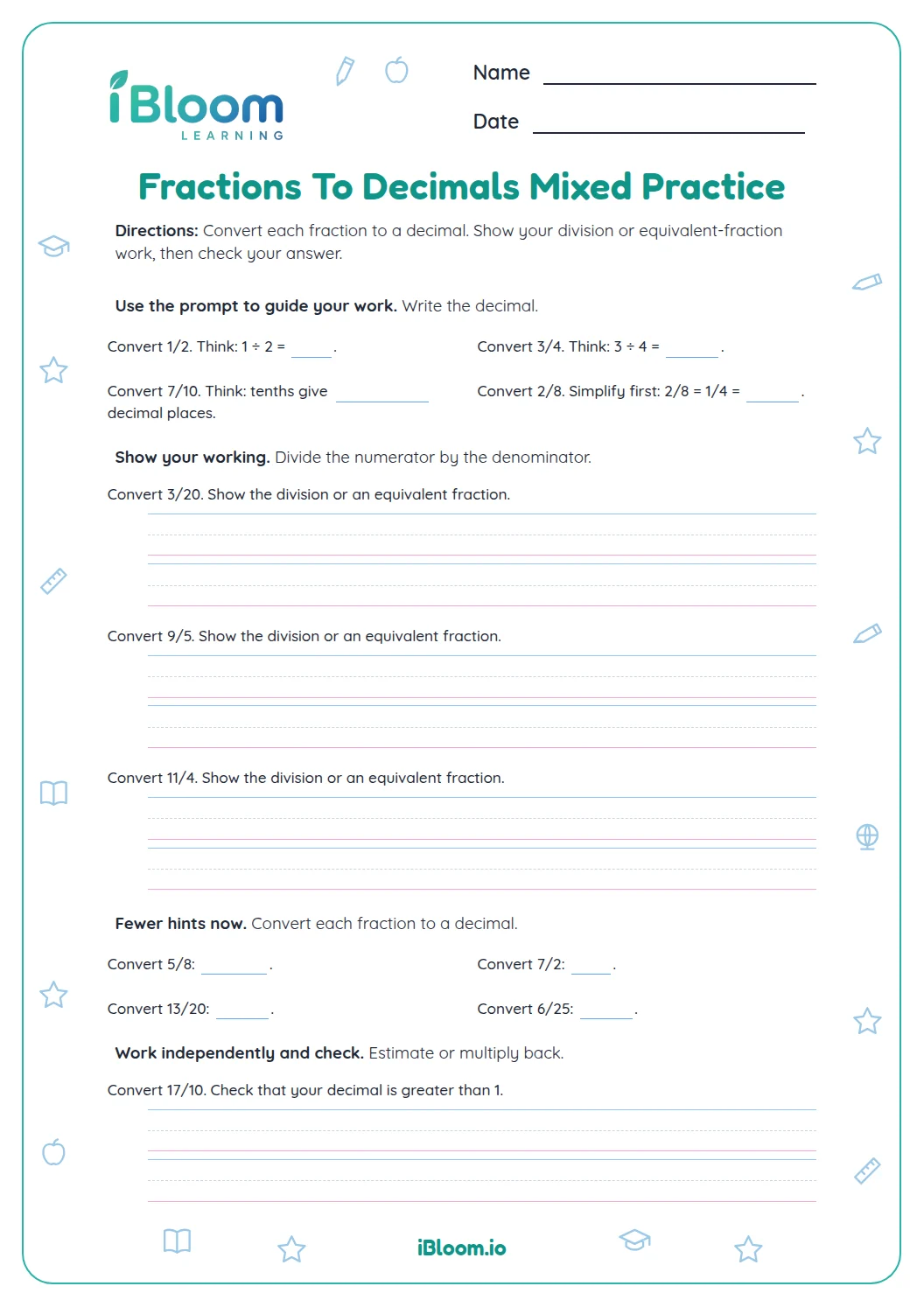
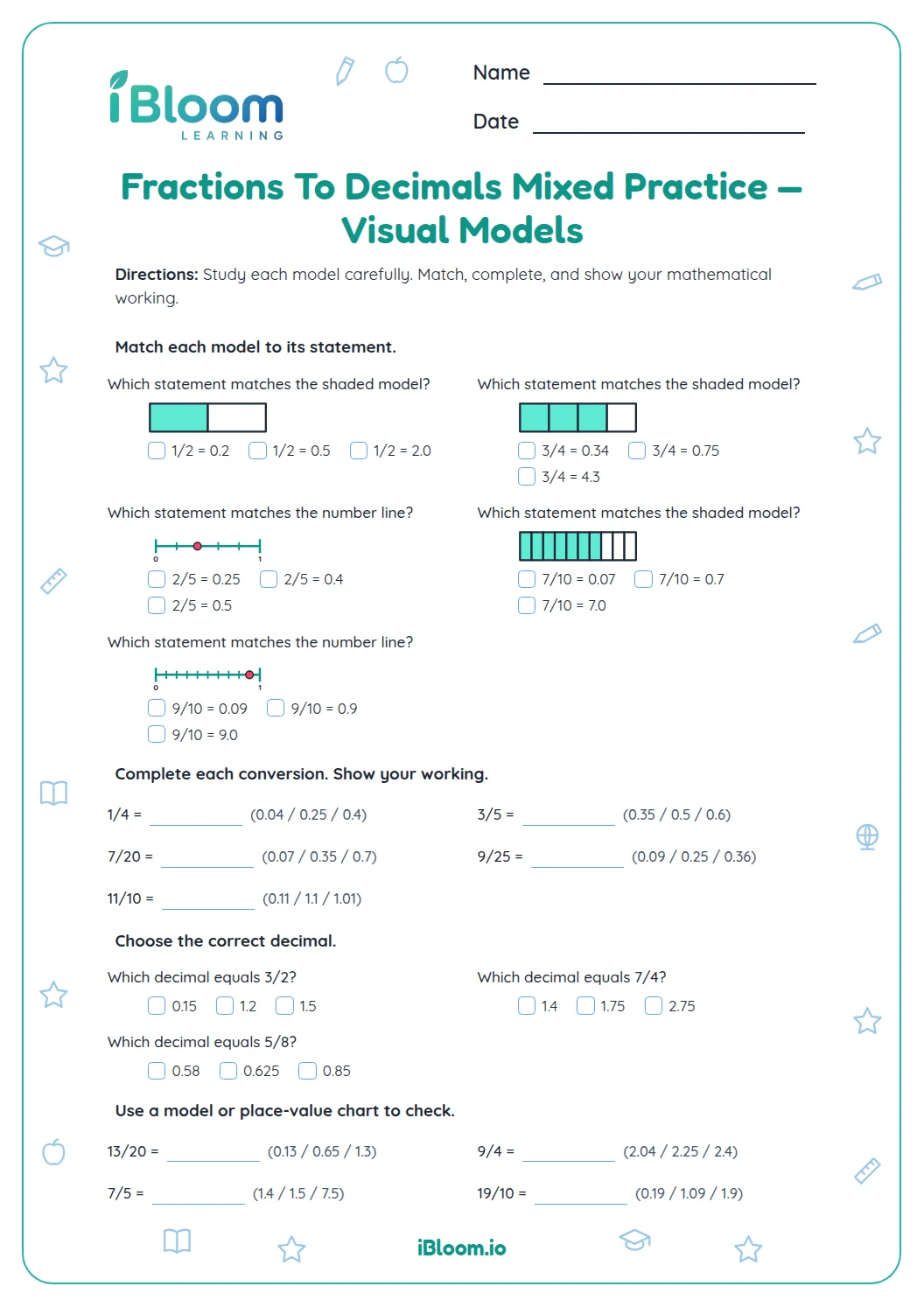
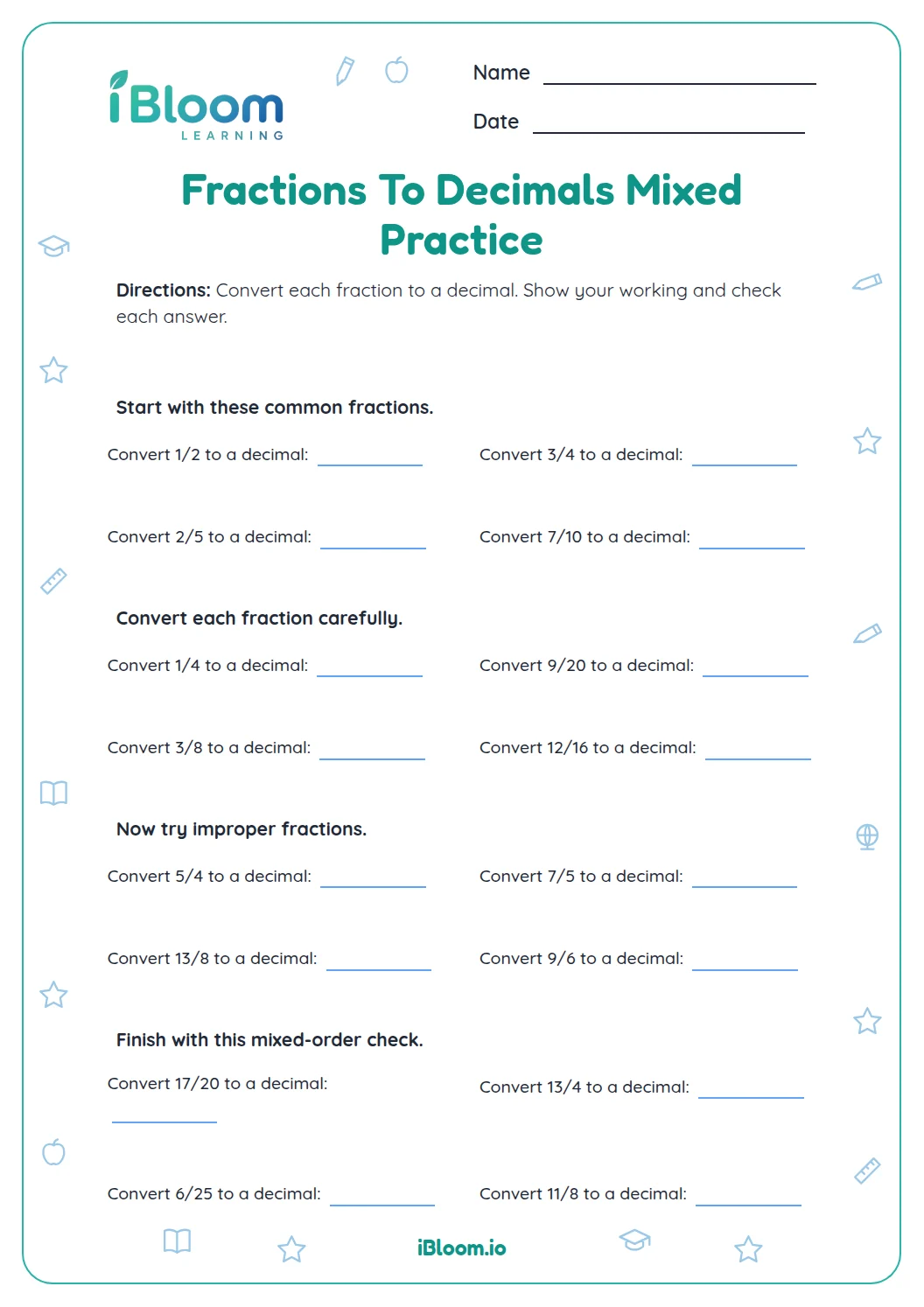
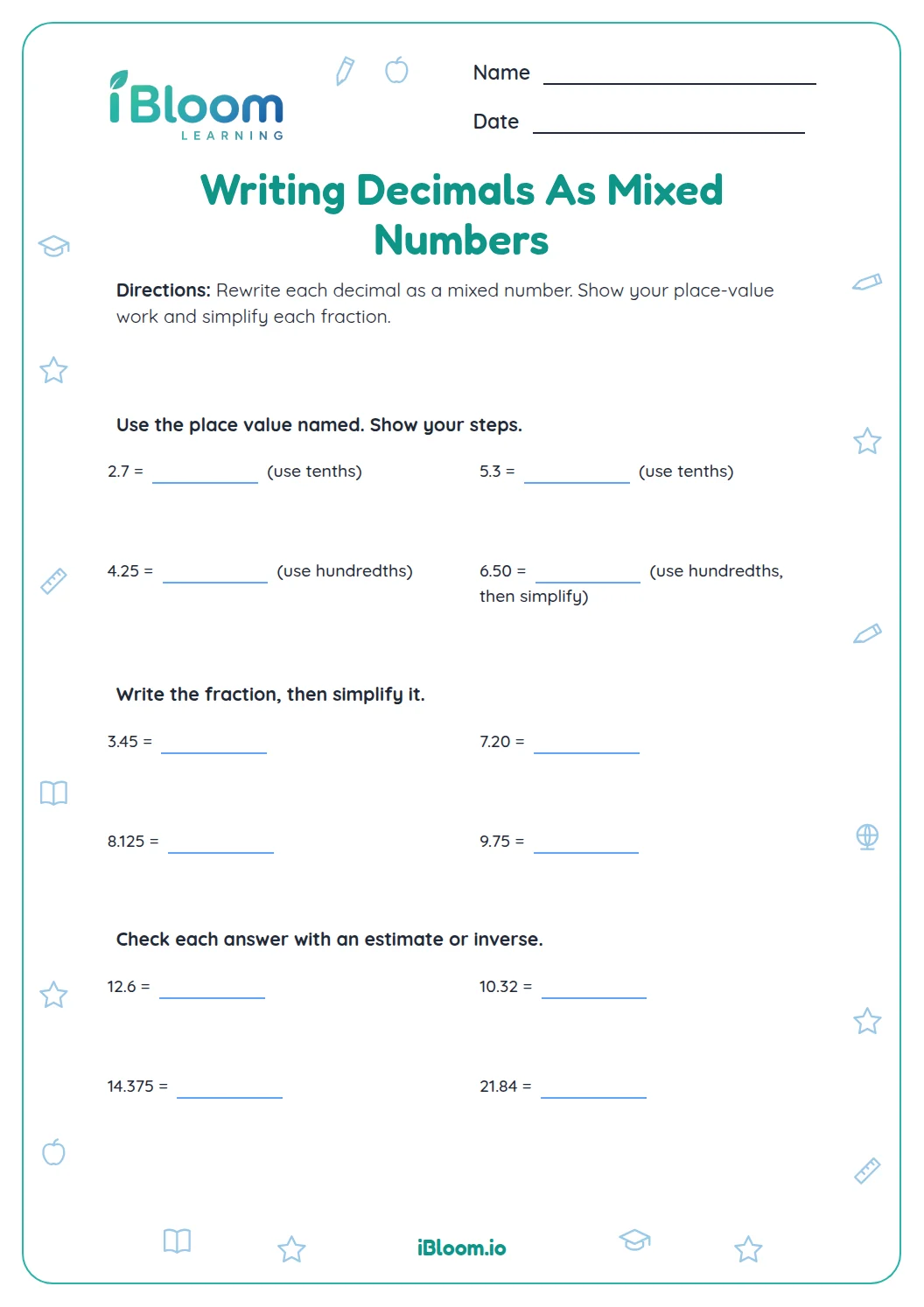
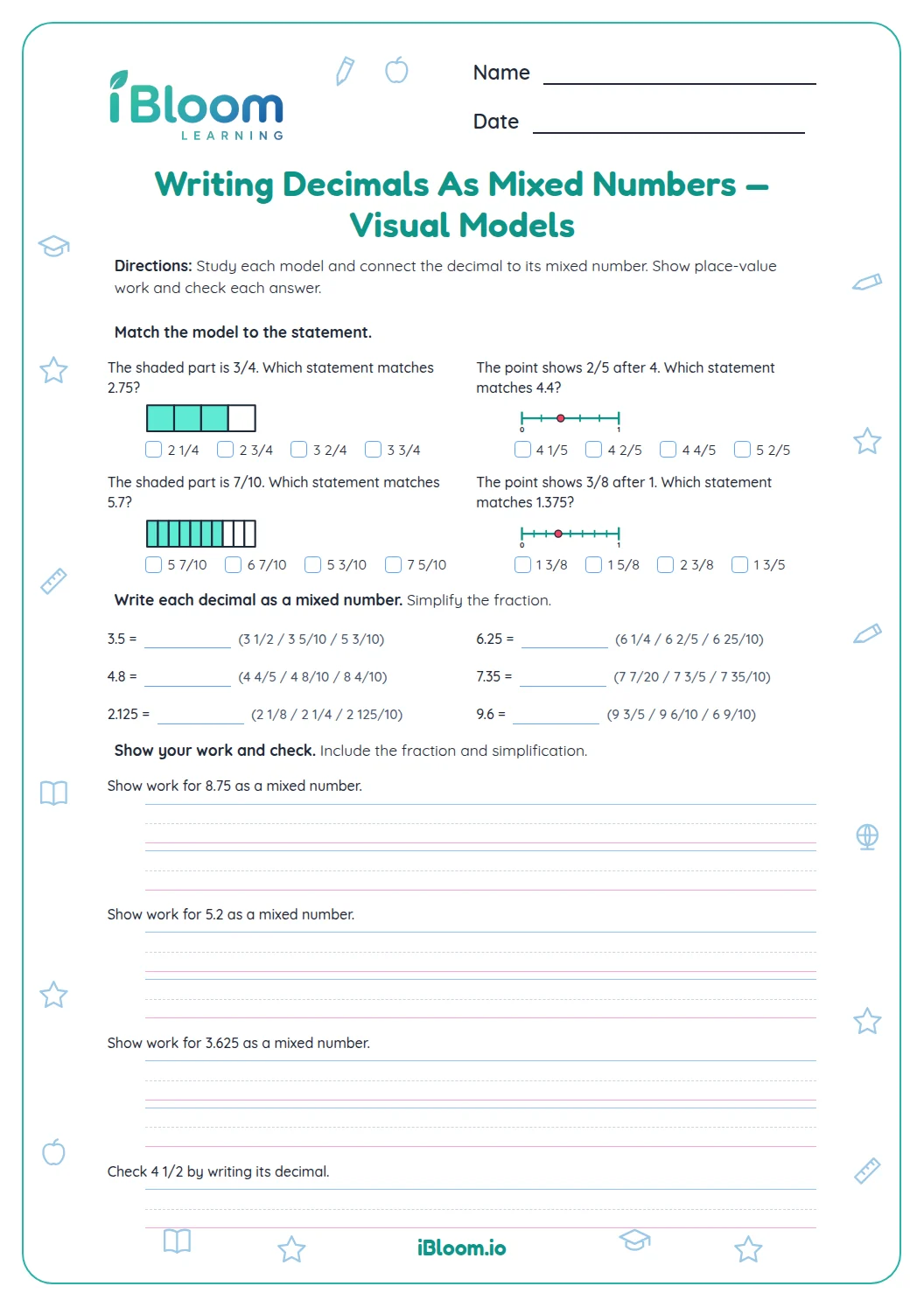
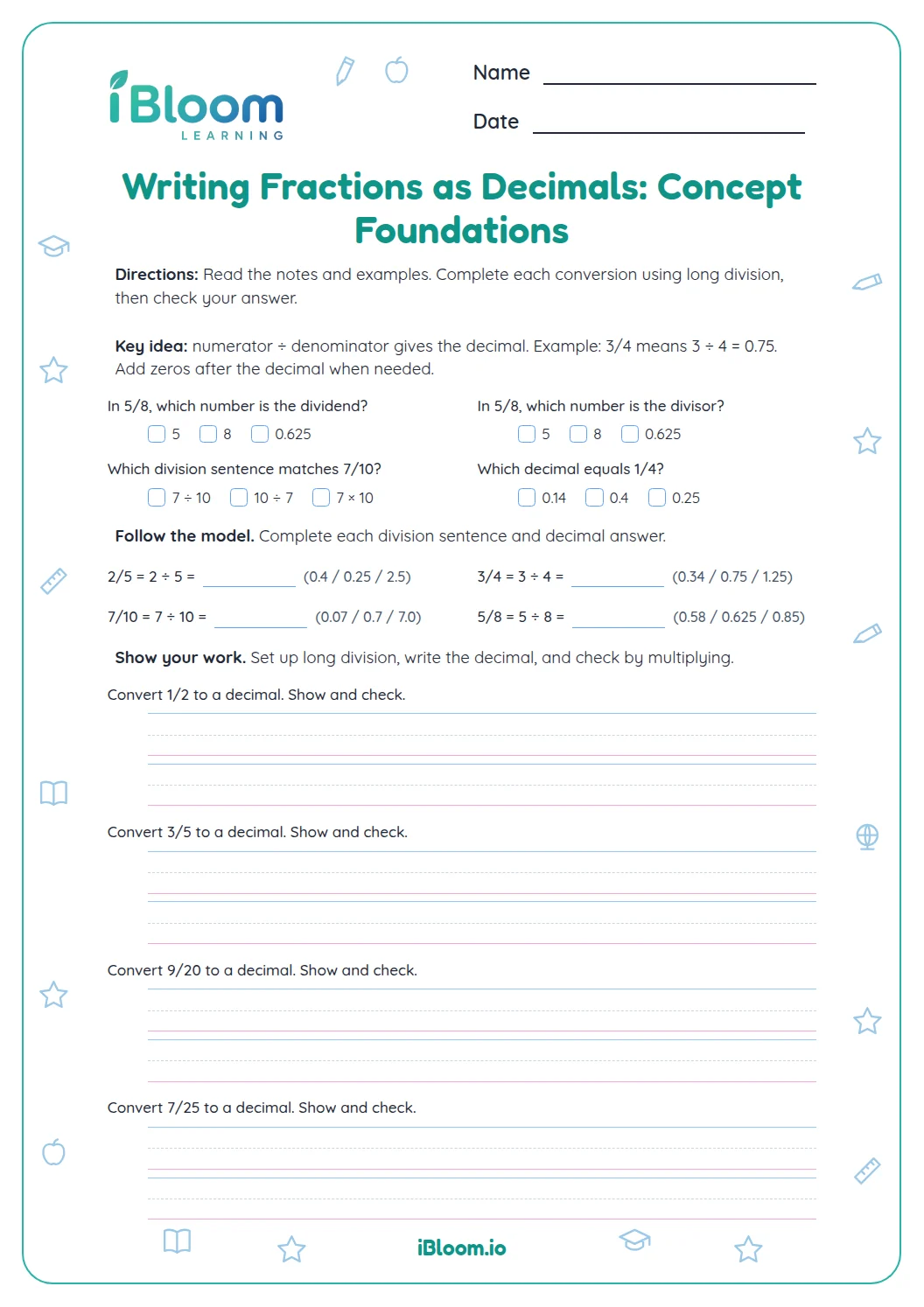
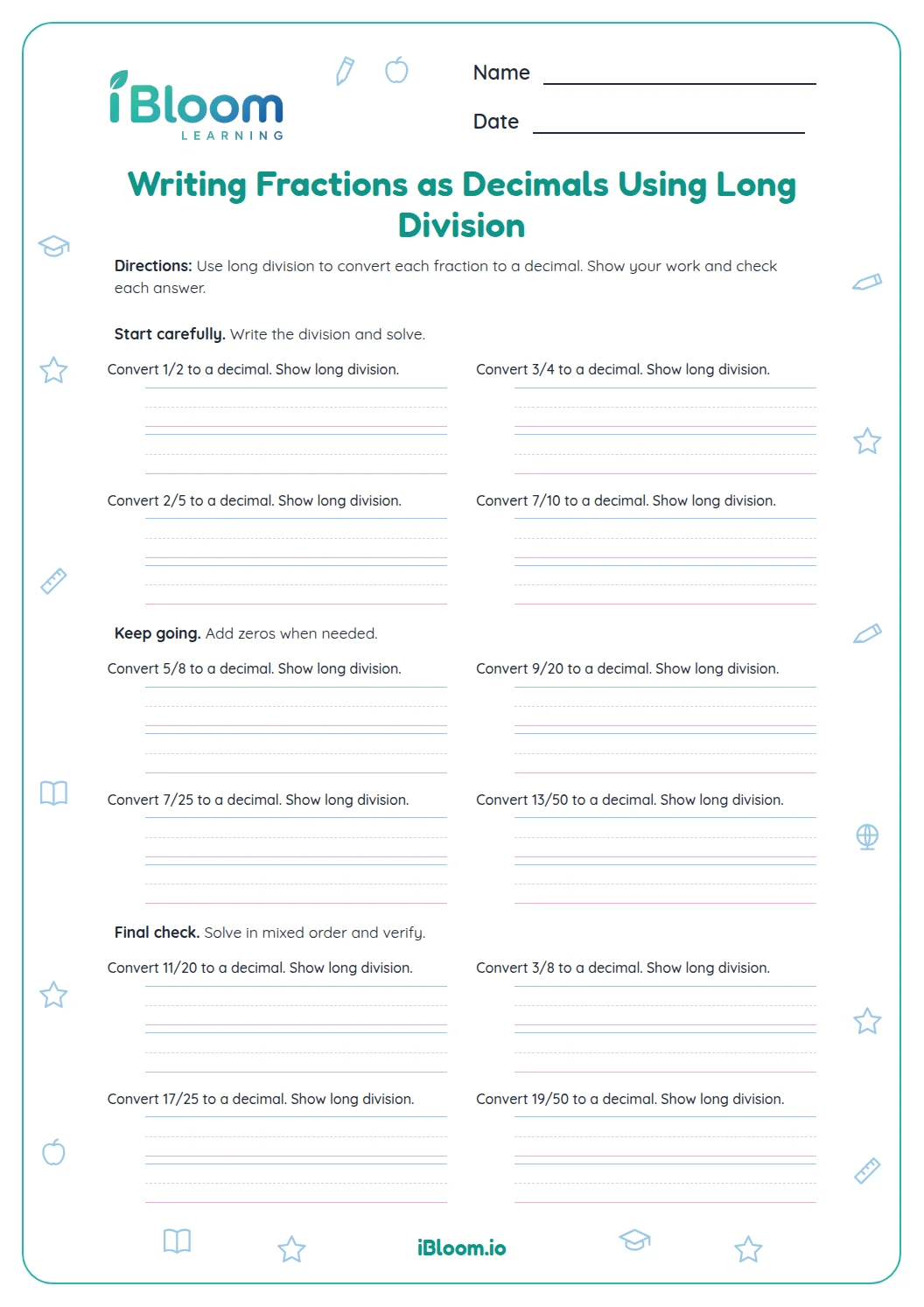
This free printable independent practice sheet is for Grade 6 students converting fractions to decimals. It has 16 problems in three parts: familiar fractions, fractions that need equivalent denominators or division, and mixed numbers. The answer key is provided on a separate page.
Aligned to 5.NF.B.3
How can a fraction become a decimal?
A fraction bar means division: 3/4 is 3 ÷ 4. For familiar denominators, rename the fraction in tenths or hundredths; for sevenths or eighths, divide to find the exact decimal.
- 13/4 = 75/100
- 275/100 = 0.75
What if the denominator is not 10 or 100?
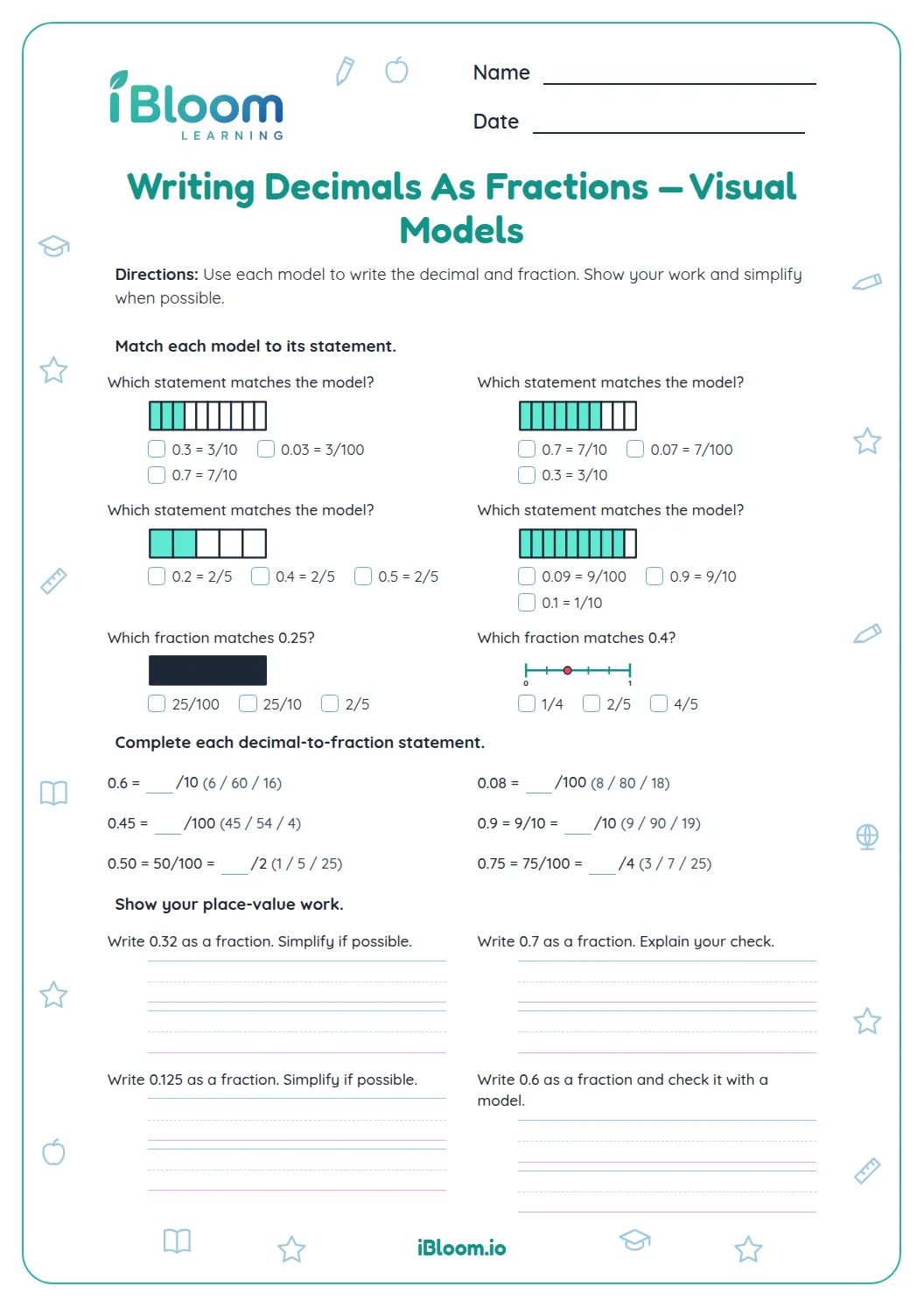
Multiply numerator and denominator by the same number to make 10, 100, or 1,000 when possible. For example, 13/25 = 52/100 = 0.52. If the denominator does not make a power of ten neatly, use division.
How do you write a mixed number as a decimal?
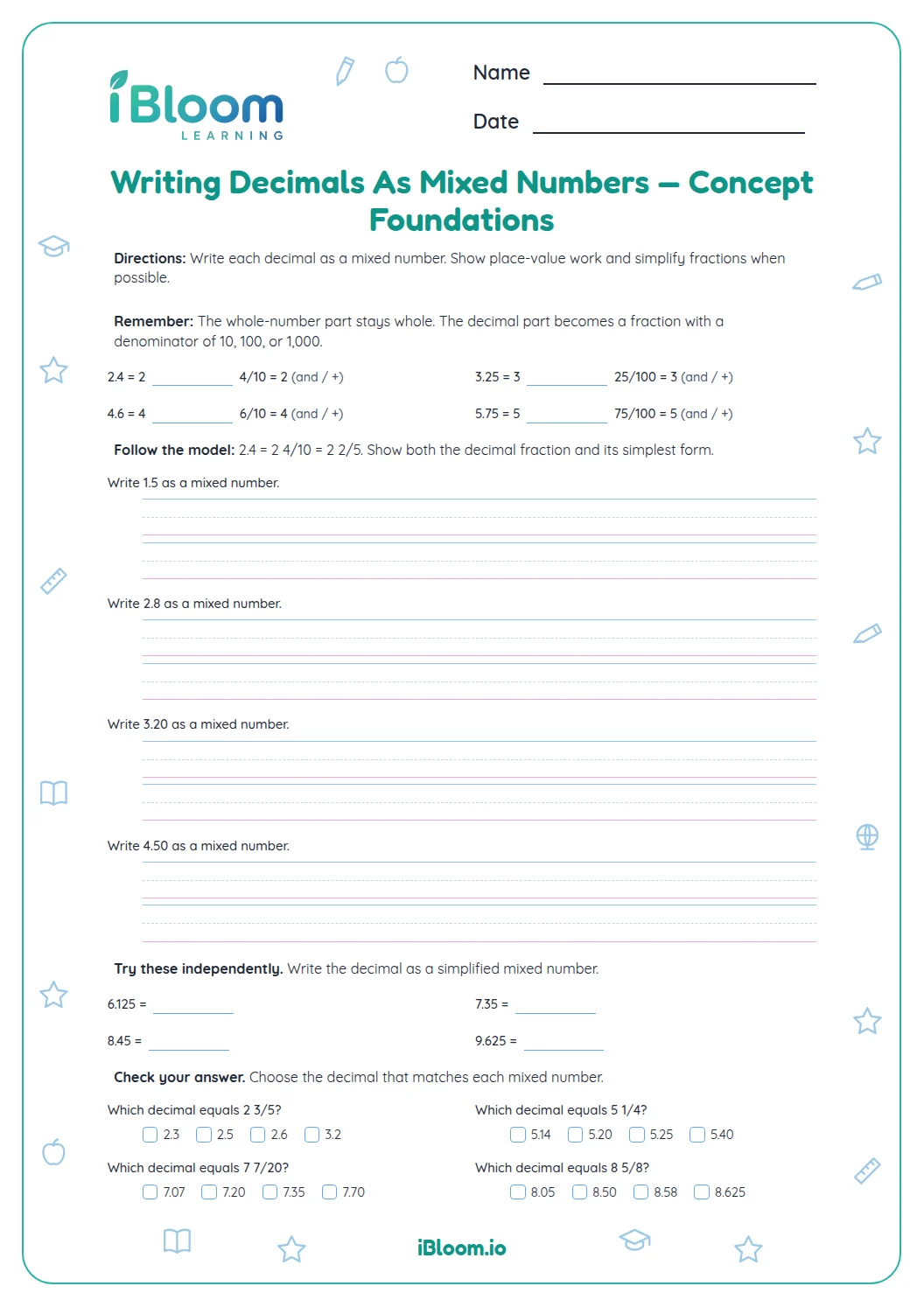
Keep the whole-number part, then convert only the fraction. For 2 7/20, 7/20 = 0.35, so the decimal is 2.35. A terminating decimal ends; do not round an exact answer.
How to work through the sheet
- 1Read numerator and denominator as division.
- 2Look for denominator 10, 100, or 1,000.
- 3Write digits in decimal places.
- 4Keep the whole-number part of a mixed number.
- 5Check by multiplying by the denominator.
Common slips and fixes
The mistake
Writing 3/4 as 0.34.
The fix
Use equivalents or division: 3/4 = 0.75.
The mistake
Changing only the denominator.
The fix
Scale numerator and denominator equally.
The mistake
Dropping the whole number.
The fix
Convert only the fractional part.
Common Core alignment
This page practices the listed skills through the worksheet activities.
Interpret a fraction as division to write its decimal value.
On this sheet: Each item converts a fraction to its decimal quotient.
Show the official wordingHide the official wording
Interpret a fraction as division of the numerator by the denominator (a/b = a ÷ b). Solve word problems involving division of whole numbers leading to answers in the form of fractions or mixed numbers, e.g., by using visual fraction models or equations to represent the problem.
What to practice next
Make more practice
Further reading
Questions parents and teachers ask
How do I write 3/4 as a decimal?
Divide 3 by 4, or rename 3/4 as 75/100. The exact decimal is 0.75. Question 2 uses this familiar conversion, and the answer key lists the equivalent decimal so students can check their work. The worksheet moves from familiar fractions to division conversions and then mixed numbers.
Why does 7/8 have three decimal places?
The quotient 7 ÷ 8 is 0.875, which ends at the thousandths place. Writing 0.87 would round the value and would not be exact. This worksheet asks for exact conversions, so keep all quotient digits needed. The worksheet moves from familiar fractions to division conversions and then mixed numbers.
How do I convert a mixed number?
Keep the whole-number part and convert only the fraction. For 1 3/4, the fraction is 0.75, so the full decimal is 1.75. Questions 12–16 use this method, and the key shows each complete value. The worksheet moves from familiar fractions to division conversions and then mixed numbers.
Can equivalent decimals have different forms?
Yes. For example, 7/10 equals 0.7 and 0.70 because a zero at the end of a decimal does not change its value. The answer key uses a concise form; an equivalent decimal with a trailing zero is also correct. The worksheet moves from familiar fractions to division conversions and then mixed numbers.
What is included in the answer key?
The separate key lists an exact decimal for each of the 16 questions in worksheet order. It includes both proper fractions and mixed numbers, so students can check the fractional part and the whole-number part. The worksheet moves from familiar fractions to division conversions and then mixed numbers.
How can students check a conversion?
Multiply the decimal by the denominator and see whether the product is the numerator. For example, 0.45 × 20 = 9, confirming 9/20 = 0.45. This inverse check works for each fraction on the sheet. The worksheet moves from familiar fractions to division conversions and then mixed numbers.