


About this worksheet
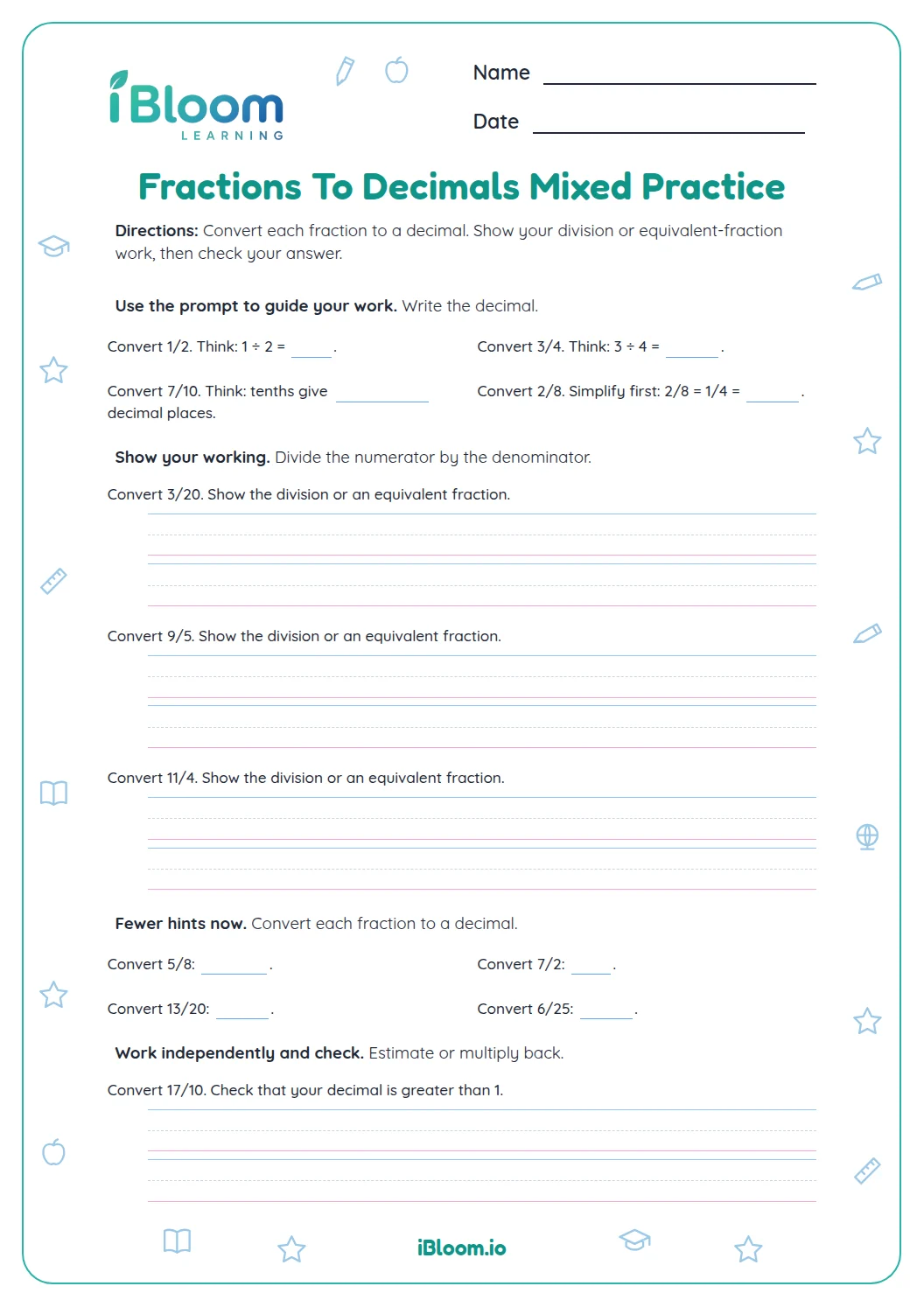
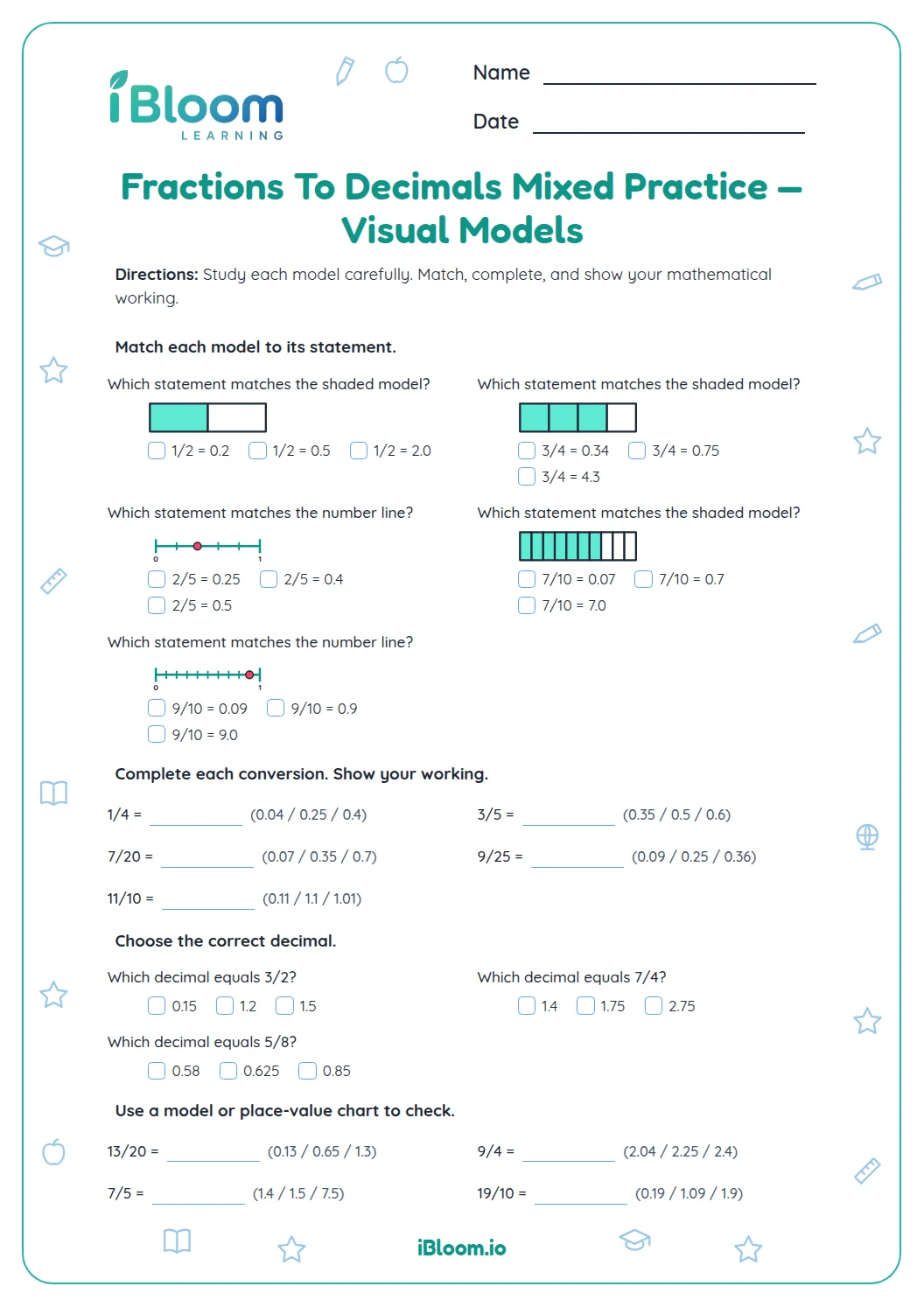
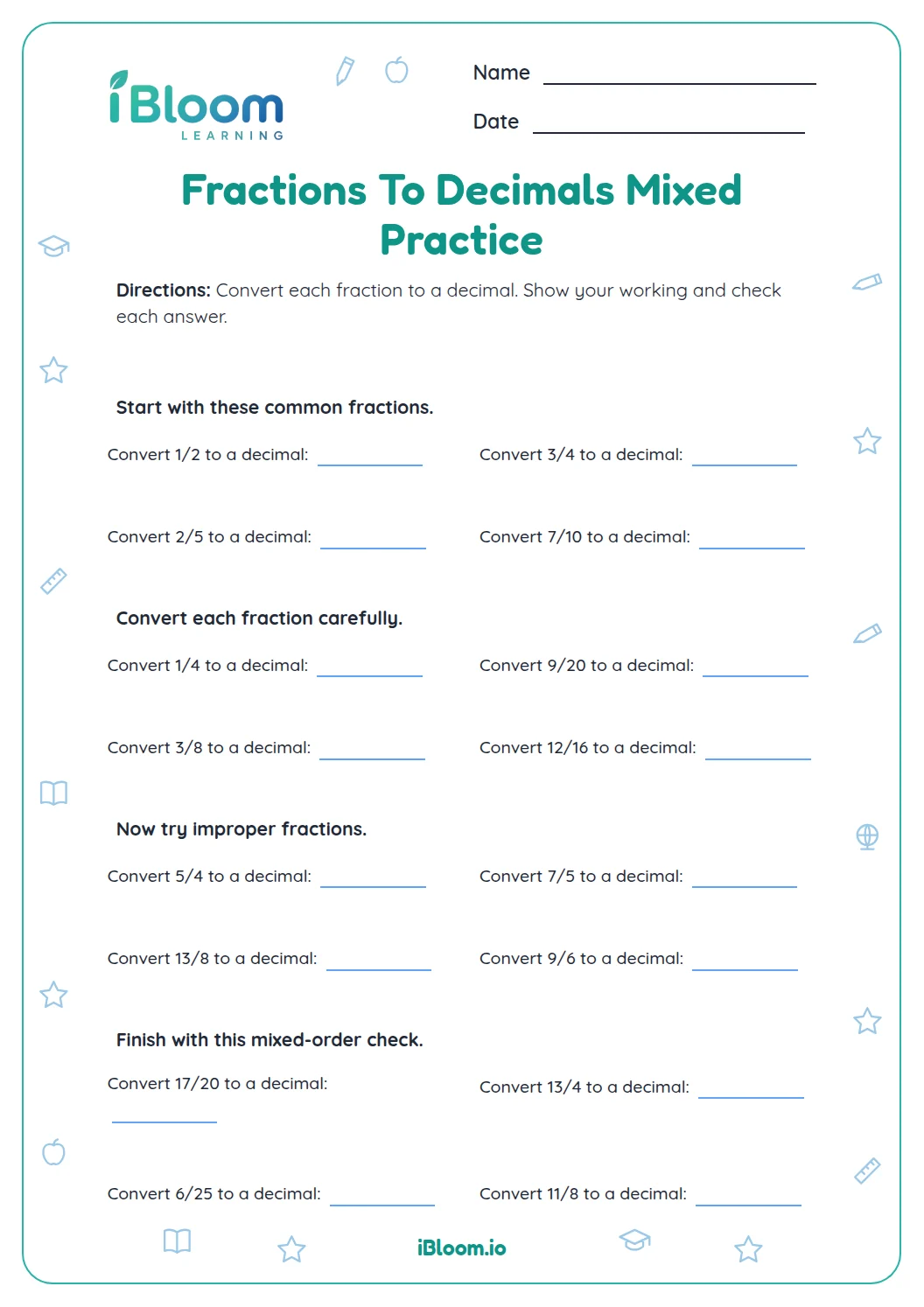
This Grade 6 worksheet guides learners through writing fractions as decimals by dividing the numerator by the denominator. The first four prompts leave room to set up long division; later questions continue division through remainders and include repeating decimals and measurement situations. A separate answer key gives the decimal quotients and units.
Why does division convert a fraction to a decimal?
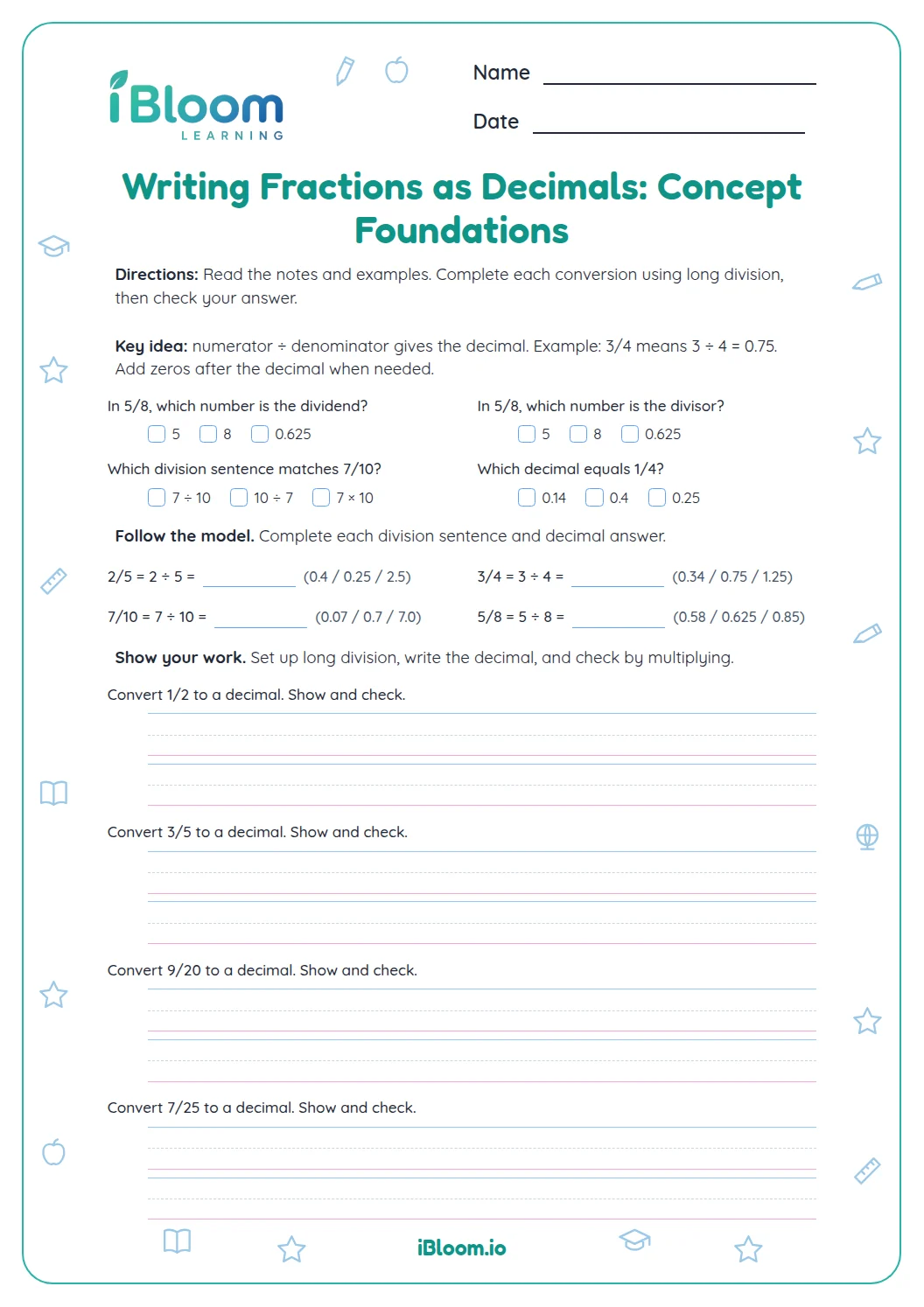
A fraction bar means division: 3/4 is 3 ÷ 4. Set up the numerator as the dividend and the denominator as the divisor. If the numerator is smaller, write 0 before the decimal point and add a zero to continue dividing.
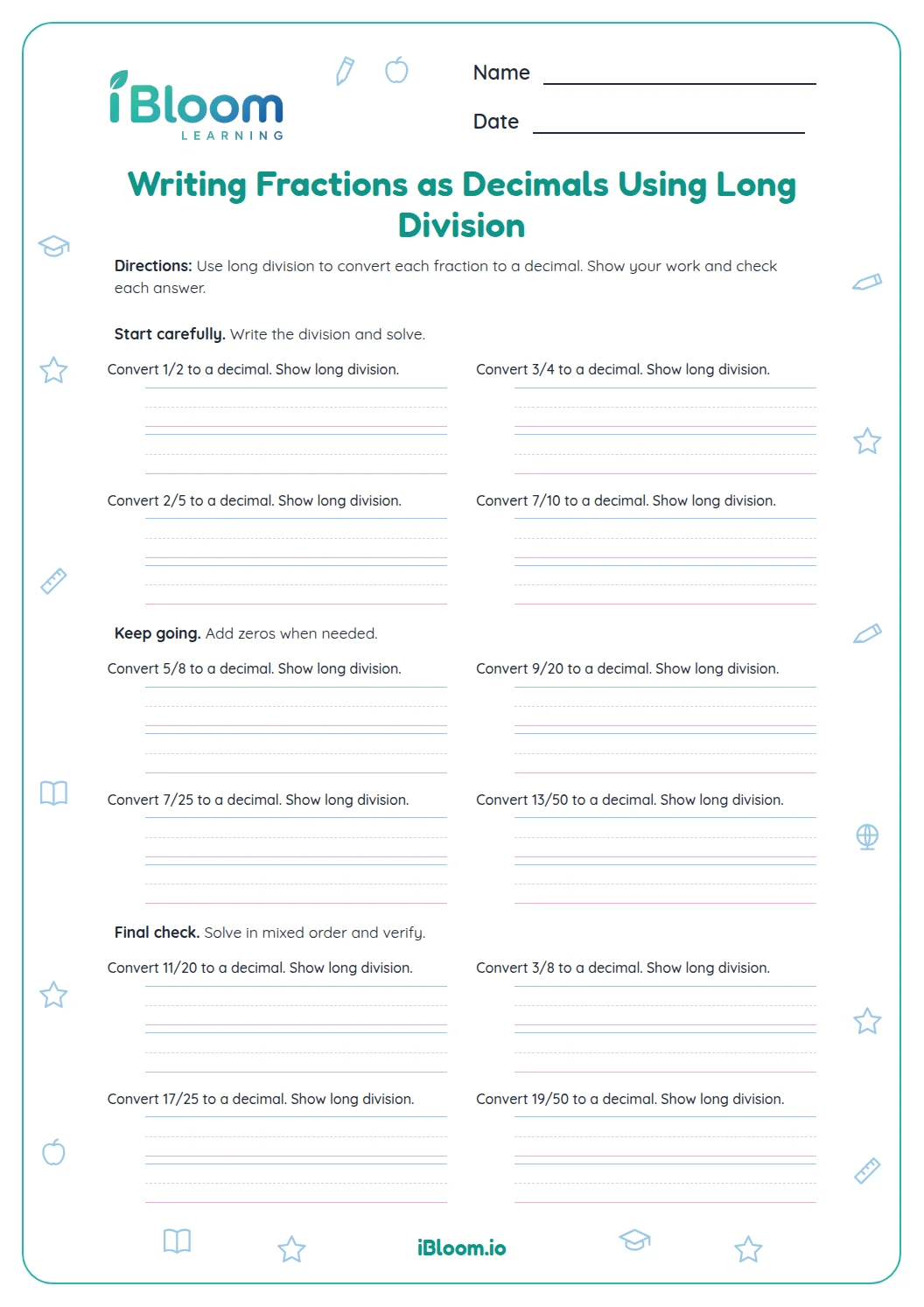
Part A asks children to set up long division for four fractions, from common values like one half to a quotient greater than one.
- 13/4 means 3 ÷ 4
- 2Set up 3 ÷ 4 in long division.
- 3Continue to 0.75; 3/4 = 0.75.
When should you add a zero after the decimal?
A zero to the right of a decimal does not change the value, so 3 can be written as 3.000 for division. Bring down a zero whenever a remainder remains. Keep the decimal point directly above the decimal point in the quotient.
For 5/8, divide 5.000 by 8: 50 tenths gives 6 tenths, then continue to 0.625.
- 15 ÷ 8 = 0.625
- 28 goes into 50 six times; remainder 2.
- 3Bring down 0, then continue to 0.625.
What if the remainder repeats?
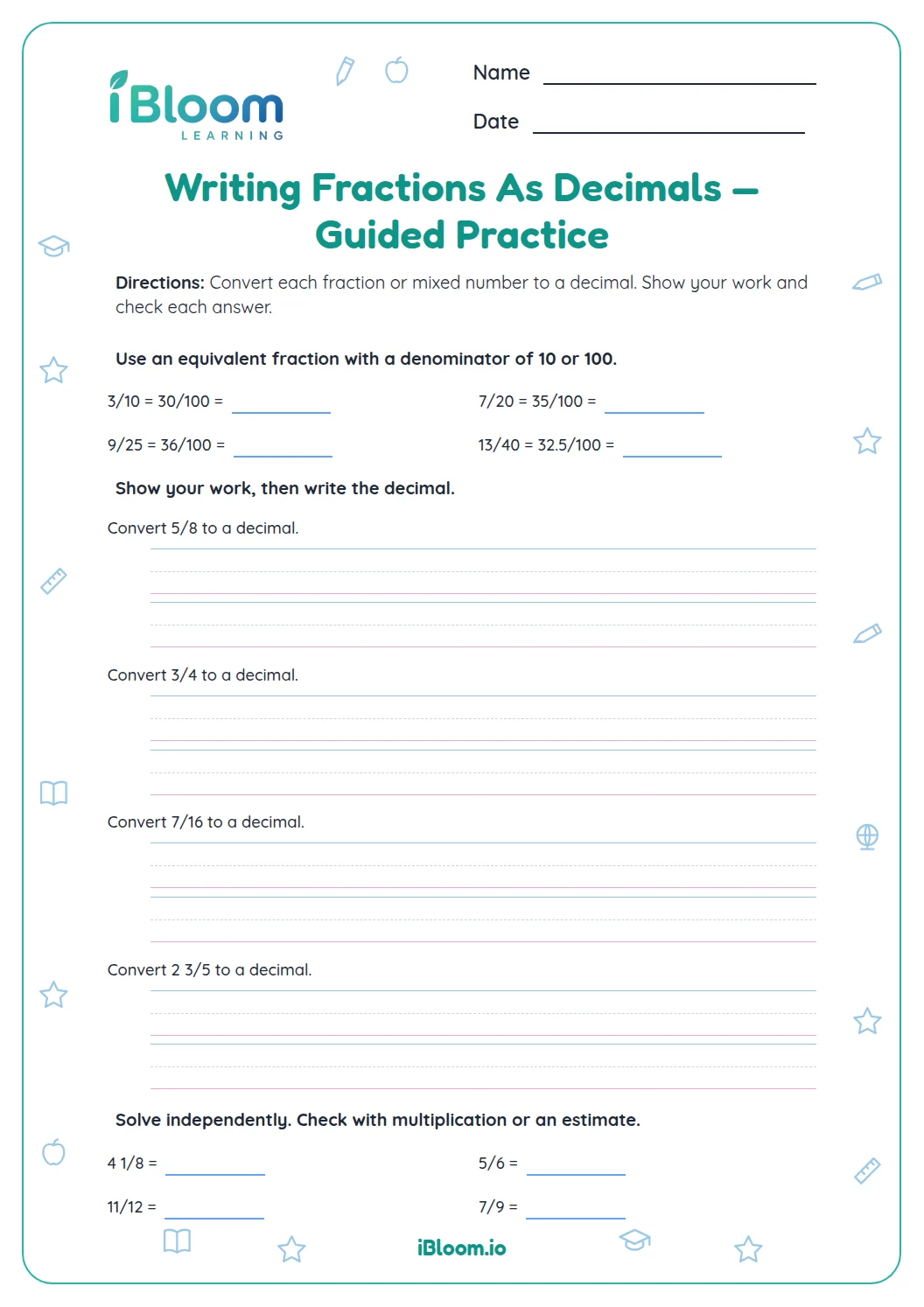
Some fractions produce a repeating decimal. In this sheet, write the repeating digits followed by an ellipsis, such as 2 ÷ 3 = 0.666.... The same remainder returns, so the digit pattern continues.
Do not round unless a question asks for rounding; these questions ask for an exact repeating decimal.
- 12 ÷ 3 = 0.666...
- 2The 6 repeats forever.
How do you use a decimal quotient in a measurement problem?
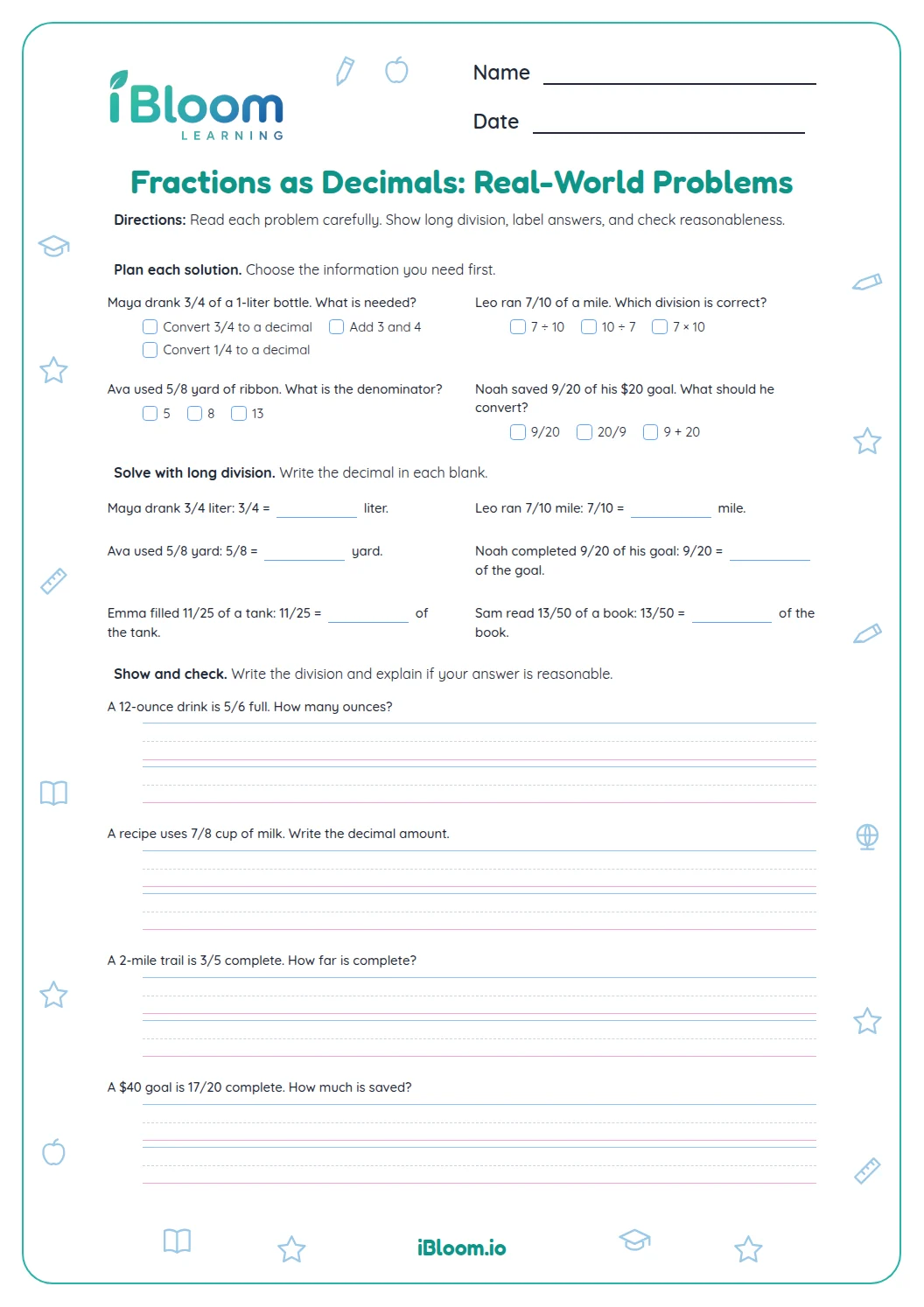
Divide the number of units in the numerator by the denominator, then attach the unit from the story. A measurement answer should keep the same unit: 7/8 yard becomes 0.875 yard.
Estimate first: a fraction between 0 and 1 should have a decimal between 0 and 1.
- 17 ÷ 8 = 0.875
- 2The ribbon is 0.875 yard long.
How to use this worksheet
- 1Read the fraction bar as “divided by.”
- 2Place the numerator inside long division and the denominator outside.
- 3If the quotient is less than 1, write 0 before the decimal point.
- 4Add zeros after the decimal to continue a remainder.
- 5Stop when the remainder is zero, or show a repeating pattern with an ellipsis.
- 6Check that the decimal is reasonable and include units in stories.
Common slips and ways to check
The mistake
Dividing the denominator by the numerator.
The fix
Read a/b as a ÷ b; the numerator is the dividend.
The mistake
Dropping the leading zero for a value less than one.
The fix
Write 0. before the decimal digits, as in 0.75.
The mistake
Stopping at a nonzero remainder and calling the quotient exact.
The fix
Continue division with zeros or identify the repeating remainder and digits.
What to practice next
Make more practice
Further reading
Questions parents and teachers ask
Why does a fraction mean division?
The fraction bar means divide the numerator by the denominator. For example, 3/4 means 3 ÷ 4, which equals 0.75. Later questions write the division sentence beside each fraction, so children can focus on finding the quotient. Check the quotient with multiplication.
Where does the decimal point go in long division?
In long division, place the quotient’s decimal point directly above the decimal point in the dividend. For 5 ÷ 8, continue with 5.000 until the quotient is 0.625 and the remainder is zero. The first four prompts leave working lines for the setup.
Why can zeros be added after the decimal point?
Appending zeros to a whole number after its decimal point does not change its value: 5 equals 5.000. Those zeros let the division continue when there is a remainder. Keep bringing down zeros until the remainder becomes zero or repeats.
What should I write for a repeating decimal?
Show the repeating digits and use an ellipsis to signal that they continue. For example, 2 ÷ 3 = 0.666.... This worksheet uses ellipses for repeating quotients such as 5/6 and 2/3, rather than rounding them to a shorter decimal.
How can I check a fraction-to-decimal answer?
Multiply the decimal by the denominator and see whether the product returns the numerator. For 3/4, 0.75 × 4 = 3. You can also estimate: a positive fraction less than one should have a decimal value between zero and one.
Does this worksheet include an answer key?
Yes. The separate key lists all 16 quotients, including repeating decimals, and labels the answers to the four measurement situations. Compare the quotient and unit, and check that a terminating division ends with a zero remainder. The key also accepts equivalent decimal forms when they have the same value.