

About this worksheet
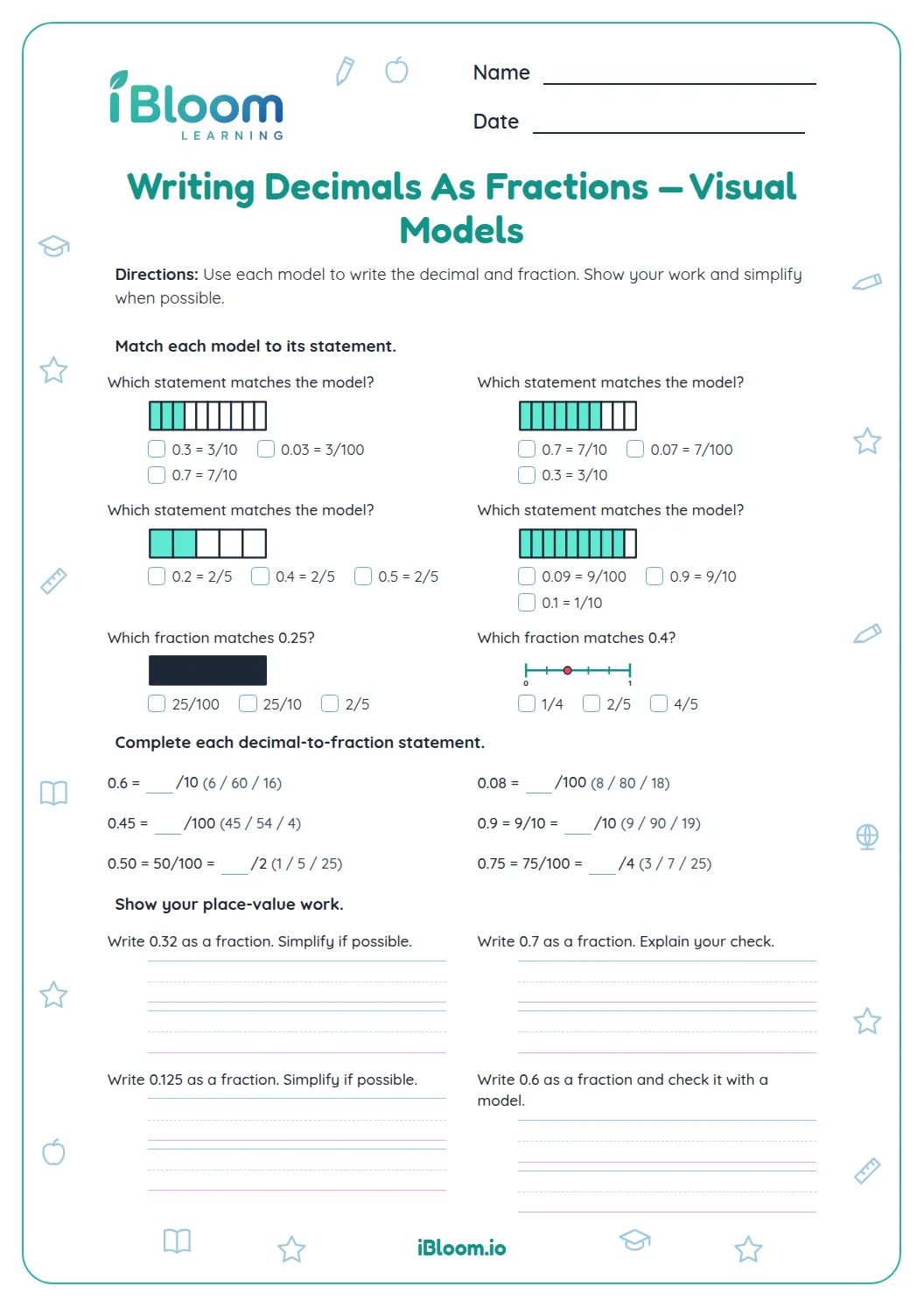
This Grade 6 printable builds the connection between decimal place value and fractions. Students write decimals through thousandths as fractions with denominators 10, 100, or 1,000, then complete equivalent number statements. The answer key gives a quick way to check each place-value conversion. Students connect decimal place names to equivalent fractional units.
How does place value name the denominator?
One digit after the decimal point means tenths, two digits mean hundredths, and three mean thousandths. In question 2, 0.07 has seven hundredths, so it is 7/100.
- 10.07 has two decimal places
- 2Two places name hundredths
- 30.07 = 7/100
What if the decimal has a zero?
Reduce the fraction when the numerator and denominator share a factor. For question 8, 0.36 is 36/100; divide both numbers by 4 to get 9/25. Keep any zero that holds a place before simplifying.
- 10.36 = 36/100
- 2Divide numerator and denominator by 4
- 336/100 = 9/25
How can you check the fraction?
For a check, write the decimal as a fraction with its place-value denominator before reducing. For example, 0.570 is 570/1,000, which reduces to 57/100.
- 10.570 = 570/1,000
- 2Divide both by 10
- 3570/1,000 = 57/100
How to use this worksheet
- 1Count the digits after the decimal point.
- 2Use 10, 100, or 1,000 as the place-value denominator.
- 3Write every digit after the decimal point in the numerator.
- 4Reduce numerator and denominator by the same factor when possible.
- 5Check by reading the fraction as a decimal.
Common mistakes and quick fixes
The mistake
Using 10 for every decimal.
The fix
Count decimal places first: two places means a denominator of 100 before reducing.
The mistake
Dropping an interior zero in 3.04.
The fix
Keep the zero in 3.04 to make 304 hundredths, then reduce 304/100 to 76/25.
The mistake
Using only the final digit as numerator.
The fix
Use every digit after the decimal point, then simplify the fraction if possible.
What to practice next
Make more practice
Questions parents and teachers ask
How does a decimal tell you its fraction denominator?
Count the digits after the decimal point. One place names tenths, two places name hundredths, and three places name thousandths. For example, 0.07 is seven hundredths, or 7/100. The first set of questions practices this place-value connection before students reduce selected fractions.
When should students simplify a decimal fraction?
In Part B, students write each decimal as a fraction and reduce it when the numerator and denominator have a common factor. For example, 0.36 becomes 36/100 and then 9/25. The answer key shows simplified forms for that section.
Why does 3.04 become 304/100?
The 3 represents three wholes and the 4 is in the hundredths place. Together, that is 304 hundredths, or 304/100. The zero holds the tenths place; simplifying gives 76/25. Keeping the zero in the numerator preserves the decimal’s value.
How many questions and pages are included?
The worksheet has 14 questions across two pages, followed by a two-page answer key. Students identify place-value denominators, convert decimals to fractions, simplify selected fractions, and complete equivalent number statements. The worksheet and key previews show the layout.
Can an equivalent fraction be correct?
Yes. Equivalent fractions have the same value, such as 36/100 and 9/25. Part A asks students to show the denominator named by place value, while Part B asks them to simplify. The answer key gives the expected form for each section so the task is clear.