




About this worksheet
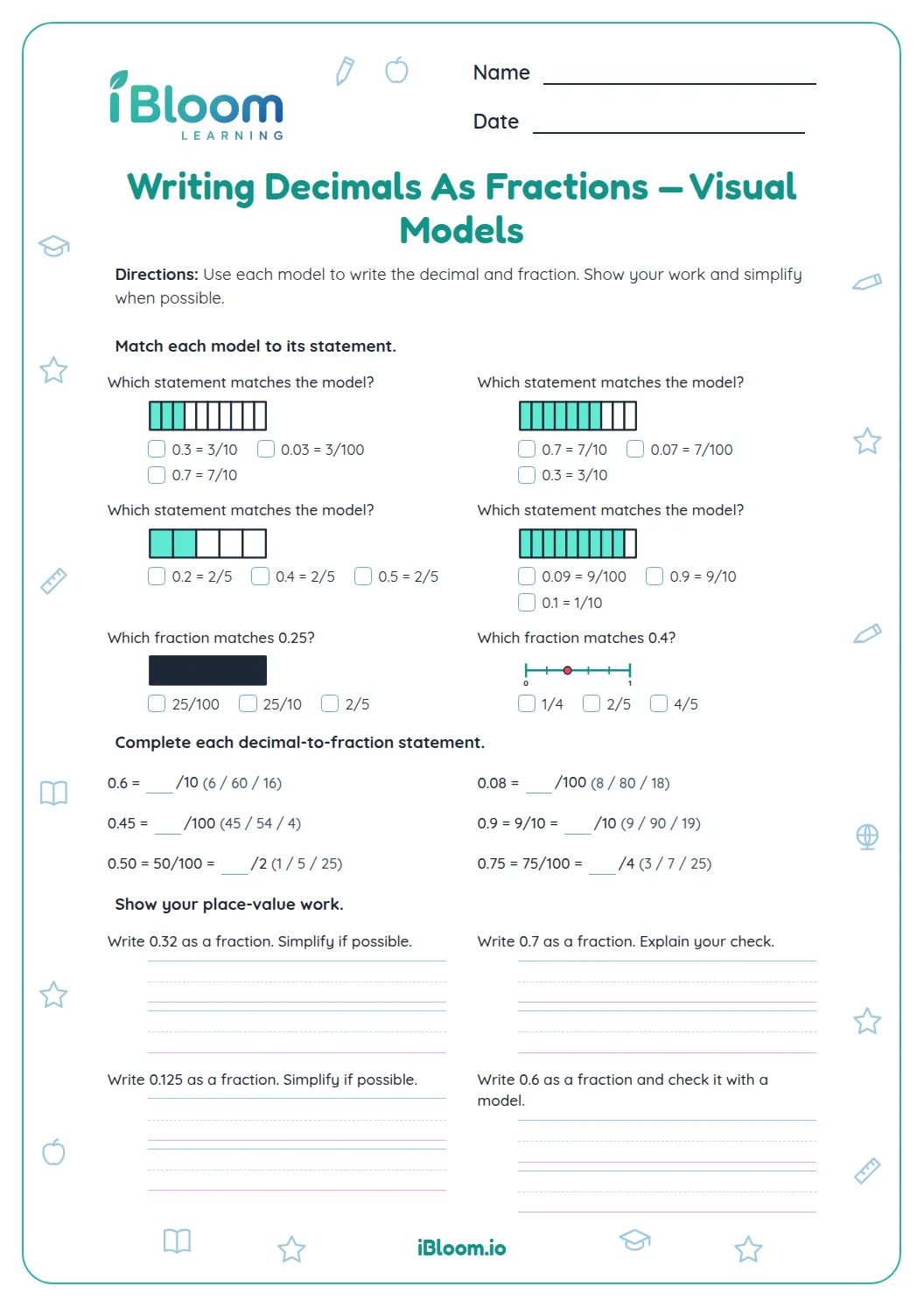
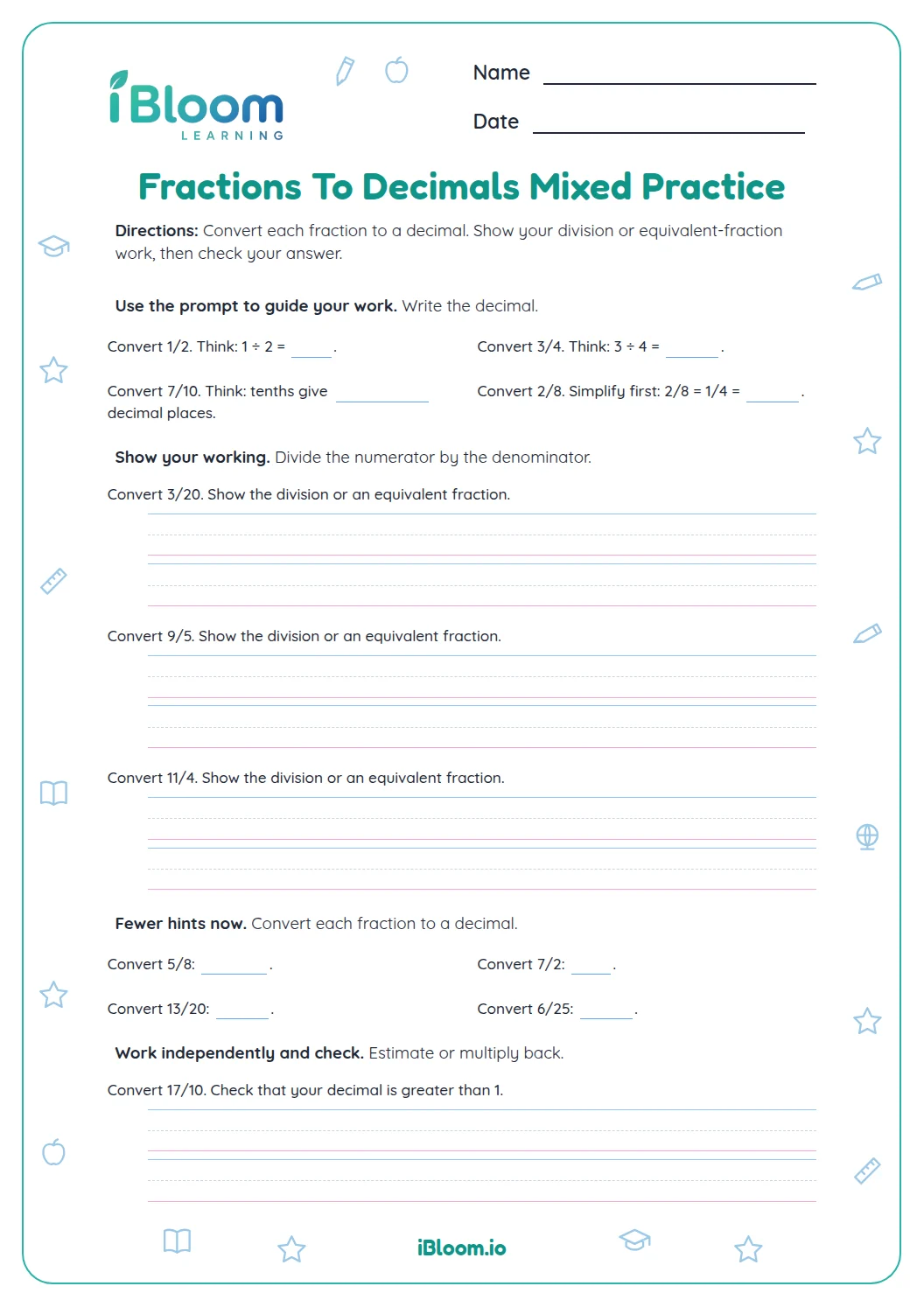
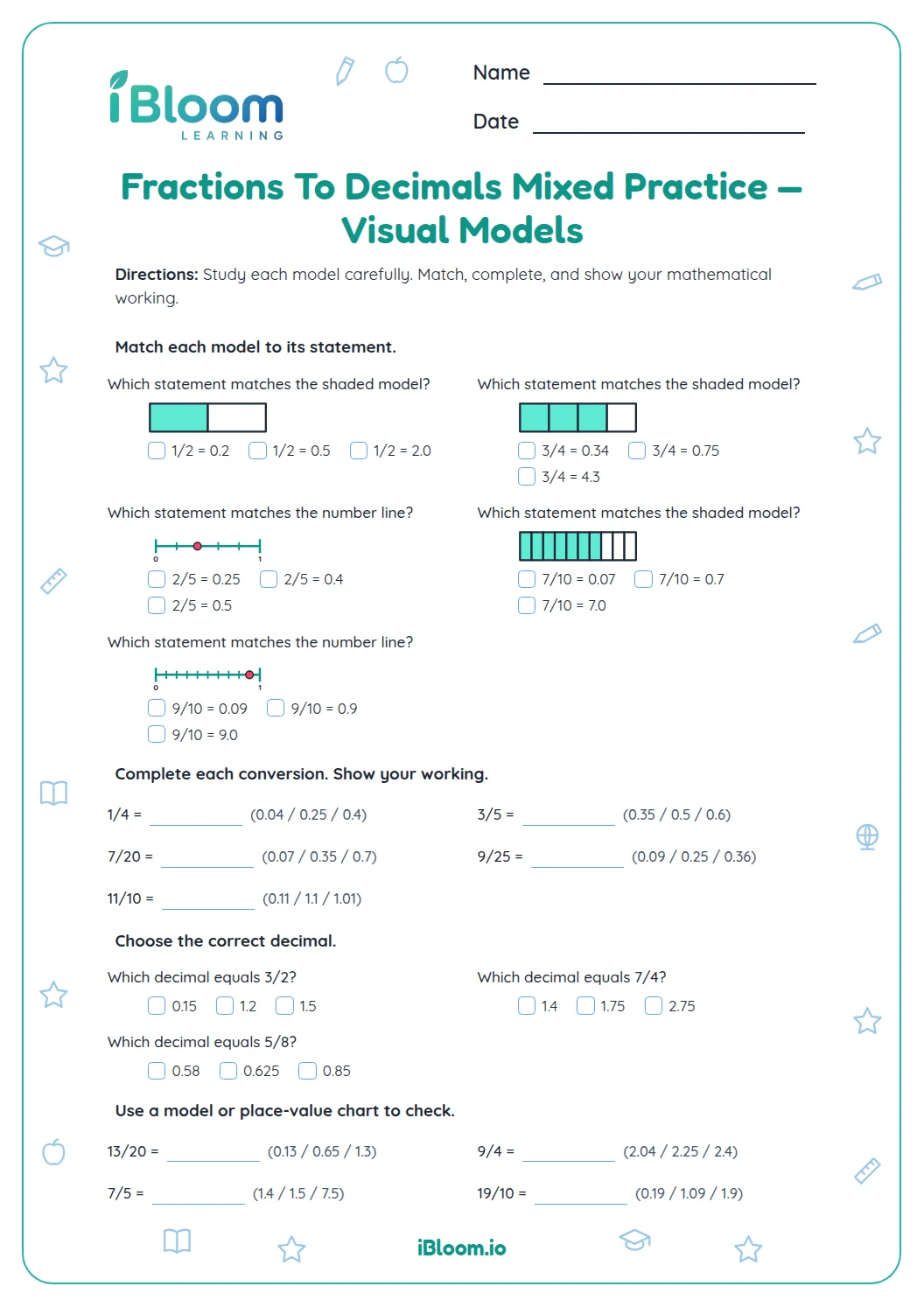
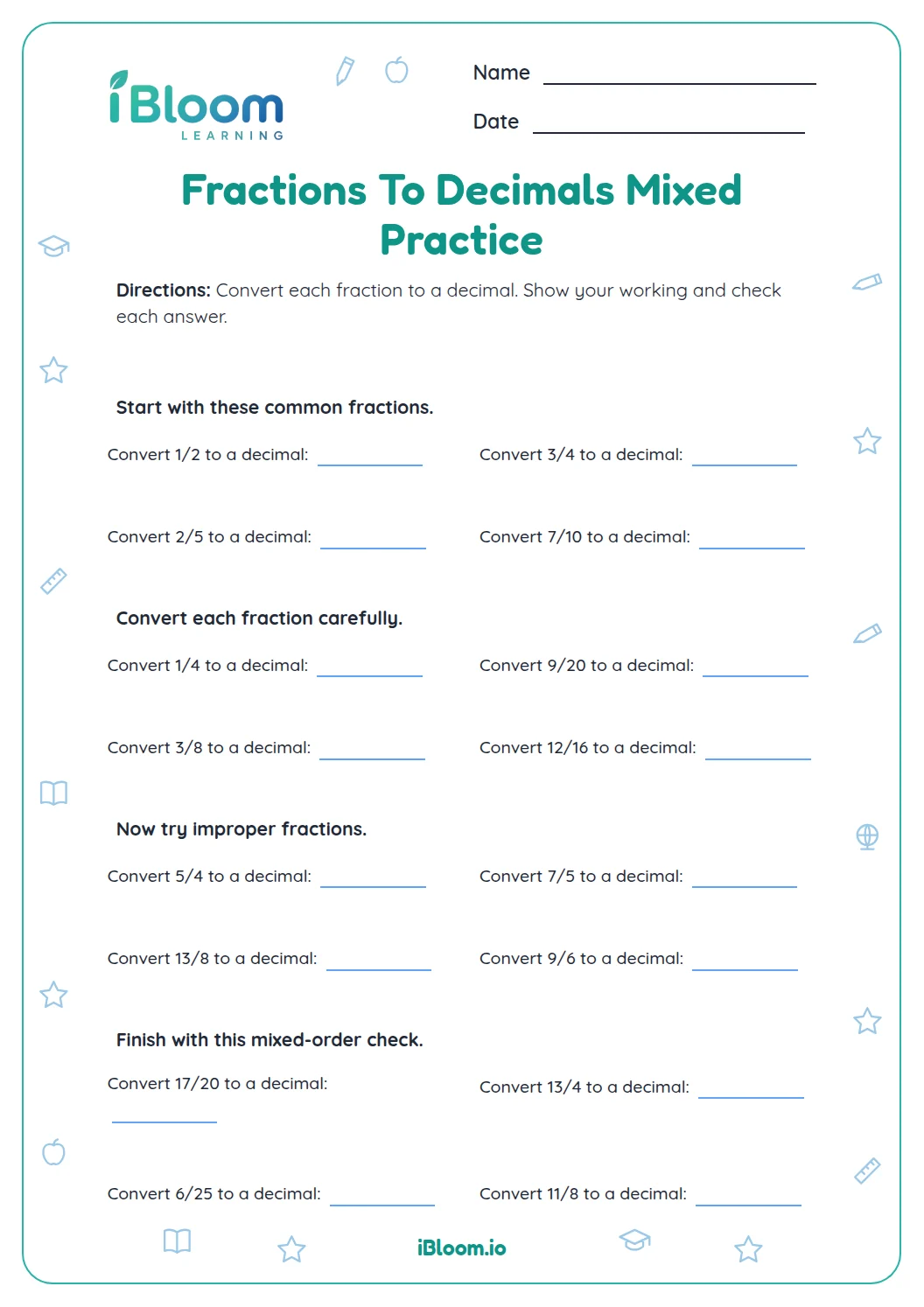
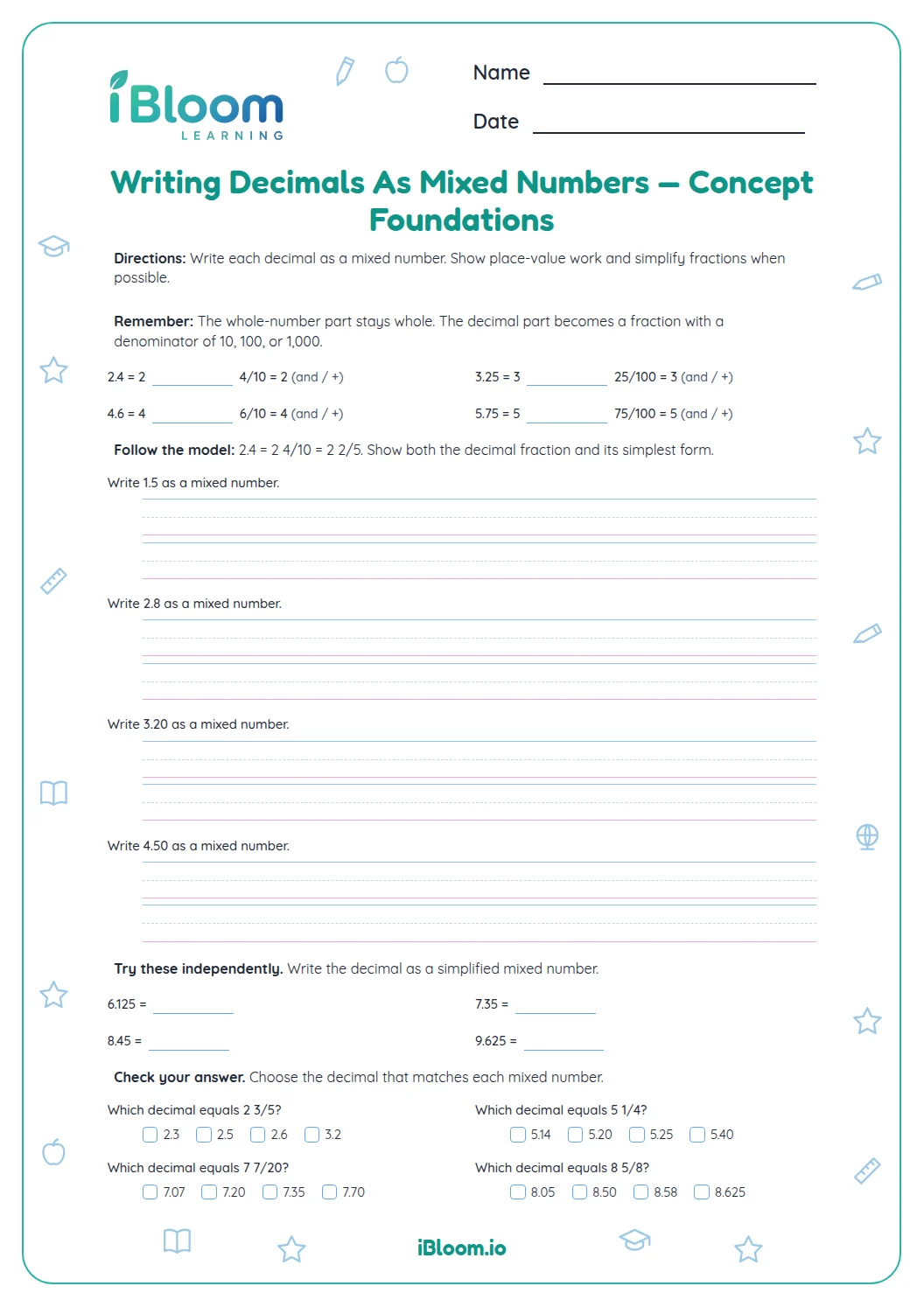
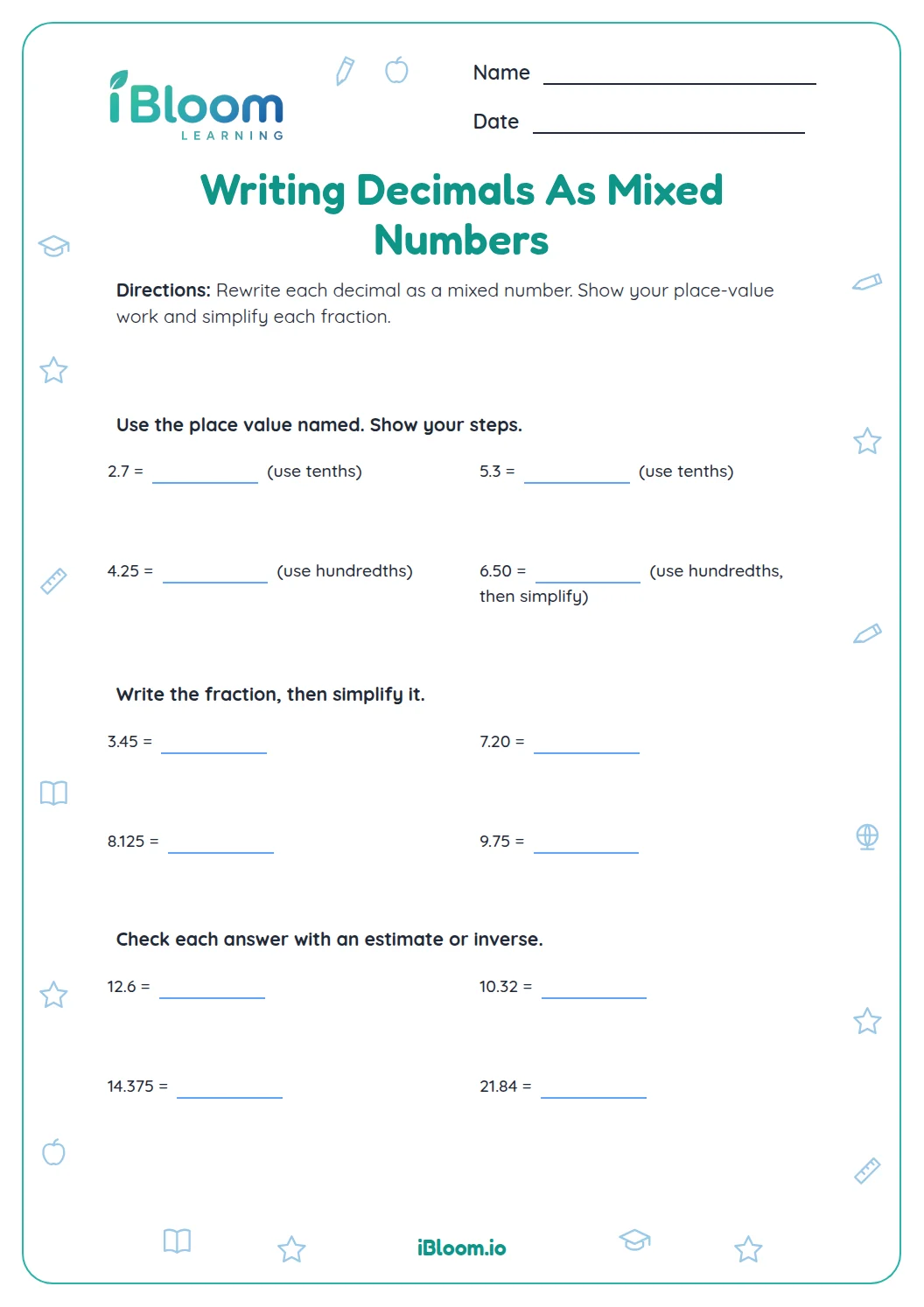
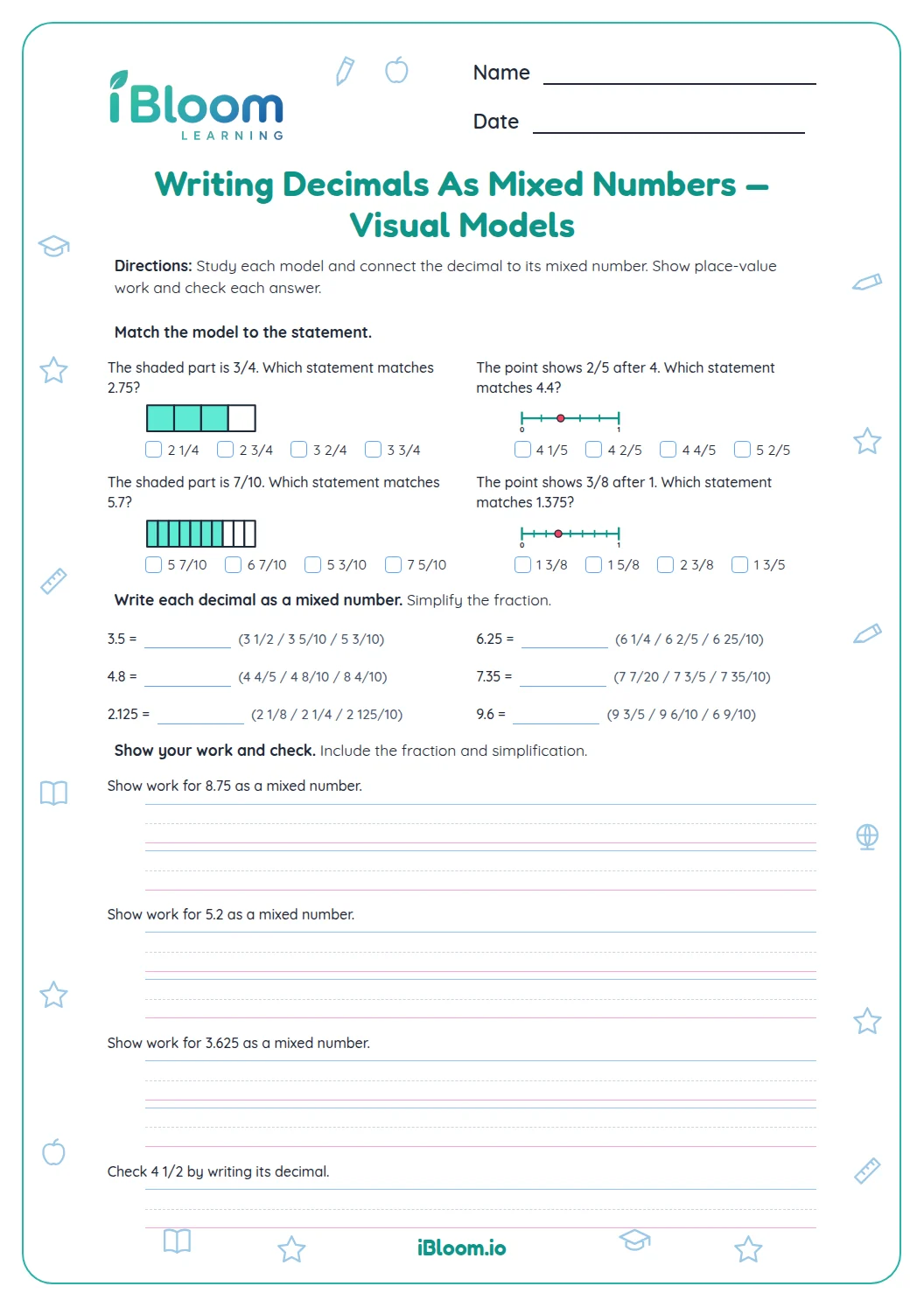
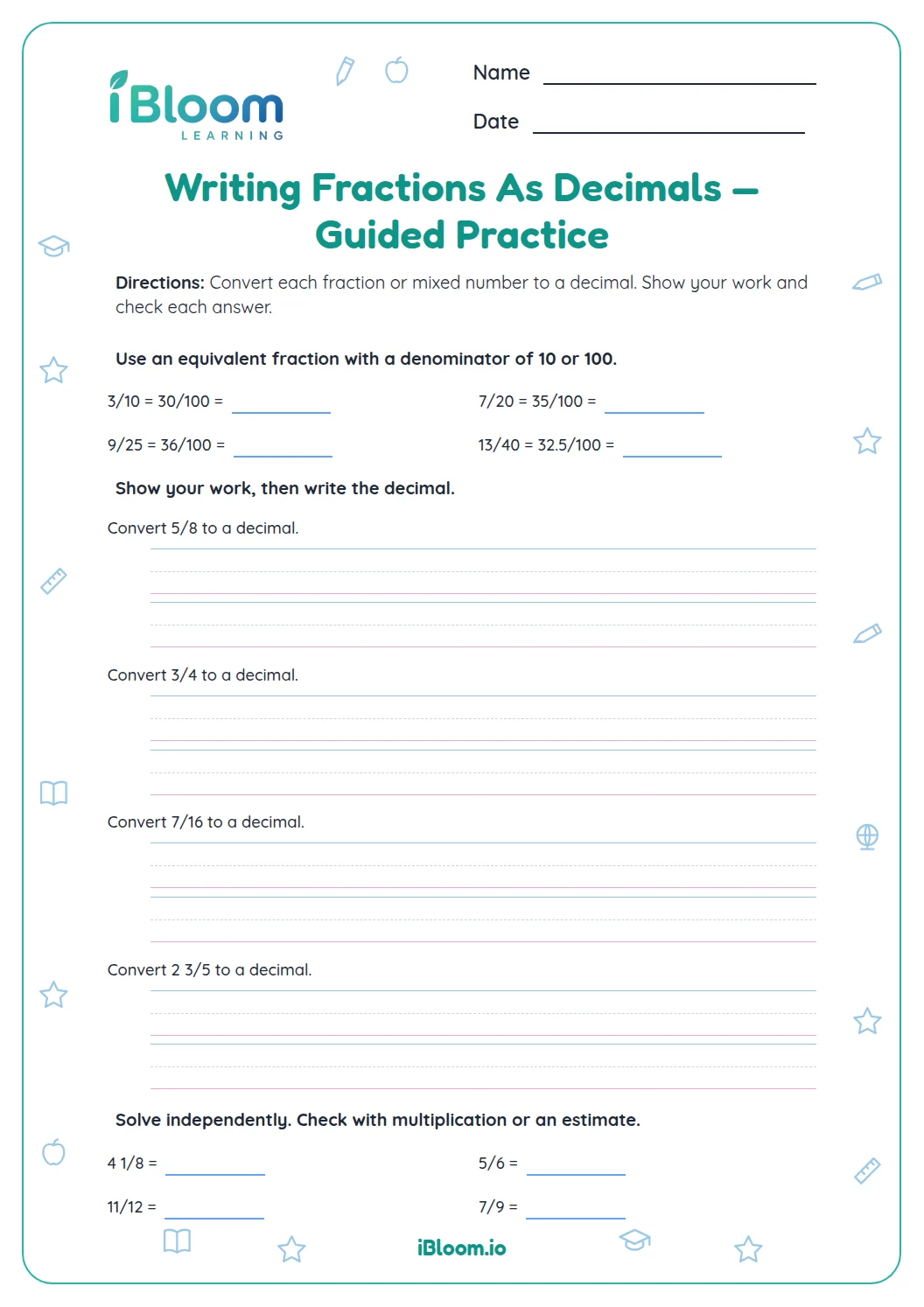
This Grade 6 reasoning worksheet practices writing decimals as fractions, finding equivalent forms, and using decimal place value to explain a correction. Its 14 questions include fraction conversions, multiple-choice reasoning, and two written explanations. The separate answer key gives reduced forms where requested and sample explanations. The questions focus on the relationship between decimal place value and fraction notation.
How does place value turn a decimal into a fraction?
This Grade 6 reasoning worksheet practices writing decimals as fractions, finding equivalent forms, and using decimal place value to explain a correction. Its 14 questions include fraction conversions, multiple-choice reasoning, and two written explanations. The separate answer key gives reduced forms where requested and sample explanations. The questions focus on the relationship between decimal place value and fraction notation.
For example, 0.36 means 36 hundredths, or 36/100. Divide the numerator and denominator by 4 to get 9/25.
What will students do in each part?
Part A converts decimals, including tenths, hundredths, and thousandths, into fractions and equivalent forms. Part B checks common place-value reasoning. Part C explains equivalence and corrects a tenths-versus-hundredths error. For example, 0.36 is 36/100, which simplifies to 9/25.
How can an adult support practice?
Use the last decimal place to name the initial denominator: 0.3 is 3/10, while 0.03 is 3/100. Then simplify by dividing numerator and denominator by the same factor. Check that the fraction still represents the original decimal, as 36/100 and 9/25 both equal 0.36.
How to use this worksheet
- 1Read the directions and scan the first model or example.
- 2Work through each part in order, writing clearly in the answer spaces.
- 3Pause to explain one strategy or shape clue aloud.
- 4Check every response with the separate answer key.
- 5Choose one missed question and solve or copy it again carefully.
Common mistakes and quick fixes
The mistake
Using 100 as the denominator for a number in tenths.
The fix
Count decimal places and name the place value of the final digit.
The mistake
Choosing an answer without checking the amount or clue.
The fix
Use the visual model, place value, or stated attribute to verify the choice.
The mistake
Skipping the check after finishing.
The fix
Compare each response with the key and correct one item in a different color.
What to practice next
Make more practice
Questions parents and teachers ask
What skill does the page practice?
The 14 questions ask students to write decimals as fractions, simplify equivalent forms, and explain place-value reasoning. Items include tenths, hundredths, and thousandths, plus multiple-choice checks and two written explanations. The answer key gives the requested fractions and sample explanations.
How do you write 0.36 as a fraction?
Two digits follow the decimal point, so 0.36 is 36 hundredths, or 36/100. Both 36 and 100 divide by 4, giving 9/25. To check, divide 9 by 25 or compare equivalent values; the reduced fraction still names 0.36.
Why does 0.4 equal both 4/10 and 2/5?
Four tenths is 4/10. Divide both numerator and denominator by 2 to get 2/5. These fractions are equivalent because the same amount was divided from the top and bottom; each represents the decimal 0.4. Multiplying 2/5 by 2/2 returns 4/10.
Does this worksheet include an answer key?
Yes. The separate answer key lists the fraction answers, including reduced forms where the prompt requests them. It also gives sample responses for the two explanation questions. A student’s wording can differ as long as it correctly explains the place value or equivalent fraction.
How can students avoid mixing up tenths and hundredths?
Name the place value of the final digit. In 0.3, 3 is in the tenths place, so 0.3 = 3/10. In 0.03, 3 is in the hundredths place, so 0.03 = 3/100. Writing the denominator before simplifying helps prevent the two values from being confused.