




About this worksheet
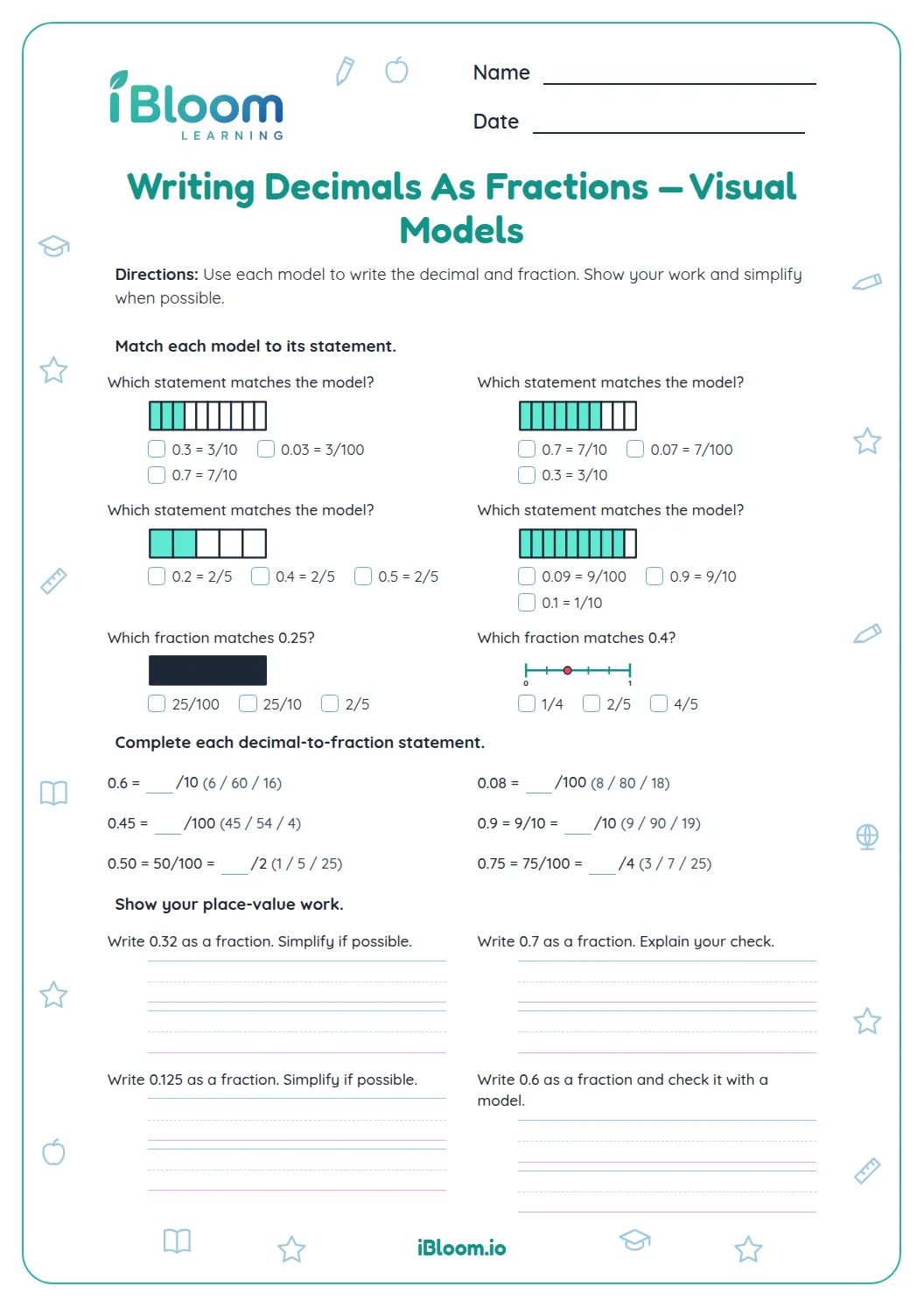
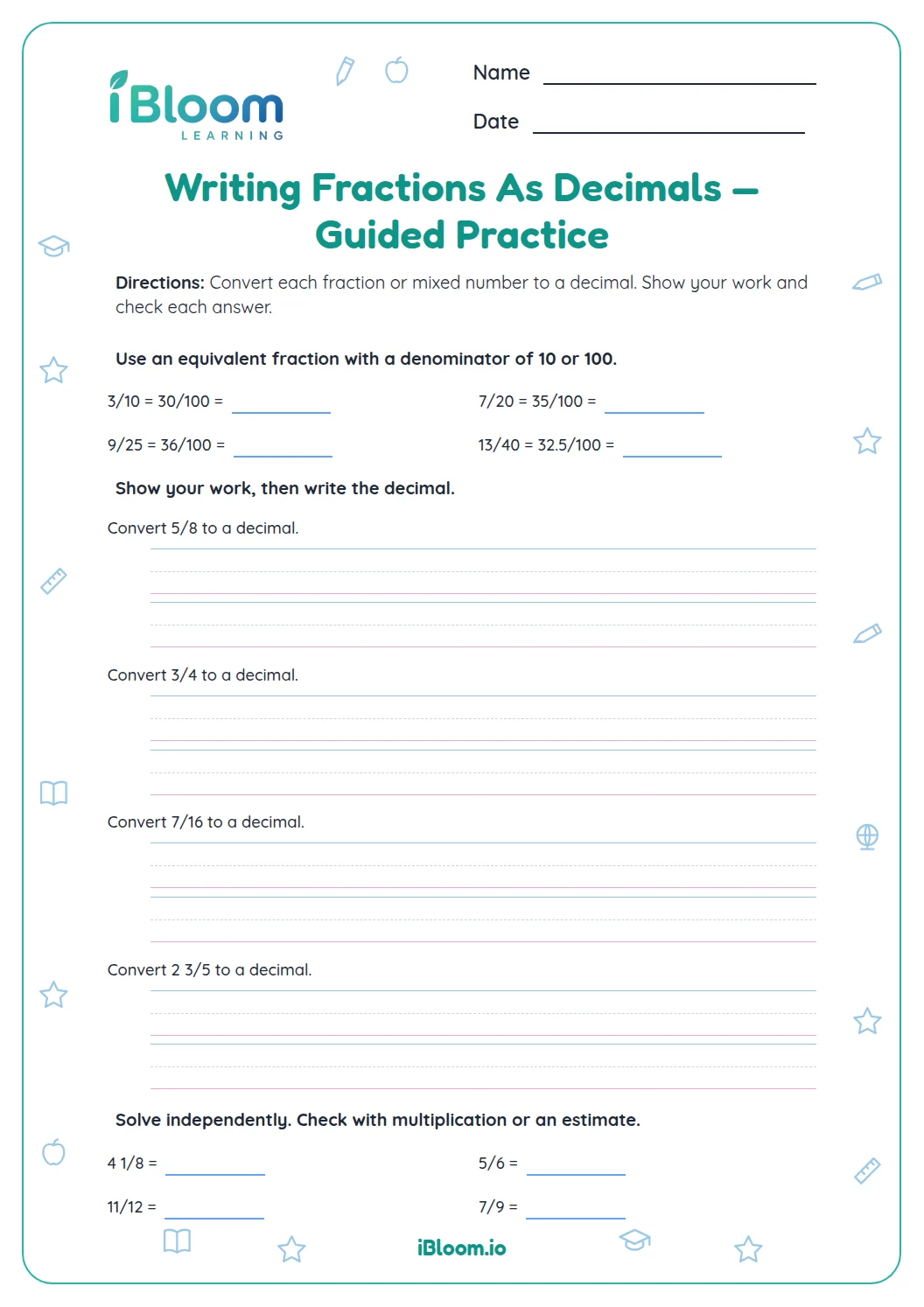
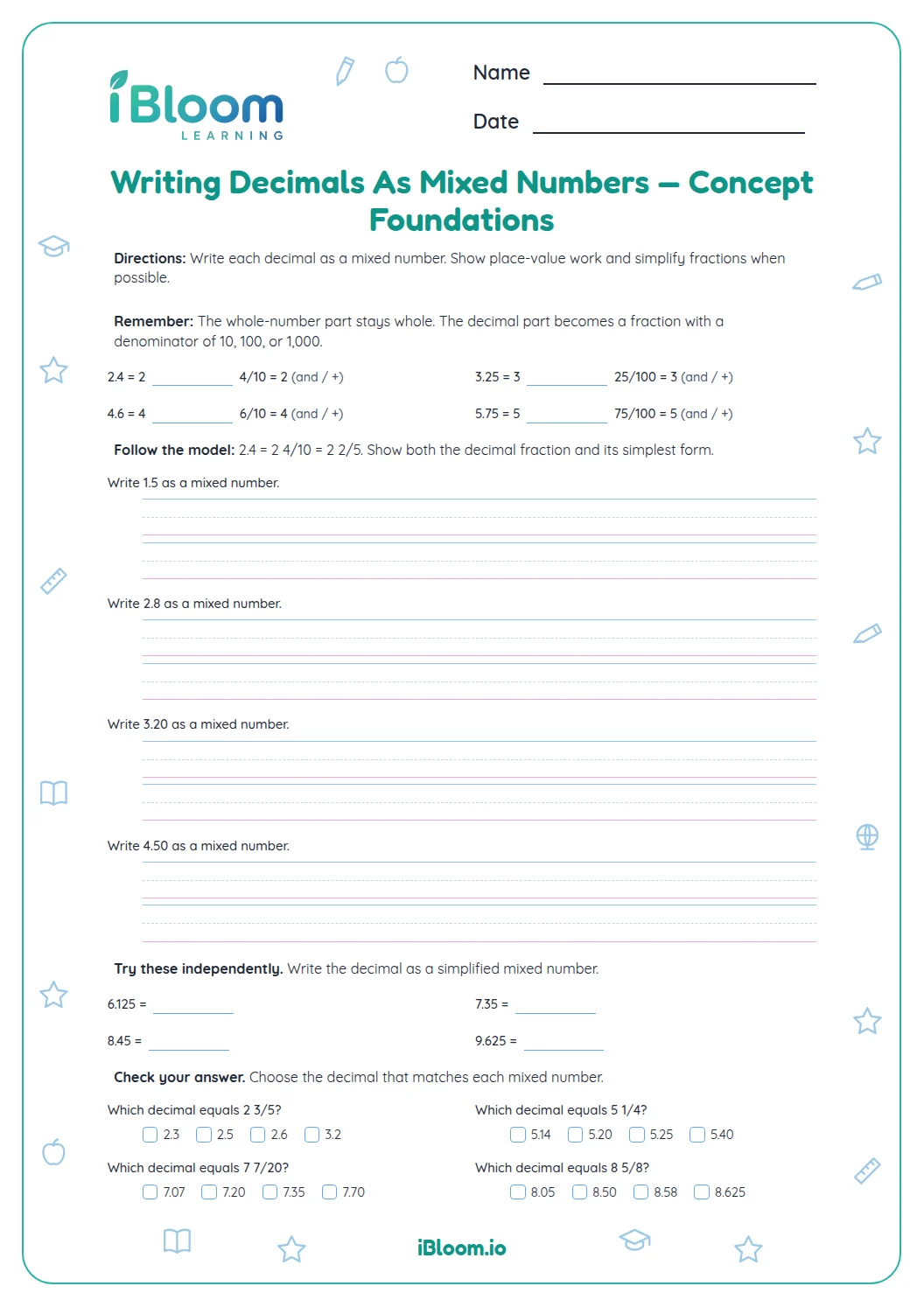
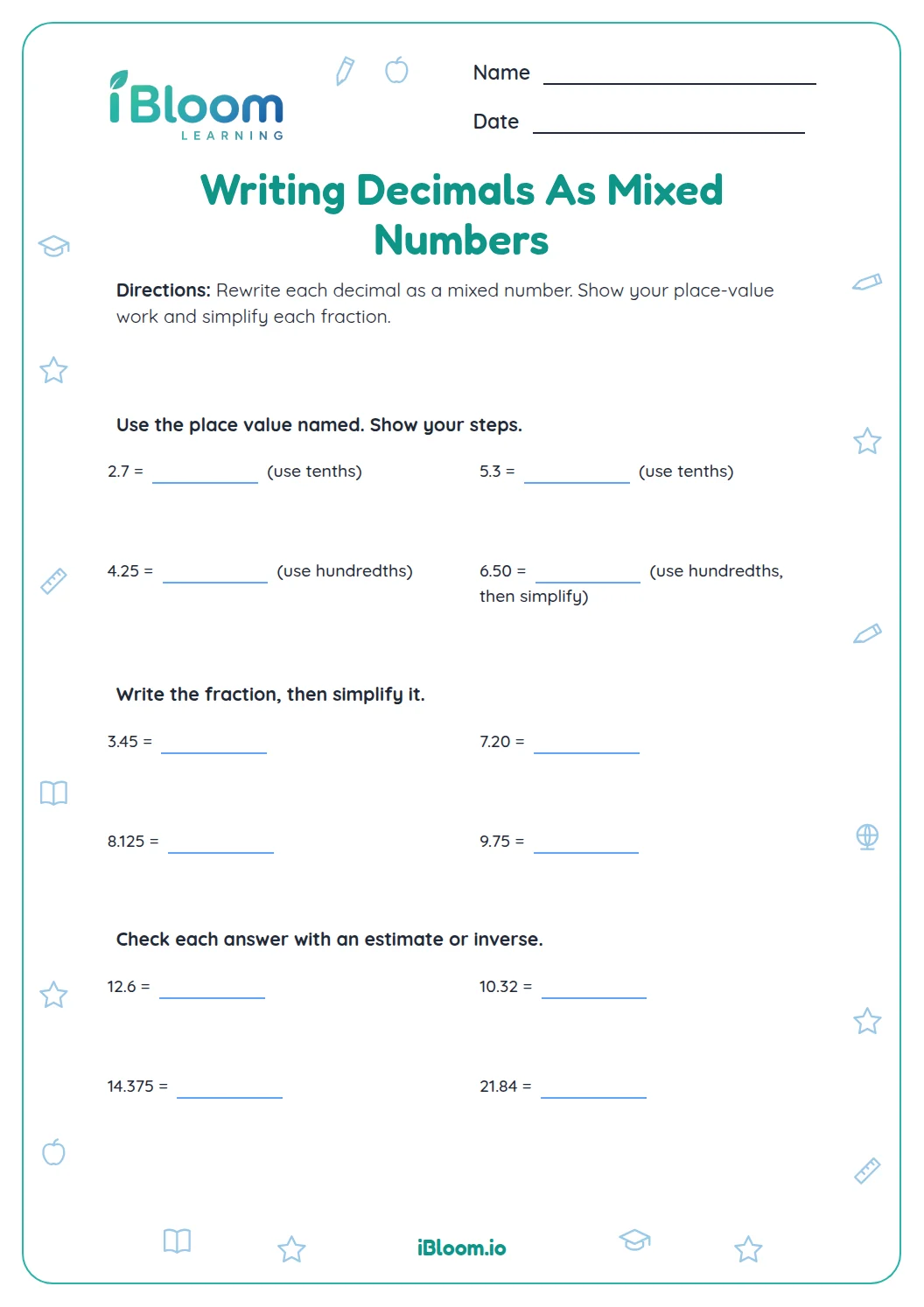
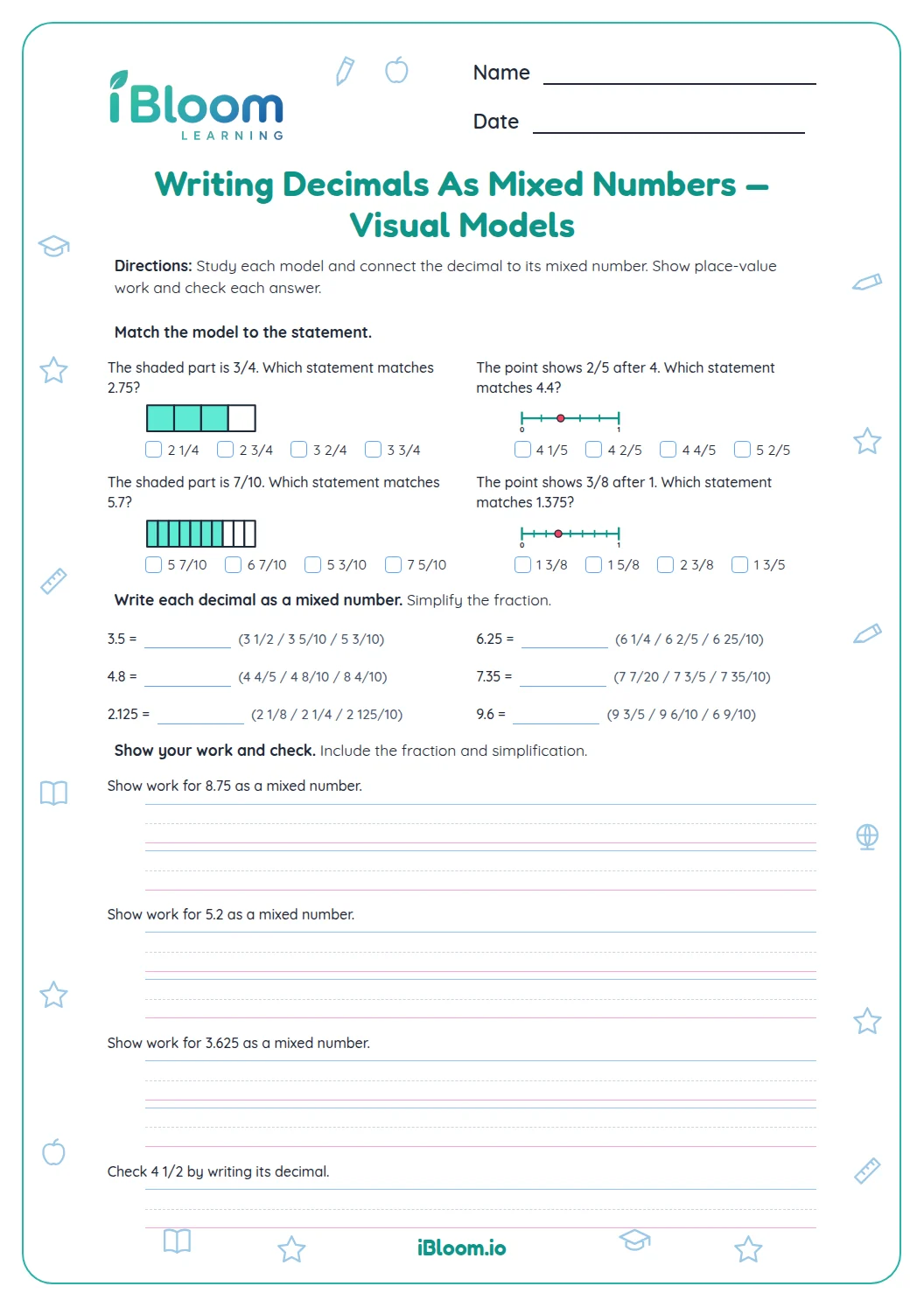
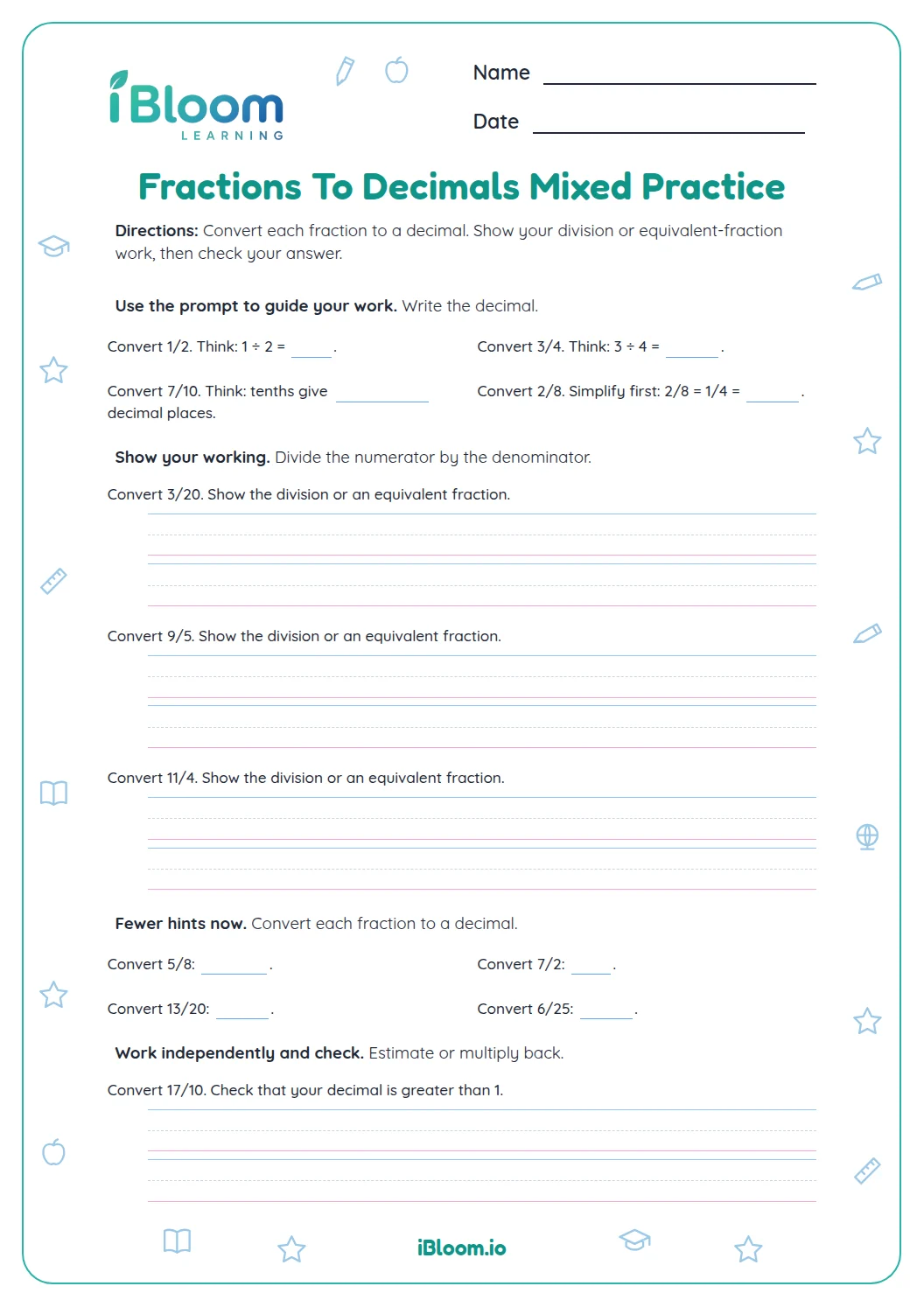
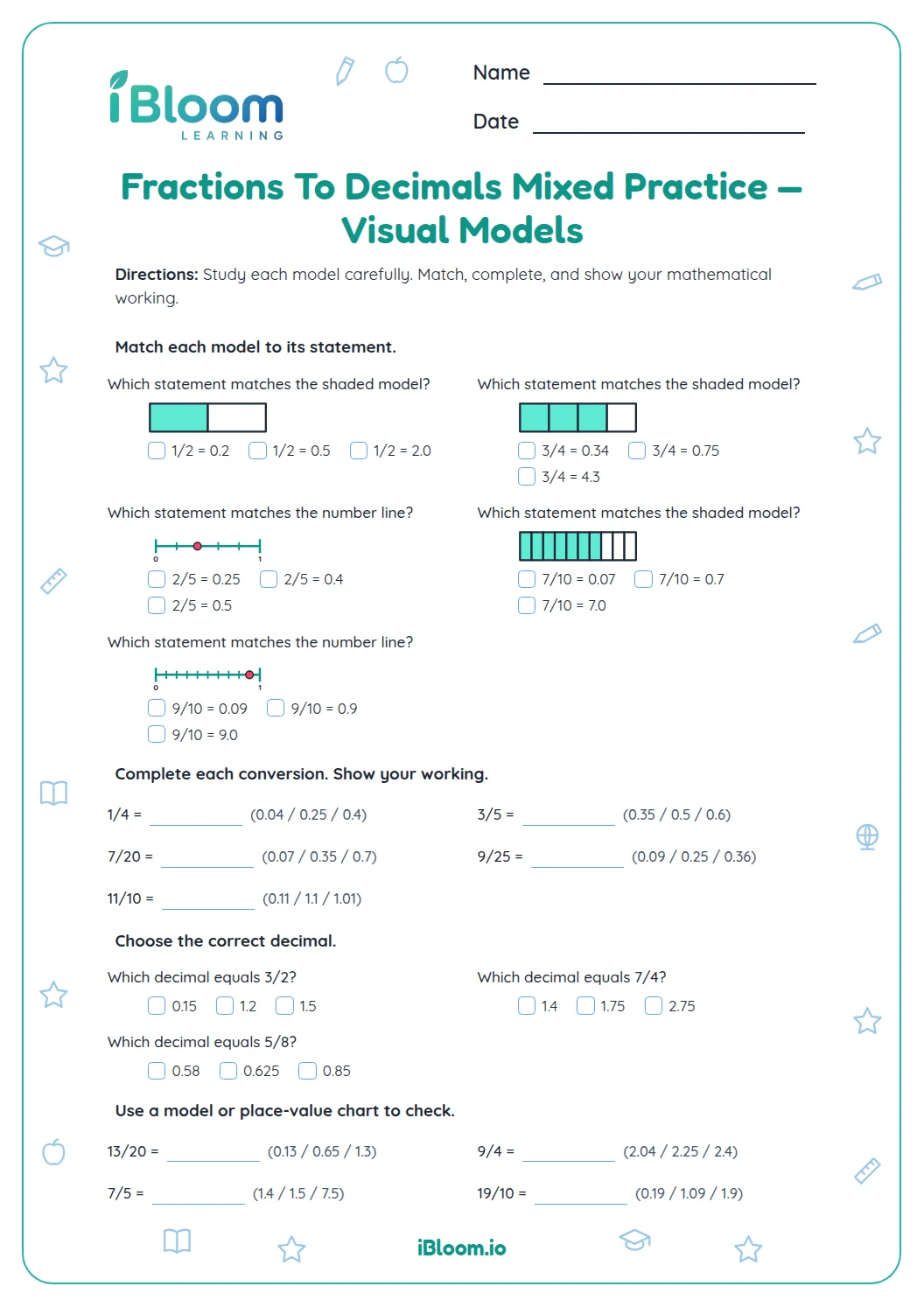
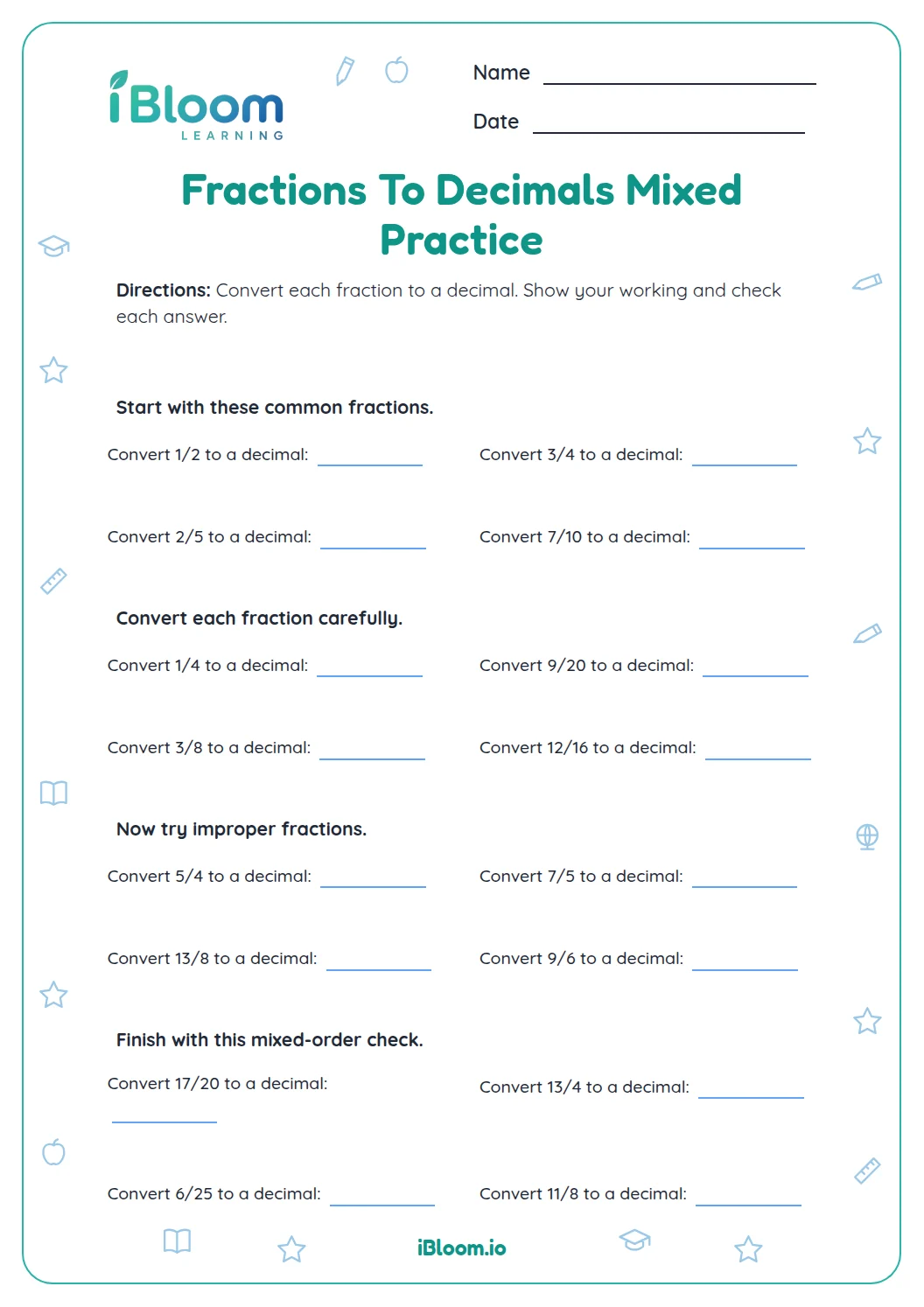
This Grade 6 worksheet builds independent practice converting decimals to fractions. Students rewrite tenths and hundredths, simplify fractions, express values greater than one as mixed numbers, and compare a decimal with a fraction. A final explanation checks the idea that equivalent notation names the same value. The answer key provides simplified forms and a sample explanation.
Aligned to 4.NF.C.6
How does place value create a fraction?
Tenths, hundredths and thousandths tell you the starting denominator. Reduce numerator and denominator by the same factor.
- 10.25 = 25/100 = 1/4.
How do you simplify a decimal fraction?
Write the digits over the appropriate power of ten, then divide top and bottom by a common factor.
- 10.125 = 125/1000 = 1/8.
How can you compare a decimal and a fraction?
Convert both values to a common form or compare equivalent fractions. Keep the value unchanged as you rename it.
How to use this worksheet
- 1Count the decimal places to choose tenths, hundredths or thousandths.
- 2Write the decimal digits as the numerator.
- 3Reduce by dividing numerator and denominator by a common factor.
- 4For values above one, separate the whole number from the fractional part.
- 5Use equivalent forms to compare values.
Common mistakes and fixes
The mistake
Using the number of digits as the denominator
The fix
Use 10, 100 or 1,000 based on the last decimal place.
The mistake
Forgetting to simplify
The fix
Look for a common factor in the numerator and denominator.
The mistake
Comparing numerators with unlike denominators
The fix
Rename values with a common denominator or use decimal place value.
Common Core alignment
These problems connect decimal place value with equivalent fractions and number comparisons.
Write decimal fractions with denominators 10 or 100 in decimal notation.
On this sheet: The worksheet practices the reverse conversion: reading decimals through hundredths as equivalent fractions.
Show the official wordingHide the official wording
Use decimal notation for fractions with denominators 10 or 100. For example, rewrite 0.62 as 62/100; describe a length as 0.62 meters; locate 0.62 on a number line diagram.
What to practice next
Make more practice
Further reading
Questions parents and teachers ask
Why should the fraction be simplified?
A simplified fraction has no common factor greater than one in its numerator and denominator. For example, 25/100 reduces to 1/4 by dividing both numbers by 25. The denominator names the number of equal parts in one whole, and the numerator counts those parts.
What denominator should I use for 0.35?
The last decimal place names the denominator: hundredths for two places and thousandths for three. Write 0.35 as 35/100, then divide numerator and denominator by 5 to get the equivalent fraction 7/20. Always reduce both numerator and denominator by the same factor to keep the fraction equivalent.
How do I write a decimal greater than one as a mixed number?
Separate the whole number, then convert the decimal part. In 1.2, the decimal part is 2/10, which reduces to 1/5, so the mixed number is 1 1/5. Check that the fractional part is less than one whole and that the mixed number matches the decimal.
Why compare 0.45 with 4/9?
The comparison uses equivalent forms. Since 0.45 is 45/100 or 9/20 and 4/9 is about 0.444, 0.45 is greater. The answer key selects 0.45. Convert 4/9 to a decimal or use common denominators to see that it is less than 0.45.
What does the explanation question look for?
A complete response connects 0.30 to 30/100 and simplifies 30/100 to 3/10. Other wording is fine if it explains that both notations name the same value. Ask the student to point to the hundredths in 0.30 and explain how thirty hundredths reduces.