




About this worksheet
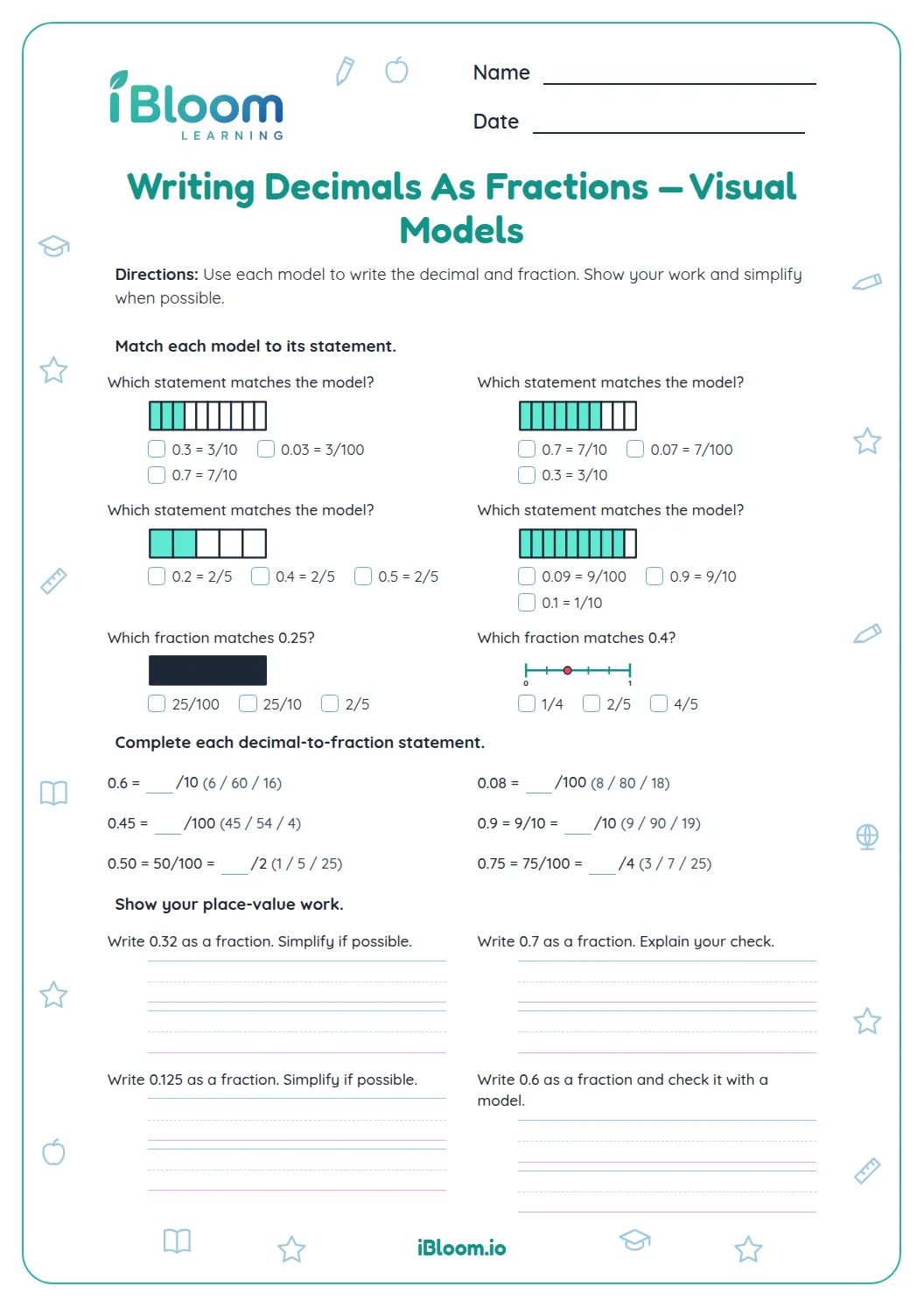
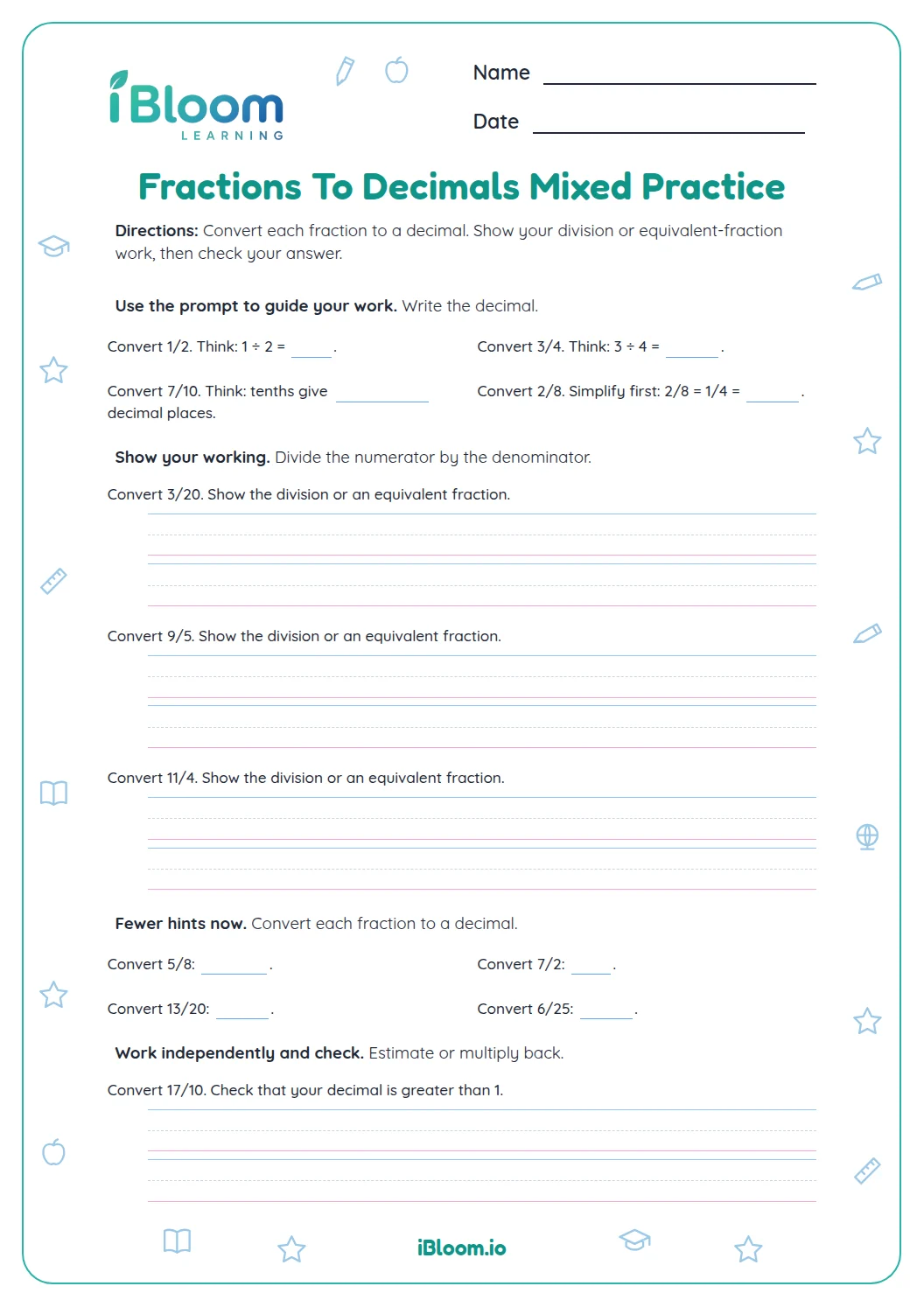
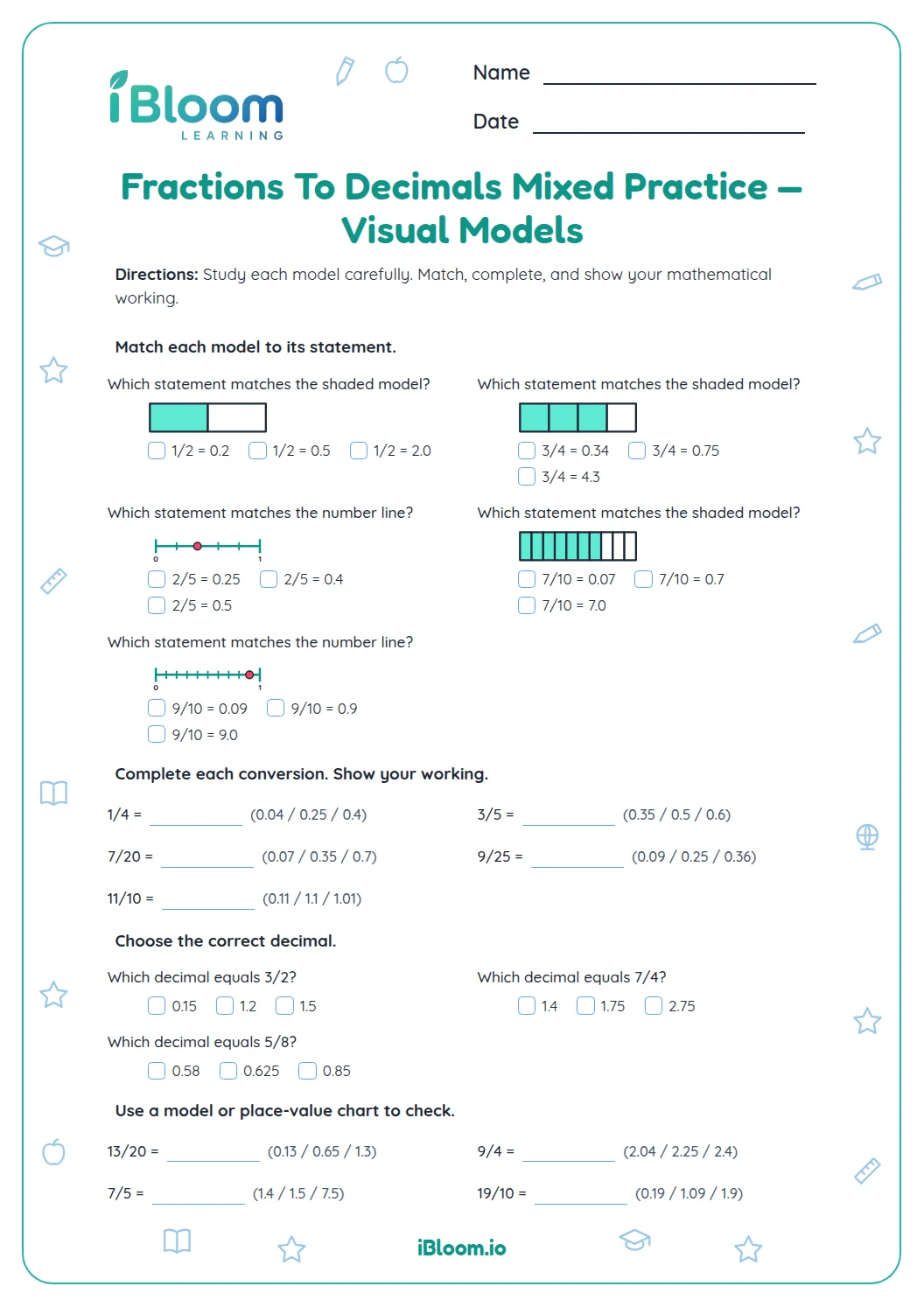
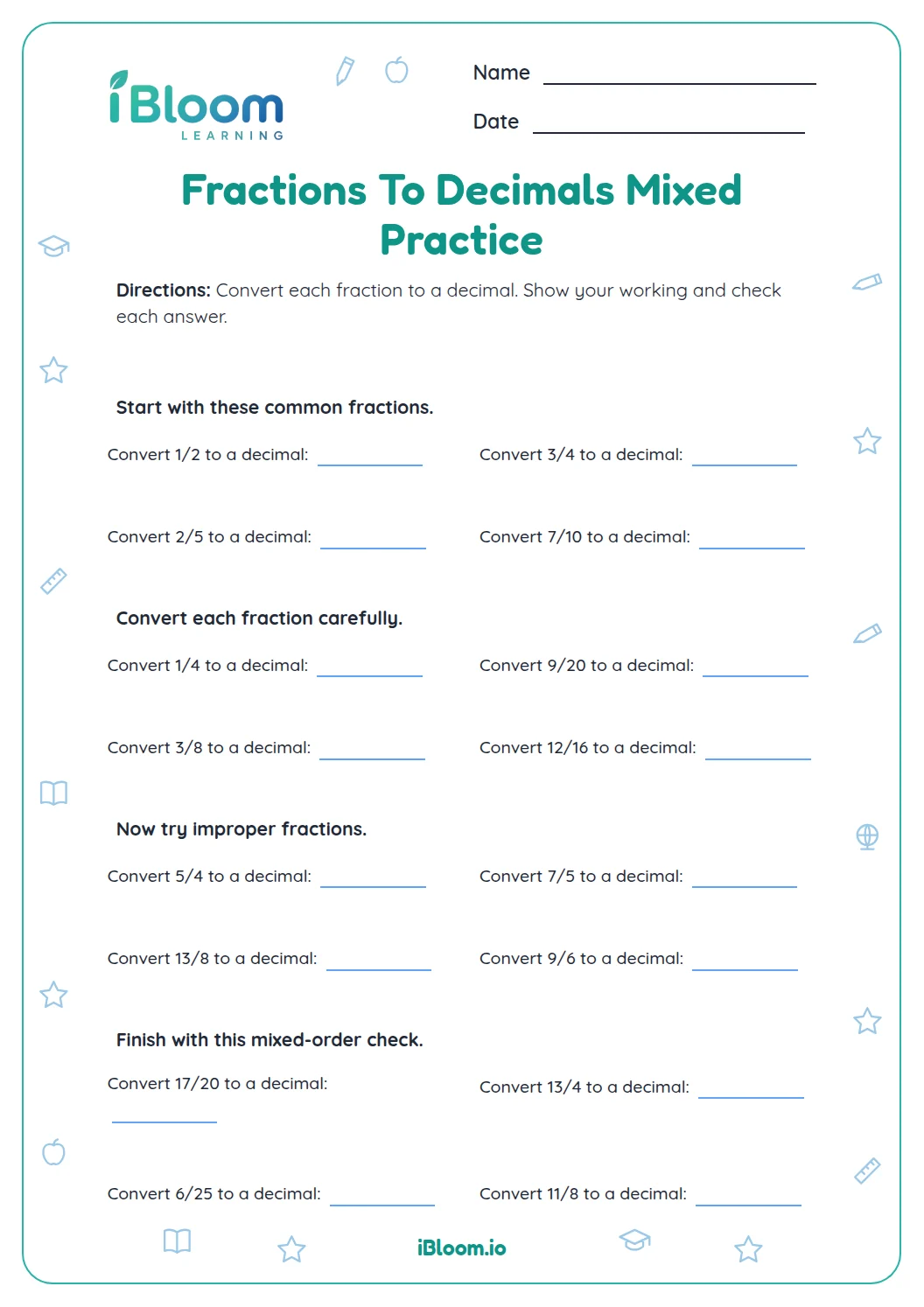
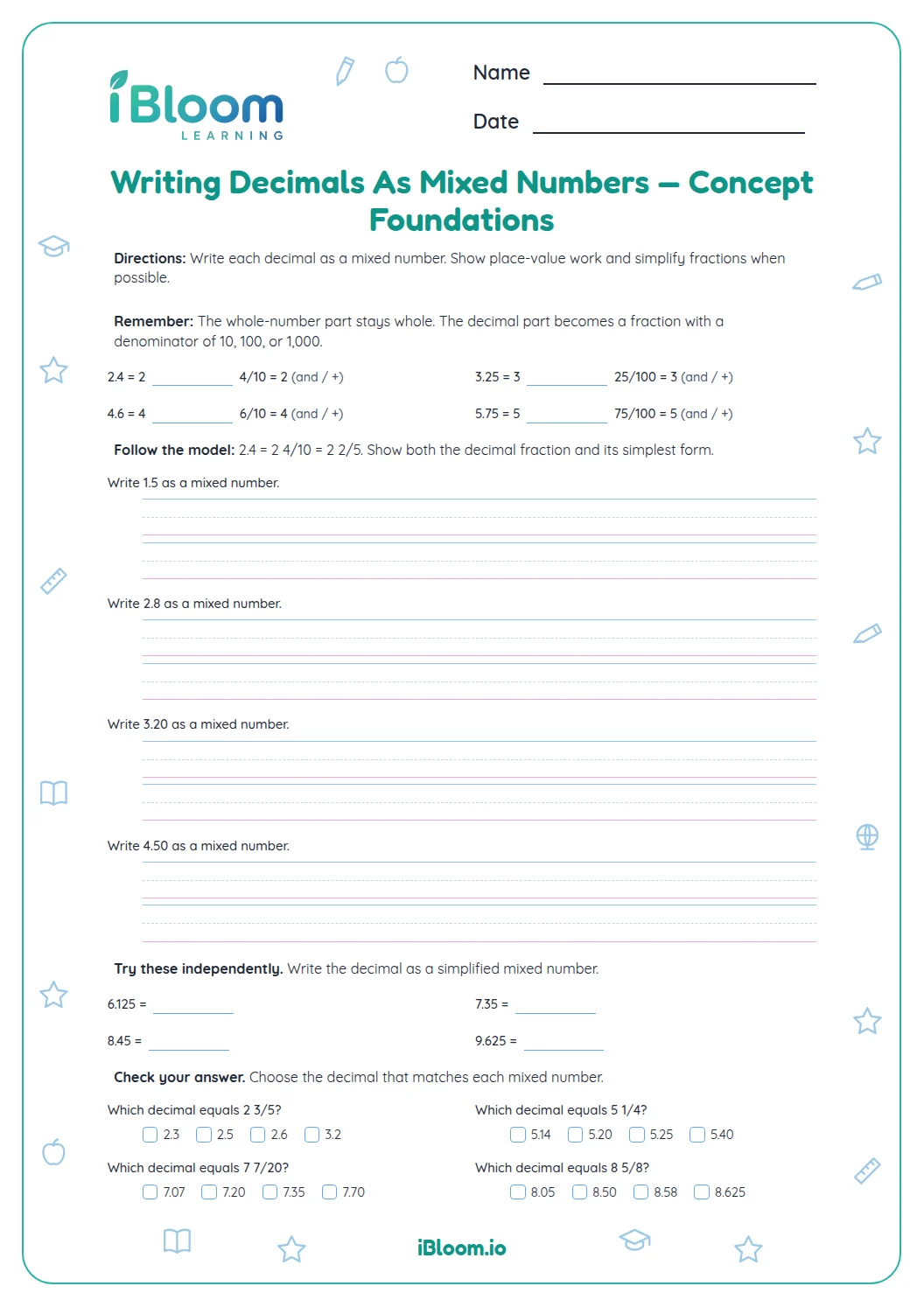
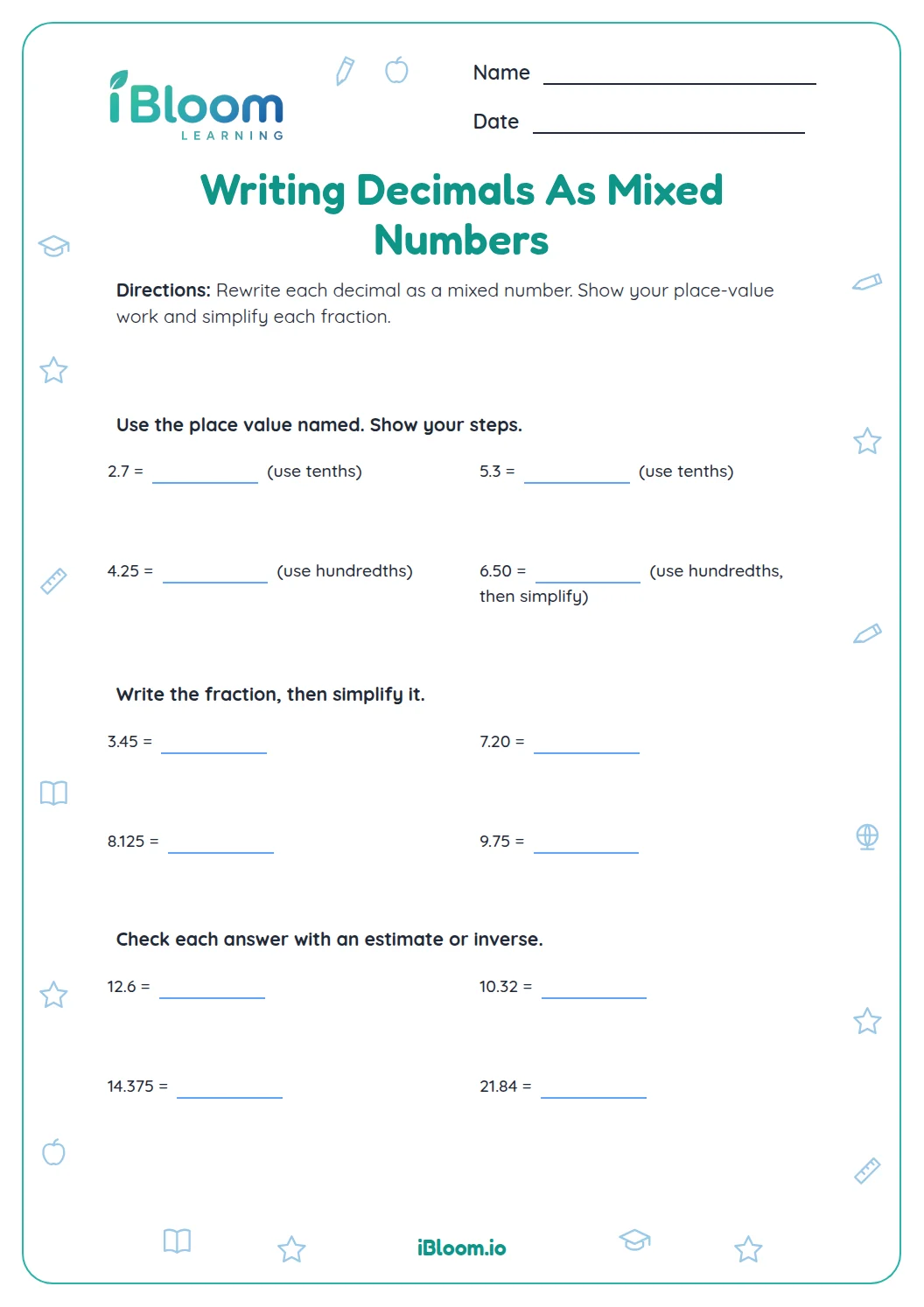
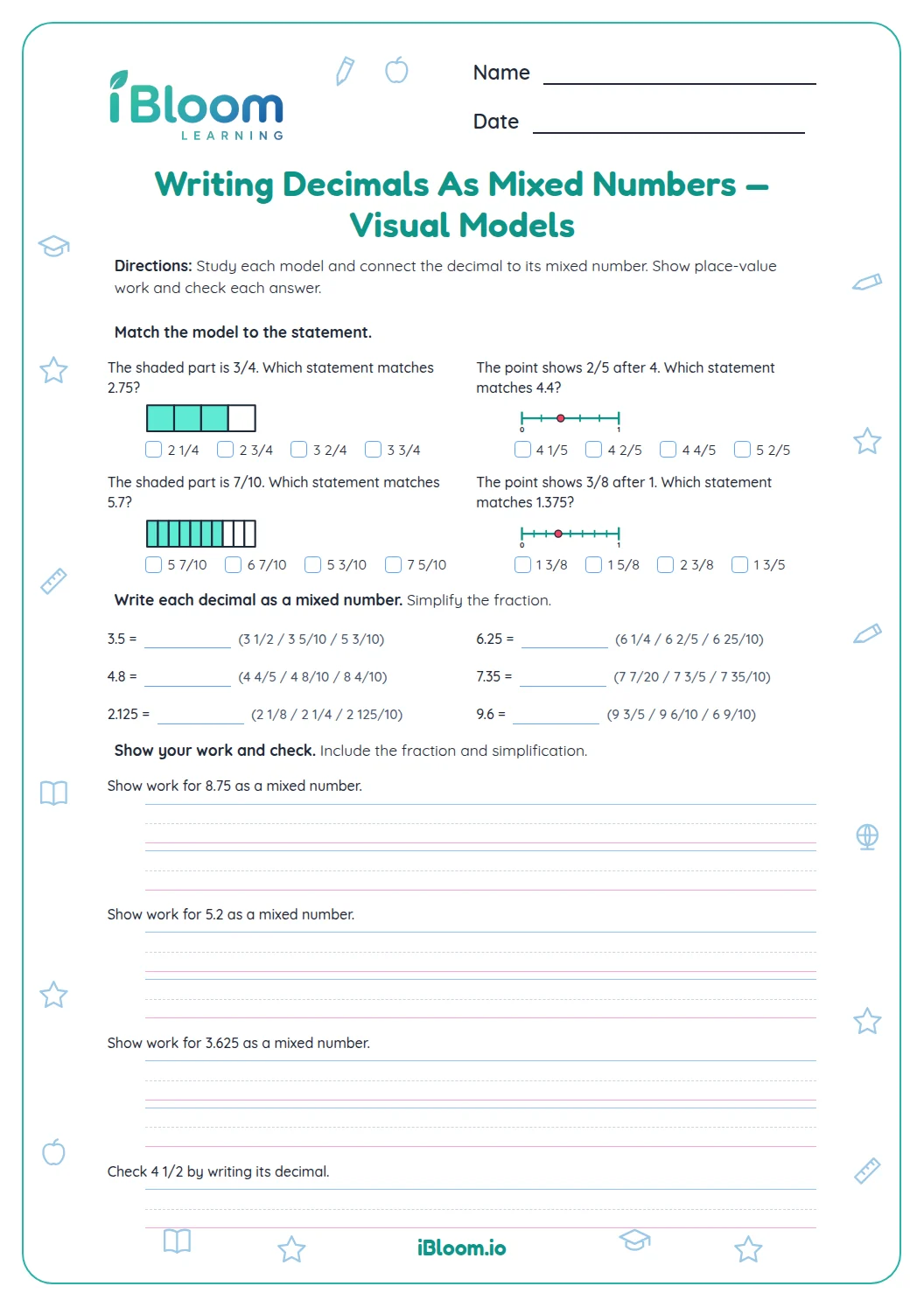
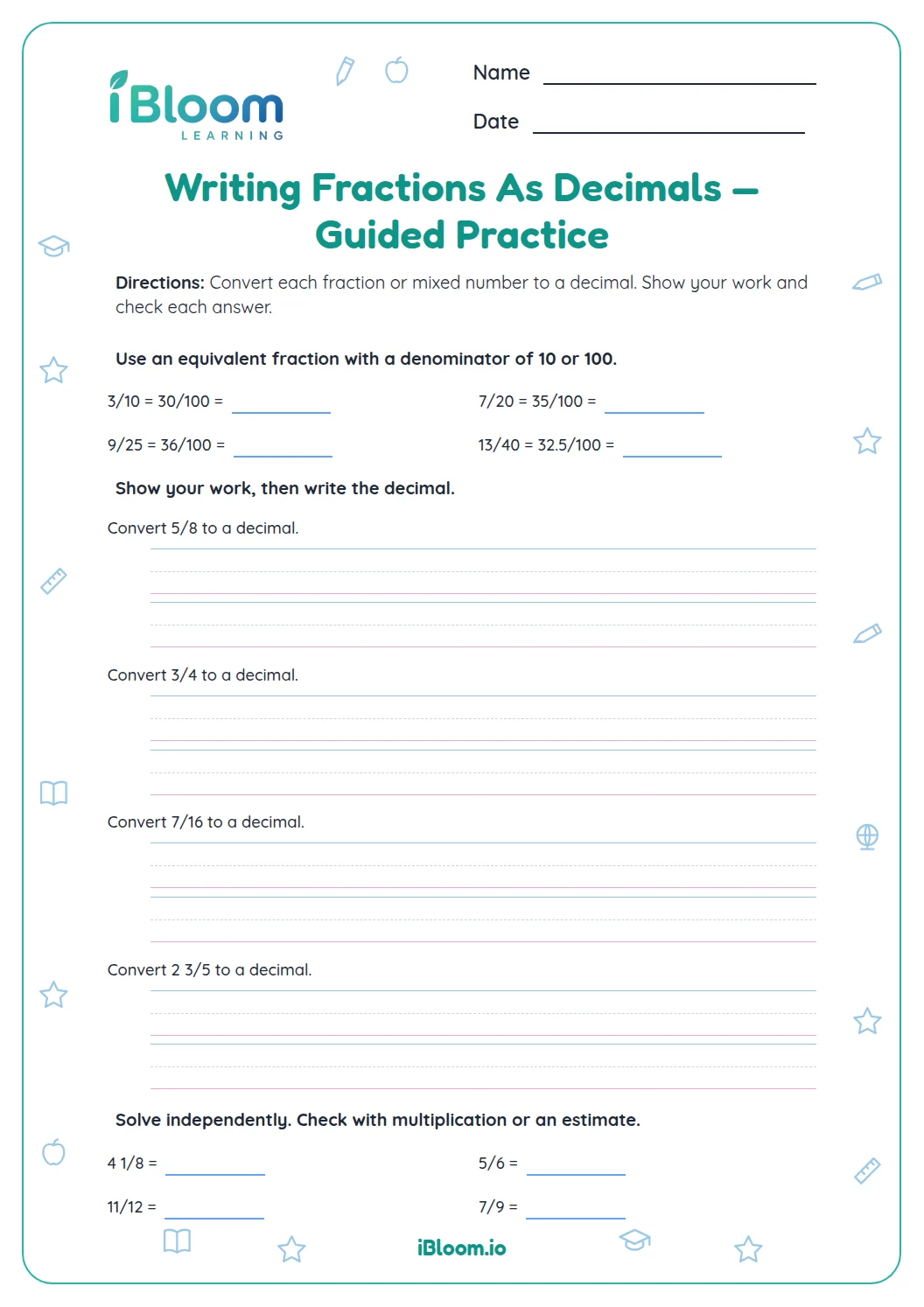
This Grade 6 printable practices writing decimals as fractions, first by naming tenths, hundredths, or thousandths and then by simplifying. Sixteen questions are split into two parts, with room to show how the decimal digits set the denominator. A separate answer key includes equivalent simplest-form fractions where requested.
How does a decimal place tell you the denominator?
The first part focuses on place value: one digit after the decimal represents tenths, two represent hundredths, and three represent thousandths. Write the digits as the numerator over the matching power of ten.
For instance, 0.4 is 4/10. In Part B, reduce the fraction by dividing numerator and denominator by the same factor until it is in simplest form.
- 10.4 = 4/10
- 2There is one digit after the decimal, so use tenths.
- 3For simplest form, divide the numerator and denominator by a common factor.
What changes in Part B?
Questions 1–8 ask for the numerator over a denominator that matches the decimal place. Questions 9–16 ask for the fraction in simplest form, so students must also reduce when possible.
- Part A: establish the method and record each answer.
- Part B: continue the same skill with a fresh set of examples.
- Use the answer key to review a calculation that needs another try.
How can I guide the practice?
- 1Count the digits after the decimal point.
- 2Use 10, 100, or 1,000 as the denominator for tenths, hundredths, or thousandths.
- 3Write the decimal digits as the numerator, keeping any needed zeros.
- 4For Part B, find a common factor and divide both parts of the fraction.
- 5Check that the simplified fraction has the same value as the decimal.
Common slips and how to check them
The mistake
Using 10 for a decimal with two or three places.
The fix
Count decimal places: two means hundredths, three means thousandths.
The mistake
Dropping a zero that marks a place, as in 0.040.
The fix
Write the place-value fraction first, then simplify it.
The mistake
Dividing only the numerator when simplifying.
The fix
Divide the numerator and denominator by the same common factor.
What to practice next
Make more practice
Questions parents and teachers ask
How many questions are on the worksheet?
There are 16 questions in two parts. The first eight practice writing fractions with denominators of 10, 100, or 1,000; the second eight ask for simplest form. The answer key lists the matching fractions for both kinds of question.
What skill does this page practice?
Students use decimal place value to write each decimal as a fraction, then simplify selected fractions. For example, 0.4 is 4/10, while 0.5 in simplest form is 1/2. The two parts move from reading decimal places to reducing a fraction.
Should students show their work?
Yes. The first part is most useful when students write the decimal digits over the correct place-value denominator. In the second part, show a common factor and divide both numerator and denominator by it. That makes the simplification easy to check.
How can I use the answer key?
For each answer, check the denominator against the decimal places. In simplest-form questions, also check that the numerator and denominator share no factor greater than 1. The key shows both the place-value fraction or its reduced equivalent, depending on the question.
How long will the worksheet take?
Plan for about 20 minutes for all 16 questions, including time to show the fraction steps and check simplified forms. Students can finish the place-value set first, review it with an adult, then work through the simplest-form questions at their own pace.