



About this worksheet
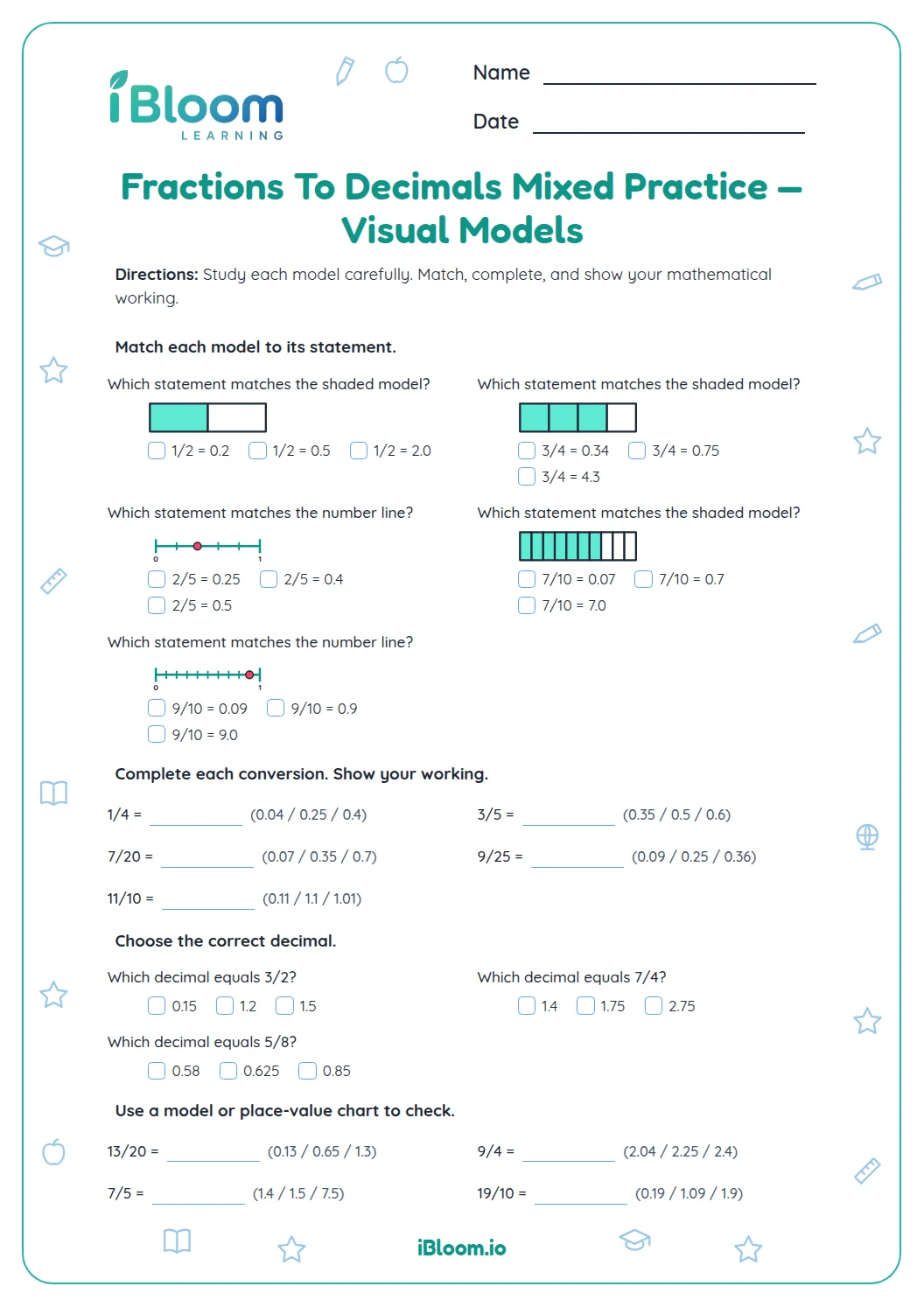
This free Grade 6 math worksheet connects fractions to decimals through a fraction bar, a number line and a hundredths grid. Students read models, convert fractions with denominators such as 4, 8, 20, 25, 10 and 100, and finish by drawing and labeling two equivalent-value models. A separate answer key supports checking each conversion and drawing.
How do visual models connect fractions to decimals?
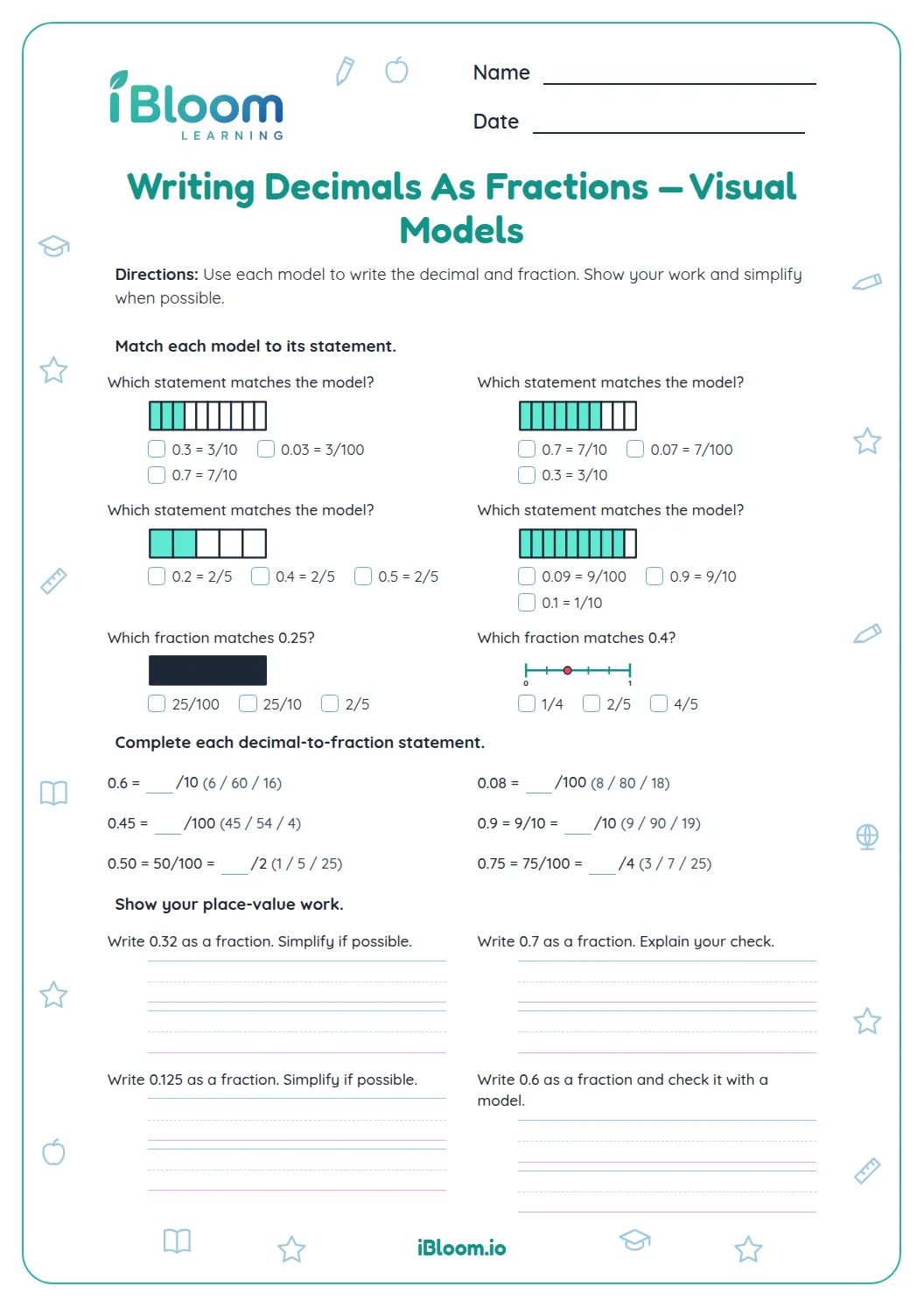
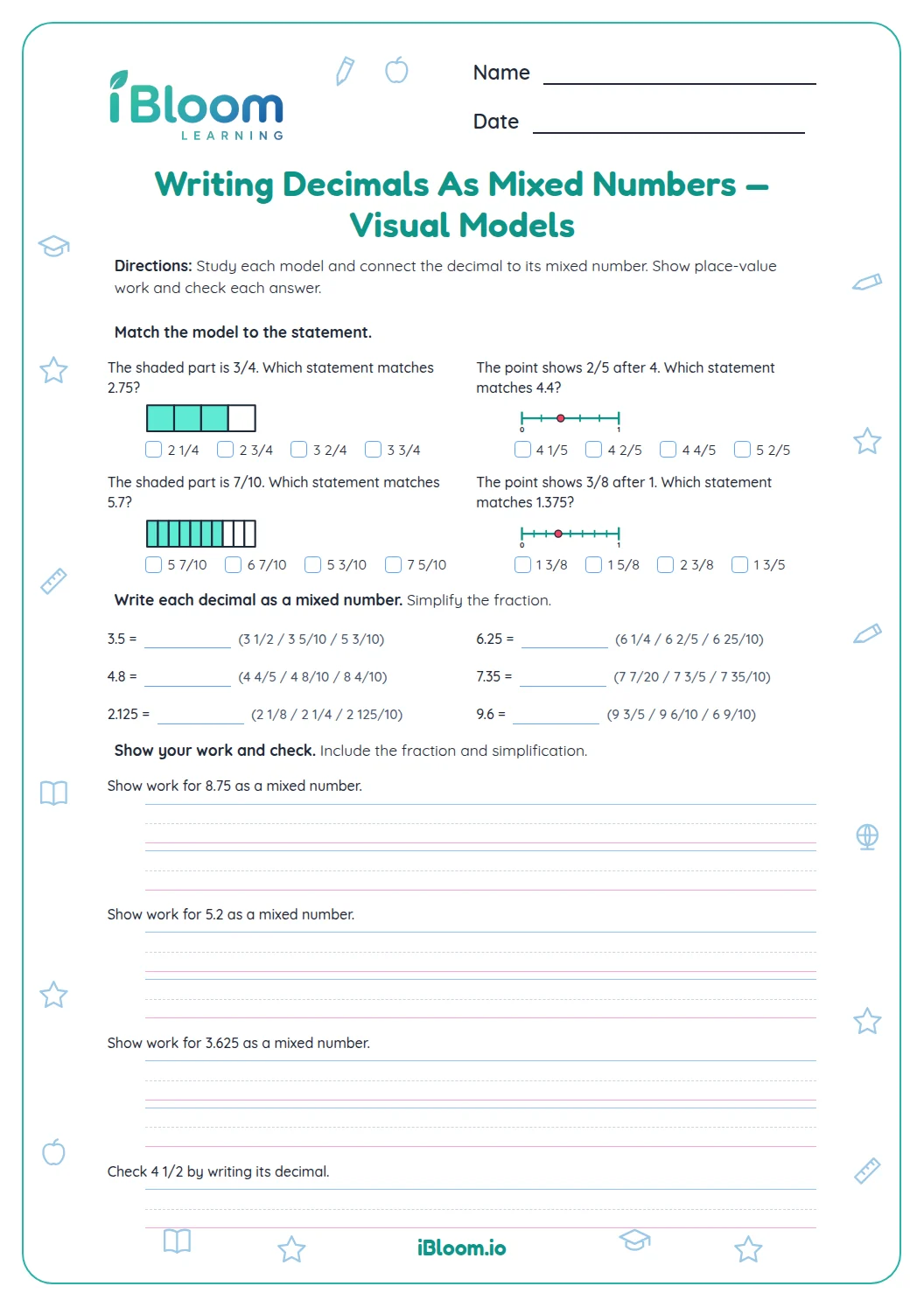
A fraction bar shows equal parts, a number line shows a value’s location, and a hundredths grid makes decimal place value visible. Students use each model to connect a fraction with an equivalent decimal.
For example, three of four equal parts is 3/4. Since 3/4 = 75/100, the decimal is 0.75.
- 1Question 1 asks which decimal is equivalent to 3/4.
- 23/4 = 75/100 = 0.75
What conversion facts are useful?
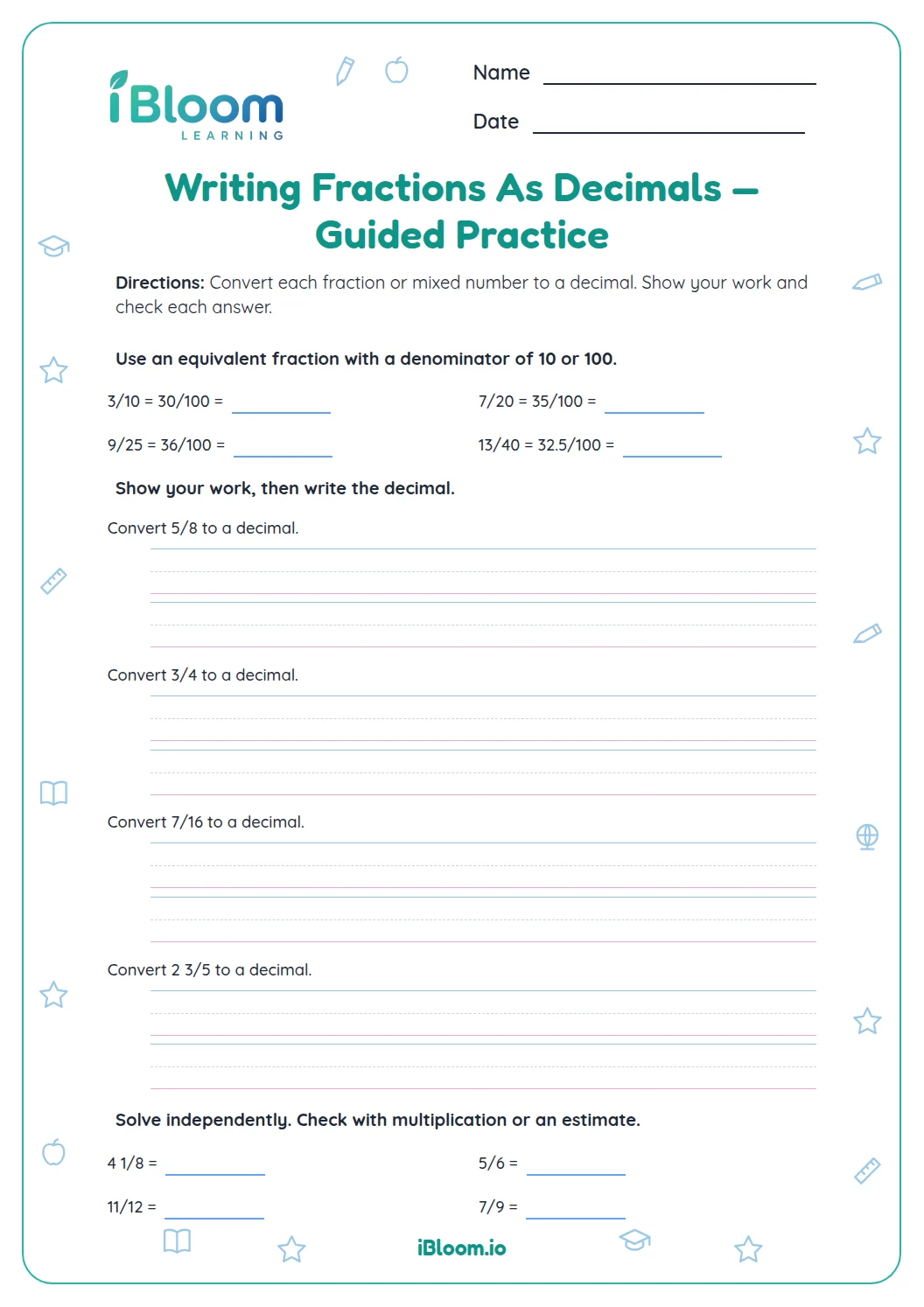
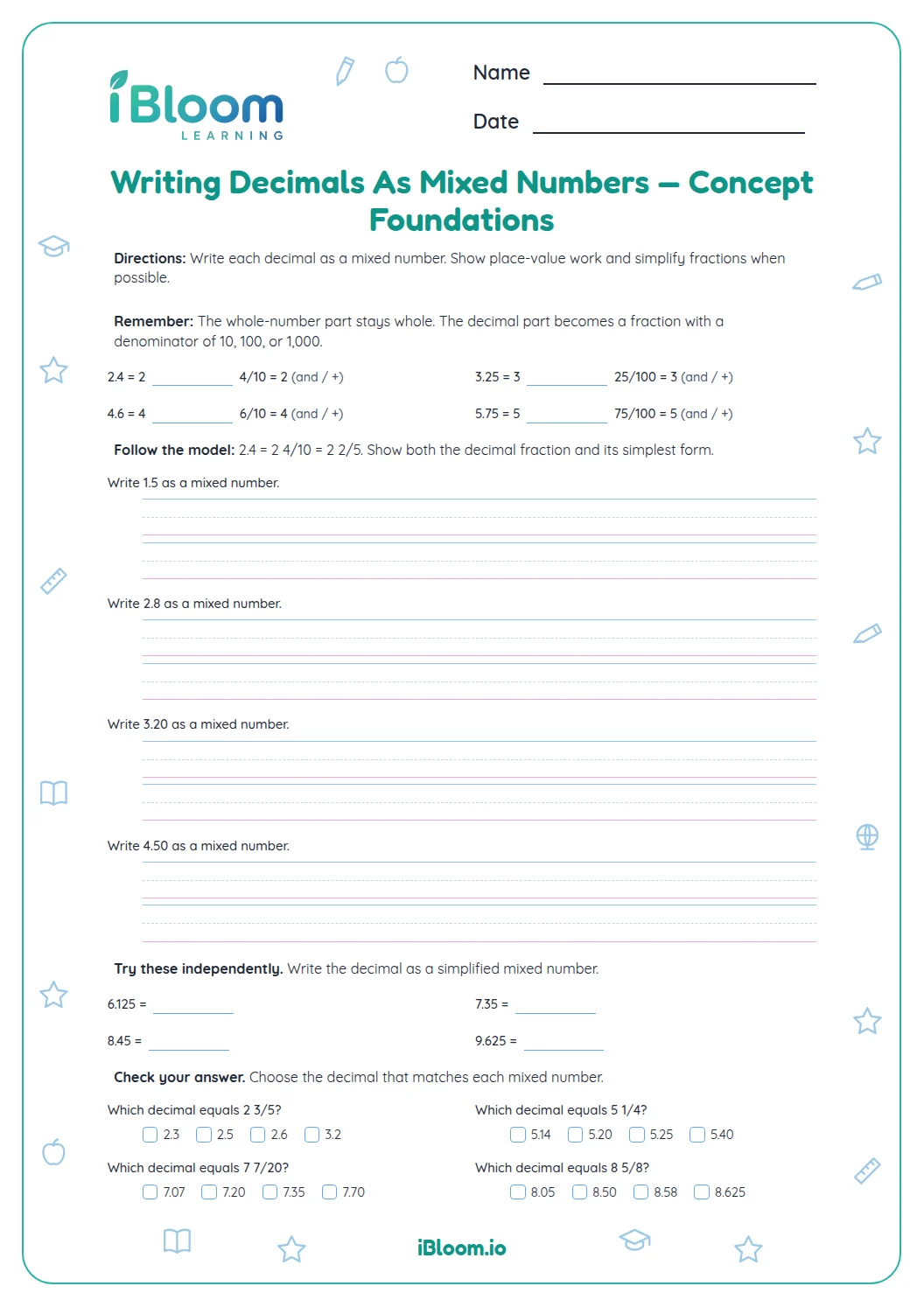
Fractions with denominators 10 and 100 can be written directly as tenths and hundredths. Other denominators in this practice can be changed to an equivalent fraction: 9/20 = 45/100, and 13/25 = 52/100.
Always keep the decimal place value aligned with the denominator. Eighteen hundredths is 0.18, not 1.8.
How can students check an equivalent decimal?
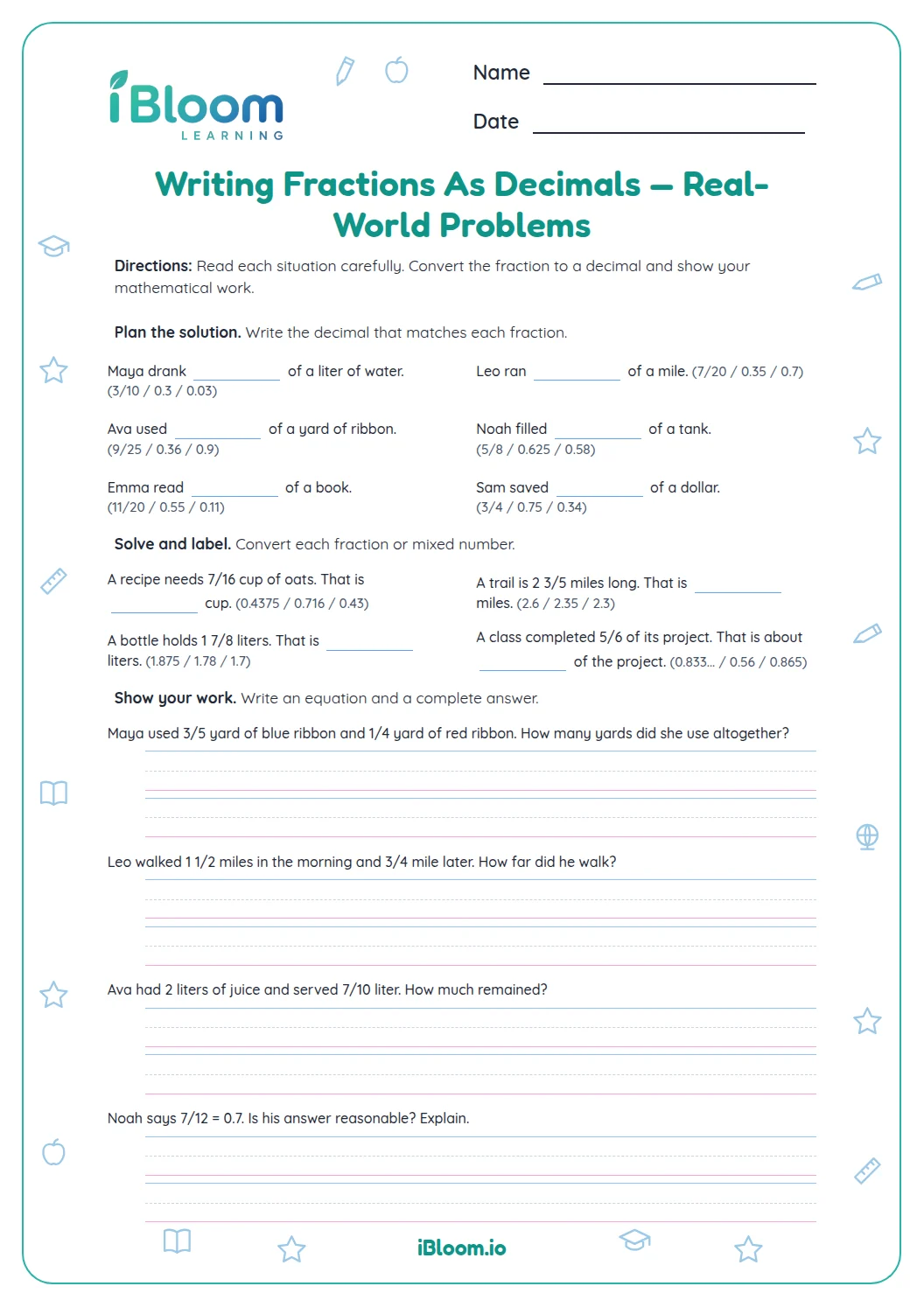
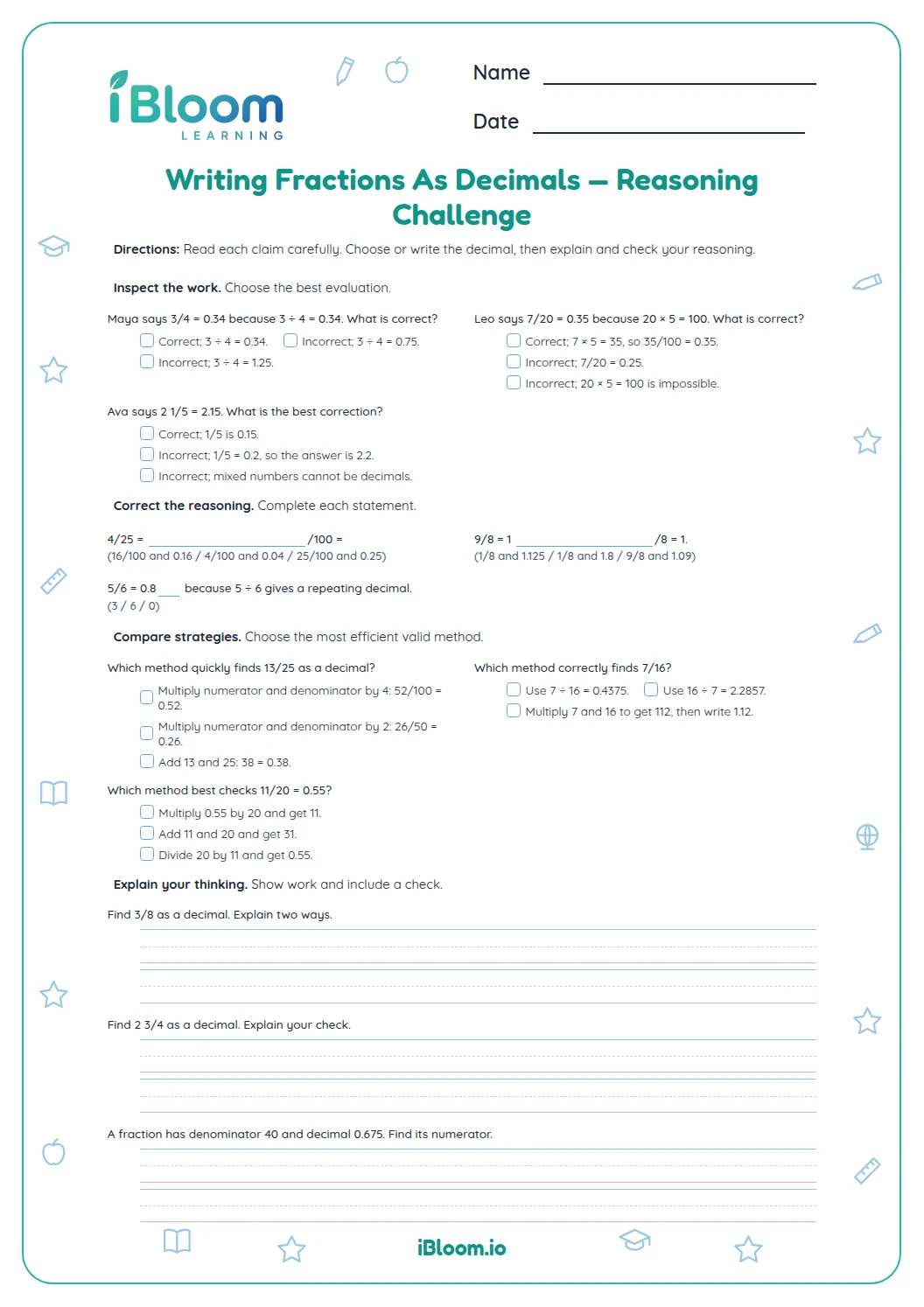
Estimate whether the decimal makes sense: a fraction less than one must have a decimal value less than one. Then use multiplication to check an equivalent fraction, such as 13/25 = 52/100 because both numerator and denominator were multiplied by 4.
The models offer another check: count equal parts and compare the shaded amount with the decimal value.
How to use this worksheet
- 1Read the model before looking at the answer choices.
- 2Name the whole and count the shaded equal parts.
- 3For denominators other than 10 or 100, make an equivalent fraction.
- 4Place the decimal point according to tenths or hundredths.
- 5Check the result against the model or by converting back to a fraction.
Common mistakes and quick fixes
The mistake
Writing 18/100 as 1.8.
The fix
Say “eighteen hundredths” and place 18 in the hundredths places: 0.18.
The mistake
Reading 3/4 as 0.34 because the digits are 3 and 4.
The fix
Use equal parts or make an equivalent fraction: 3/4 = 75/100 = 0.75.
The mistake
Stopping at 0.5 for 5/8.
The fix
Check the denominator: 5/8 is 0.625, which is greater than 1/2.
What to practice next
Make more practice
Questions parents and teachers ask
What does this worksheet teach about fractions and decimals?
It connects fractions to decimals with a fraction bar, a number line and a hundredths grid. Students convert fractions such as 7/10, 18/100, 9/20, 13/25 and 4/5. The separate answer key lists each equivalent decimal so students can check their conversions.
How many questions are included?
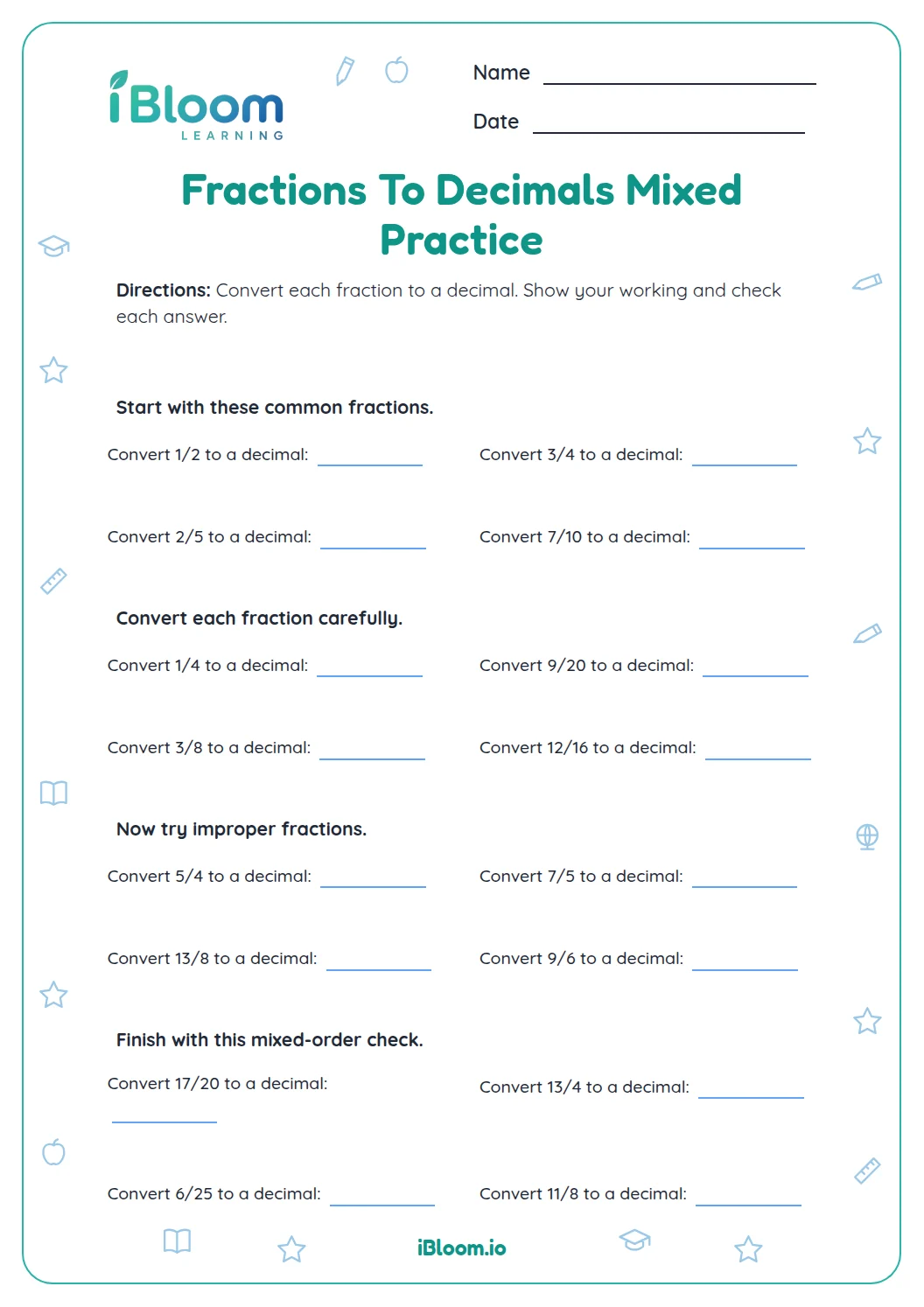
There are 14 questions: three visual-model reads and 11 fraction-to-decimal conversions. The conversions use tenths, hundredths, fourths, fifths, eighths and twentieths. The separate answer key gives each equivalent value. The worksheet and answer key each print as two pages.
How does the 3/4 model become a decimal?
The fraction bar shows three of four equal parts shaded, so it represents 3/4. Multiply the numerator and denominator by 25 to get 75/100. Seventy-five hundredths is written 0.75, which is also the location of the same amount on a number line.
Why does 18/100 equal 0.18?
The denominator 100 tells us the fraction counts hundredths. Eighteen hundredths puts 18 in the hundredths places, giving 0.18. The worksheet connects this notation with shaded visual models so place value stays visible. A decimal less than one is written with a zero before its decimal point.
Can a student use division to check?
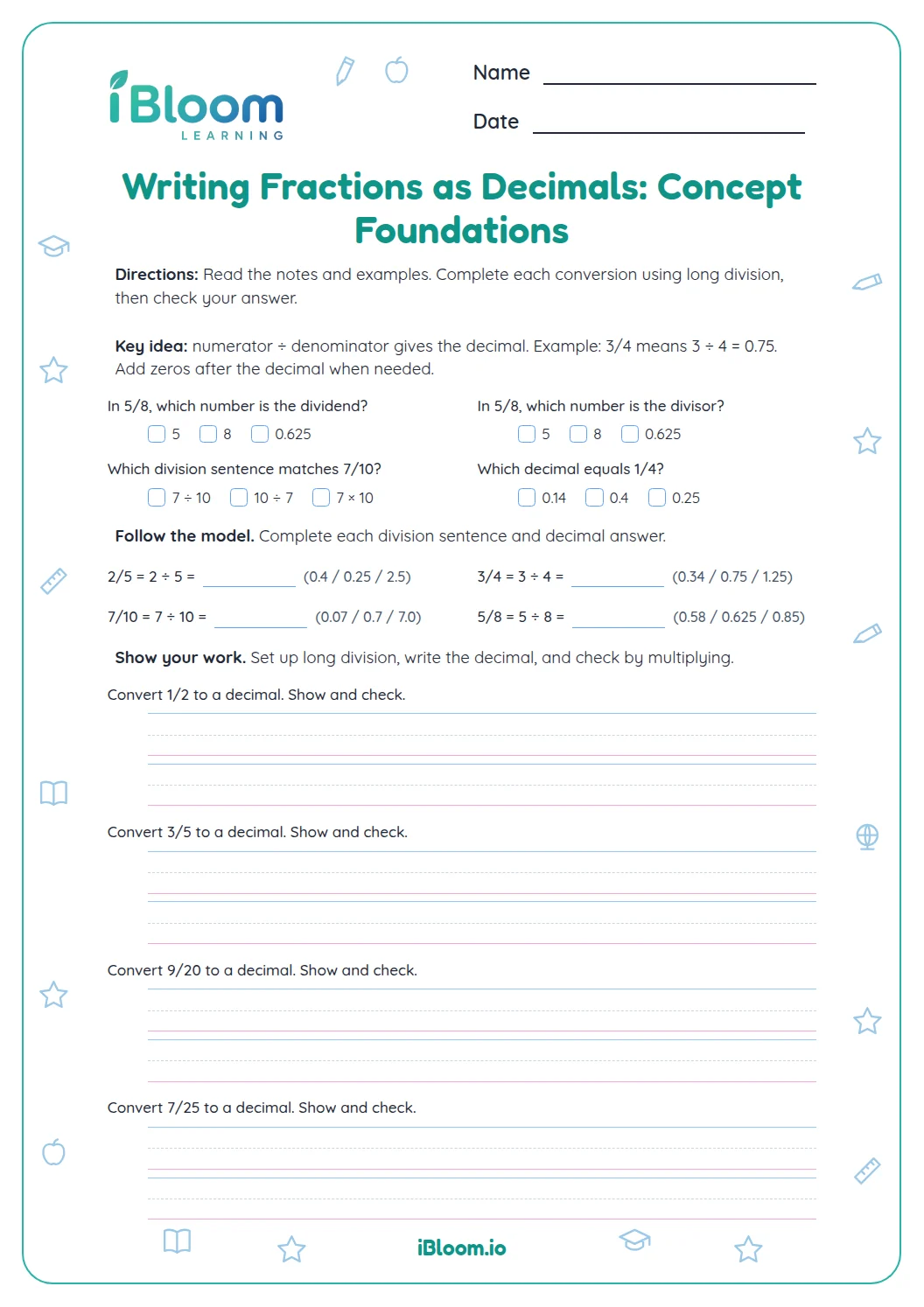
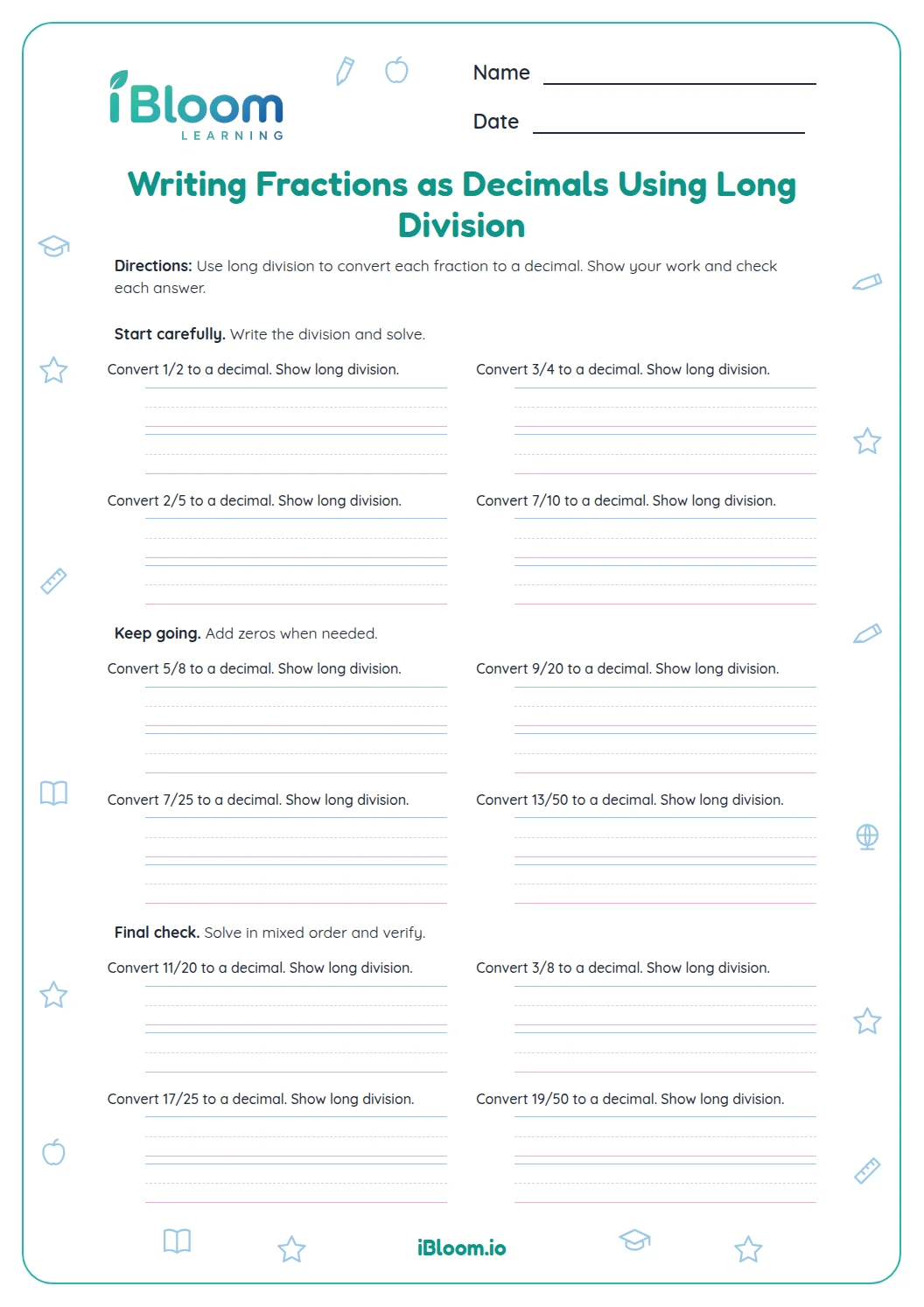
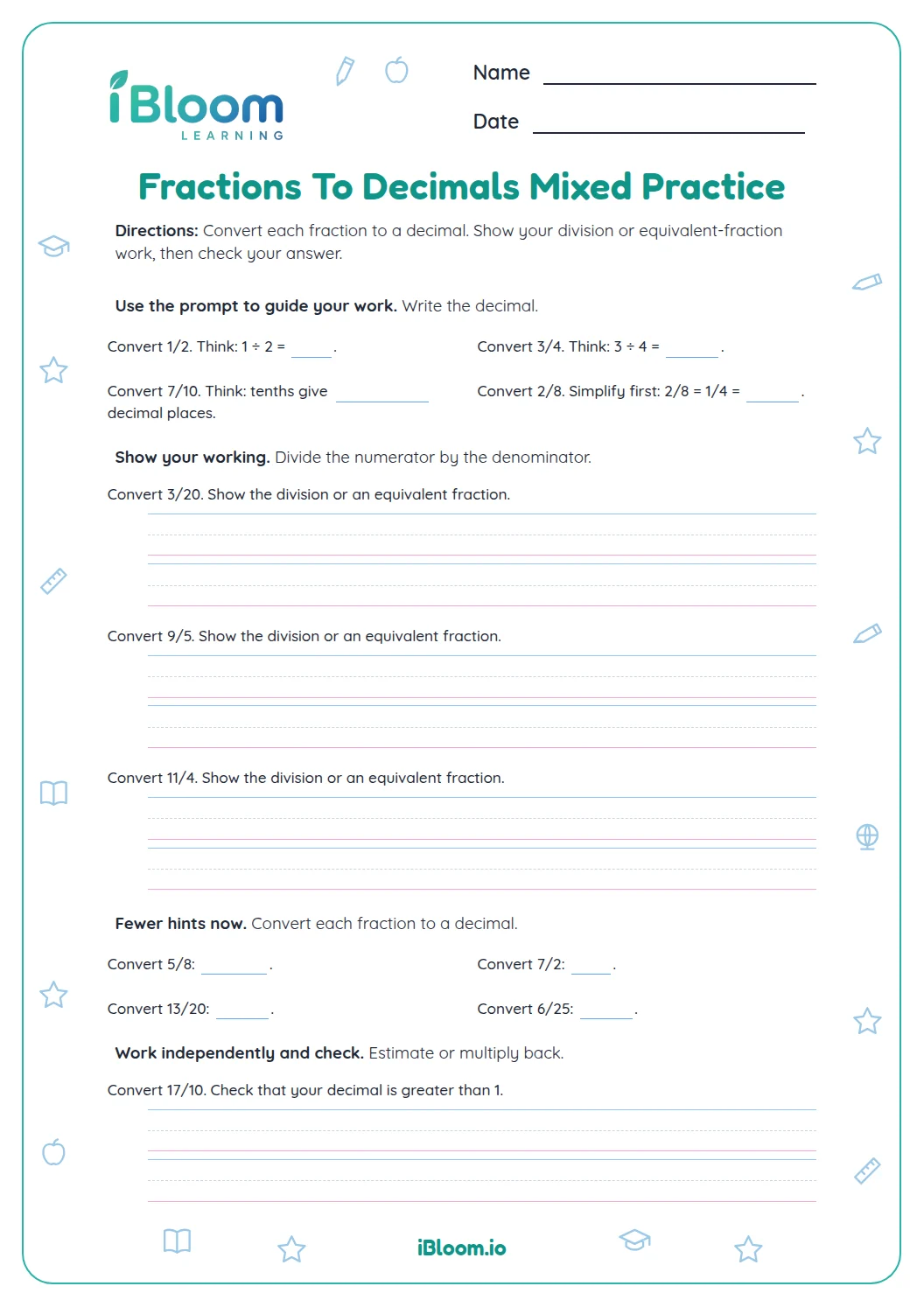
Yes. Dividing the numerator by the denominator gives the decimal value, so 3 ÷ 4 = 0.75 and 9 ÷ 20 = 0.45. Students can also create equivalent fractions with denominators of 10 or 100 when that is convenient. This strategy provides an independent check.