


About this worksheet
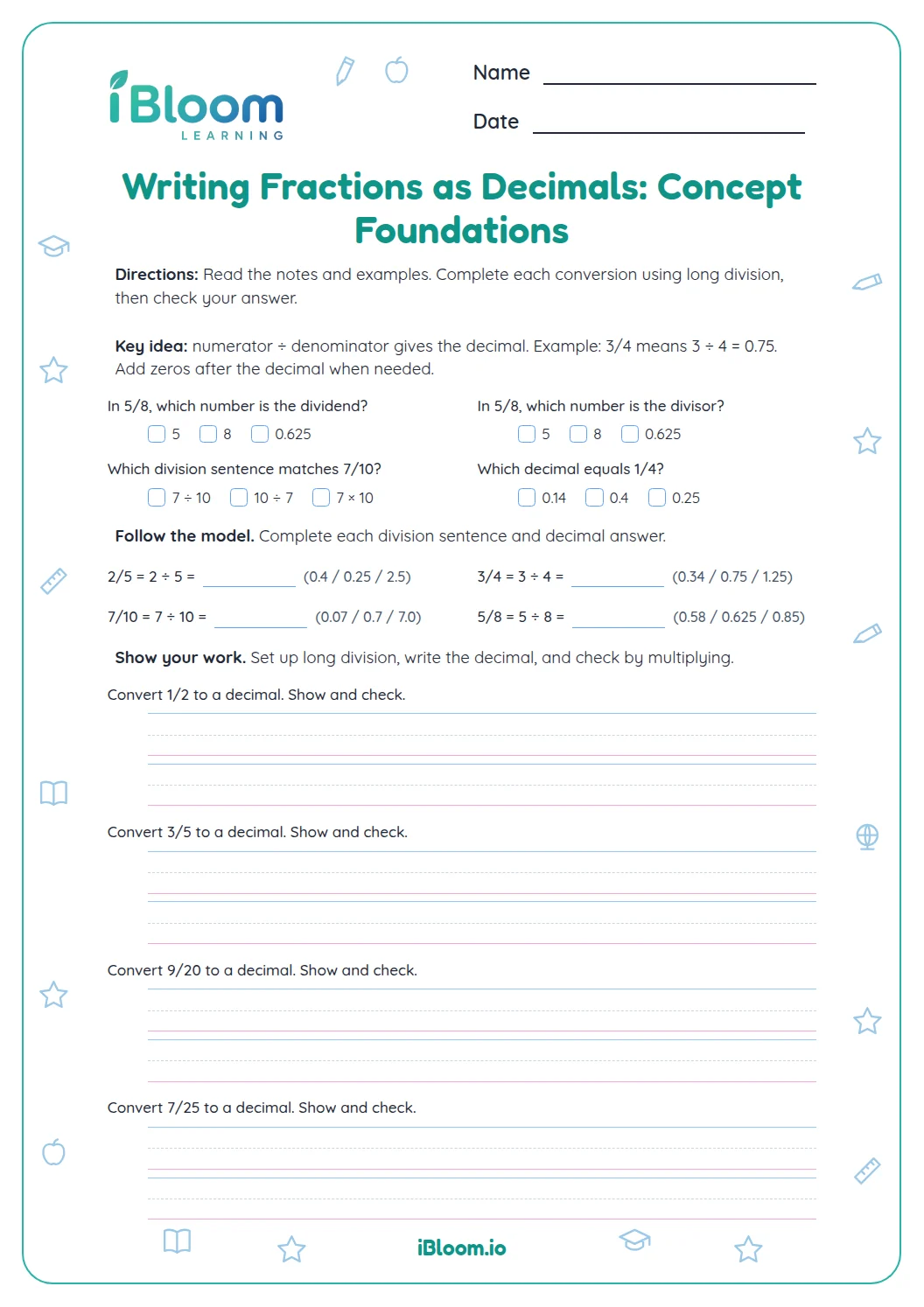
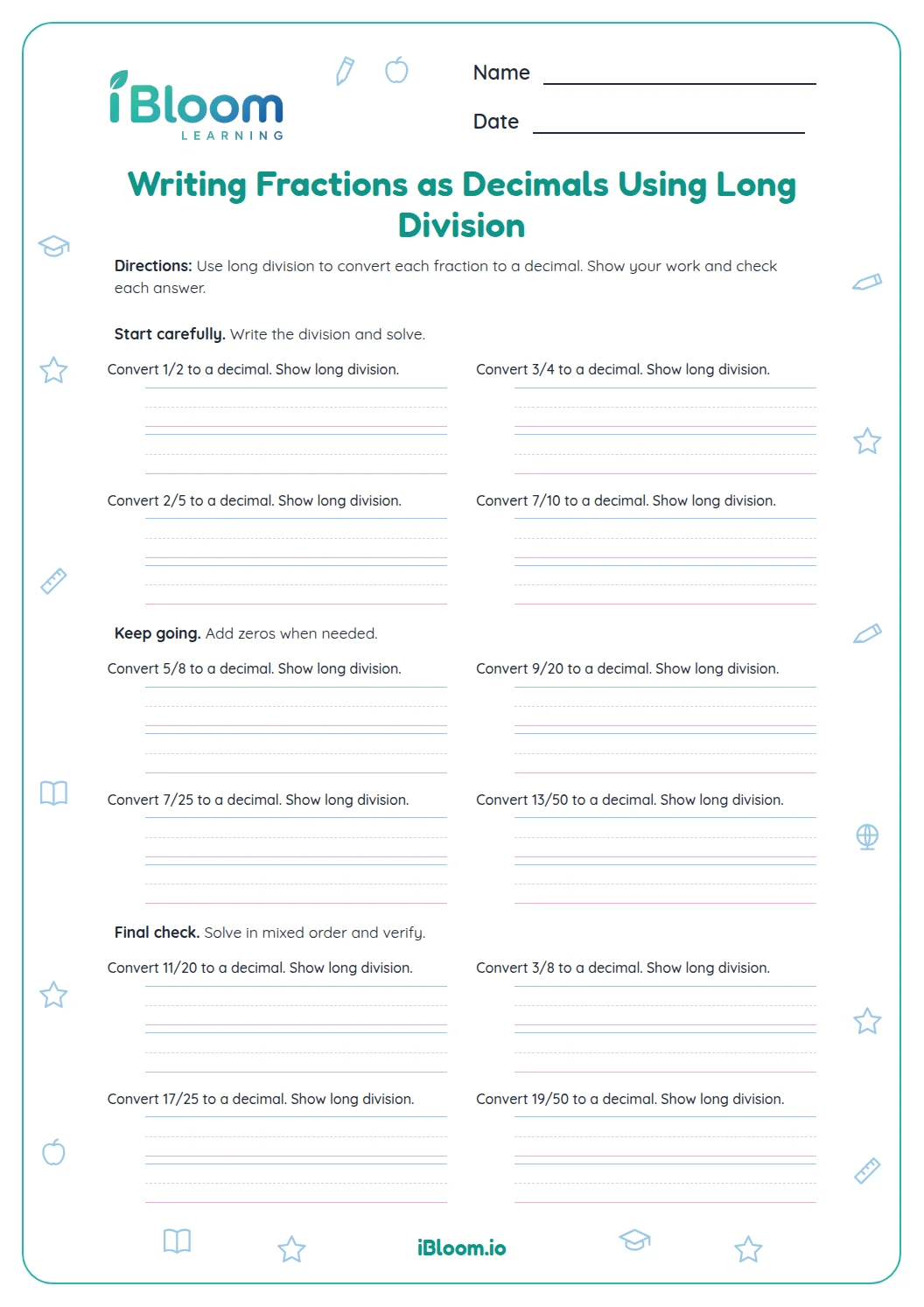
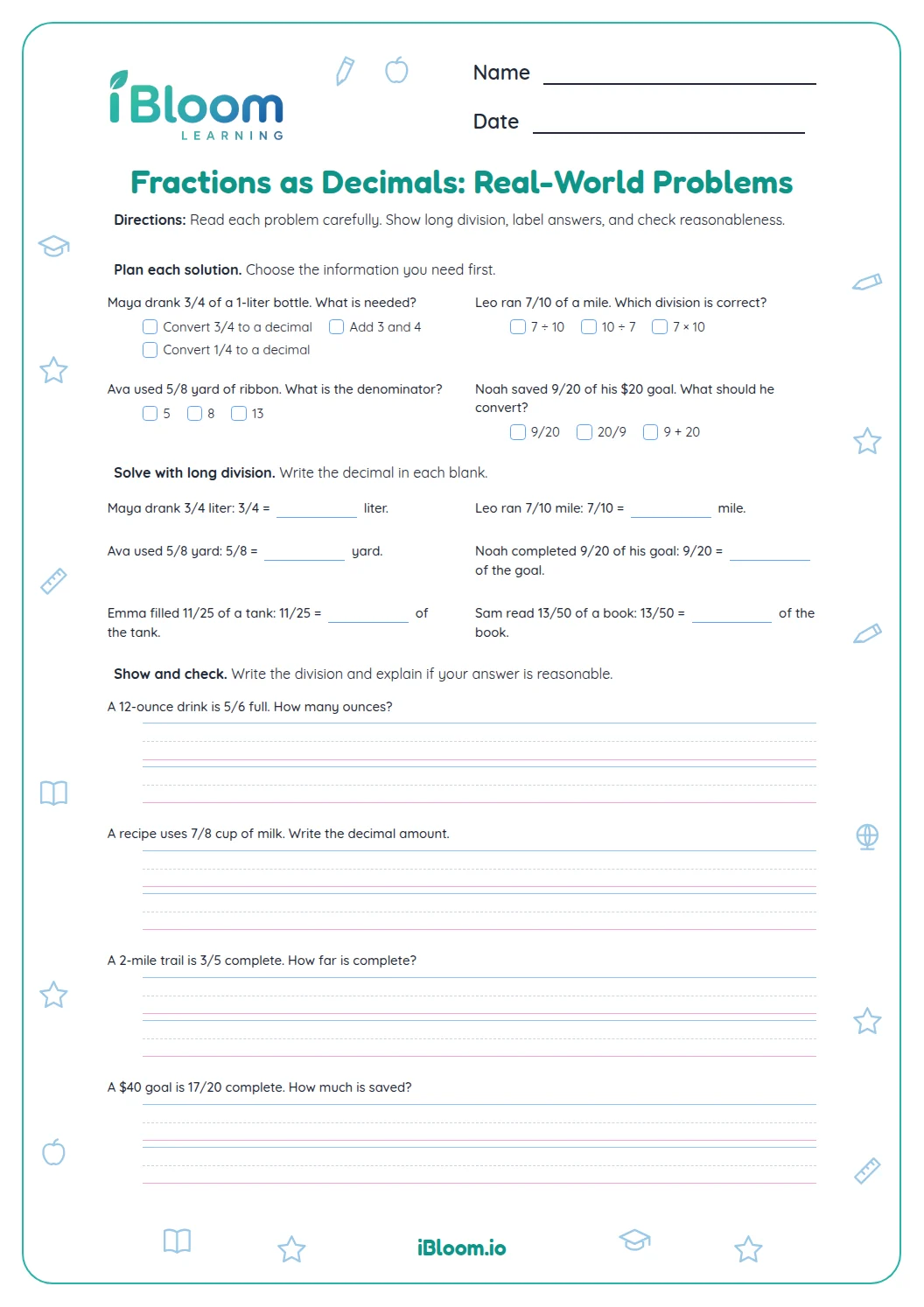
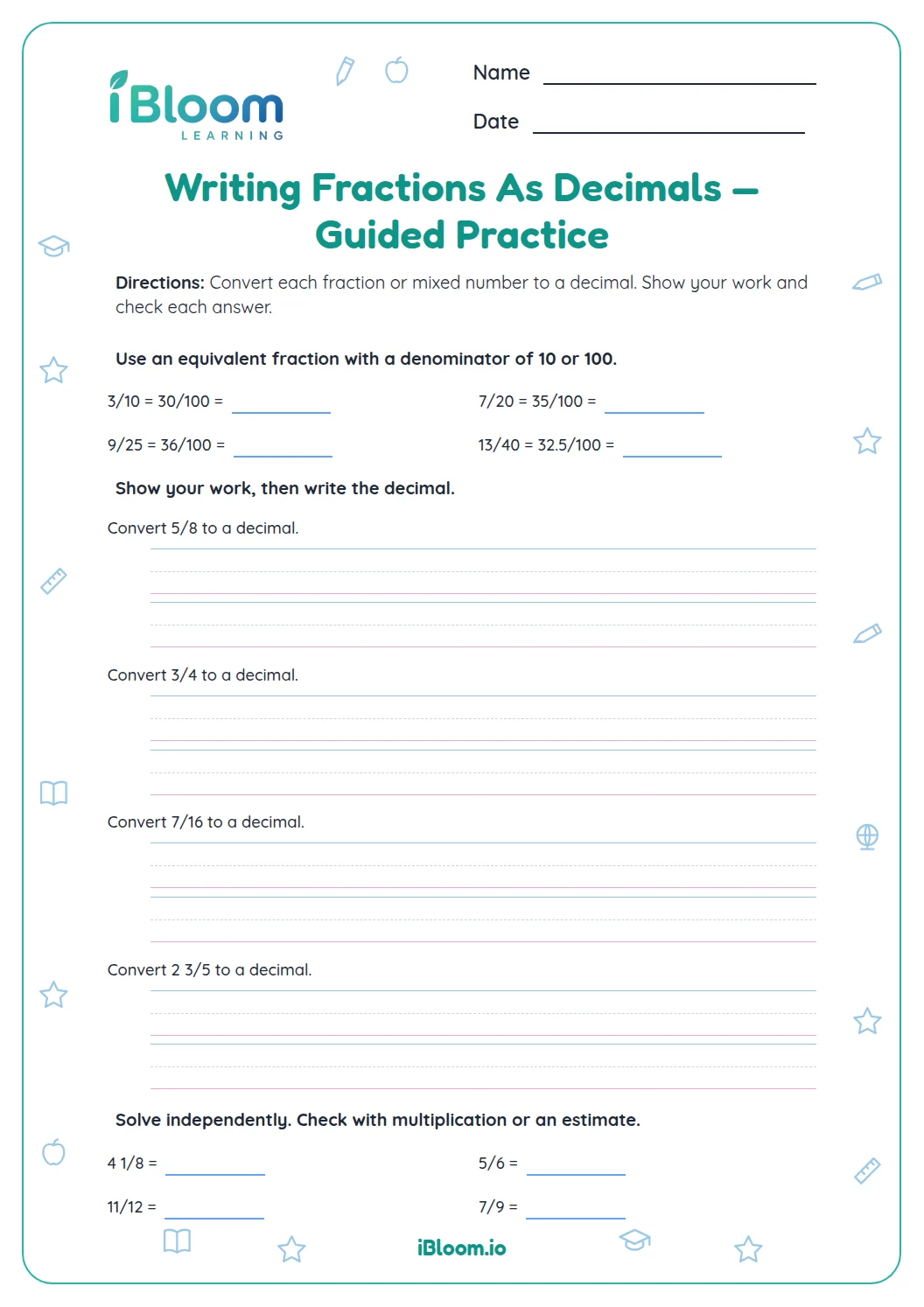
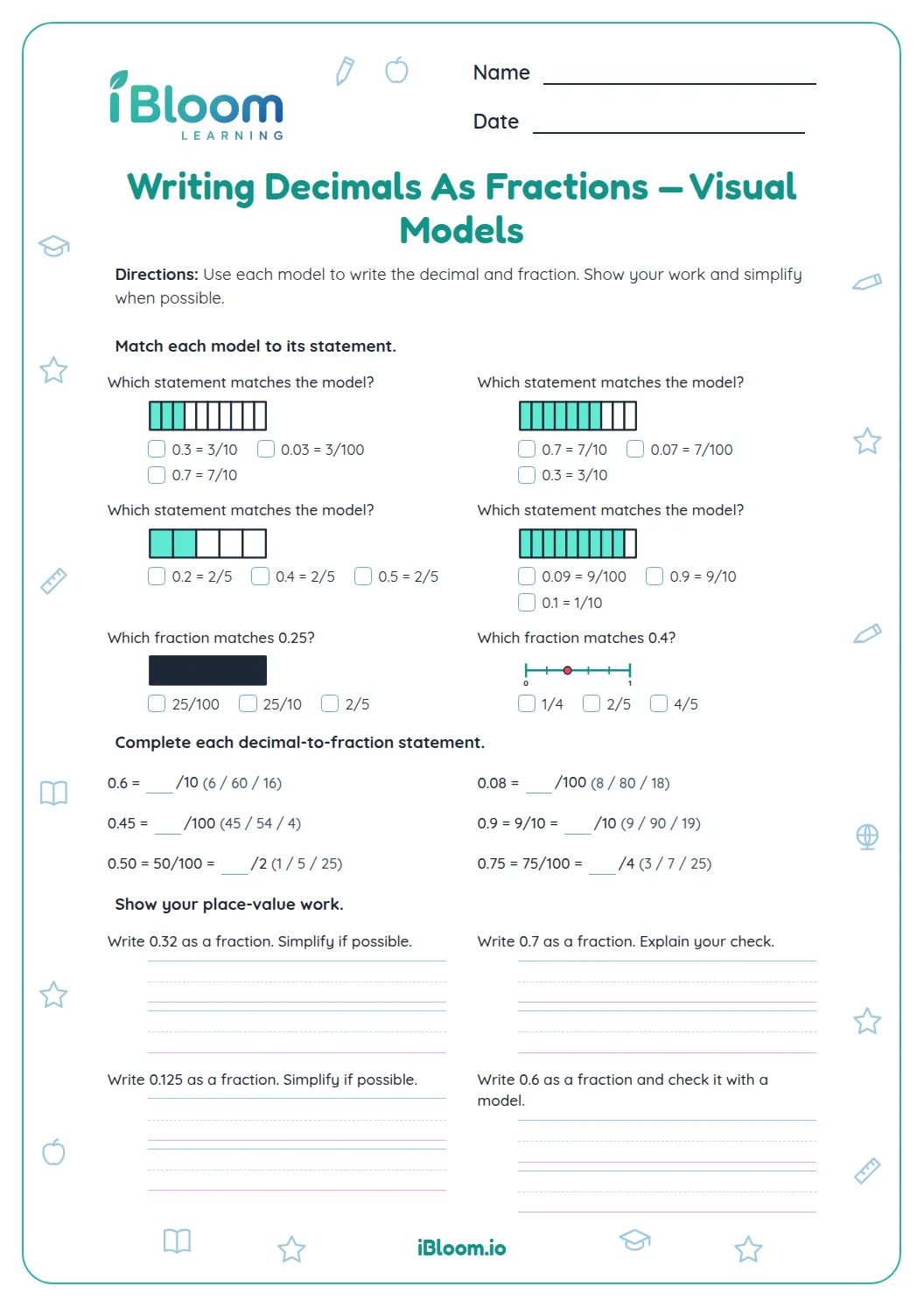
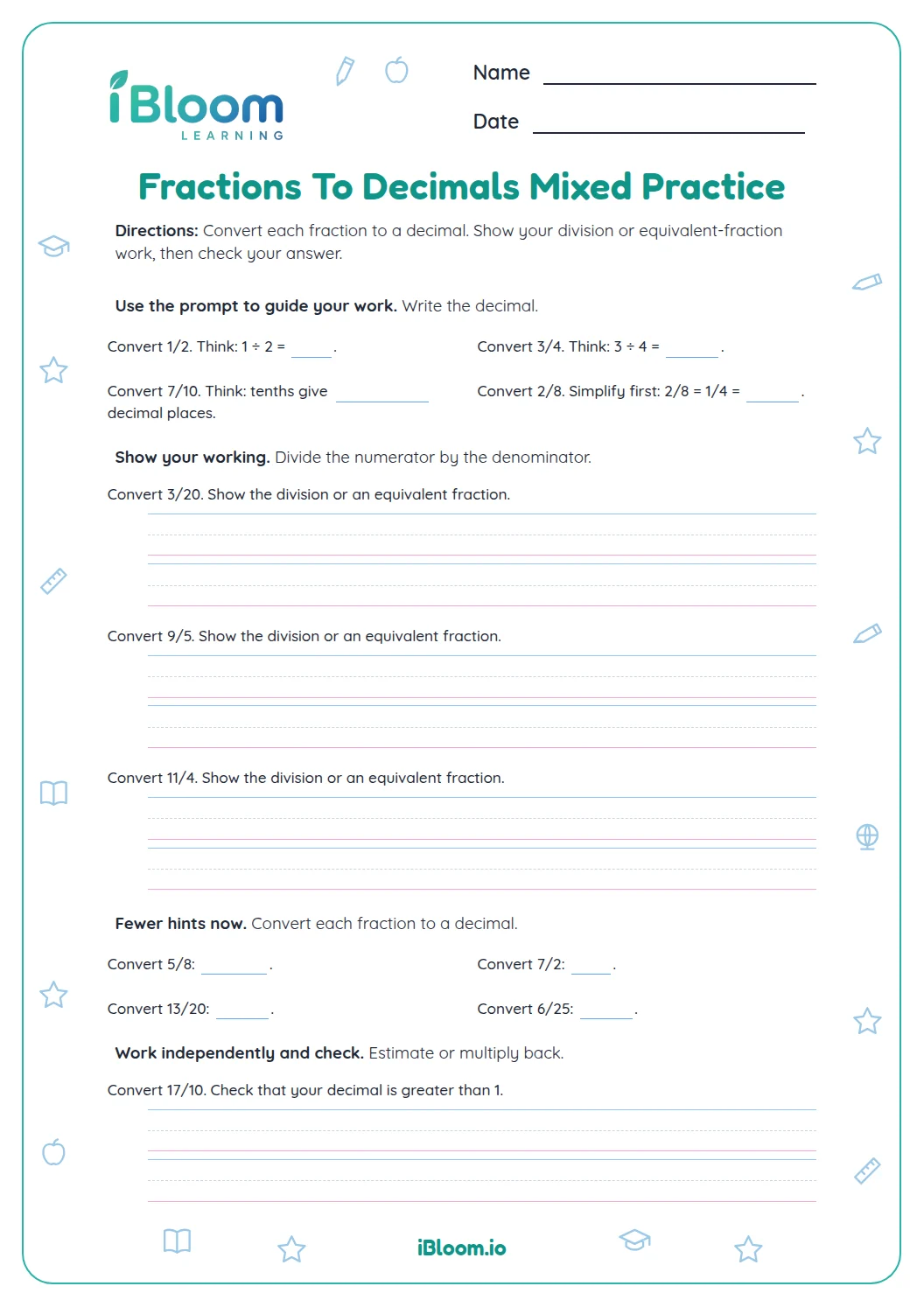
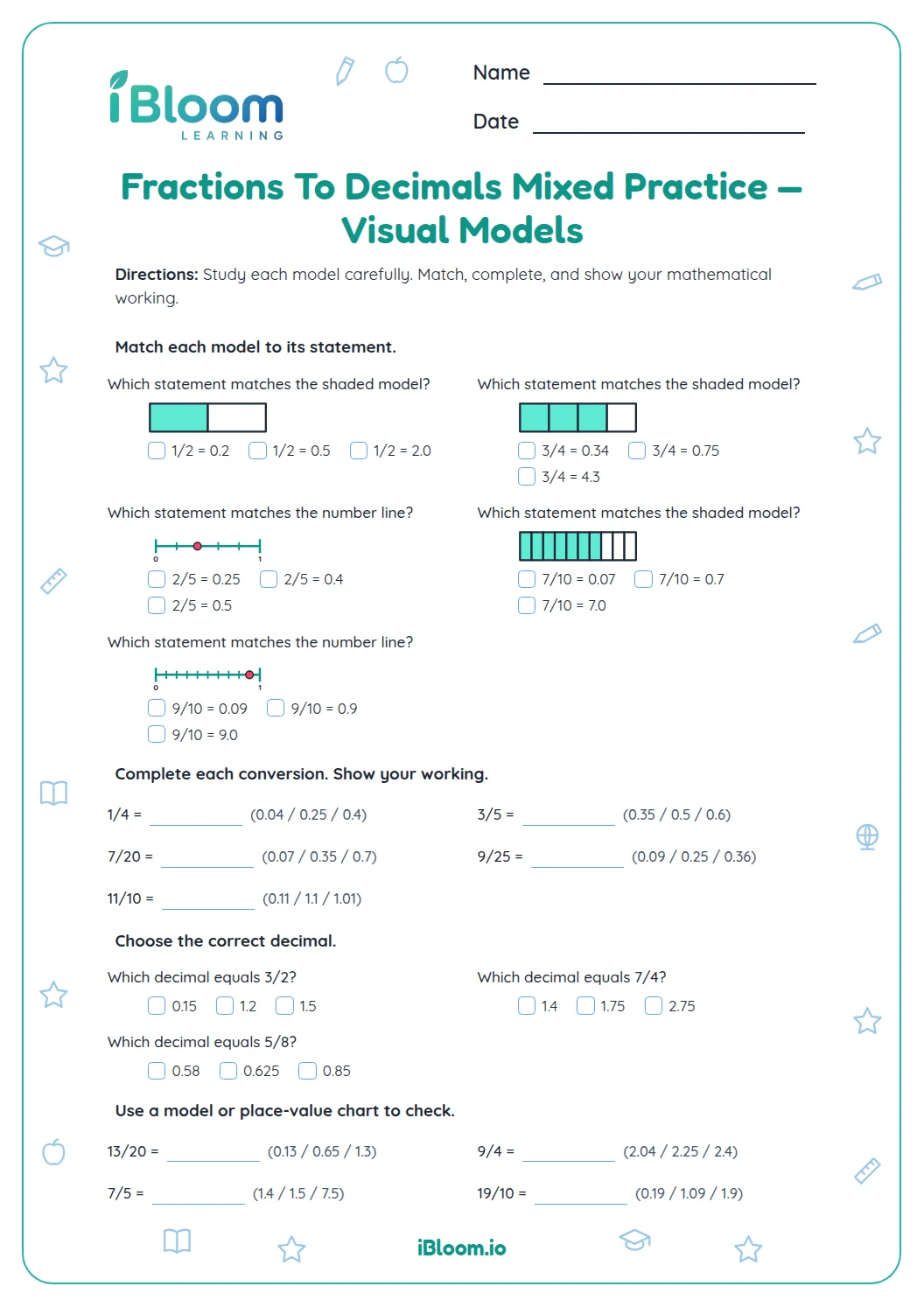
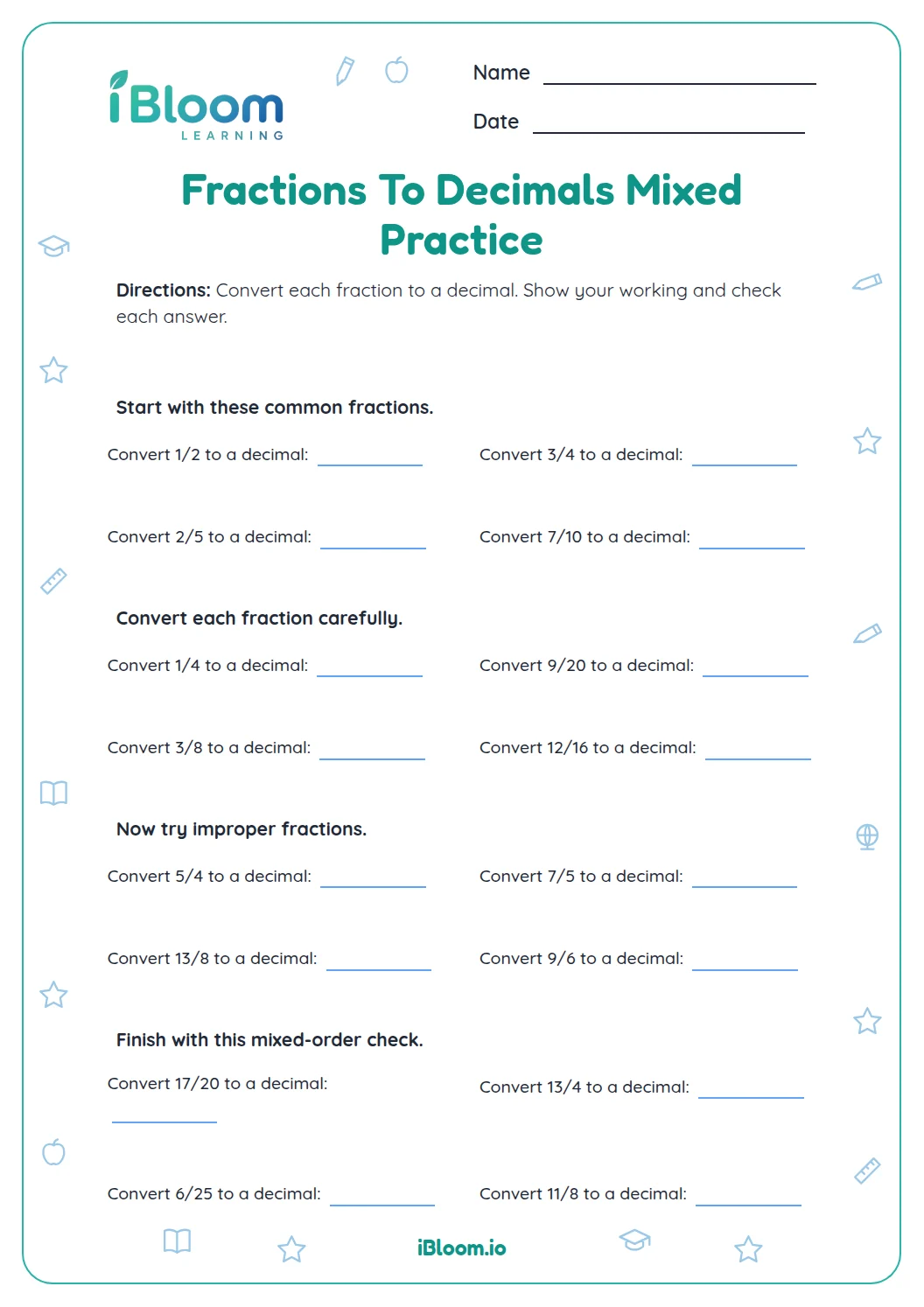
This Grade 6 printable connects fraction notation, shaded models, and decimal quotients. Students match nine shaded fraction models to decimal values and use long division to solve five quotients, with workspace for the division. A separate answer key lists each decimal. The conversion practice focuses on terminating decimal forms of fractions.
Aligned to CCSS.Math.Content.4.NF.C.6
How does a model show a decimal?
A shaded tenth or hundredth names a part of one whole. Three of ten equal strips are 3/10, or 0.3. A hundredths grid with 42 shaded squares represents 42/100, or 0.42.
Question 2 shows 42 hundredths shaded. Since 42/100 is 0.42, the decimal has 4 in the tenths place and 2 in the hundredths place.
- 1Model: 42 of 100 small squares are shaded.
- 2Fraction: 42/100
- 3Decimal: 0.42
- 4Check: 0.42 has 4 tenths and 2 hundredths.
How does long division write a fraction as a decimal?
A fraction bar also means division: divide the numerator by the denominator. For 9/20, divide 9 by 20. Add a decimal point and zeros to continue the division until the quotient ends.
The visual models provide a reasonableness check. Forty-five shaded hundredths is 45/100, the same value as 9/20.
What is on the practice sheet?
The 14 questions include nine model choices and five decimal quotients found with long division. The quotient questions include working space, and the key lists the exact decimal for each item.
How to use this worksheet
- 1Read the fraction as numerator divided by denominator.
- 2Use the shaded model to identify the part of one whole.
- 3For a division item, extend the dividend with zeros as needed.
- 4Write the decimal with each digit in its correct place.
- 5Compare the quotient with the drawing and check the answer key.
Common mistakes and quick fixes
The mistake
Stopping division before the quotient is exact.
The fix
Continue with decimal zeros until the remainder is zero for these terminating decimals.
The mistake
Putting 5/100 down as 0.5.
The fix
Name the place: five hundredths is 0.05, while five tenths is 0.5.
The mistake
Reading the denominator as the number of decimal places automatically.
The fix
Use division or rename the fraction in tenths or hundredths; the denominator alone does not set the answer.
Common Core alignment
The tenths and hundredths model questions practice the standard below by writing those fractions as decimals.
Use decimal notation for fractions with denominators 10 or 100.
On this sheet: The tenths and hundredths grid questions write fractions with denominators 10 or 100 in decimal notation.
Show the official wordingHide the official wording
Use decimal notation for fractions with denominators 10 or 100.
What to practice next
Make more practice
Further reading
Questions parents and teachers ask
How do you write a fraction as a decimal?
Divide the numerator by the denominator. For 9/20, divide 9 by 20 to get 0.45. This worksheet also includes shaded models that help connect decimal places with tenths and hundredths. Children can use the model as a check after completing the division.
Does this worksheet include long division?
Yes. Five items ask students to find decimal quotients with long division, and those questions include space to show the division. The separate key lists the decimal answers. Students can continue the quotient with zeros when a remainder remains.
How many questions are included?
There are 14 questions: nine multiple-choice model questions and five long-division quotients. The models include fraction circles, tenths strips, and hundredths grids. The questions span four printable pages, followed by four answer-key pages. Families can work through the questions a few at a time and use the key after each group.
What does the answer key show?
The separate key lists the correct decimal for each model and quotient. Students can compare the written quotient with the shaded amount in the model questions. For the hundredths grids, check the hundredths digit as well as the tenths digit.
What if the division does not end right away?
Continue the quotient by adding zeros after the decimal point in the dividend. The five division questions on this sheet have terminating decimal answers, so the remainder eventually becomes zero. The answer key gives the full decimal for each one.