


About this worksheet
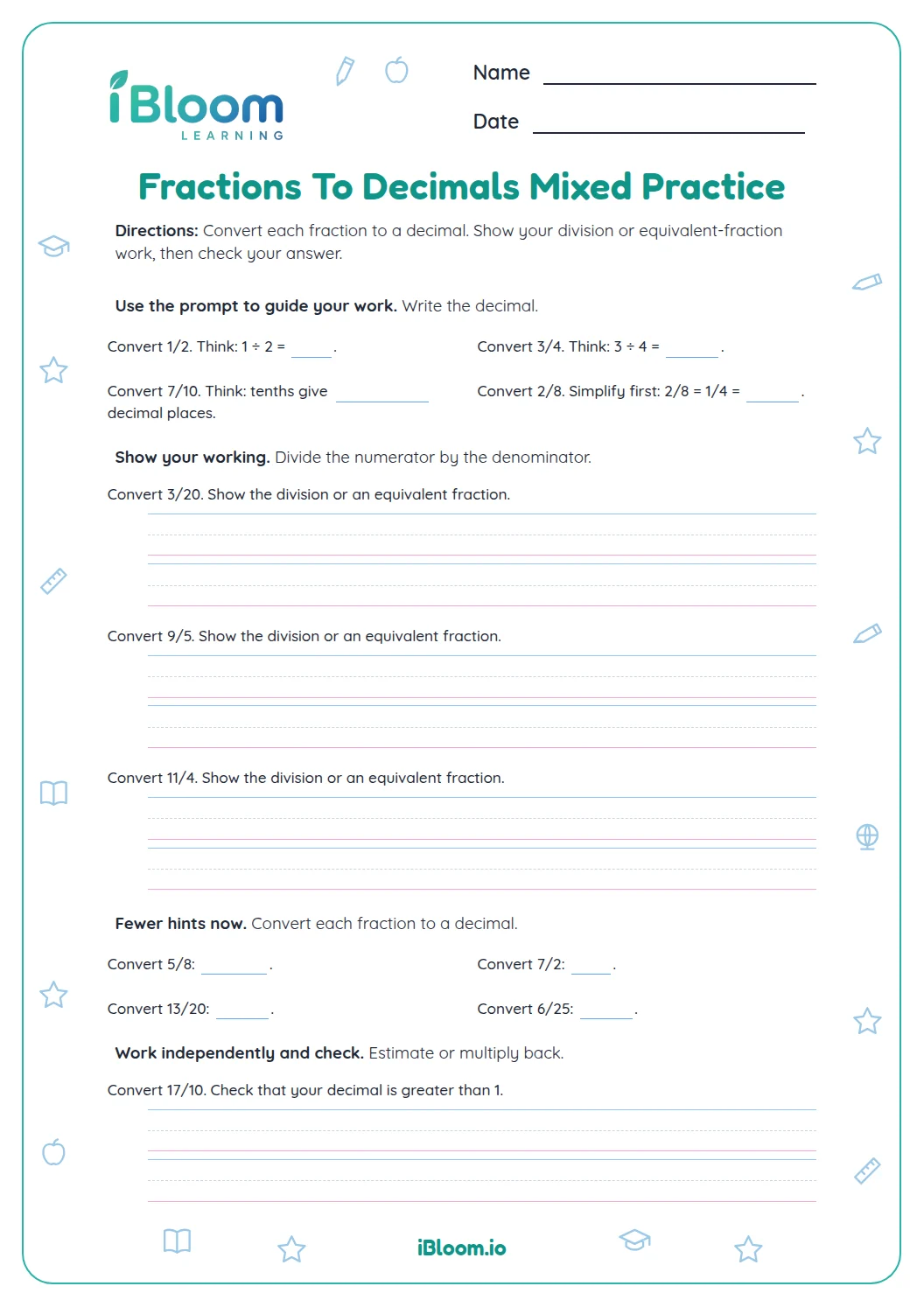
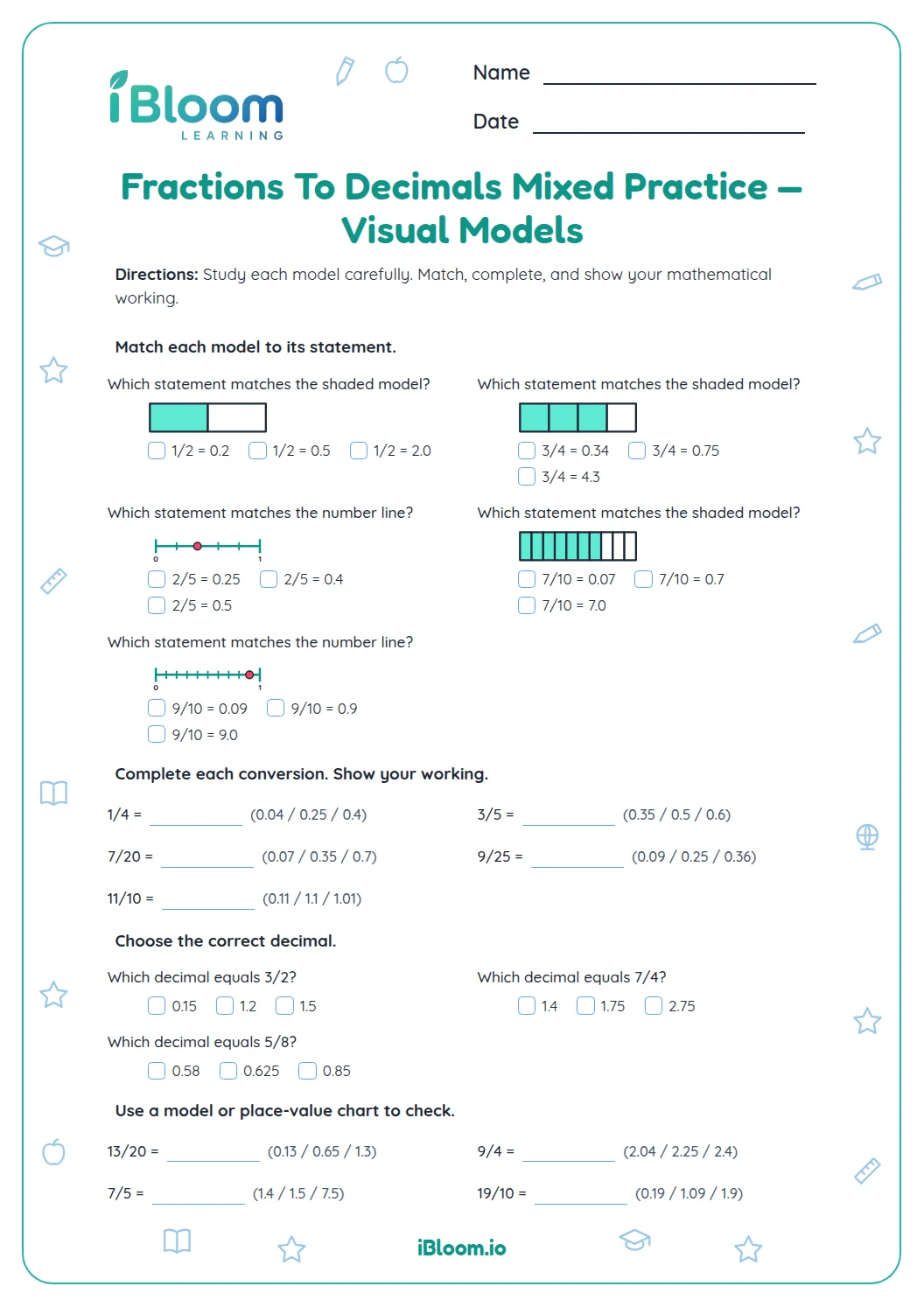
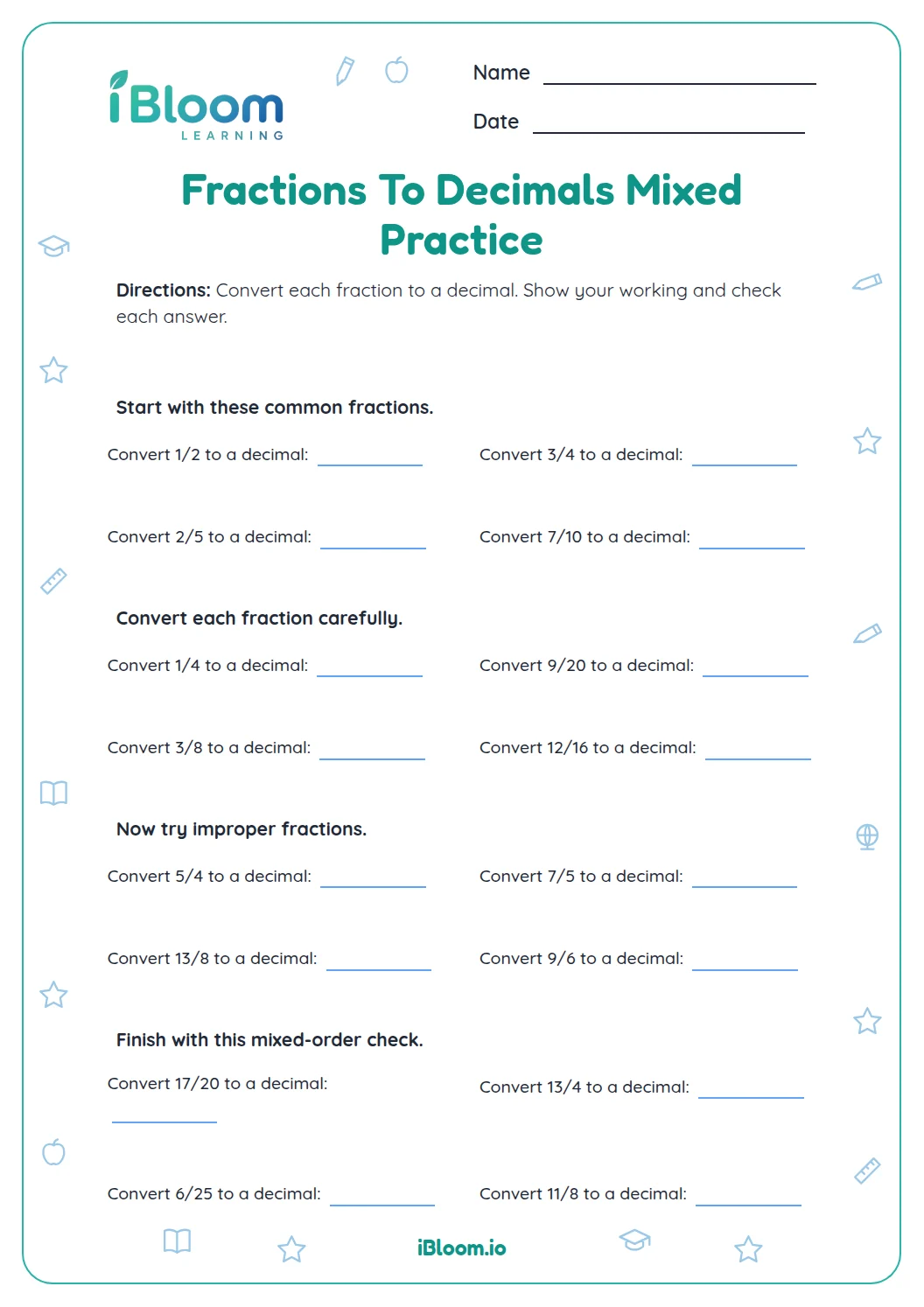
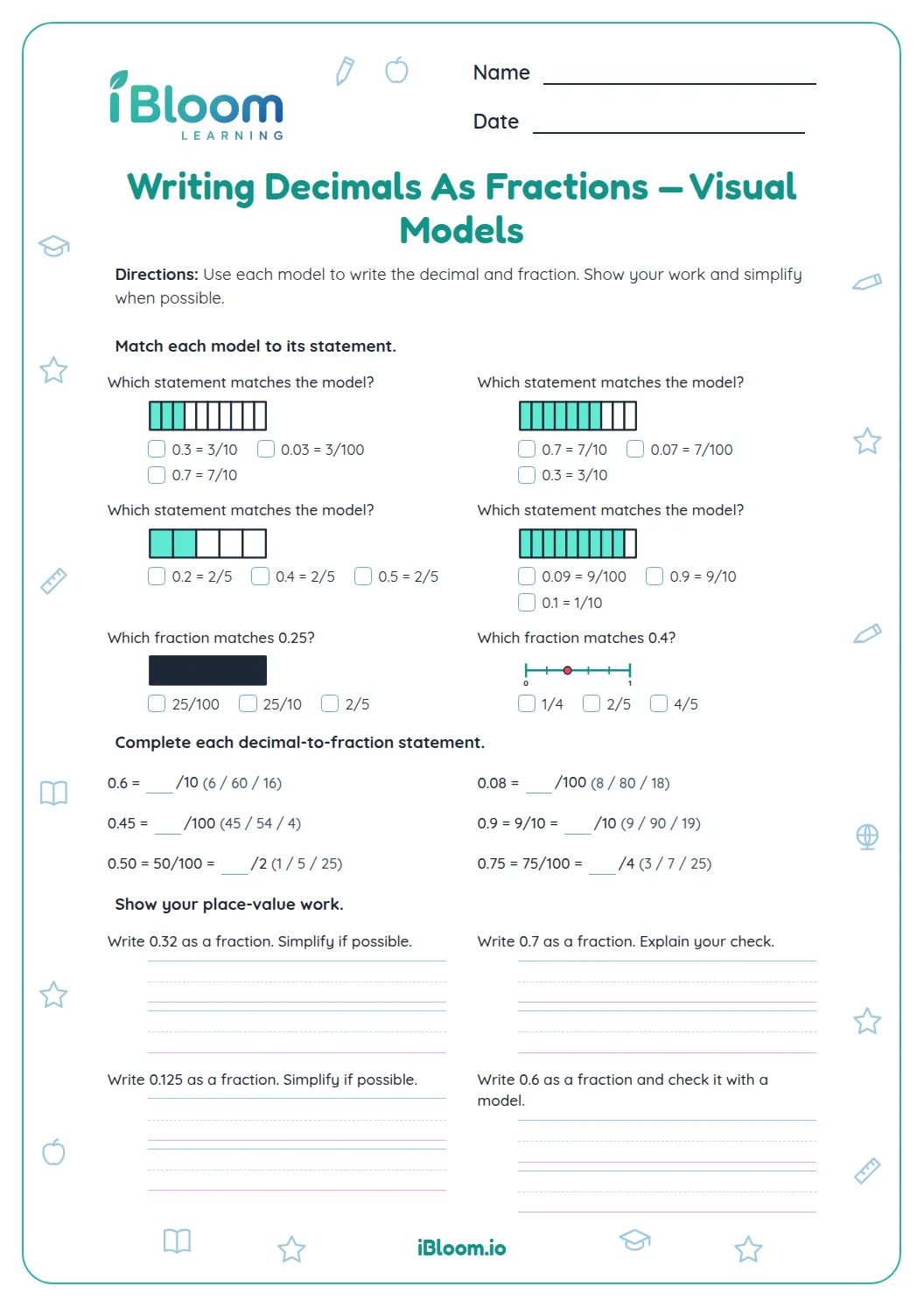
This Grade 6 reasoning challenge connects fractions to decimal quotients. Students divide numerators by denominators, compare decimal values, correct a place-value error, and apply conversions to measurement contexts. The 16 questions focus on terminating decimal equivalents and include a separate answer key.
How does division make a decimal?
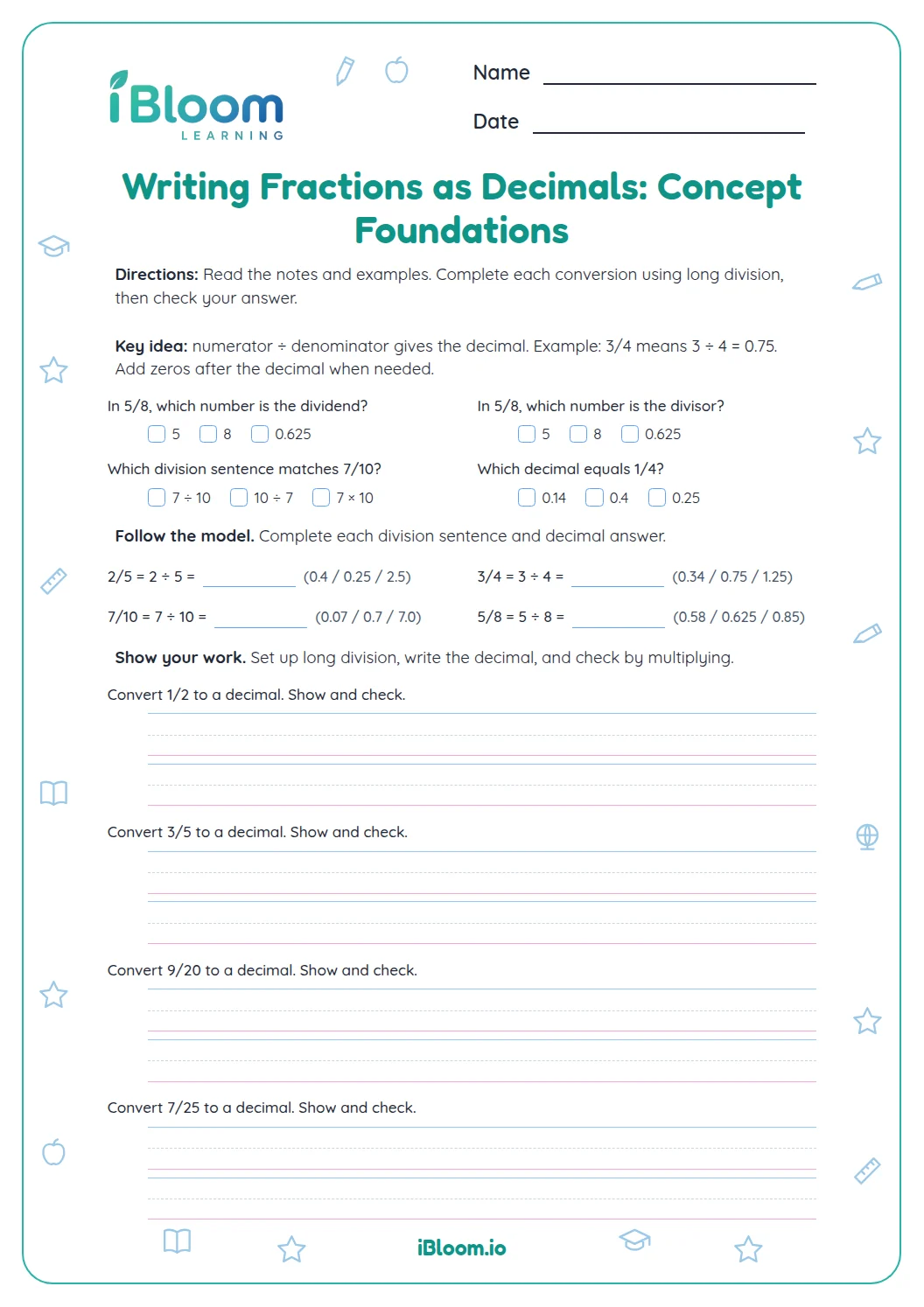
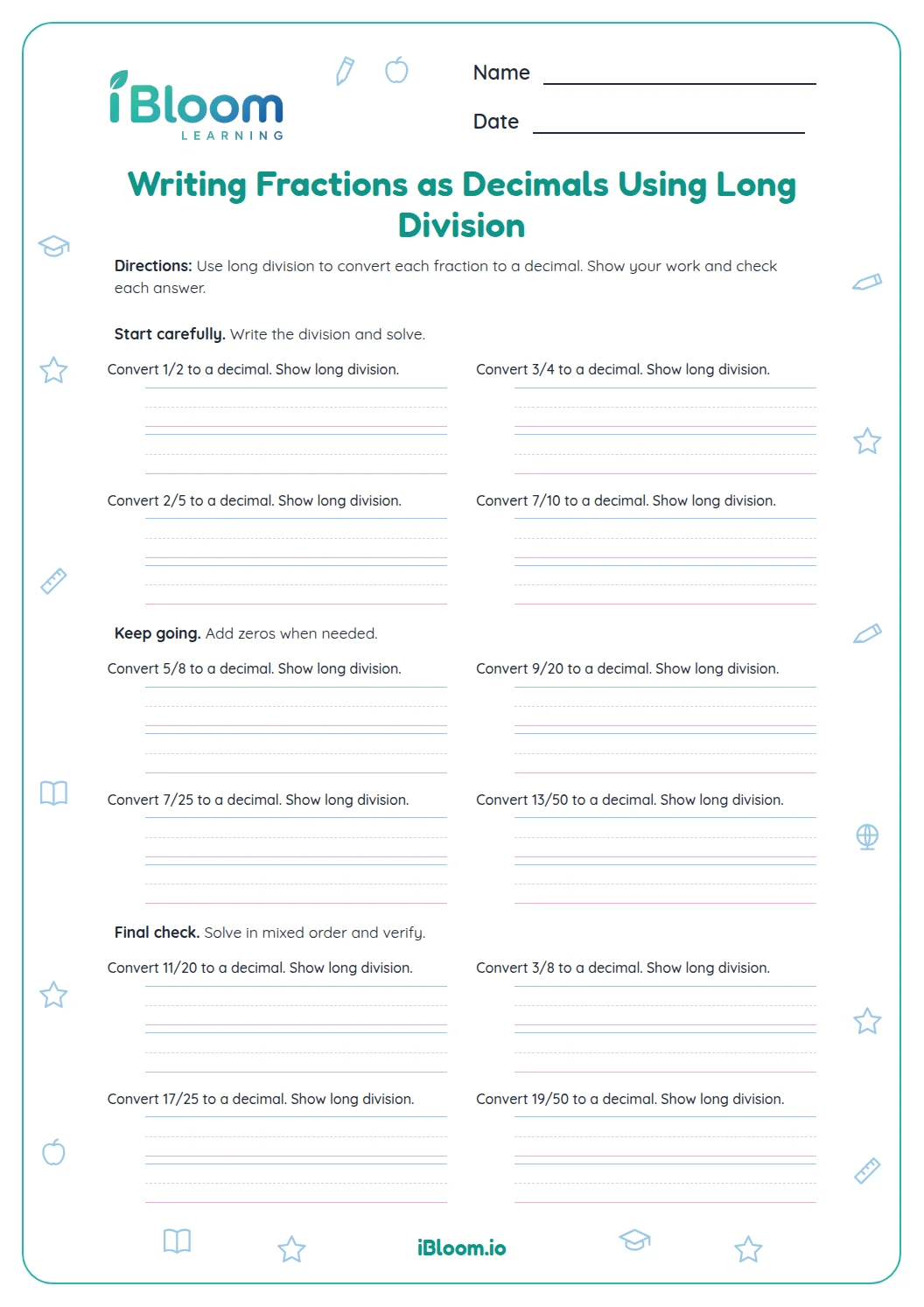
A fraction bar means division: the numerator is divided by the denominator. If the numerator is smaller, write a decimal point and add zeros as needed to continue dividing.
- 13/8 means 3 ÷ 8
- 23.000 ÷ 8 = 0.375
- 3So 3/8 = 0.375
How can decimals help compare fractions?
Convert both fractions to decimals, then compare digits from left to right. Equal values in a place can be followed by the next place.
- Convert each fraction by division.
- Line up decimal points.
- Compare tenths, then hundredths and later places.
How do you check a conversion?
Multiply the decimal by the denominator. The result should match the numerator. For 3/8, 0.375 × 8 = 3, confirming the quotient.
How to use this worksheet
- 1Read the fraction as numerator divided by denominator.
- 2Set up the division and add a decimal point and zeros when needed.
- 3Continue until the remainder is zero.
- 4Write the quotient with its decimal point.
- 5Check by multiplying the quotient by the denominator.
Common mistakes and quick fixes
The mistake
Putting the numerator digits after a decimal point.
The fix
Divide instead; for 5/8 calculate 5 ÷ 8 rather than writing 0.58.
The mistake
Stopping before the remainder reaches zero.
The fix
Add a zero to the dividend and continue the quotient.
The mistake
Comparing decimal digits without aligning place values.
The fix
Line up decimal points before comparing tenths and smaller places.
What to practice next
Make more practice
Further reading
Questions parents and teachers ask
Why use long division for a fraction?
A fraction represents division of the numerator by the denominator. Long division gives the decimal quotient and helps learners see why a fraction such as 3/8 equals 0.375. Students then use quotients to compare values and solve related reasoning prompts.
Do all fraction decimals end?
No. This page uses examples with terminating decimals so each quotient can be written exactly. Some other fractions produce repeating decimal patterns rather than a final zero remainder. In those cases, a decimal may need to be expressed with a repeating pattern or rounded.
What should students do when the numerator is smaller?
Write the quotient as a decimal, place the decimal point, and annex zeros to continue dividing. Those zeros keep the value of the dividend unchanged while allowing the quotient to continue. Stop when the remainder is zero for the terminating examples here.
How can a decimal conversion be checked?
Multiply the decimal quotient by the denominator. The product should equal the numerator. For instance, 0.35 × 20 = 7 checks that 7/20 is 0.35. This inverse operation catches errors in place value and division steps. Students can then compare the product with the original numerator.
Is the answer key included?
Yes. A separate key lists decimal equivalents and sample explanations. It includes all 16 results. It includes all 16 results. For comparison items, it includes both values and the correct comparison so students can check their reasoning. Open-ended explanations may use different words while showing the same mathematical idea.