


About this worksheet
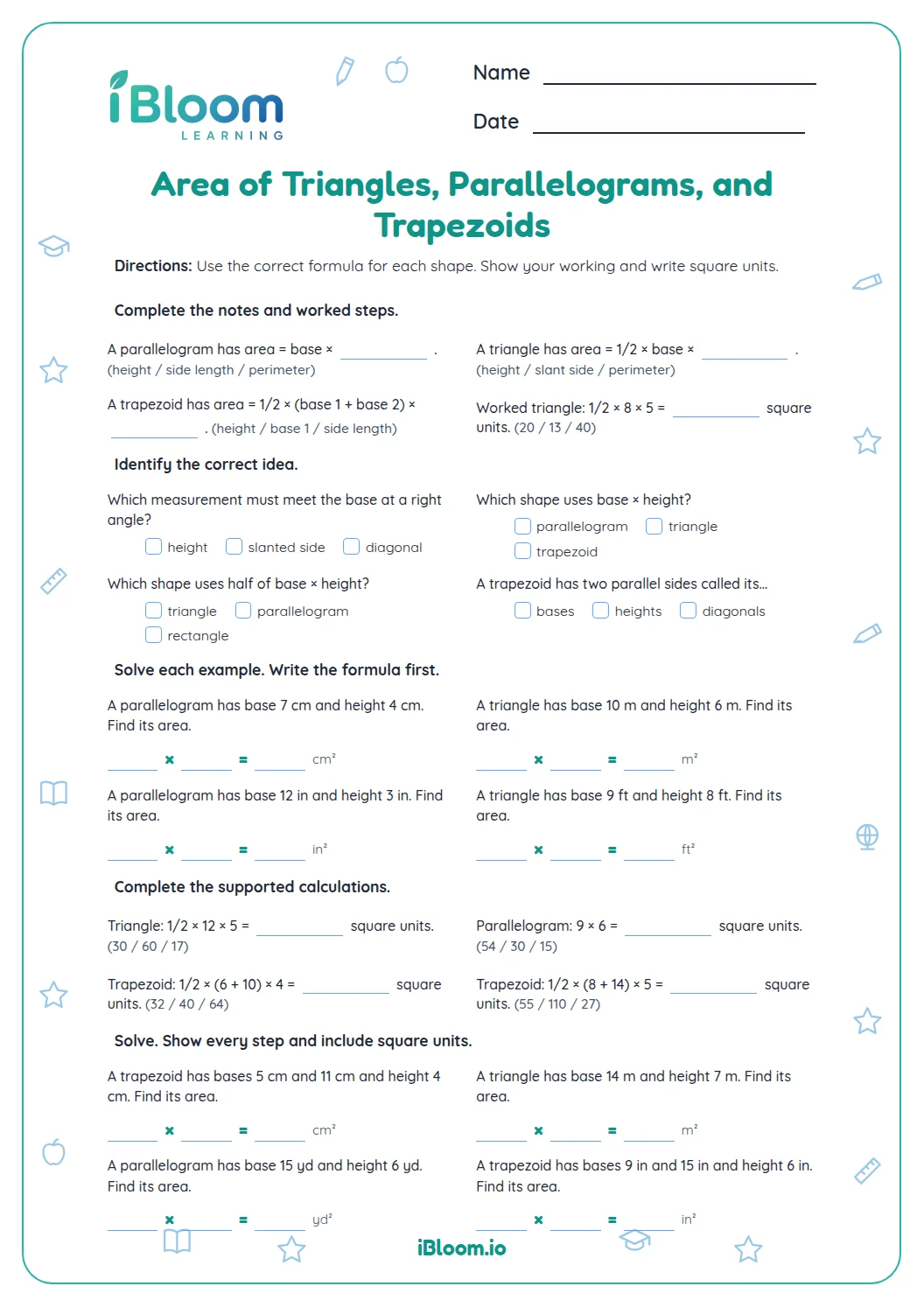
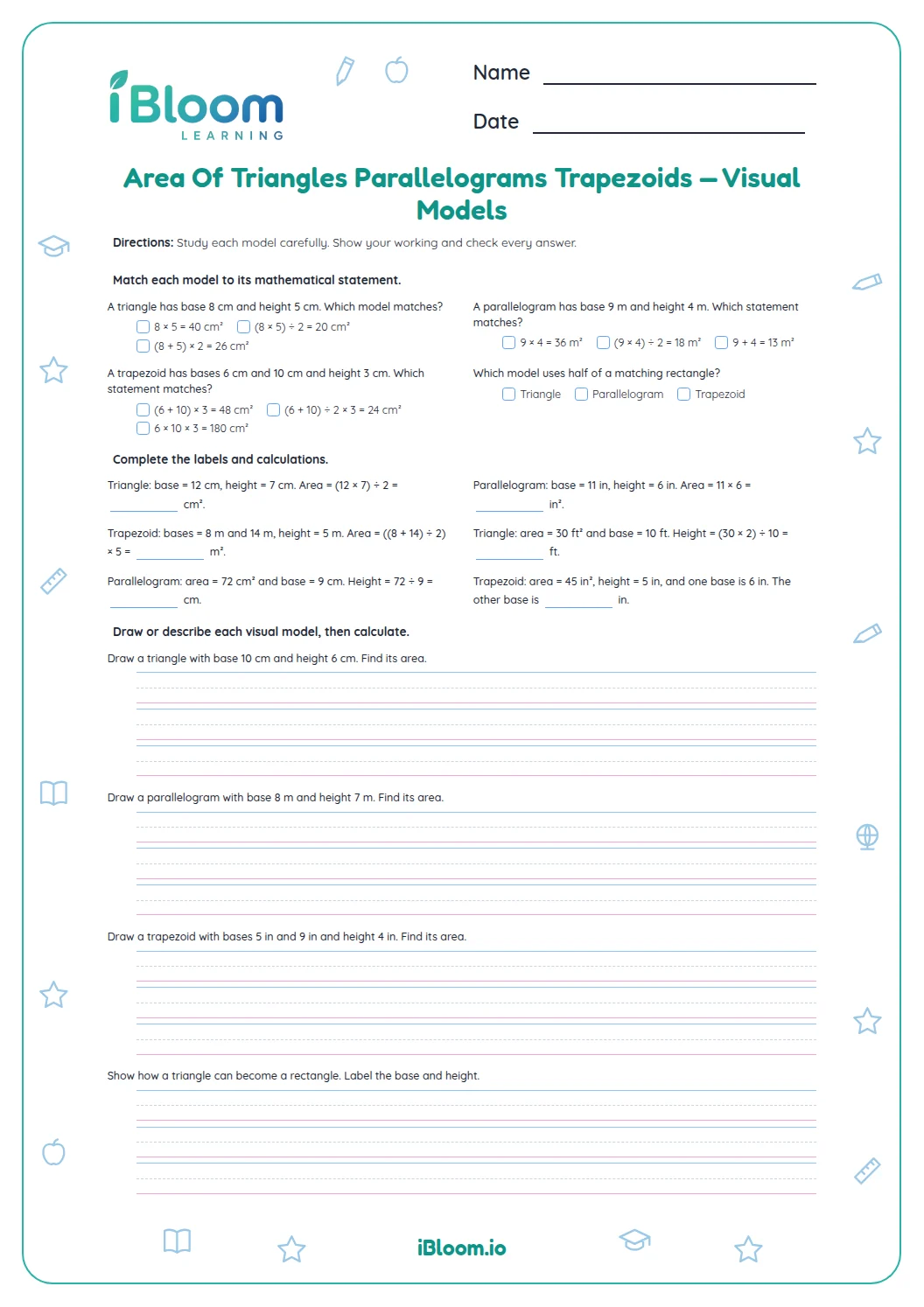
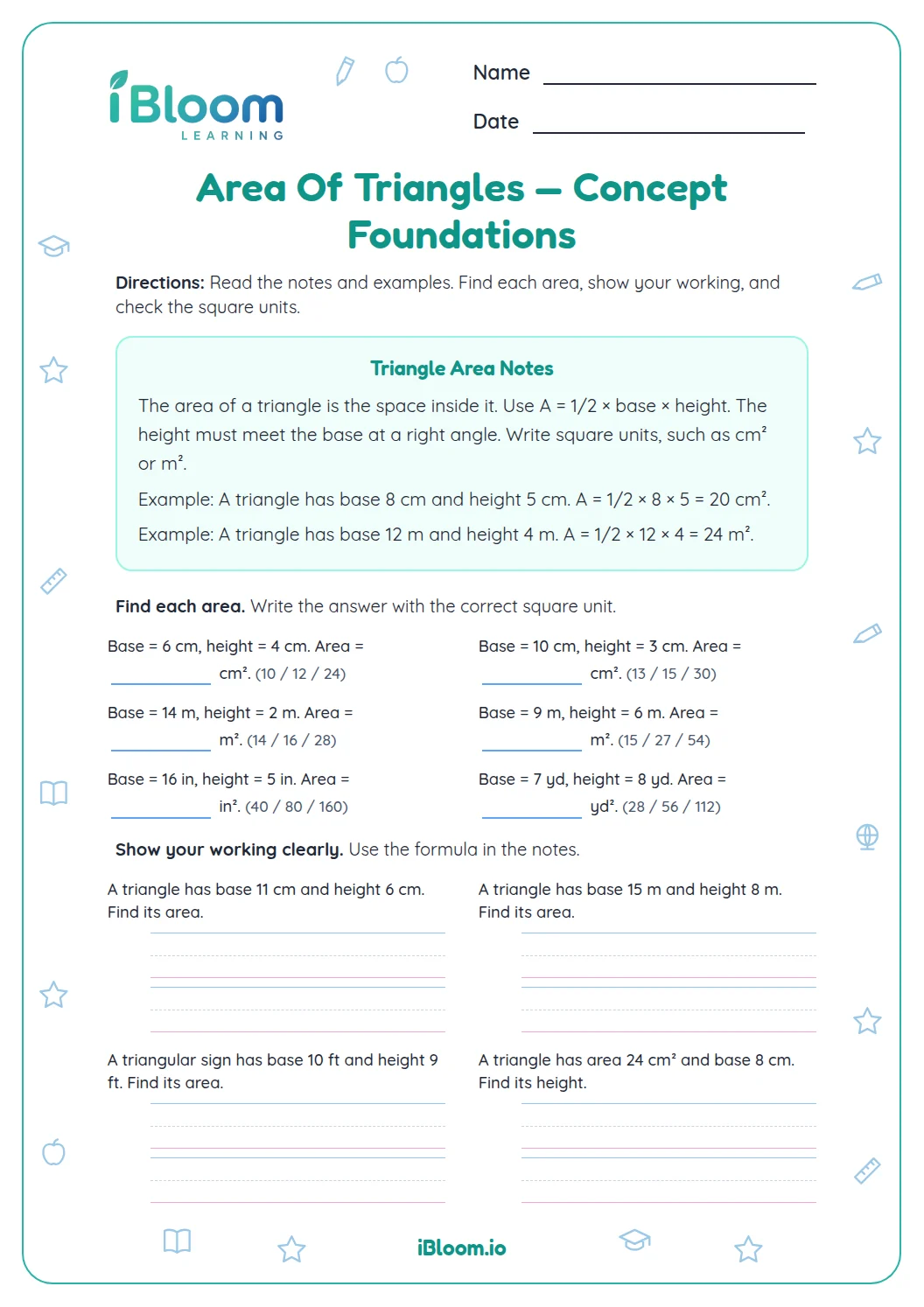
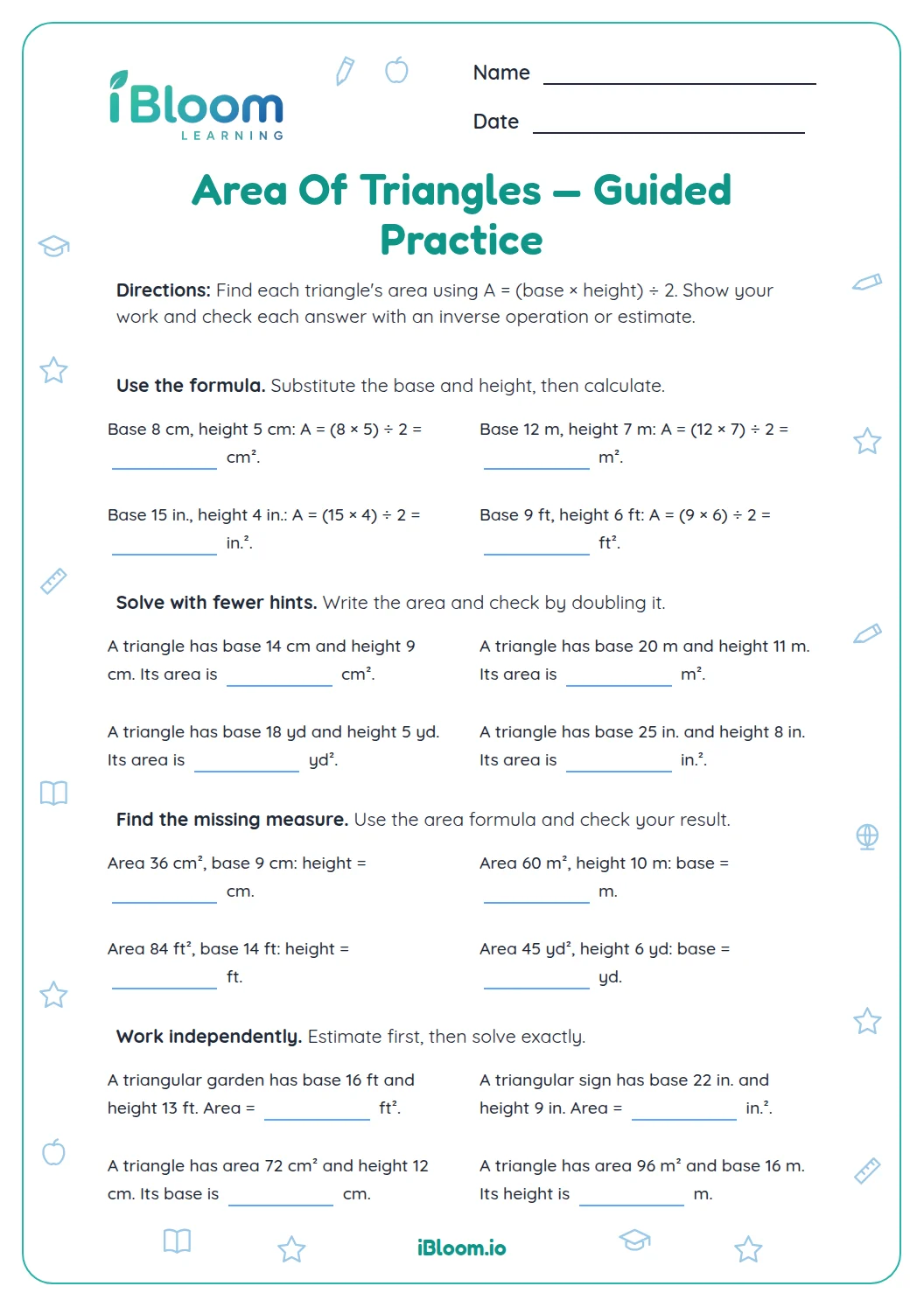
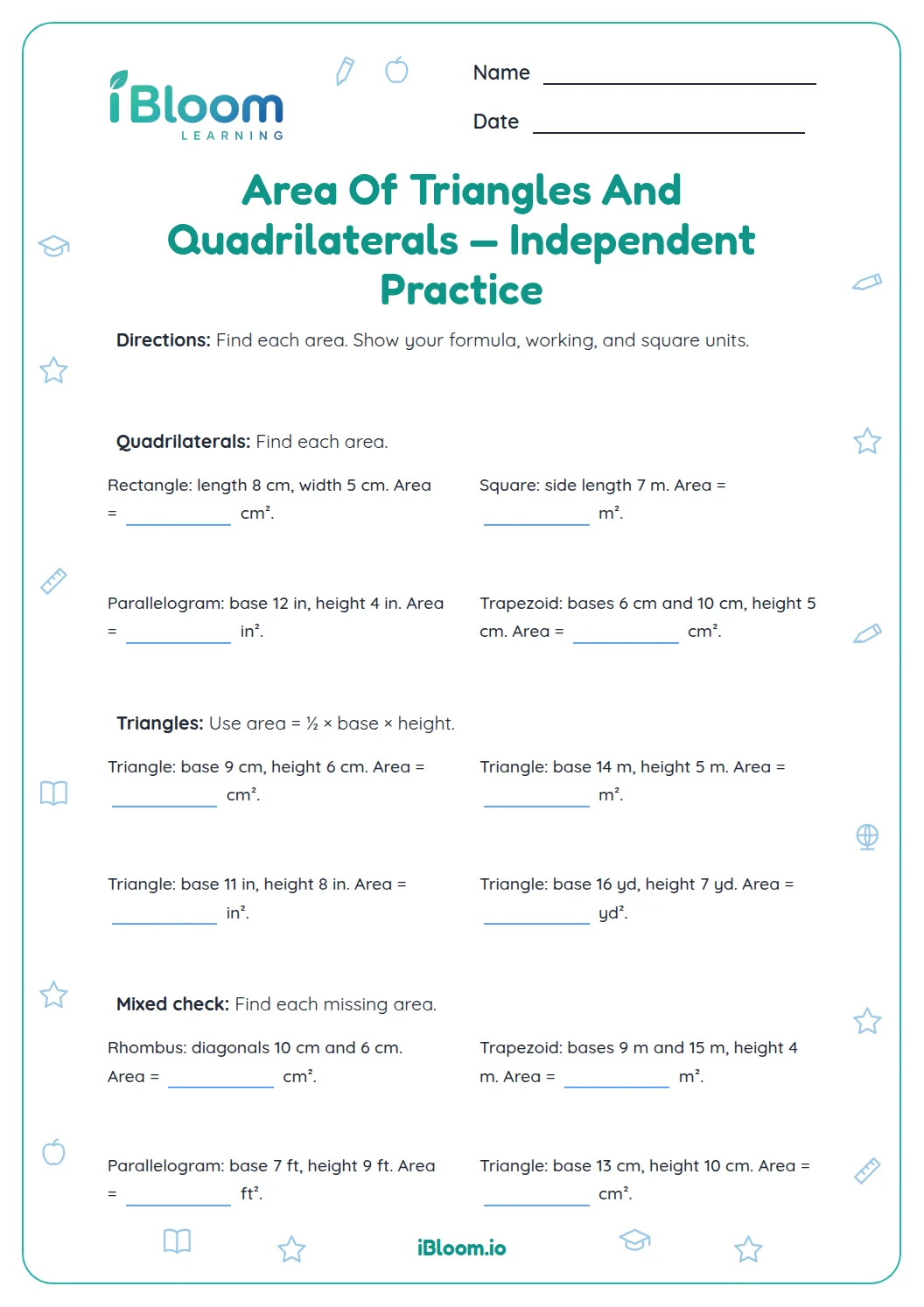
This Grade 6 geometry worksheet has 16 independent area problems: four triangles, four parallelograms, and four trapezoids in each of two rounds. Every prompt gives the necessary base, height, and (for trapezoids) parallel bases in centimeters, so students can select a formula and show calculations. The answer key includes square units.
Aligned to 6.G.A.1
How do I choose an area formula?
Use one-half base times height for a triangle. For a parallelogram, multiply base and perpendicular height. For a trapezoid, add the two parallel bases, multiply by height, and divide by two.
- 1Bases: 6 cm and 10 cm; height: 4 cm
- 2(6 + 10) × 4 ÷ 2
- 316 × 4 ÷ 2 = 32 cm²
Which measurement is the height?
Height is the perpendicular distance to the base. Use the given height even when a slanted side looks longer.
Why label the area in square units?
Area measures a two-dimensional surface. Measurements in centimeters produce square centimeters, so every result needs cm².
How can I use this worksheet?
- 1Underline the base and perpendicular height in the prompt.
- 2Choose the formula for the named shape.
- 3Substitute the measurements and calculate.
- 4For a trapezoid, add the two parallel bases before multiplying by height.
- 5Label the result in square centimeters and check the key.
What mistakes should I watch for?
The mistake
Using the slanted side as a parallelogram height.
The fix
Use only the perpendicular distance between the base and its opposite side.
The mistake
Forgetting to halve a triangle product.
The fix
Calculate base times height, then divide that product by 2.
The mistake
Using only one trapezoid base.
The fix
Add both parallel bases, multiply by height, and halve the result.
Common Core alignment
This practice connects the worksheet tasks to the standard below.
Find polygon areas by composing or decomposing shapes.
On this sheet: The problems use triangle and trapezoid formulas and base-height relationships.
Show the official wordingHide the official wording
Find the area of right triangles, other triangles, special quadrilaterals, and polygons by composing into rectangles or decomposing into triangles and other shapes; apply these techniques in the context of solving real-world and mathematical problems.
What to practice next
Make more practice
Further reading
Questions parents and teachers ask
What formulas are practiced?
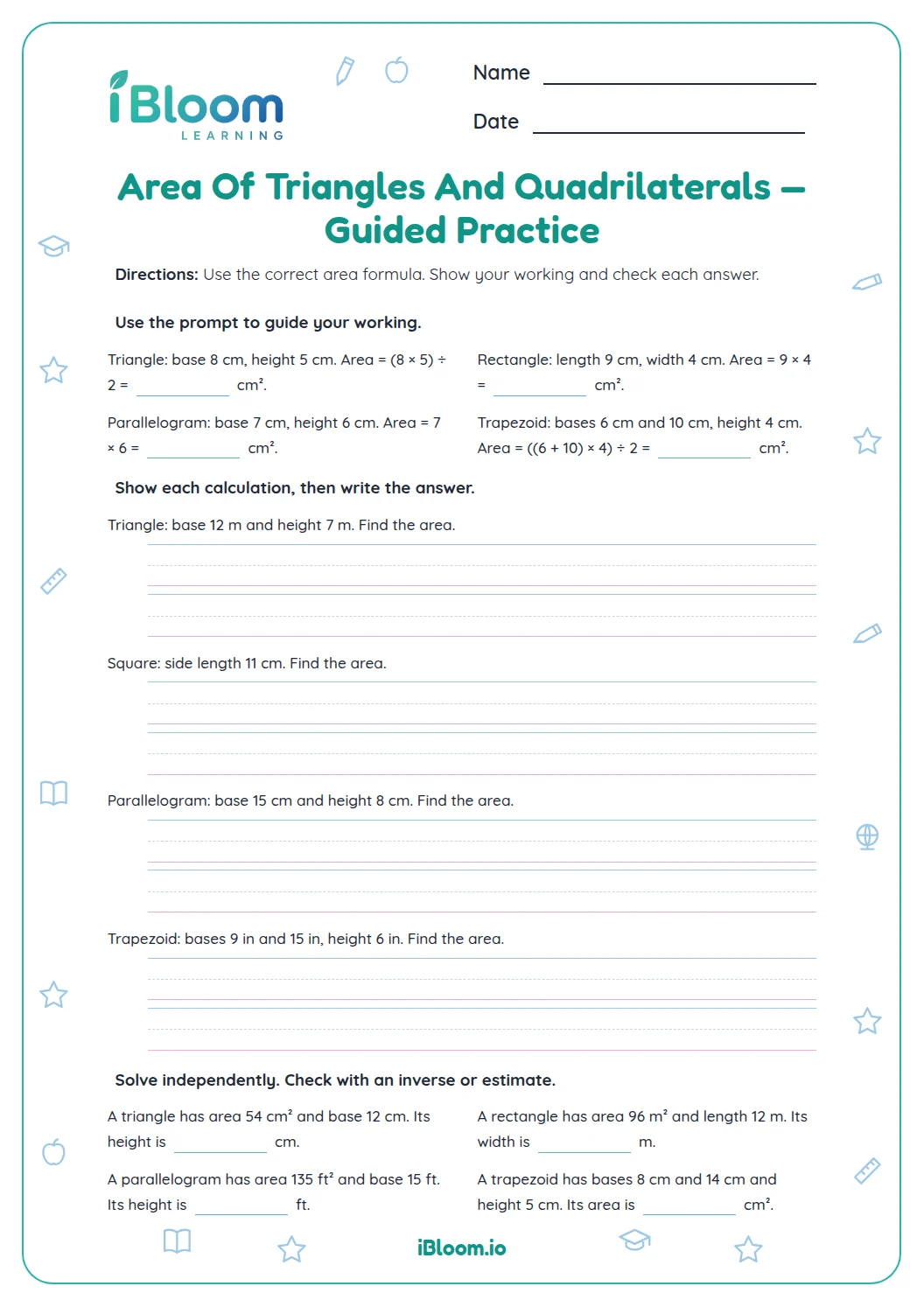
The page practices triangle area, parallelogram area, and trapezoid area. Each prompt names the shape and gives its base, height, and, for trapezoids, both parallel bases. Learners select the appropriate calculation and enter an area in square centimeters. All measurements use centimeters.
Does the worksheet include diagrams?
The prompts state each shape and its measurements in text, so no unlabeled figure has to be interpreted. This keeps the base and perpendicular height explicit and leaves the learner to focus on choosing and applying the area relationship. Use the printed labels as given.
Why does area use square centimeters?
Area measures the surface covered by square units. Since the given side measurements are in centimeters, the answers are in square centimeters, written cm². The unit belongs with the calculated area rather than with a single side length. Each answer needs the squared unit.
What should students remember about height?
Height is the perpendicular distance to the chosen base. A slanted side of a parallelogram or trapezoid is not automatically its height. Use the perpendicular height specified in each prompt when calculating the area. Check that the height is perpendicular to the base.
How can the key help with errors?
Compare the result and the square-unit label with the key. If an answer differs, check the formula first, then the arithmetic. For a trapezoid, add the parallel bases before multiplying by the height and dividing by two. This catches two common calculation slips.