

About this worksheet
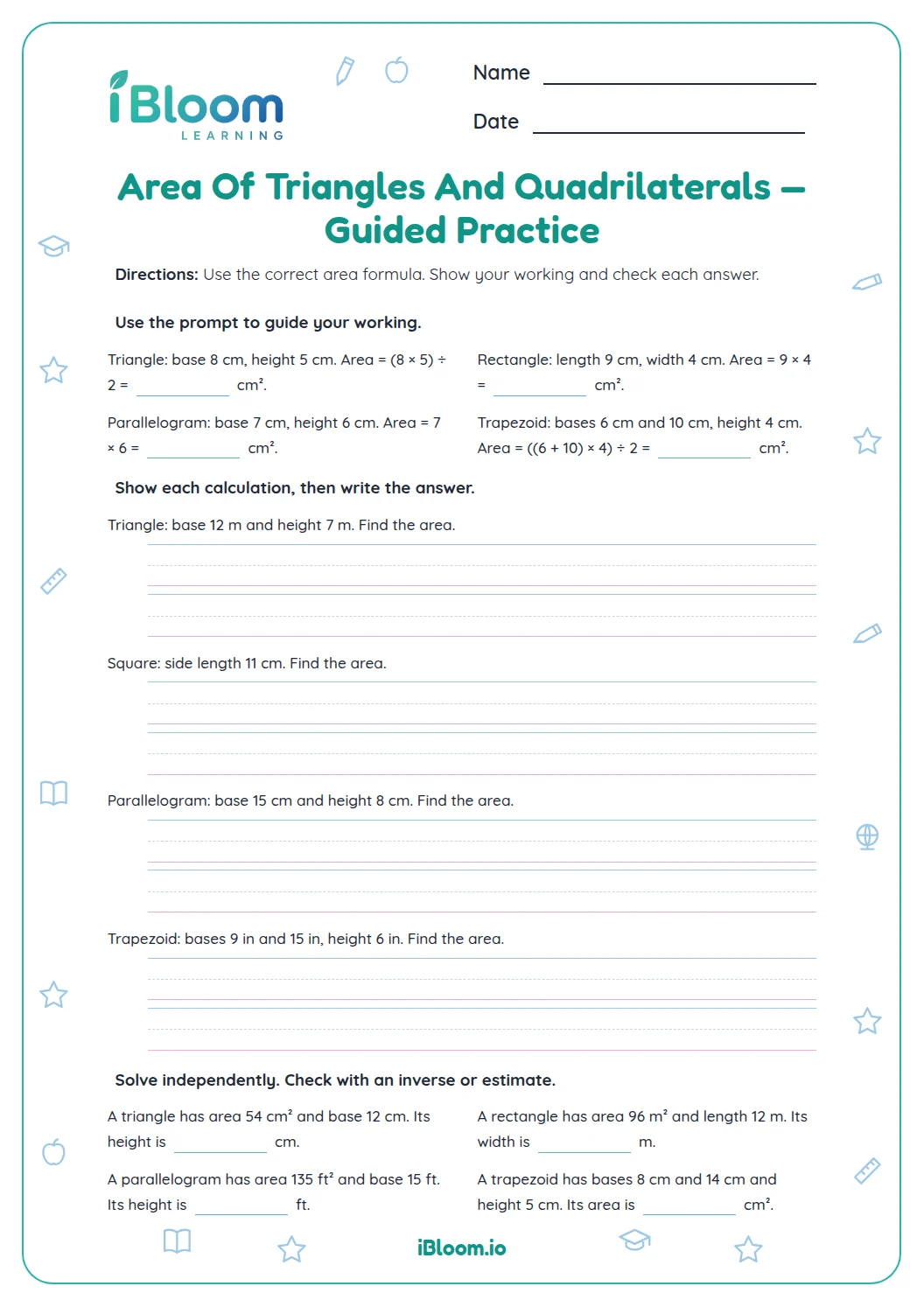
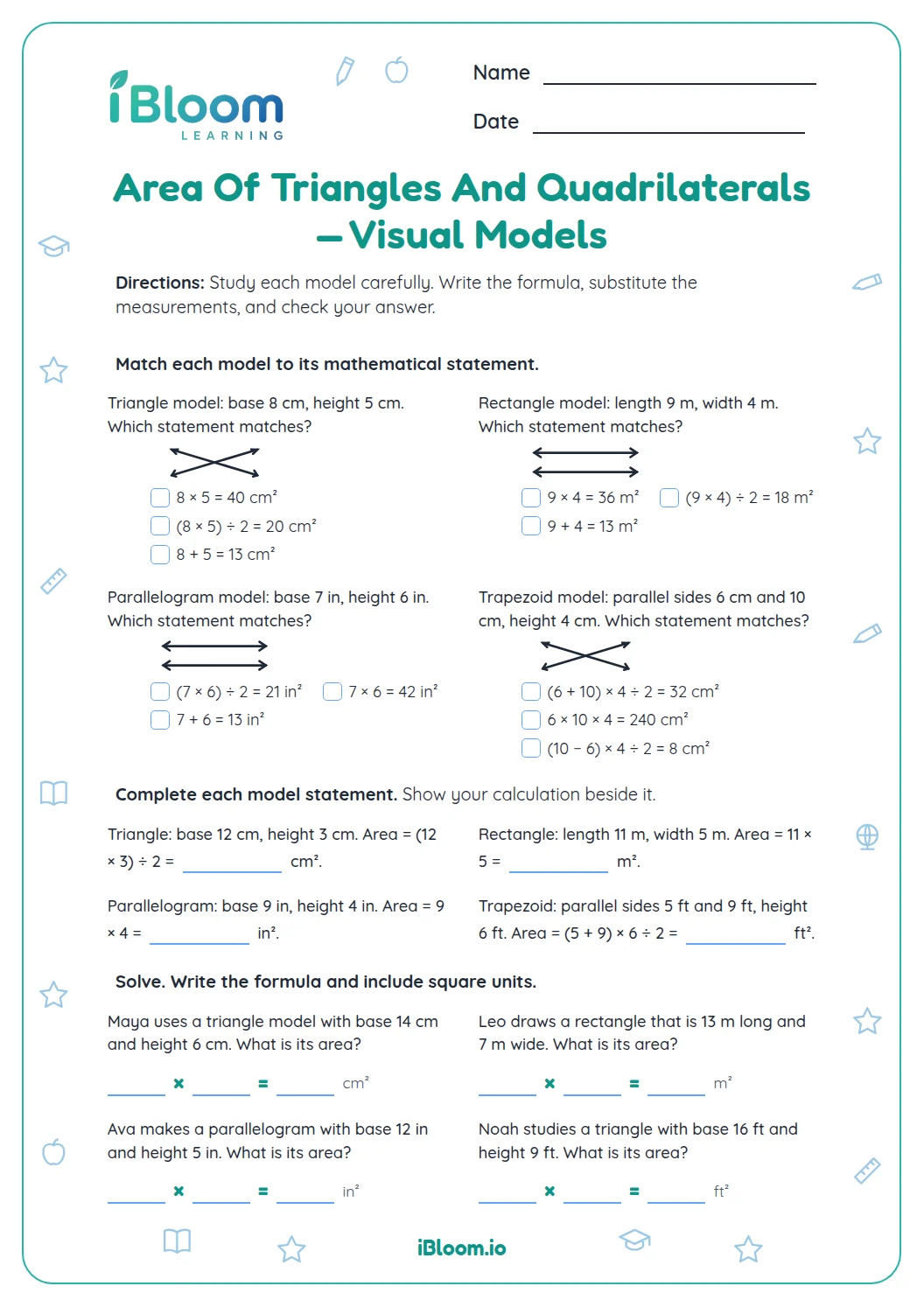
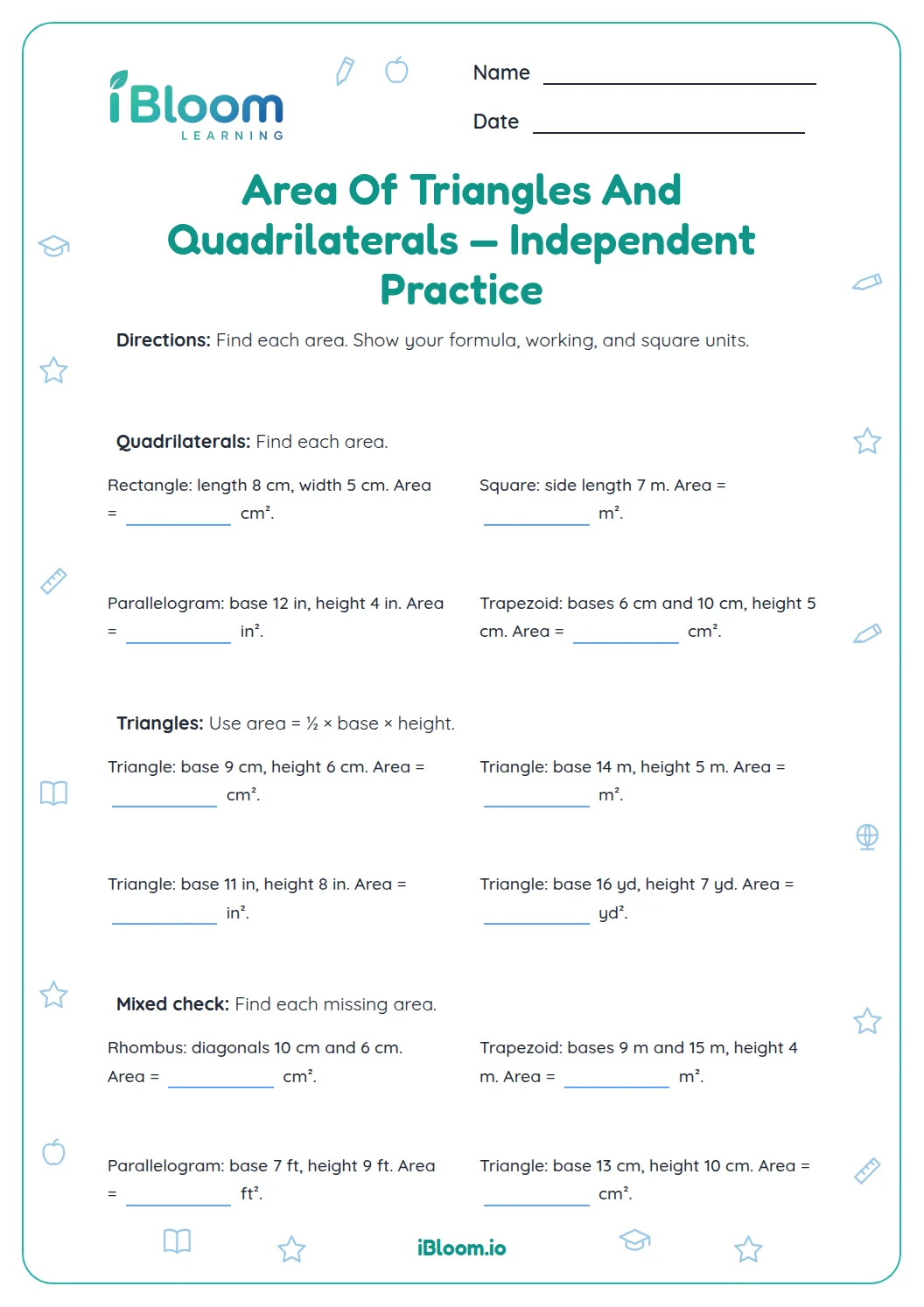
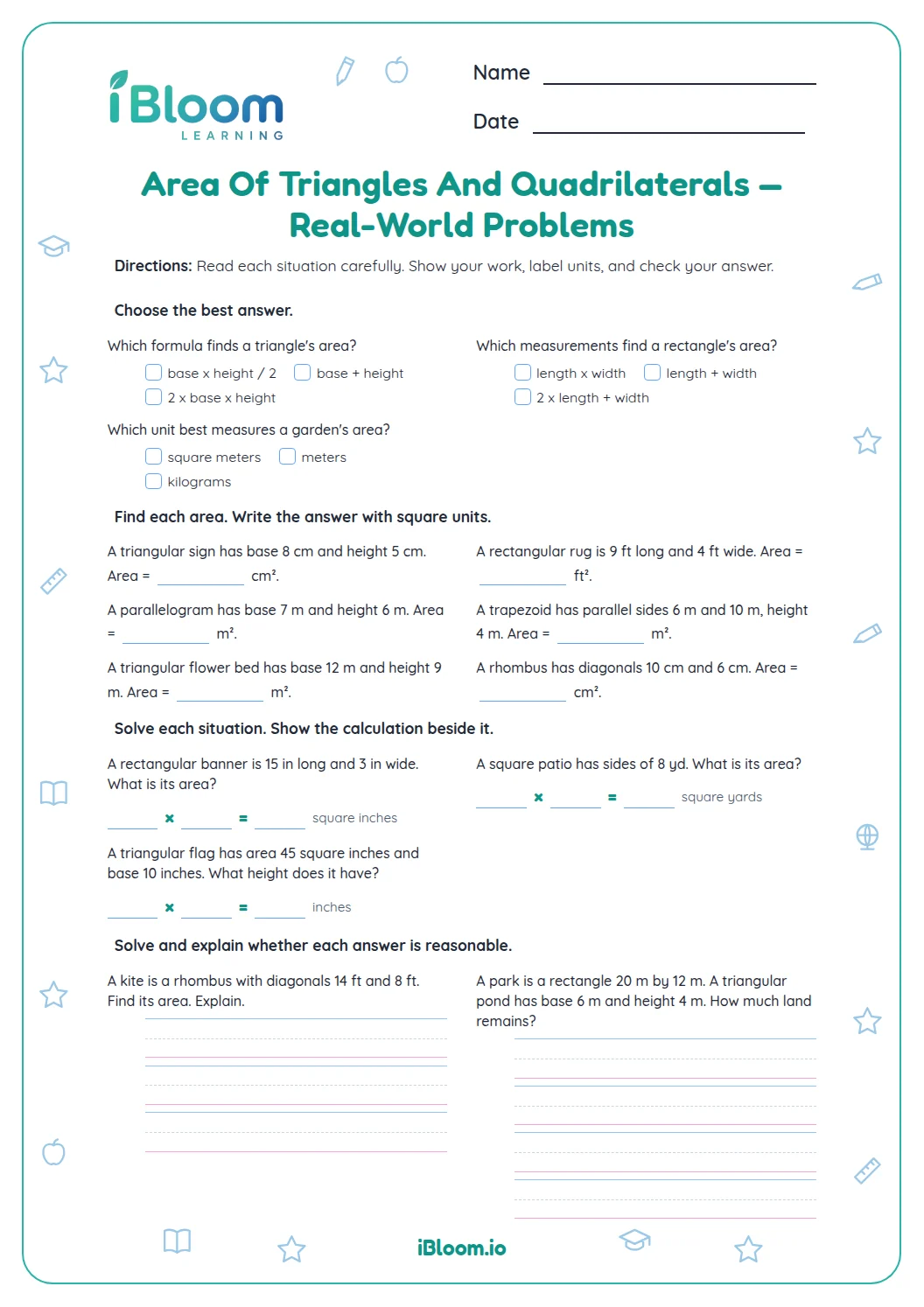
This Grade 6 printable builds area concepts for triangles and quadrilaterals. Children connect a shaded rectangle to square units, use base and perpendicular height for parallelograms and triangles, average the bases of trapezoids, and solve missing-dimension and context questions. The 14 questions align with CCSS 6.G.A.1 by practicing areas of triangles and special quadrilaterals in mathematical and real-world contexts. A separate answer key supports checking calculations and units.
Aligned to 6.G.A.1
How does a grid show area?
Count square units to see that area measures the surface a shape covers. Question 1 describes a rectangle with 6 rows and 4 columns, so its area is 6 × 4 = 24 square units.
- 16 rows × 4 columns
- 26 × 4 = 24
- 3Area = 24 square units
Why is a triangle half of a matching parallelogram?
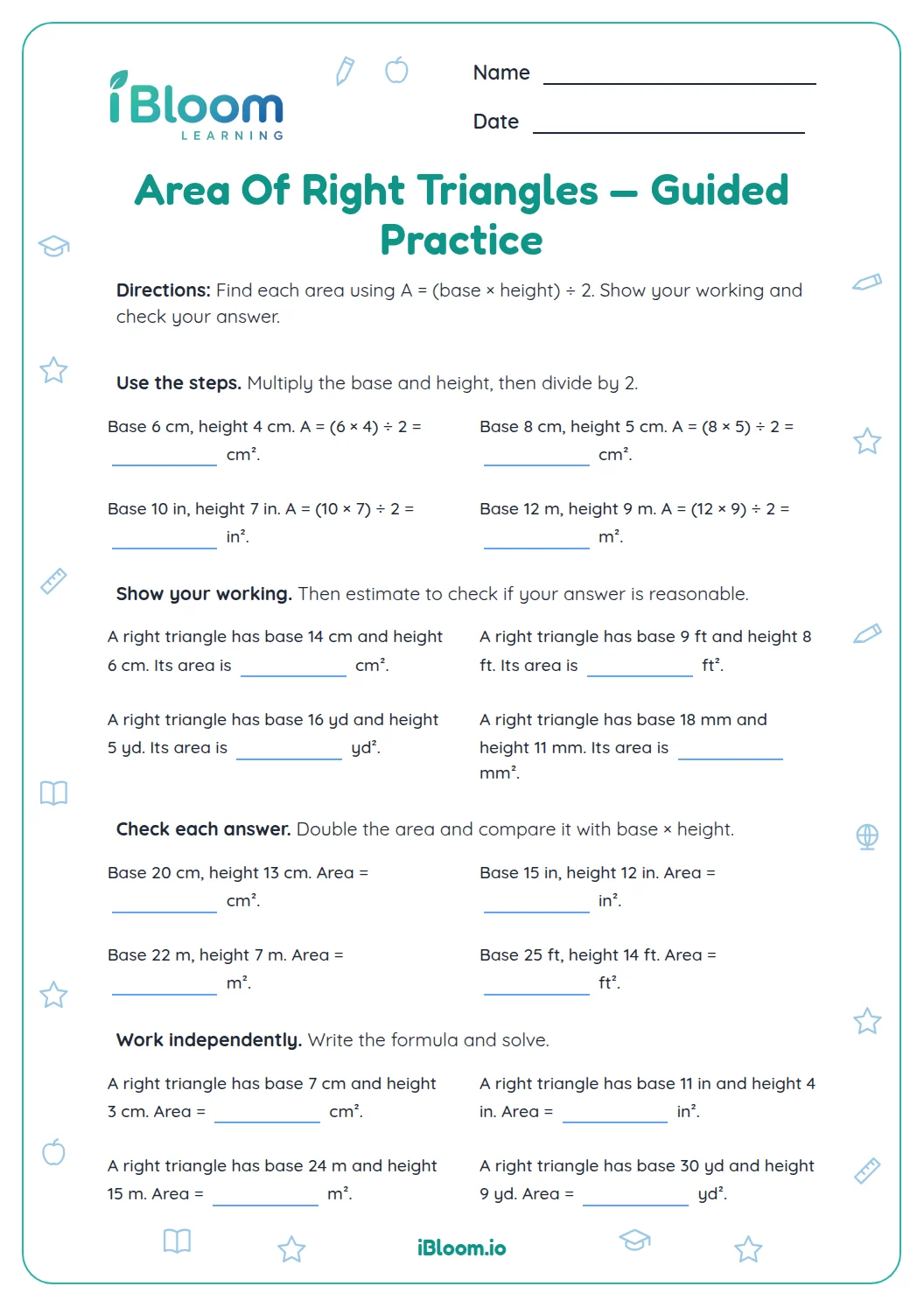
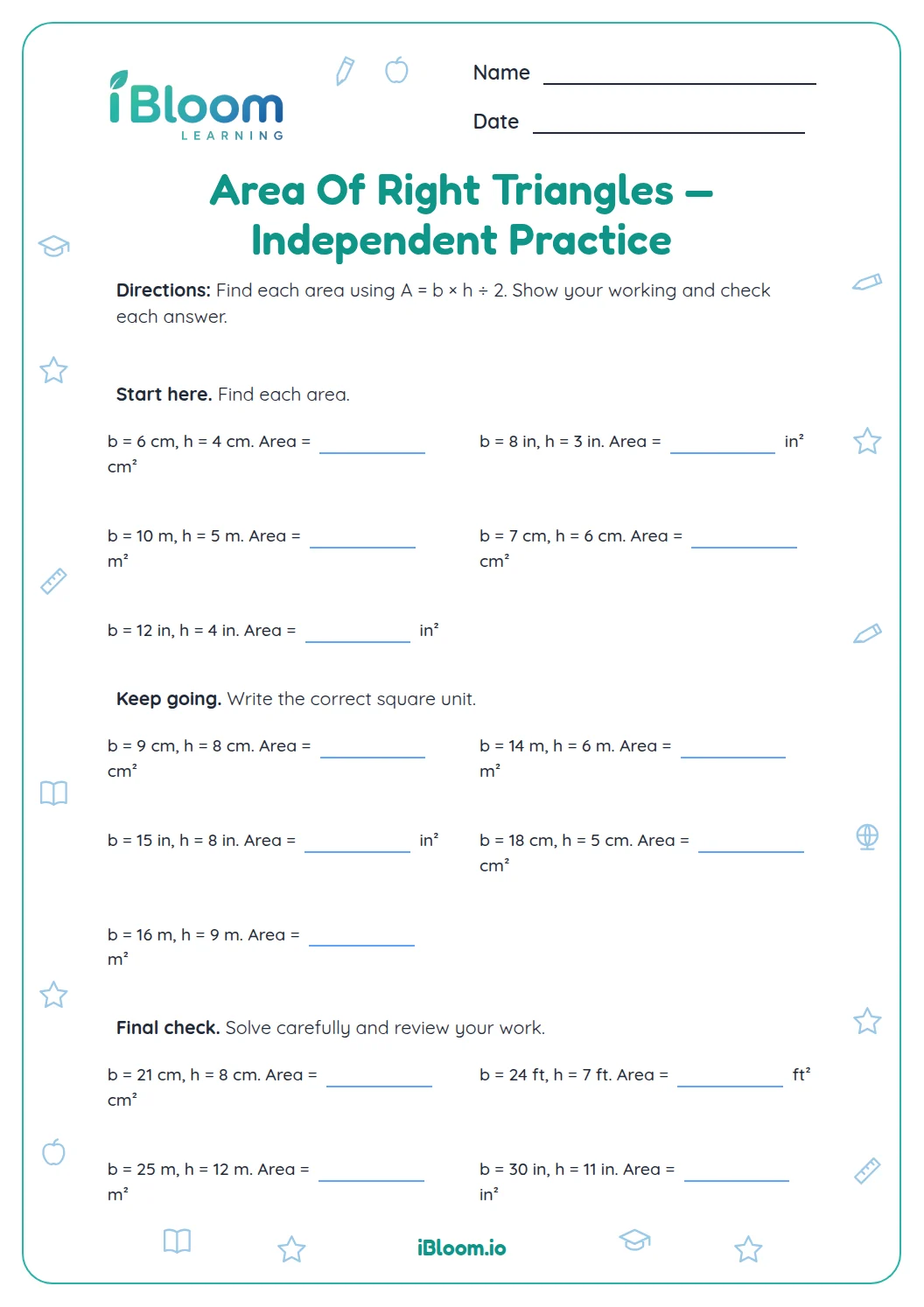
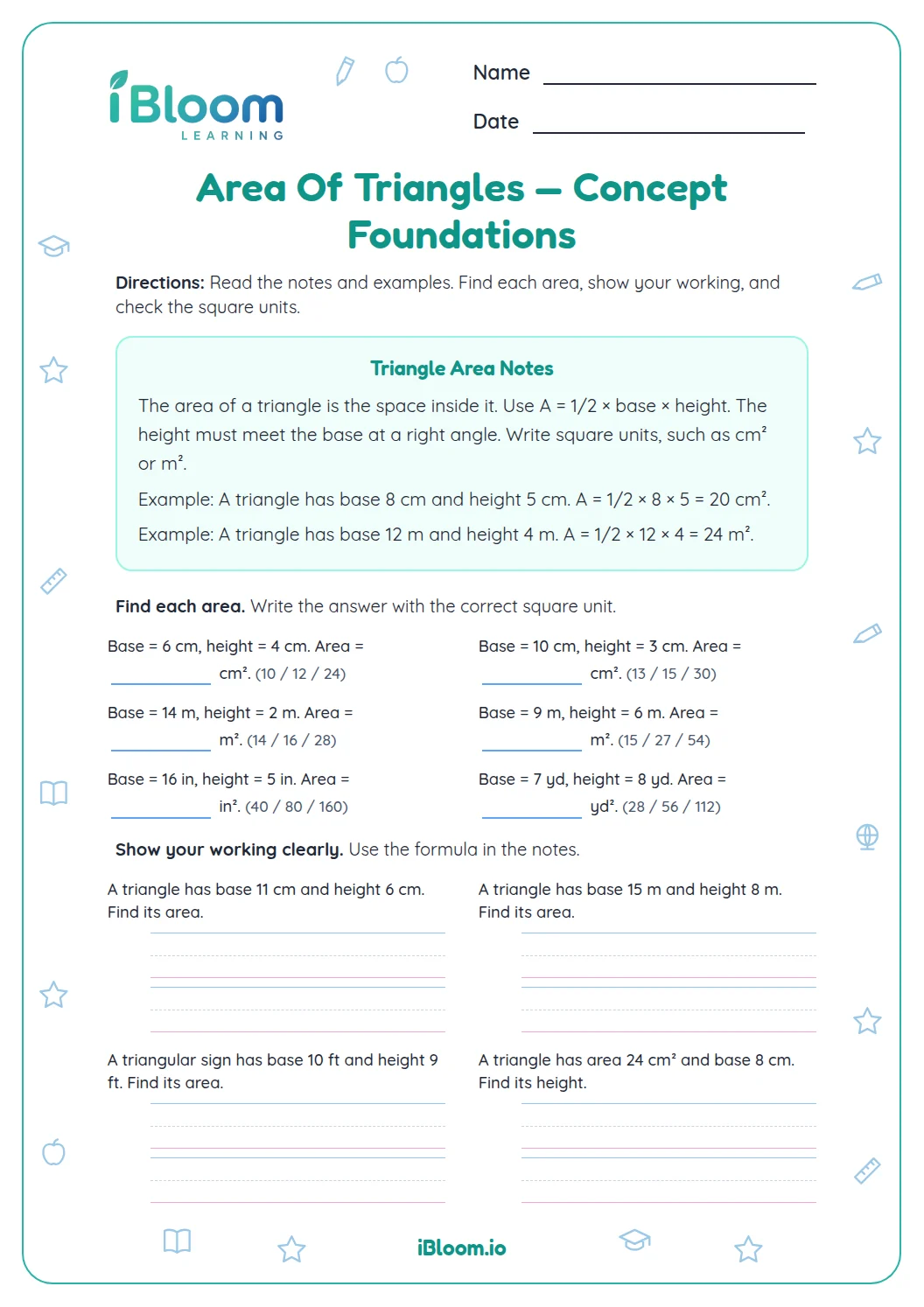
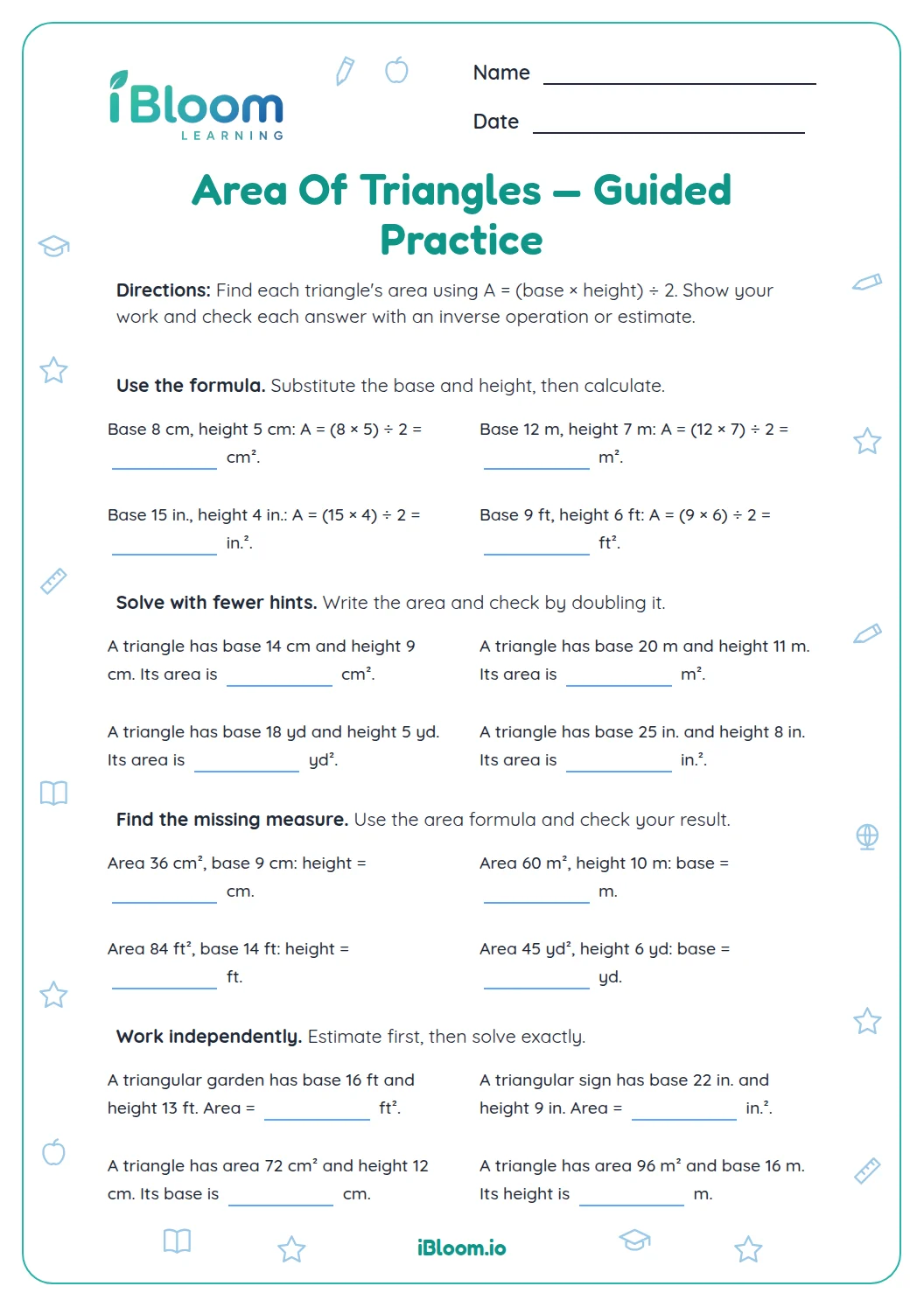
Two matching copies of a triangle can form a parallelogram with the same base and height. So a triangle’s area is base × height ÷ 2. For question 3, 10 × 6 ÷ 2 = 30 square inches.
How does a trapezoid use both parallel bases?
The two parallel bases have different lengths. Average them, then multiply by the perpendicular height: (base 1 + base 2) × height ÷ 2. Keep units squared for area.
How to use this worksheet
- 1Identify the shape and list the dimensions given.
- 2Check that height meets the base at a right angle.
- 3Choose the relationship that matches the shape.
- 4For a trapezoid, add the two bases before multiplying by height and halving.
- 5For a missing dimension, reverse the area relationship.
- 6Write square units for area and linear units for a length.
Common mistakes and quick fixes
The mistake
Using a slanted side as parallelogram height.
The fix
Use the perpendicular distance from base to opposite side.
The mistake
Forgetting to halve triangle or trapezoid area.
The fix
Compare with a matching rectangle or parallelogram to check the size.
The mistake
Writing cm instead of square cm for area.
The fix
Area counts square units, such as square centimeters.
Common Core alignment
The activities use area relationships and decomposition to calculate shape areas.
Find areas of triangles and special quadrilaterals using shape relationships.
On this sheet: Questions calculate areas of triangles, parallelograms, trapezoids, and rectangles in grids and contexts.
Show the official wordingHide the official wording
Find the area of right triangles, other triangles, special quadrilaterals, and polygons by composing into rectangles or decomposing into triangles and other shapes; apply these techniques in the context of solving real-world and mathematical problems.
What to practice next
Make more practice
Further reading
Questions parents and teachers ask
Why does a triangle formula divide by two?
A triangle with a given base and perpendicular height is half of a matching parallelogram. Multiply base by height to find the whole parallelogram area, then divide by two. For question 3, 10 × 6 ÷ 2 gives 30 square inches.
What does perpendicular height mean?
The height is the straight distance from a base to the opposite side at a right angle. It may not be the slanted side of a parallelogram. Using the perpendicular height keeps the area calculation tied to the shape’s actual base.
How many questions are on the worksheet?
There are 14 questions in two parts. Ten have a fill-in blank for an area or missing dimension, and four use short-answer prompts. Students calculate triangle and quadrilateral areas, solve for missing dimensions, and work through area in context. The answer key lists the results.
How do you calculate trapezoid area?
Add the lengths of the two parallel bases, multiply by the height, and divide by two. For bases 8 and 4 with height 3, (8 + 4) × 3 ÷ 2 = 18 square units. The worksheet uses this relationship in guided and context questions.
Why are some answers in square units?
Area measures a two-dimensional surface, so it is counted in square units such as square centimeters or square inches. A missing height is a length, so that answer uses centimeters or units without “square.” The worksheet prints the requested unit beside each blank.
Is the answer key included?
Yes. The answer key is a separate page with the results for the areas and dimensions. For fill-in questions, the worksheet prints the requested unit beside the blank; the key gives the number. For short-answer questions, check both the numerical answer and its unit.