

About this worksheet
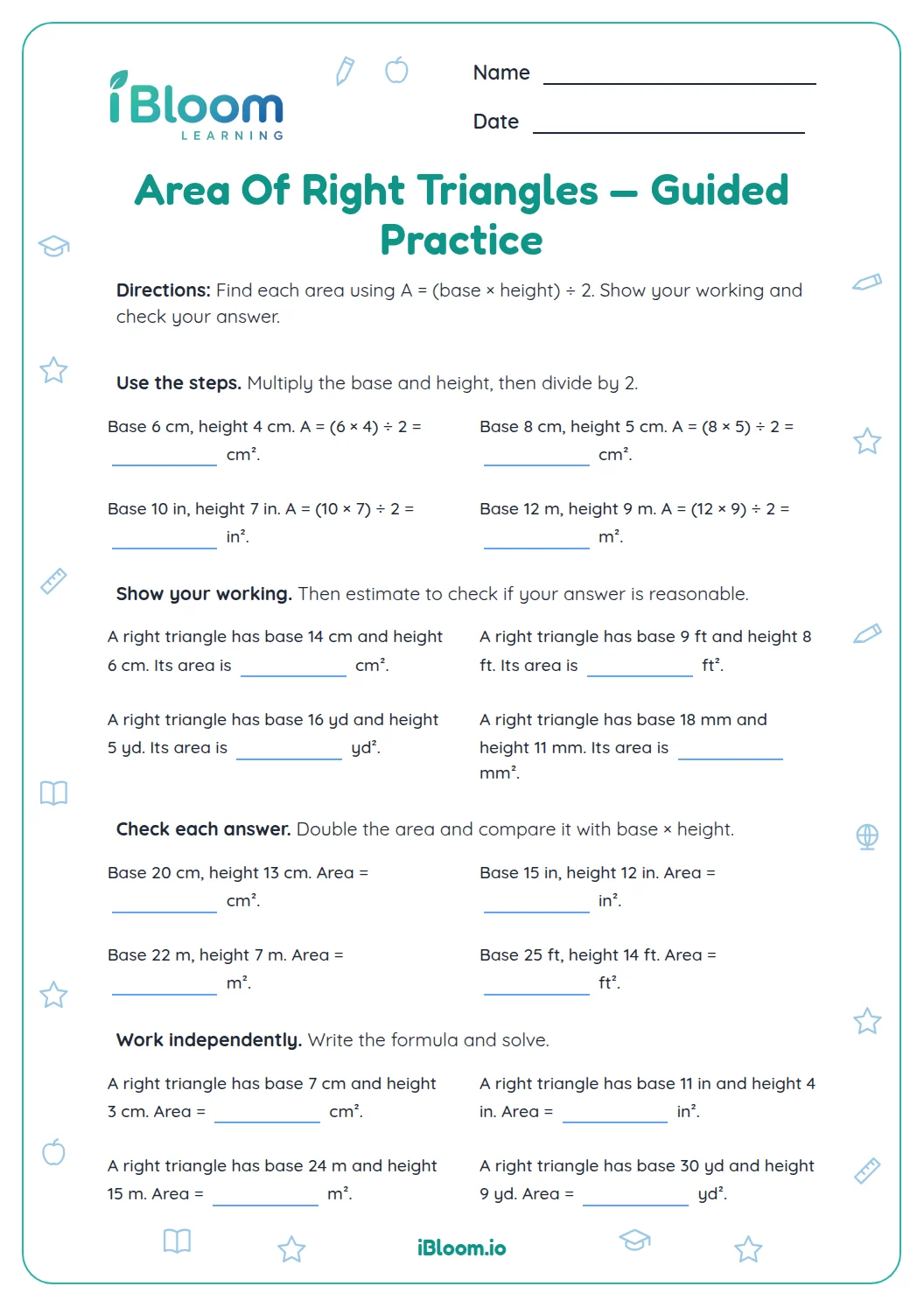
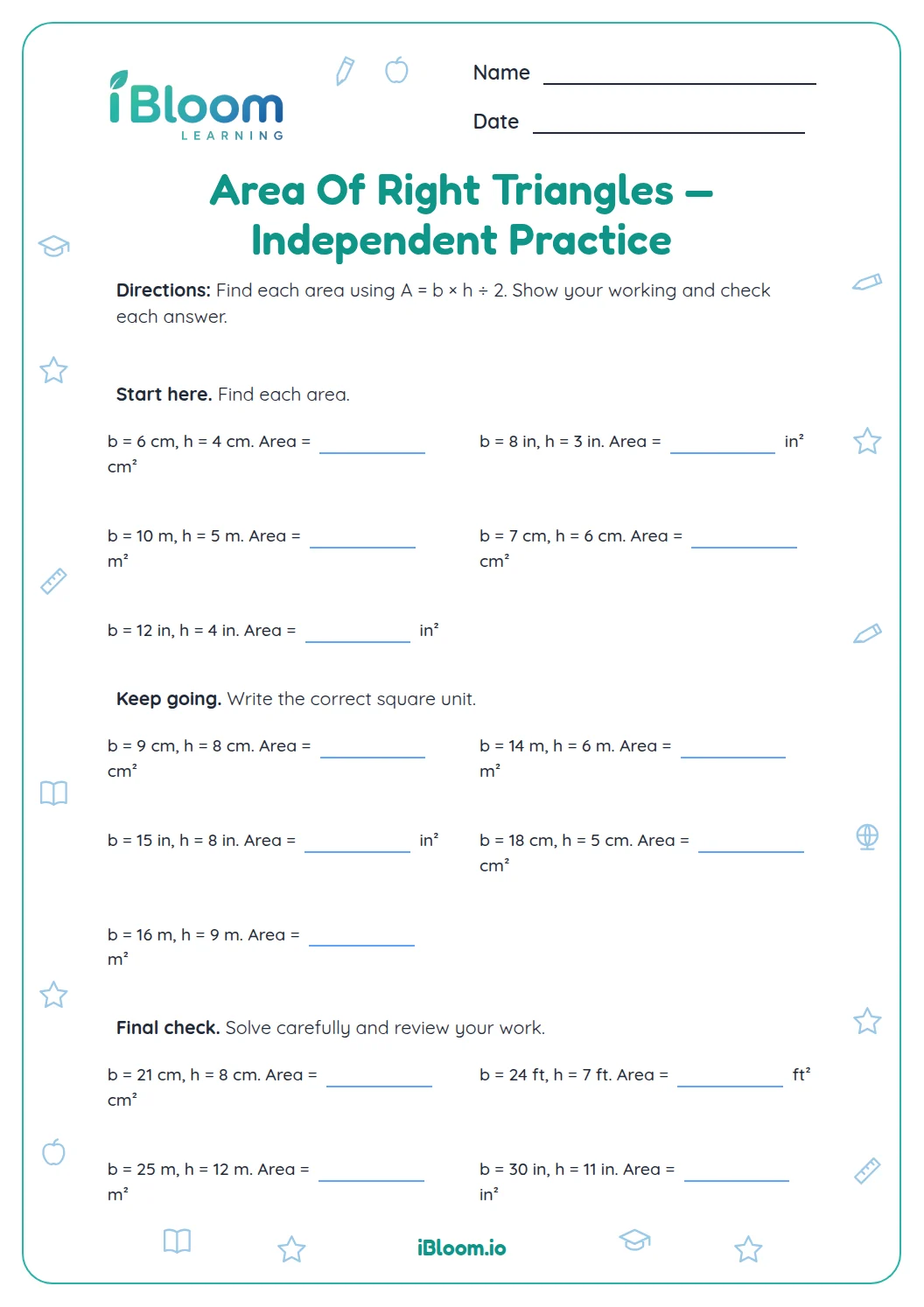
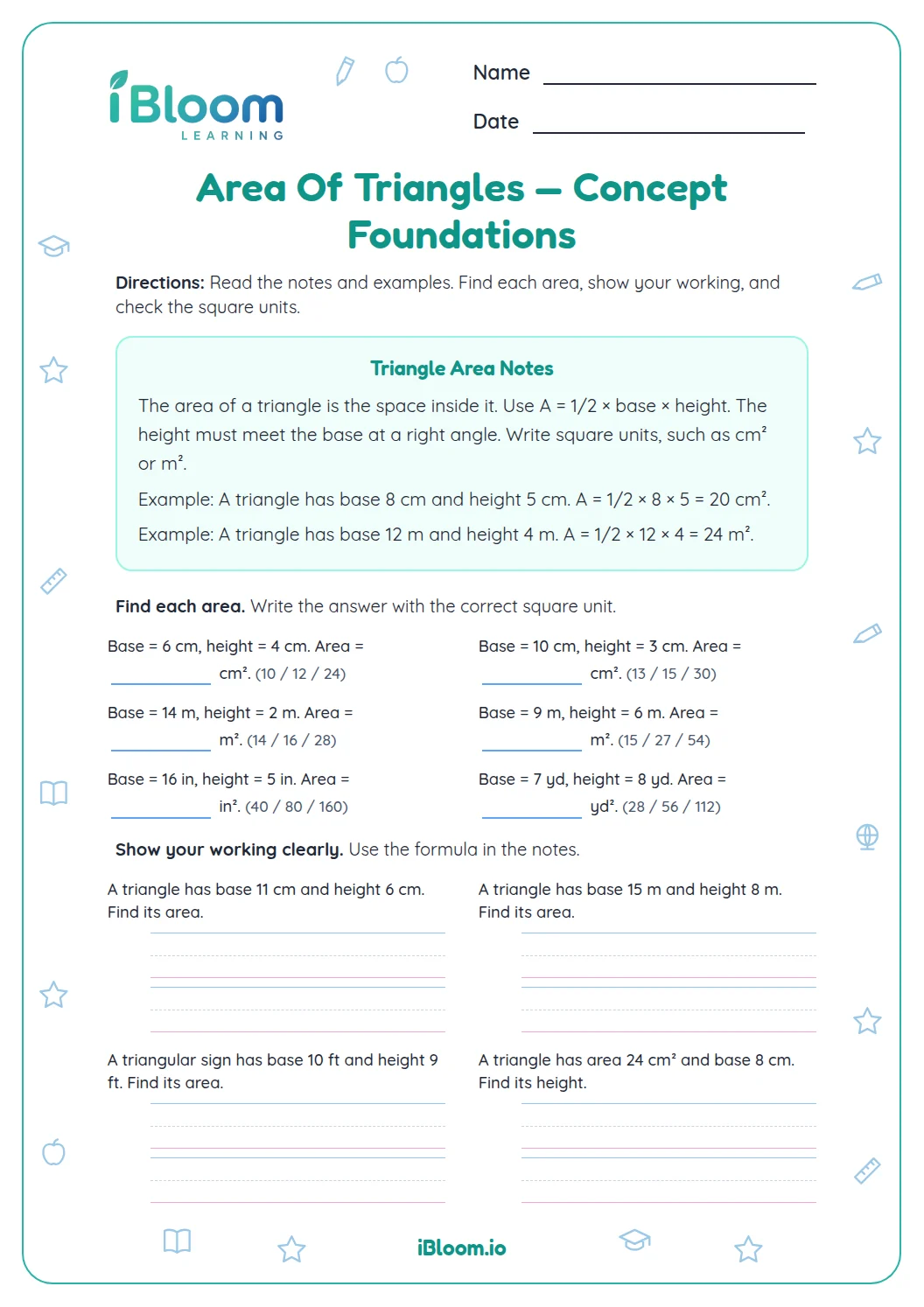
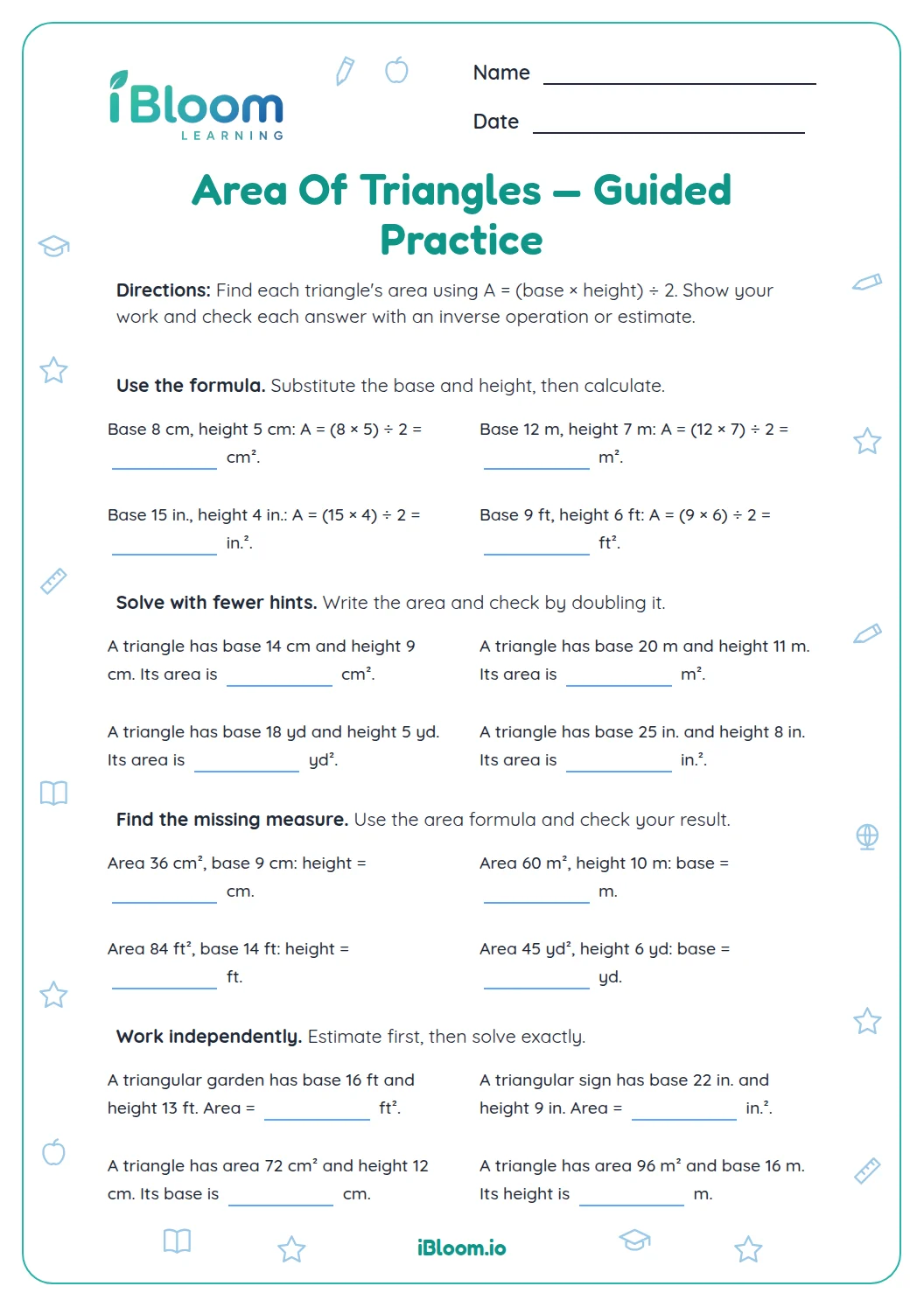
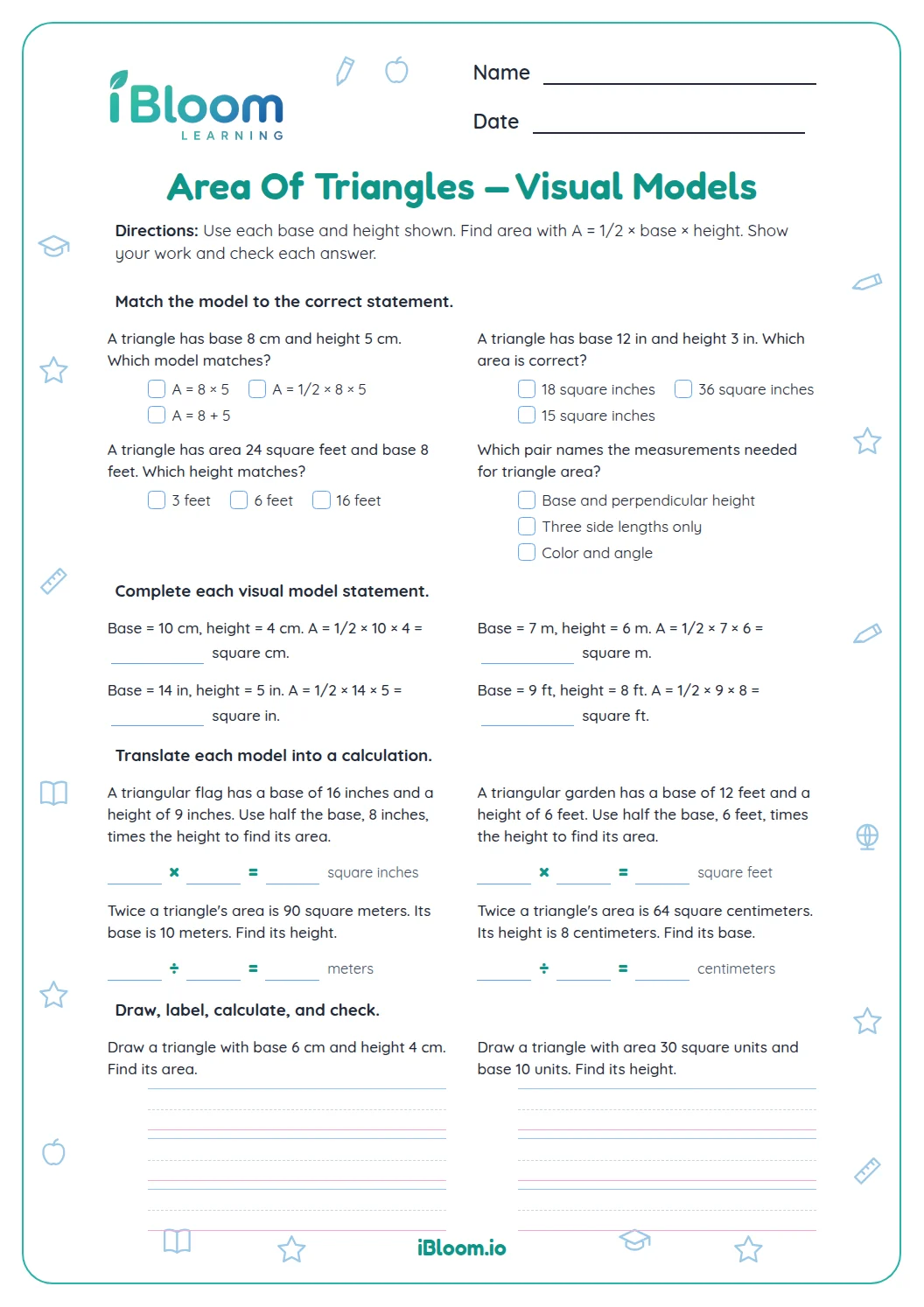
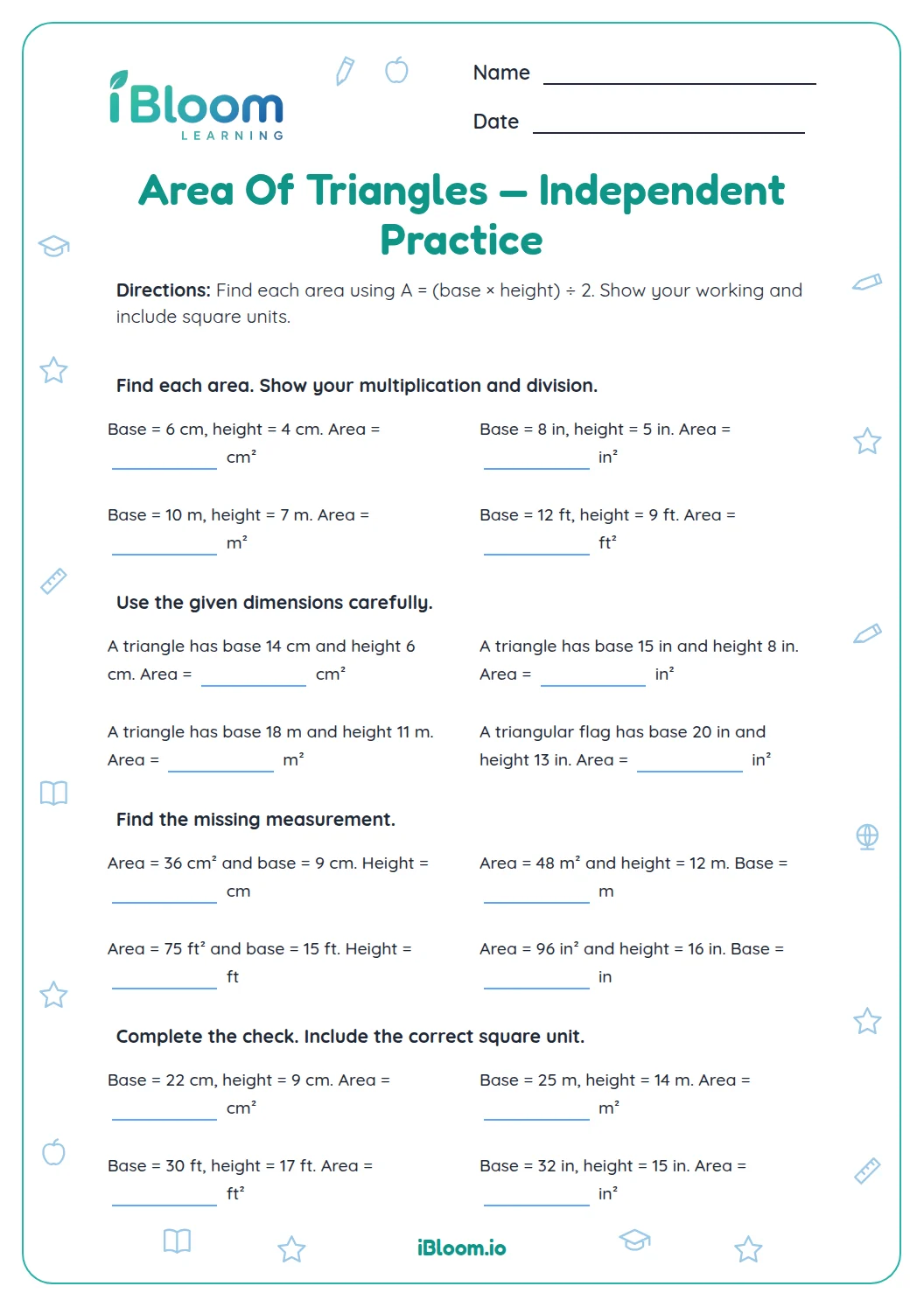
A right triangle’s area is half the product of its perpendicular base and height. This Grade 6 worksheet builds from calculating area to finding a missing dimension and applying the rule to a measured triangle. Fourteen questions use whole-number dimensions, and a separate answer key shows the results.
Aligned to 6.G.A.1
How do you use the right-triangle area rule?
Multiply the base by the perpendicular height, then take half of that rectangle’s area. Keep the measurements in the same unit, and label area in square units.
For a missing dimension, work backward from the area: double the area, then divide by the known side.
- 1Base = 6 ft and height = 3 ft.
- 2Area = 6 × 3 ÷ 2 = 9 square feet.
- 3The answer is 9 sq ft.
What kinds of problems are included?
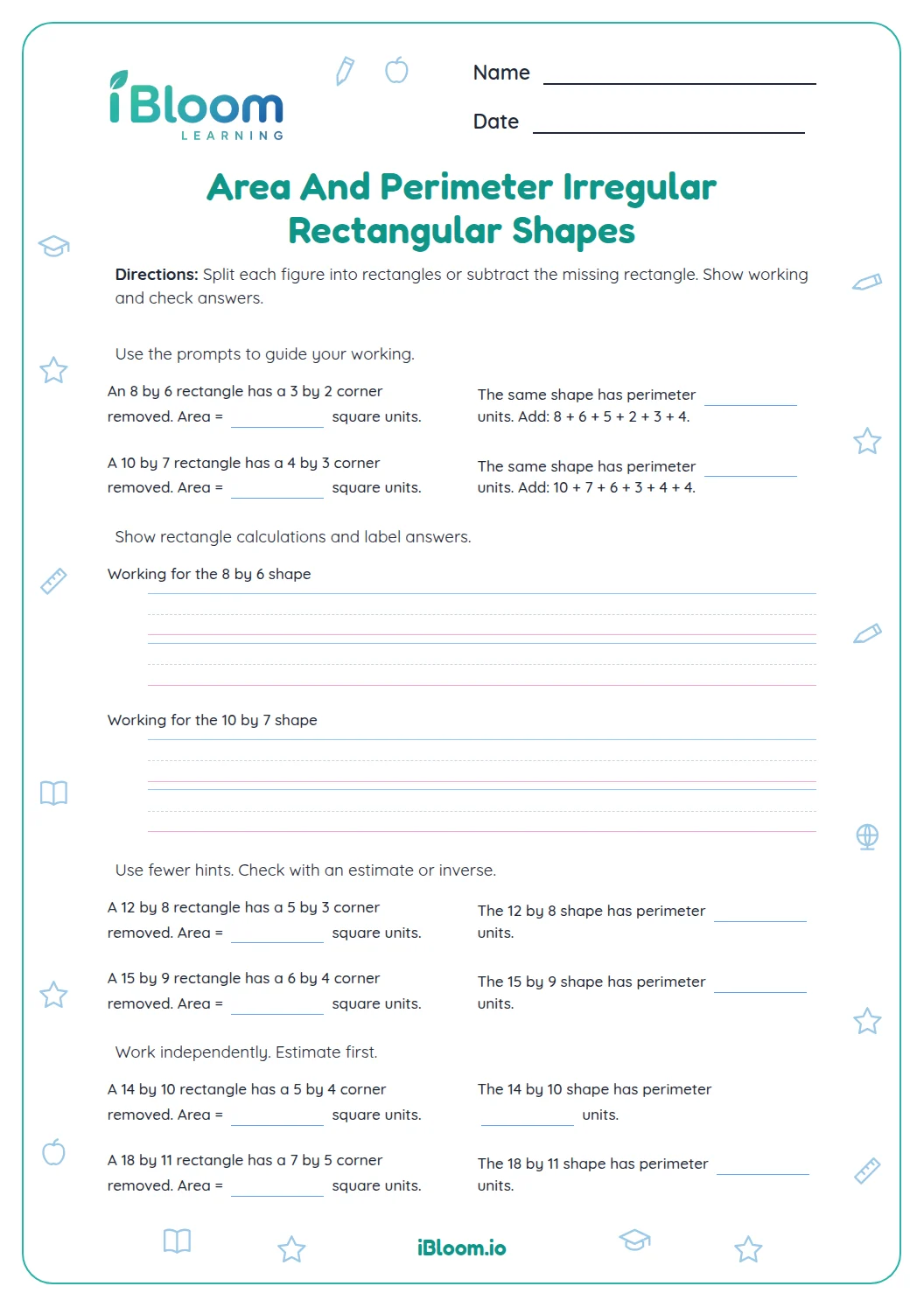
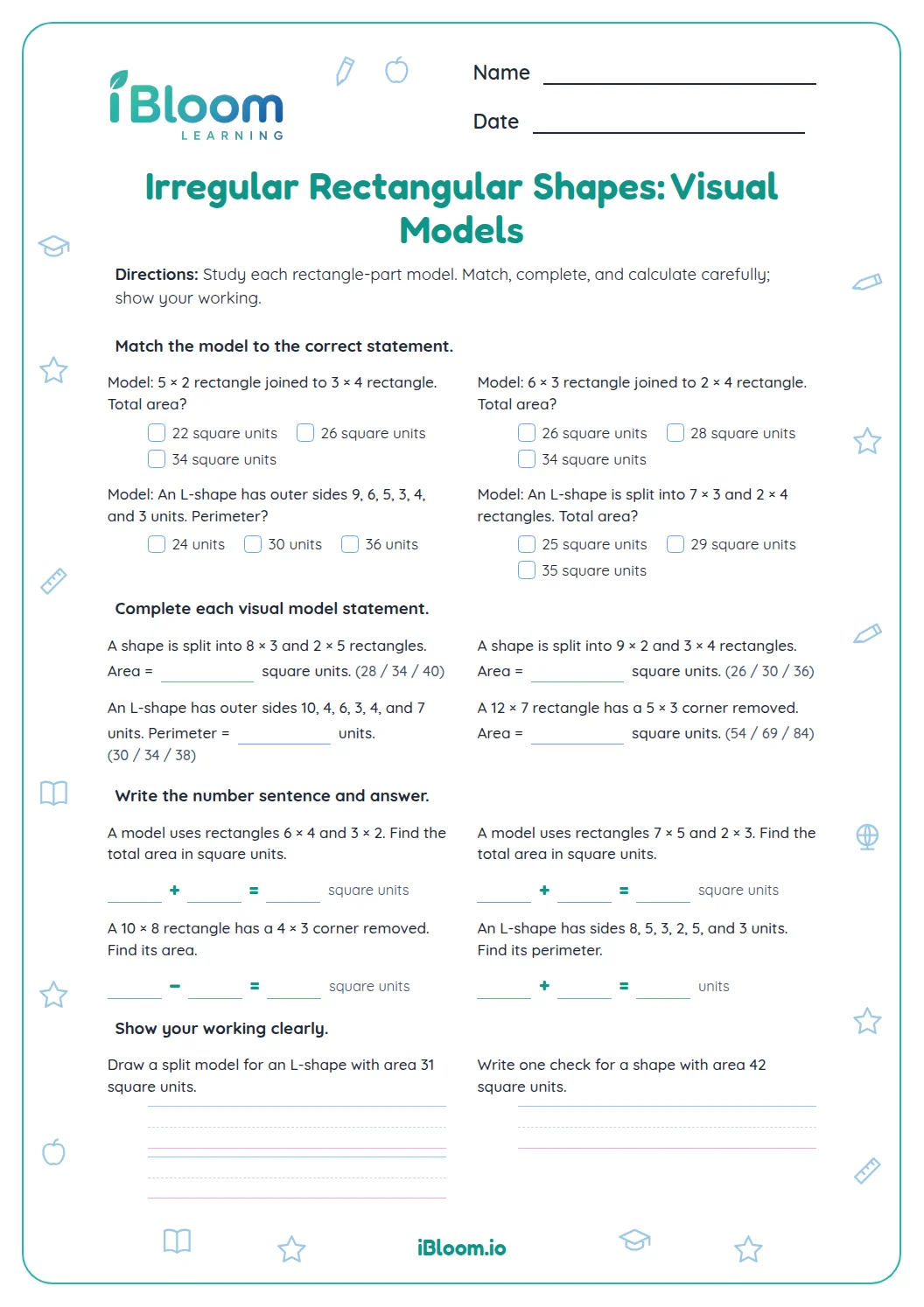
Part A practices direct area calculations and missing dimensions. Part B checks the rule and applies it to a triangle with measurements in feet. Part C returns to calculations and inverse questions. The 14 items use the same base-times-height-divided-by-two method shown on the former sheet.
How can an adult help with a missed answer?
Ask the learner to identify the perpendicular base and height before calculating. If the area is given, ask what operation reverses multiplying the two dimensions and taking half. Finish by checking that the answer is an area, so its unit is squared.
How to use this worksheet
- 1Identify the base and perpendicular height.
- 2For area, multiply the two measures and divide by 2.
- 3For a missing side, double the area and divide by the known side.
- 4Include square units when a word problem asks for area.
- 5Check each response with the separate answer key.
Common mistakes and quick fixes
The mistake
Multiplying base and height but forgetting to take half.
The fix
Compare the triangle with a rectangle that has the same base and height, then halve the rectangle’s area.
The mistake
Using the wrong side as the height.
The fix
Use the perpendicular height that meets the base at a right angle.
The mistake
Writing a length unit for area.
The fix
Label square feet, square centimeters, or another square unit.
Common Core alignment
This printable practices the standard below through focused questions.
A right triangle is half of a rectangle with the same base and perpendicular height.
On this sheet: The worksheet questions use this skill directly.
Show the official wordingHide the official wording
Find the area of right triangles, other triangles, special quadrilaterals, and polygons by composing into rectangles or decomposing into triangles and other shapes; apply these techniques in the context of solving real-world and mathematical problems.
What to practice next
Make more practice
Further reading
Questions parents and teachers ask
How many questions are on the worksheet?
There are 14 questions in three parts: area and missing-measure calculations, a rule check and application, and a final set of calculations. The page is designed for Grade 6 practice. A separate answer key lets learners check each result after attempting the work.
What is the formula for a right triangle’s area?
Multiply the base by the perpendicular height, then divide by 2. A rectangle with those same dimensions has area base times height, and a right triangle is half of it. The worksheet uses this relationship in direct calculations and missing-dimension problems.
Does the worksheet include a word problem?
Yes. Question 9 gives a right triangle with a 6-foot base and a 3-foot height and asks for its area. The correct calculation is 6 × 3 ÷ 2, or 9 square feet. Other items focus on the number relationship itself.
What should the area unit look like?
Area uses square units because it measures a two-dimensional surface. If the side lengths are in feet, report square feet; if they are in centimeters, report square centimeters. The answer key includes a square-foot label for the word problem.
Can a learner use this for review?
Yes. The questions revisit the area rule from direct computation through inverse problems. Ask the learner to say which measurements are the base and perpendicular height, then explain why the result is halved. The answer key supports a quick check after independent practice.