

About this worksheet
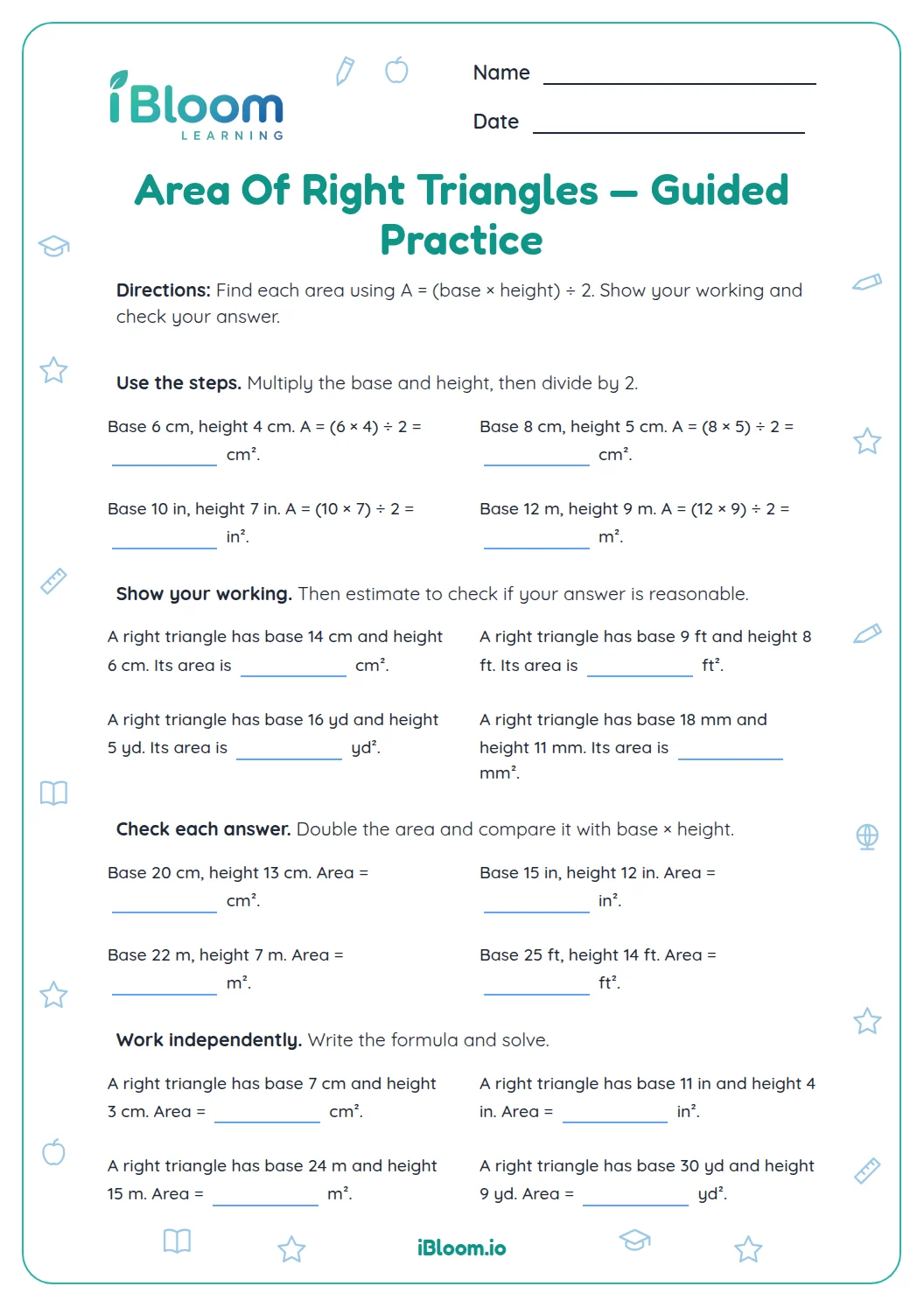
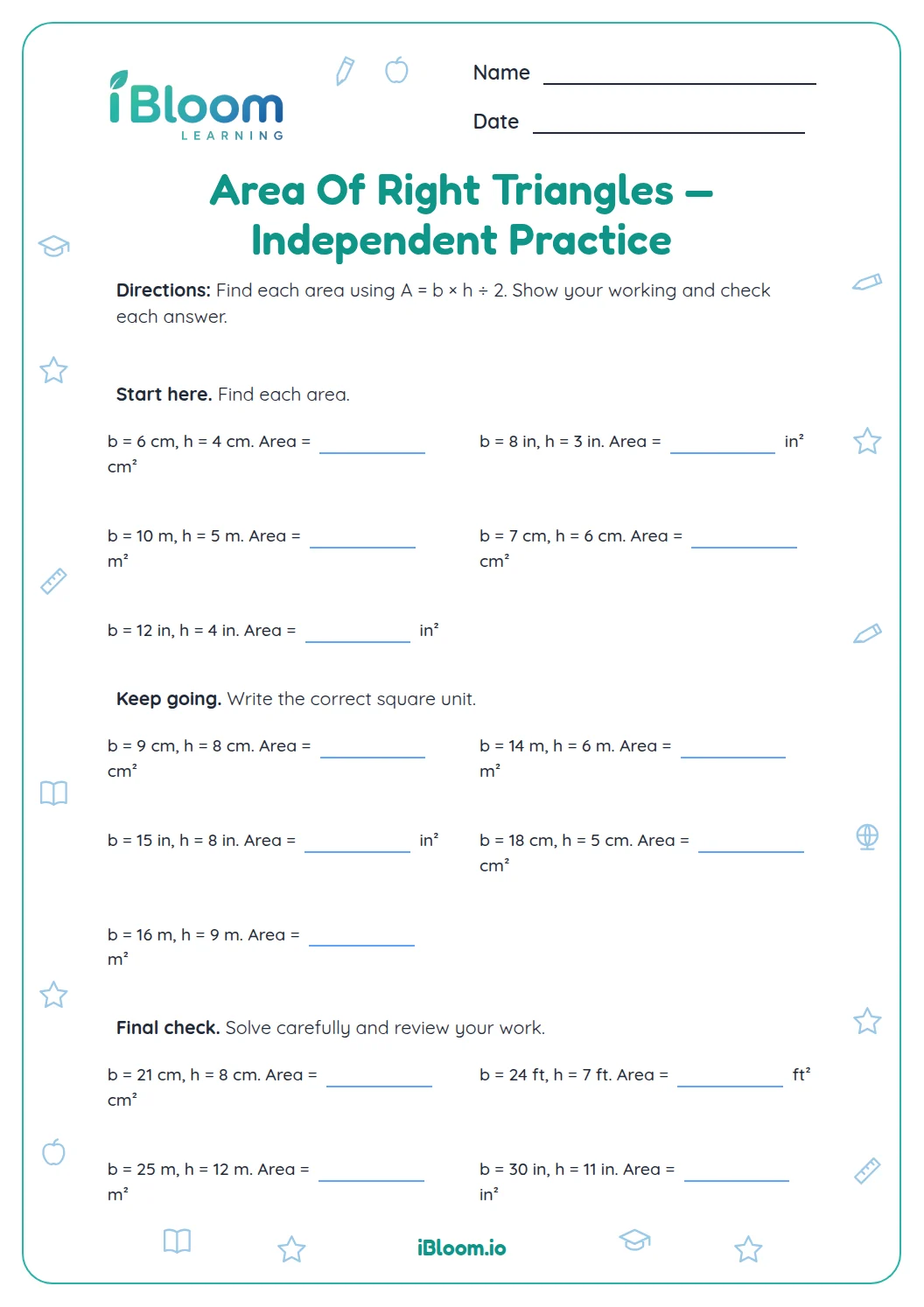
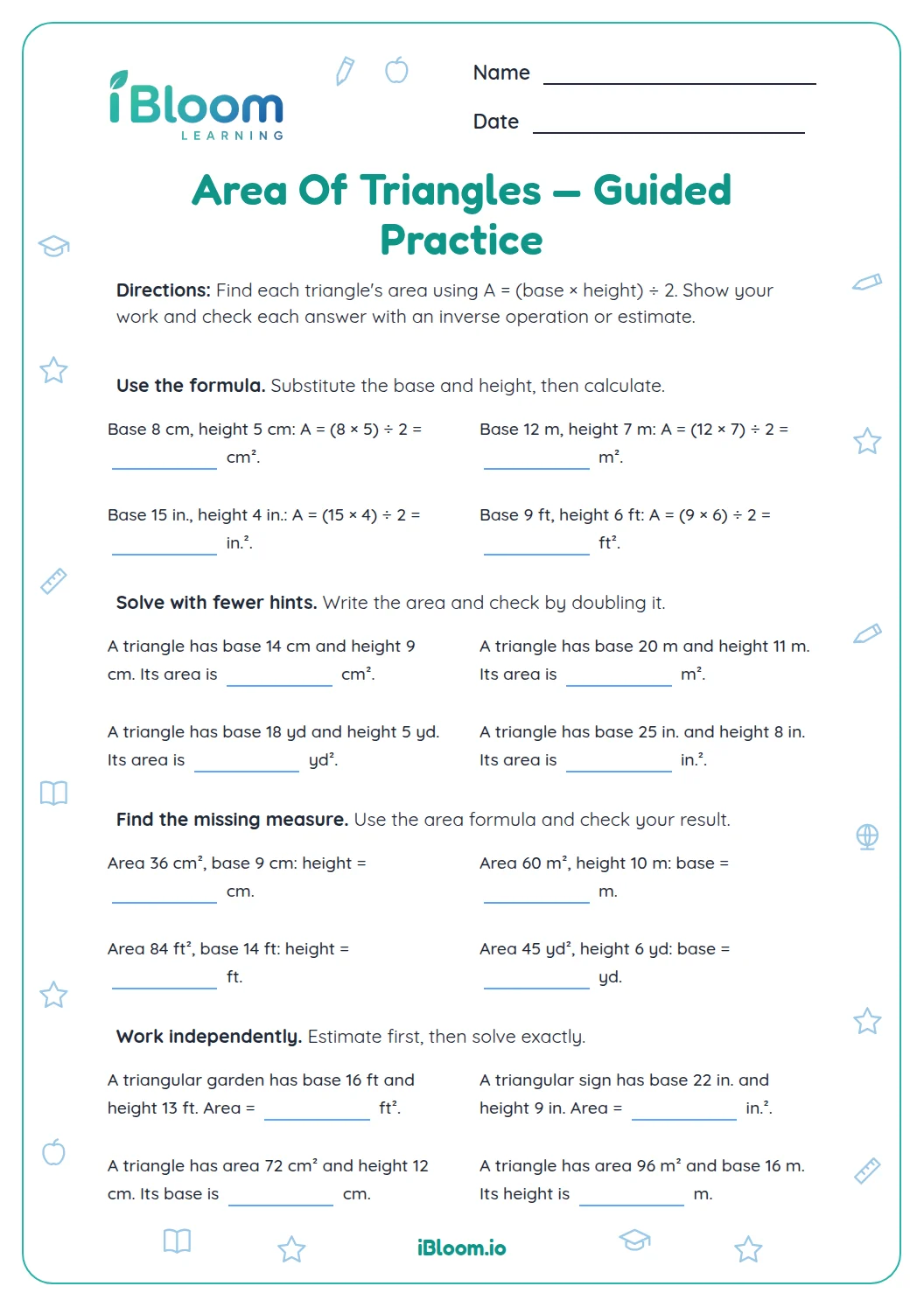
This Grade 6 geometry worksheet gives 16 real-world problems about the area of right triangles. Each prompt identifies the two perpendicular legs and their units; learners multiply those lengths and take half. A separate answer key supports checking the numerical areas and square units.
Aligned to 6.G.A.1
How do you find the area of a right triangle?
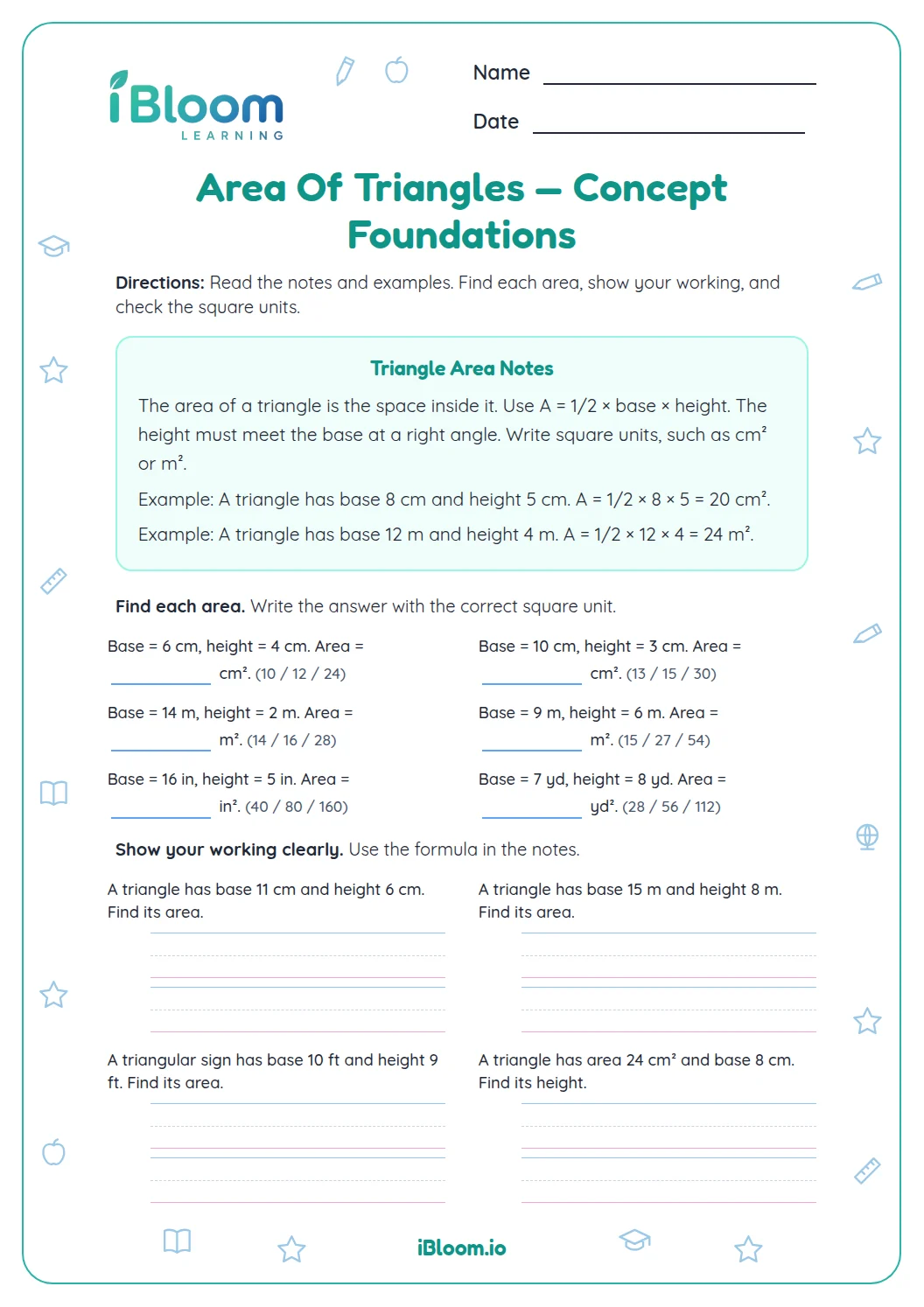
A right triangle can be paired with a matching triangle to make a rectangle. Its area is half the rectangle’s area: A = 1/2 × base × perpendicular height.
- 1For the garden corner with legs 12 ft and 7 ft: A = 1/2 × 12 × 7 = 42 ft².
Which measurements belong in the formula?
Use the base and the height that meets it at a right angle. In a right triangle, the two legs form that right angle, so either leg can be the base if the other is its perpendicular height.
How should the final area be written?
Multiply the length units and report square units. For example, feet multiplied by feet gives square feet, written ft².
How can I use this worksheet?
- 1Underline the two perpendicular side lengths in each problem.
- 2Write A = 1/2 × base × height.
- 3Substitute the lengths and multiply before taking half.
- 4Include square units and check that the answer is about half a rectangle.
Common mistakes and quick fixes
The mistake
Using a sloping side as the height.
The fix
Use the two side lengths that meet at the right angle; the height must be perpendicular to the chosen base.
The mistake
Forgetting to take half of the product.
The fix
Multiply the perpendicular lengths, then divide the product by 2 before writing the area.
The mistake
Writing a length unit instead of an area unit.
The fix
Keep the squared unit shown in the prompt, such as ft² or cm², because area measures a surface.
Curriculum alignment
This worksheet gives learners focused practice with the skill named in the standard.
Use half the product of a right triangle’s perpendicular legs to solve practical area problems.
On this sheet: The questions directly practice the stated skill.
Show the official wordingHide the official wording
Find the area of right triangles, other triangles, special quadrilaterals, and polygons by composing into rectangles or decomposing into triangles and other shapes.
What to practice next
Make more practice
Further reading
Questions parents and teachers ask
What formula is used?
Use A = 1/2 × base × perpendicular height. Multiply the perpendicular lengths, then take half of the product. The answer uses square units, such as ft² when both side lengths are in feet. The worksheet gives the leg lengths in each context.
Why is a right triangle’s area half of a rectangle?
Two matching right triangles can be joined along their sloping sides to form a rectangle. One triangle therefore has half the rectangle’s area, which is half the product of its perpendicular legs. This explains the one-half in the area rule.
Which measurements should learners use?
Use the two lengths that meet at a right angle. Those are the perpendicular legs of each right triangle. The real-world prompts name both measurements, so learners can focus on applying the formula and carrying the length unit into square units.
What units belong in the answer?
Area is reported in square units. For example, side lengths in feet produce square feet, written ft²; lengths in centimeters produce square centimeters, written cm². The blank already shows the unit, so learners only need to enter the number. The answer line provides a space for each value.
What should learners show in their work?
Write or think through one-half times the first leg times the second leg. Multiply the leg lengths and divide by two, then label the result with the matching squared unit. For 12 ft and 7 ft, the area is 42 ft².