
About this worksheet
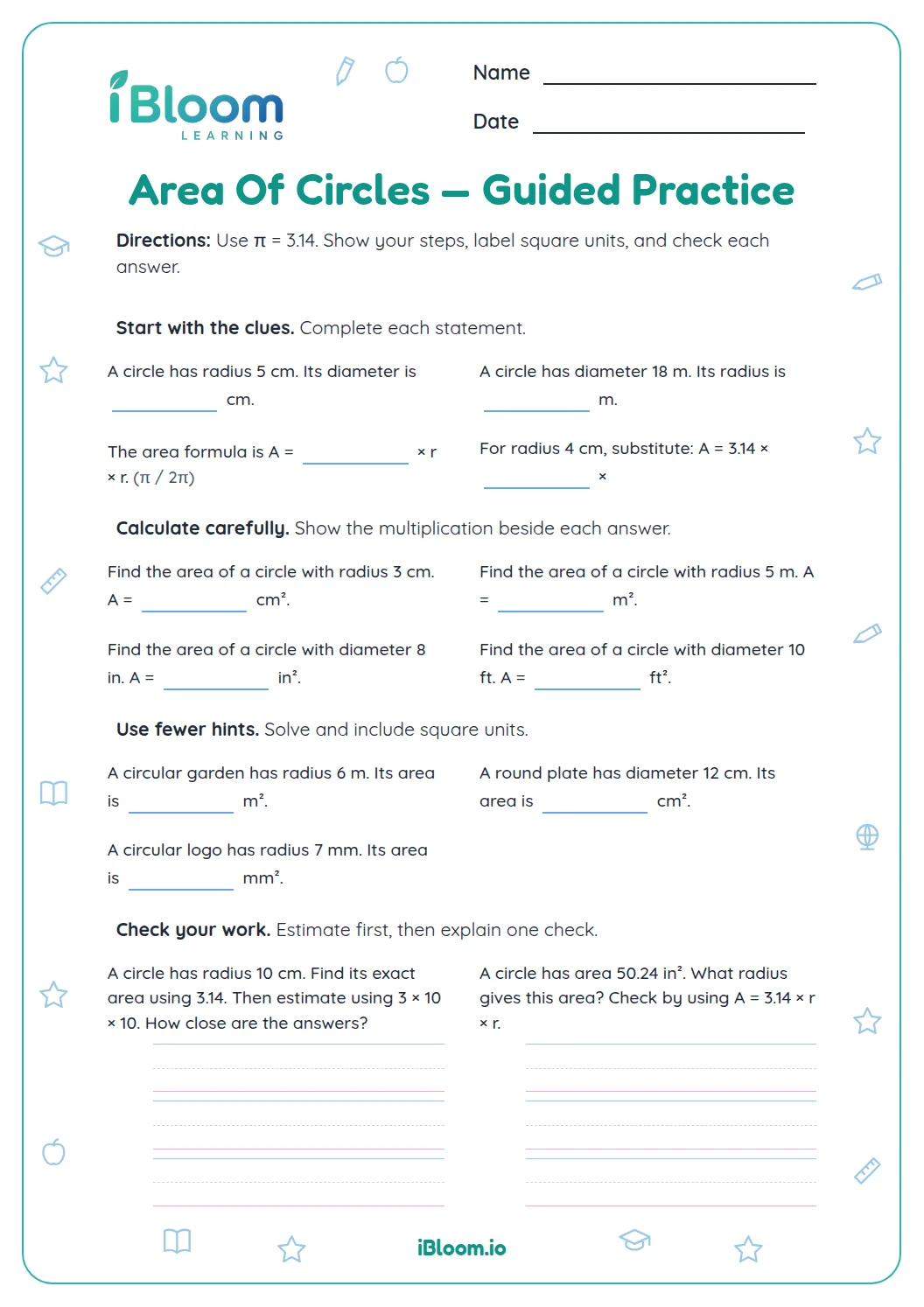
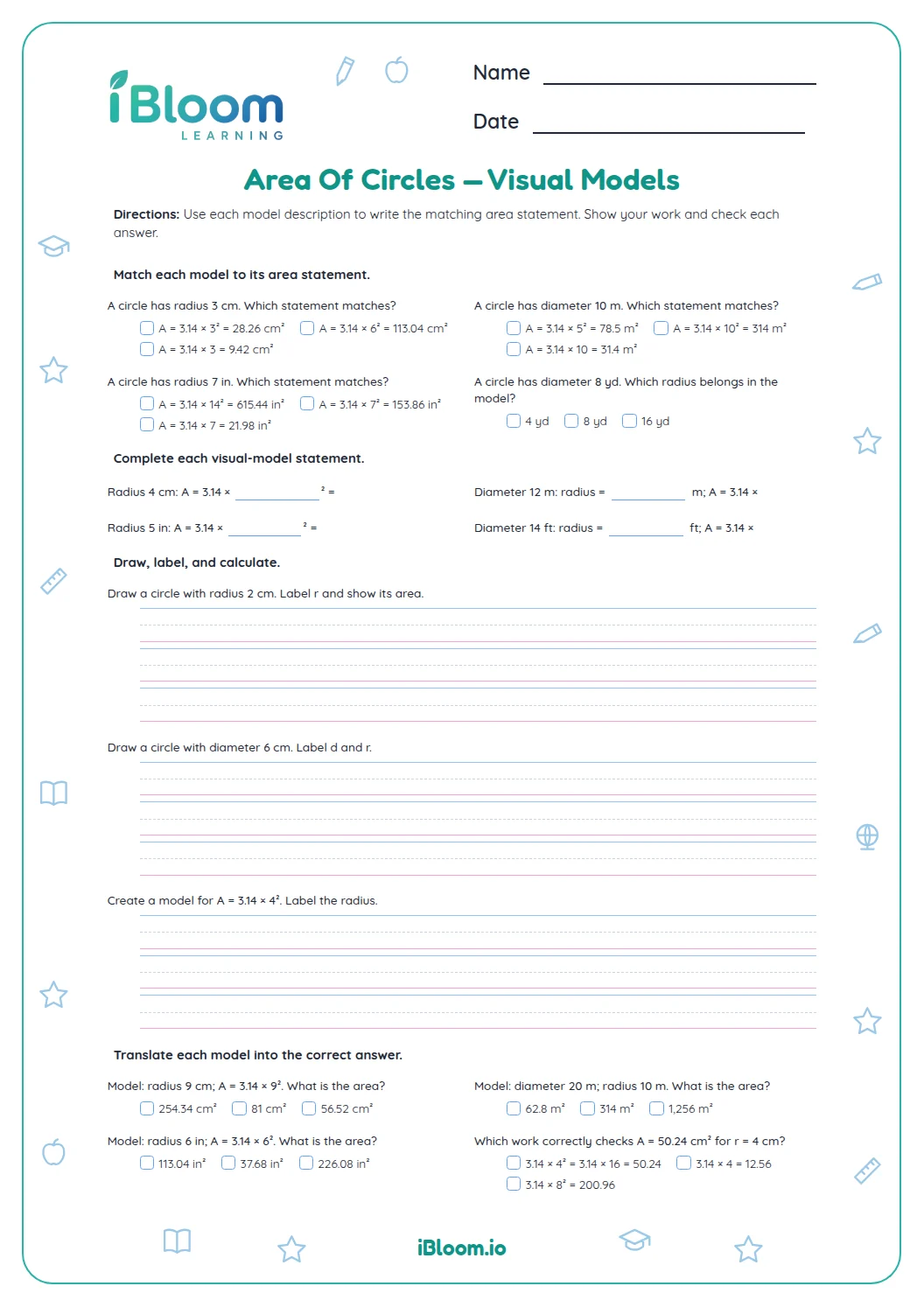
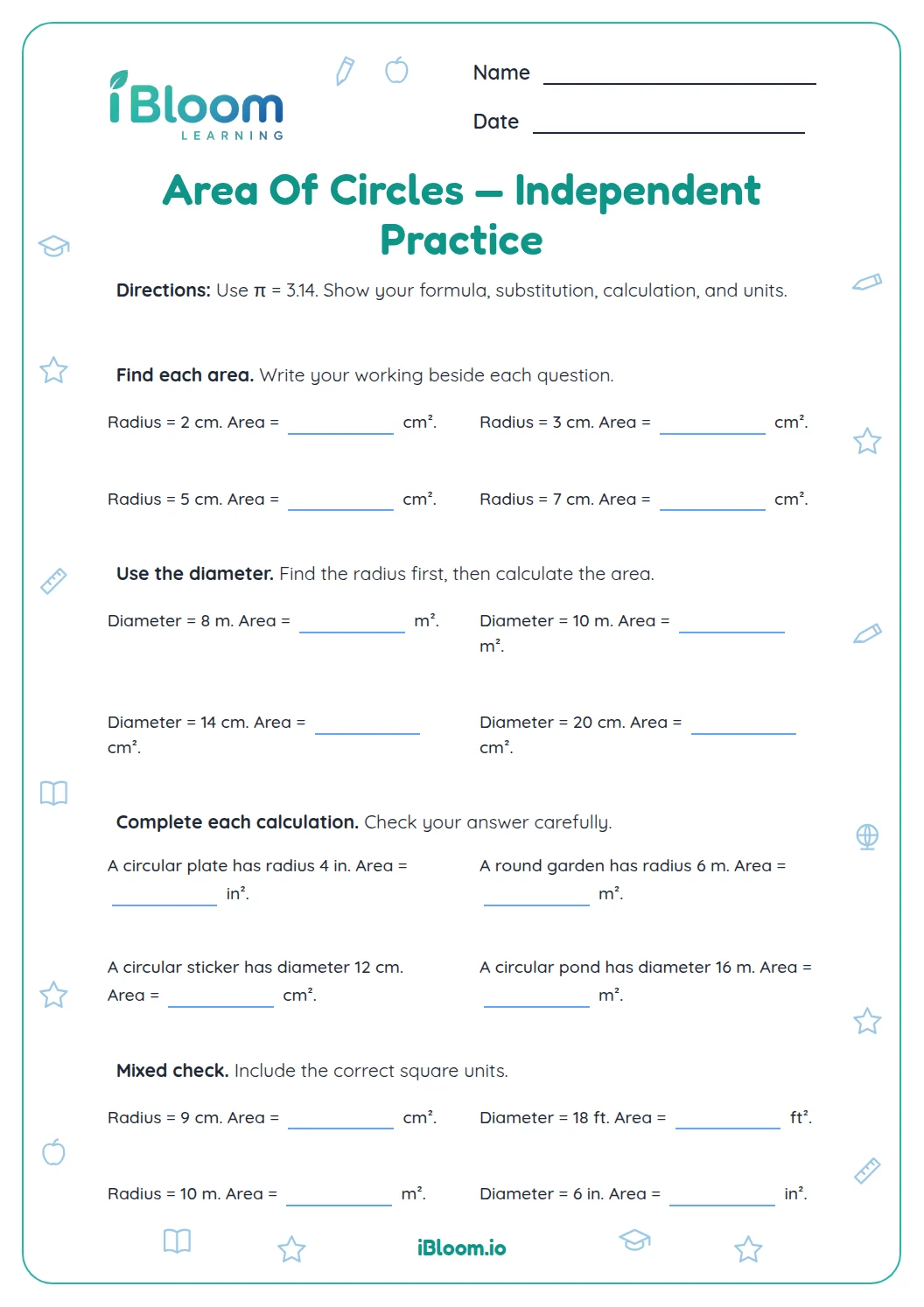
This Grade 6 printable has 14 questions on circle area. Learners identify radius and diameter, choose A = πr², calculate areas using π = 3.14, and explain square units. Several questions ask learners to convert a diameter to a radius before calculating. A separate answer key includes the numerical results and sample explanation.
Aligned to 7.G.B.4
How do learners connect radius, diameter, and the formula?
The opening section checks radius, diameter, and the formula A = πr². When a diameter is given, halve it to find the radius used in the formula.
Question 6 asks what to square for a 10 cm diameter: the radius is 5 cm.
How do the calculation questions build circle-area practice?
Calculation items provide the radius or diameter and ask for area using 3.14. Keep the units squared in the final result.
For a 3 cm radius, 3.14 × 3 × 3 = 28.26, so the area is 28.26 cm².
What reasoning do the final questions ask for?
The final questions consider a mistaken radius, how area changes when radius doubles, and why area uses square units.
Doubling a radius multiplies its squared value by four; q11’s answer is four times as large.
How to use this worksheet
- 1Identify whether the given measure is a radius or diameter.
- 2If it is a diameter, divide by 2 to find the radius.
- 3Substitute the radius into A = πr².
- 4Square the radius, then multiply by 3.14.
- 5Label the result in square units and check with the key.
Common mistakes and quick fixes
The mistake
Using diameter as r in the formula.
The fix
Divide the diameter by 2 before substituting.
The mistake
Multiplying by 3.14 before squaring r.
The fix
Find r² first, then multiply by 3.14.
The mistake
Writing a length unit for area.
The fix
Use a square unit such as cm² or in².
Common Core alignment
This practice connects the worksheet activities to the standard below.
Use radius and A = πr² to find circle areas and explain square units.
On this sheet: Use radius and A = πr² to find circle areas and explain square units.
Show the official wordingHide the official wording
Know the formulas for the area and circumference of a circle and use them to solve problems; give an informal derivation of the relationship between the circumference and area of a circle.
What to practice next
Make more practice
Further reading
Questions parents and teachers ask
What formula does the worksheet use?
The worksheet uses A = πr², with π set to 3.14 for its calculations. Learners square the radius and multiply by 3.14. If a problem gives diameter, they first divide it by two to get the radius. This order keeps the formula connected to the given measure.
How many questions are included?
There are 14 questions in four parts. They cover radius and diameter, formula choice, area calculations, and reasoning about square units or a common setup mistake. The answer key provides calculated areas and a sample written explanation. Learners can show work beside each calculation.
Why must diameter be changed to radius?
The formula uses r for radius, which is the distance from the center to the circle’s edge. Diameter spans the circle through its center and is twice the radius. For a 10 cm diameter, use 5 cm as r before squaring.
What units should area answers use?
Area is reported in square units, such as cm², in², or ft². The given length unit is squared because area measures a two-dimensional surface. The calculation items on this worksheet expect the square unit that matches the radius or diameter.
How can learners check their calculations?
First confirm the radius, halving any diameter that was given. Then square that value, multiply by 3.14, and check the arithmetic. Finally, attach the correct square unit. The answer key lists the expected totals for comparison, including the area values rounded to hundredths where needed.