
About this worksheet
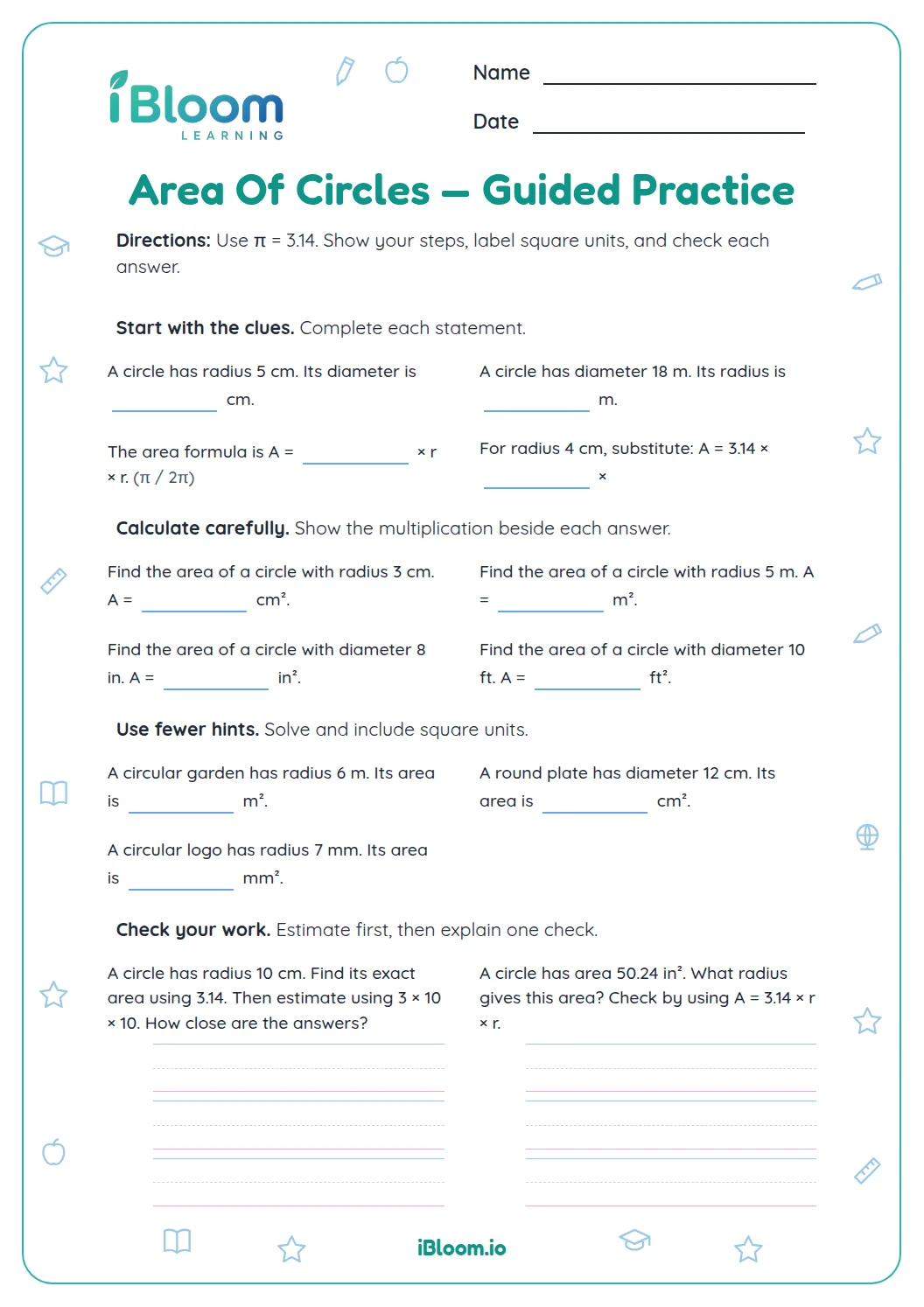
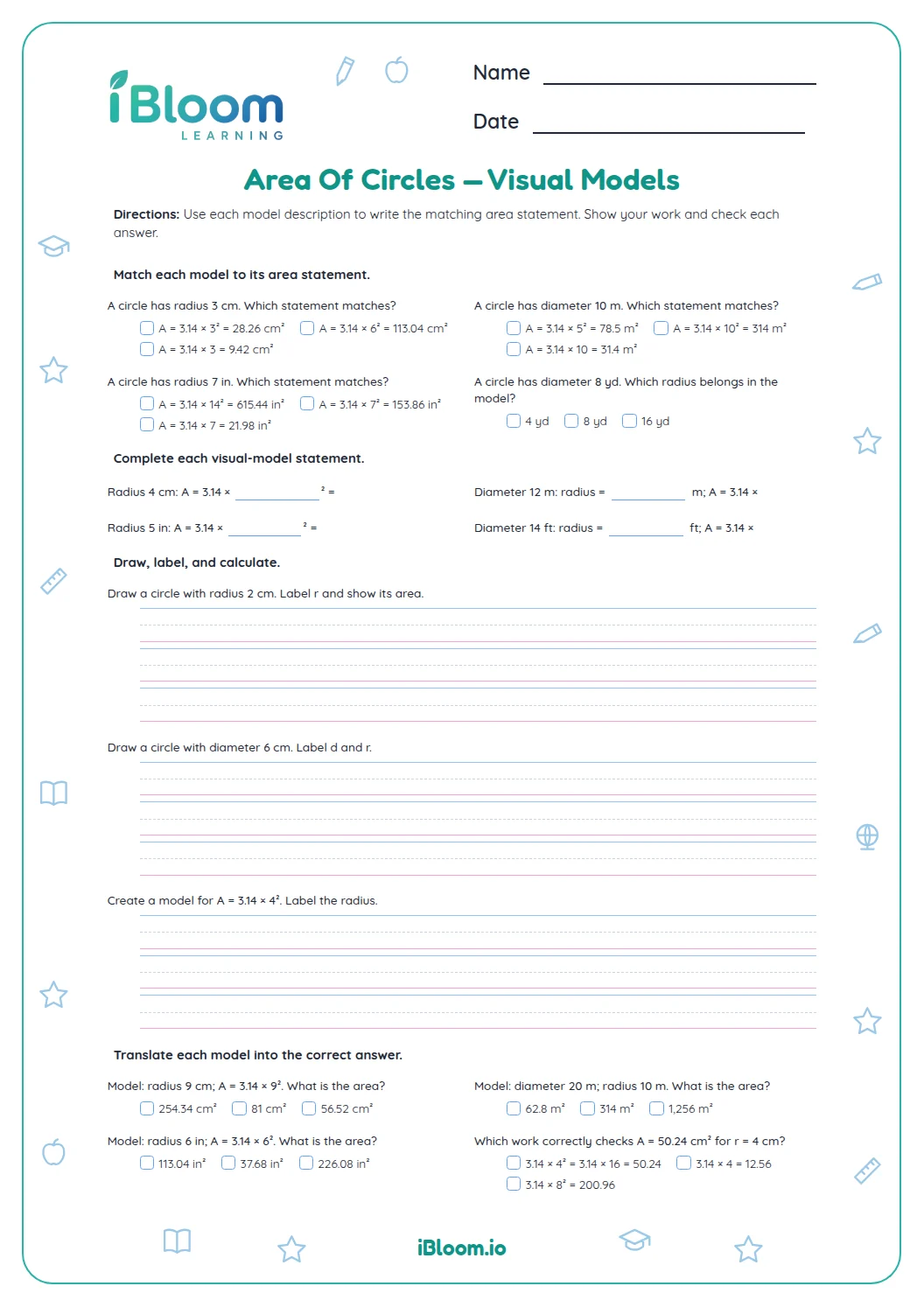
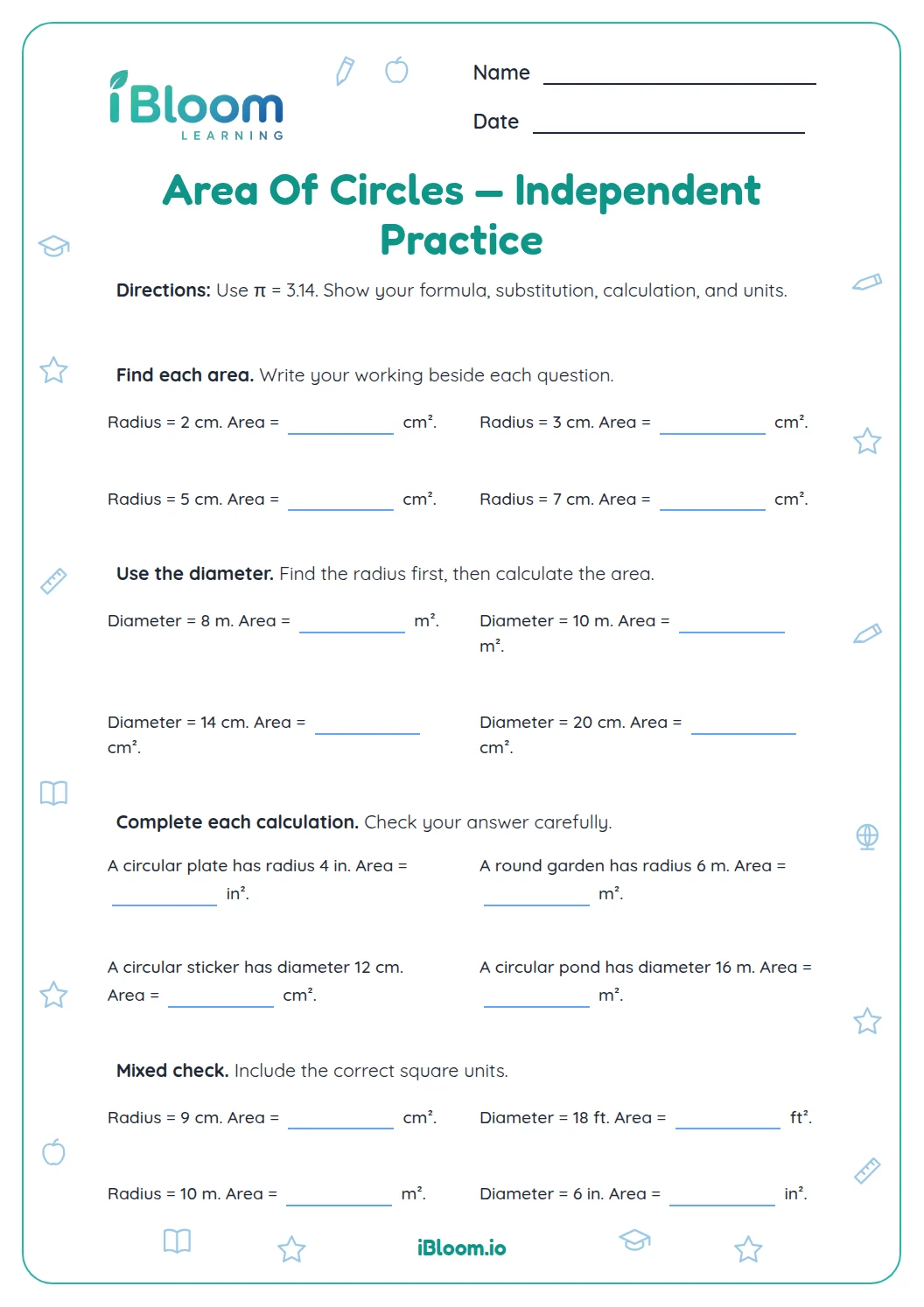
This printable Grade 6 math worksheet practices area of circles using radius and diameter. Students find radius from diameter, calculate area with π = 3.14, and reason about how changing radius affects area. It includes 16 questions: radius, diameter, area calculations, and scaling reasoning and a separate answer key.
How do I work with area of circles using radius and diameter?
Students find radius from diameter, calculate area with π = 3.14, and reason about how changing radius affects area.
Square the radius before multiplying by π.
- 1Diameter is 10 in. Find area.
- 2Radius = 10 ÷ 2 = 5 in.
- 3Area = 3.14 × 5² = 78.5 in².
What practice is included?
16 questions: radius, diameter, area calculations, and scaling reasoning. The questions move from direct practice to applying the same idea.
How to use this worksheet
- 1Identify whether the given measure is radius or diameter.
- 2If given diameter, divide it by 2.
- 3Square the radius.
- 4Multiply by π or 3.14 as directed.
- 5Use square units for area.
Common mistakes and quick fixes
The mistake
Using diameter as the radius.
The fix
Divide the diameter by 2 before using A = πr².
The mistake
Multiplying π by the radius only.
The fix
Square the radius first, then multiply by π.
The mistake
Thinking doubled radius doubles area.
The fix
Squaring a doubled radius makes the area four times as large.
What to practice next
Make more practice
Questions parents and teachers ask
How many questions are on this challenge?
There are 16 questions about radius, diameter, area calculations, and how circle area changes when the radius changes. The worksheet has a separate answer key. Encourage students to record the radius and its square before multiplying, then label the result in square units. Show the radius step and label each area with square units.
What formula does the worksheet use?
Use A = πr². Square the radius, then multiply by π. When a decimal is requested, use 3.14 as the directions specify. Encourage students to record the radius and its square before multiplying, then label the result in square units. Show the radius step and label each area with square units.
How do I use a diameter to find circle area?
The radius is half the diameter. For a 10-inch diameter, the radius is 5 inches; then calculate 3.14 × 5² = 78.5 square inches. Encourage students to record the radius and its square before multiplying, then label the result in square units. Show the radius step and label each area with square units.
What happens to area when radius doubles?
The area becomes four times as large because the radius is squared in the formula. For example, changing a radius from 3 to 6 multiplies area by 2². Encourage students to record the radius and its square before multiplying, then label the result in square units. Show the radius step and label each area with square units.
Why does the answer use square units?
Area measures the space inside a two-dimensional shape, so the unit is squared. A circle measured in centimeters has area in square centimeters. Encourage students to record the radius and its square before multiplying, then label the result in square units. Show the radius step and label each area with square units.
Does the answer key show the calculations?
The key gives the answer for each item, including units where relevant. Students can compare their area calculations and reasoning with those answers. Encourage students to record the radius and its square before multiplying, then label the result in square units. Show the radius step and label each area with square units.