

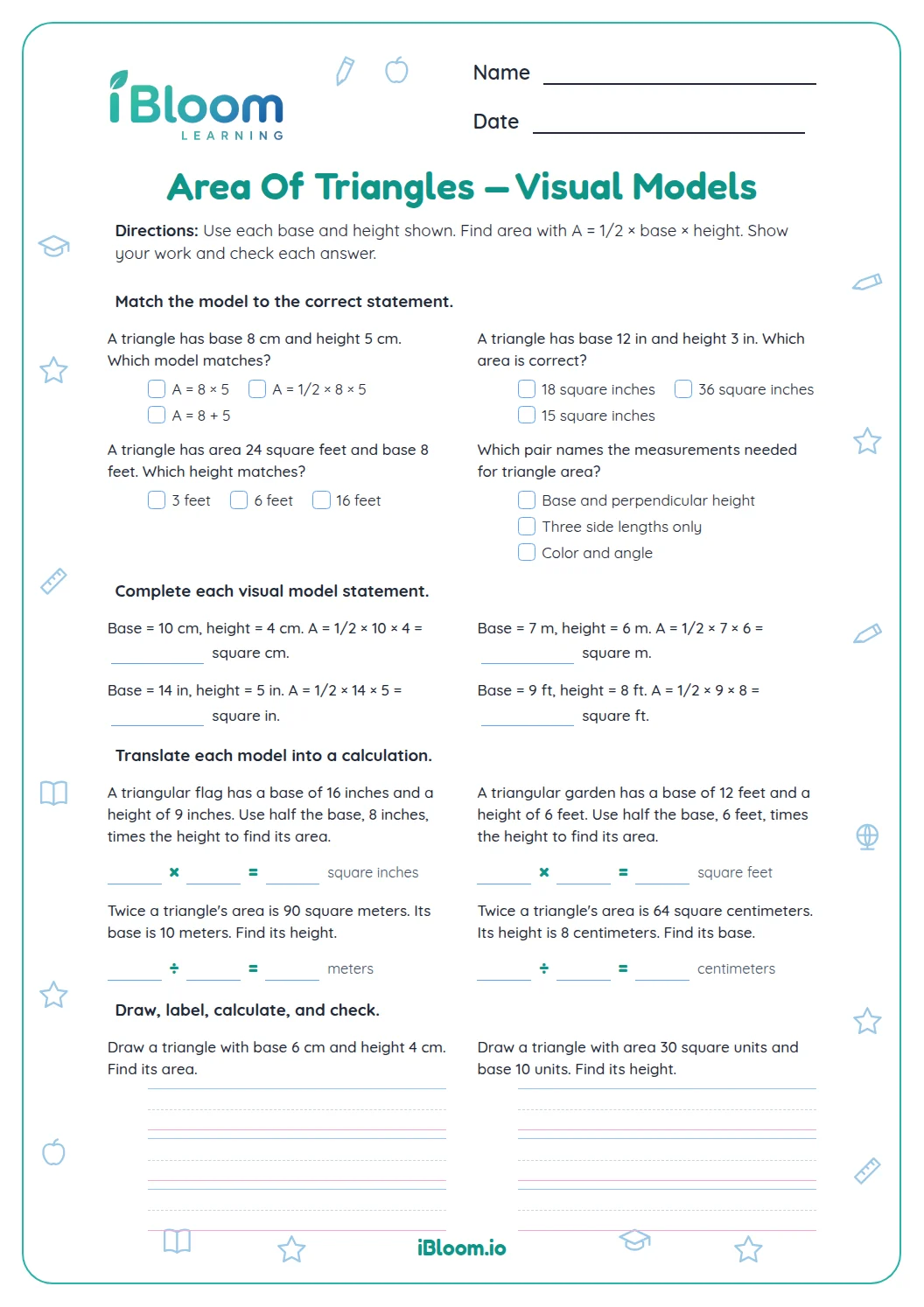
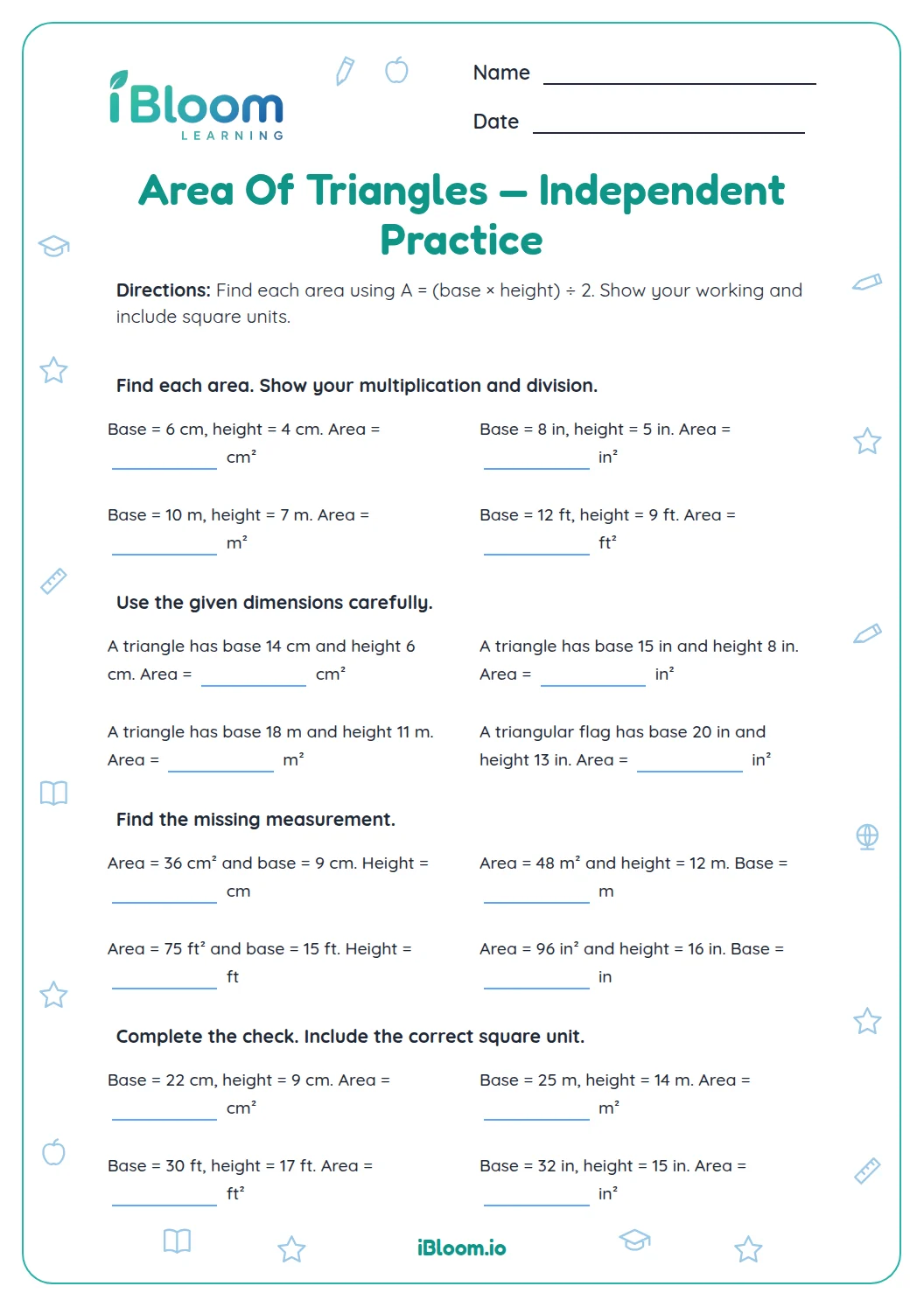
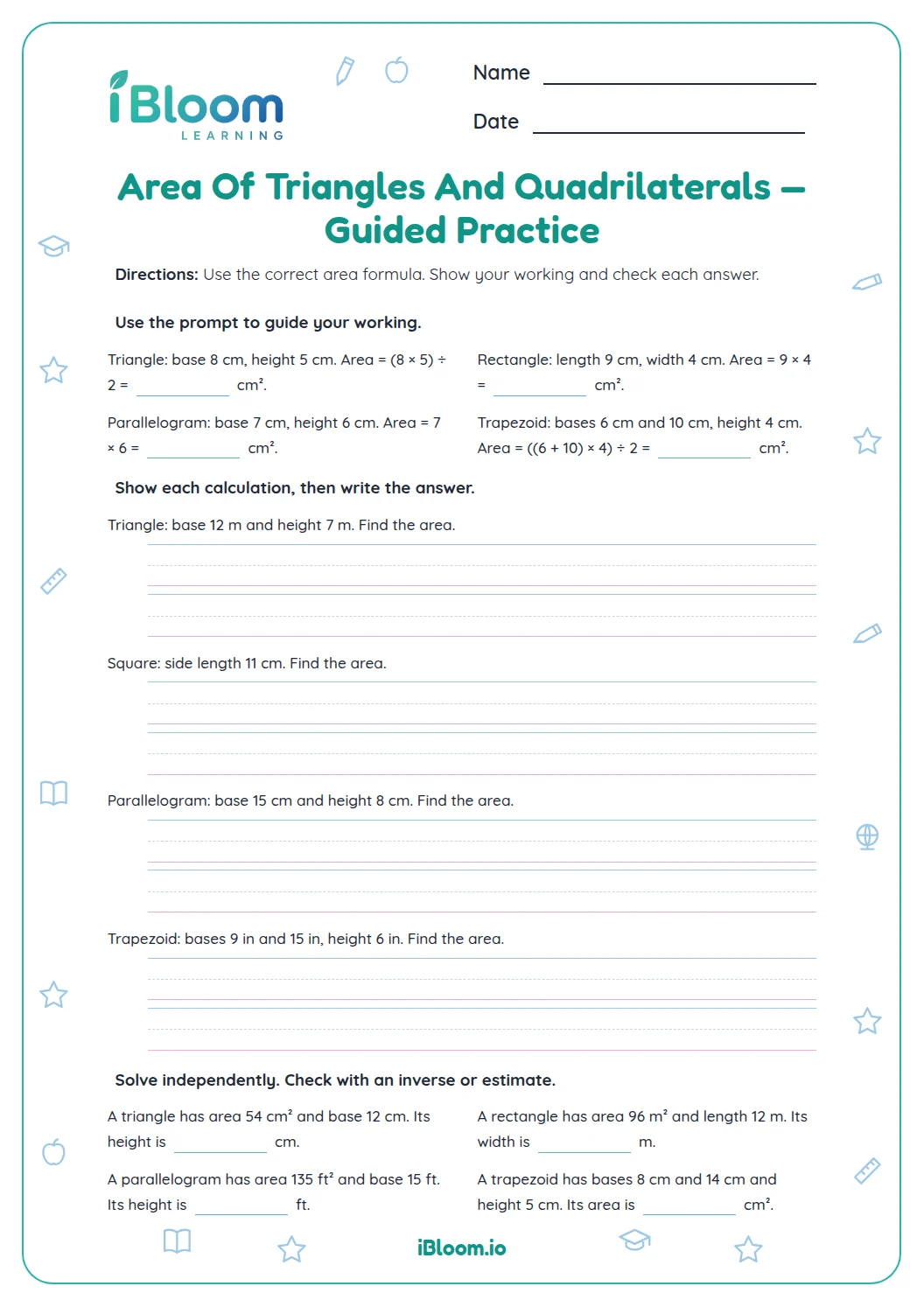
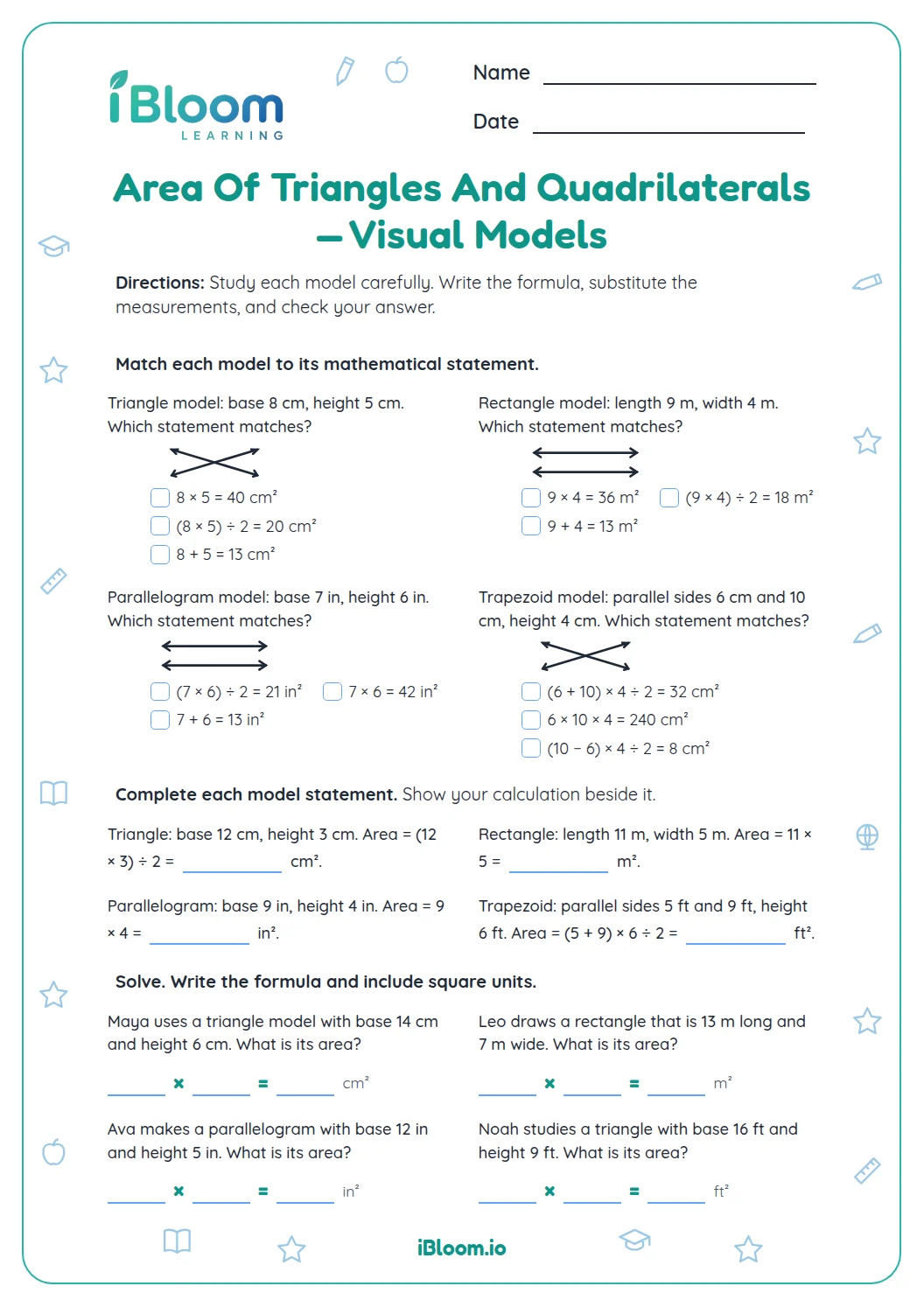
About this worksheet
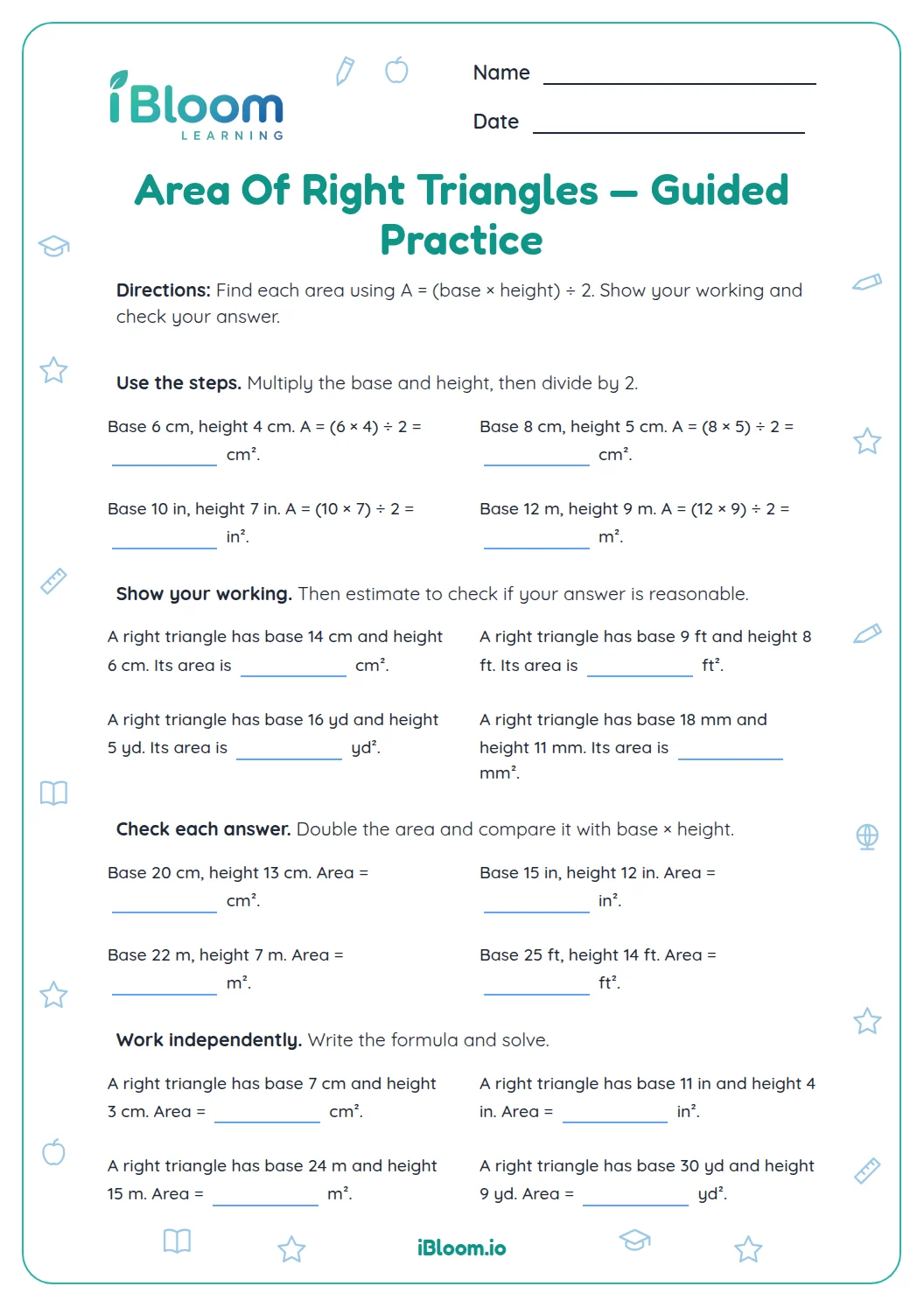
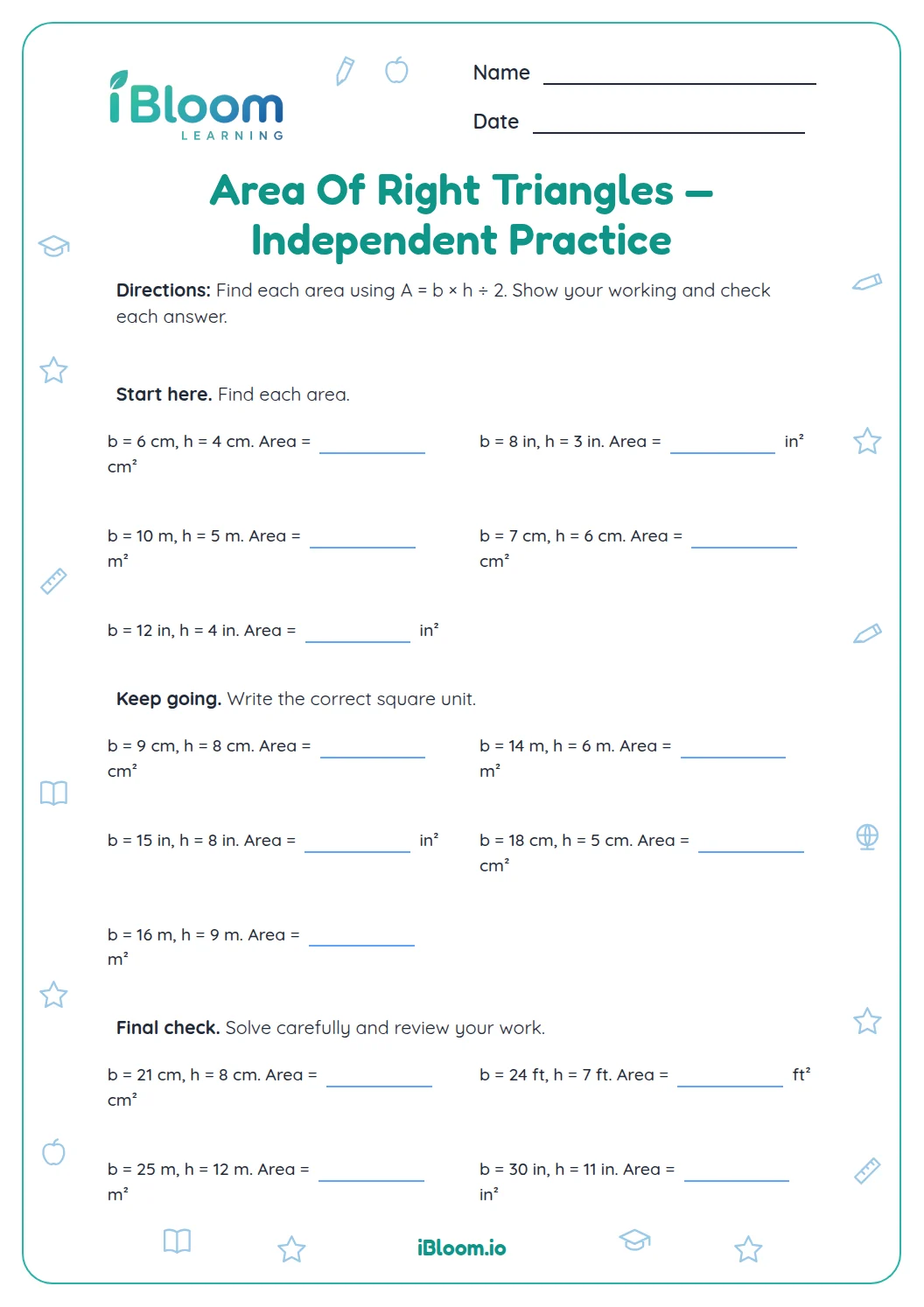
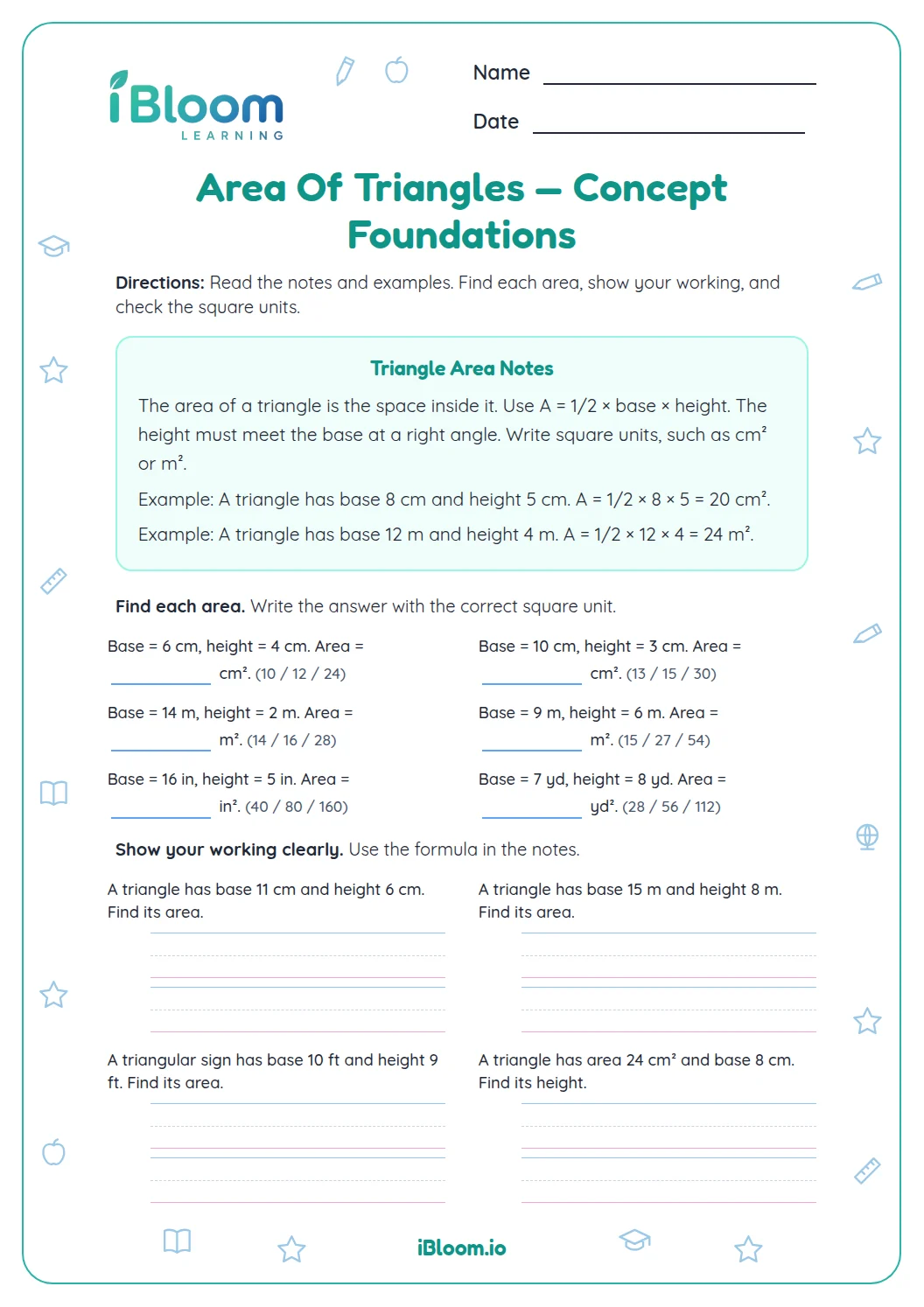
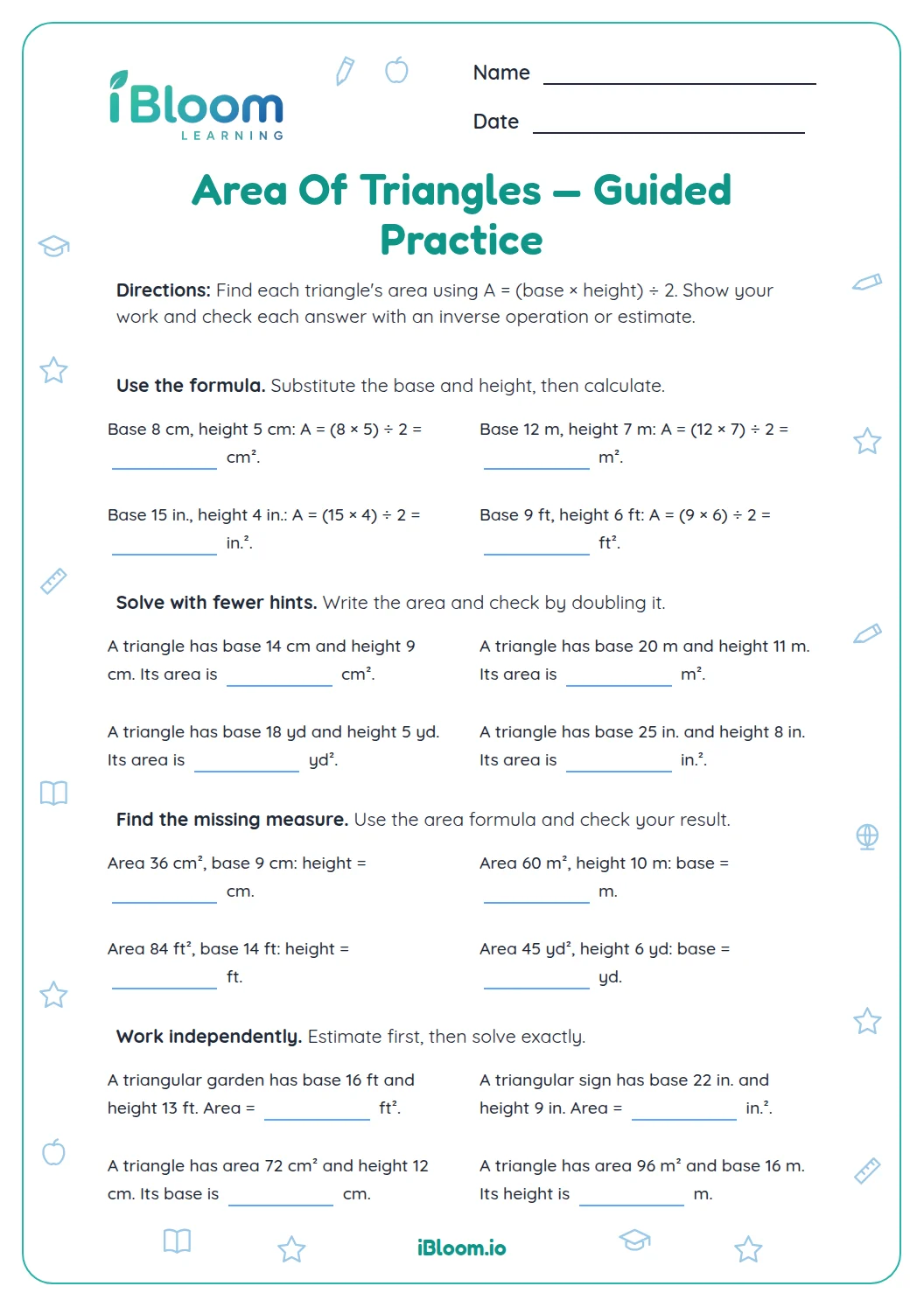
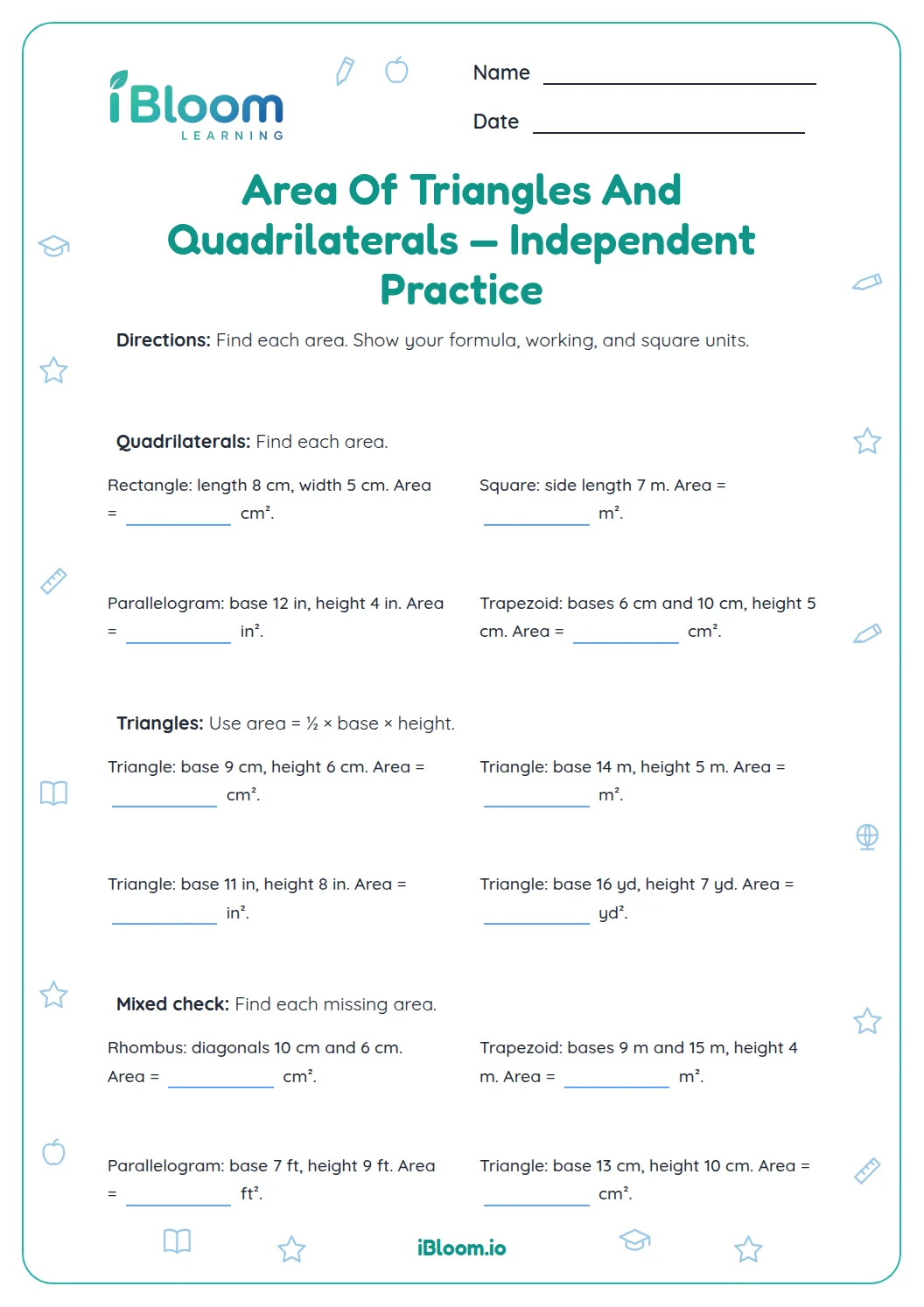
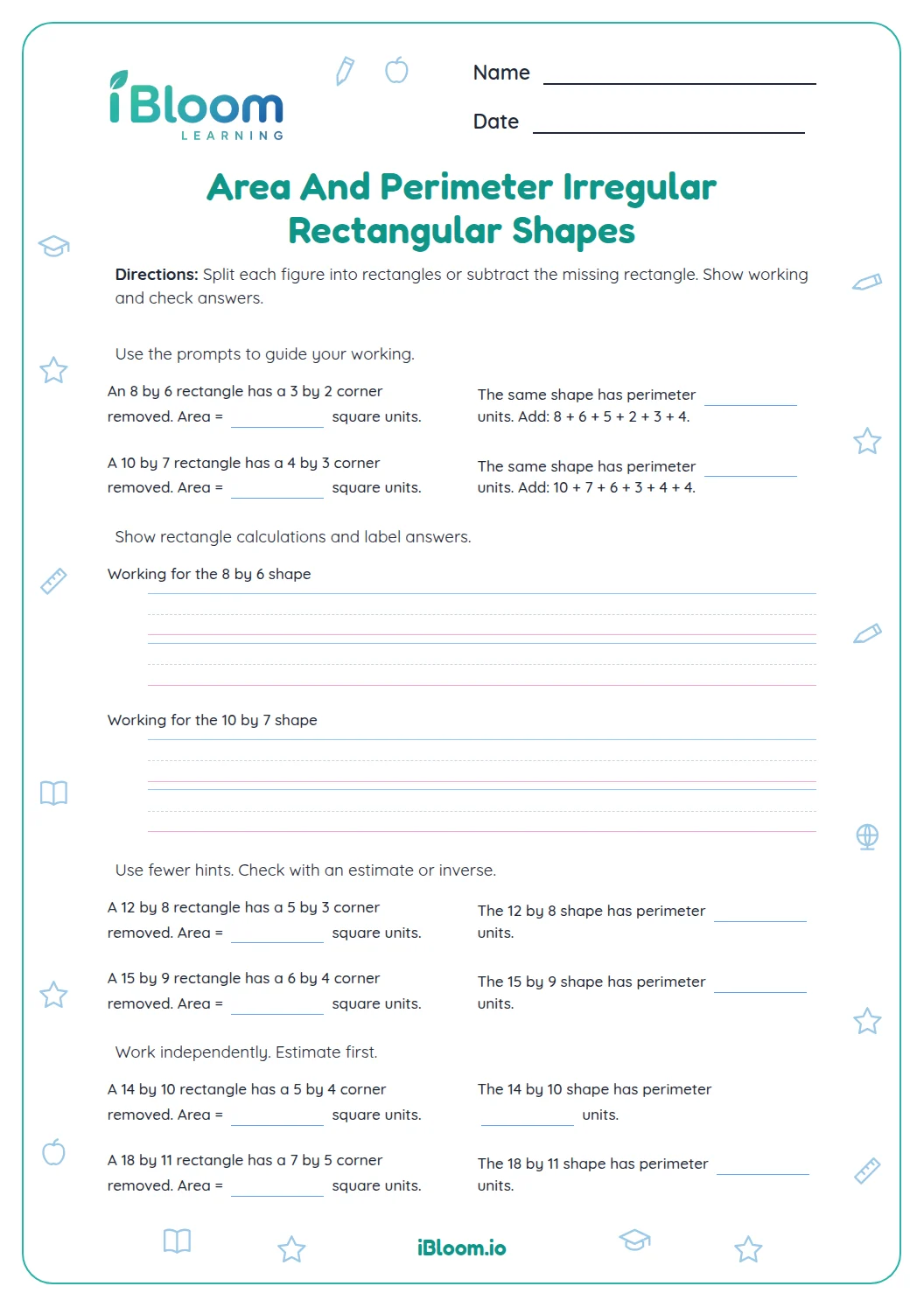
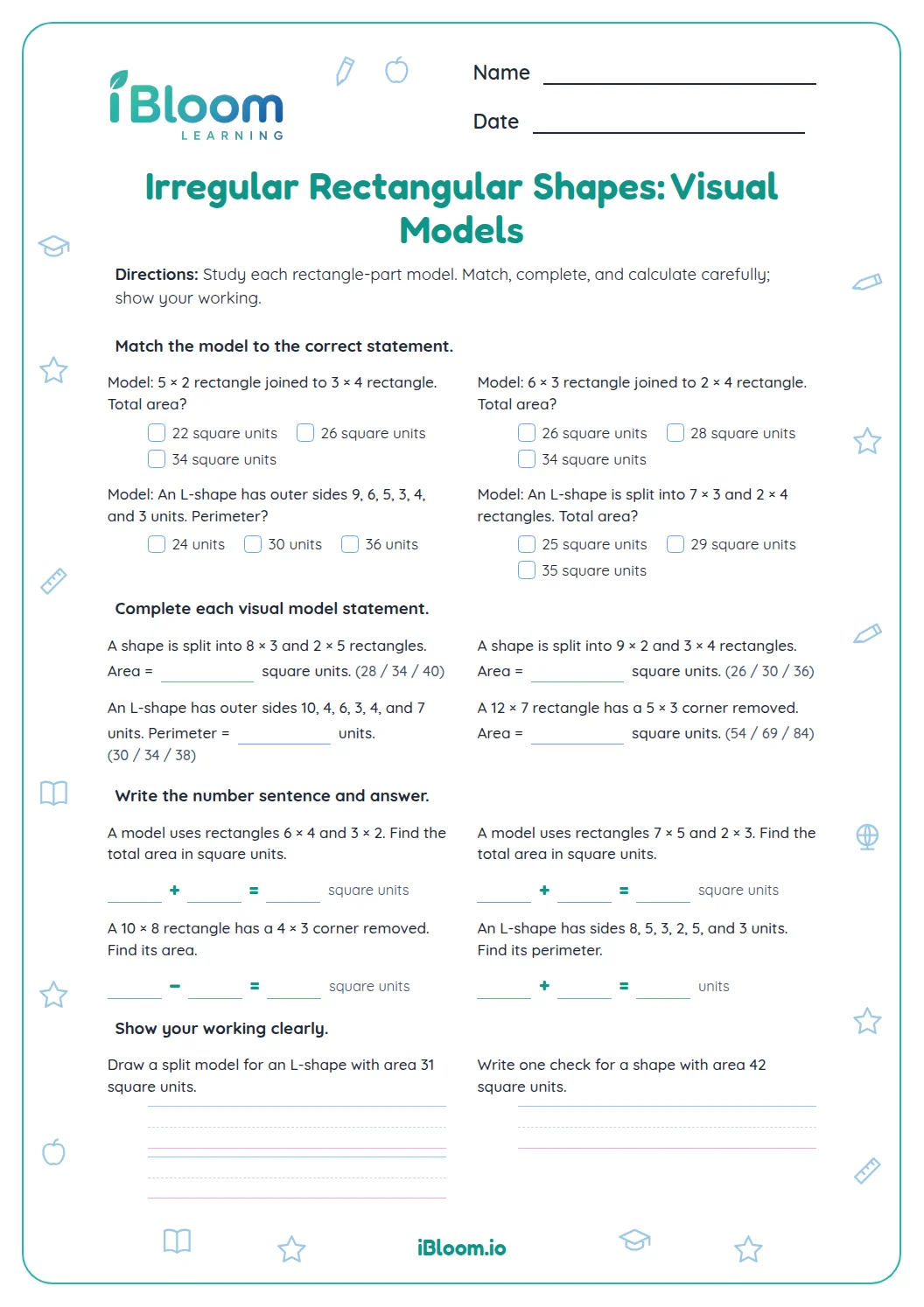
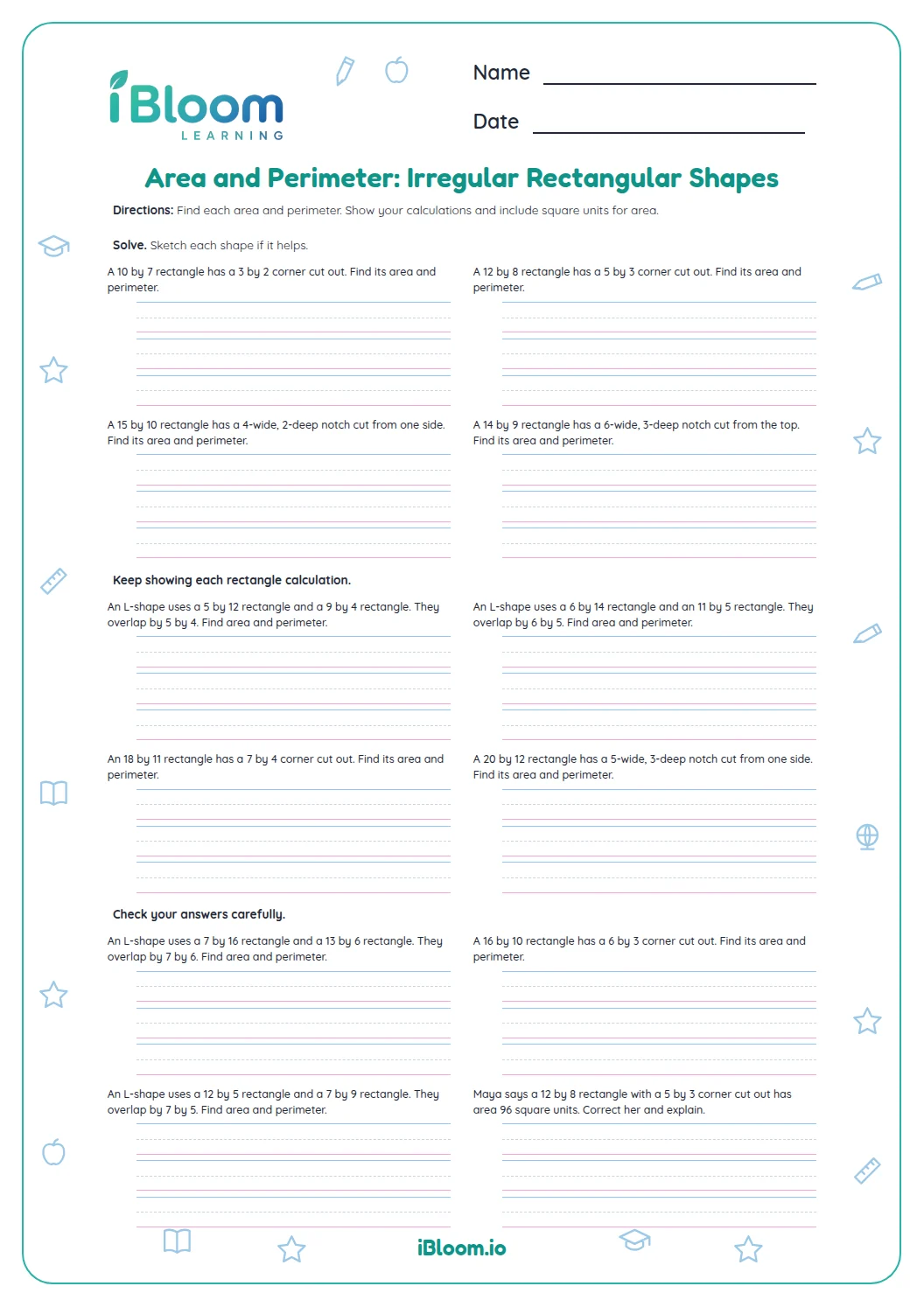
This Grade 6 geometry worksheet gives students 14 opportunities to find the area of a right triangle. The first problems connect a right triangle to a rectangle with the same perpendicular base and height; later items practice the calculation directly. Students multiply base by height, then divide by two, and record area in square units. The two-page worksheet is followed by a two-page answer key. The worked example below uses the worksheet’s 6-by-4 model.
Aligned to 6.G.A.1
Why is a right triangle half of a rectangle?
Two congruent right triangles can fit together to form a rectangle. The rectangle’s side lengths are the triangle’s perpendicular base and height, so its area is base × height. One of the matching triangles has half that area.
For question 1, the matching rectangle is 6 units by 4 units. Its area is 24 square units, and half is 12 square units.
- 1A = (6 × 4) ÷ 2
- 2A = 24 ÷ 2 = 12 square units
Which sides are the base and height?
Use the two sides that meet at the right angle. They are perpendicular, so their lengths can be multiplied to find the matching rectangle’s area. Divide that product by two for the triangle.
The worksheet names each base and height in its prompts. Keep the square-unit label in the answer because area measures a two-dimensional surface, not a side length.
How to use this worksheet
- 1Read the directions at the start of each part.
- 2Try the first question together and explain the clue or strategy.
- 3Complete the remaining questions, showing work where it helps.
- 4Use the answer key to check each response.
- 5Review any missed item by naming the step that changes the answer.
Common mistakes and quick fixes
The mistake
Multiplying base by height and stopping at the rectangle area.
The fix
Divide the product by 2 because the triangle is half of the matching rectangle.
The mistake
Using a slanted side as the height.
The fix
Choose the perpendicular leg that meets the base at the right angle.
The mistake
Writing a linear unit for area.
The fix
Use square units, square inches, or square centimeters.
Common Core alignment
Students find right-triangle areas by relating each triangle to a rectangle and applying the method to mathematical problems.
Find triangle area by decomposing or composing shapes and solve related problems.
On this sheet: The models connect each right triangle to a rectangle with the same base and height.
Show the official wordingHide the official wording
Find the area of right triangles, other triangles, special quadrilaterals, and polygons by composing into rectangles or decomposing into triangles and other shapes; apply these techniques in the context of solving real-world and mathematical problems.
What to practice next
Make more practice
Further reading
Questions parents and teachers ask
What is the area formula for a right triangle?
Multiply the perpendicular base by the perpendicular height, then divide by 2: A = (base × height) ÷ 2. Question 1 uses base 6 and height 4, so its area is (6 × 4) ÷ 2 = 12 square units.
Why do we divide by 2?
Two identical right triangles can be joined along their slanted sides to make a rectangle. The rectangle has the same base and height as one triangle and twice its area. Dividing the rectangle’s base-times-height product by 2 gives the area of one triangle.
Can the slanted side be the height?
The height must be perpendicular to the chosen base. In a right triangle, the two legs meet at a right angle, so those measurements serve as base and height. The slanted side is the hypotenuse and is not the perpendicular height to either leg.
Why are area answers in square units?
Area counts square units that cover a surface. Multiplying two side lengths gives square units, such as square units from 6 units × 4 units. The answer key includes “square units” with the modeled problems so the result is labeled as area.
How many problems use a visual model?
The first two problems use right-triangle drawings and name a matching rectangle’s dimensions in the prompt. The remaining 12 give a base and height for calculation. All 14 use the same relationship: halve the area of the rectangle made from those perpendicular side lengths.
How many pages are included?
The worksheet has 14 questions across two pages. Its answer key is another two pages. Students can use the first model to connect the rectangle’s area to half of that area, then apply the formula to the later base-and-height calculations.