
About this worksheet
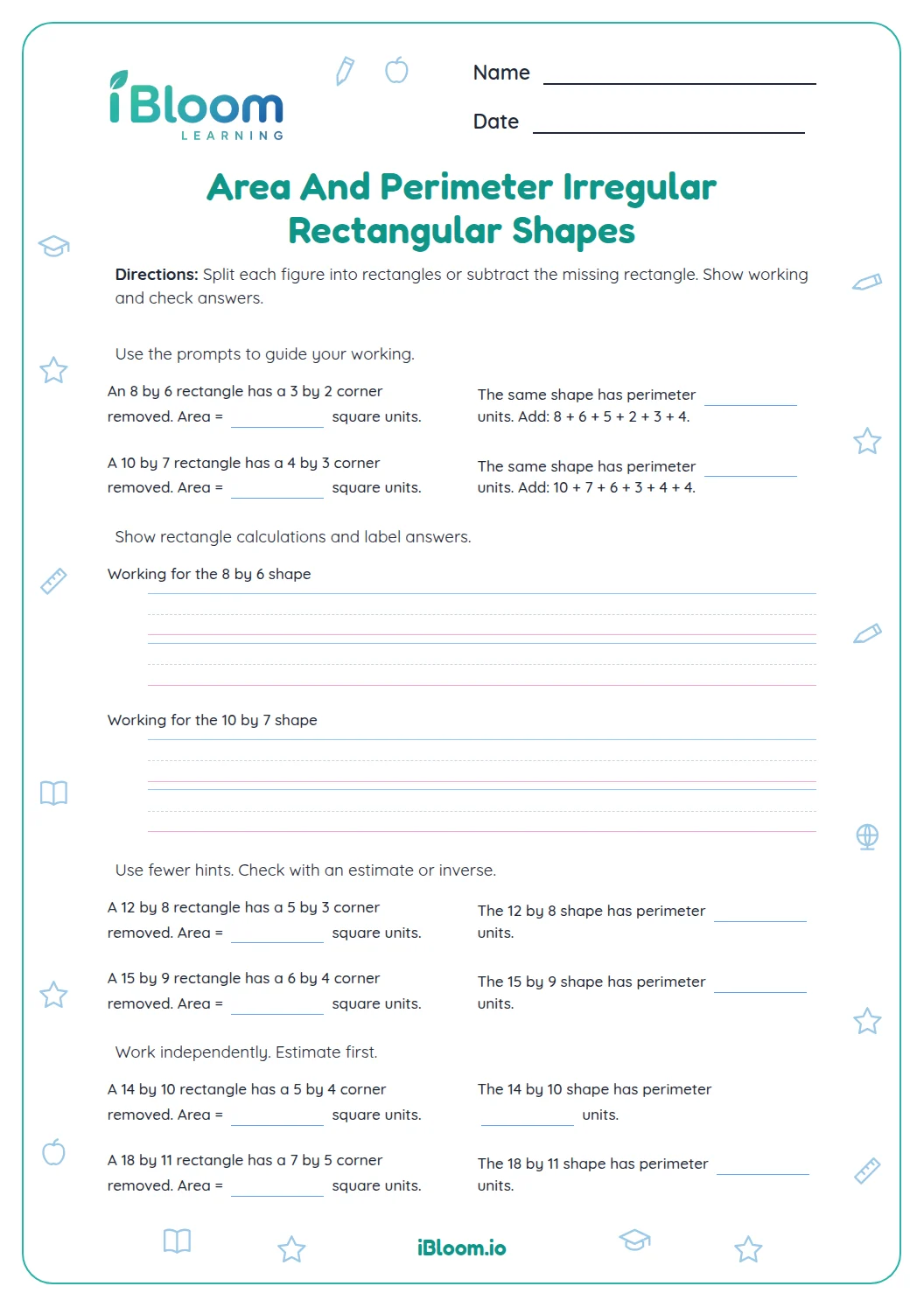
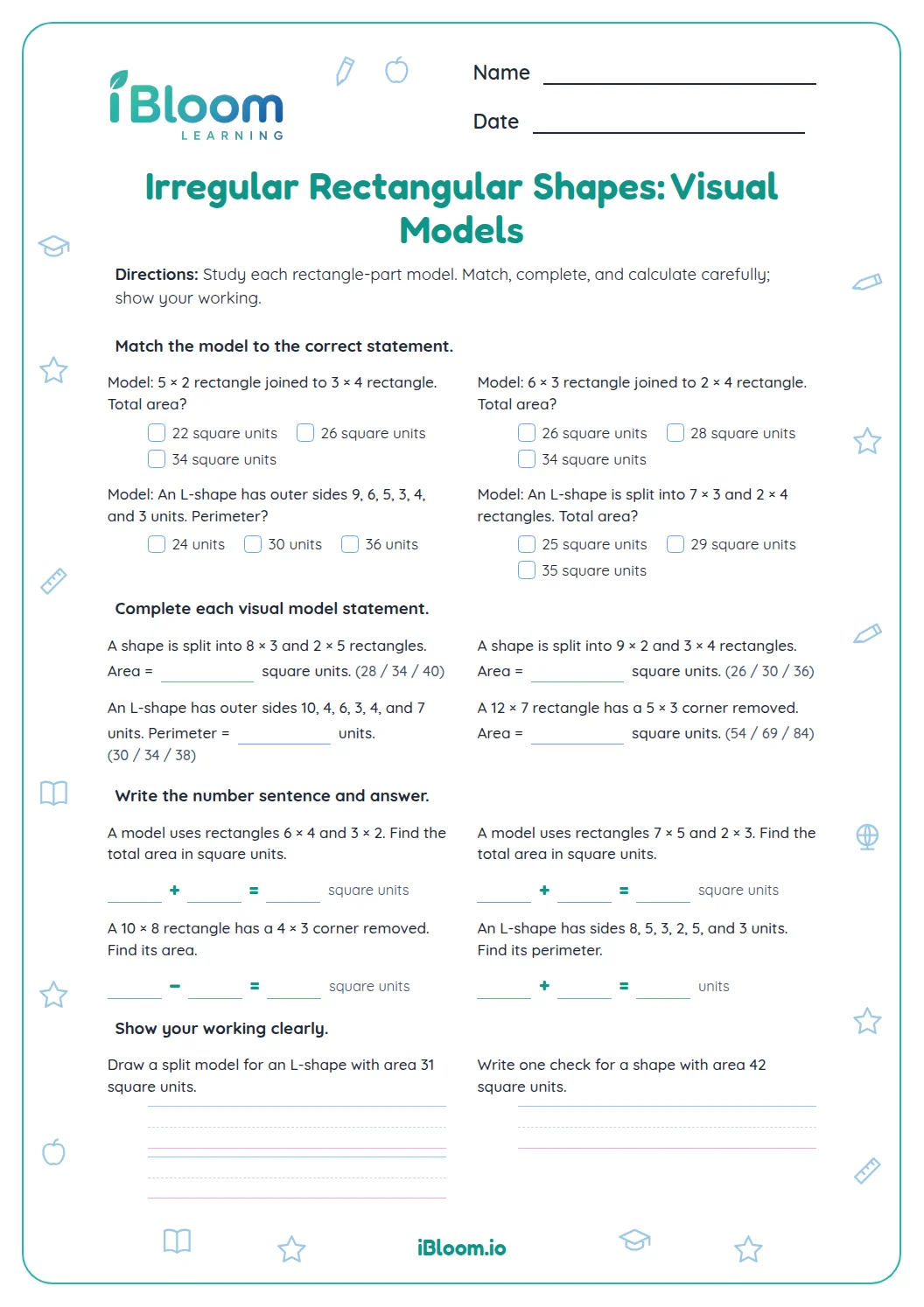
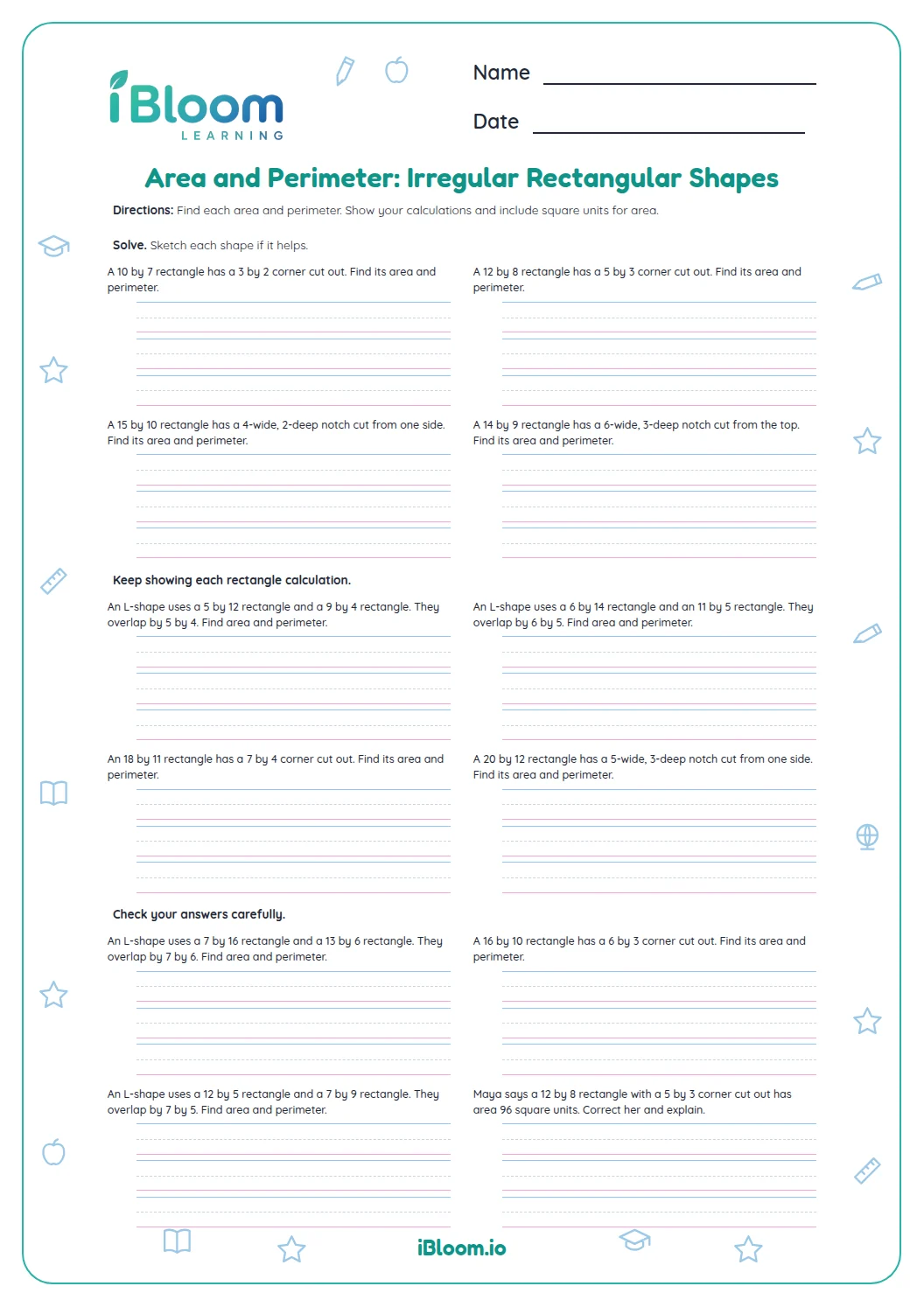
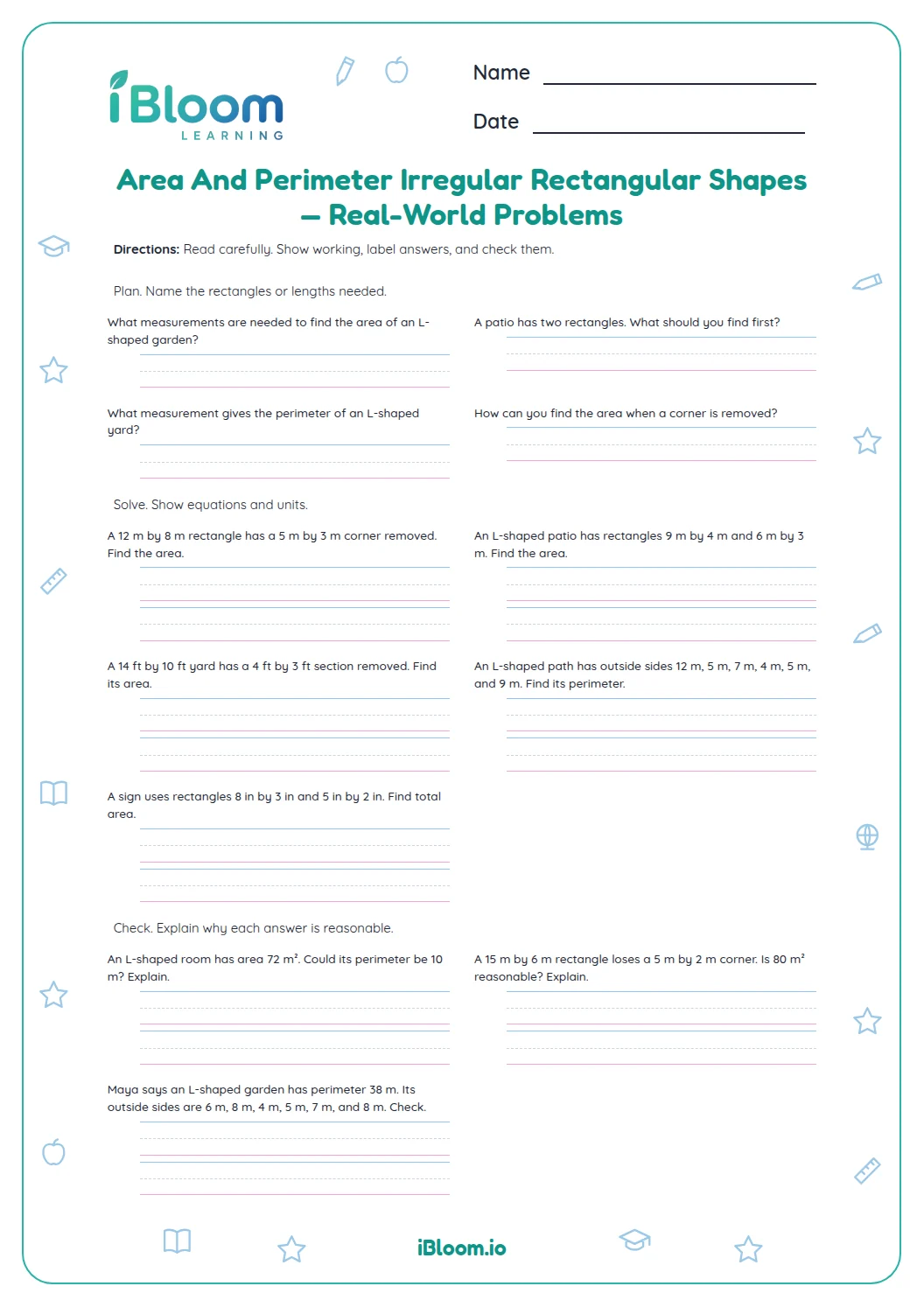
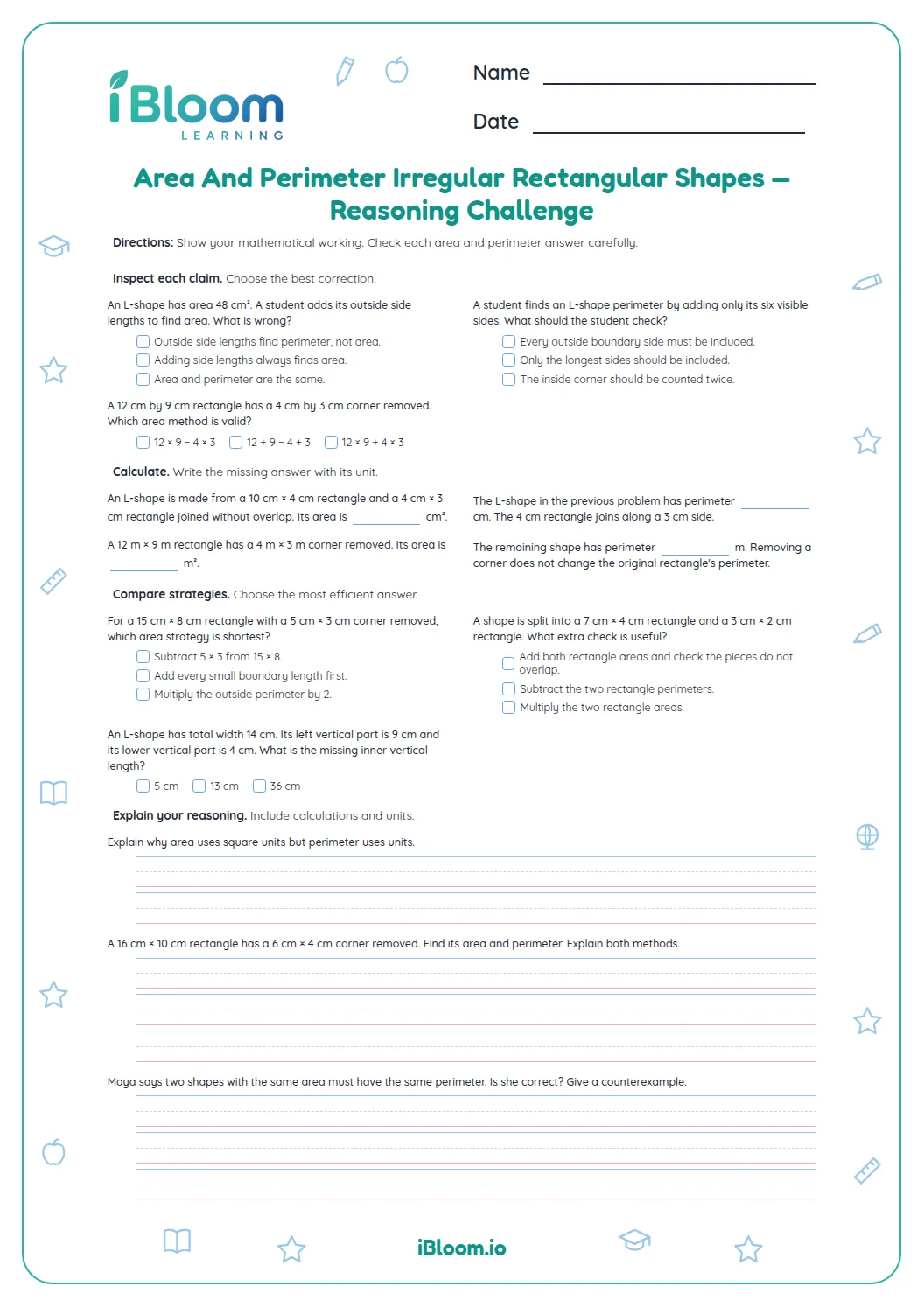
This Grade 6 geometry worksheet uses shaded unit grids and short calculations to build area and perimeter reasoning for irregular rectangular shapes. Students count square units inside shapes, trace exposed edges, and apply the same ideas to rectangle situations. Fourteen items include a separate answer key.
Aligned to 6.G.A.1 and 3.MD.D.8
How can a grid show area?
Each shaded cell is one square unit. Count each shaded cell once, including cells along the boundary. For an L-shape, count row by row or split the shape into rectangles.
- 1Top two rows: 4 + 4 = 8 squares
- 2Bottom two rows: 2 + 2 = 4 squares
- 3Area: 12 square units
Which edges count toward perimeter?
Perimeter follows the outside boundary. Shared edges between neighboring shaded squares are inside the shape, so they do not count. Count the exposed unit edges once each.
How can you handle a shape with a missing corner?
The final eight questions apply the same measurements to rectangles and short situations. Area answers use square units; perimeter answers use units.
- Part A: count shaded cells for area
- Part B: count outside edges for perimeter
- Part C: apply area and perimeter to short situations
How can an adult guide the practice?
- 1Count shaded cells to find area, and write square units.
- 2For perimeter, trace the outside edge and count each exposed unit segment.
- 3Split an L shape into rectangles when that makes counting easier.
- 4Check the label: area uses square units; perimeter uses units.
Common slips and helpful fixes
The mistake
Counting shared inside edges as part of the perimeter.
The fix
Only count edges along the outside boundary.
The mistake
Writing units instead of square units for area.
The fix
Area counts square cells, so label it in square units.
The mistake
Missing a row or arm of an L shape.
The fix
Count one row at a time or split the shape into rectangles.
Common Core alignment
Students use unit grids to find polygon area and solve perimeter problems.
Use decomposition and unit squares to find polygon area.
On this sheet: Use decomposition and unit squares to find polygon area.
Show the official wordingHide the official wording
Find the area of right triangles, other triangles, special quadrilaterals, and polygons by composing into rectangles or decomposing into triangles and other shapes; apply these techniques in the context of solving real-world and mathematical problems.
Solve polygon perimeter problems by adding side lengths and identifying outside edges.
On this sheet: Count exposed grid edges and add rectangle side lengths to find perimeter.
Show the official wordingHide the official wording
Solve real world and mathematical problems involving perimeters of polygons, including finding the perimeter given the side lengths, finding an unknown side length, and exhibiting rectangles with the same perimeter and different areas or with the same area and different perimeters.
What to practice next
Make more practice
Further reading
Questions parents and teachers ask
What is the difference between area and perimeter?
Area measures the surface inside a shape and is counted in square units on these grids. Perimeter measures the distance around the outside and is counted in units. The worksheet has separate parts to practice both measurements. The grid lets students check either method by counting the shaded cells.
How do I count area in an L shape?
Count all shaded unit squares, row by row, or split the L into two rectangles and add their areas. Question 1 can be counted as eight squares in the top rows and four more below, for 12 square units.
How do I find the perimeter of a grid shape?
Trace the outside boundary and count each exposed unit edge once. Do not count edges between two shaded squares, because those edges are inside the shape and are not part of its perimeter. The shared interior edges should not be counted.
Why does area use square units?
Each grid cell is a unit square, so counting cells measures how many square units cover the shape. Perimeter counts lengths along the boundary, so its unit is a regular length unit instead. Area answers use square units, and perimeter answers use units.
How many practice items are included?
There are 14 questions: eight grid problems and six short applications. The grids include four area questions and four perimeter questions. A separate answer key lists the measurement and units for each numeric answer, making it easier to check the method and result.
Does the key show both area and perimeter?
Yes. It lists the appropriate measurement and unit for each question. For items asking for both measures, area is listed in square units and perimeter in units, in the order stated by the prompt. Look at the prompt to see whether area, perimeter, or both are requested.