


About this worksheet
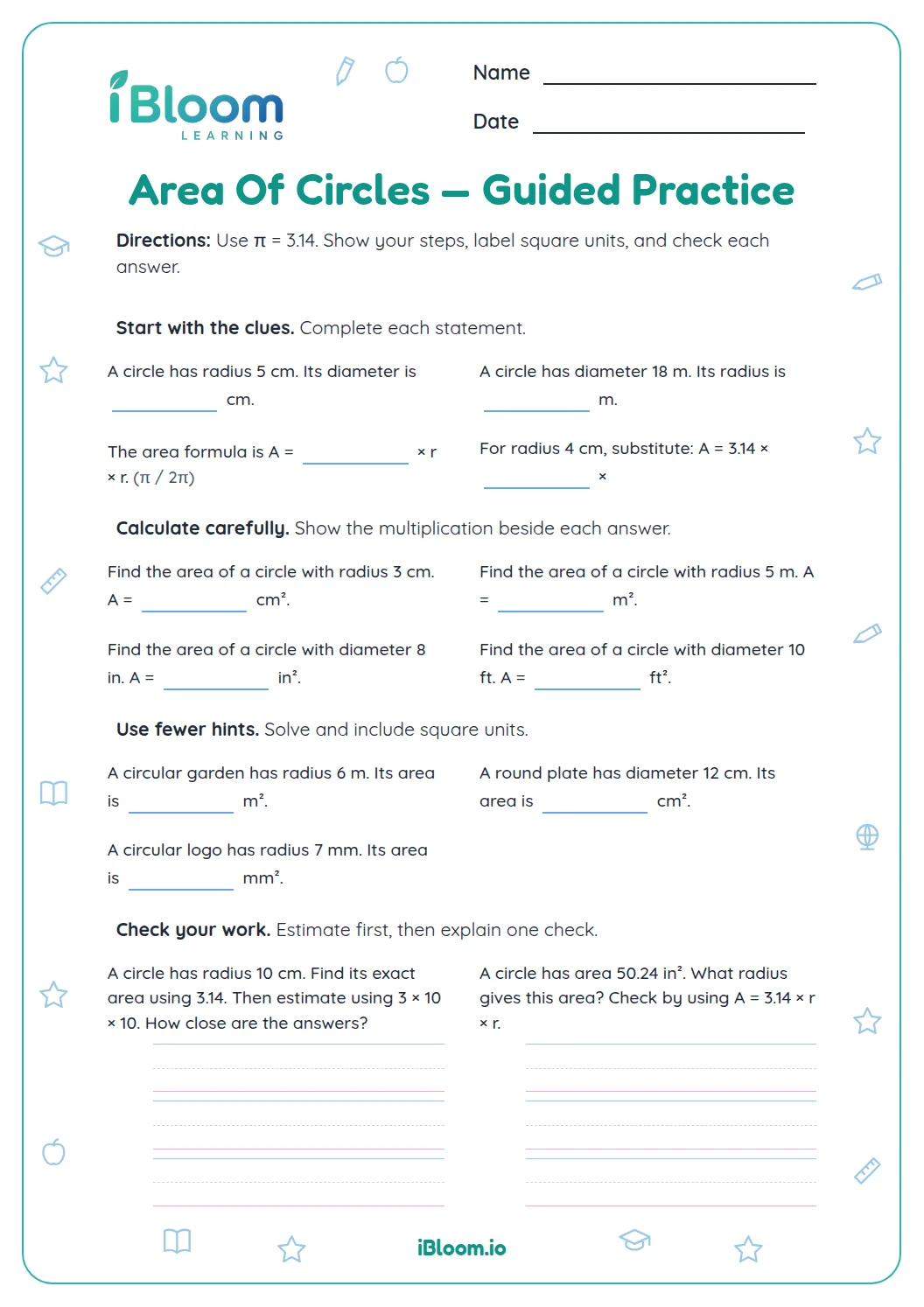
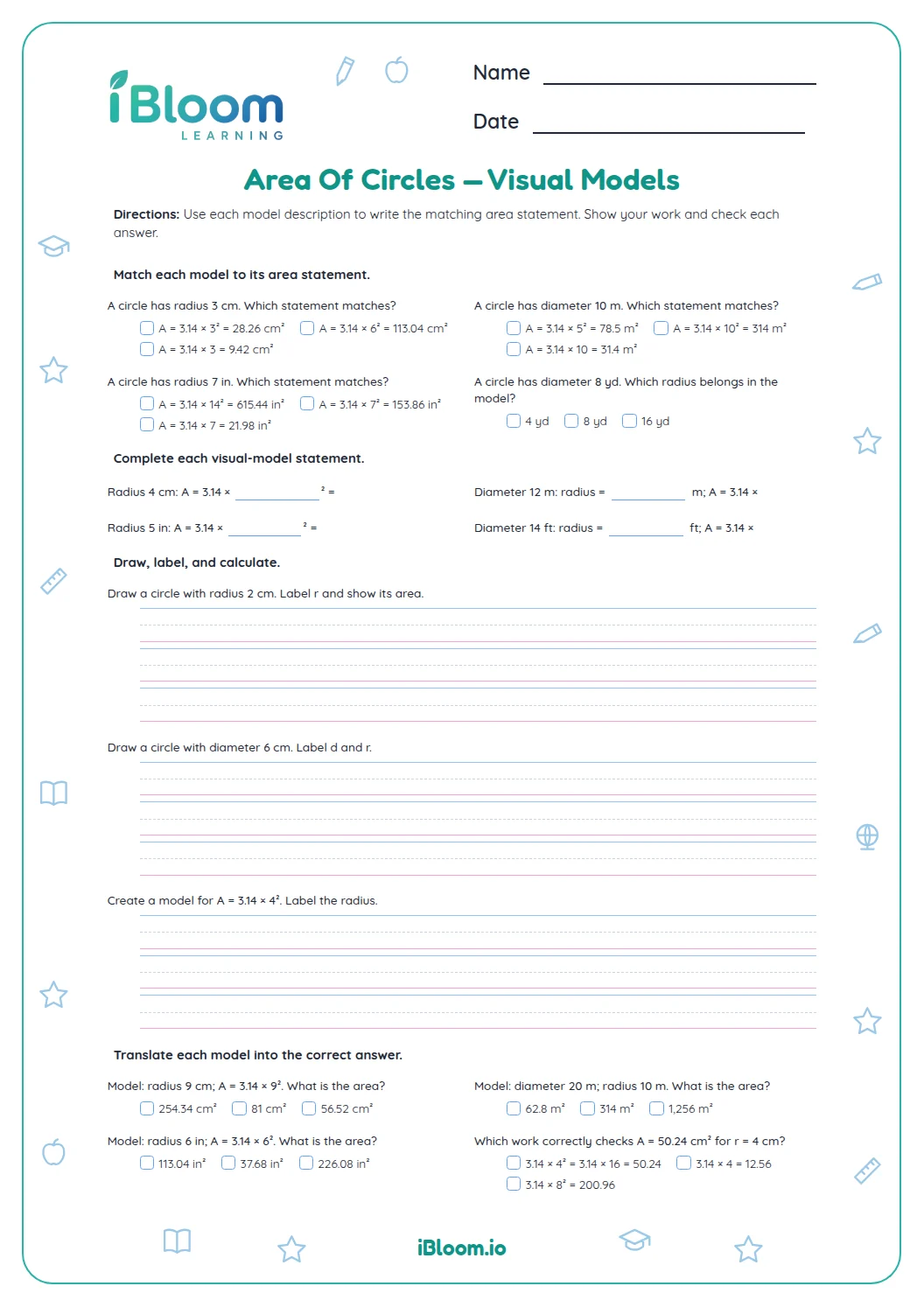
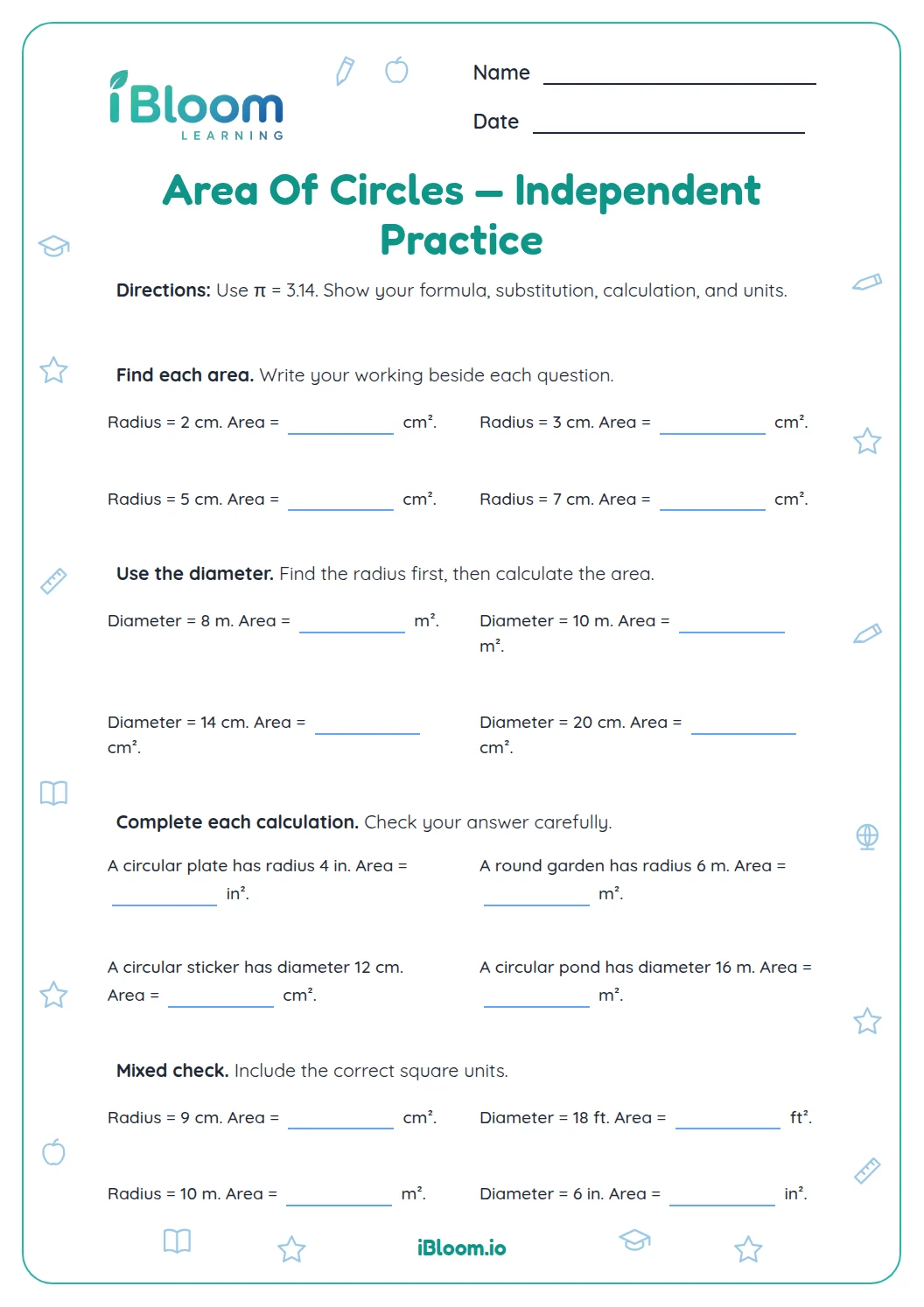
This free printable worksheet gives Grade 6 students 12 real-world problems about the area inside a circle. Part A supplies a radius, Part B supplies a diameter, and Part C asks students to combine areas, compare sizes, or find a covering cost. Students use A = 3.14 × r × r throughout and label answers in square units. The circle-area work practices Common Core 7.G.B.4. A separate answer key gives the final answers; students show their calculations in Part C so an adult can check both the chosen radius and the multiplication.
Aligned to 7.G.B.4
What does circle area measure?
Area tells how much flat space a circle covers. A rug covers floor space, and a pond has a circular water surface. The answer uses square units, such as ft² or m², because it describes a surface.
The worksheet uses 3.14 for pi so every student works with the same approximation. Keep the result of that calculation; no additional rounding is needed.
How do students use a diameter?
A diameter crosses the circle through its center. Its length is twice the radius, so divide it by 2 before using the area formula. Question 5 puts this decision into a lid problem.
- 1Diameter = 10 in; radius = 10 ÷ 2 = 5 in
- 2Area = 3.14 × 5 × 5 = 78.5 in²
How do the final four problems change the task?
Part C keeps the same area formula but adds a decision after the calculation. Students add two equal placemat areas, subtract the areas of two rugs, multiply a garden area by a price, and subtract a mat area from a stage area.
For the stage, the mat lies fully inside its boundary. Subtracting the mat area leaves exactly the uncovered surface. Encourage students to name what their final number measures before selecting a unit.
How to use this worksheet
- 1Read the formula and identify what r stands for.
- 2Complete the four radius problems and write each missing area.
- 3For each diameter problem, write diameter ÷ 2 before using the formula.
- 4In Part C, underline the question asking for a total, difference, cost, or uncovered area.
- 5Check the final answers with the key and inspect the radius calculation whenever an answer differs.
Mistakes to check together
The mistake
Using 10 as the radius of the 10-inch lid.
The fix
Write r = 10 ÷ 2 = 5 before calculating its area.
The mistake
Calculating 3.14 × r × 2.
The fix
The formula needs r × r. For radius 3, use 3 × 3 = 9.
The mistake
Writing $78.50 for the mulch cost.
The fix
That number is the garden area. Multiply 78.5 m² by $2 per square meter to get $157.
Curriculum alignment
Use the circle area formula to solve problems about circular surfaces.
On this sheet: Students calculate circle areas from radii and diameters and apply them to covering and cost problems.
Show the official wordingHide the official wording
Know the formulas for the area and circumference of a circle and use them to solve problems; give an informal derivation of the relationship between the circumference and area of a circle.
What to practice next
Make more practice
Further reading
Questions parents and teachers ask
Should students use 3.14 or a calculator’s pi key?
Use 3.14 for every question on this sheet. That instruction keeps the calculations consistent with the answer key, including the 78.5-square-inch lid. A calculator may help check multiplication after students write their setup, but its pi key gives a different approximation and therefore different decimals.
Why does the lid problem start with division?
The lid’s 10-inch measurement is its diameter, so students divide by 2 to find a 5-inch radius. The formula uses the radius twice. Writing 3.14 × 5 × 5 then gives 78.5 square inches, which measures the surface inside the lid’s circular edge.
How much working should students show?
Students should record the radius, the area calculation, and any final operation the situation needs. For the mulch problem, that means 10 ÷ 2 = 5, then 3.14 × 5 × 5 = 78.5, then 78.5 × 2 = 157. The answer is $157 because the last step finds cost.
Does the uncovered stage problem require a special formula?
No, students can subtract one circle area from the other. The stage area is 78.5 square feet and the mat area is 28.26 square feet. Because the mat lies fully on the stage, subtracting gives 50.24 square feet of uncovered surface. Both areas must use the same unit.
What does the answer key show?
The separate answer key gives a final answer for all 12 problems, with printed square units beside the missing areas and dollars for the mulch cost. Use the student’s working to check the reasoning behind those answers. A wrong diameter choice can be corrected before repeating the multiplication.