


About this worksheet
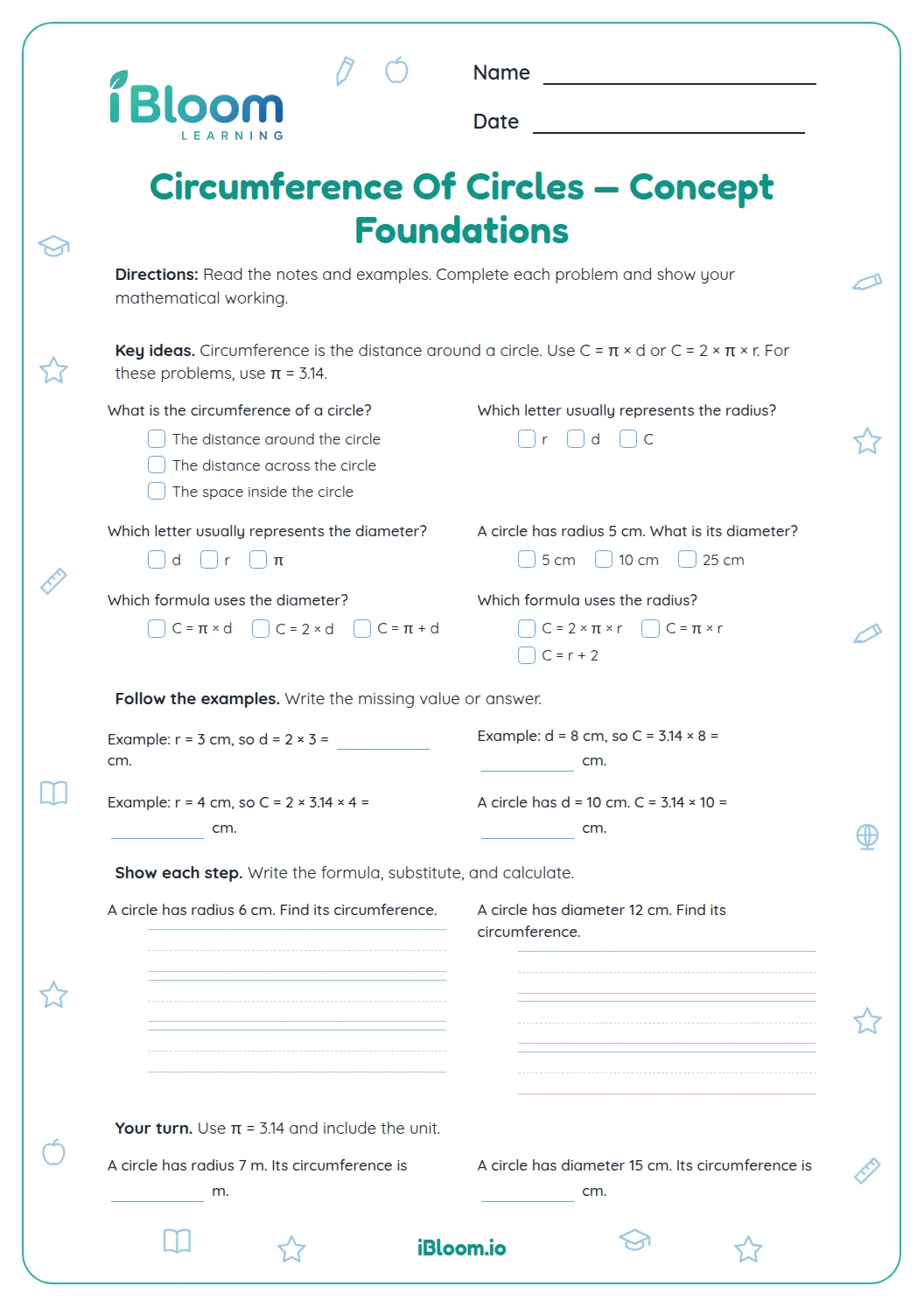
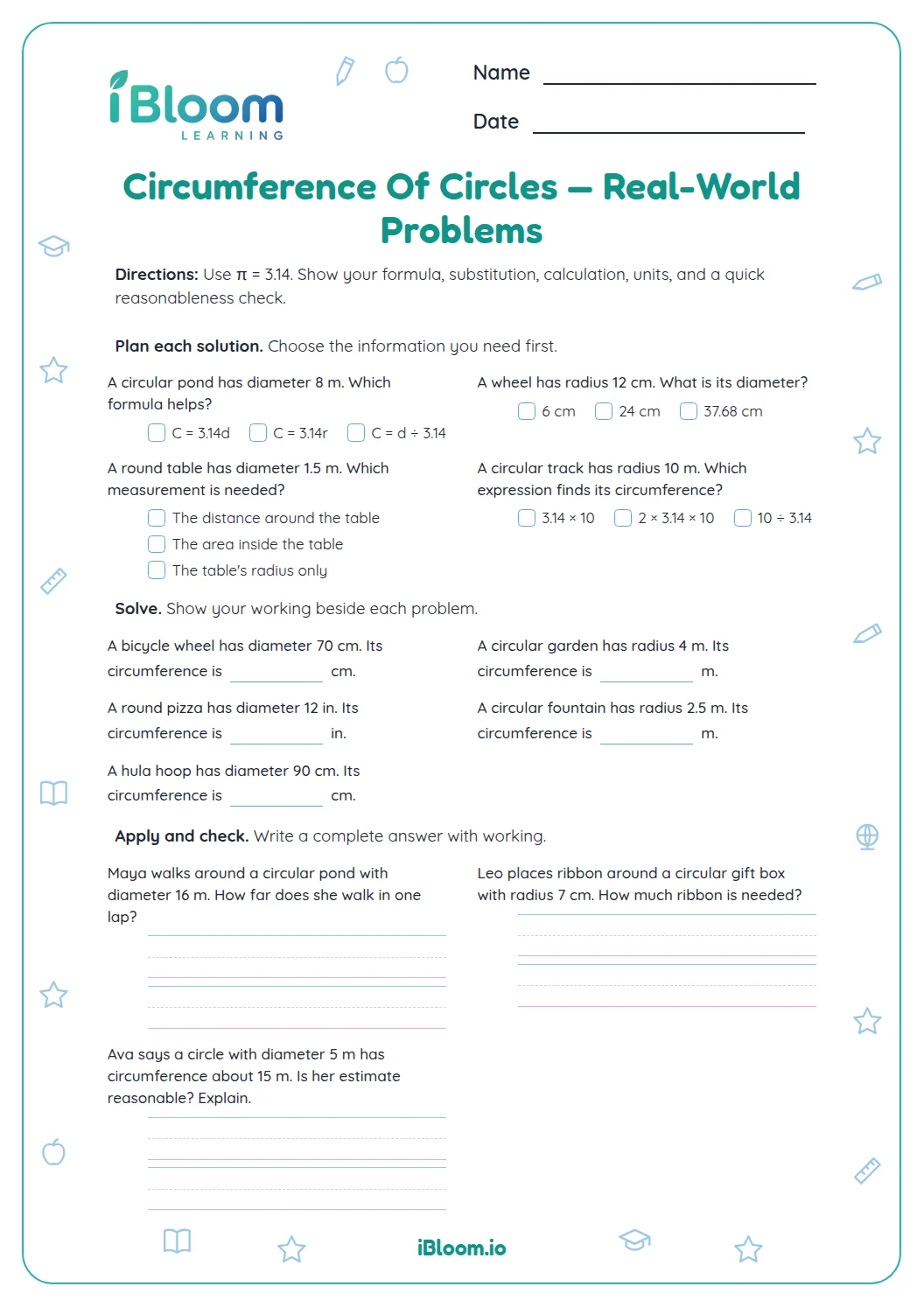
This Grade 6 independent-practice sheet asks students to calculate circumference from a circle’s diameter or radius, using π = 3.14. Four questions use diameters, four use radii, and seven mix the two forms in measurement contexts. Each response includes a working space and a unit. The answer key gives the calculated circumference for all 15 problems.
Aligned to 7.G.B.4
How is circumference found from diameter?
Part A provides four diameter values. Multiply each diameter by 3.14, then write the circumference using the measurement’s unit.
- 1A circle has a diameter of 4 cm. Find its circumference.
- 2C = πd = 3.14 × 4 = 12.56 cm.
How is circumference found from radius?
Part B gives four radii. Since the diameter is twice the radius, use C = 2 × 3.14 × r.
How can students choose the formula in mixed problems?
Part C alternates radius and diameter contexts. Read which measure is supplied, select the matching formula, and include the stated unit in the answer.
How to use this worksheet
- 1Read the problem and mark whether it gives radius or diameter.
- 2Choose C = πd for diameter or C = 2πr for radius.
- 3Substitute the given value and use π = 3.14.
- 4Multiply carefully and show the calculation in the work space.
- 5Write the answer with the unit from the question.
- 6Check that the result is about three times the diameter.
Common mistakes and quick fixes
The mistake
Using the radius formula with a diameter.
The fix
Identify the given measure before choosing a formula.
The mistake
Using a radius as though it were a diameter.
The fix
For a radius, multiply by 2π or double it first to find the diameter.
The mistake
Leaving off or changing the unit.
The fix
Copy the unit from the question into the final circumference.
Use a circle formula to calculate circumference from a radius or diameter.
On this sheet:
Show the official wordingHide the official wording
Know the formulas for the area and circumference of a circle and use them to solve problems; give an informal derivation of the relationship between the circumference and area of a circle.
What to practice next
Further reading
Questions parents and teachers ask
What formulas does this practice use?
Use C = πd when the problem gives a diameter and C = 2πr when it gives a radius. The worksheet sets π equal to 3.14, so students can focus on selecting the formula, substituting the measure, and calculating. Writing the formula first makes it easier to check the chosen measure and unit.
Are both radius and diameter included?
Yes. The first four problems give diameters, the next four give radii, and the final seven mix the two forms. This lets students practice recognizing which measure the problem provides before calculating. Writing the formula first makes it easier to check the chosen measure and unit.
Should students include units in their answers?
Yes. Circumference is a length, so the answer should use the unit named in the problem, such as centimeters, meters, inches, yards, feet, or millimeters. The answer key includes the matching units. Writing the formula first makes it easier to check the chosen measure and unit.
Why does a radius problem use 2πr?
A circle’s diameter is twice its radius. Since circumference can be found with π times the diameter, substituting 2r for the diameter gives the equivalent formula C = 2πr. Writing the formula first makes it easier to check the chosen measure and unit.
How long should this worksheet take?
Plan for about 25 minutes to complete 15 calculations and show work. Students who need more practice choosing between radius and diameter can pause to mark the given measure before each calculation. Writing the formula first makes it easier to check the chosen measure and unit.