


About this worksheet
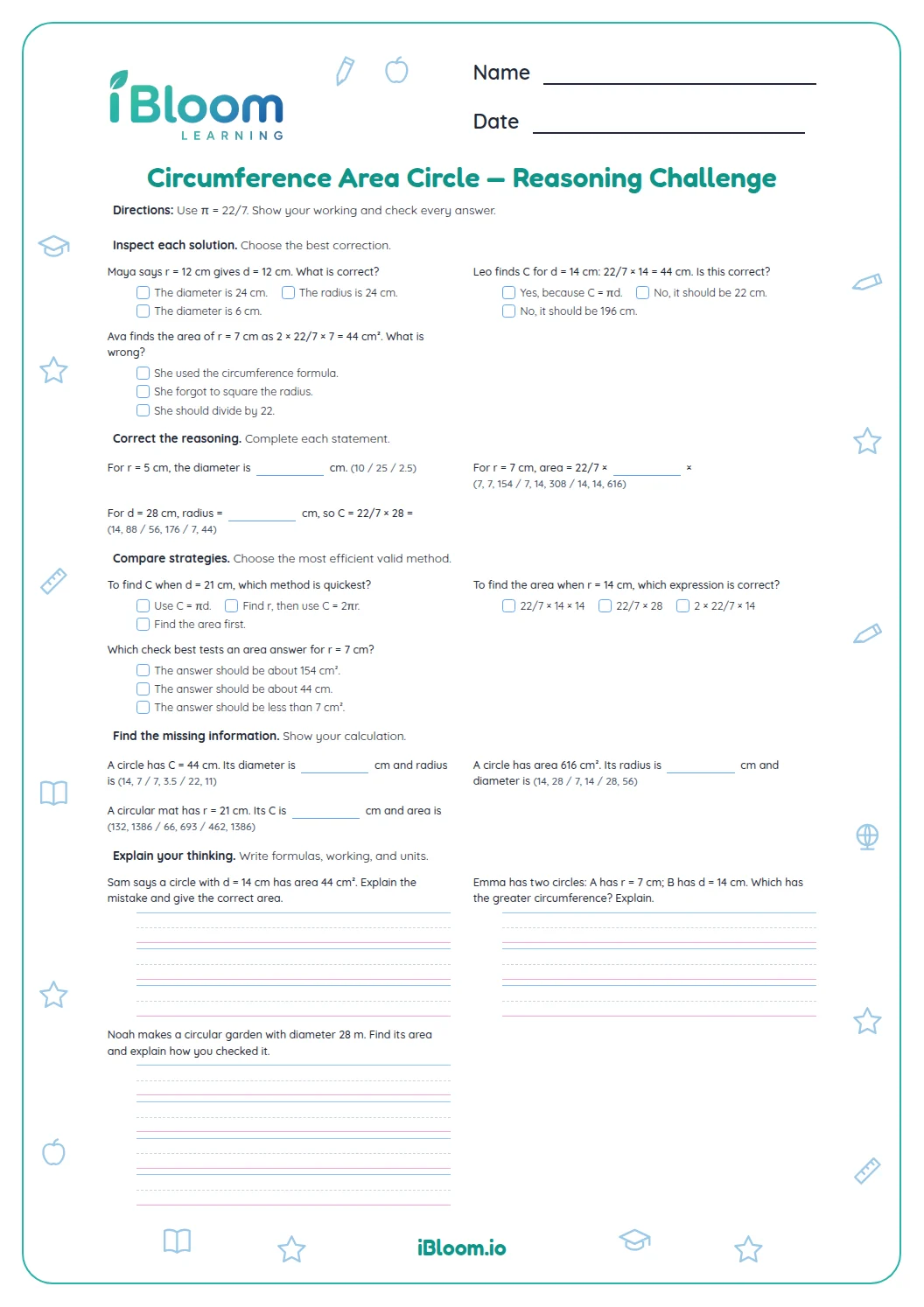
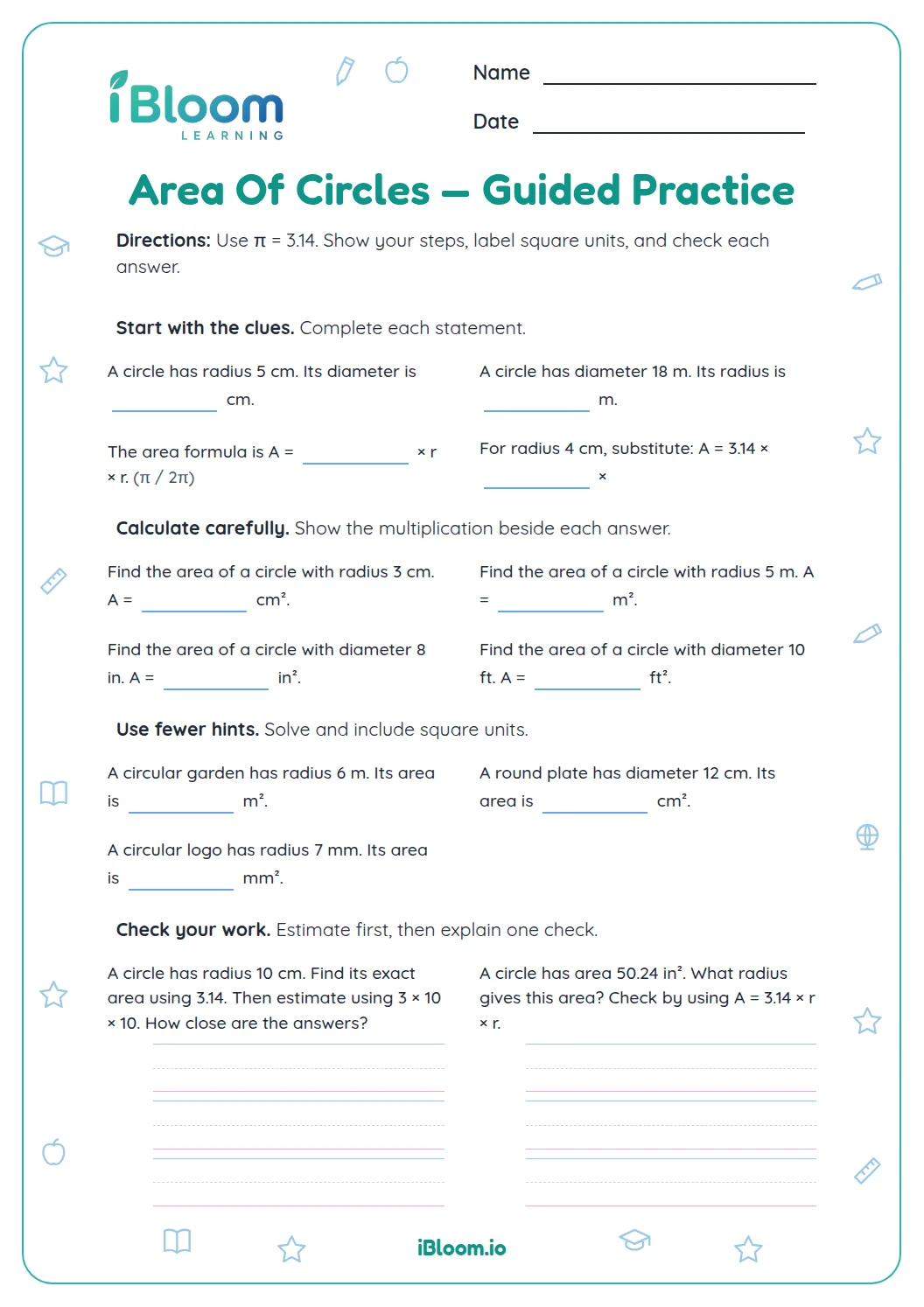
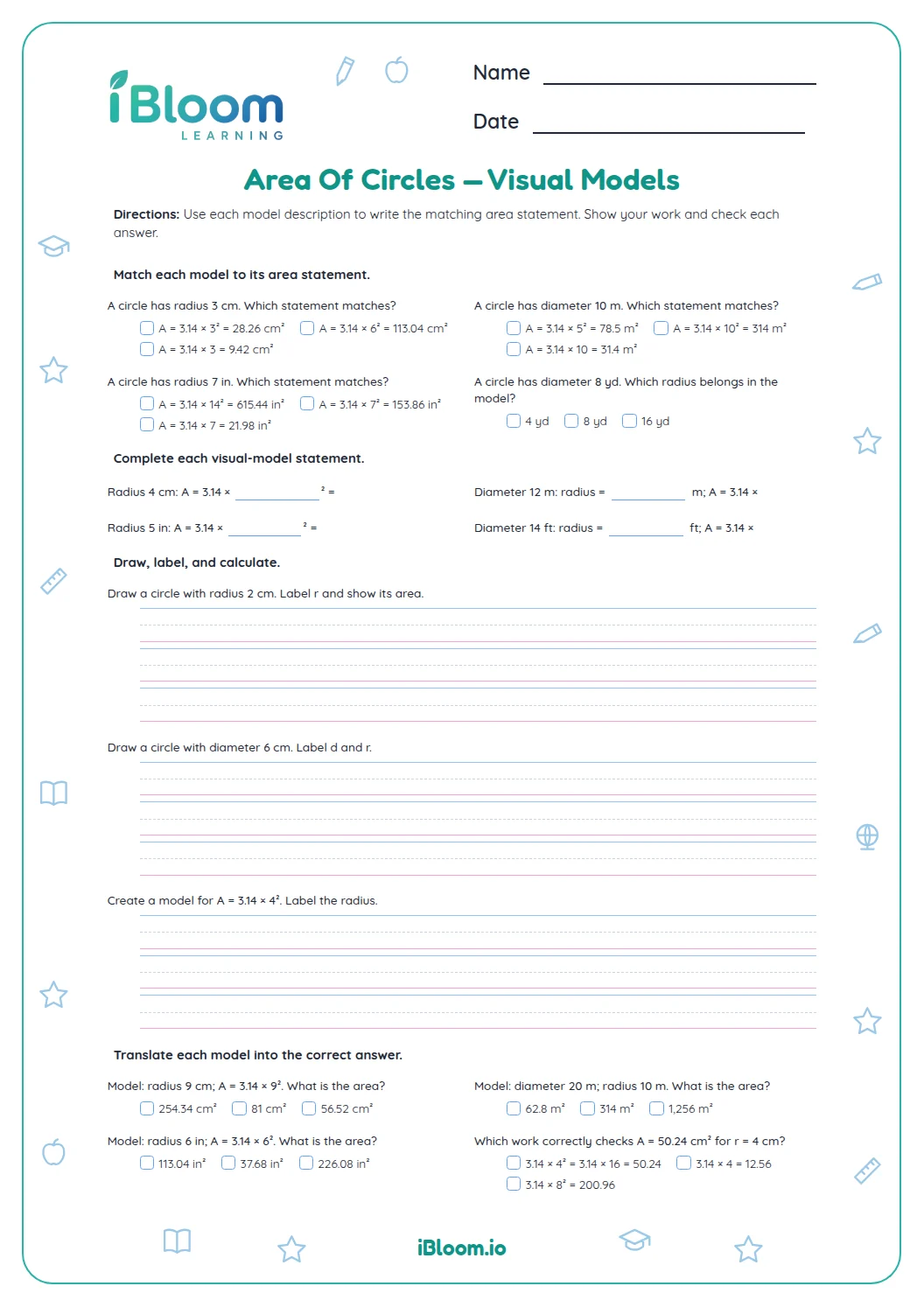
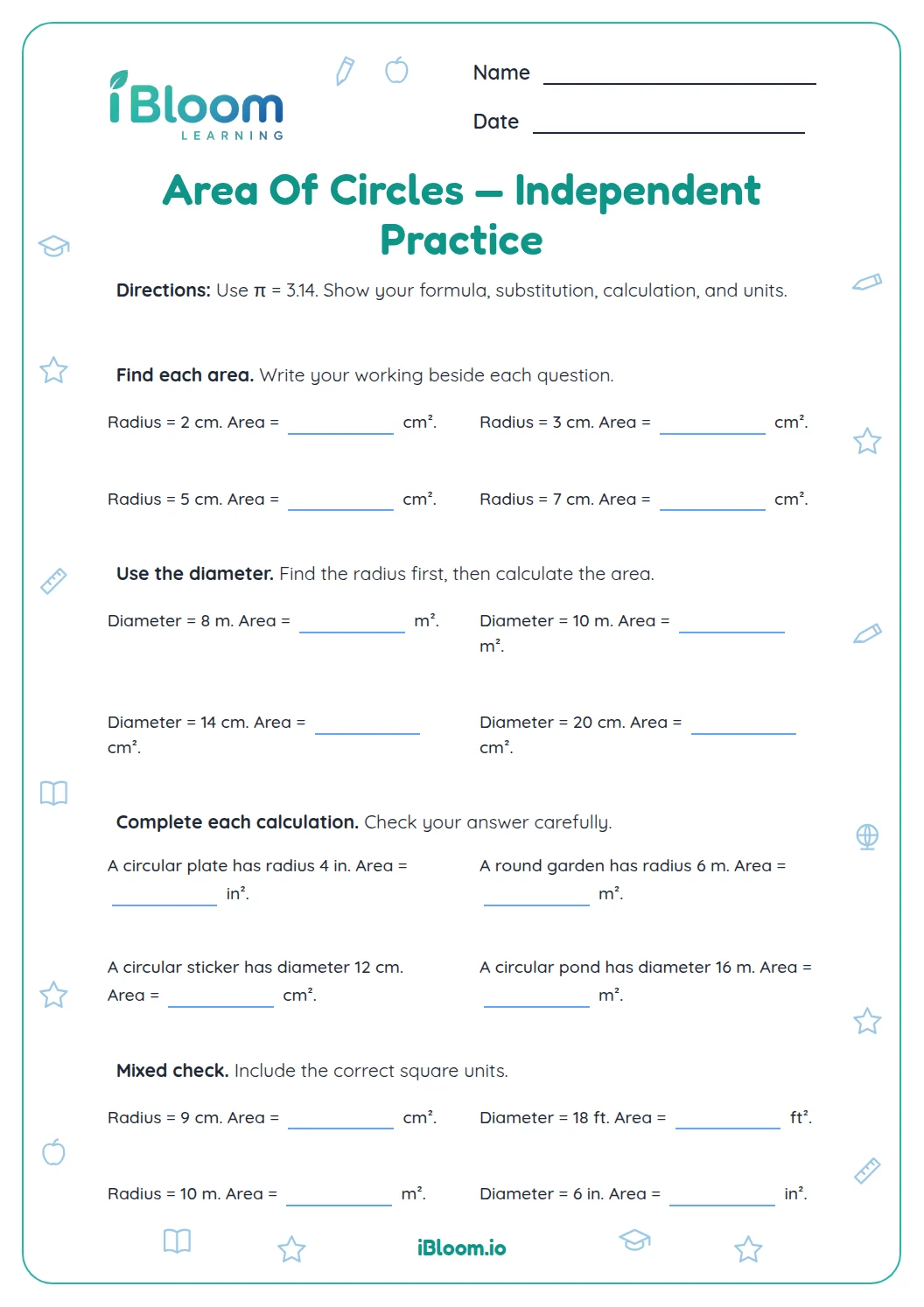
This printable Grade 6 circle worksheet builds a routine for distinguishing area from circumference and using radius or diameter correctly. Its 14 questions move from formula choices to calculations and applications. Learners use π = 22/7, as on the original sheet, and include the correct units. The work practices circle formulas described in Common Core 7.G.B.4. A separate answer key supports checking formulas, substitutions, calculations, and units.
Aligned to 7.G.B.4
How are radius and diameter connected?
The radius runs from a circle’s center to its edge. The diameter goes across the circle through the center, so it is two radii long. If r = 4 cm, then d = 8 cm.
Which formula matches the question?
Circumference can be found with C = πd or C = 2πr. Area is A = πr². The squared radius matters: for r = 7 m, area is 49π square meters, or 154 m² when π = 22/7.
- 1Radius = 7 m; find area.
- 2Use A = πr².
- 3Substitute: A = 22/7 × 7 × 7.
- 4Answer: 154 m²
What kinds of circle problems are included?
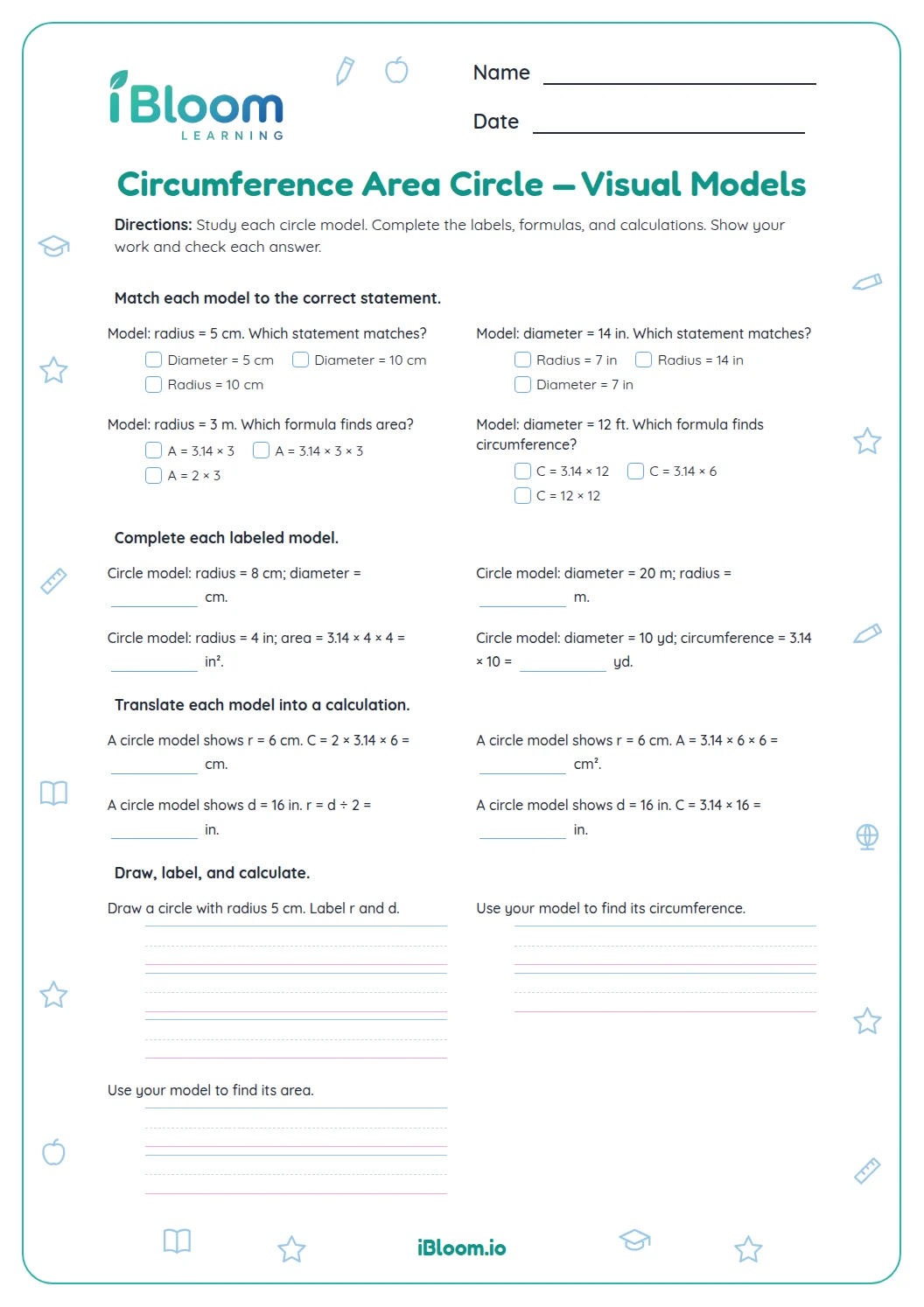
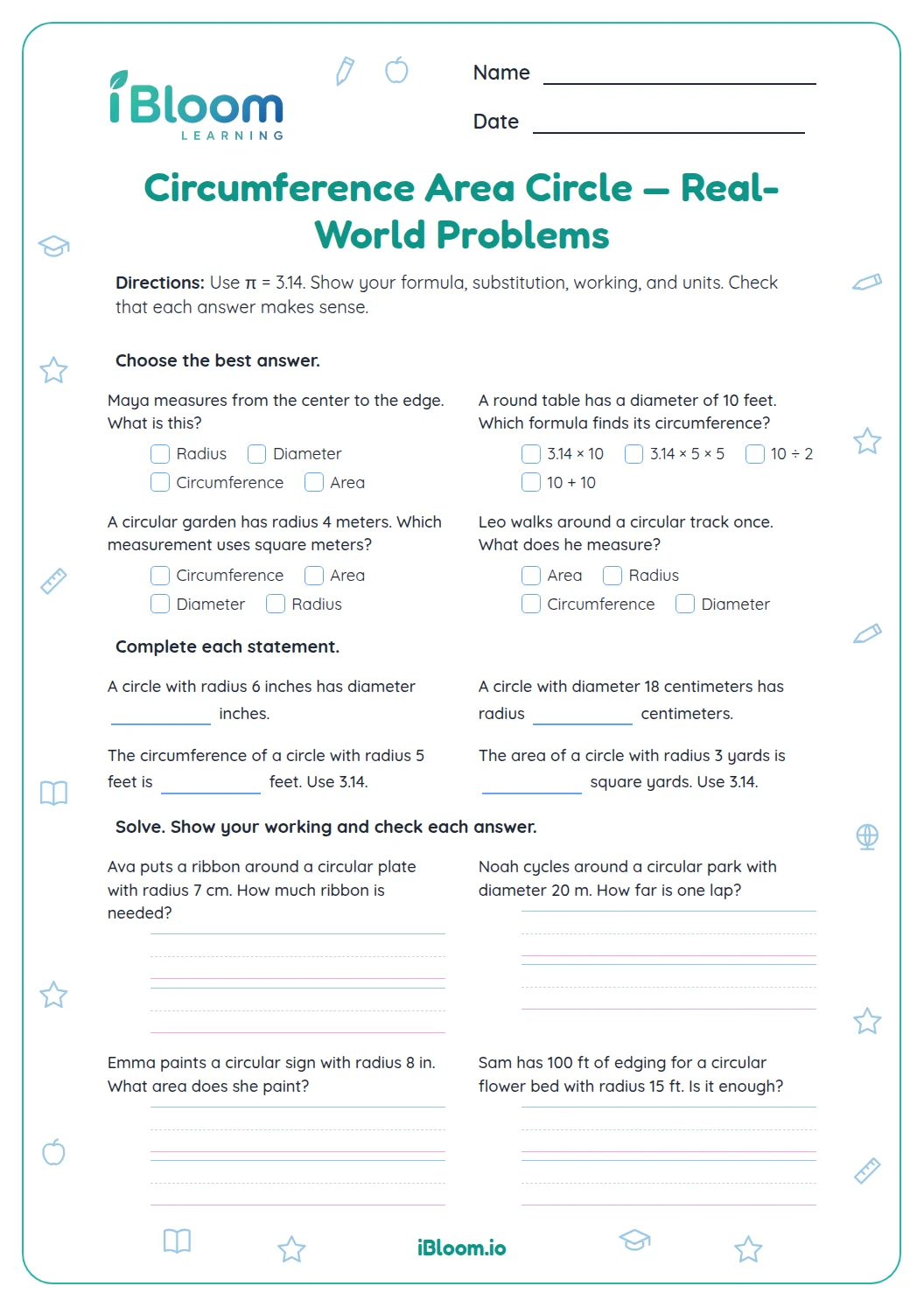
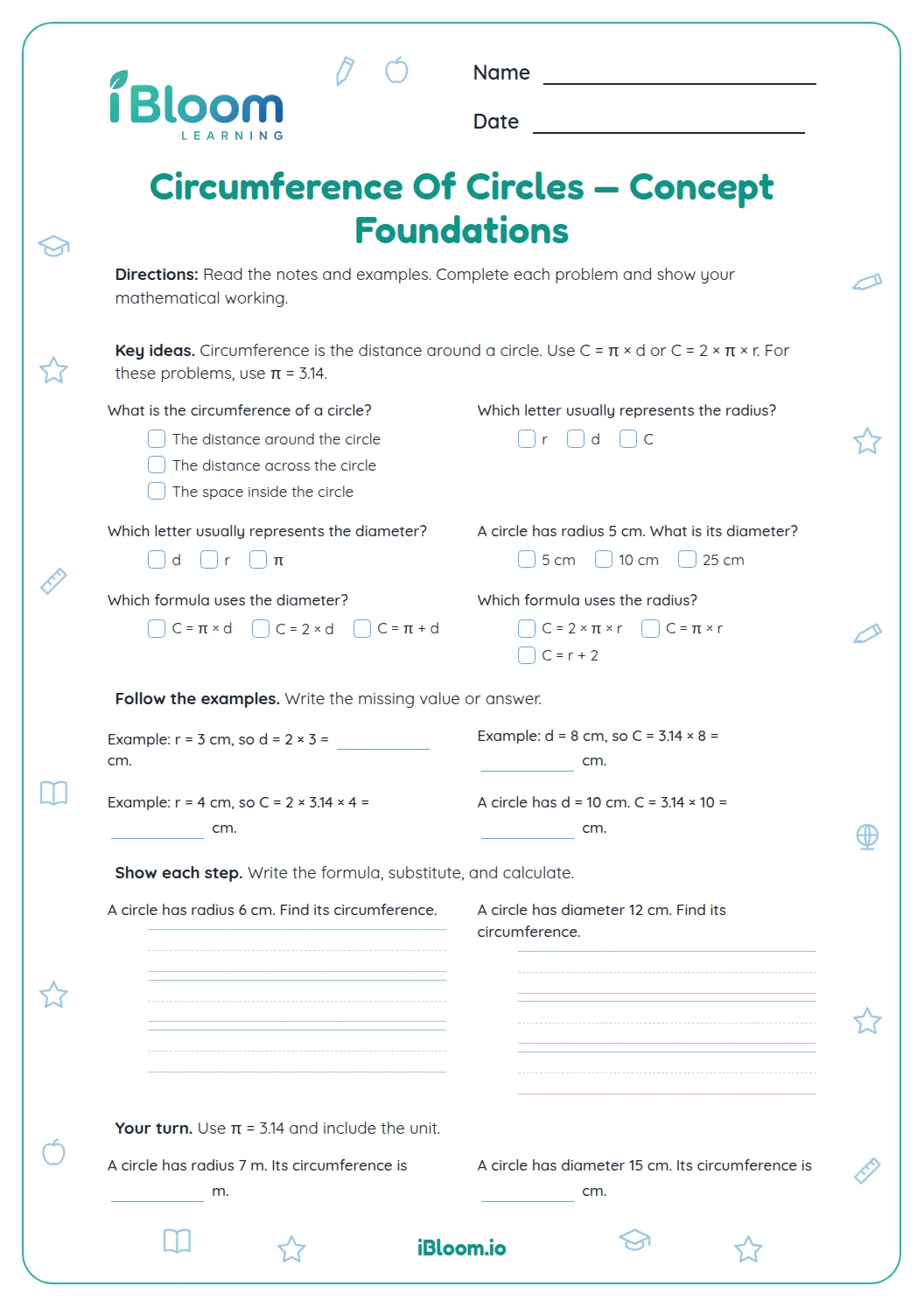
Part A checks formula choice and radius-diameter relationships. Part B gives direct calculations with π = 22/7. Part C applies the formulas to trim, garden area, and reverse questions.
For each calculation, include square units for area and ordinary length units for circumference.
How to use this worksheet
- 1Read whether the question asks about the edge or the inside.
- 2Mark the given measure as radius or diameter.
- 3Choose C = πd or A = πr².
- 4Substitute the measure and use π = 3.14 when asked.
- 5Check arithmetic and write length units for circumference or square units for area.
Common mistakes and quick fixes
The mistake
Using diameter as r in A = πr².
The fix
If diameter is given, divide by 2 to get the radius before finding area.
The mistake
Calling the area a length.
The fix
Area uses square units such as cm²; circumference uses units such as cm.
The mistake
Squaring 2πr or multiplying r by 2 instead of squaring it.
The fix
In A = πr², calculate r × r first, then multiply by π.
Curriculum alignment
This practice connects the worksheet tasks with the listed learning standard.
Use circle formulas to find area and circumference.
On this sheet: Learners identify and apply the circumference and area formulas with given circle measures.
Show the official wordingHide the official wording
Know the formulas for the area and circumference of a circle and use them to solve problems; give an informal derivation of the relationship between the circumference and area of a circle.
What to practice next
Make more practice
Further reading
Questions parents and teachers ask
What is the difference between area and circumference?
Circumference measures the distance around a circle, while area measures the space inside it. This worksheet asks learners to choose the matching formula before calculating with a radius or diameter. A useful check is whether the question describes a boundary or a surface to cover.
How many questions are included?
There are 14 questions in three parts: six formula and relationship choices, four direct calculations, and four applications or reverse problems. A separate answer key gives the results. The worksheet and key each use two pages. Check the radius or diameter given before substituting.
Should students use 3.14 or π?
This worksheet uses π = 22/7, matching the method on the original sheet. Several values are chosen so the 7 in the denominator cancels cleanly. Keep π in formula expressions when a question asks for an expression rather than a numerical result.
How do radius and diameter relate?
The diameter crosses the circle through its center, while the radius reaches from the center to the edge. The diameter is twice the radius, so d = 2r. For a 14 cm diameter, for example, the radius is 7 cm.
What is a common mix-up on circle questions?
A common slip is using the area formula for a boundary question. Look for words such as around, edge, or trim for circumference; space inside or cover points to area. Also check that area answers use square units and circumference answers use length units.
Does this worksheet include an answer key?
Yes. The separate answer key lists the choices and computed values. For a calculation, check the formula, substitution, and units as well as the final number. The key uses π = 22/7 throughout, as directed on the worksheet.