


About this worksheet
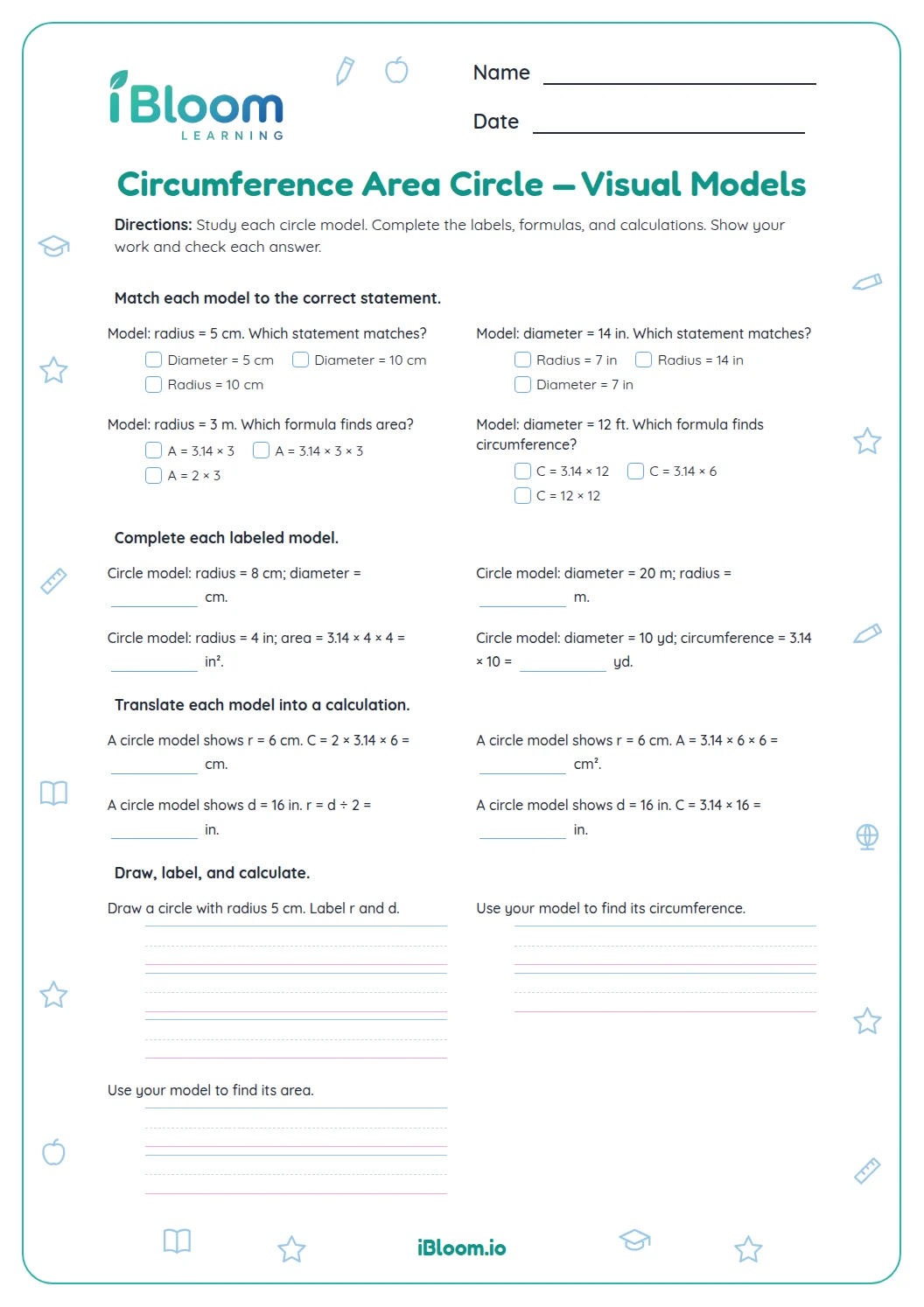
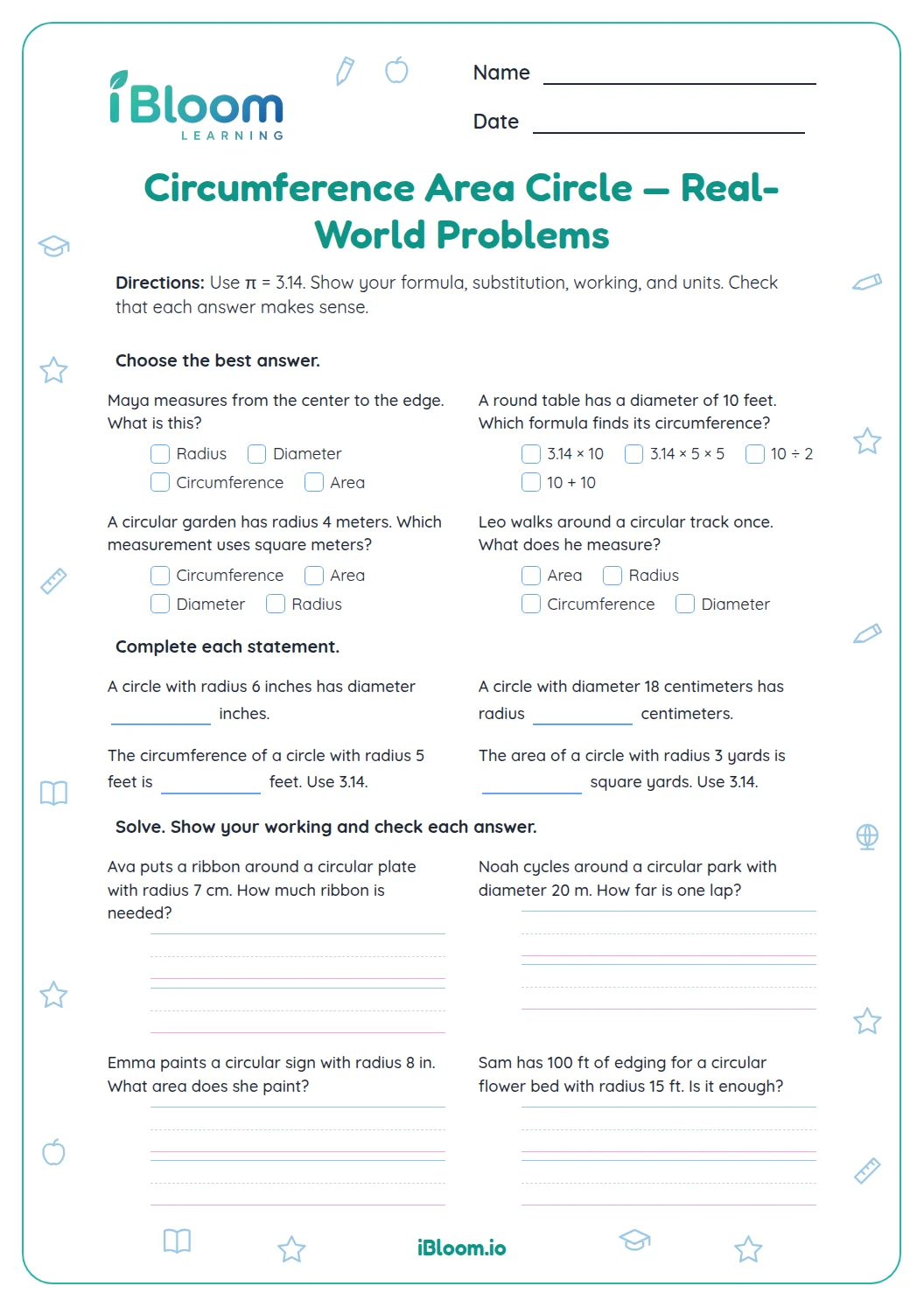
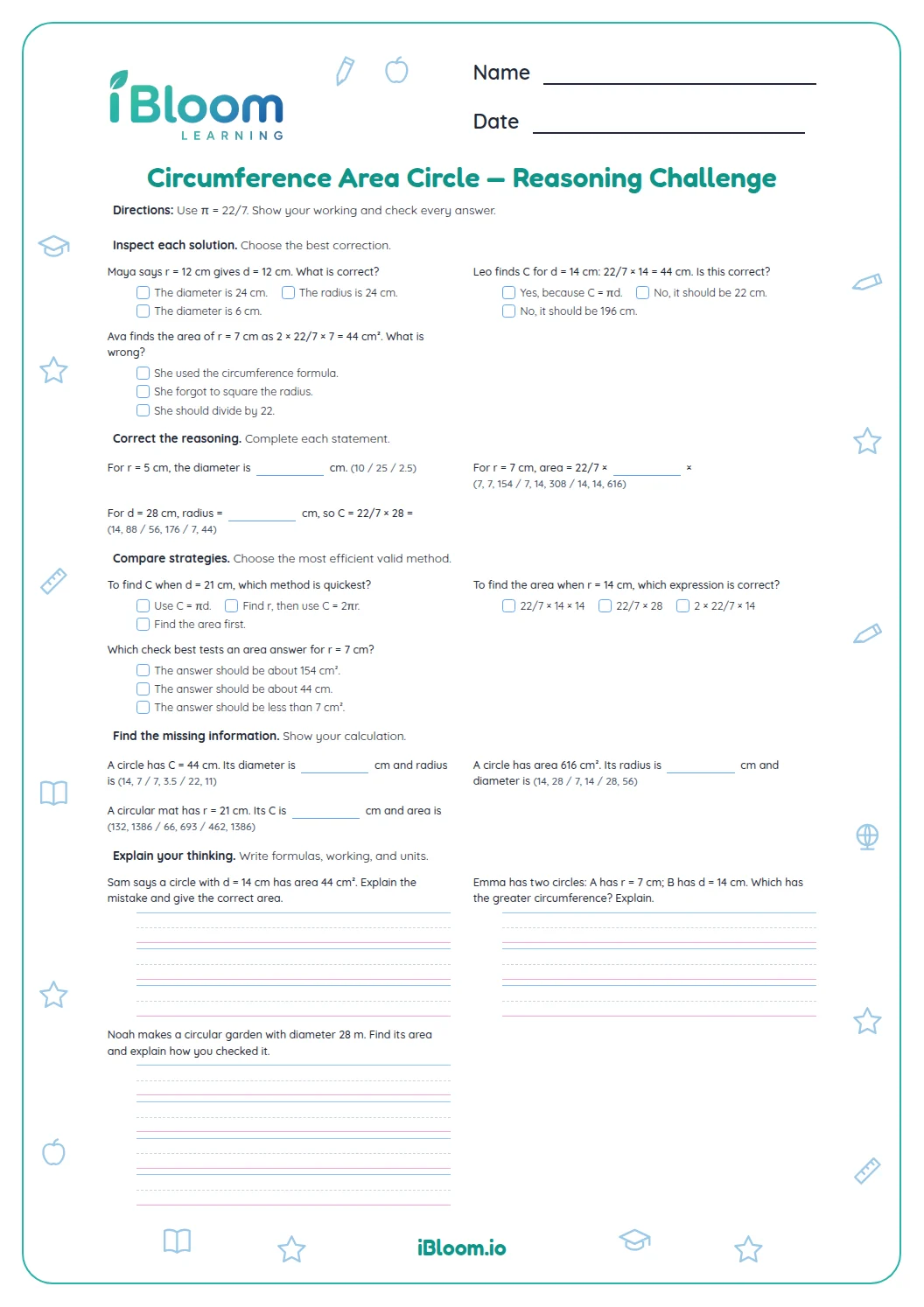
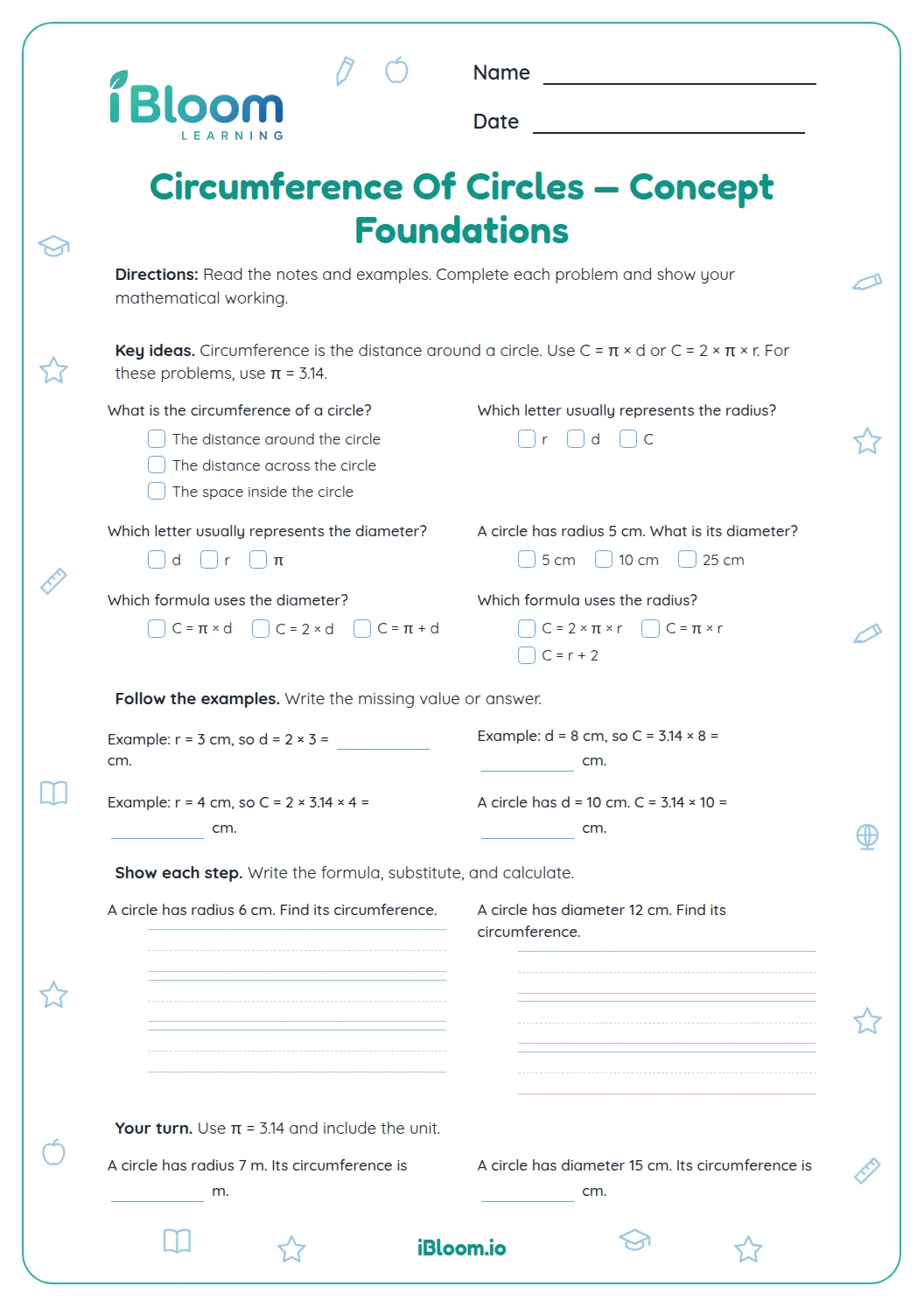
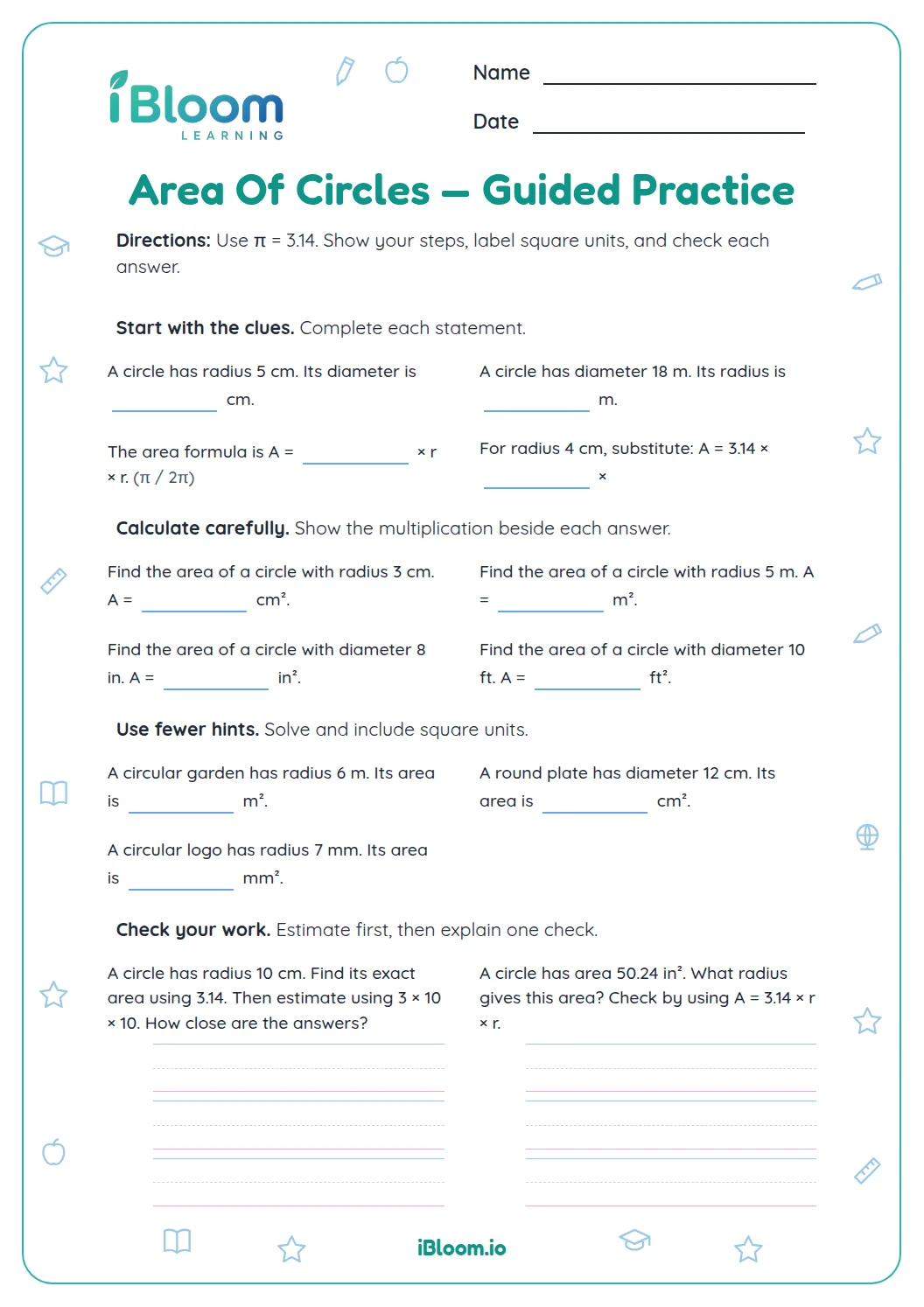
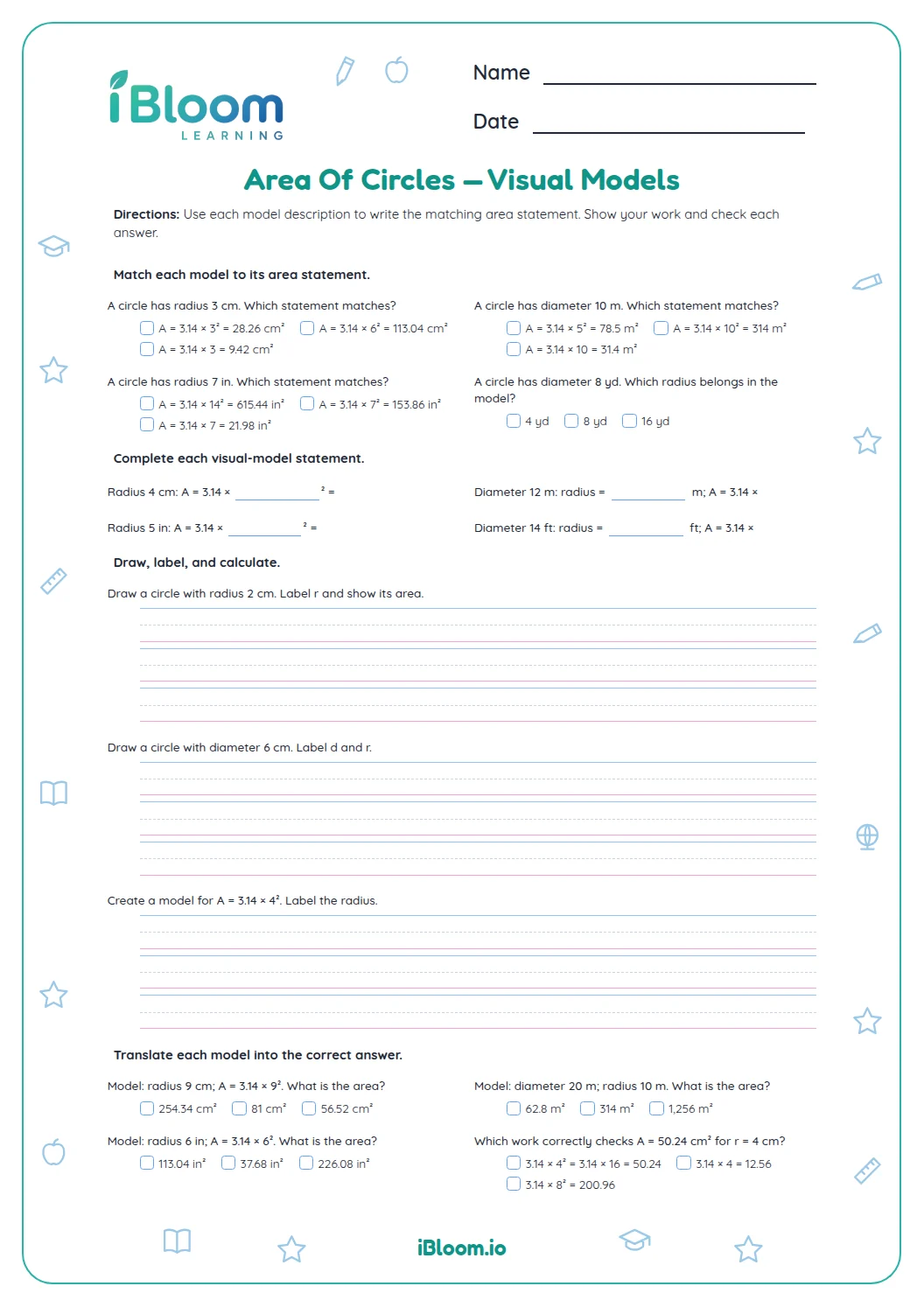
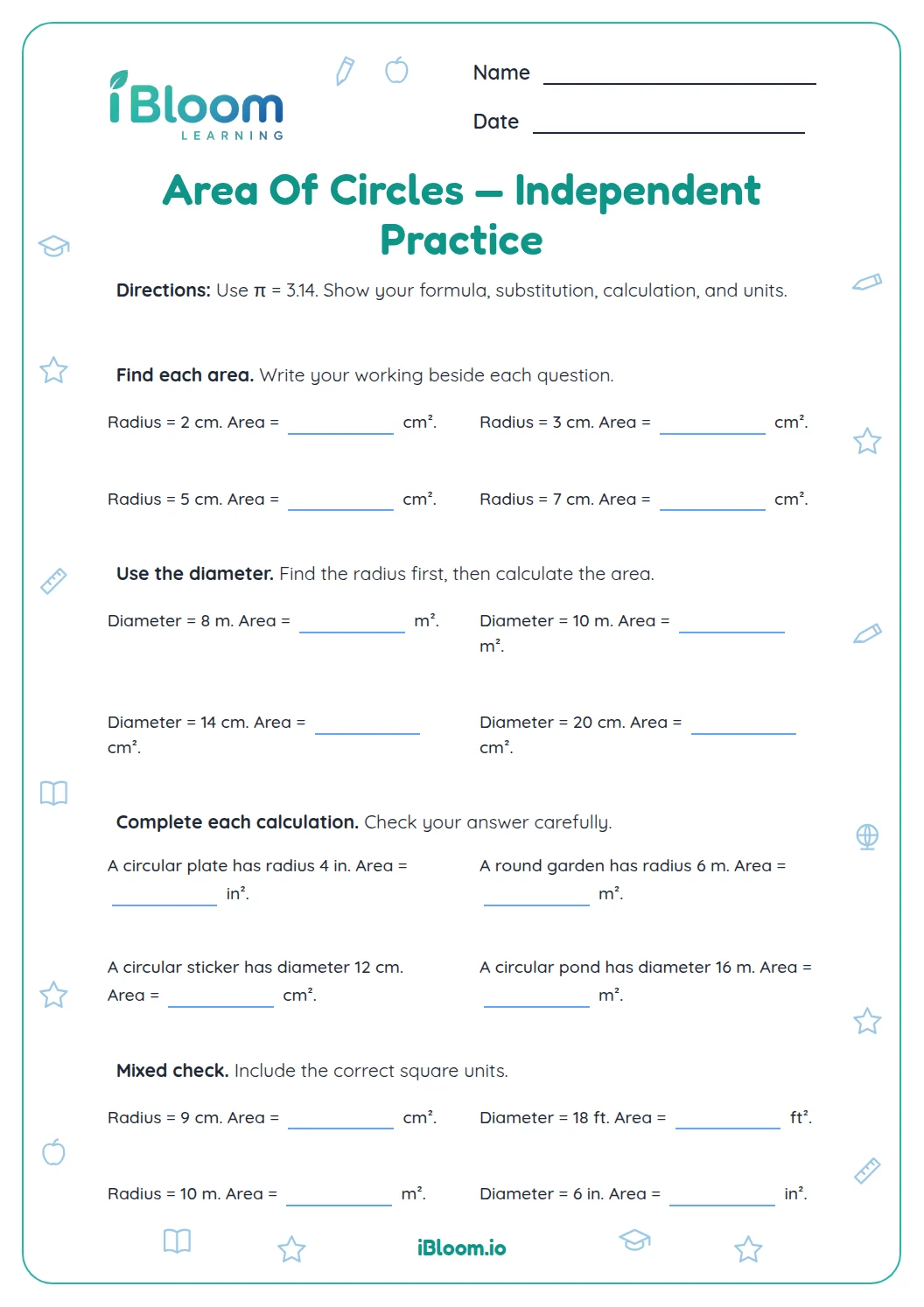
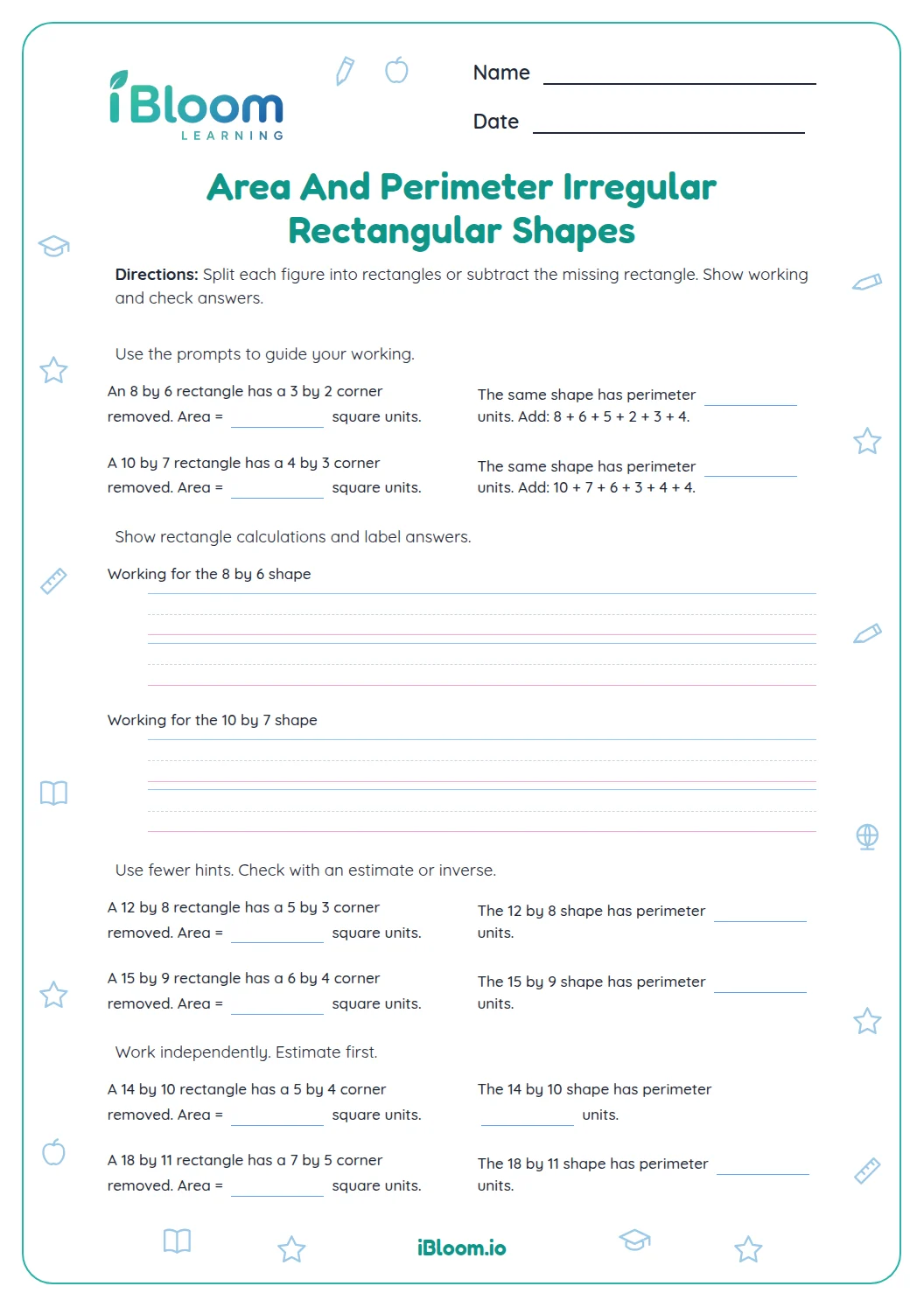
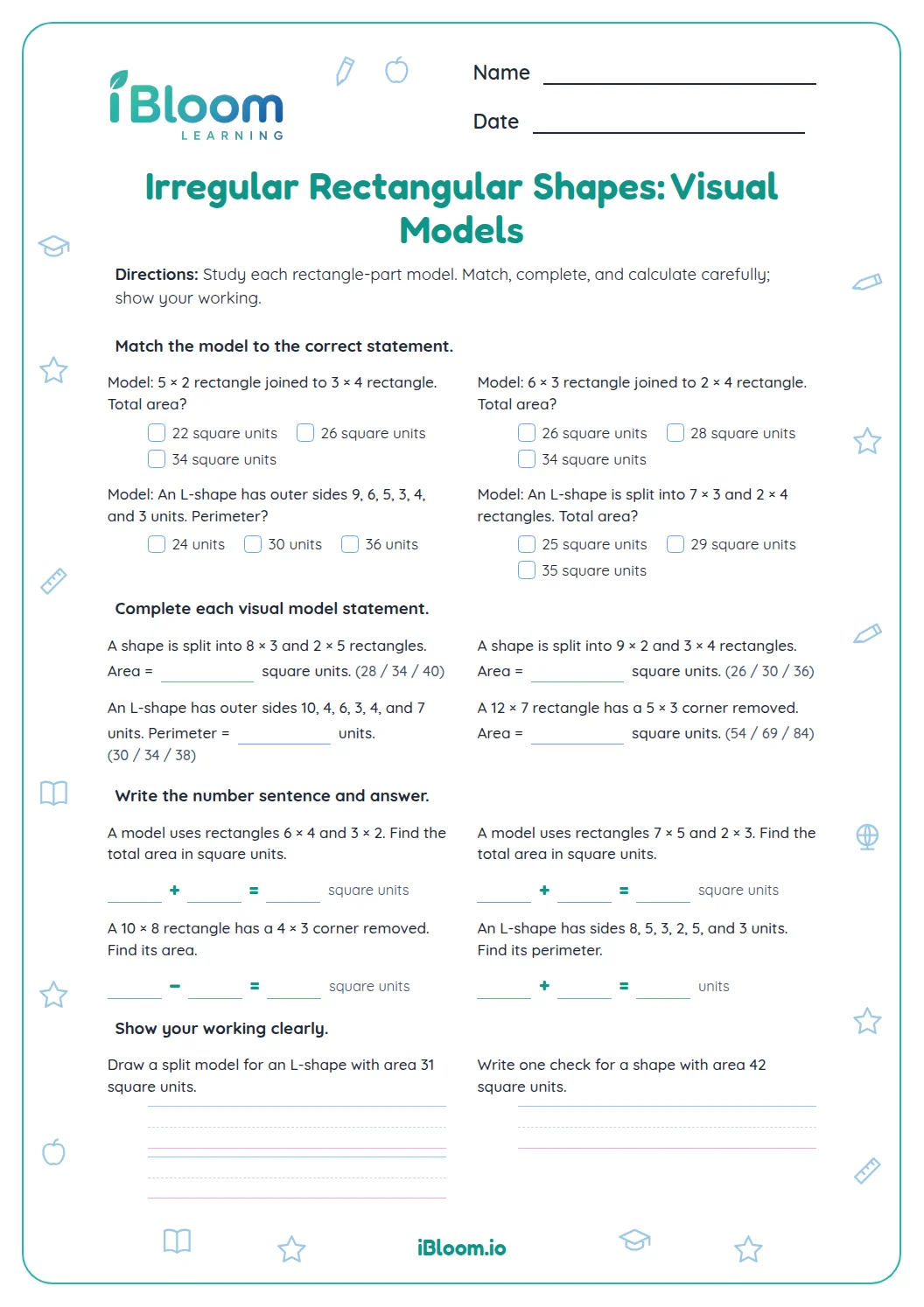
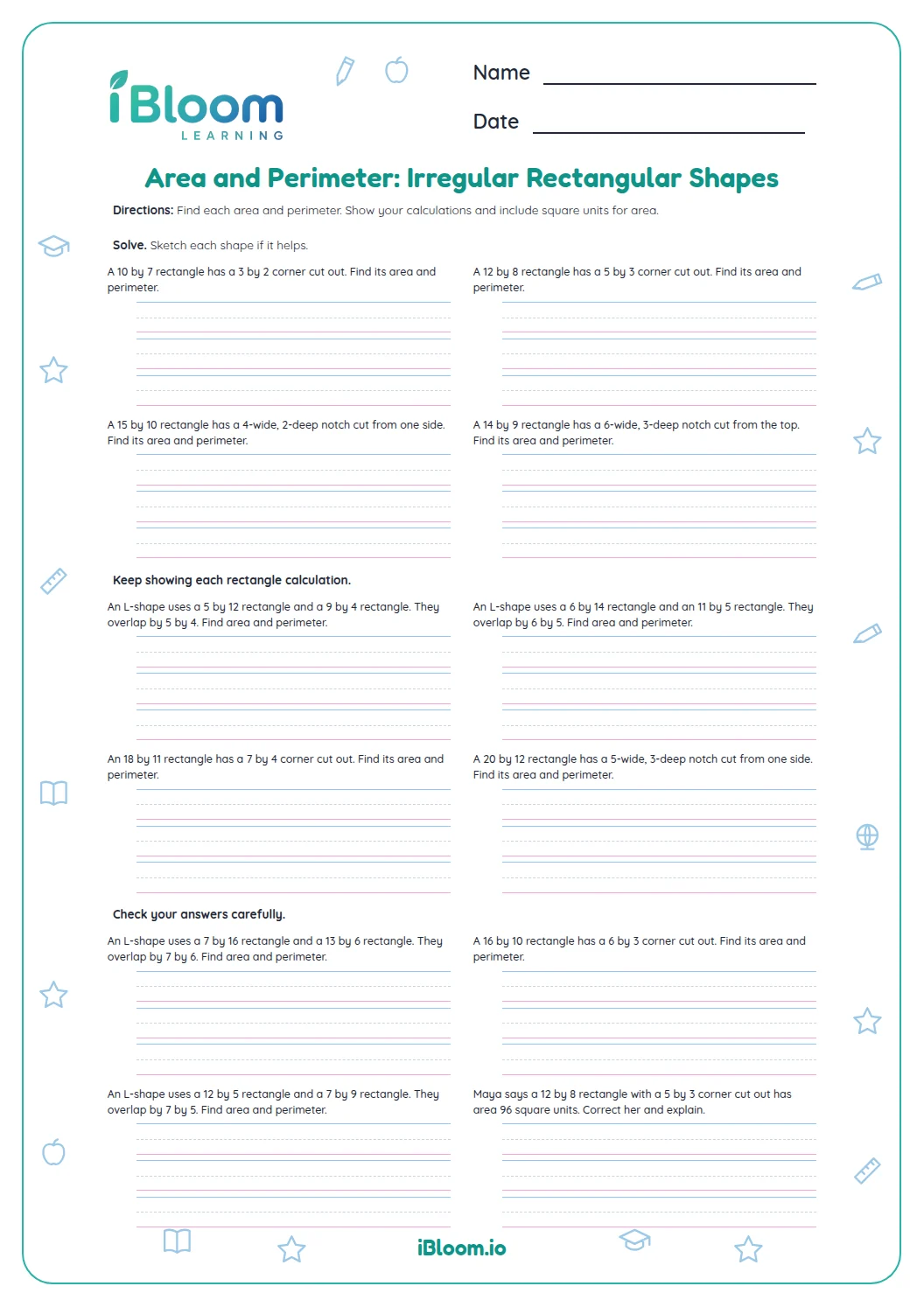
This Grade 6 worksheet gives 16 circle calculations using both radius and diameter. Learners find circumference with C = 2 × 3.14 × r or C = 3.14 × d, and area with A = 3.14 × r × r, halving a given diameter before using the area formula. Answers include the appropriate linear or square units. The area problems apply formula-based measurement in mathematical contexts; a separate answer key is included.
Aligned to 6.G.A.1
How do you find circumference?
Use C = 2 × 3.14 × r when the radius is given, or C = 3.14 × d when the diameter is given. For a radius of 5 cm, 2 × 3.14 × 5 = 31.4 cm.
How do you find circle area?
Use A = 3.14 × r × r. If the diameter is 10 ft, first find r = 5 ft, then calculate 3.14 × 5 × 5 = 78.5 square ft.
Why do the units change?
Circumference measures distance around a circle, so its answer uses a linear unit such as centimeters. Area covers a surface, so its answer uses square units.
How to solve the circle problems
- 1Decide whether each prompt asks for circumference or area.
- 2Identify whether the given measure is radius or diameter.
- 3For area with a diameter, divide it by 2 to find radius.
- 4Substitute into the matching formula and calculate with 3.14.
- 5Label area with square units and circumference with linear units.
Common circle calculation mistakes
The mistake
Using the diameter as the radius in an area calculation.
The fix
Halve the diameter before substituting for r.
The mistake
Using a circumference formula for area.
The fix
Match C = 3.14 × d or 2 × 3.14 × r to circumference; use A = 3.14 × r × r for area.
The mistake
Labeling area with a linear unit.
The fix
Use square units for area and linear units for circumference.
Common Core alignment
This worksheet gives children focused practice with a named Common Core skill.
Apply a formula to calculate circle area in mathematical measurement problems.
On this sheet: The area items apply the area-formula technique to circle measurements.
Show the official wordingHide the official wording
Find the area of right triangles, other triangles, special quadrilaterals, and polygons by composing into rectangles or decomposing into triangles and other shapes; apply these techniques in the context of solving real-world and mathematical problems.
What to practice next
Make more practice
Further reading
Questions parents and teachers ask
What formulas do children use?
The worksheet uses C = 2 × 3.14 × r or C = 3.14 × d for circumference, and A = 3.14 × r × r for area. The prompts give either radius or diameter, so children identify the measure before substituting.
How do you find area when the diameter is given?
First divide the diameter by 2 to find the radius. Then substitute that radius into A = 3.14 × r × r. For a 10-foot diameter, the radius is 5 feet and the area is 78.5 square feet. Pause after each part and ask the learner to explain how the clue or operation supports the answer.
Why are area answers in square units?
Area measures the surface inside the circle, so its units are square units, such as square inches or square meters. Circumference measures the distance around the circle and uses a linear unit such as inches or meters. Pause after each part and ask the learner to explain how the clue or operation supports the answer.
Can this worksheet support independent practice?
Yes, if children have learned the circle formulas and how radius relates to diameter. The prompts identify the measurement and ask for a calculation; the separate key provides results with units for checking. Pause after each part and ask the learner to explain how the clue or operation supports the answer.
How long may the circle practice take?
Allow about 25 minutes for 16 calculations with both circumference and area. Problems that give diameter for area require an extra step to find radius. The worksheet and answer key each span four pages. Pause after each part and ask the learner to explain how the clue or operation supports the answer.