


About this worksheet
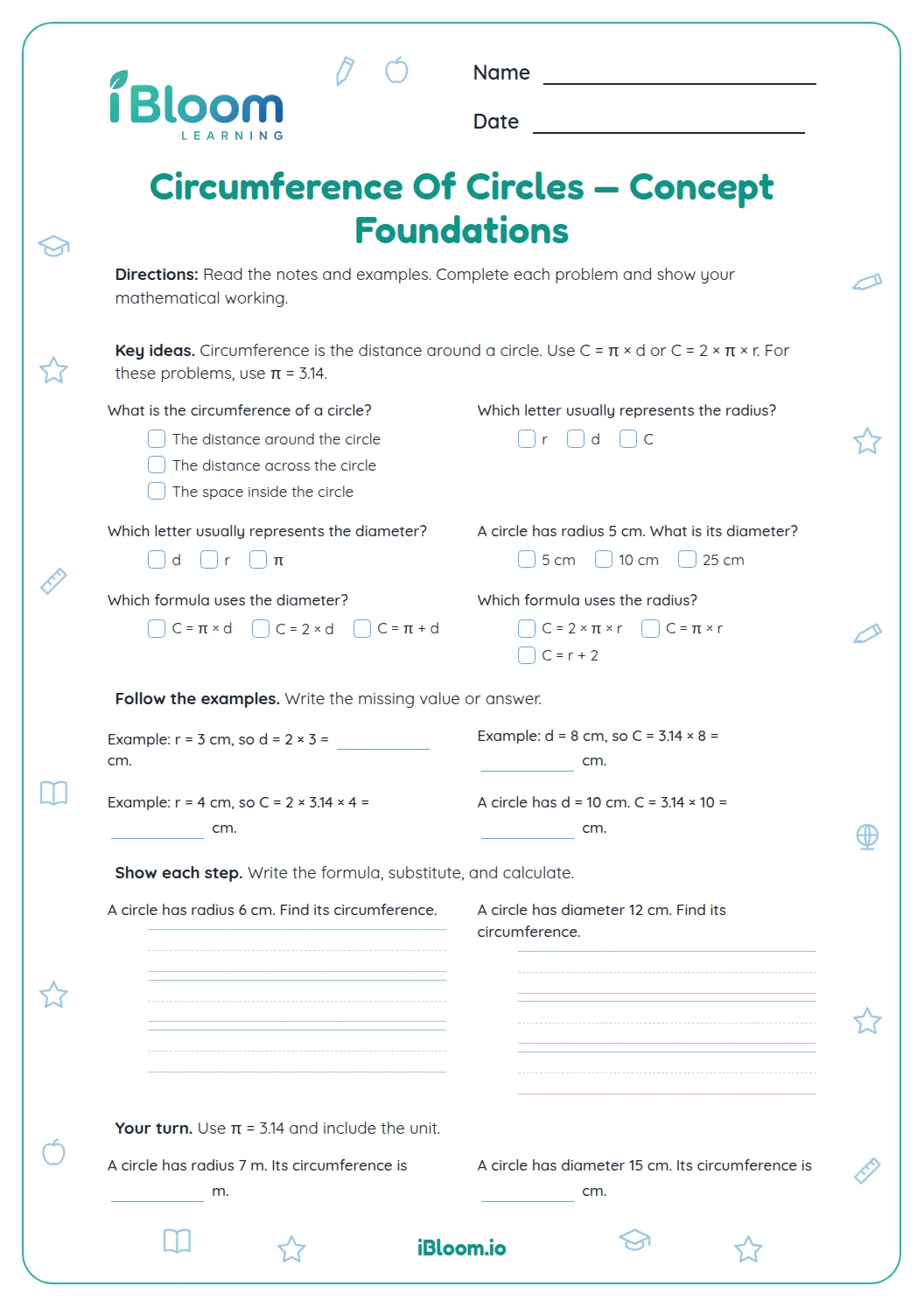
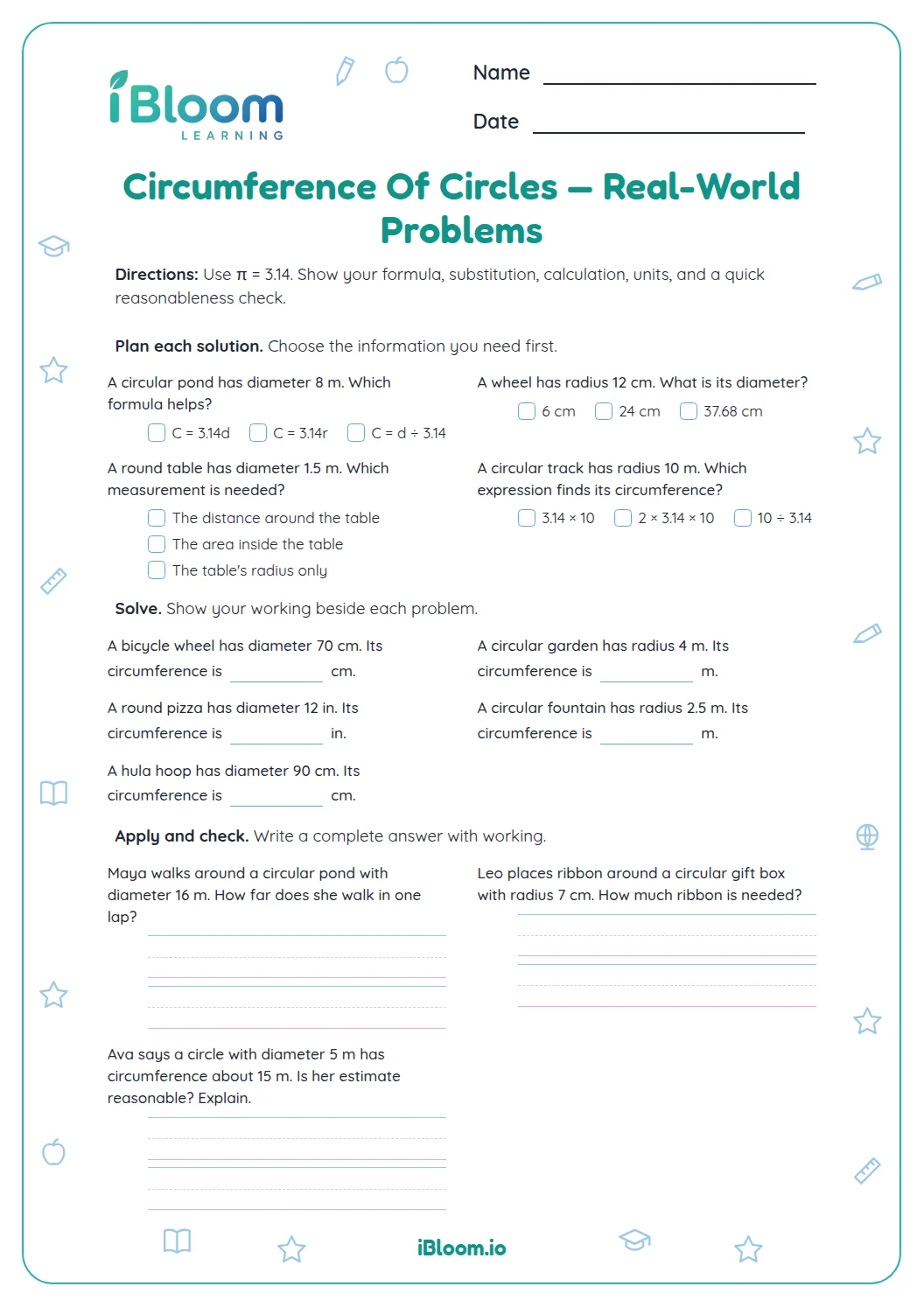
This free printable worksheet gives Grade 6 learners practice reasoning about the circumference of circles. Children choose between C = πd and C = 2πr, calculate with π ≈ 3.14, solve for a missing radius or diameter, and explain how circumference changes when diameter changes. The 16 questions move from choosing a relationship to real-world laps and error checks. A separate answer key supports quick checking.
Aligned to 7.G.B.4
Which circumference formula should I use?
Use C = πd when the diameter is given. If the radius is given, use C = 2πr because the diameter is twice the radius. Keep the unit attached to the result.
- 1Radius = 7 in
- 2C = 2 × 3.14 × 7
- 3C = 43.96 in
How can I work backward from circumference?
Because circumference equals π times diameter, divide the circumference by 3.14 to find diameter. Divide that diameter by 2 to find radius.
What changes when the diameter changes?
The constant π stays the same, so circumference scales with diameter. A diameter twice as large gives a circumference twice as large.
What kinds of problems are on the page?
There are 16 questions in three parts: choose a formula, calculate or work backward, then explain the diameter relationship. The answer key is separate.
How to use this worksheet
- 1Check whether the given measure is a radius or a diameter.
- 2Choose C = πd or C = 2πr.
- 3Substitute the measure and use 3.14 for π.
- 4Multiply and write the correct unit.
- 5For a missing measure, undo multiplication by dividing by 3.14.
- 6Use the answer key to check calculations and explanations.
Common mistakes and quick fixes
The mistake
Using the radius as the diameter.
The fix
Double the radius before using C = πd.
The mistake
Multiplying by 2 after using the diameter formula.
The fix
Use either πd or 2πr; do not apply both formulas.
The mistake
Dropping the unit from a real-world answer.
The fix
Carry the given length unit into the circumference.
Common Core alignment
This worksheet practices the Common Core standard named below.
Use C = πd or C = 2πr to solve circle problems.
On this sheet: Children choose circumference formulas, find missing measures, and reason about how circumference changes with diameter.
Show the official wordingHide the official wording
Know the formulas for the area and circumference of a circle and use them to solve problems; give an informal derivation of the relationship between the circumference and area of a circle.
What to practice next
Make more practice
Further reading
Questions parents and teachers ask
What is the difference between radius and diameter?
The radius measures from a circle’s center to its edge. The diameter crosses the circle through its center, so it is twice the radius. On this sheet, use C = 2 × 3.14 × r when the radius is given and C = 3.14 × d when the diameter is given.
What value of pi should children use?
Use 3.14 for the calculations on this worksheet. For example, a circle with an 8 cm diameter has a circumference of 3.14 × 8 = 25.12 cm. Keeping the approximation consistent makes each answer easy to compare with the separate key.
How can I find a diameter from circumference?
Divide the circumference by 3.14 to find the diameter. For instance, 31.4 cm ÷ 3.14 = 10 cm. If the question asks for radius instead, divide that diameter by 2. The worksheet includes both forward calculations and questions that reverse the relationship.
Does doubling a circle’s diameter double its circumference?
Yes. The formula C = πd multiplies the diameter by the same value of π each time. If the diameter doubles while π stays fixed, the circumference doubles too. The last question asks learners to explain this relationship in their own words.
What does the answer key include?
The separate key gives the formula choices, calculated circumferences, missing measures, and units. It also includes a sample explanation for the scaling question. For open reasoning, accept different wording when it correctly connects a doubled diameter with a doubled circumference.
How long might this worksheet take?
Plan for about 25 minutes, with time to show calculations and check units. The formula choices are brief, while the reverse-measure and real-world items take more working. Let the learner explain any answer that differs from the key before correcting it.