

About this worksheet
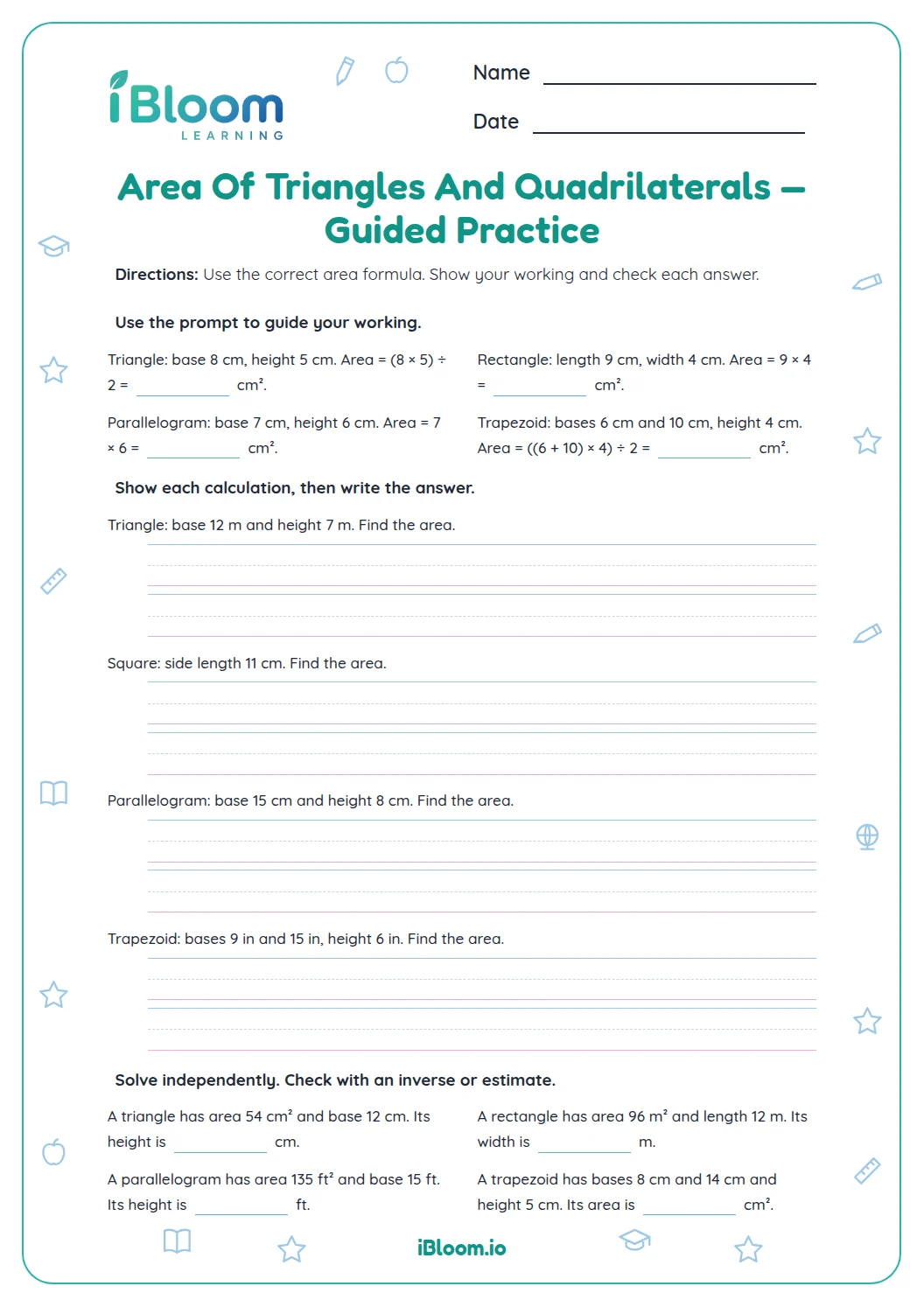
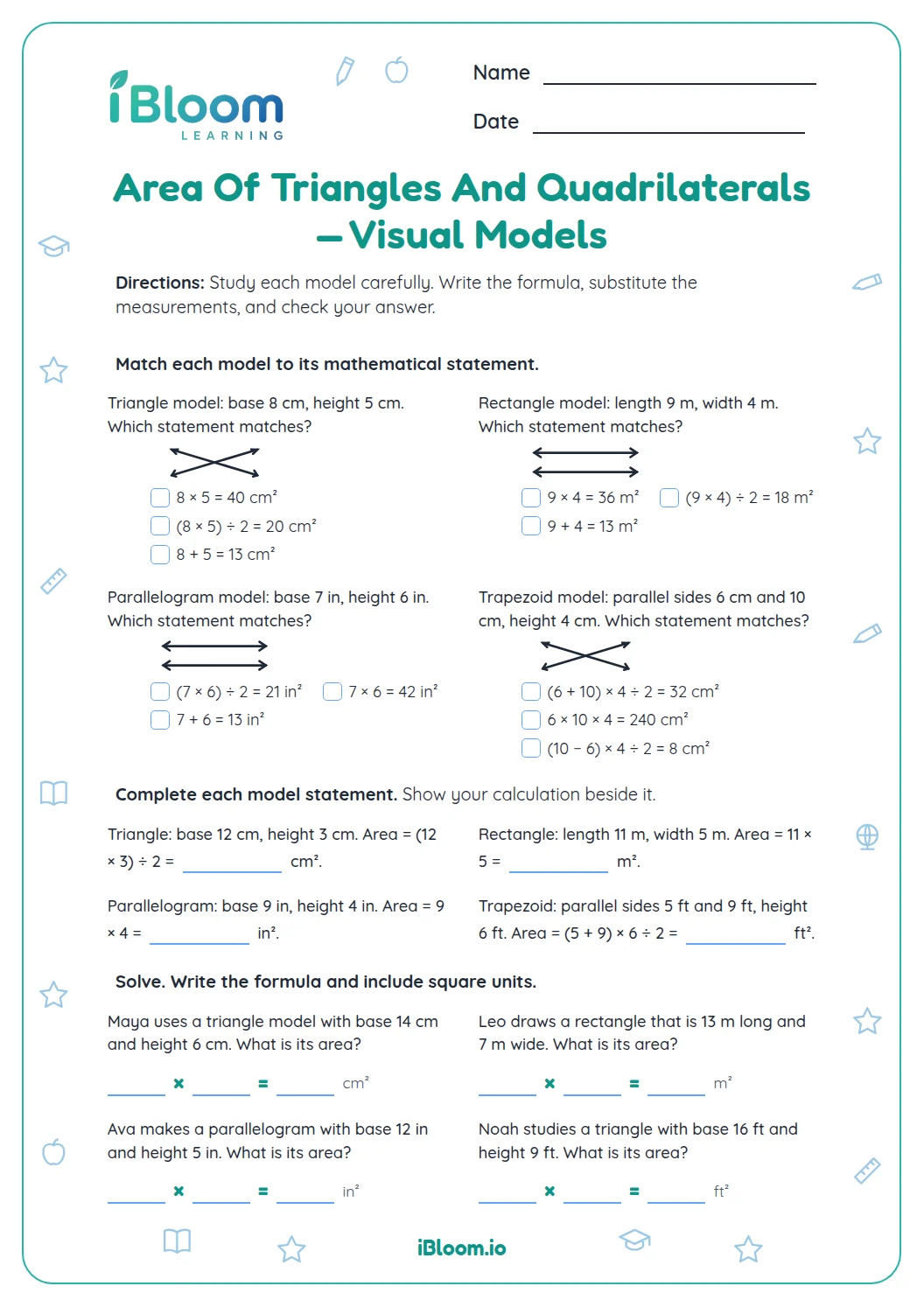
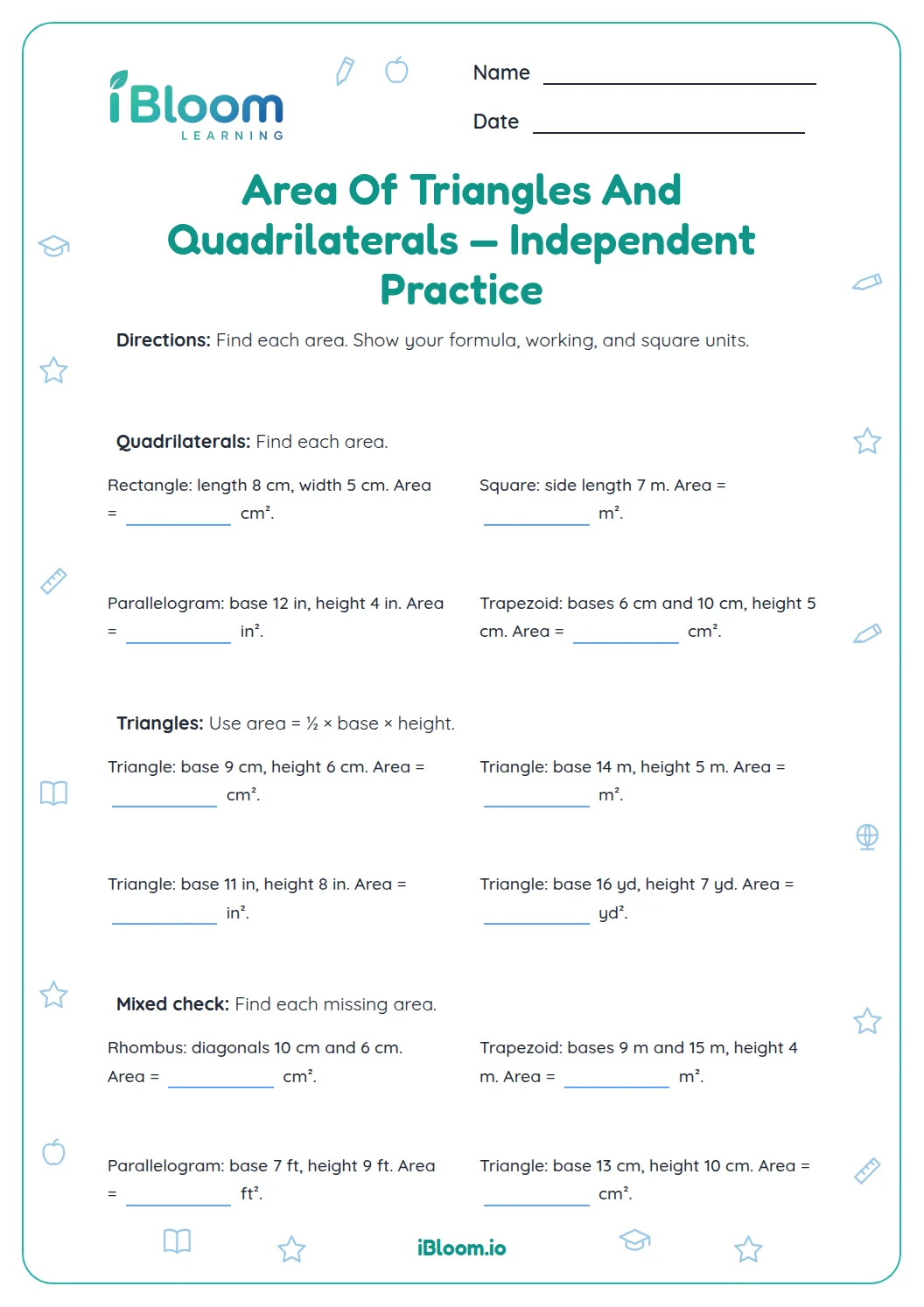
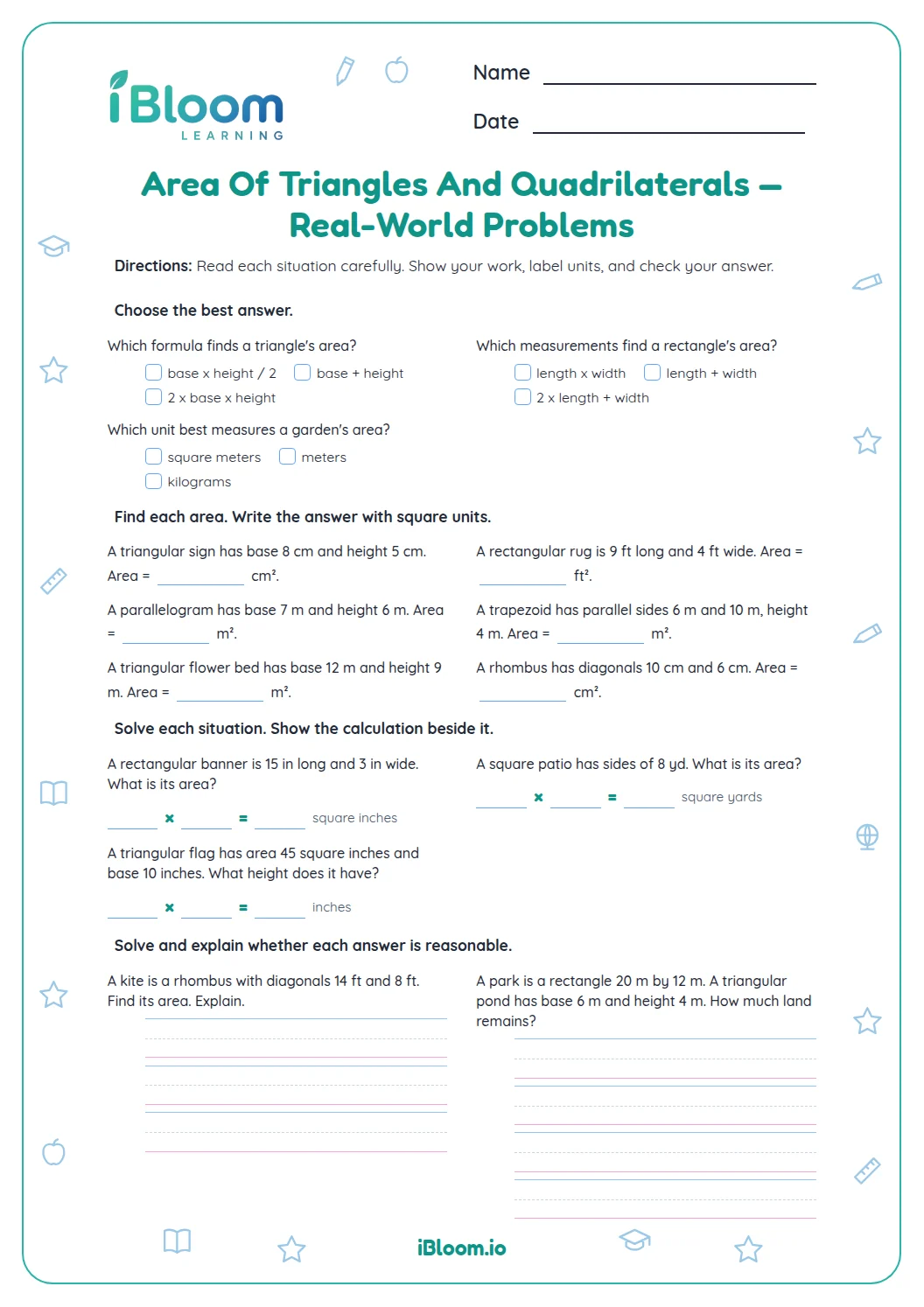
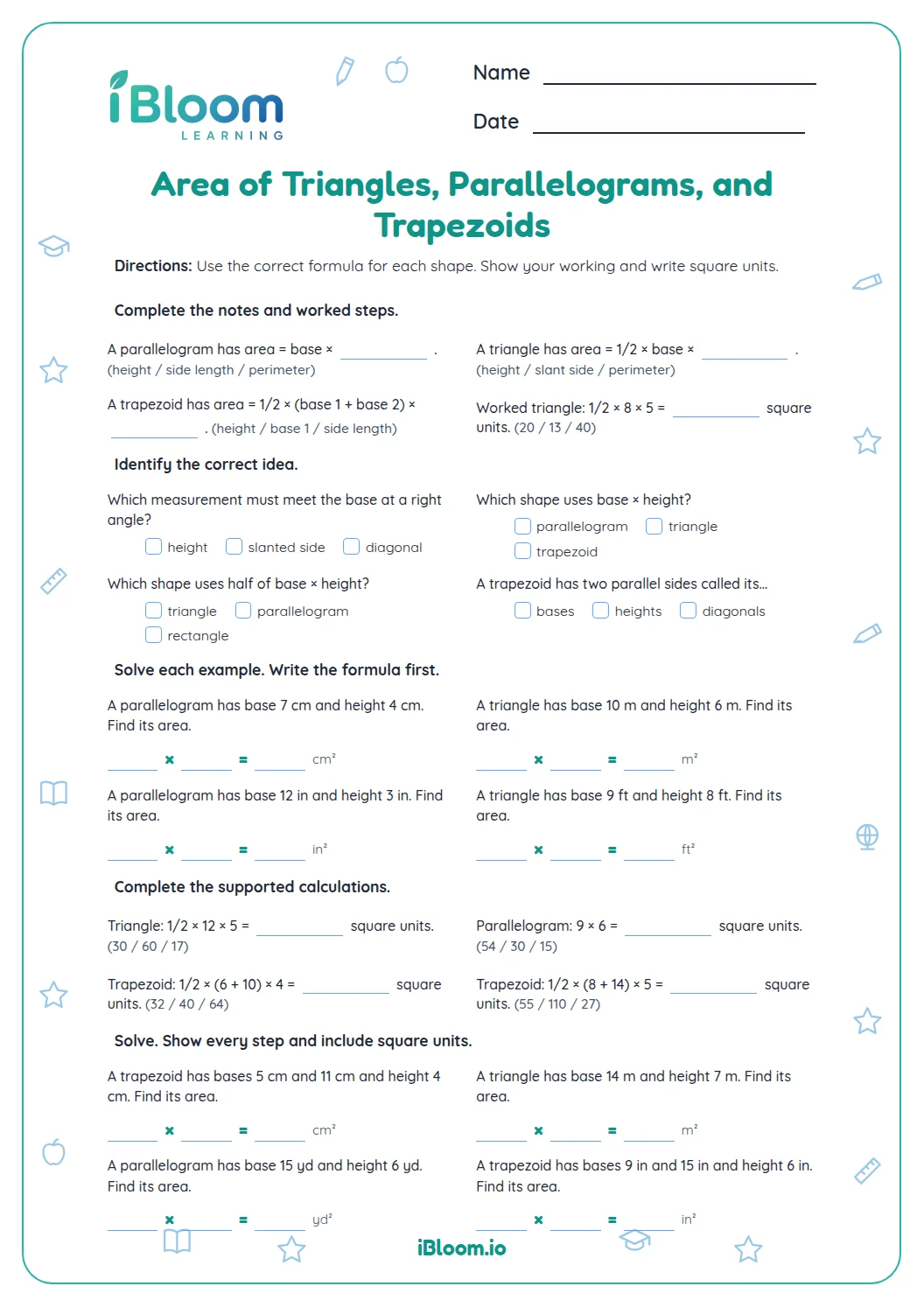
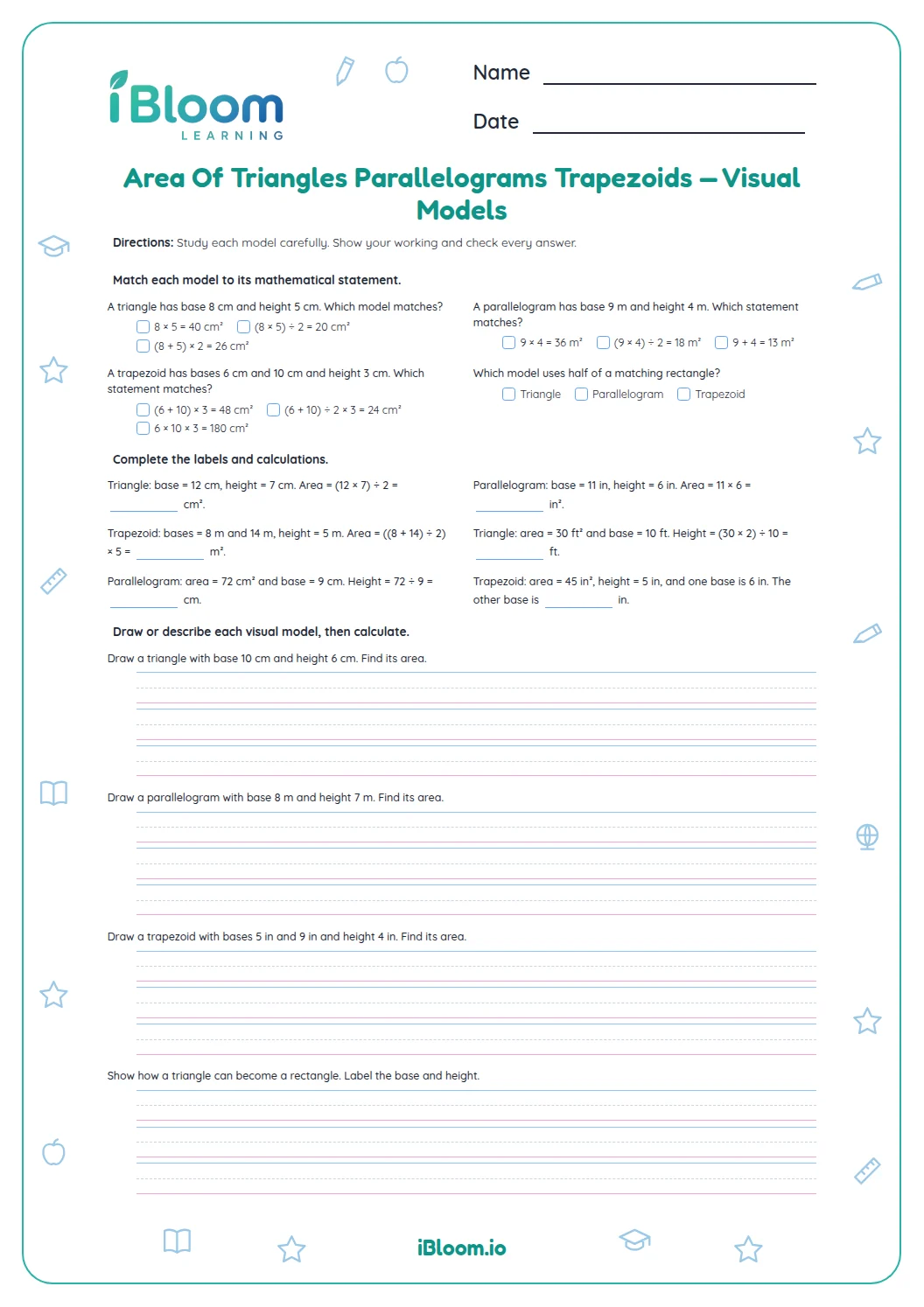
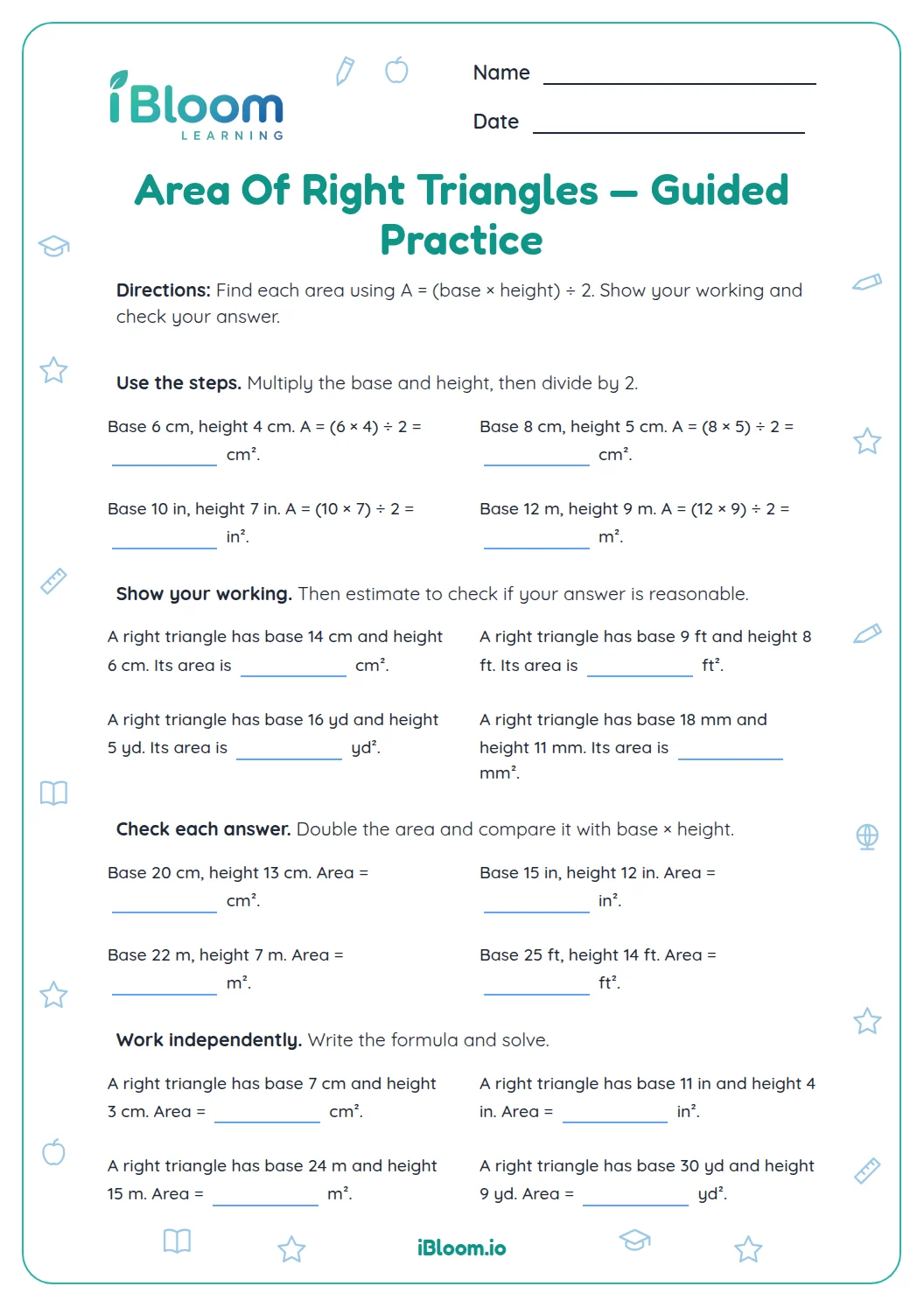
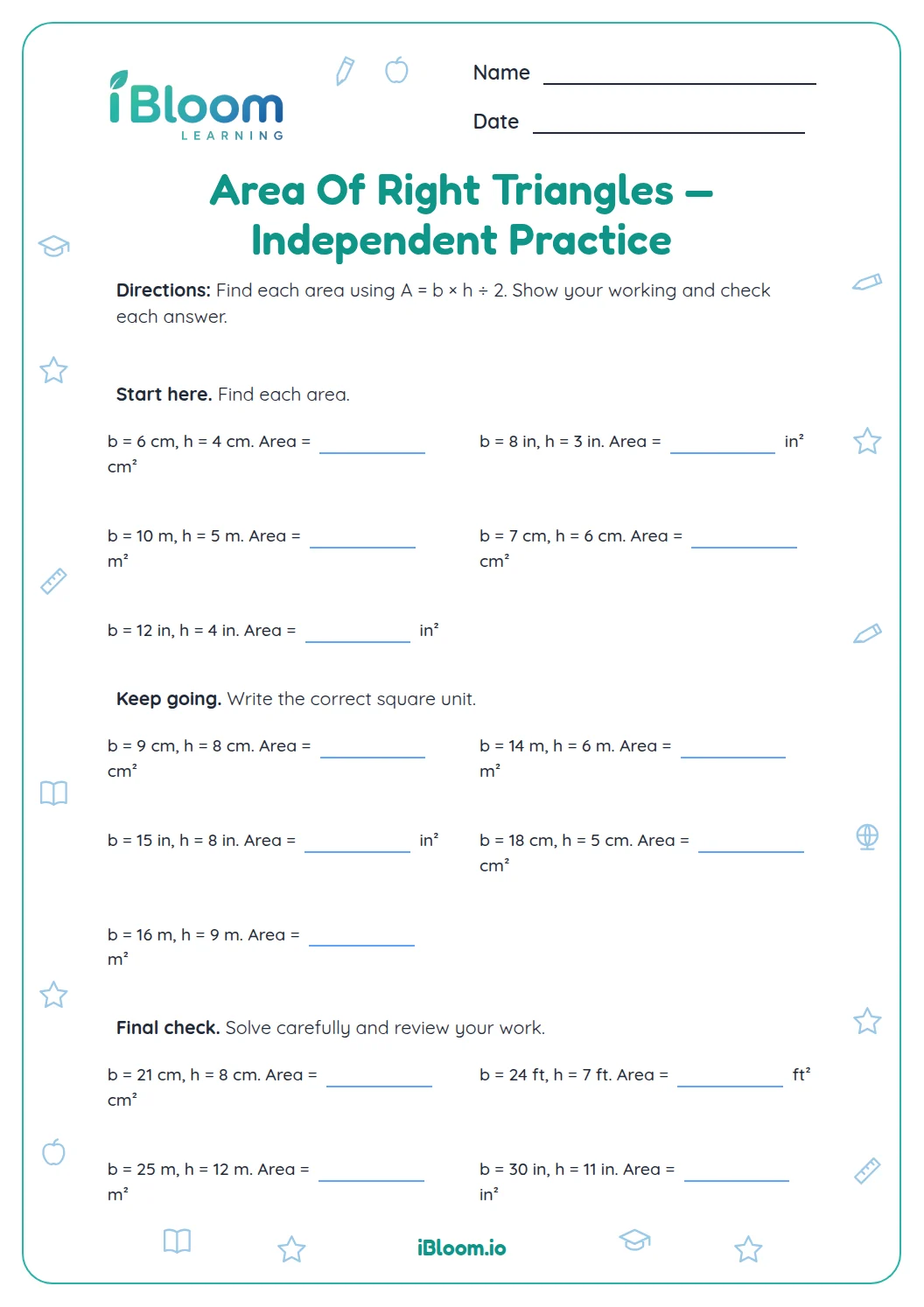
This Grade 6 worksheet practices area of triangles, parallelograms, trapezoids, and rectangles. Children calculate from base and perpendicular height, work backward to find a missing measure, and explain why the triangle formula includes one half. The 15 questions connect to CCSS 6.G.A.1 and include a separate answer key.
Aligned to 6.G.A.1
Why is a triangle half of a rectangle?
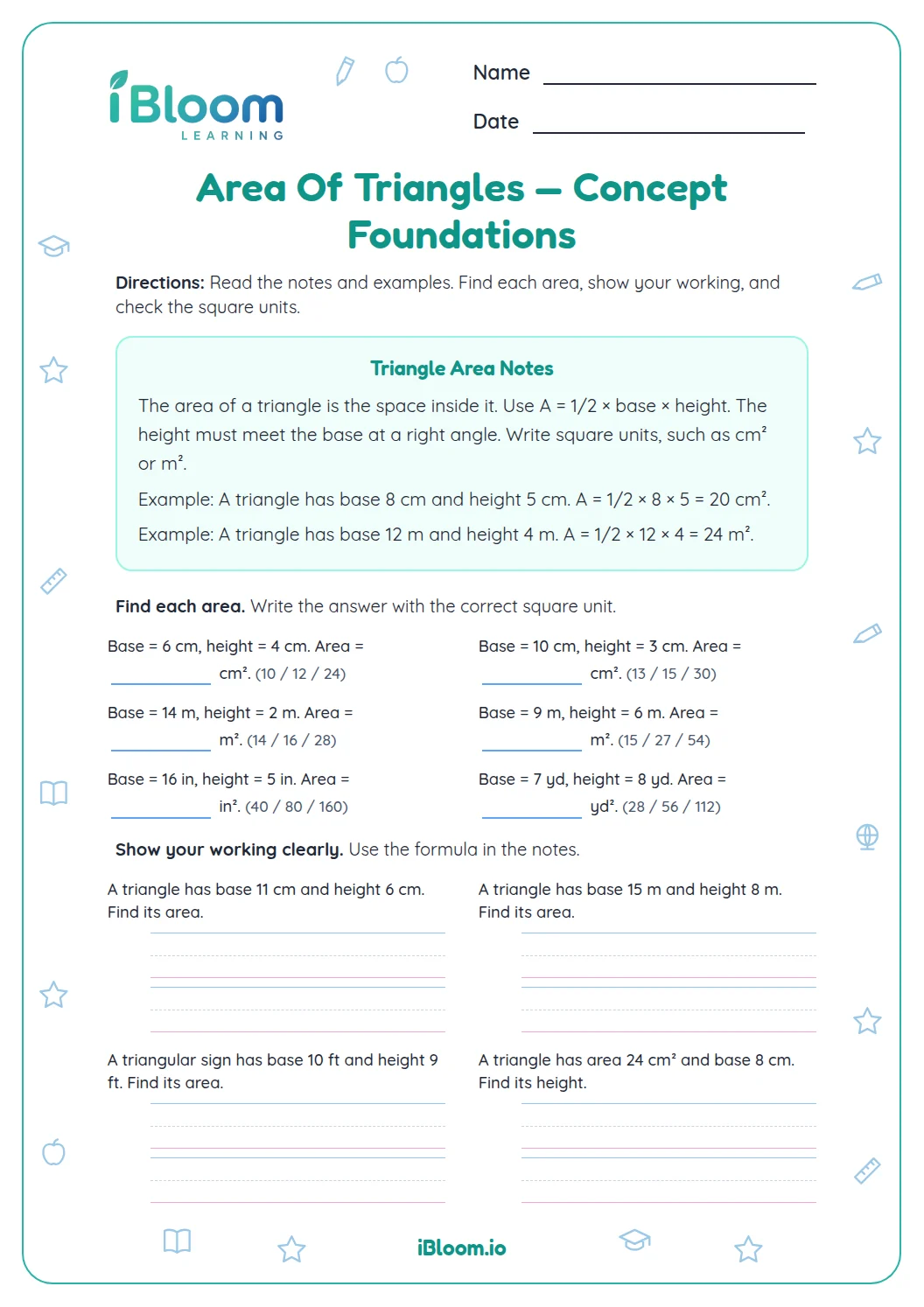
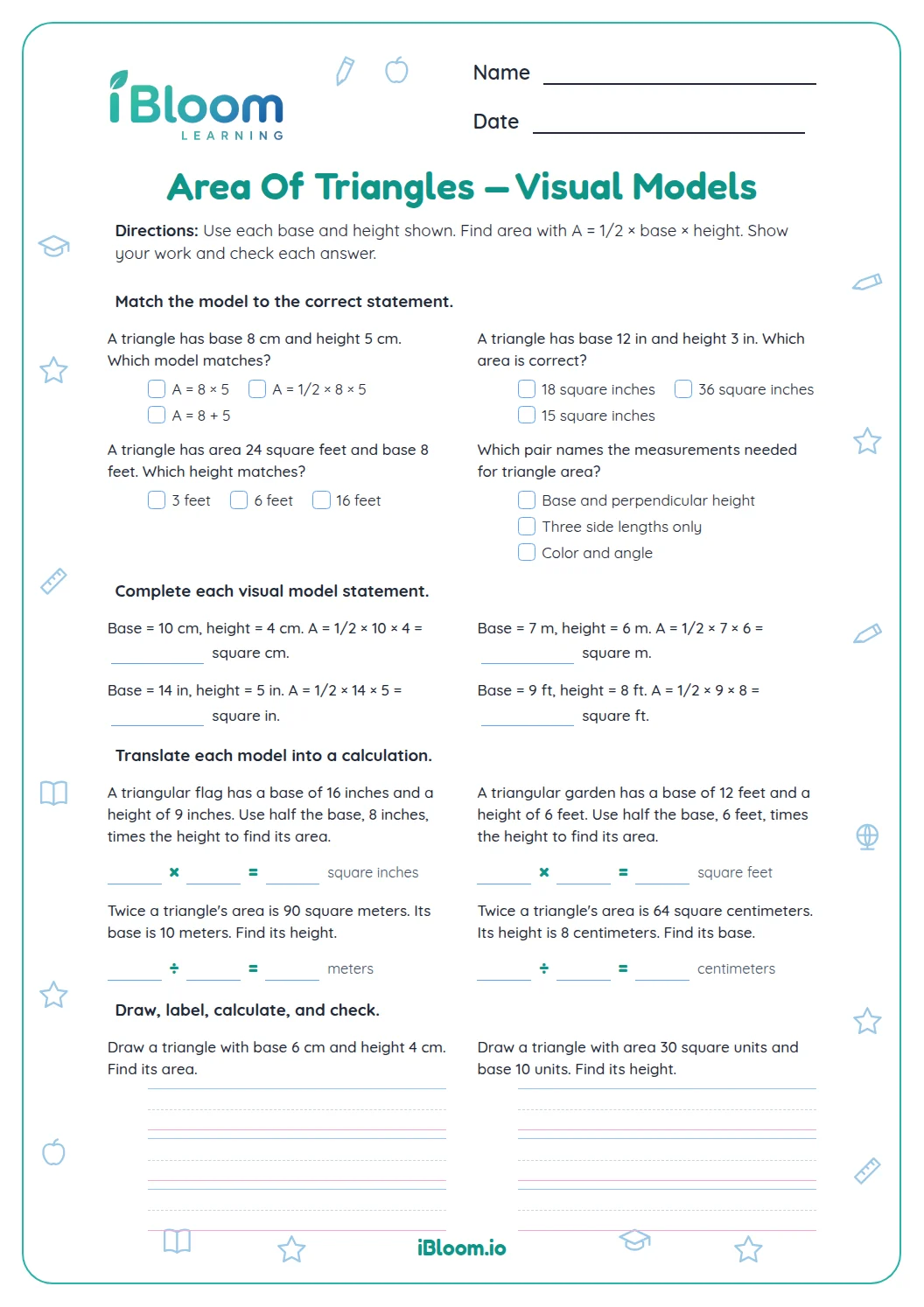
Two matching triangles can form a parallelogram with the same base and height. Since the parallelogram area is base × height, one triangle has half that area.
For question 1, 10 × 6 ÷ 2 = 30 cm². The answer is half the area of the matching rectangle.
- 1Triangle: base 10 cm, height 6 cm
- 210 × 6 = 60
- 360 ÷ 2 = 30 cm²
How do the quadrilateral area rules differ?
A parallelogram uses base × perpendicular height. A trapezoid uses the average of its two parallel bases multiplied by height. A rectangle is length × width. Label square units in every area answer.
How can a child check an area answer?
Estimate whether the result is sensible, keep units squared, and check which formula matches the shape. In question 10, divide 96 square inches by 12 inches to find the 8-inch width.
A clear way to solve each problem
- 1Name the shape and choose its area rule.
- 2Identify the base and perpendicular height.
- 3Substitute the measurements with their units.
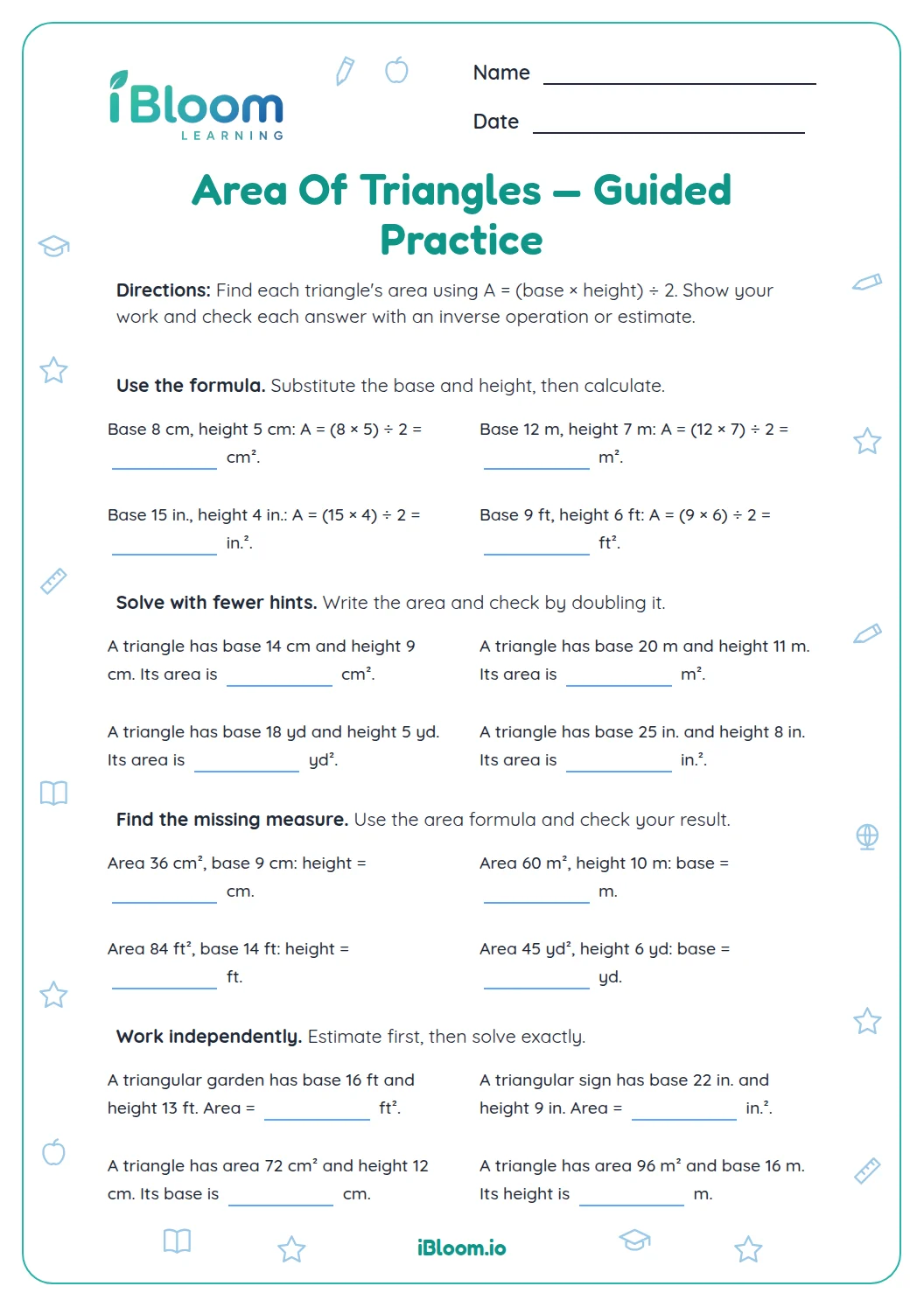
- 4For a triangle, divide the base-height product by 2.
- 5Use square units and substitute back to check missing measures.
Common mistakes and quick fixes
The mistake
Using base plus height instead of multiplying.
The fix
Write the formula first: parallelogram area = base × height.
The mistake
Forgetting to halve a triangle’s base-height product.
The fix
Pair two matching triangles to make one parallelogram, then halve.
The mistake
Using the slanted side as parallelogram height.
The fix
Use the perpendicular distance from base to opposite side.
Common Core alignment
This worksheet gives children practice with the standard below.
Find areas of triangles and special quadrilaterals by composing or decomposing shapes.
On this sheet: Questions use triangle and quadrilateral area formulas and related reasoning.
Show the official wordingHide the official wording
Find the area of right triangles, other triangles, special quadrilaterals, and polygons by composing into rectangles or decomposing into triangles and other shapes; apply these techniques in the context of solving real-world and mathematical problems.
What to practice next
Make more practice
Further reading
Questions parents and teachers ask
What does the triangle height mean?
The height is the perpendicular distance from the chosen base to the opposite vertex or side. It meets the base at a right angle. A slanted side is not automatically the height. The worksheet states the base and height for its formula problems, then asks children to use area relationships to find missing measures.
Why do triangles use one half?
Two matching triangles can fit together to make a parallelogram with the same base and height. That makes one triangle half of base times height. Question 1 practices the calculation with a 10 cm base and 6 cm height, giving an area of 30 square centimeters.
How do you find a trapezoid’s area?
Add the two parallel base lengths, divide by 2, then multiply by the perpendicular height. For example, bases 8 and 14 with height 5 give (8 + 14) × 5 ÷ 2 = 55 square units. This matches question 3 and keeps the trapezoid rule distinct from the parallelogram rule.
Why are area units squared?
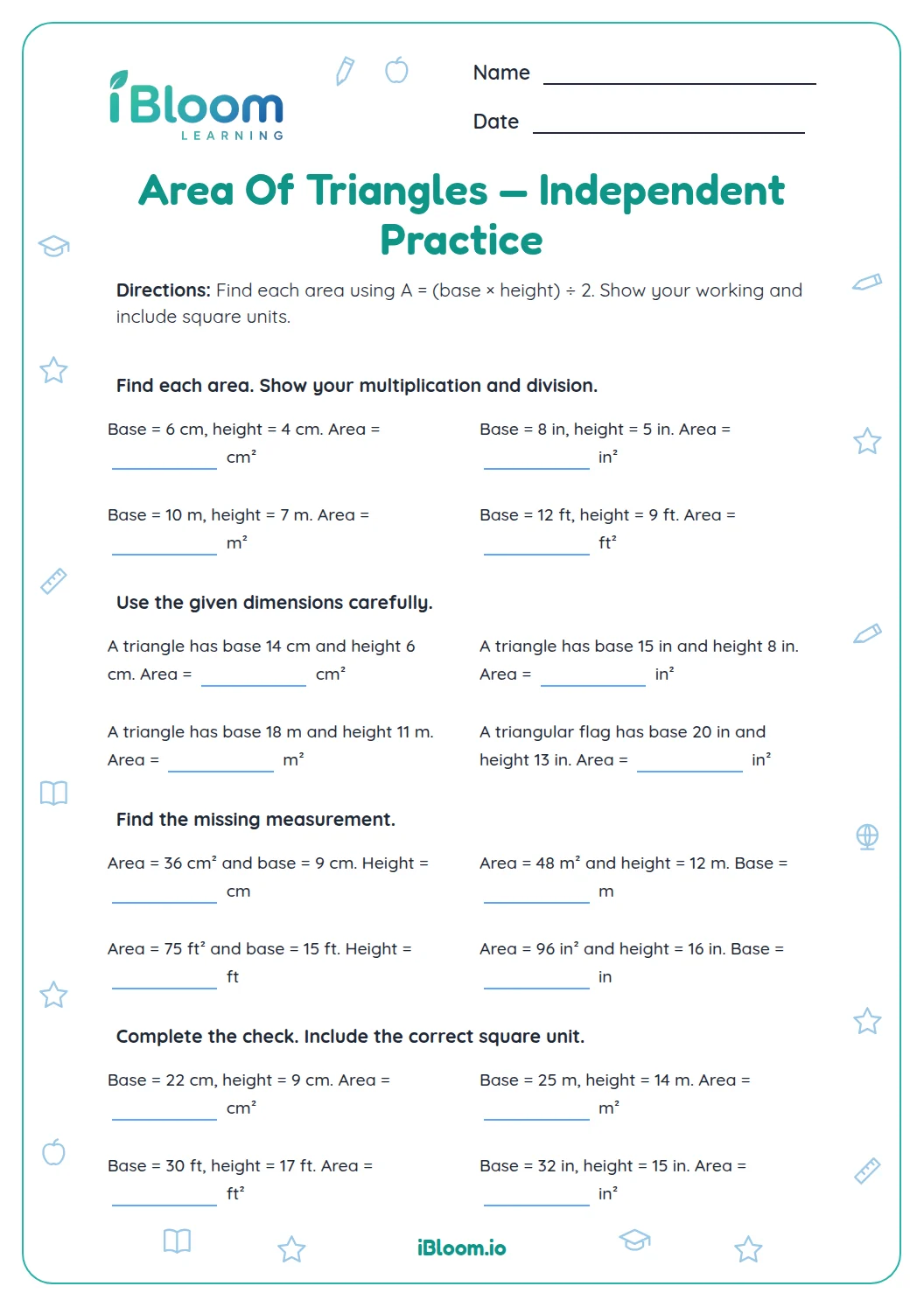
Area counts square units that cover a surface. A length in centimeters multiplied by another length in centimeters gives square centimeters, written cm². Keep the squared unit in the final answer. For example, question 1 uses centimeters for both measures, so its result is 30 cm².
What is on the answer key?
The separate key shows the calculated areas and missing measures, including the rectangle width in question 9. It also gives the formula choice and the numeric answers. There are 15 questions across the two printable pages, so the key is arranged to match both worksheet pages.