
About this worksheet
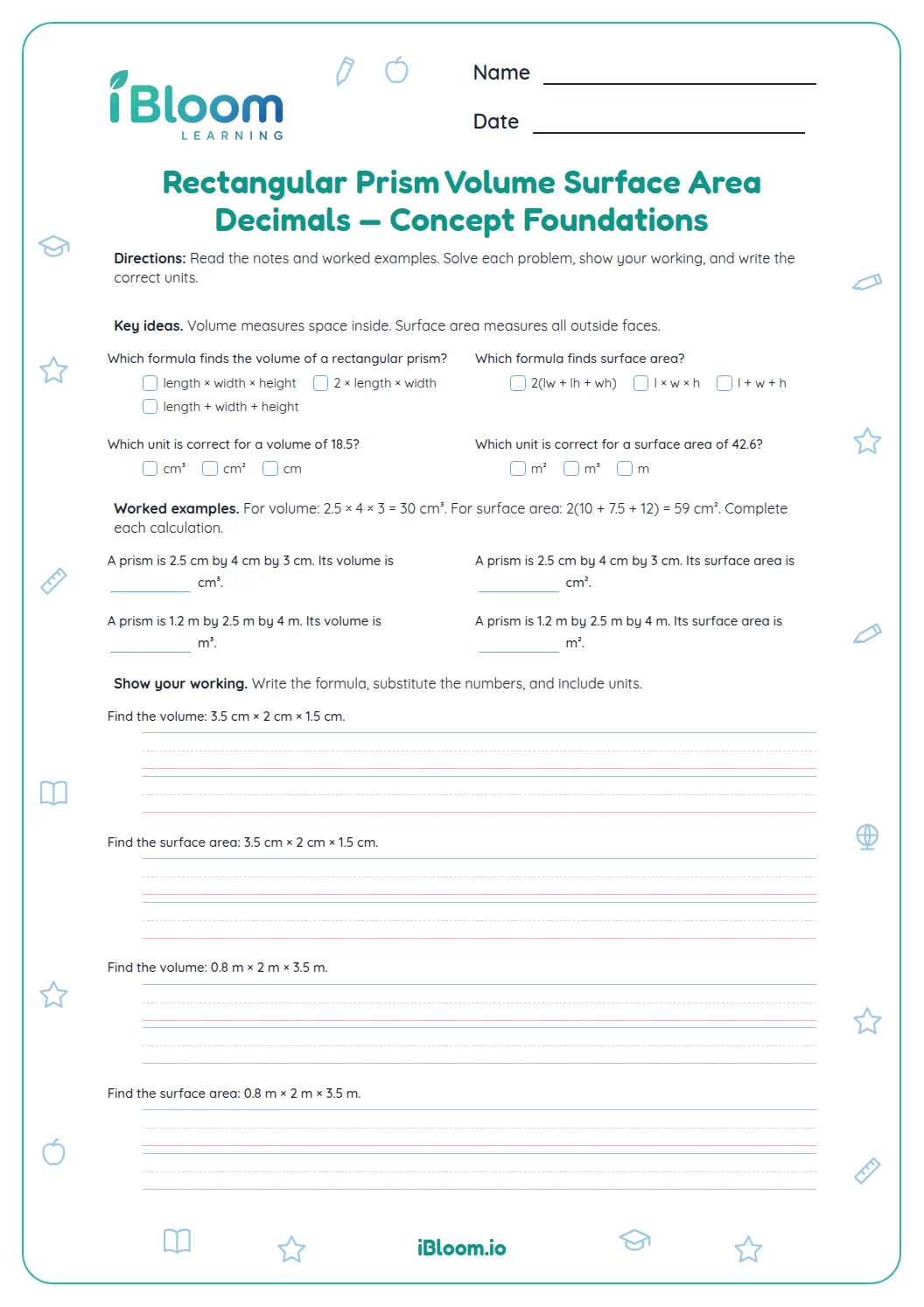
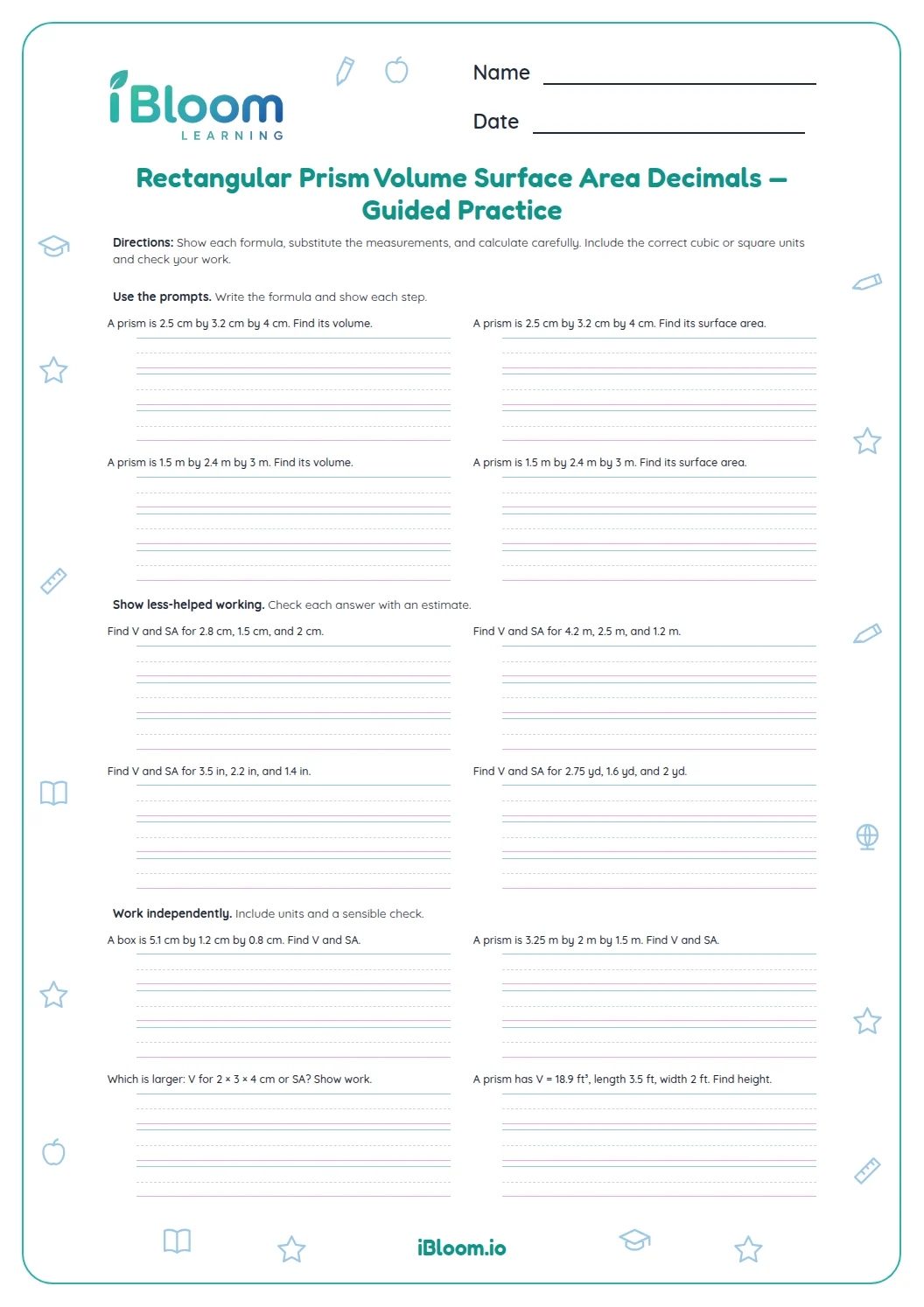
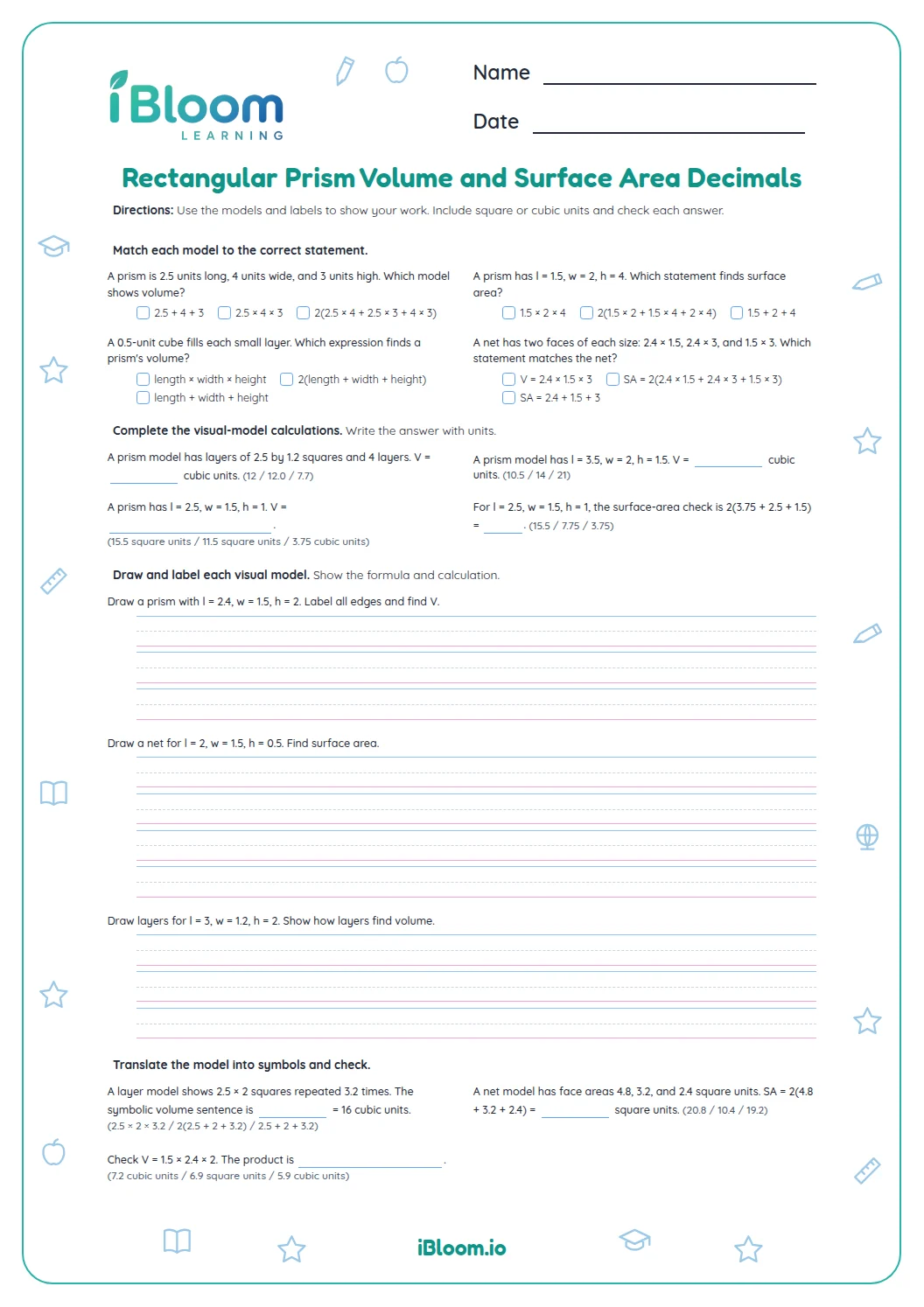
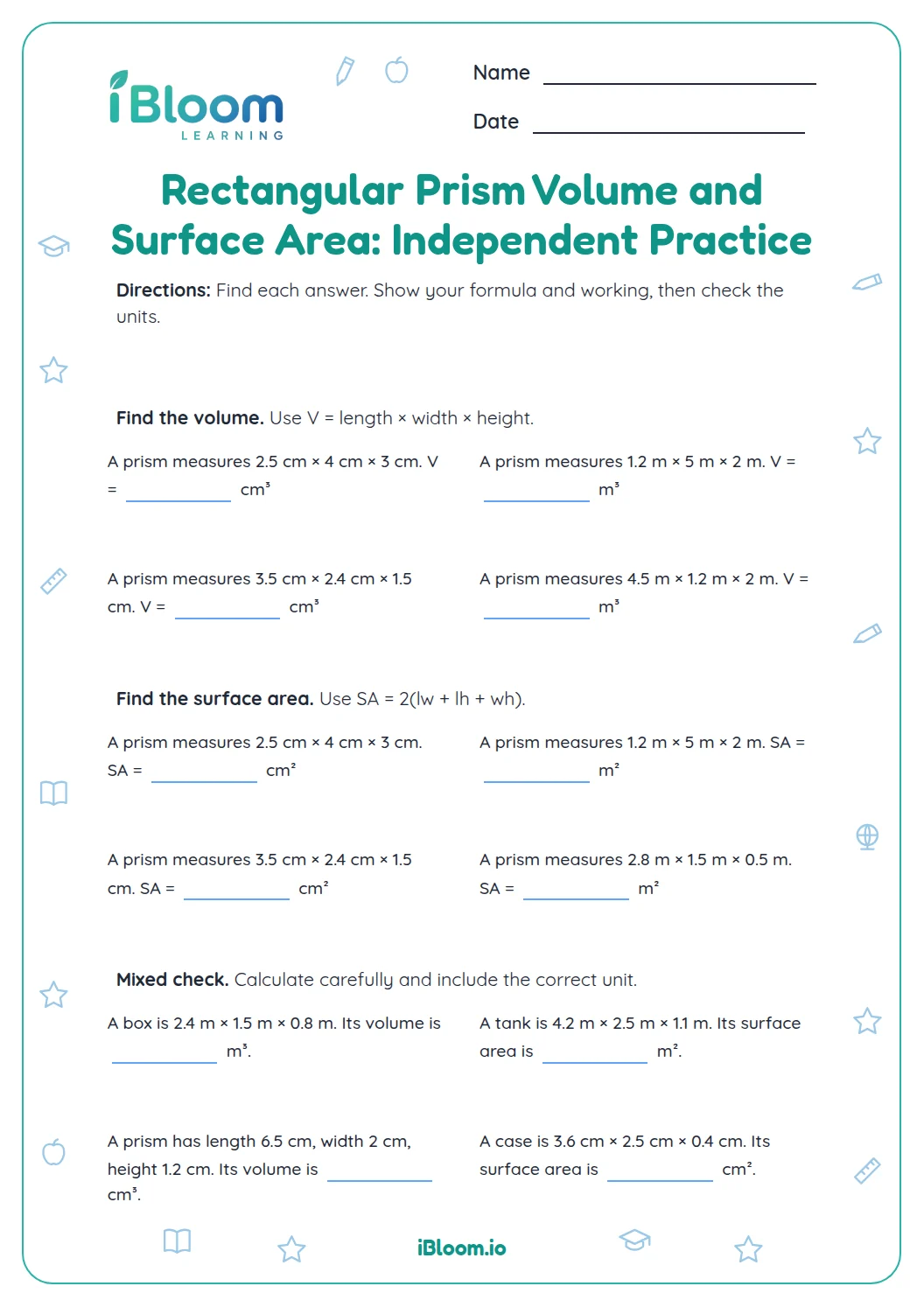
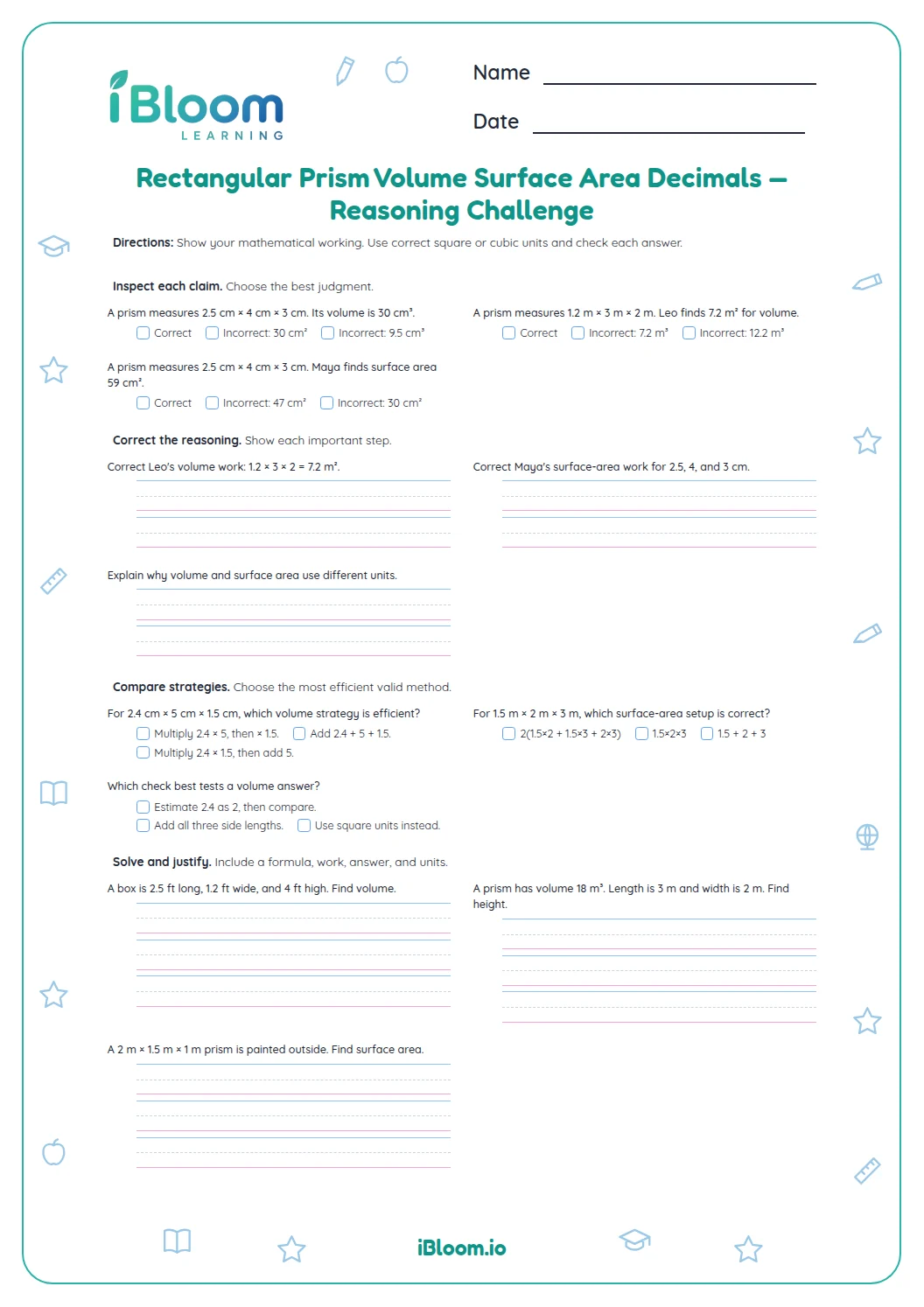
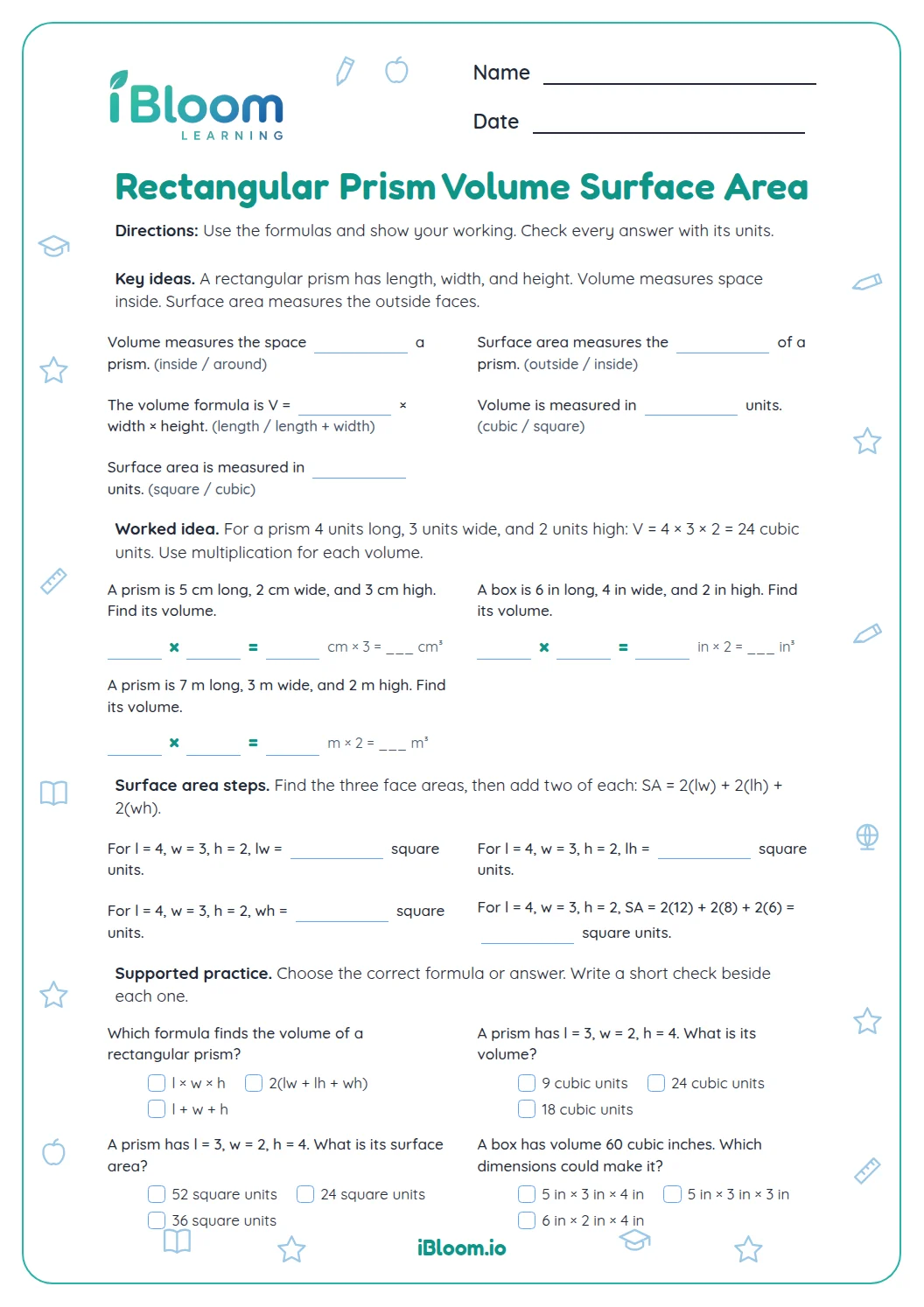
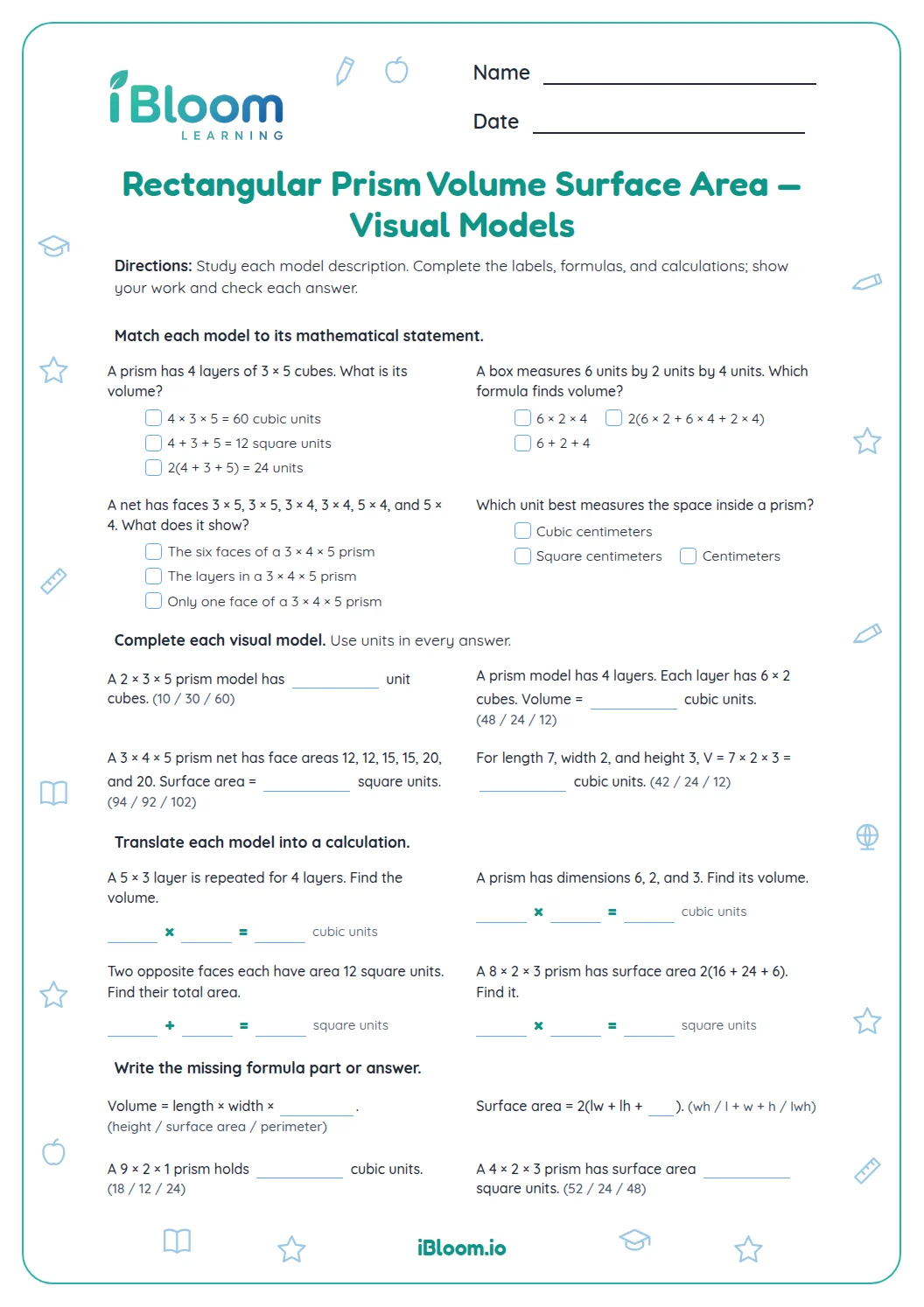
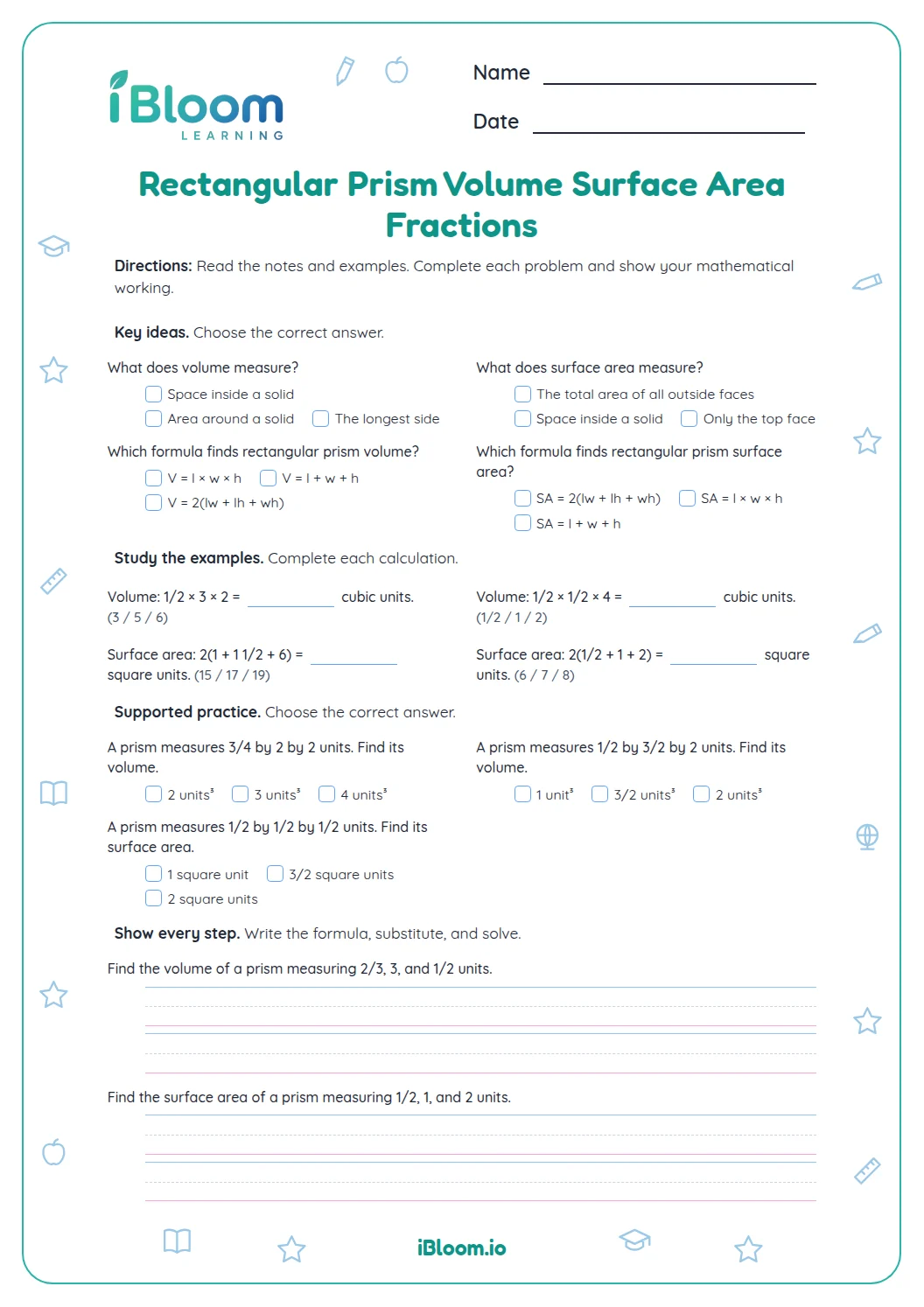
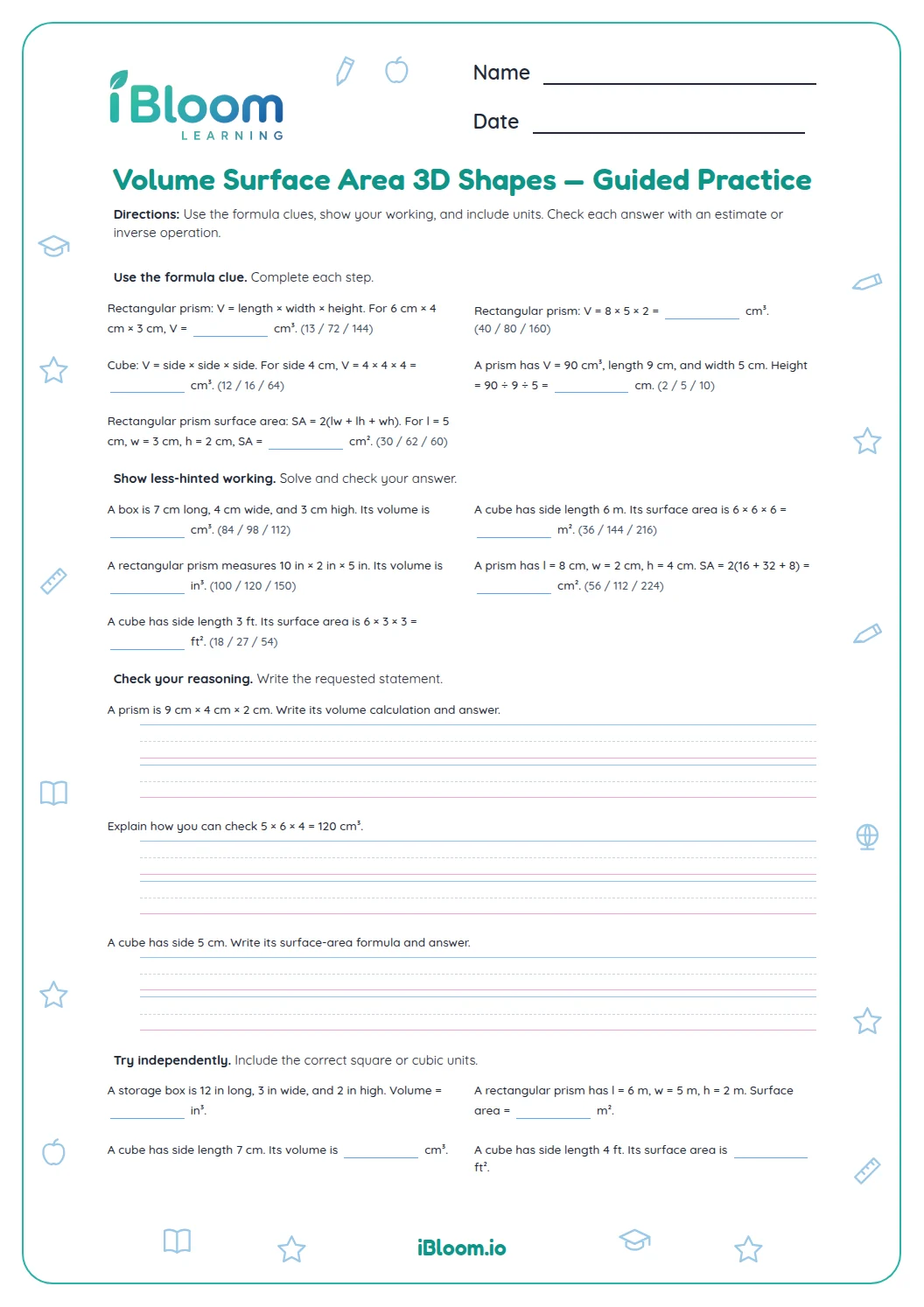
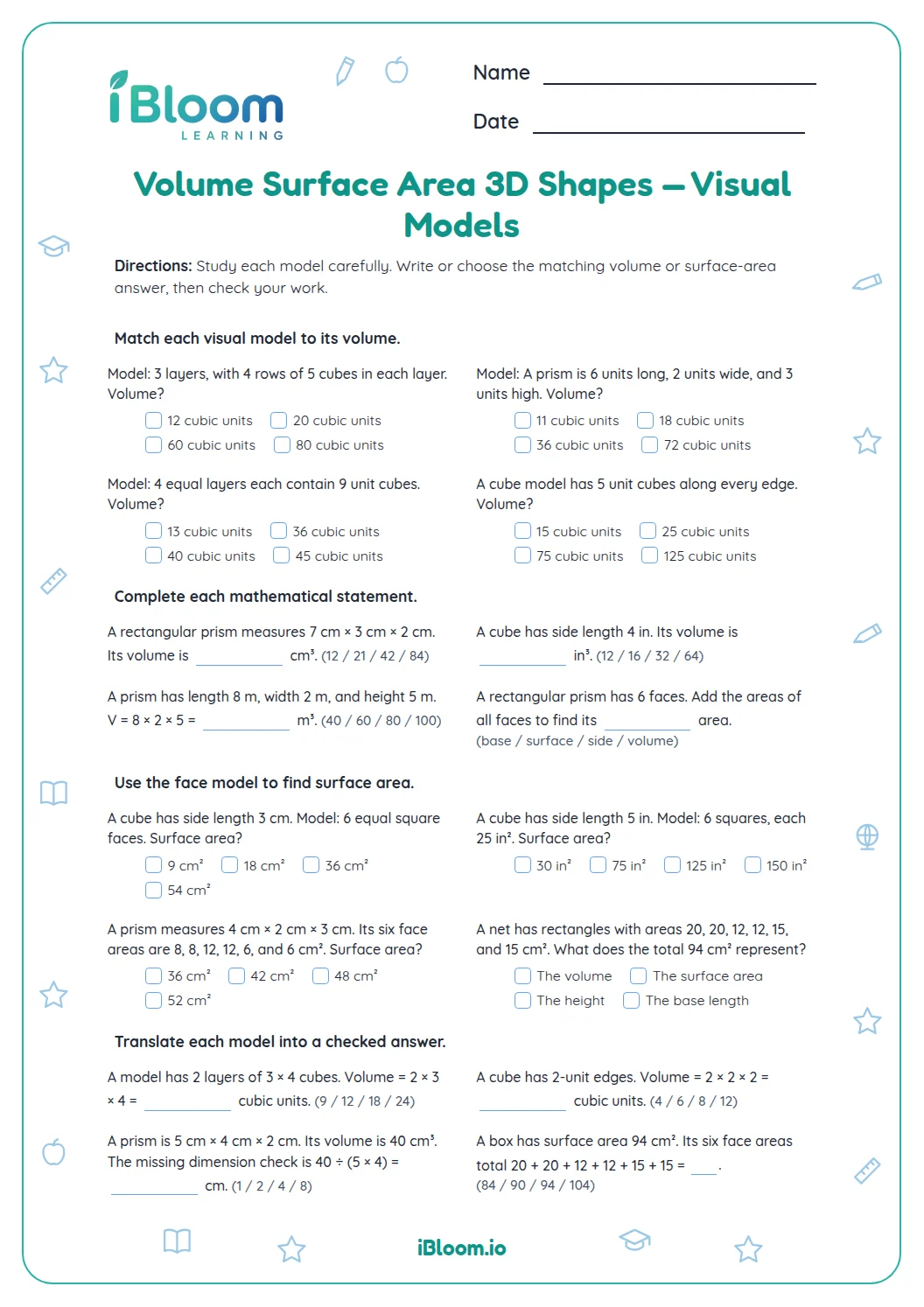
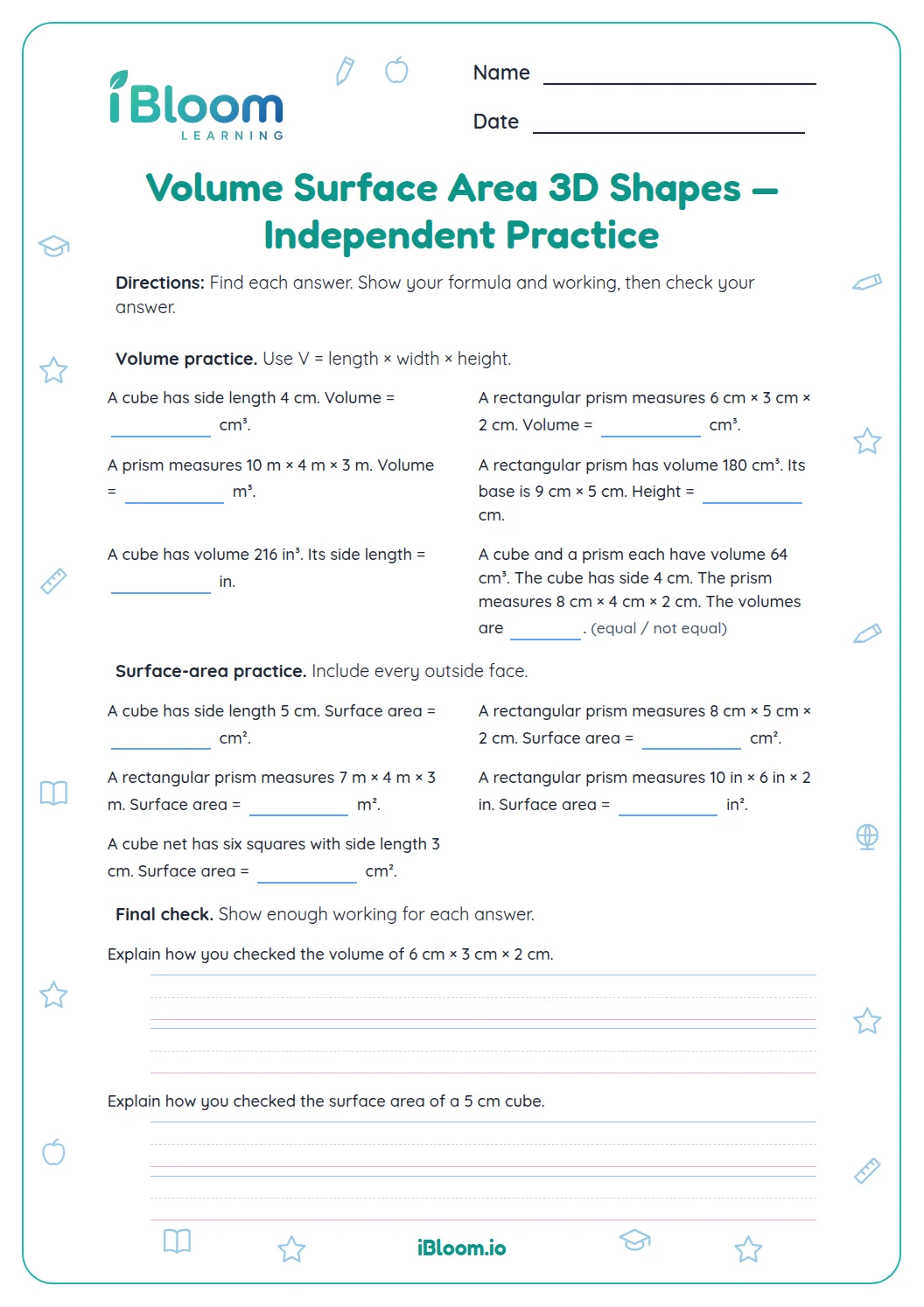
This Grade 6 worksheet follows the original sequence: distinguish volume from surface area, then calculate each measure with rectangular-prism dimensions. Four quick choices sort inside capacity from outside covering; five decimal products find volume; five items total face areas, including a lidless tray. The answer key includes units. The volume problems practice CCSS 6.G.A.2.
Aligned to 6.G.A.2
When do you use volume or surface area?
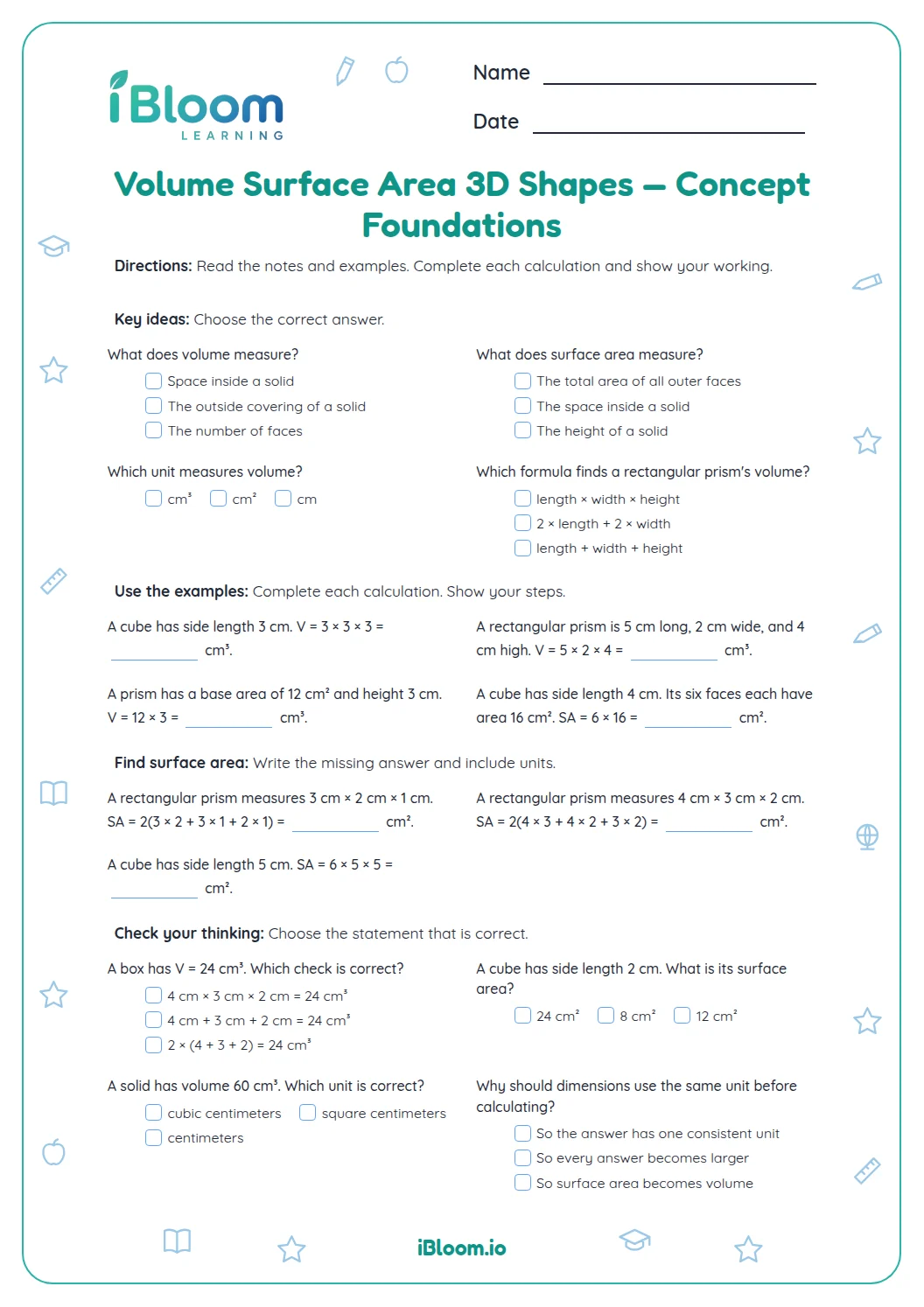
Volume measures the space inside a prism, so its units are cubic. Surface area totals the areas of its outside faces, so its units are square. Part A asks you to identify which measure fits the situation.
How do decimal dimensions give a volume?
Multiply all three edge lengths. Keep the unit with each dimension in mind: feet multiplied three times give cubic feet. In question 7, 1.5 × 0.8 × 0.6 = 0.72, so the aquarium volume is 0.72 m³.
- 11.5 × 0.8 = 1.2
- 21.2 × 0.6 = 0.72 m³
How do you total a prism’s face areas?
Find each pair of matching rectangular faces and add their areas. A closed prism has six faces; a lidless tray does not have a top. Question 10 uses 2(4 × 3 + 4 × 2 + 3 × 2) = 52 in².
A routine for each problem
- 1Decide whether the situation asks about inside space or outside faces.
- 2Write the three dimensions with the same unit.
- 3For volume, multiply length, width and height.
- 4For surface area, add the face areas and omit any face the prompt says is missing.
- 5Check that the answer uses cubic units for volume or square units for area.
Common prism-measure mistakes
The mistake
Using square units for volume.
The fix
Three lengths are multiplied, so label volume in cubic units such as ft³.
The mistake
Finding only the area of the base when the question asks for total surface area.
The fix
Count and add every face that exists; use matching pairs of faces to check the total.
The mistake
Including a top on the lidless tray.
The fix
Read the description, then leave out the missing face before adding the remaining areas.
Common Core alignment
The volume calculations apply the rectangular-prism formula with decimal edge lengths.
Use volume formulas for rectangular prisms with fractional edge lengths.
On this sheet: Part B multiplies decimal edge lengths in real-world rectangular-prism situations.
Show the official wordingHide the official wording
Find the volume of a right rectangular prism with fractional edge lengths by packing it with unit cubes of the appropriate unit fraction edge lengths, and show that the volume is the same as would be found by multiplying the edge lengths of the prism. Apply the formulas V = l w h and V = b h to find volumes of right rectangular prisms with fractional edge lengths in the context of solving real-world and mathematical problems.
What to practice next
Make more practice
Further reading
Questions parents and teachers ask
What is the difference between volume and surface area?
Volume measures the space inside a three-dimensional object and uses cubic units. Surface area measures the total area of its outside faces and uses square units. Part A helps learners decide which measure a situation asks for. Question 1 asks about the bin’s capacity, while question 2 asks what covers its outside.
How do I calculate the volume in question 5?
Multiply the bin’s three edge lengths: 2.5 × 2 × 1.2. The product is 6, and the three foot dimensions make the result 6 cubic feet, written 6 ft³. Write the unit as ft³ because three lengths measured in feet were multiplied.
Why does surface area use square units?
Each face is a rectangle, so its area is measured in square units. Add the areas of the faces that are present to get the prism’s total outside area. For example, a 4-in by 3-in by 2-in box has 52 in² of surface area.
How should a student handle the lidless tray?
The prompt says to exclude the open top, so add the base and four side faces only. For the 5-inch by 3-inch by 2-inch tray, those face areas total 47 square inches. Its five remaining faces are the bottom and four sides.
Does the worksheet include an answer key?
Yes. The separate key lists each selected measure and each calculated result with its unit. For a missed problem, check whether the issue was choosing the measure, multiplying dimensions, or counting faces. Use the unit shown in the question so the answer stays tied to its dimensions.