
About this worksheet
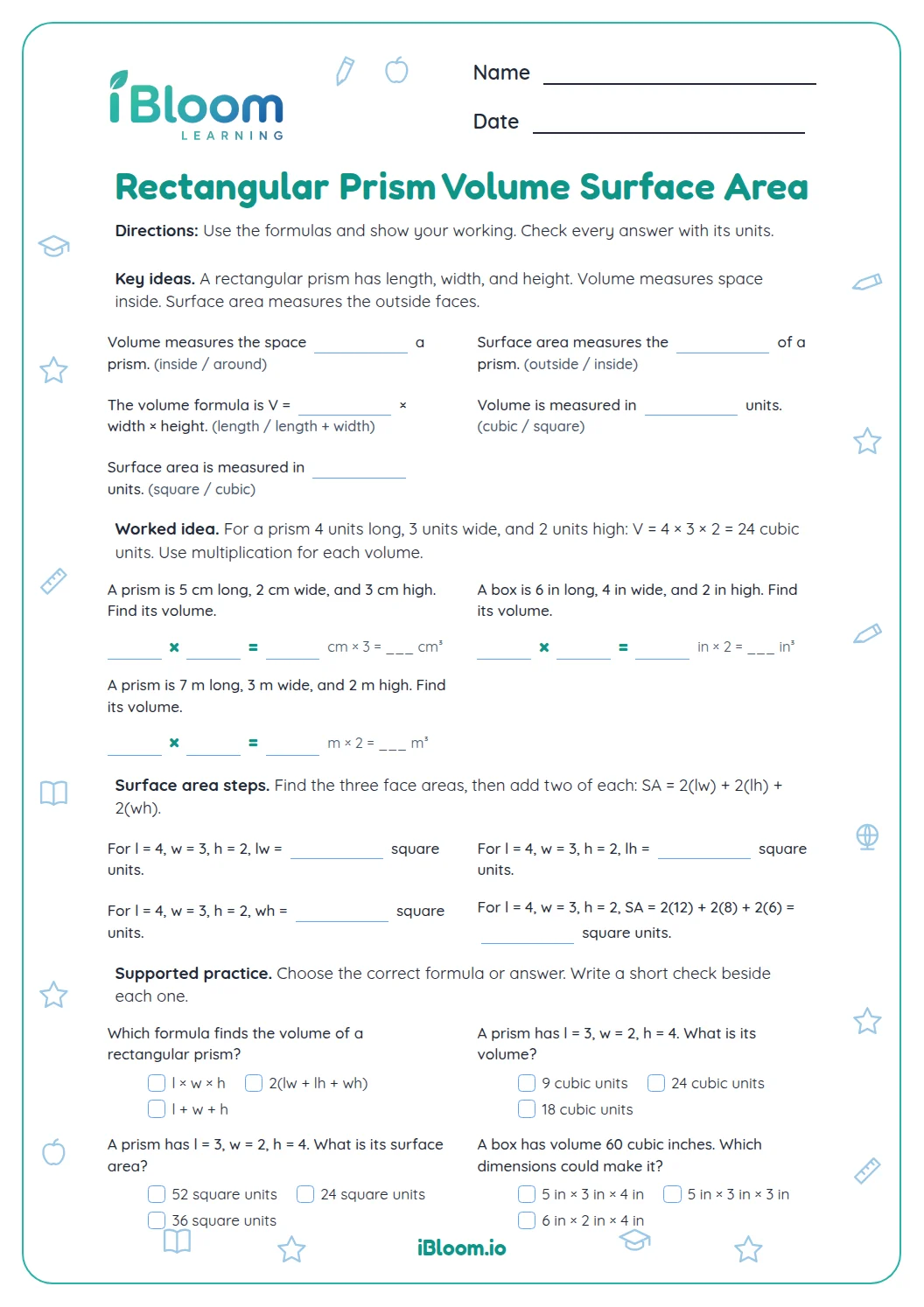
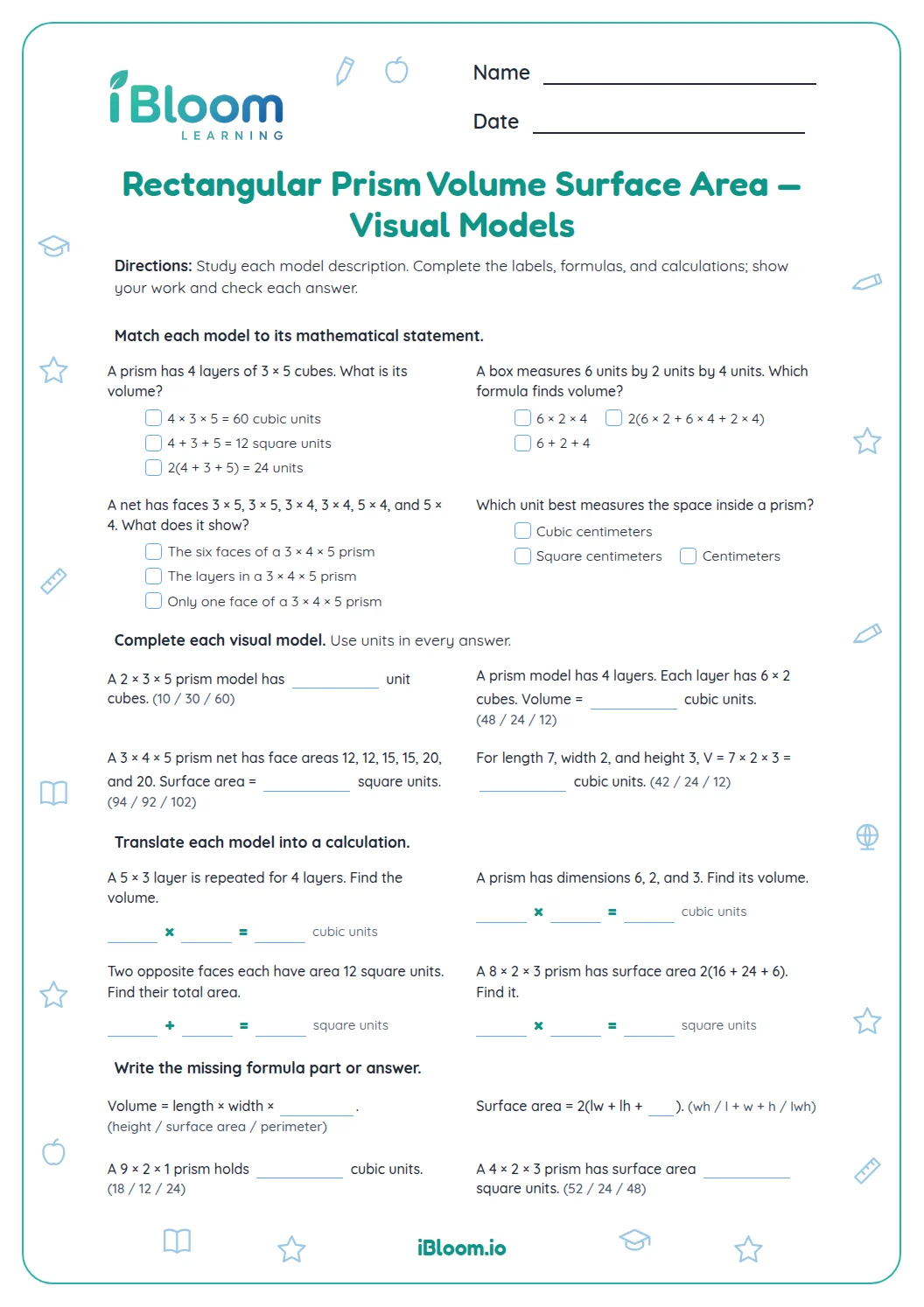
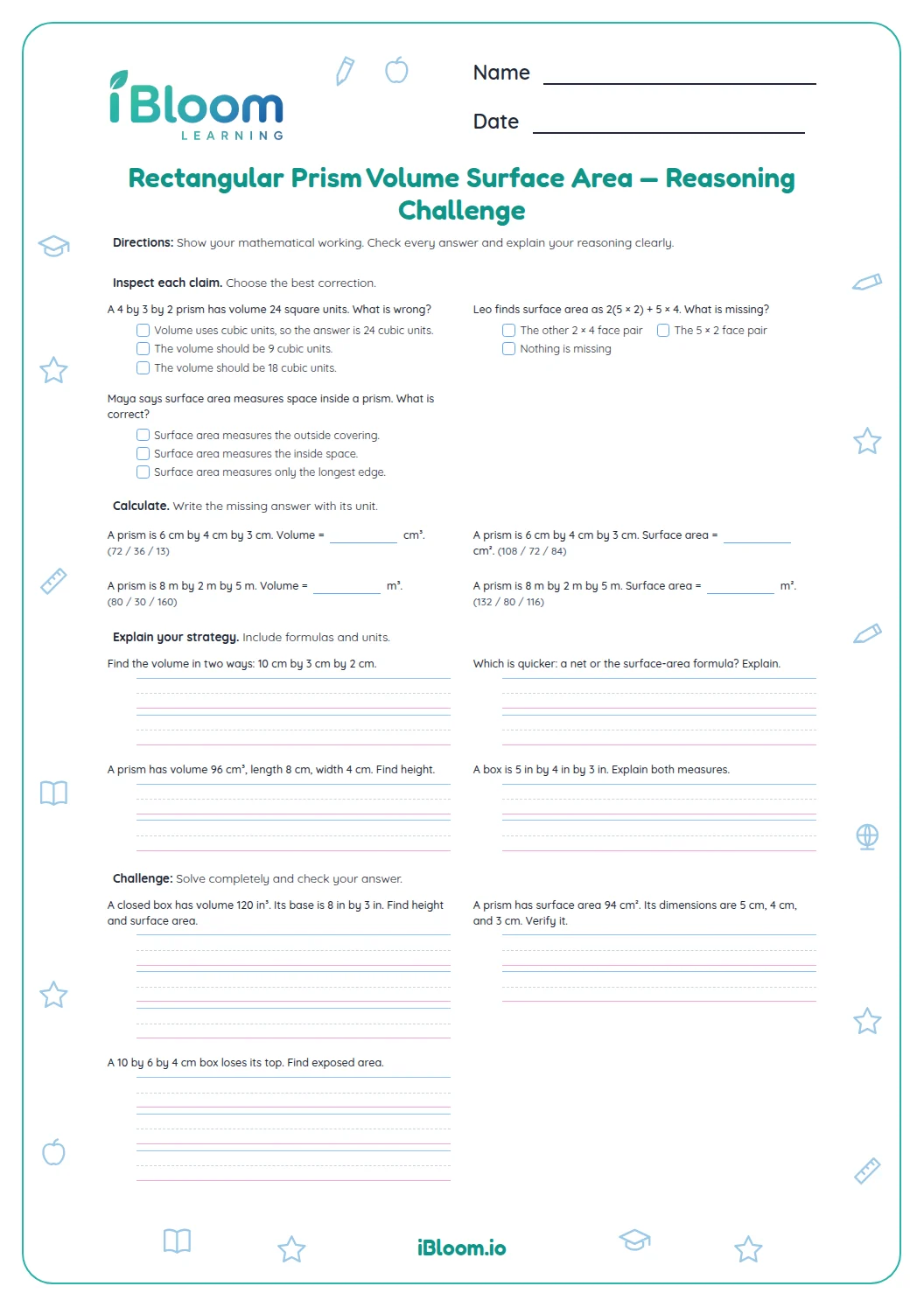
This Grade 6 printable gives independent practice with rectangular prism volume and surface area. Students calculate six volumes, six surface areas, and two mixed sets of measures using the dimensions provided. The answer key shows the numerical results and square or cubic units. Directions ask students to write a formula and show their working before checking.
How do you find a prism’s volume?
Multiply its length, width, and height. Keep the units cubic because three dimensions are multiplied.
- 11) 8 cm × 3 cm × 4 cm = 96 cm³
- 2The product measures the space inside the prism.
How do you find surface area?
Find the area of each pair of equal rectangular faces, then add the three pair totals. The formula 2(lw + lh + wh) accounts for all six faces.
Why do the units change?
Area combines two lengths, so its units are squared. Volume combines three lengths, so its units are cubed. The mixed questions make that distinction visible for one set of dimensions.
How to use this worksheet
- 1Mark the length, width, and height in each problem.
- 2For volume, multiply all three dimensions.
- 3For surface area, calculate lw, lh, and wh, then double their sum.
- 4Write cm² or in² for area and cm³ or in³ for volume.
- 5Use the answer key to check formulas, calculations, and units.
Common mistakes and quick fixes
The mistake
Using l × w for volume and stopping after one face.
The fix
Multiply length, width, and height for the volume.
The mistake
Adding the three face areas without counting opposite faces.
The fix
Double the sum lw + lh + wh because each face has an equal opposite face.
The mistake
Writing square units for volume.
The fix
Use cubic units when three dimensions are multiplied.
What to practice next
Make more practice
Questions parents and teachers ask
What formula finds a rectangular prism’s volume?
Multiply length by width by height. For the first problem, 8 × 3 × 4 = 96, so the volume is 96 cm³. The cubic unit signals that volume measures three-dimensional space. Each problem gives all three dimensions, so students can focus on choosing and applying the formula.
How is surface area different from volume?
Volume measures space inside the prism; surface area measures its outside faces. Volume uses cubic units, while surface area uses square units and adds the areas of all six faces. Students should label the answer with the same length unit used in the dimensions.
Why does the surface-area formula double three products?
A rectangular prism has three pairs of equal opposite faces. The products lw, lh, and wh give the areas of one face from each pair. Doubling their sum counts all six faces. The mixed section repeats the same dimensions for both calculations, which makes the difference between the measures clear.
How many problems are on this sheet?
There are 14 problems across three parts: six volume calculations, six surface-area calculations, and two mixed problems that ask for both measures. The two-page key lists each result with its unit. The problems use centimeter, inch, foot, and meter dimensions, with units included in the key.
What should students show for each calculation?
Write the relevant formula, substitute the three dimensions, and show the arithmetic. For surface area, record the three face products before doubling their sum. Finish by checking whether the unit is squared or cubed. Showing the formula makes it easier to spot whether a student found volume or added face areas.