
About this worksheet
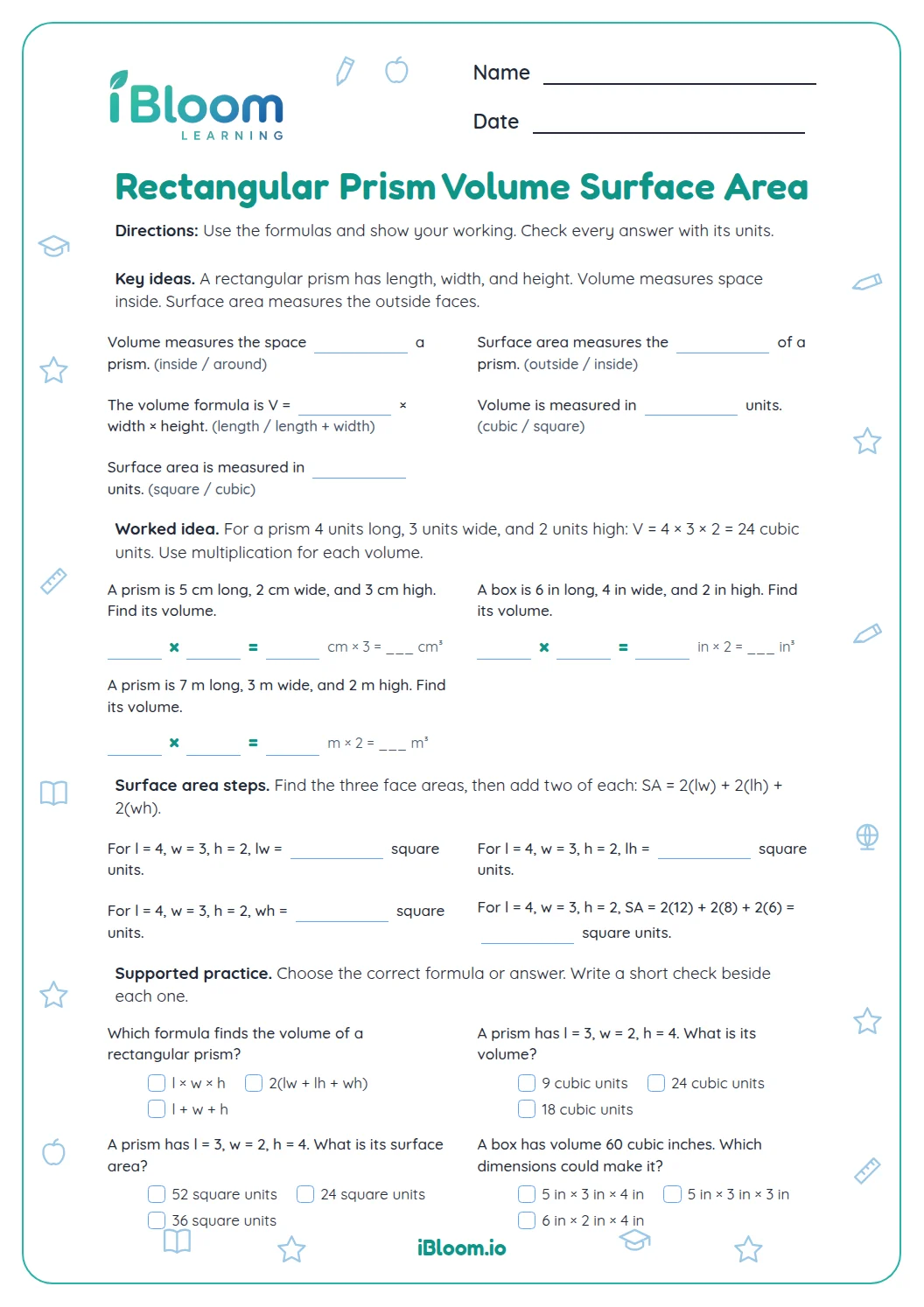
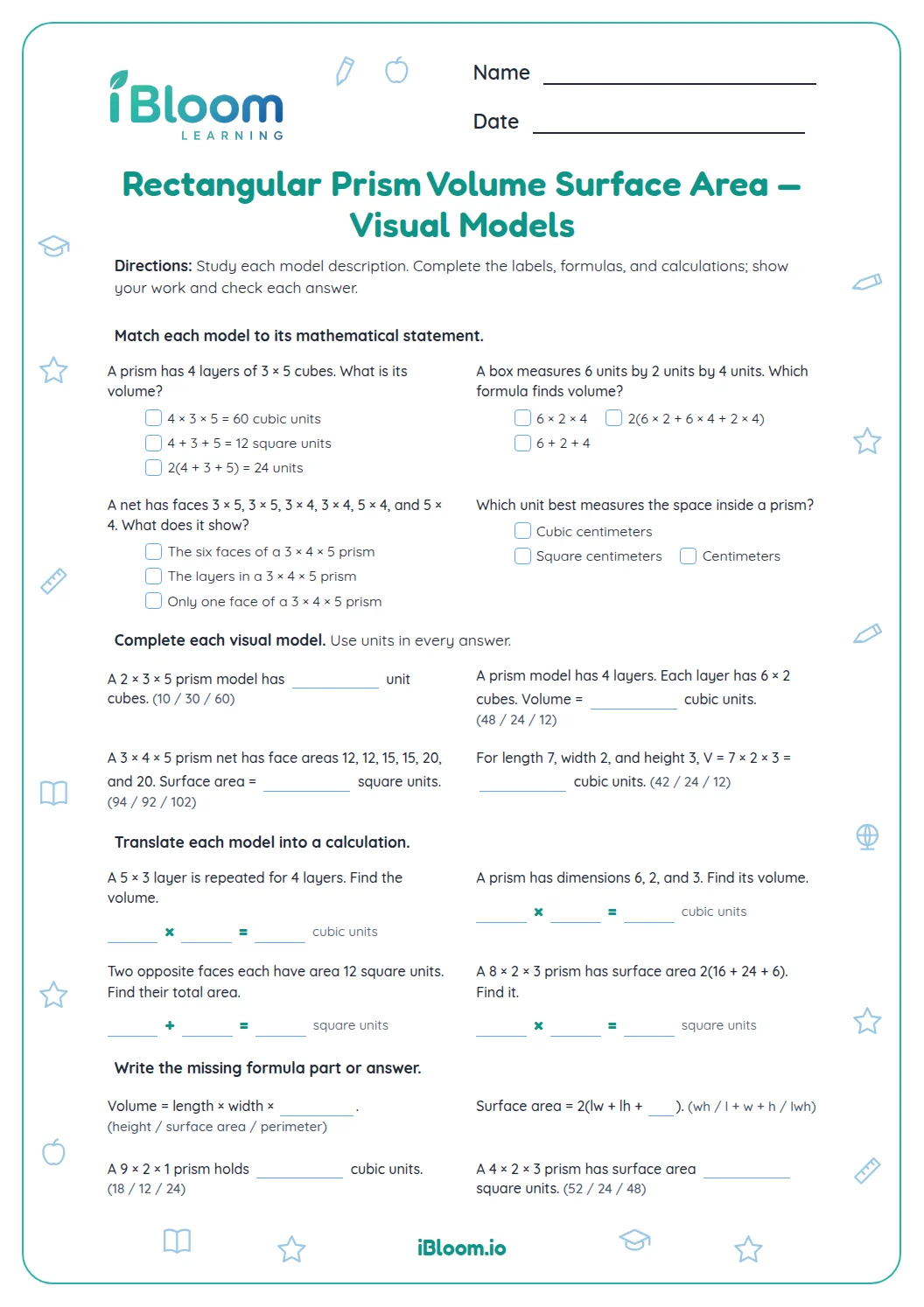
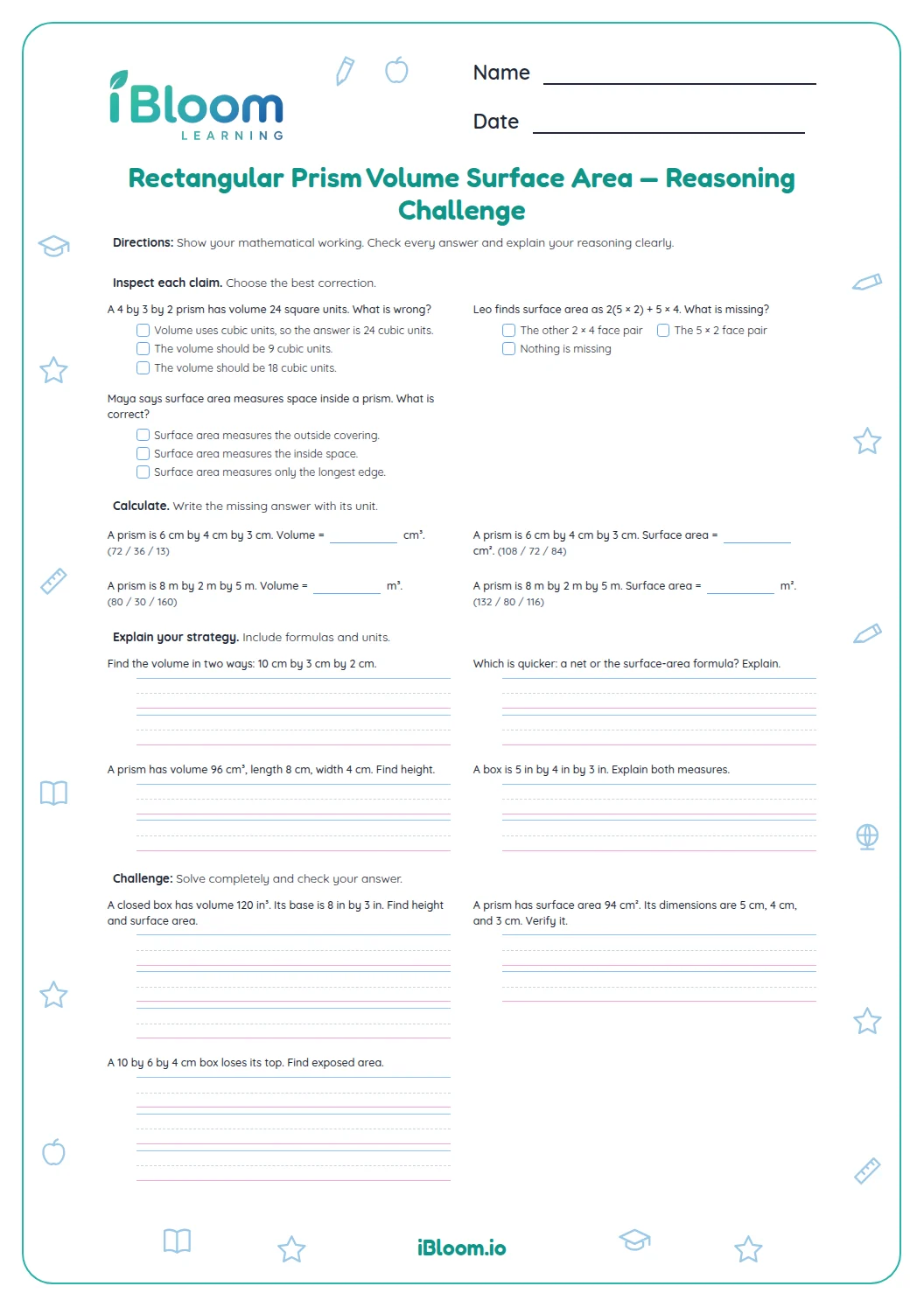
This Grade 6 printable practices rectangular prism volume and surface area in real-world settings. Across 16 questions, learners calculate cubic units, add the areas of six faces, find a missing dimension, and decide which measure fits the situation. The volume problems include a fractional edge length and connect to Common Core 6.G.A.2. A separate answer key gives concise answers with units.
Aligned to 6.G.A.2
How do dimensions give volume?
Multiply length, width, and height. Volume measures the space inside in cubic units.
- 18 × 5 × 3 = 120 cm³
What does surface area measure?
Surface area is the total area of the six outside faces. Add the matching pairs of rectangular faces.
- 12(9×4) + 2(9×2) + 2(4×2) = 124 cm²
How do you find a missing height?
Divide the volume by the product of the two base dimensions. Keep the units consistent.
- 1360 dm³ ÷ (12 dm × 5 dm) = 6 dm
Which measure fits the situation?
Space inside a prism is volume; material covering its outside is surface area. Match cubic units to volume and square units to surface area.
- 1Water inside a tank is volume; wrapping paper is surface area.
How to use this worksheet
- 1Read the direction at the start of each part.
- 2Work one item at a time and use the clue named in the prompt.
- 3Label units on measurement answers.
- 4Check the completed page with the answer key.
- 5Review any item that needs another try.
Common mistakes and quick fixes
The mistake
Using square units for volume.
The fix
Use cubic units for the space inside.
The mistake
Finding only one face for surface area.
The fix
Add all six faces, including both matching faces in each pair.
The mistake
Multiplying for a missing dimension.
The fix
Divide volume by the product of the other two dimensions.
Common Core alignment
The volume problems apply a rectangular prism formula in real-world contexts.
Apply prism volume formulas, including with fractional edge lengths, in context.
On this sheet: The volume items use V = lwh in contexts, including a prism with a fractional edge length.
Show the official wordingHide the official wording
Find the volume of a right rectangular prism with fractional edge lengths by packing it with unit cubes of the appropriate unit fraction edge lengths, and show that the volume is the same as would be found by multiplying the edge lengths of the prism. Apply the formulas V = l w h and V = b h to find volumes of right rectangular prisms with fractional edge lengths in the context of solving real-world and mathematical problems.
What to practice next
Make more practice
Further reading
Questions parents and teachers ask
What does this worksheet practice?
It has 16 Grade 6 problems on rectangular prism volume and surface area. Learners calculate cubic units, add the areas of six faces, find a missing height, and choose the correct measure for a real-world situation. Ask the learner to name the clue that helped before moving on.
How many items are on the page?
There are 16 problems in four parts. They move from calculating volume and surface area to applying dimensions in context and choosing the measure that answers a practical question. Ask the learner to name the clue that helped before moving on.
How should we use the answer key?
Complete each problem first, then compare the calculation and unit with the key. For surface area, check that all six faces were counted; for volume, check that all three dimensions were multiplied. Ask the learner to name the clue that helped before moving on.
Can an adult use this in a small group?
Yes. Model the difference between space inside a prism and material covering its outside. Learners can then solve the examples, name the measure they used, and check their answers with the key. Ask the learner to name the clue that helped before moving on.
What if an answer differs from the key?
Review whether the question asks for inside volume or outside surface area, then check the formula and units. If a dimension is missing, divide the volume by the product of the two known dimensions. Ask the learner to name the clue that helped before moving on.