
About this worksheet
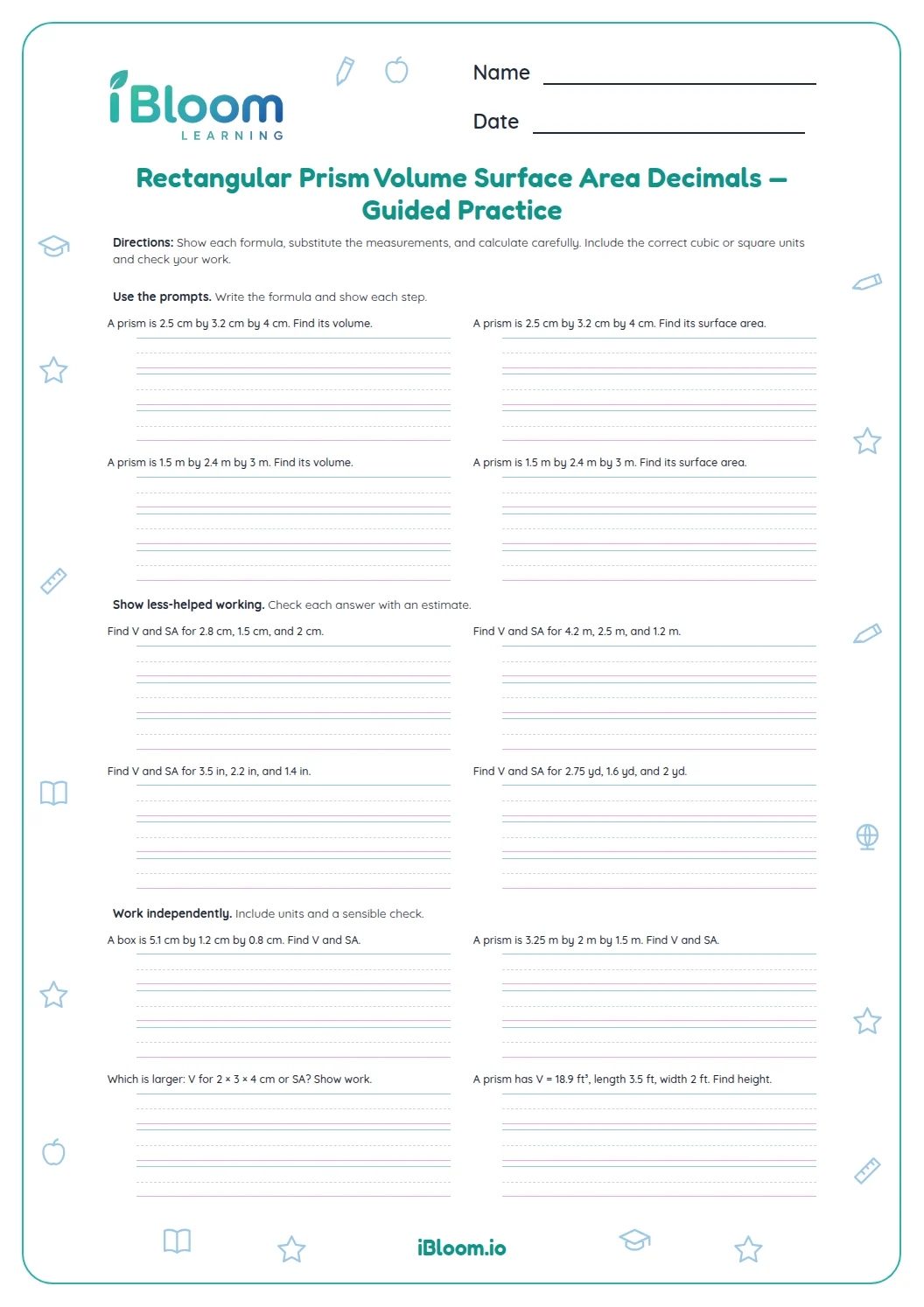
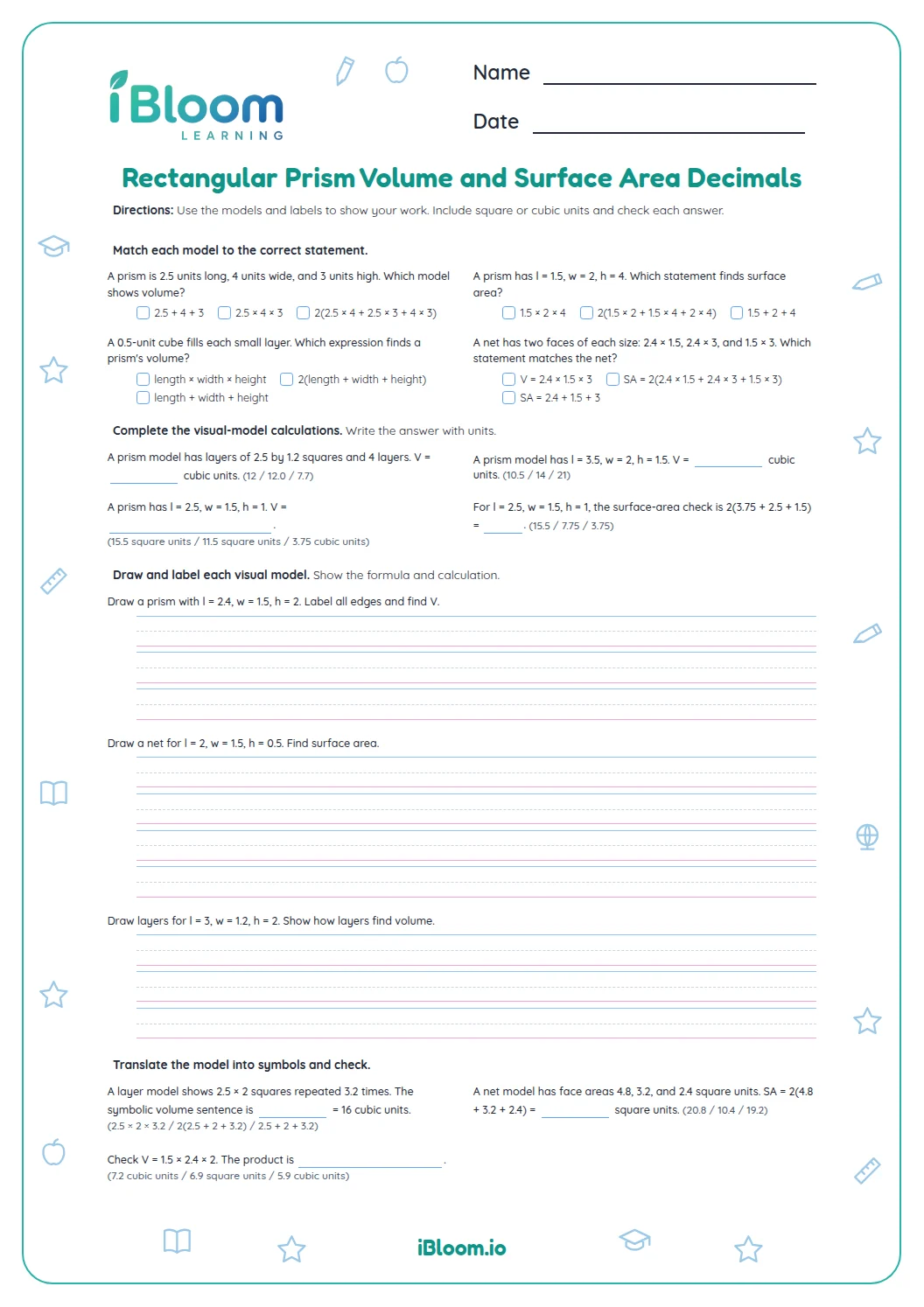
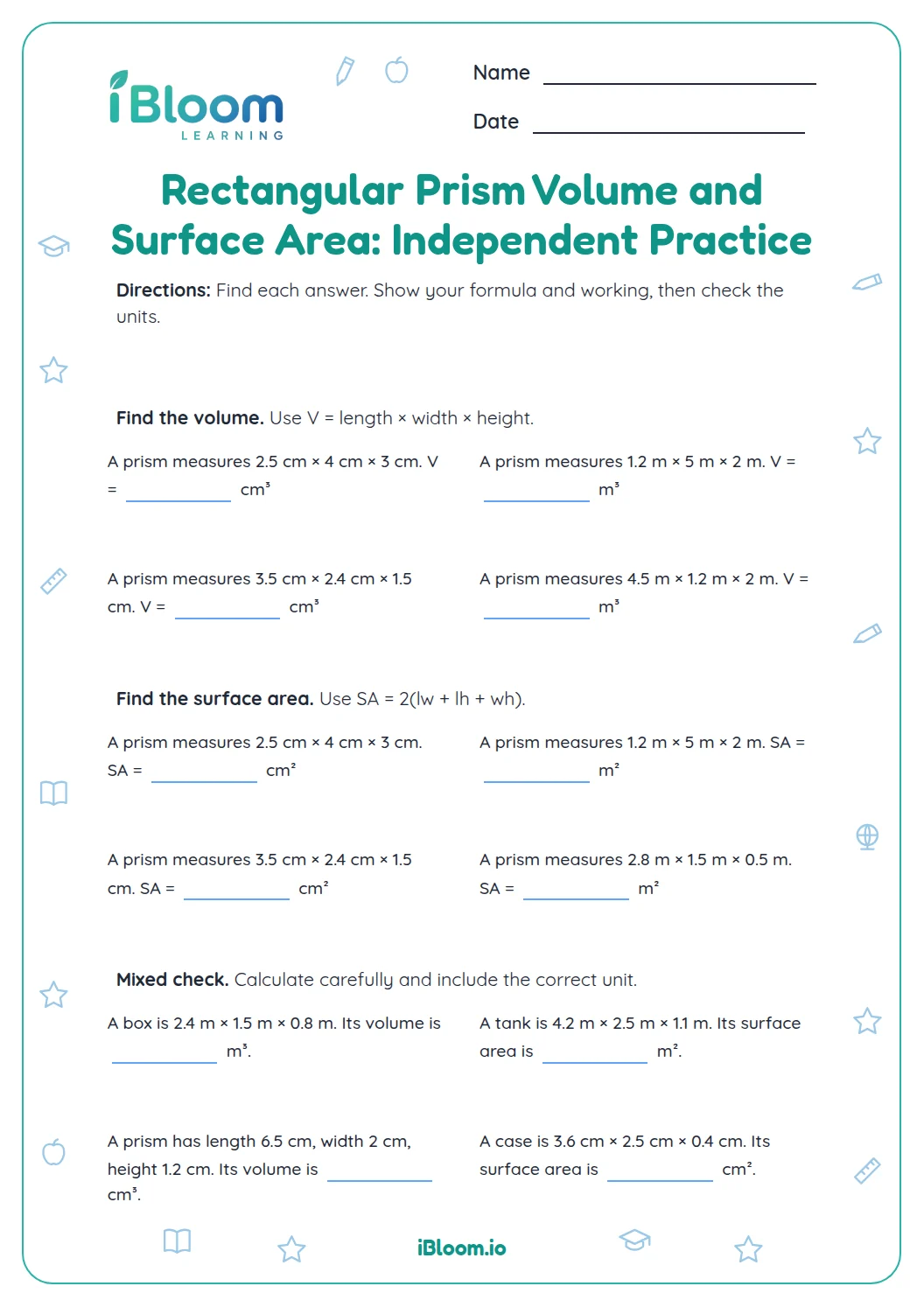
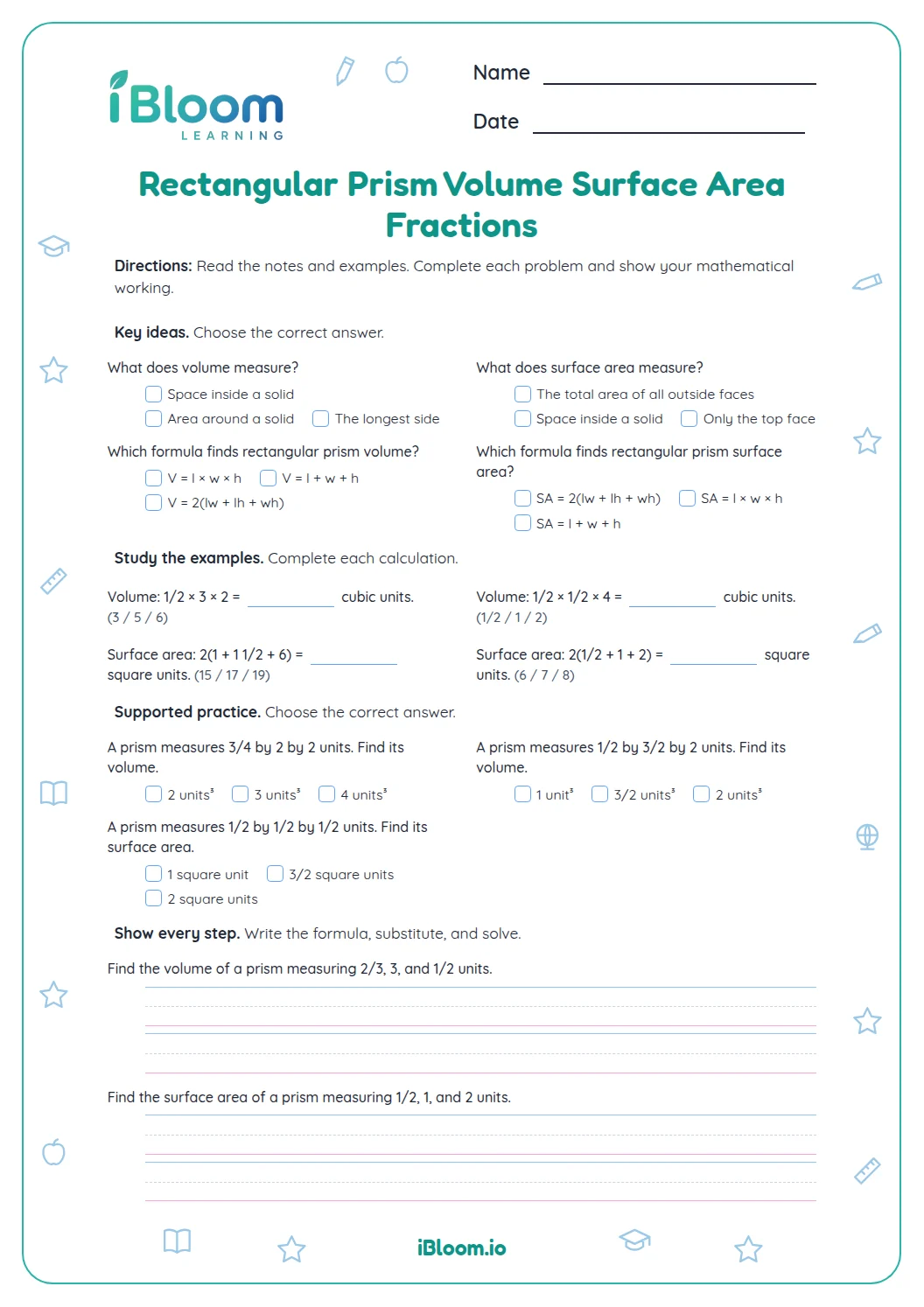
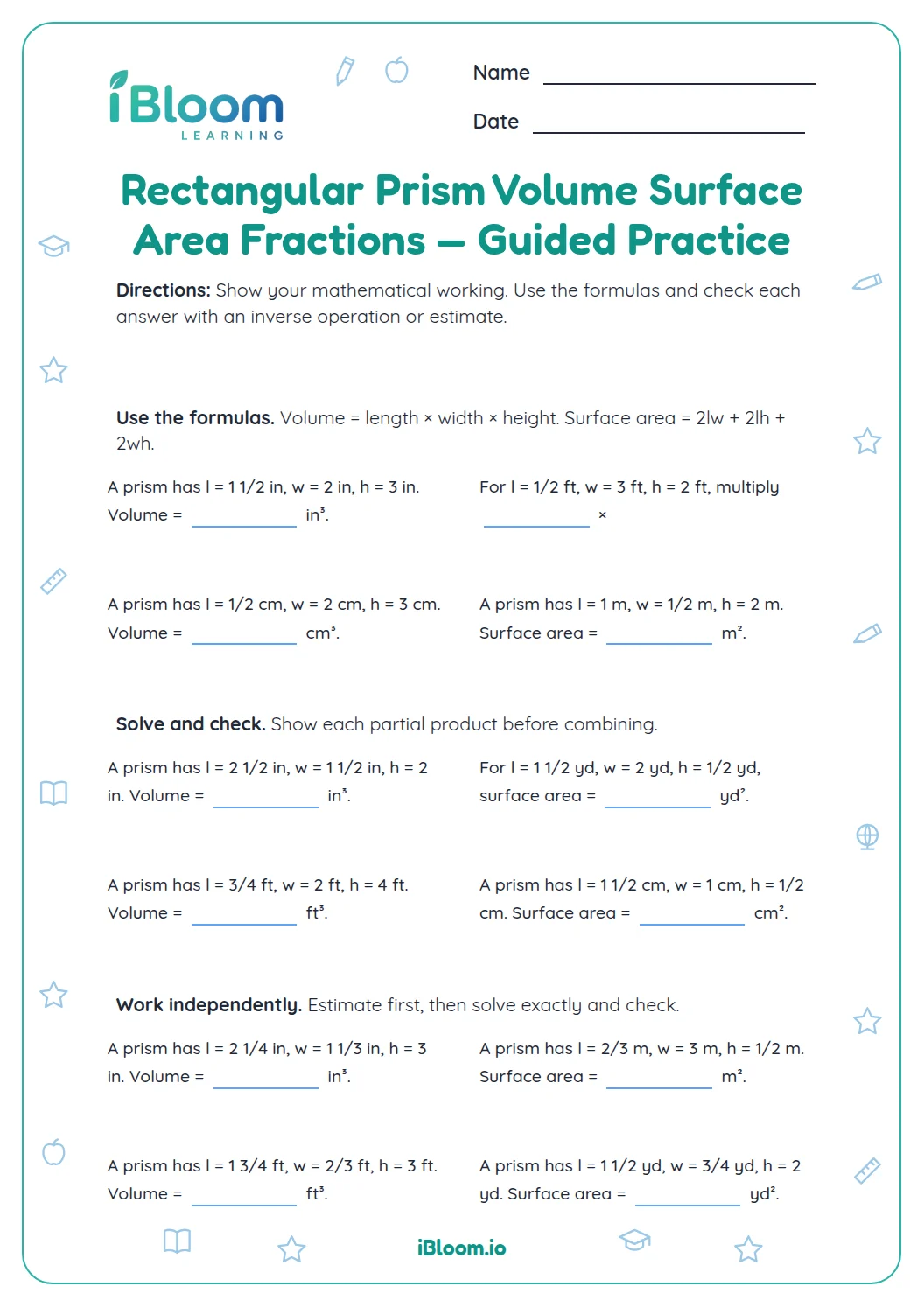
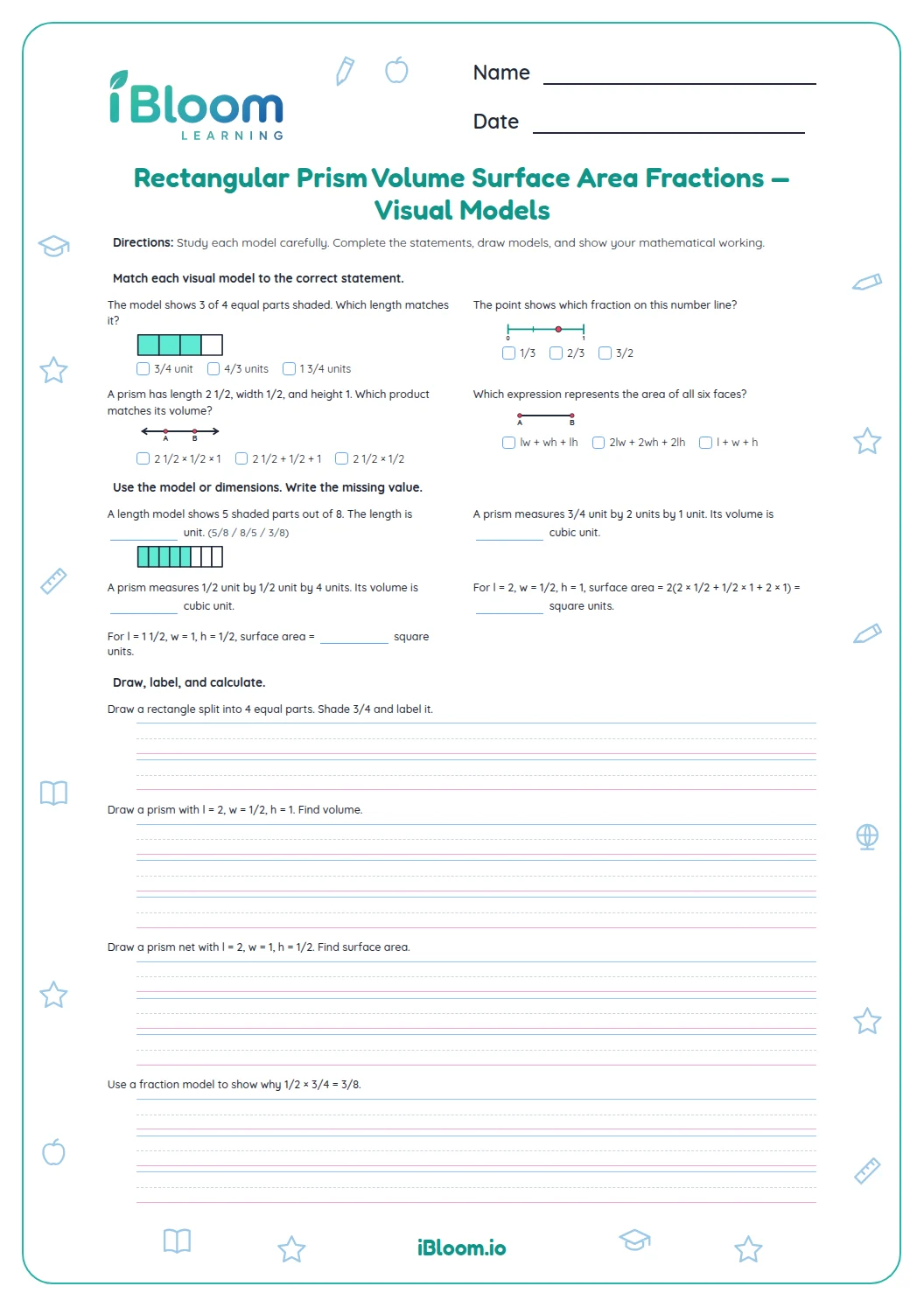
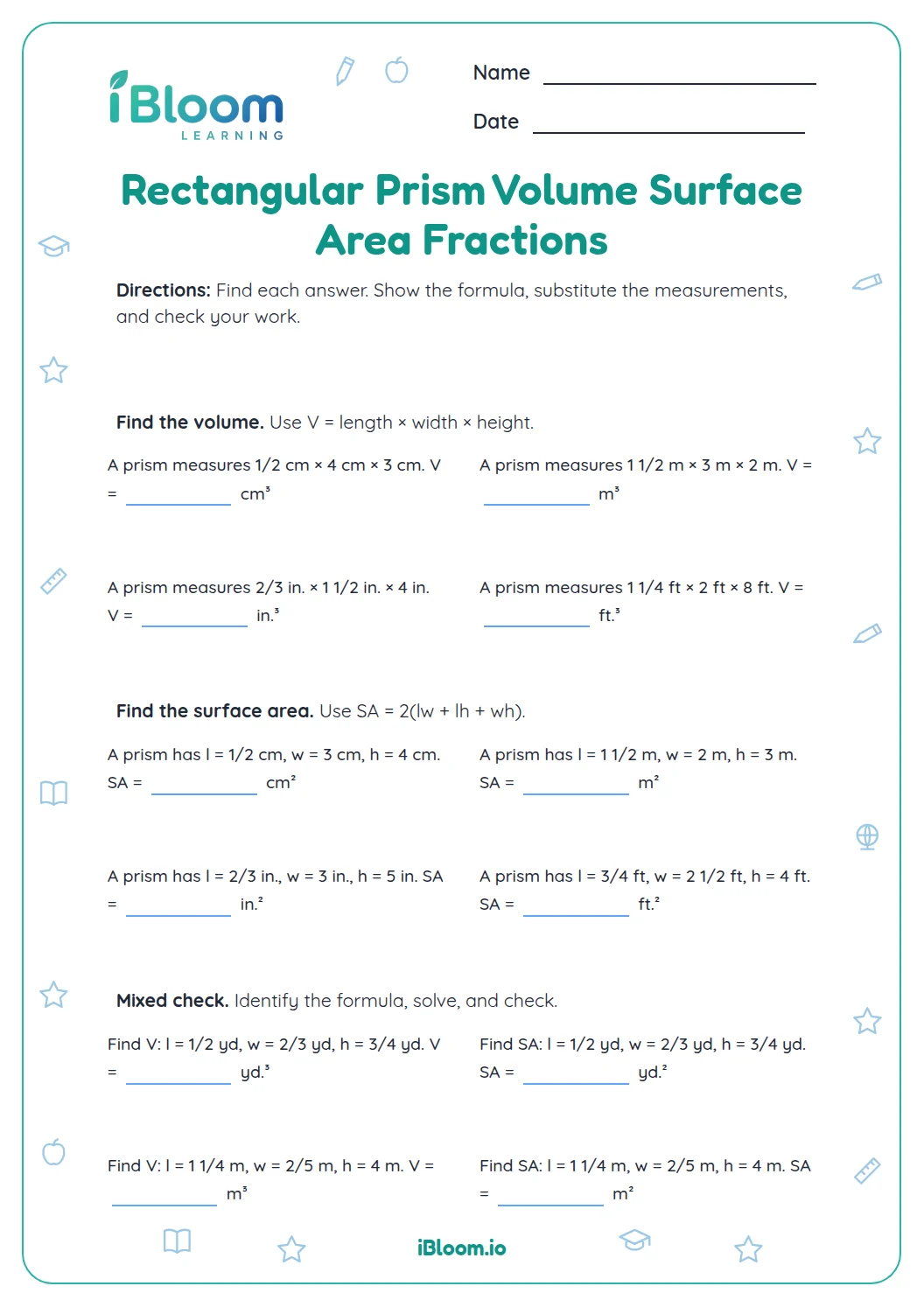
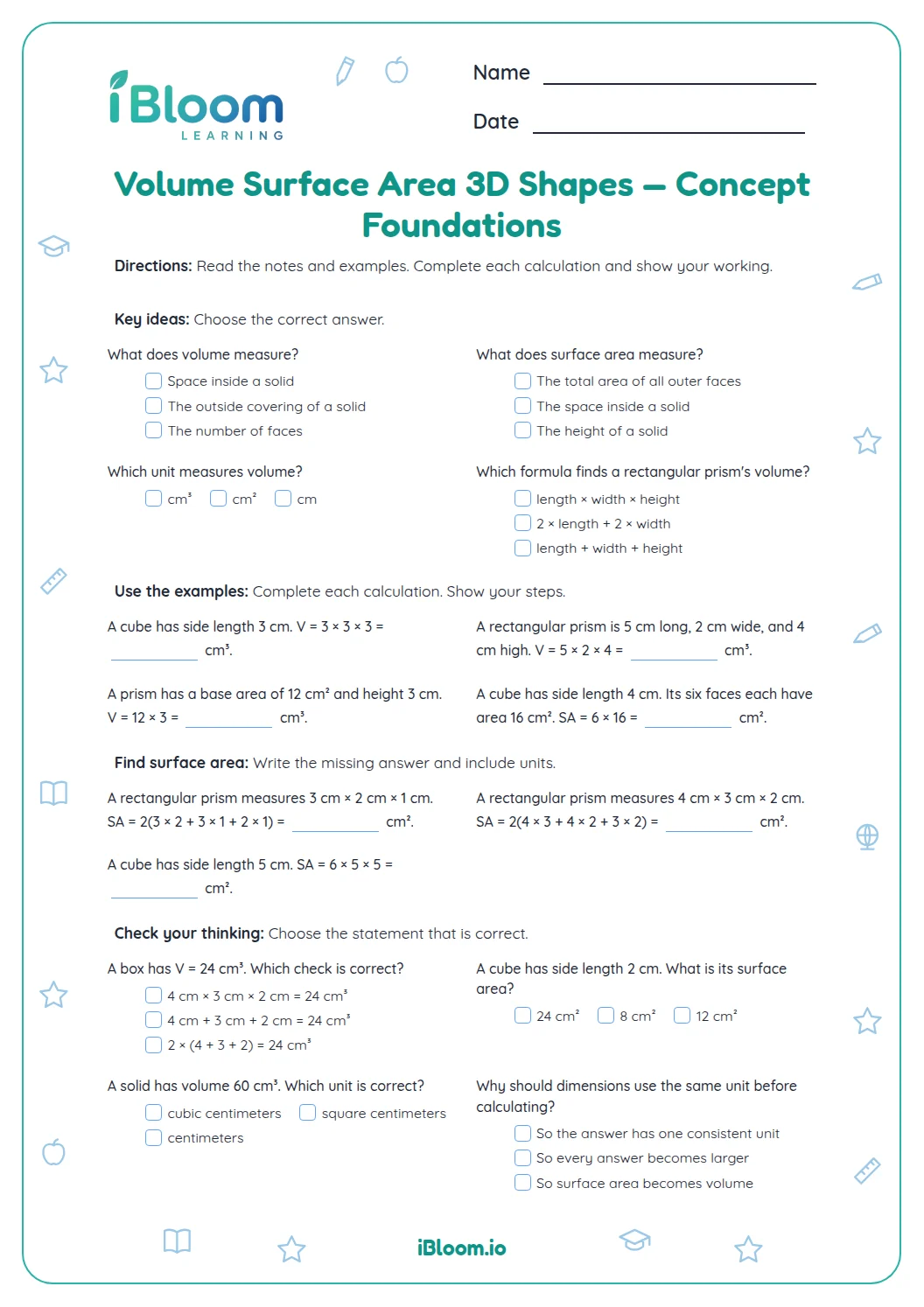
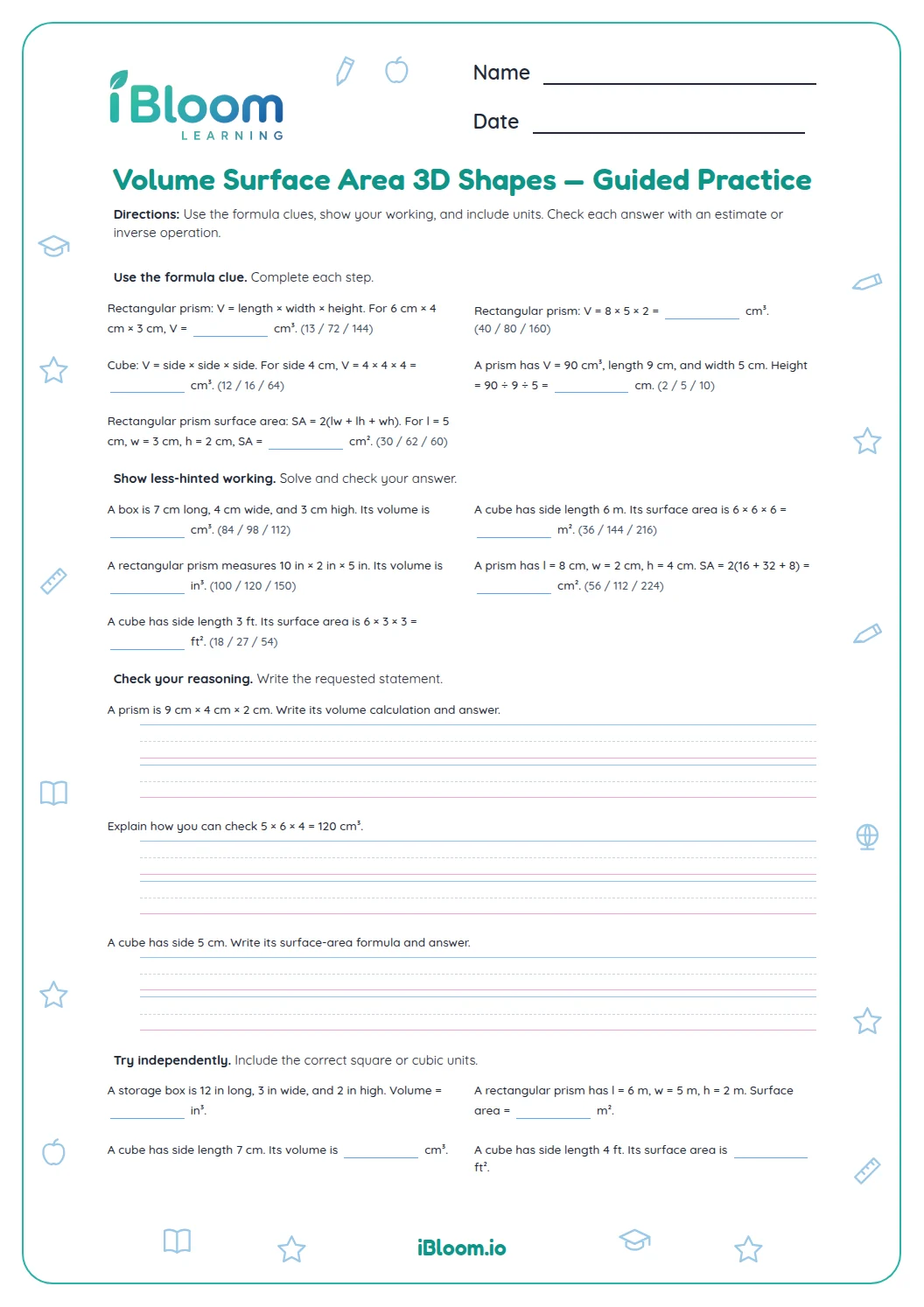
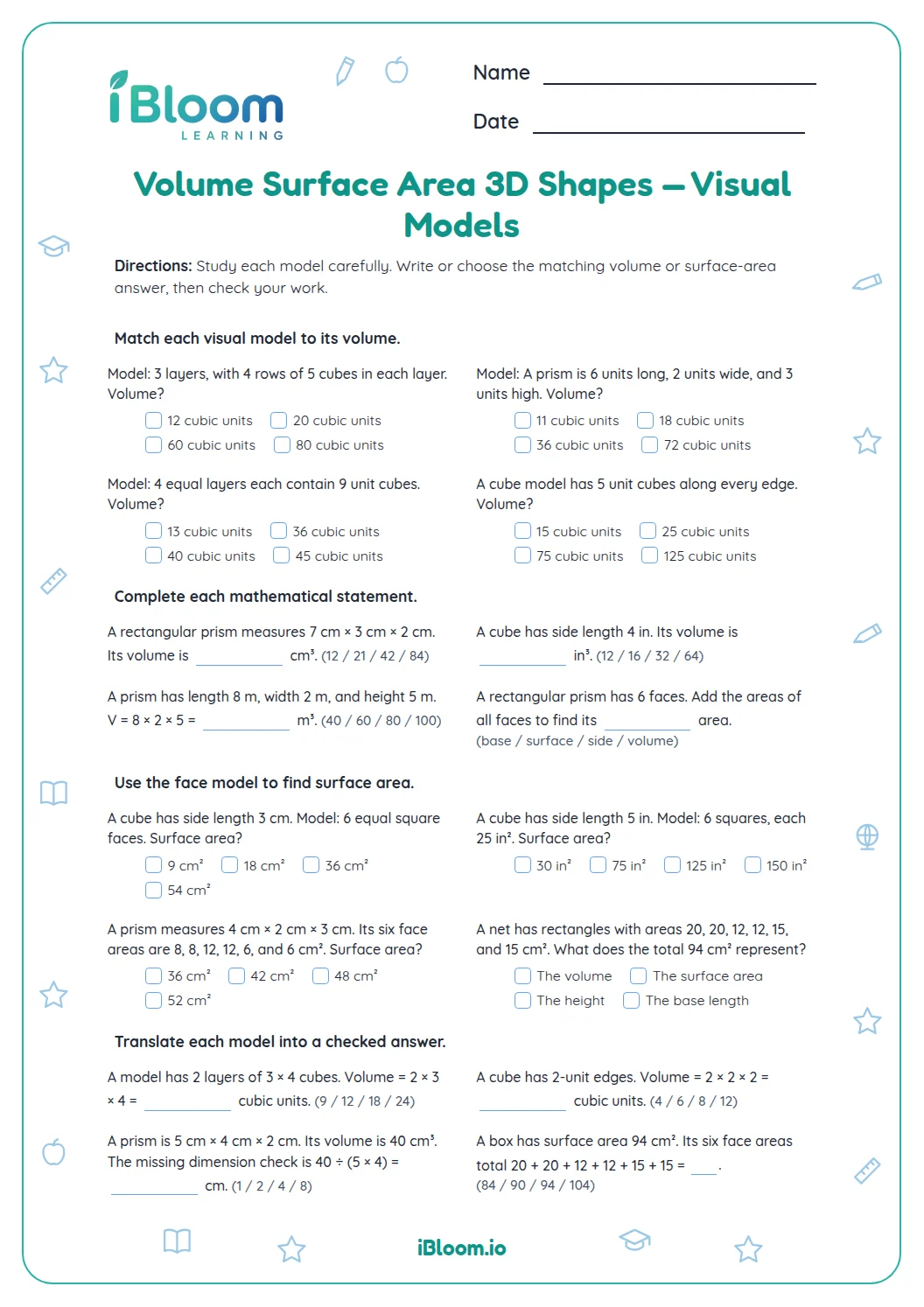
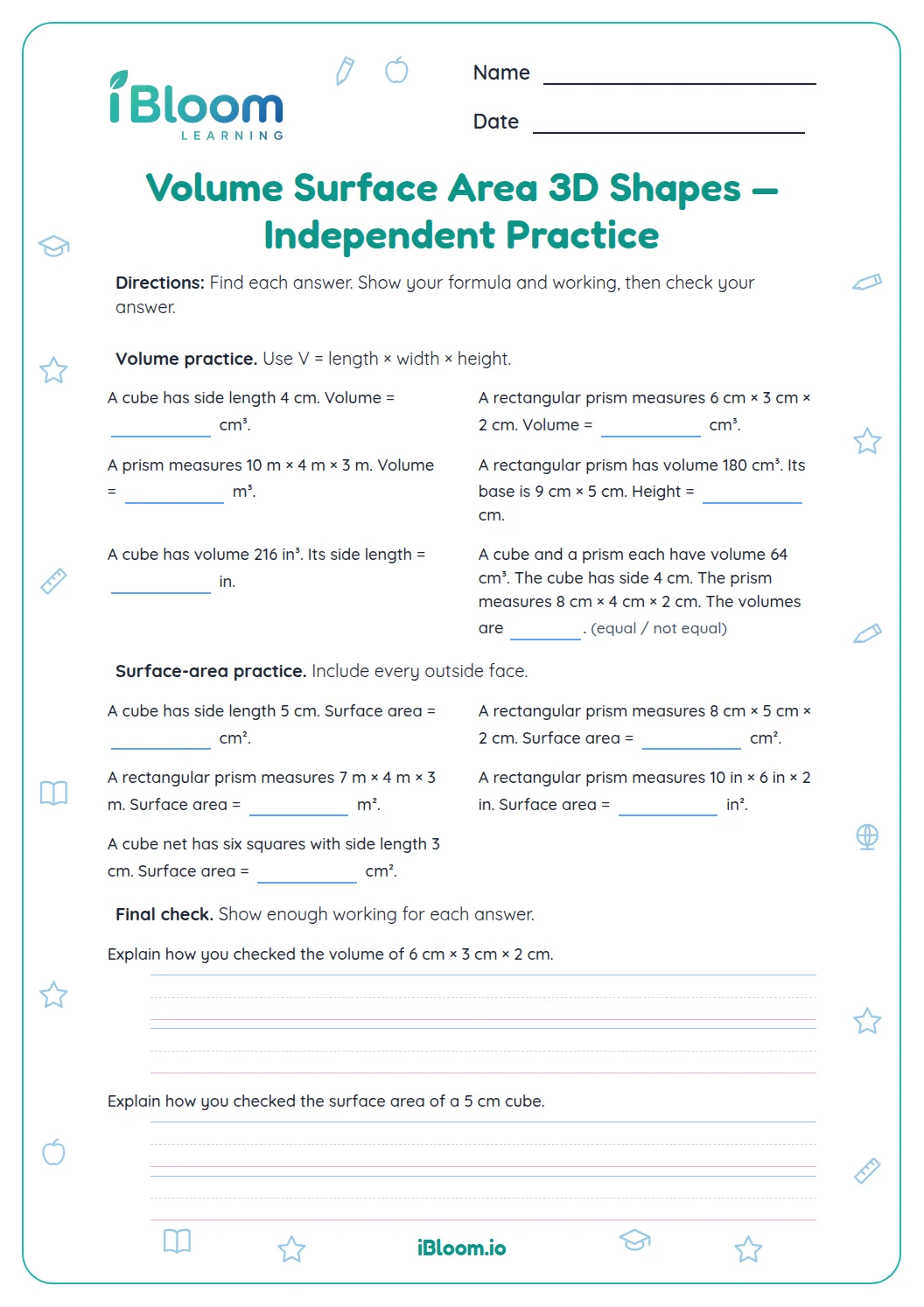
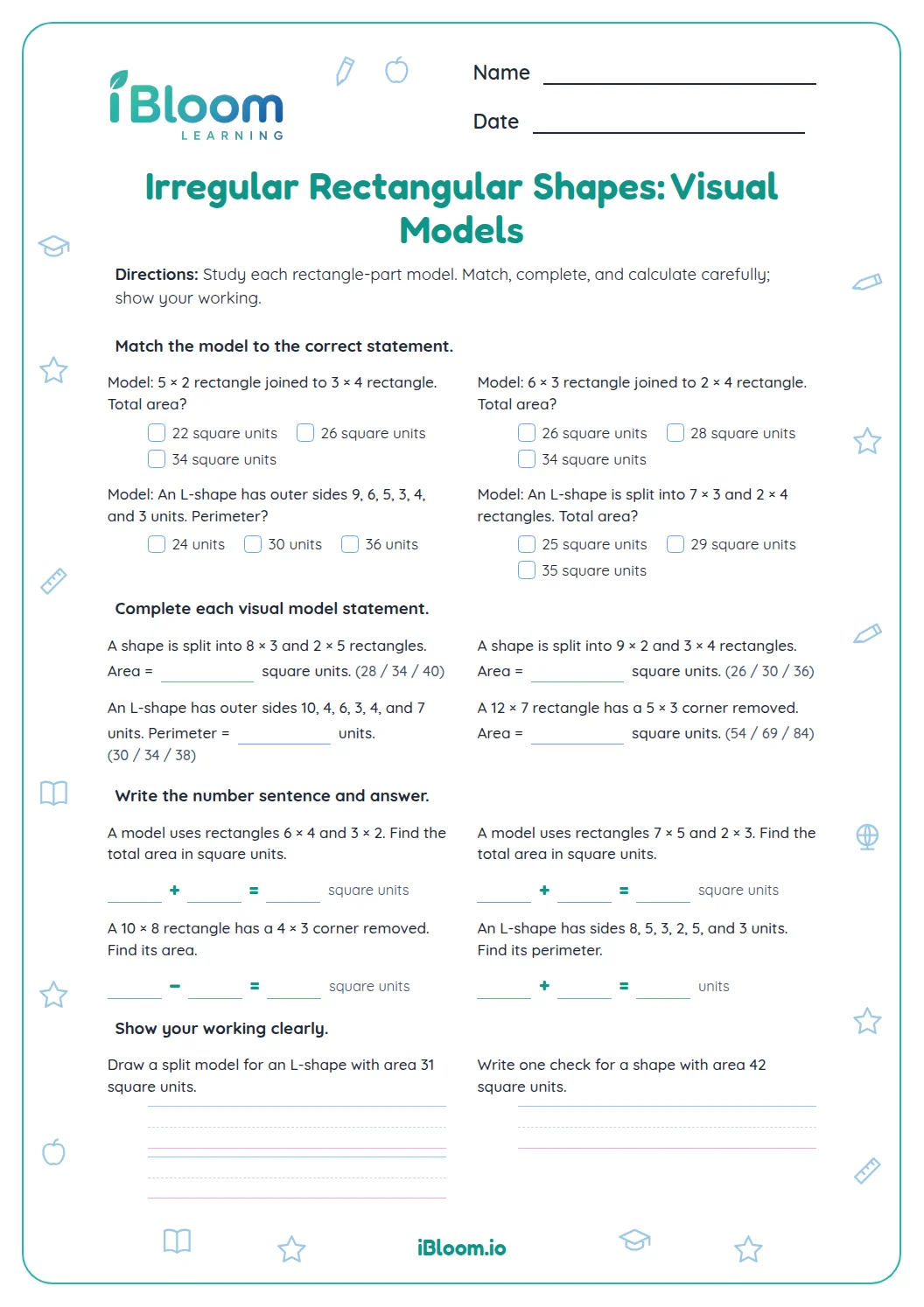
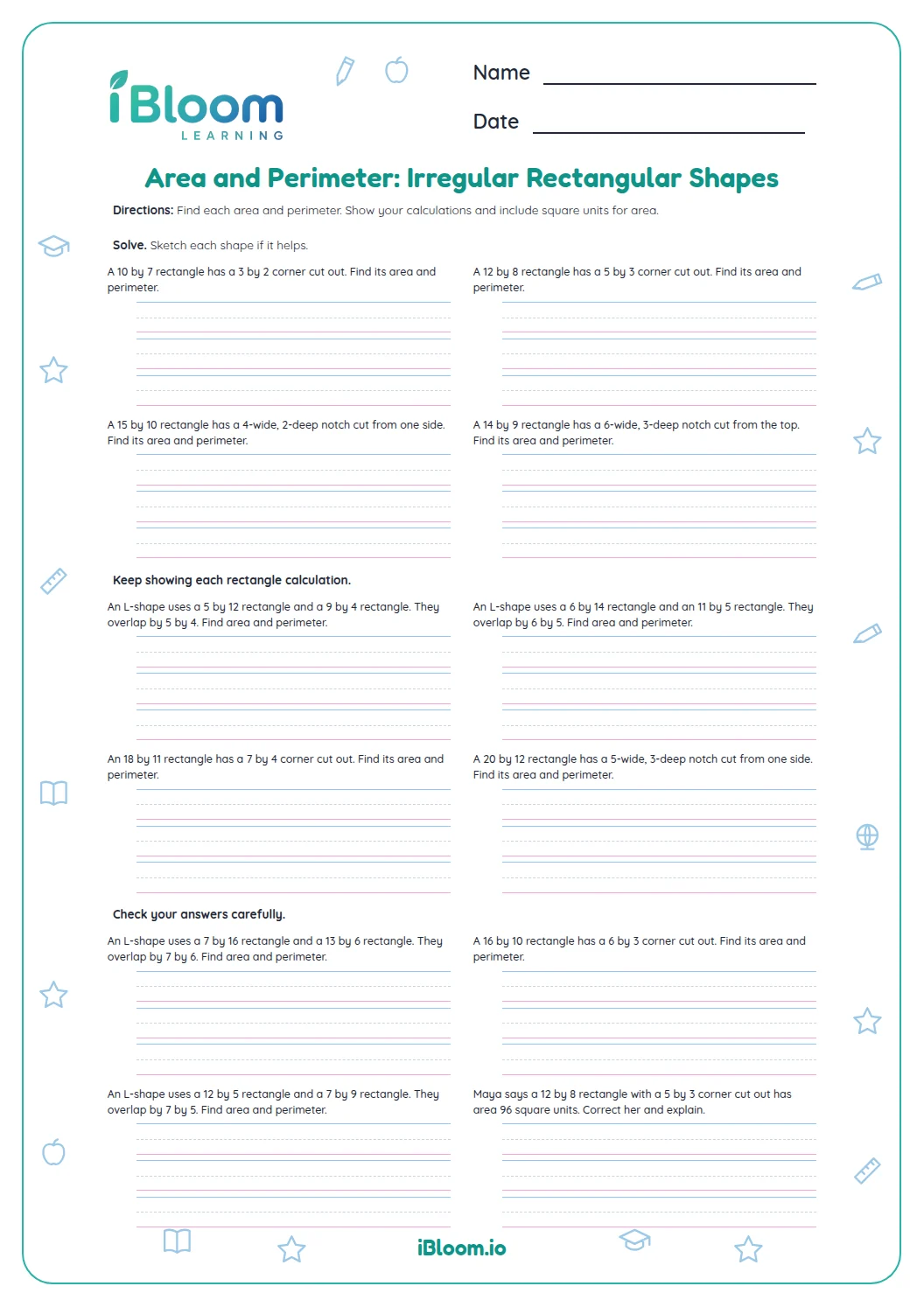
This Grade 6 printable guides students through rectangular-prism volume and surface-area calculations. It begins with whole-number dimensions, adds fractional edge lengths, then asks for face areas and the total area of the outside. The 18 questions practice the formulas connected to Common Core 6.G.A.2 and 6.G.A.4. Because the worksheet template has no labeled prism or net drawing, each prompt states the dimensions clearly; an answer key is included.
Aligned to 6.G.A.2
How do you calculate prism volume?
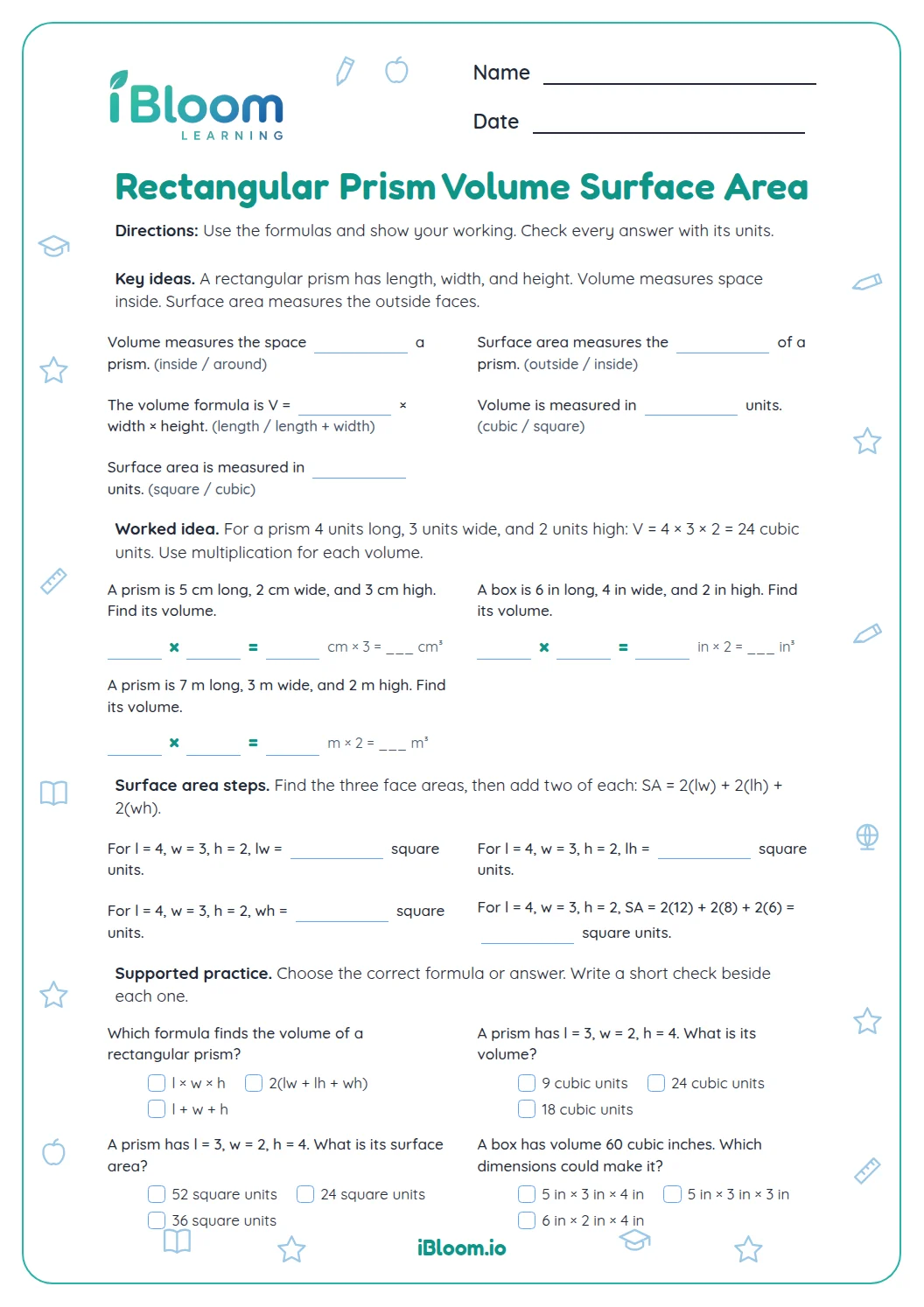
Volume measures the space inside a prism. Multiply length, width and height, or multiply the base area by height. Question 1 uses a 4 cm by 3 cm by 2 cm box: 4 × 3 × 2 = 24 cubic centimeters.
- 1V = l × w × h
- 2V = 4 × 3 × 2
- 3V = 24 cm³
- Part A: whole-number volumes (1–4)
- Part B: fractional edge lengths (5–8)
- Part C: face area, total surface area and applications (9–18)
What changes when an edge length is a fraction?
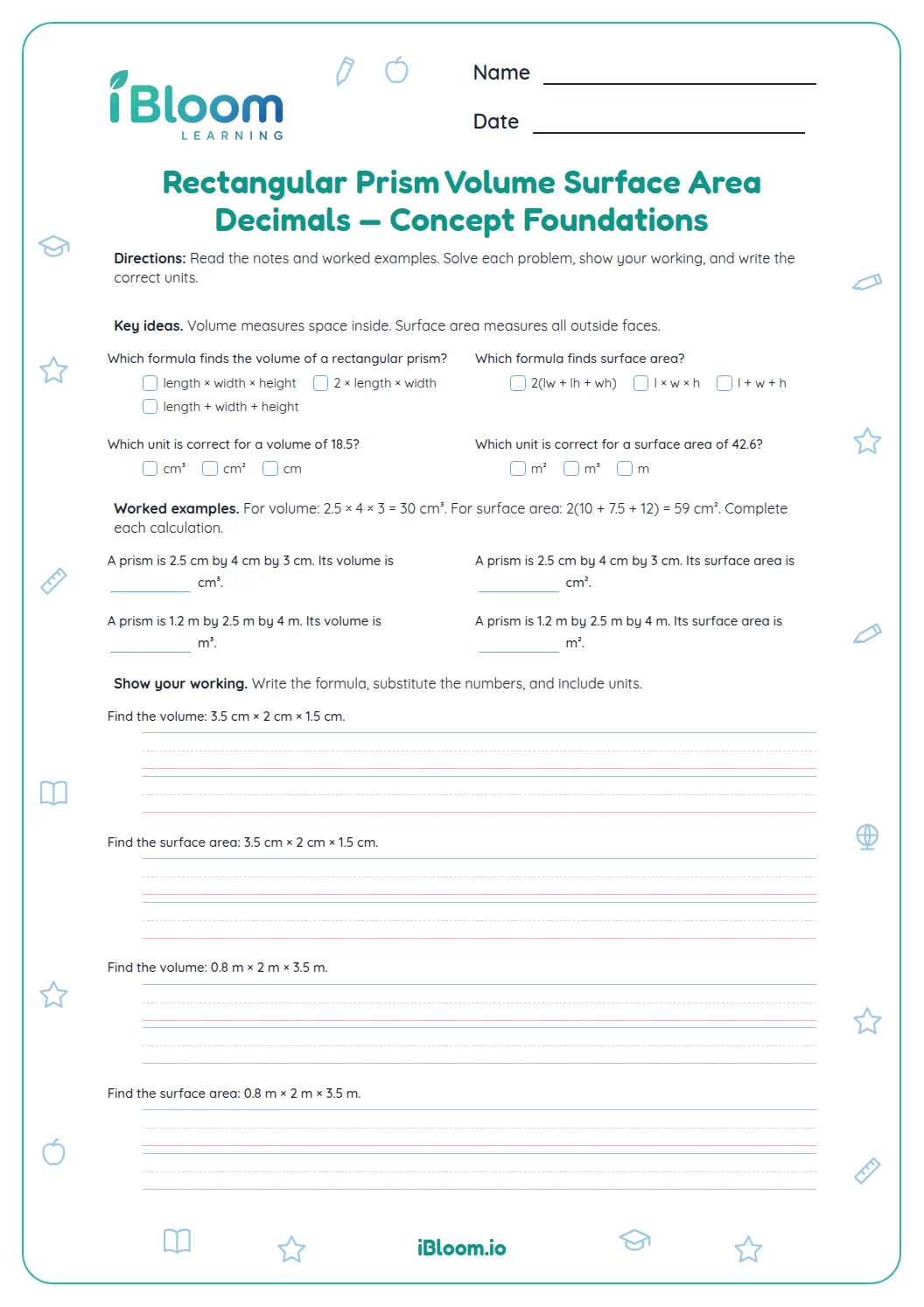
The volume formula stays the same. Multiply the fractional measure by the other two edge lengths and simplify the product. In question 5, 2 1/2 × 3 × 4 = 30, so the volume is 30 cm³. Track the units as well as the numbers.
- 12 1/2 × 3 = 7 1/2
- 27 1/2 × 4 = 30
- 3Volume = 30 cm³
How do the six faces make surface area?
Each face is a rectangle. Find each face area and add all six, or use 2lw + 2lh + 2wh because each pair of opposite faces matches. For a 6 by 4 by 2 prism, that is 2(24) + 2(12) + 2(8) = 88 square units.
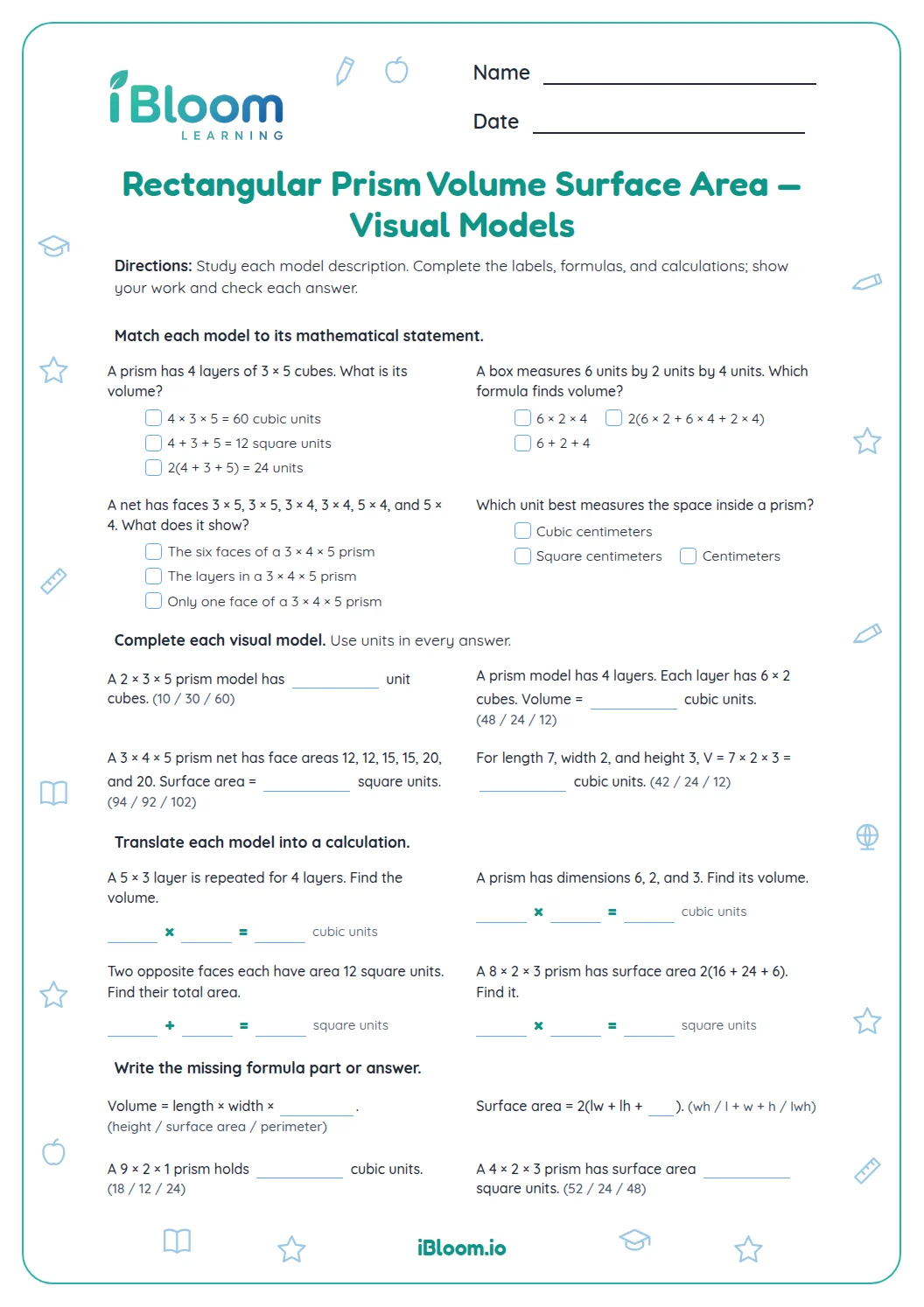
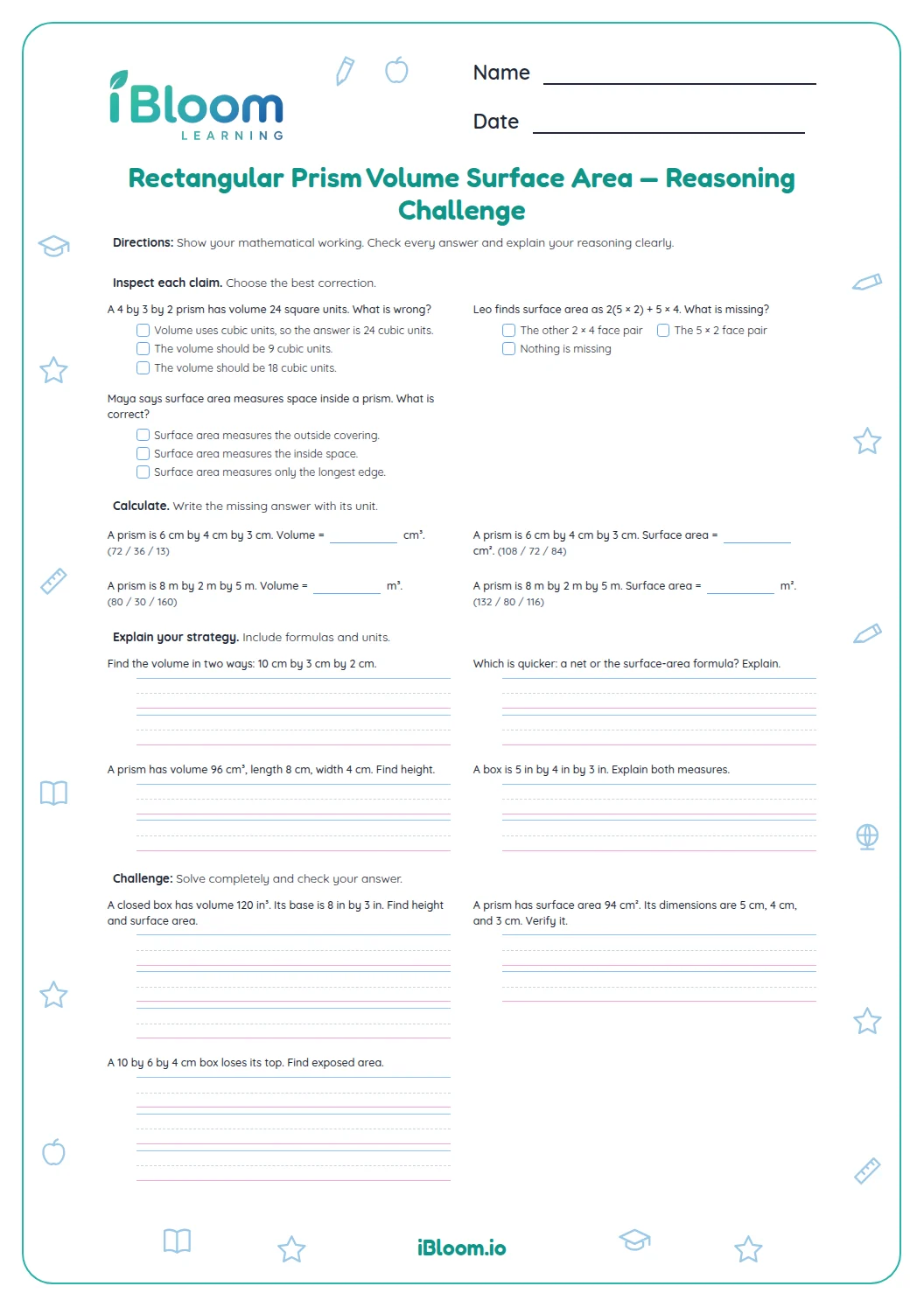
This worksheet presents dimensions in words because the printable template has no labeled-prism or net drawing. The measurements still let students practice the same volume and surface-area reasoning.
How to use the prism practice
- 1Underline the three edge lengths or the base area and height.
- 2For volume, multiply three dimensions and label the result in cubic units.
- 3For a fractional edge, multiply carefully and check the product.
- 4For surface area, find the three different rectangle areas.
- 5Double each face area and add the results, then label the answer in square units.
Common mistakes and quick fixes
The mistake
Reporting a surface area in cubic units.
The fix
Area covers flat faces and uses square units; volume fills space and uses cubic units.
The mistake
Finding the area of only one face for total surface area.
The fix
A rectangular prism has three pairs of matching faces. Add both faces in each pair.
The mistake
Multiplying only two dimensions for volume.
The fix
Use all three edge lengths, or multiply base area by the perpendicular height.
Common Core alignment
Find rectangular-prism volume by multiplying edge lengths, including fractional lengths.
On this sheet: Questions 1–8 apply V = lwh or V = bh, including fractional edge lengths and real contexts.
Show the official wordingHide the official wording
Find the volume of a right rectangular prism with fractional edge lengths by packing it with unit cubes of the appropriate unit fraction edge lengths, and show that the volume is the same as would be found by multiplying the edge lengths of the prism. Apply the formulas V = l w h and V = b h to find volumes of right rectangular prisms with fractional edge lengths in the context of solving real-world and mathematical problems.
What to practice next
Make more practice
Further reading
Questions parents and teachers ask
How do you find the volume of a rectangular prism?
Multiply its length, width and height: V = l × w × h. You can also multiply the area of the base by the height. For question 1, 4 × 3 × 2 = 24, so the box has a volume of 24 cubic centimeters.
How do you find the surface area of a rectangular prism?
Add the areas of all six rectangular faces. Opposite faces have equal areas, so another method is 2lw + 2lh + 2wh. For question 11, a 6 by 4 by 2 prism has surface area 2(24 + 12 + 8) = 88 square inches.
Why are volume units cubic and surface area units square?
Volume measures the three-dimensional space inside a prism, so its units multiply three lengths, such as cubic centimeters. Surface area measures flat faces, so units are square centimeters or square inches. Include the correct unit after every answer, based on whether you measured space or faces.
How can fractions be used in a volume problem?
Multiply the fractional edge length by the other two lengths just as you do with whole numbers. In question 5, 2 1/2 × 3 × 4 = 30 cubic centimeters. A fractional edge still describes a real prism dimension, and the volume formula works the same way.
What is different about the printable model for this topic?
Each prompt states the prism dimensions so students can focus on choosing and using the correct calculation. The set includes whole-number and fractional edge lengths, face areas, total surface area, volume, and real-world box problems. For each answer, students label square units for face area or cubic units for volume.