
About this worksheet
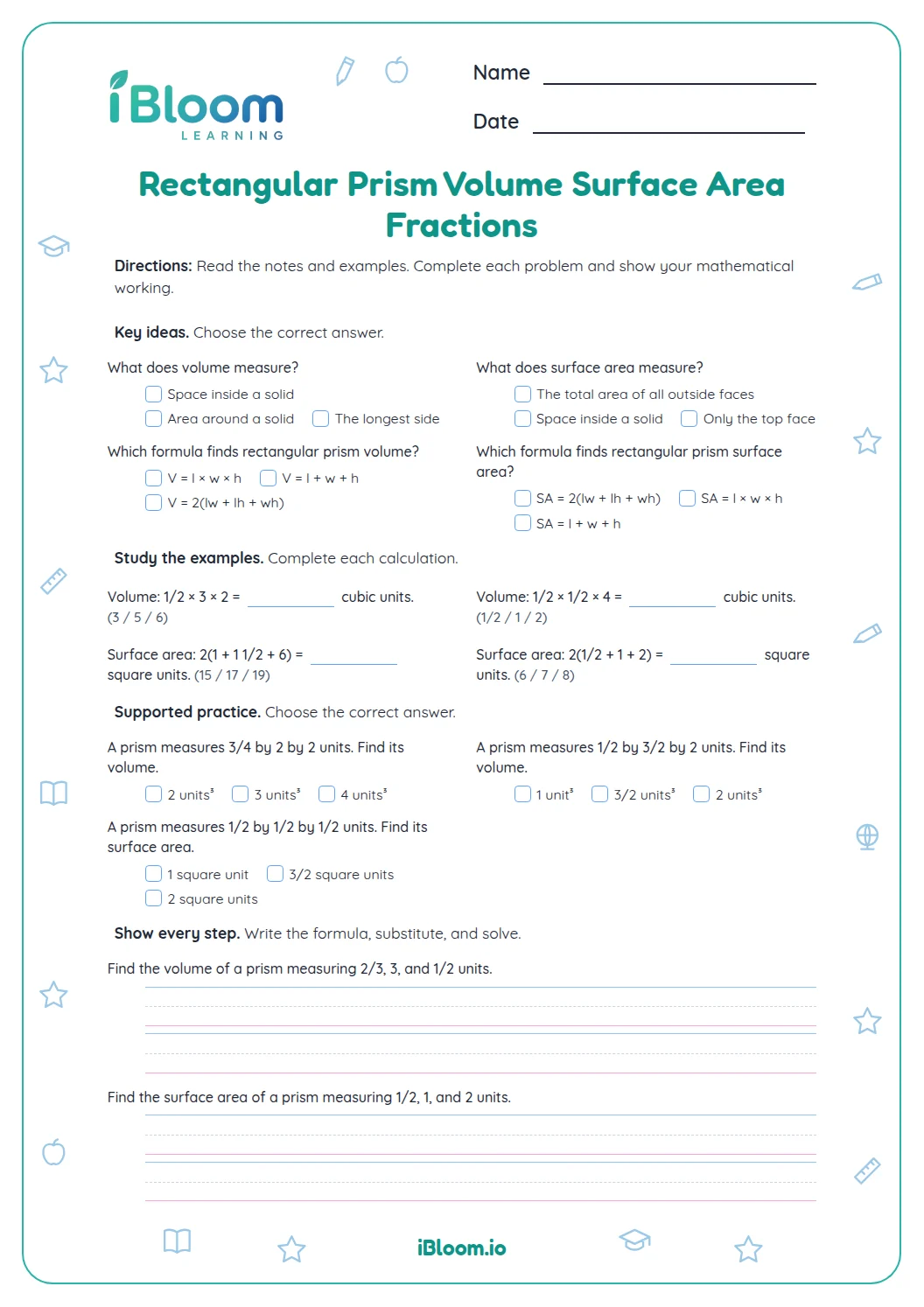
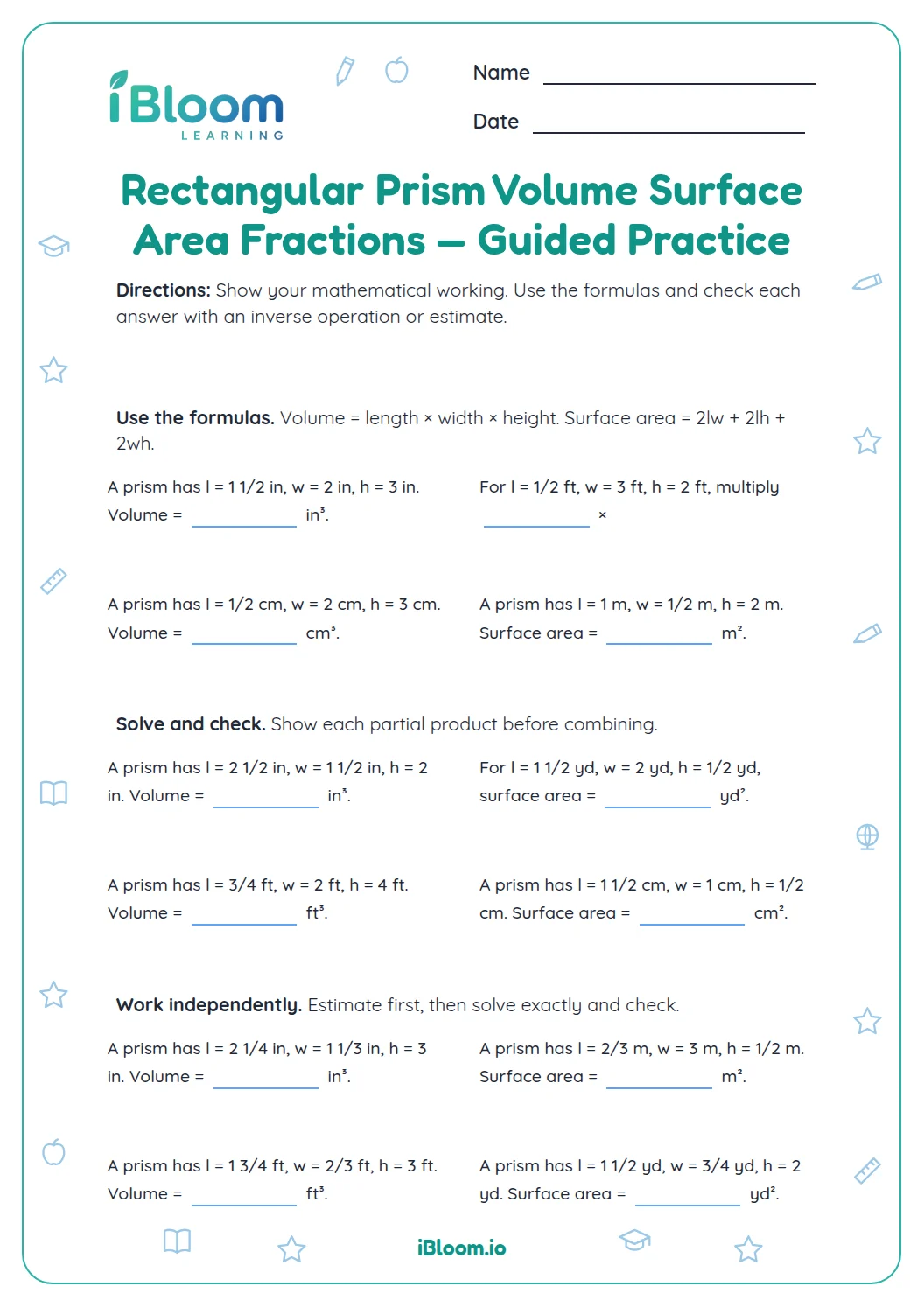
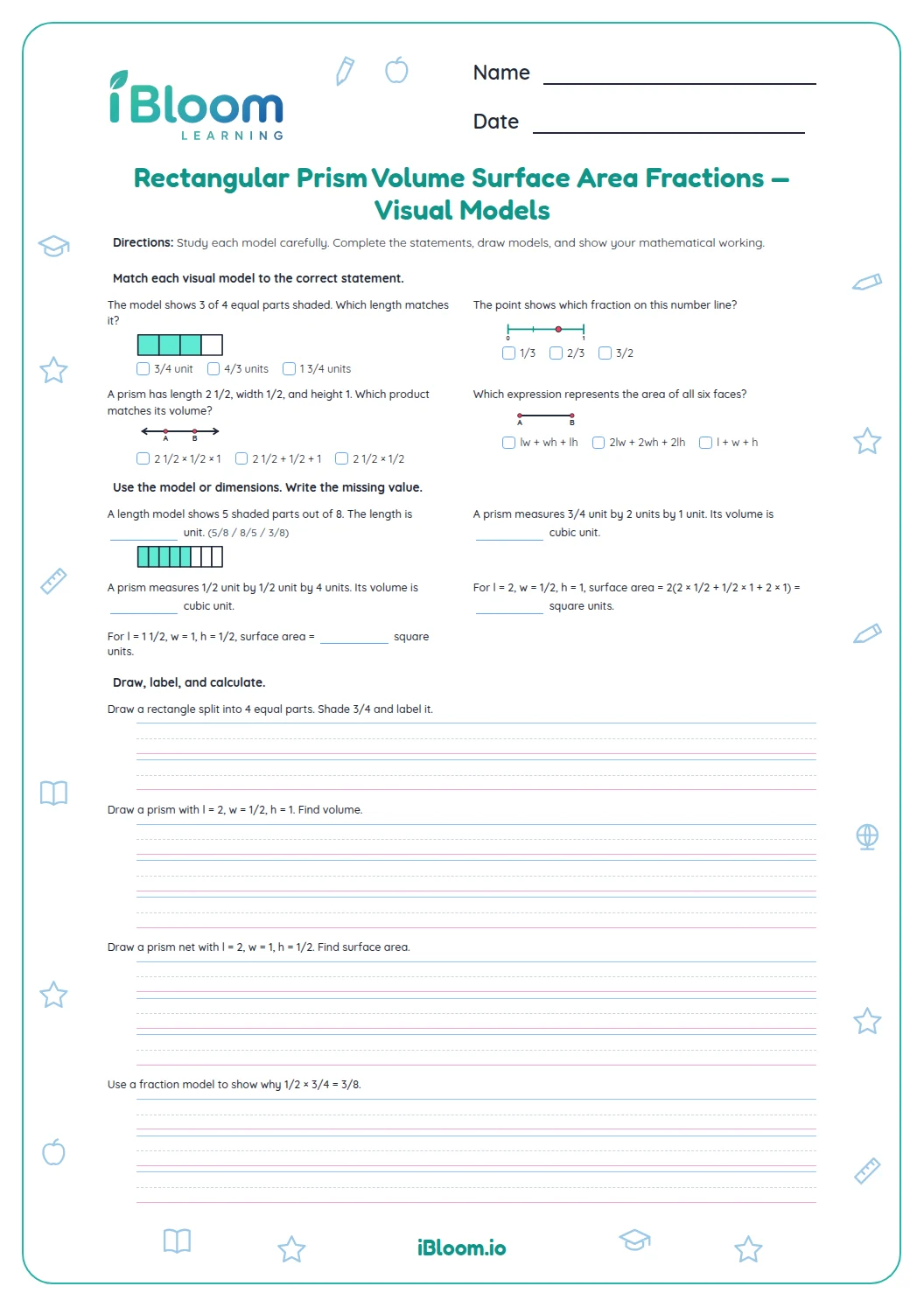
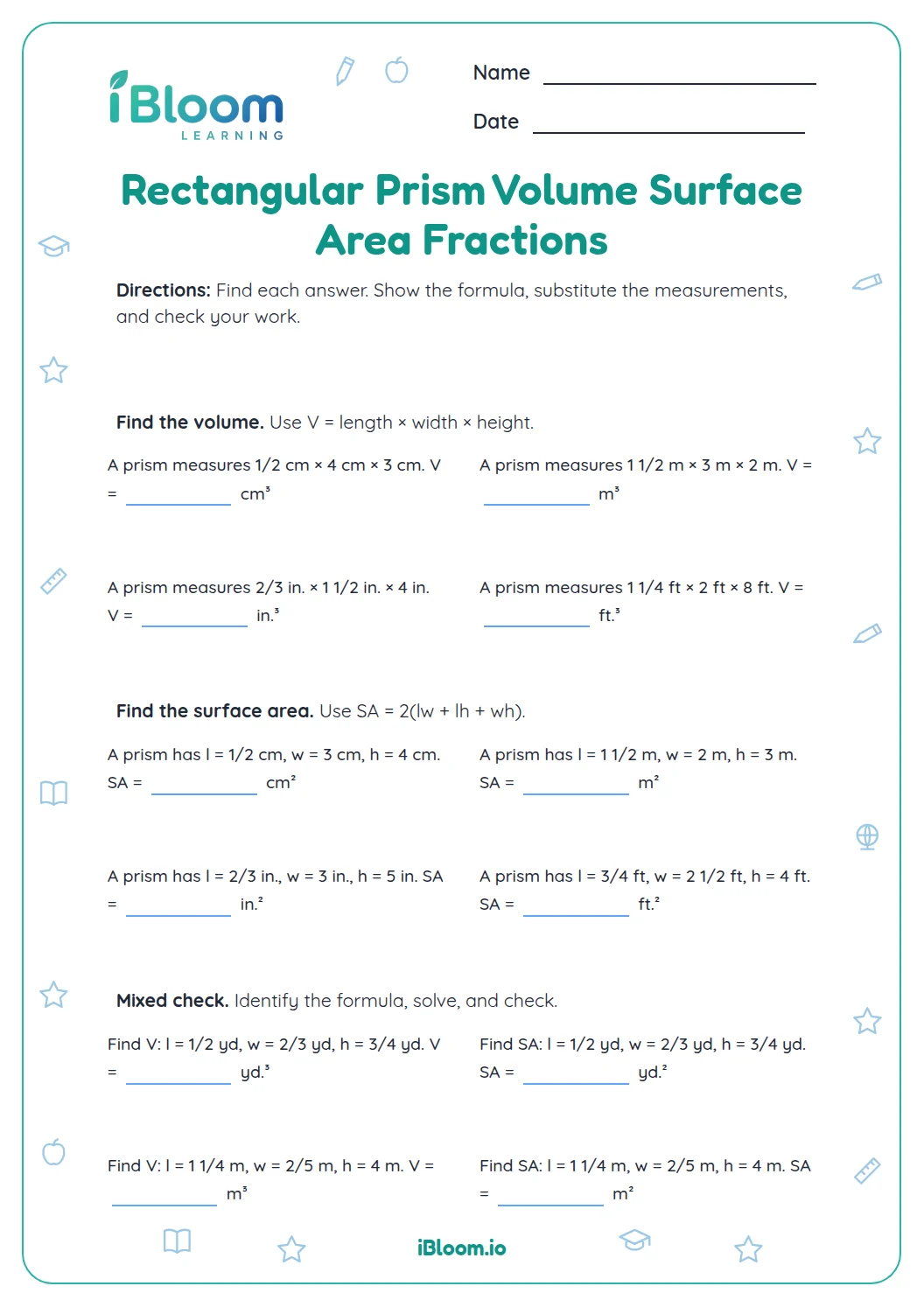
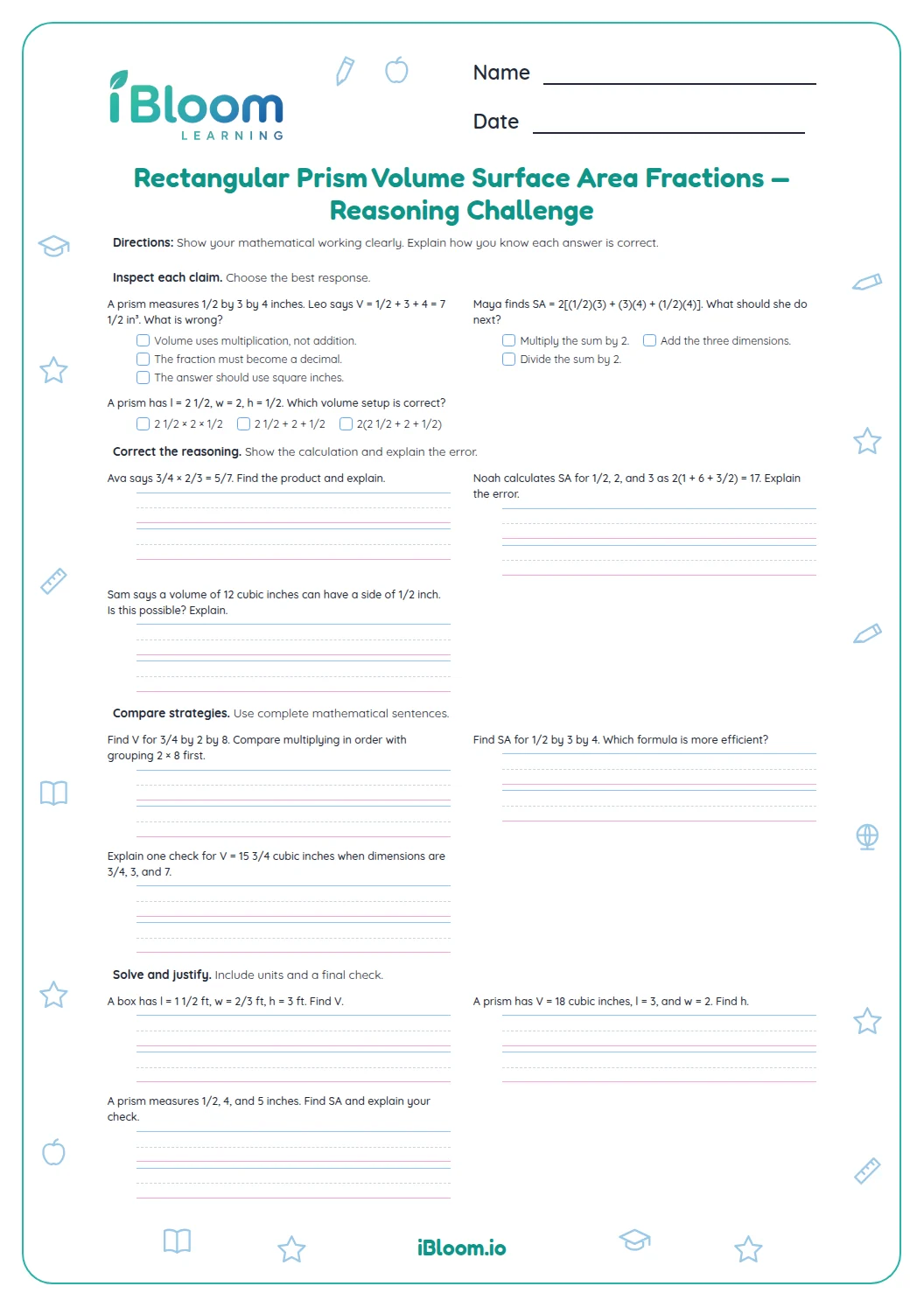
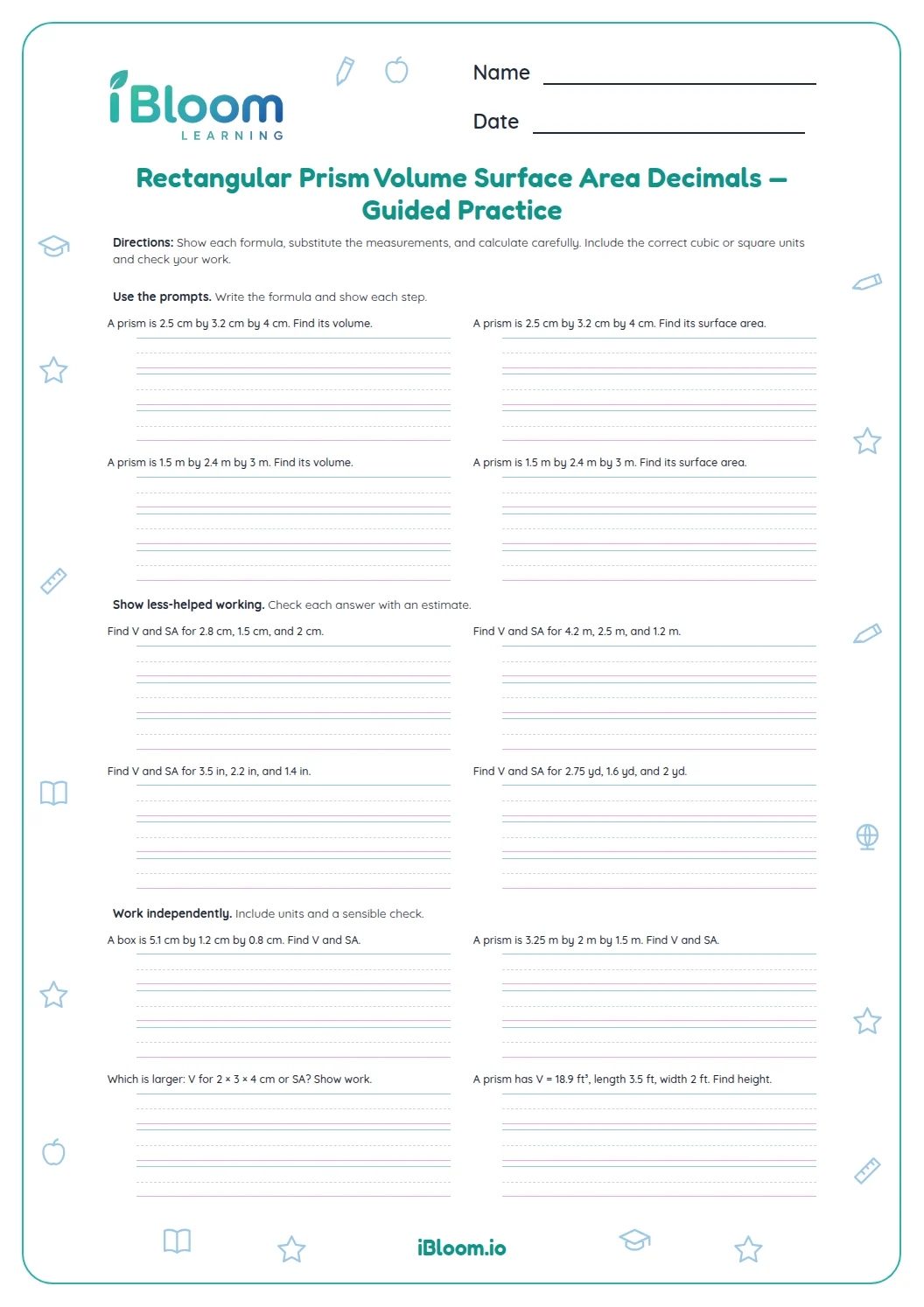
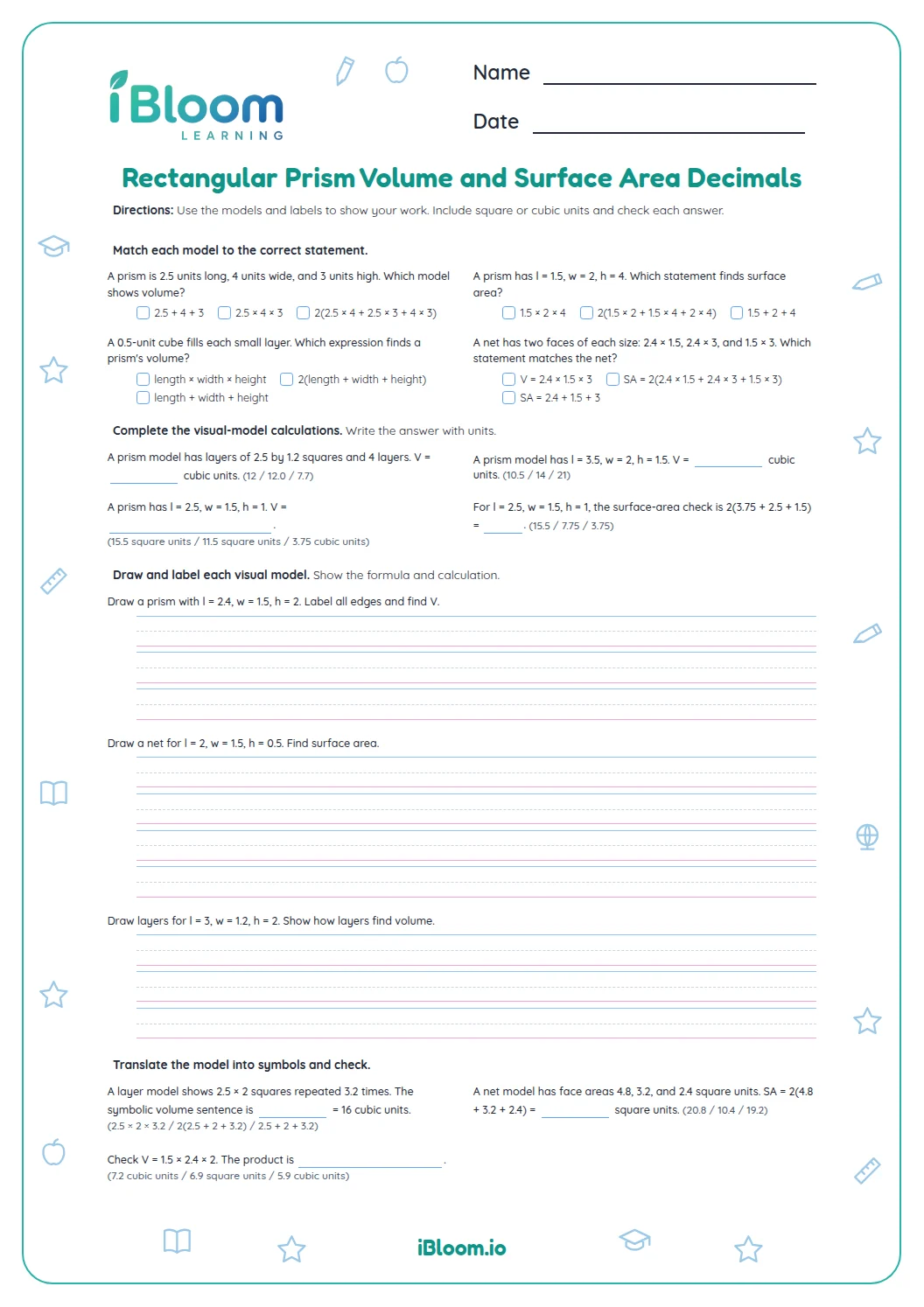
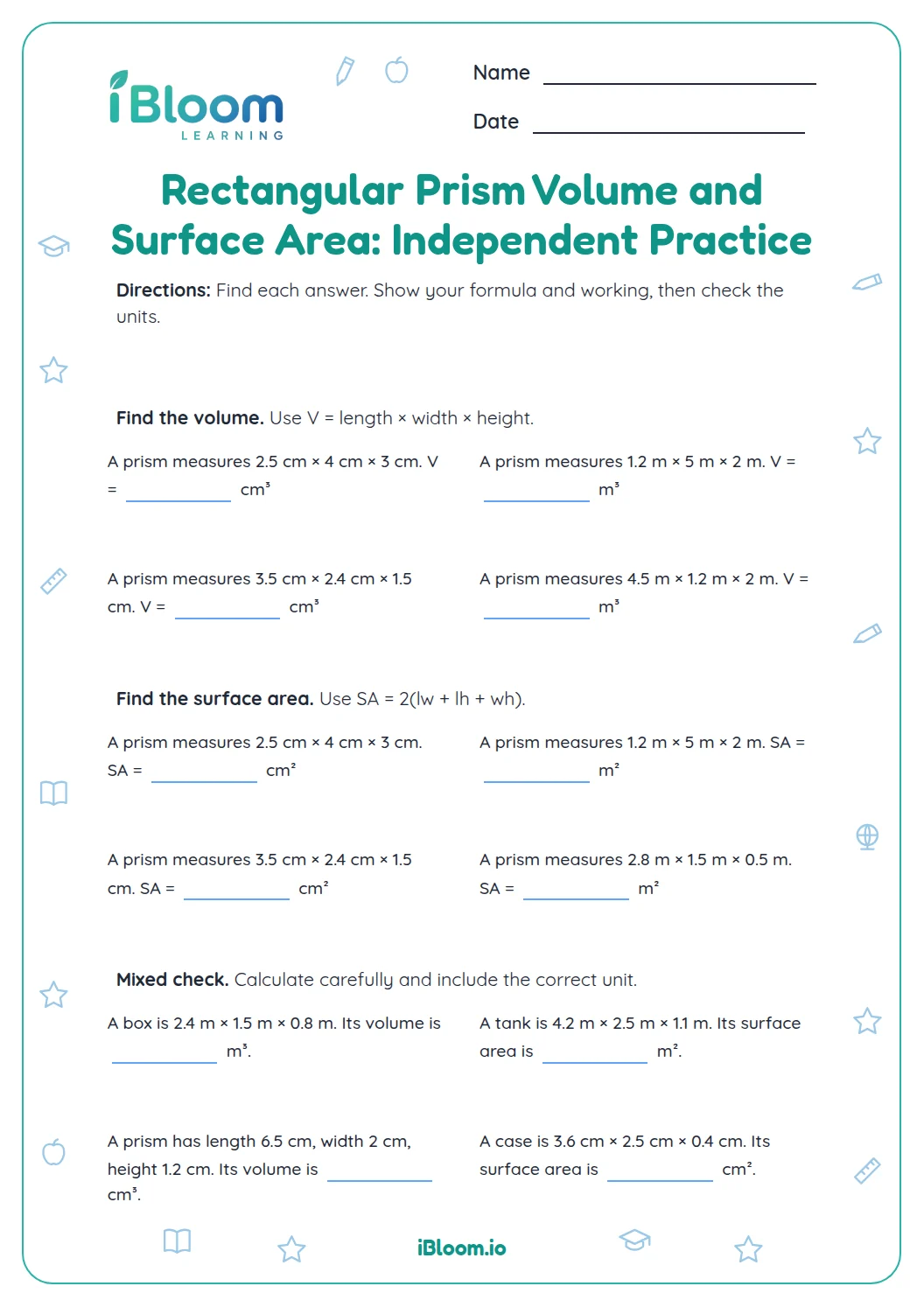
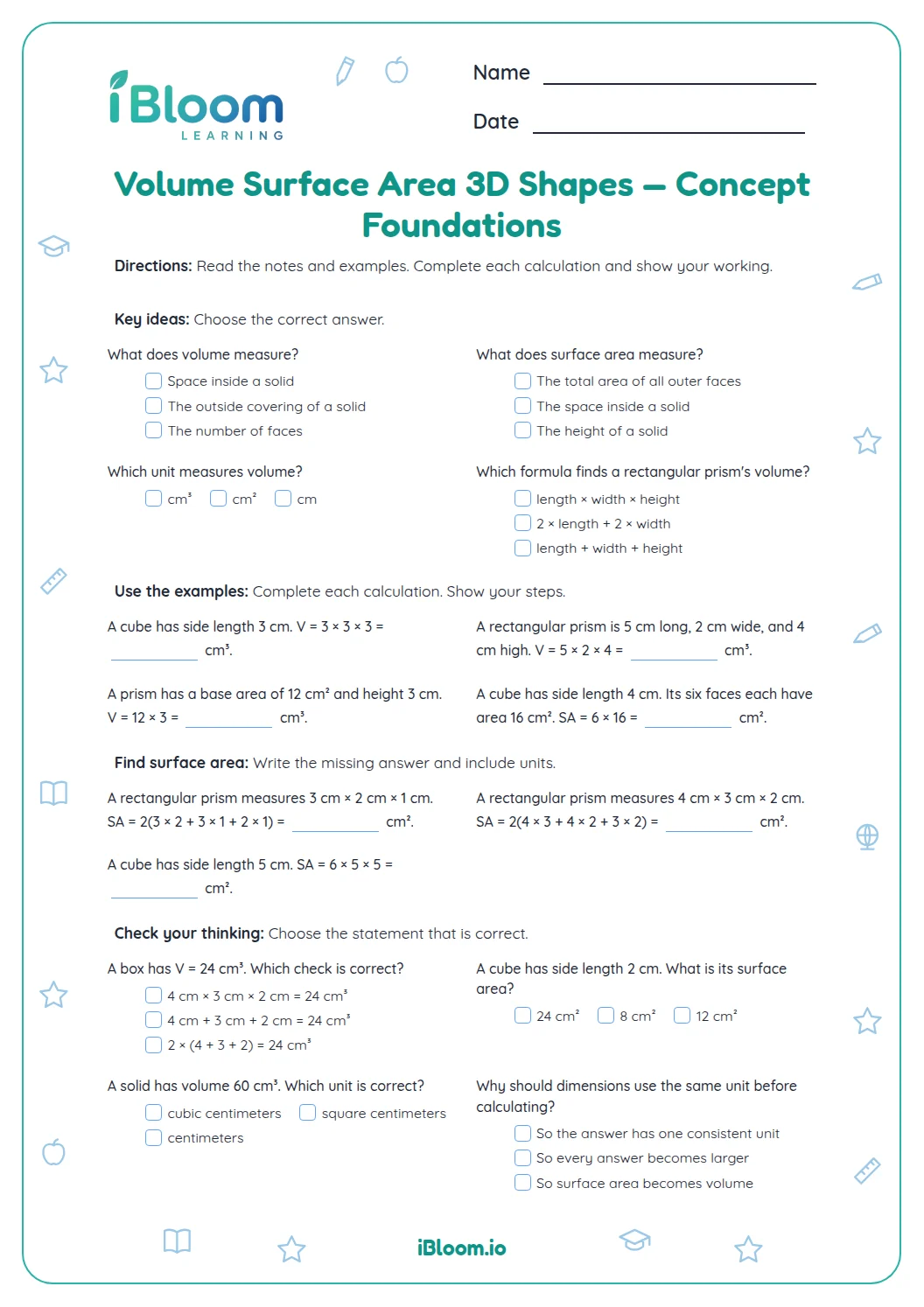
This free printable Grade 6 worksheet uses fractional edge lengths in ten rectangular prism word problems. Students find volumes for containers, calculate material to cover boxes, and decide how to handle an open tray or a partly filled tank. Part A has four volume problems, Part B has four surface area problems, and Part C has two applications. Students write calculations in the working spaces and include units. The volume work practices Common Core 6.G.A.2. A separate answer key gives simplified results for every problem.
Aligned to 6.G.A.2
Which measurement does the situation ask for?
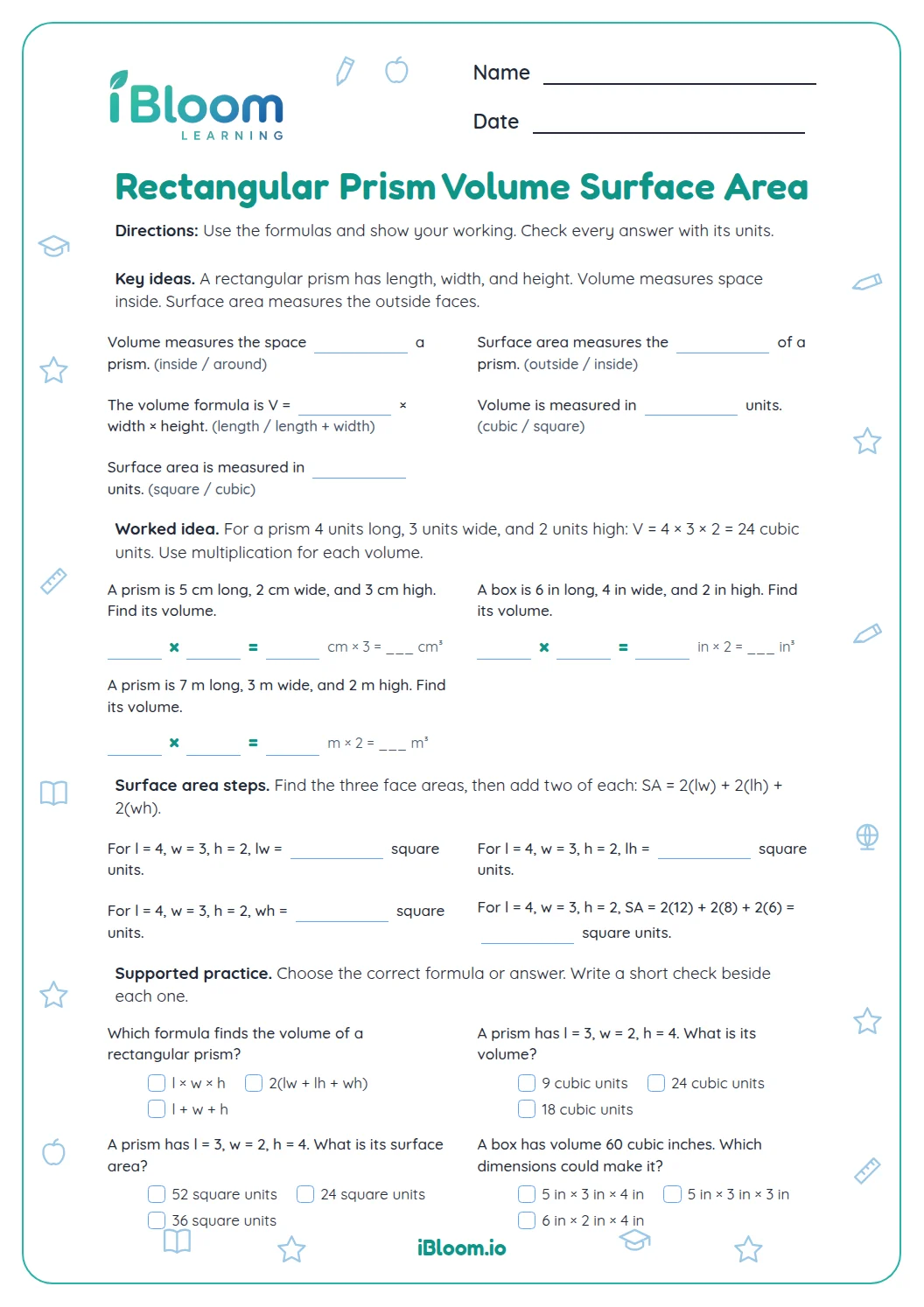
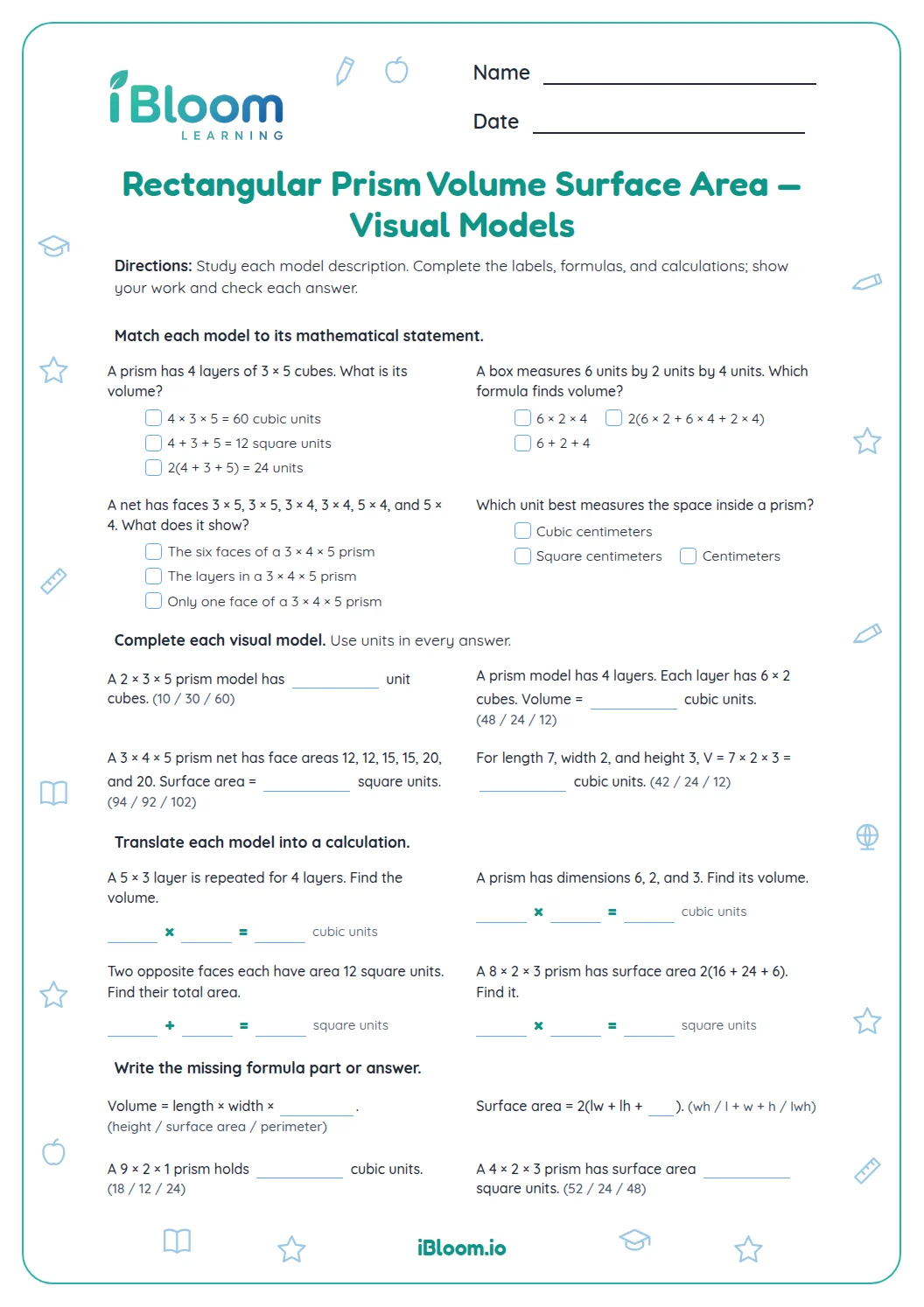
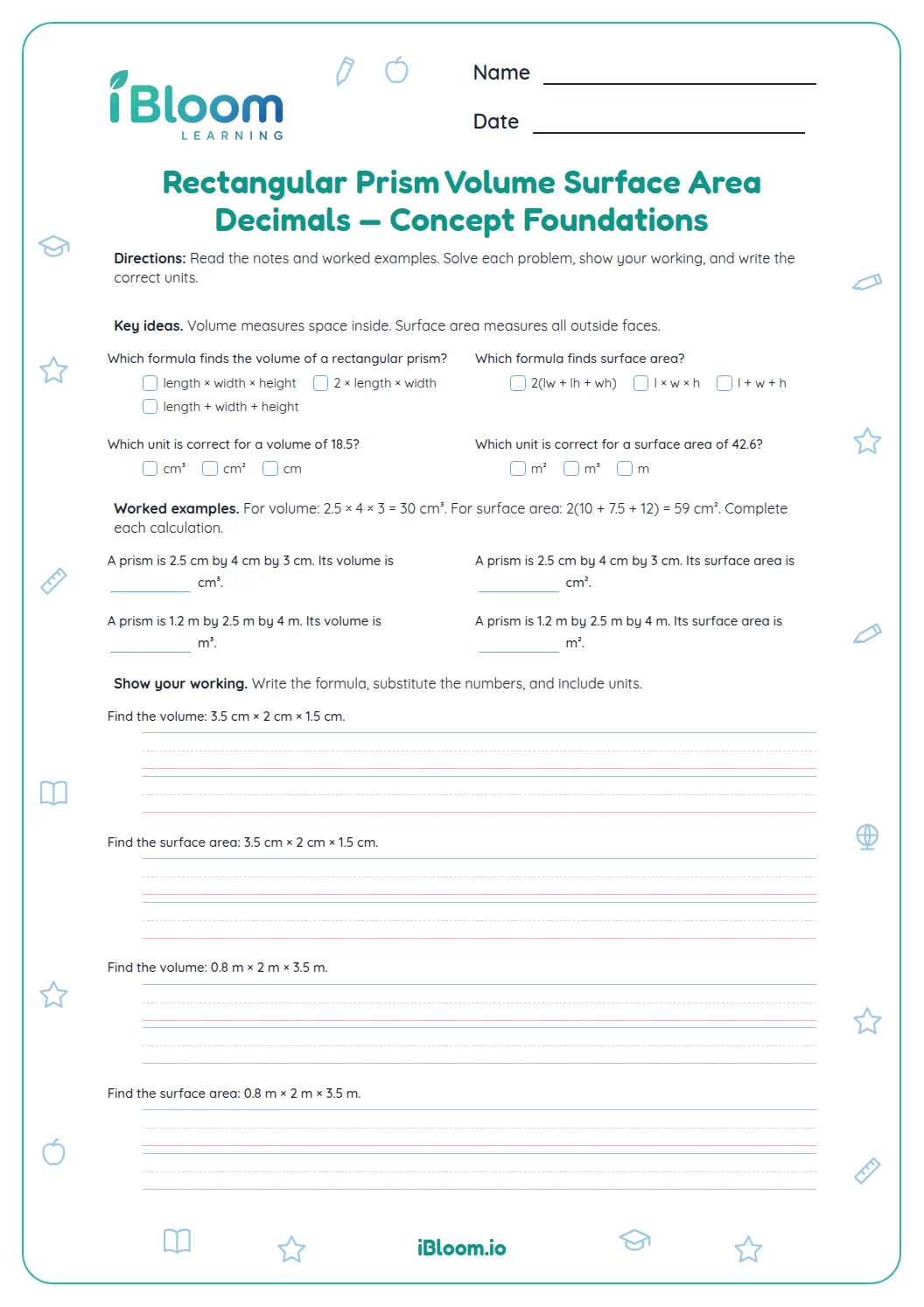
A tank’s capacity is a volume. For a right rectangular prism, multiply length, width and height: V = l × w × h. When dimensions are in feet, volume is in cubic feet. Part A uses inside dimensions so the measurements describe the space available.
Wrapping or painting concerns surface area. A closed rectangular prism has three pairs of matching faces. Its total surface area is 2 × (l × w + l × h + w × h), measured in square units.
How do fractional dimensions change the calculation?
Use the same volume relationship and multiply the fractions accurately. Rewrite mixed numbers as improper fractions, simplify factors where useful, and label the result with cubic units. Question 2 uses two mixed numbers and the fraction 2/3.
- 1Inside dimensions: 1 1/2 ft × 2/3 ft × 1 1/4 ft
- 2V = 3/2 × 2/3 × 5/4
- 3V = 5/4 = 1 1/4 ft³
How do students handle an open tray?
Question 9 asks for the inside bottom and four walls of a tray. That is five rectangles. Use l × w for the bottom, 2 × l × h for two walls, and 2 × w × h for the other two walls. The prompt identifies exactly which surfaces receive the lining.
Question 10 changes the height used for volume: the water reaches halfway up the tank. Students can halve the full volume or multiply the base area by half the inside height. Both approaches lead to the same cubic measurement.
How to use this worksheet
- 1Read each situation and underline the requested measurement.
- 2Write the dimensions and convert mixed numbers to improper fractions.
- 3For Part A, multiply the three inside dimensions and use cubic units.
- 4For Part B, find the three different face areas, double them and add.
- 5For Part C, identify the five lined faces or the actual water depth.
- 6Check calculations and units against the key.
Mistakes to notice and fix
The mistake
Adding the three dimensions to find volume.
The fix
Multiply length × width × height; addition only totals edge lengths.
The mistake
Using the closed-box formula for the open tray and counting a top.
The fix
List the bottom once and each pair of walls twice. There is no top surface to line.
The mistake
Writing square feet for an amount of water.
The fix
Water occupies three-dimensional space, so its volume uses ft³. Covering a face uses ft².
Curriculum alignment
Use fractional edge lengths to calculate rectangular prism volumes in real-world situations.
On this sheet: Students calculate the volume of containers with fractional dimensions, including a partly filled tank.
Show the official wordingHide the official wording
Find the volume of a right rectangular prism with fractional edge lengths by packing it with unit cubes of the appropriate unit fraction edge lengths, and show that the volume is the same as would be found by multiplying the edge lengths of the prism. Apply the formulas V = l w h and V = b h to find volumes of right rectangular prisms with fractional edge lengths in the context of solving real-world and mathematical problems.
What to practice next
Make more practice
Further reading
Questions parents and teachers ask
Are the dimensions inside or outside measurements?
The volume problems specify inside dimensions so students calculate the space a container holds. Covering problems give the dimensions of the solid being covered. Question 9 specifies inside faces for the tray lining. Read those details before choosing the lengths used in the calculation.
Do students need to simplify fraction answers?
Yes, students should give fractions in simplest form and may use a mixed number when appropriate. For example, question 2 gives a volume of 5/4 cubic feet on the key, which is also 1 1/4 cubic feet. Both forms represent the same volume.
Why does question 9 use only five faces?
The tray is open at the top, and its lining covers the bottom and four inside walls. Students find one bottom area and two pairs of wall areas. Listing those five rectangles first helps them avoid adding a top that the problem never asks them to cover.
How is a half-full tank different from a tank with half-length edges?
A half-full tank keeps the same base and has half the water depth. Its water volume is half the full capacity. In question 10, students can find the full volume and divide by two, or multiply the base area by half the given height.
What does the answer key include?
The key supplies a simplified numerical answer with square or cubic units for each of the ten problems. Use the working spaces to check how a student reached that result. For surface area, review the chosen faces as well as the fraction arithmetic before marking an answer.