
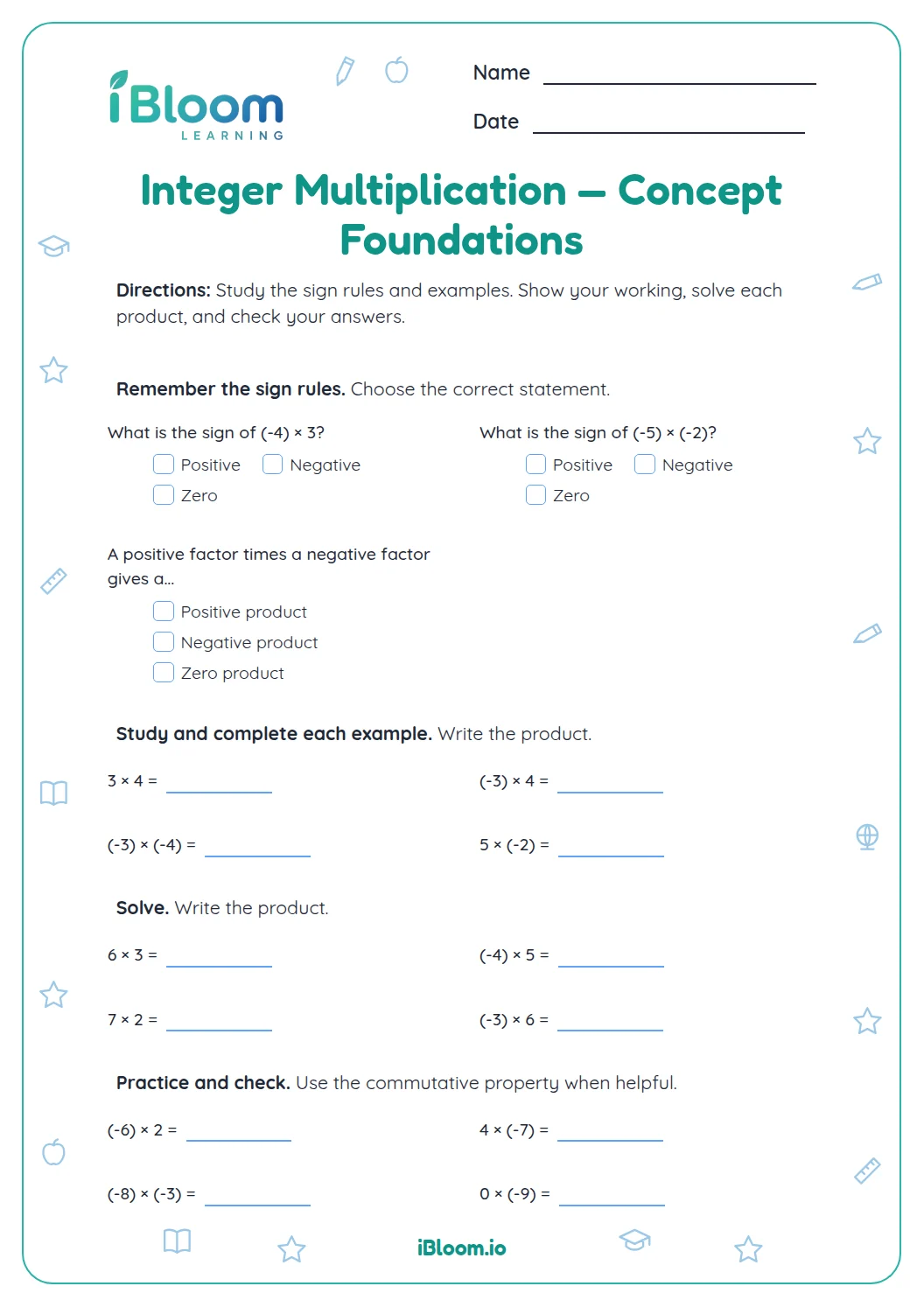
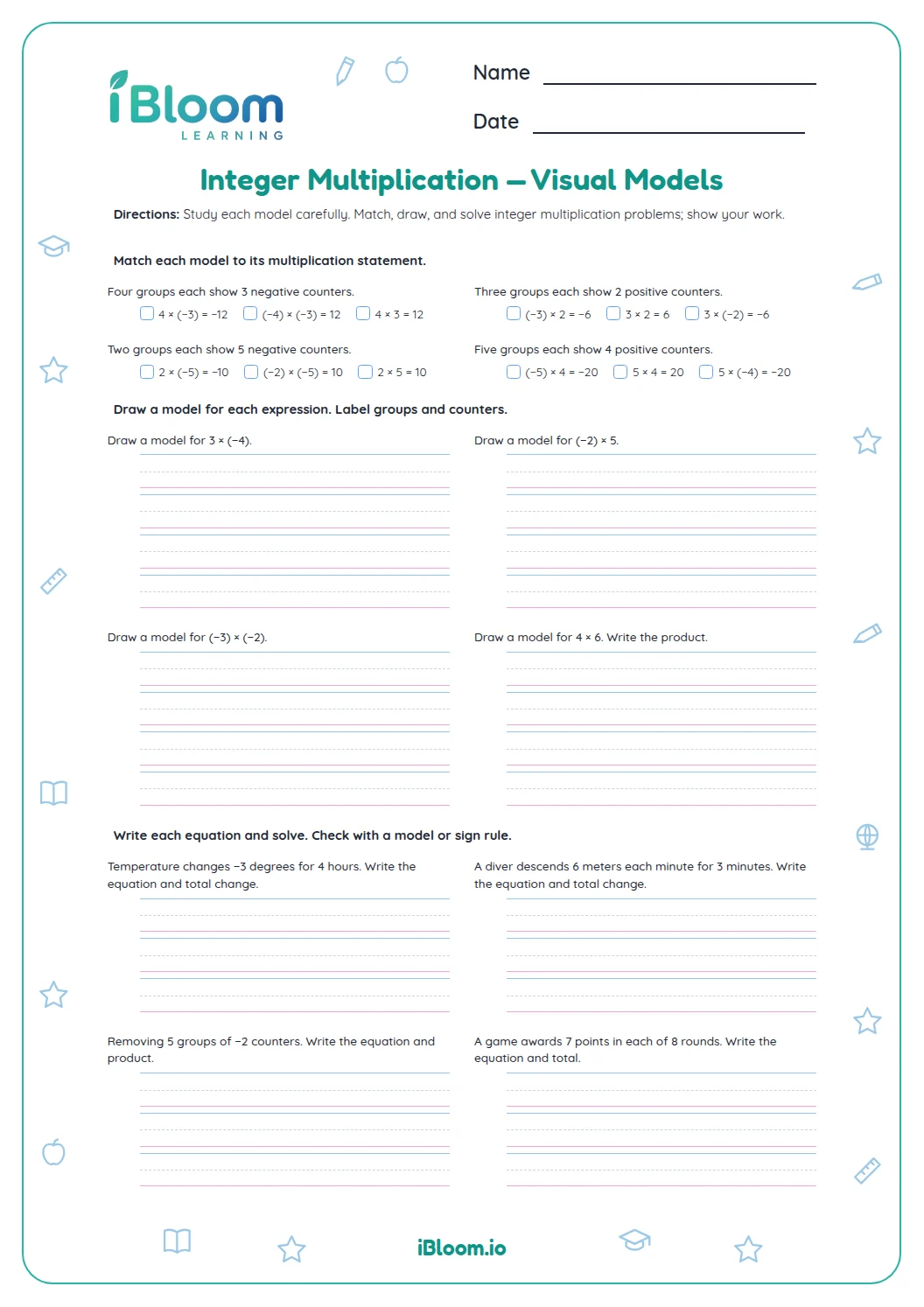
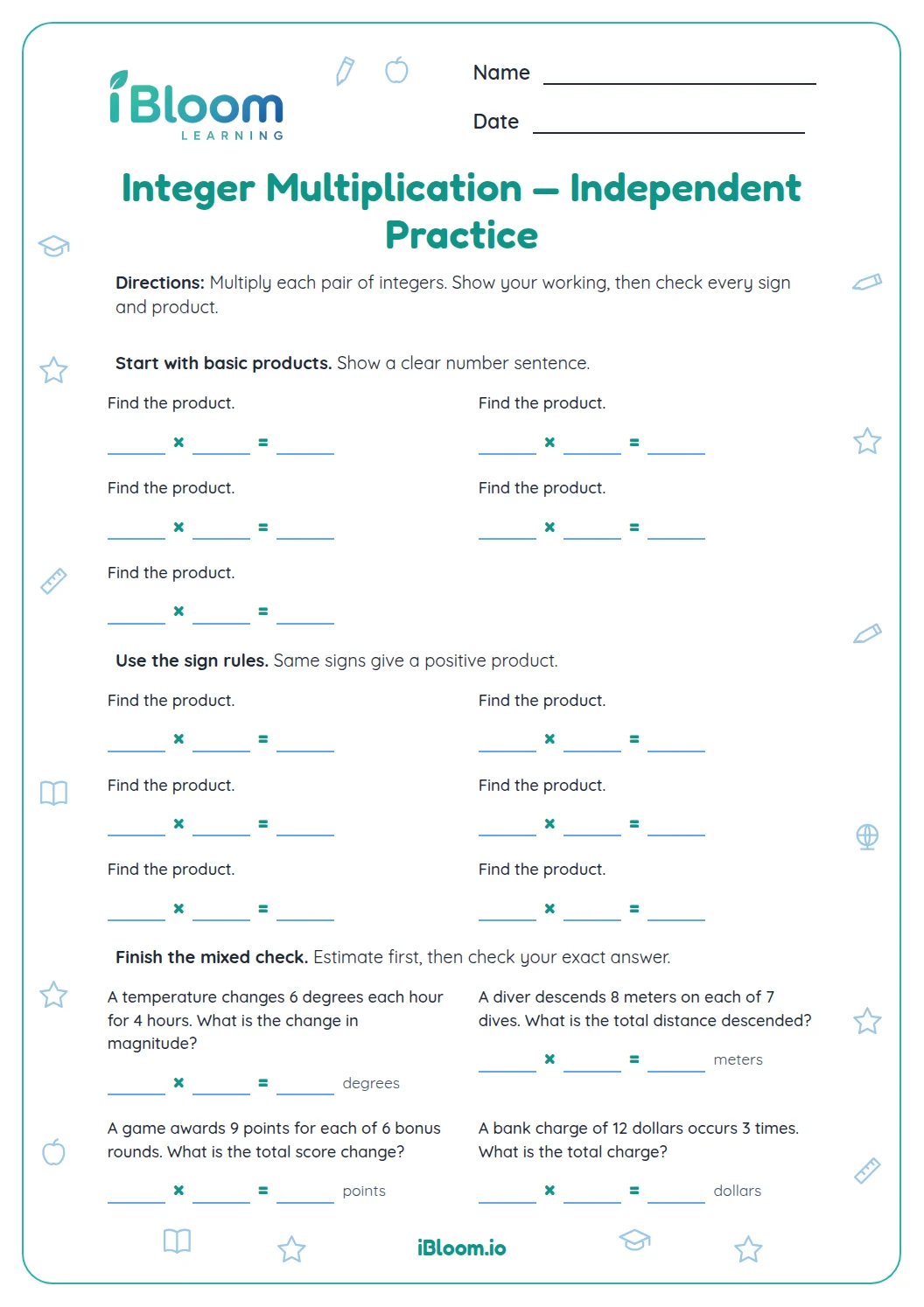
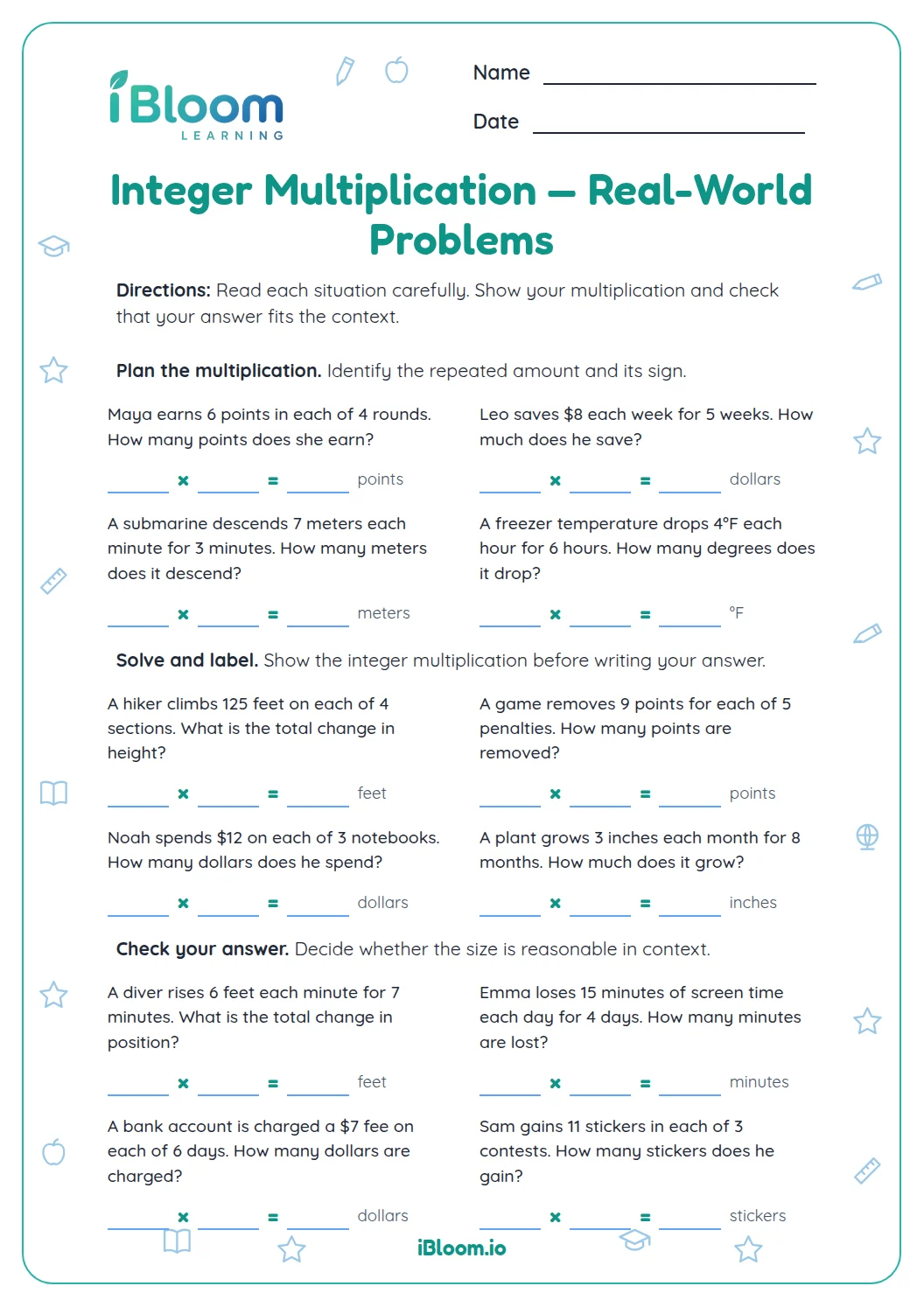
About this worksheet
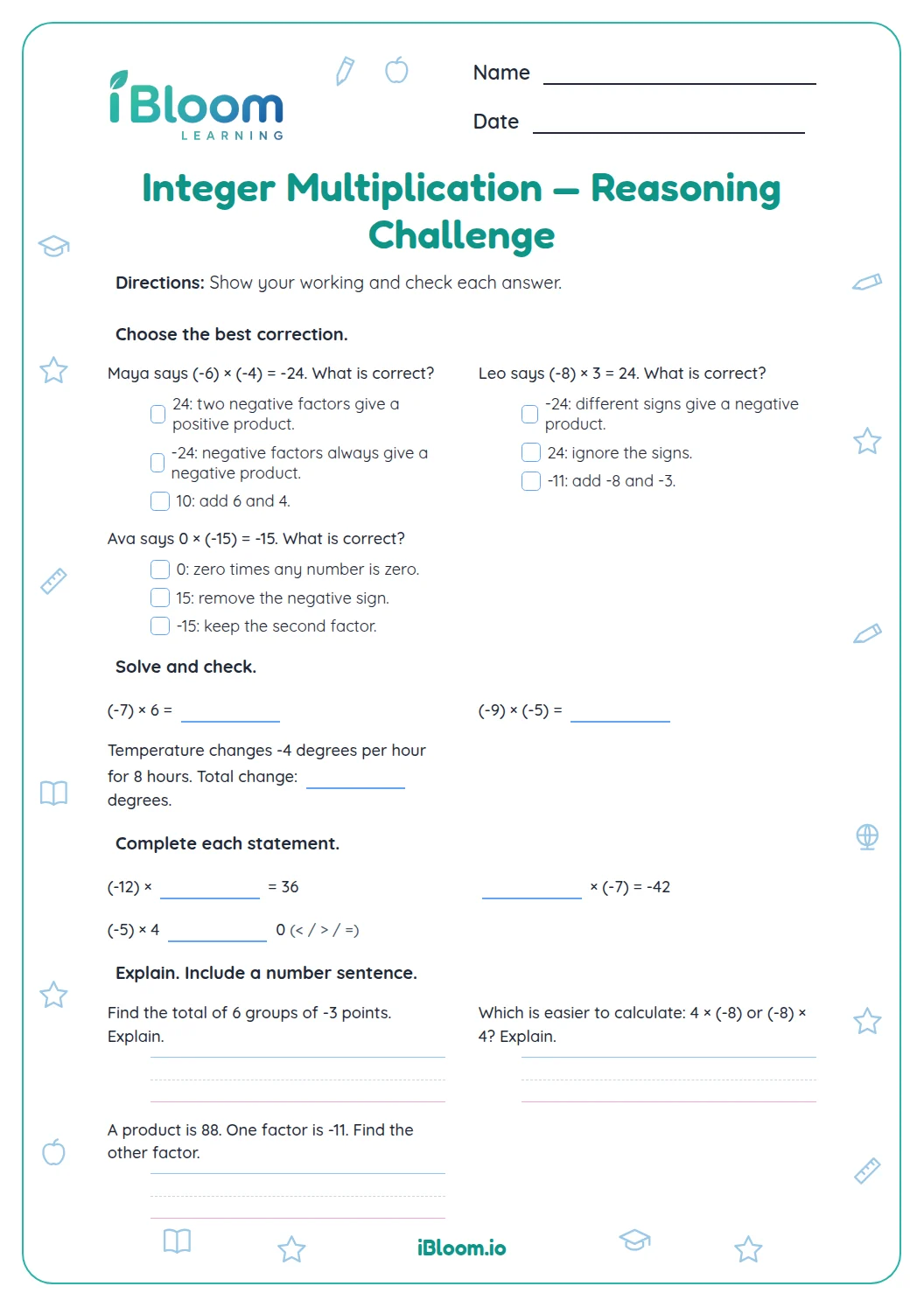
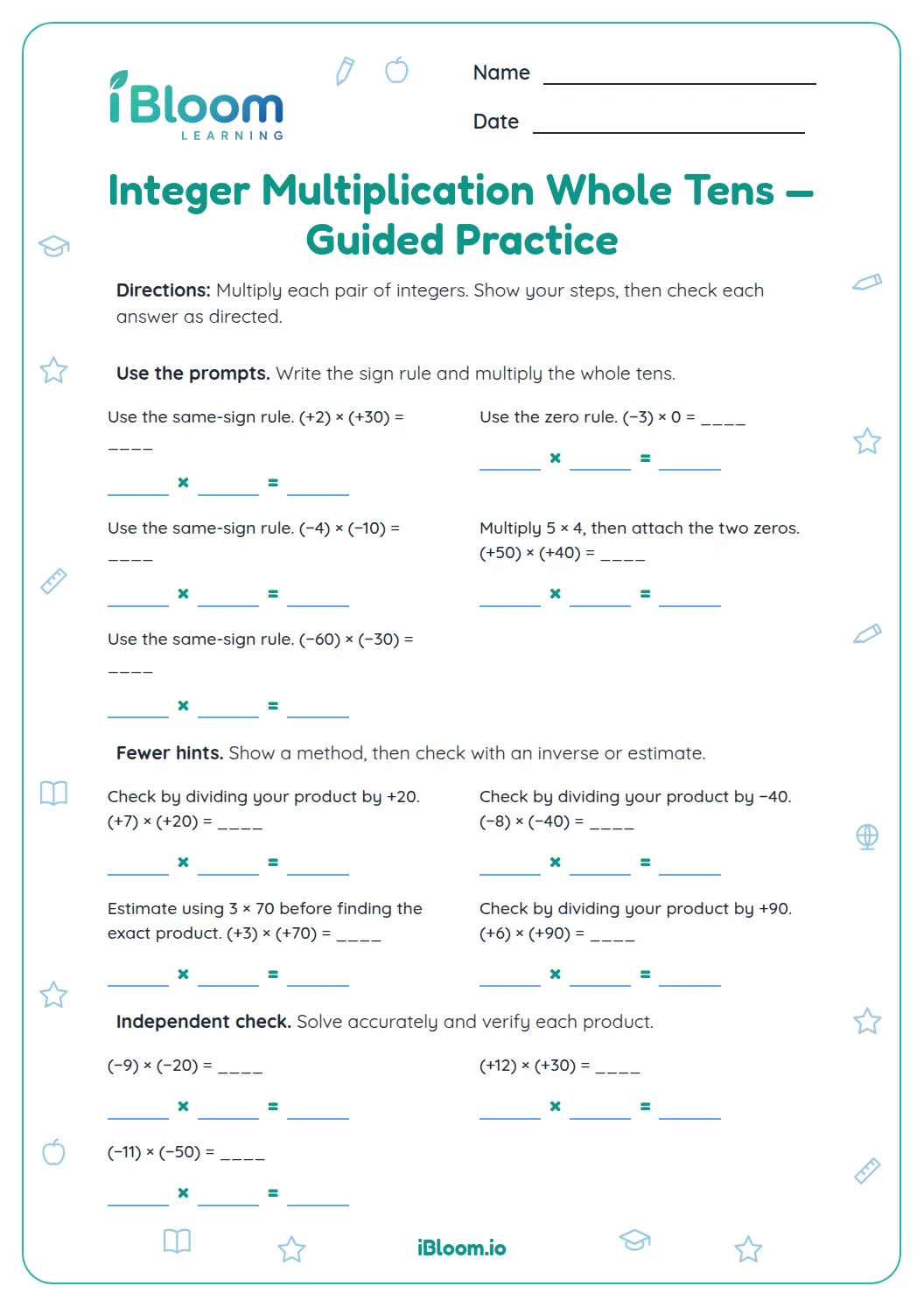
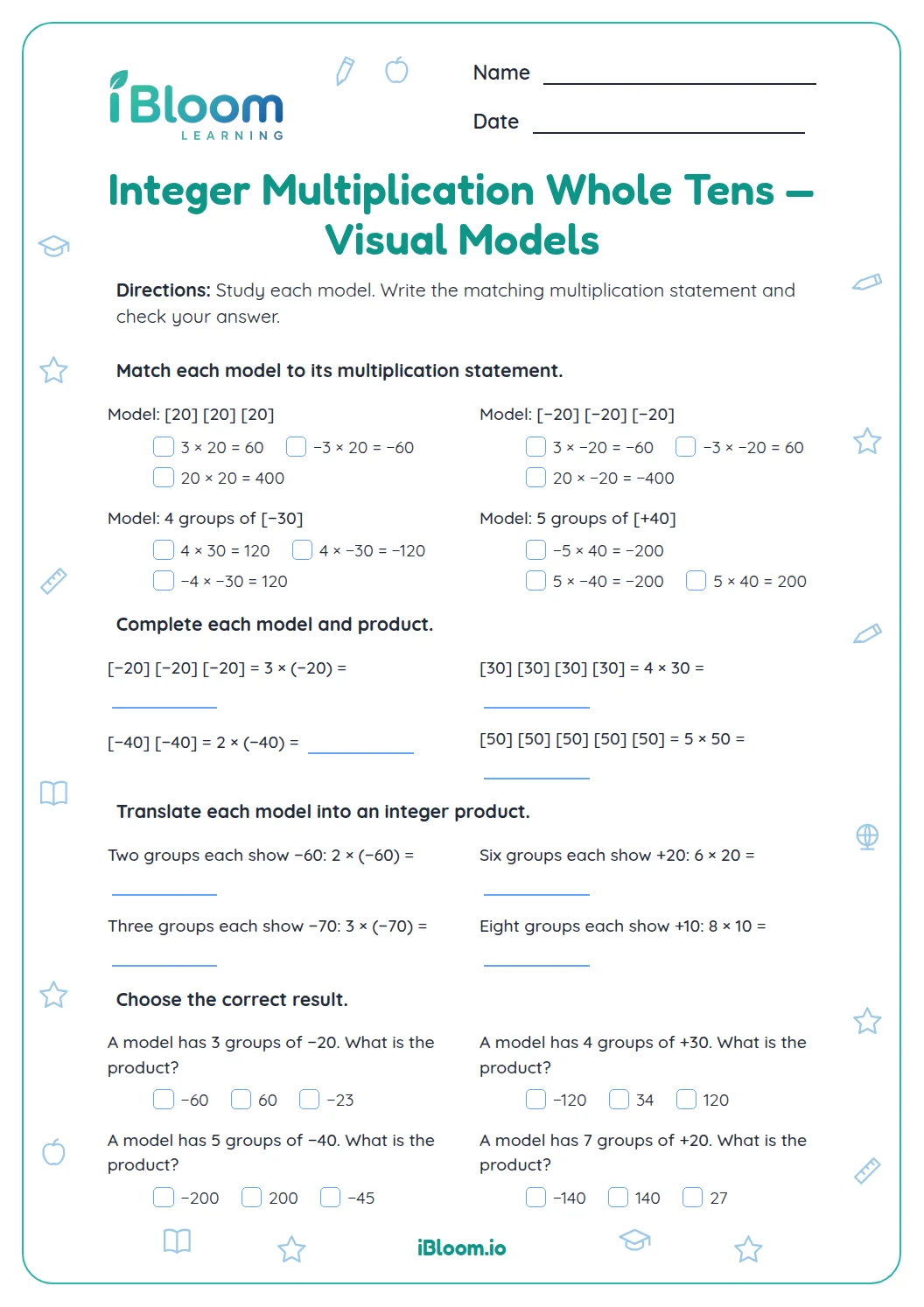
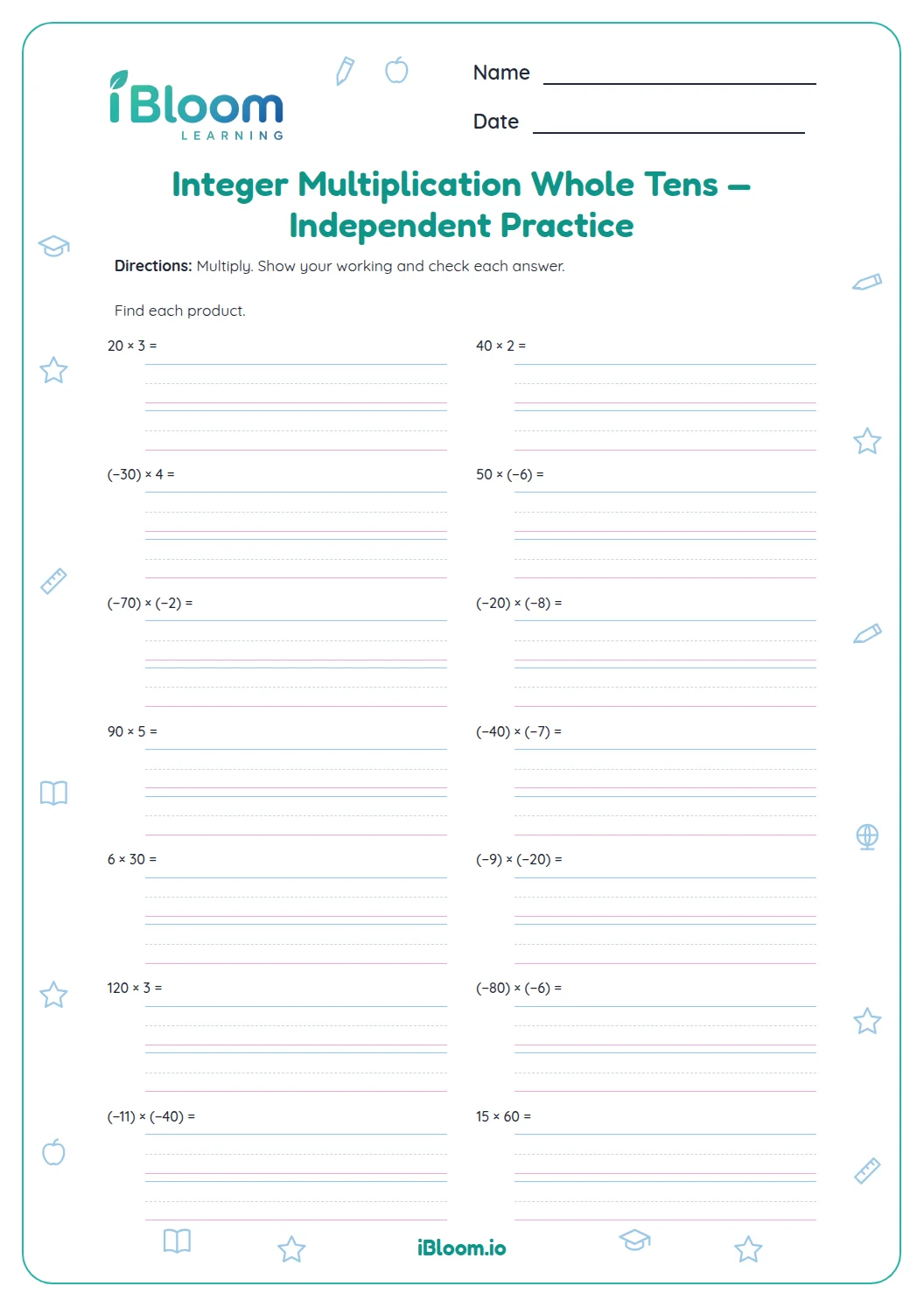
This free printable Grade 6 worksheet gives guided practice in multiplying integers. Part A starts on a number line, where four jumps of −3 from 0 land on −12, and then follows a pattern to show why (−1) × (−4) is 4. Part B asks children to predict whether a product is positive or negative before they calculate. Part C has four products such as (−4) × (−5), and Part D turns the rules into three word problems about temperature, points and depth. It practices CCSS 7.NS.A.2.a and 7.NS.A.3. A two-page answer key follows the sheet.
Aligned to 7.NS.A.2.a and 7.NS.A.3
Why does a negative times a positive give a negative?
Multiplication is repeated addition, and the number line in question 1 shows it. (−3) × 4 means four jumps of −3, each one 3 steps to the left, starting from 0. The jumps land on −12, so (−3) × 4 = −12, the same as −3 + (−3) + (−3) + (−3).
Swapping the factors gives the same product: 4 × (−3) is also −12, which is why a positive times a negative is negative too.
- 1(−6) × 7
- 2Signs: one negative, one positive. Different signs, so the product is negative.
- 3Numbers: 6 × 7 = 42.
- 4Product: −42.
Why is a negative times a negative positive?
Look at a pattern. 3 × (−5) = −15, 2 × (−5) = −10, 1 × (−5) = −5, 0 × (−5) = 0. Each time the first factor drops by 1, the product goes up by 5. Continue the pattern: (−1) × (−5) = 5, and (−2) × (−5) = 10. Question 2 asks students to continue a pattern like this one.
So (−4) × (−5) = 20. Students can also think of it as taking away debts: removing a debt of 5 four times leaves a person better off, so the result is positive.
What is on this integer multiplication worksheet?
Thirteen questions in four parts, from guided to independent.
- Part A, Build the product: four jumps of −3 on a number line, then a pattern that continues to a negative times a negative (questions 1 and 2)
- Part B, Predict the sign: choose positive or negative without calculating (questions 3 to 6)
- Part C, Multiply: four products, including two negatives (questions 7 to 10)
- Part D, Real-world problems: write an equation and solve, with units (questions 11 to 13)
How do students turn a word problem into integer multiplication?
Look for a repeated change. A temperature that drops 3 degrees every hour for 5 hours is the change −3 repeated 5 times, so the equation is (−3) × 5 = −15. The negative sign shows the drop, and the unit, degrees, says what the −15 counts.
In question 12, each foul removes 8 points. That is −8 four times, so (−8) × 4 = −32 points.
How to use this worksheet at home or in class
- 1Review the rule aloud: same signs, positive; different signs, negative.
- 2Do Part A together. Trace the four jumps of −3 on the number line with a finger, then read the pattern in question 2 and say what happens to the product each time.
- 3For Part B, ask students to underline the signs in each problem before they choose.
- 4In Part C, write the sign first, then multiply the numbers without signs, and write the product.
- 5In Part D, ask what changes and how many times. Write the equation before solving.
- 6Check with the answer key and ask students to explain the sign of one product.
Common mistakes and quick fixes
The mistake
Giving a negative product for two negatives, such as (−4) × (−5) = −20.
The fix
Say the rule: same signs make a positive. Use the pattern 2 × (−5), 1 × (−5), 0 × (−5), then (−1) × (−5).
The mistake
Dropping the negative sign in a word problem, such as writing 32 points for question 12.
The fix
Ask whether the score goes up or down. A loss is negative, so write −32 points.
The mistake
Using the rule for adding negatives, such as (−12) × (−3) = −15, because (−12) + (−3) is −15.
The fix
Ask whether the sign is × or +. For ×, multiply 12 × 3 = 36 first, then decide the sign: both factors are negative, so the product is 36.
Common Core alignment
The sheet practices the two standards below.
Know the sign rules for multiplying negative and positive numbers and explain them.
On this sheet: Parts A to C practice the sign rules for products, and Part D interprets products in real-world contexts.
Show the official wordingHide the official wording
Understand that multiplication is extended from fractions to rational numbers by requiring that operations continue to satisfy the properties of operations, particularly the distributive property, leading to products such as (-1)(-1) = 1 and the rules for multiplying signed numbers. Interpret products of rational numbers by describing real-world contexts.
Solve real-world problems with the four operations on positive and negative numbers.
On this sheet: Questions 11 to 13 solve temperature, score and depth problems by multiplying integers.
Show the official wordingHide the official wording
Solve real-world and mathematical problems involving the four operations with rational numbers.
What to practice next
Make more practice
Further reading
Questions parents and teachers ask
What does this Grade 6 integer multiplication worksheet cover?
It covers multiplying positive and negative integers using sign rules. Students build products, predict signs, multiply four pairs of integers, and solve three word problems about temperature, points and depth. The answer key shows every product with its sign and unit.
What is the easiest way to remember the sign rule?
Same signs make a positive product, and different signs make a negative product. Students can first multiply the numbers without signs, then decide on the sign by counting the negatives. An even number of negative factors gives a positive product, and an odd number gives a negative.
Why does the worksheet start with a number line and a pattern?
The number line in question 1 shows (−3) × 4 as four jumps of 3 to the left, landing on −12. The pattern in question 2 shows the product rising by 4 each step until (−1) × (−4) reaches 4. Together they show where the sign rules come from before students use them.
Should students use a calculator?
Not for this sheet. The products use facts students already know, such as 6 × 7 and 12 × 3. The new learning is the sign. If students make sign errors, ask them to say the sign rule aloud before they write each product.
Why are the word problem answers negative?
Each story describes a drop or a loss repeated several times, so each product is negative: −15 degrees, −32 points and −42 feet. Ask students to write the equation first, such as (−3) × 5 = −15, so the sign comes from the rule and the unit says what the number counts.
How long does it take, and is there an answer key?
Most students finish in about 20 minutes. Yes, a two-page answer key follows the worksheet with every answer, including the negative signs and units in the word problems, so students can check their own work or you can use it to go over mistakes.