
About this worksheet
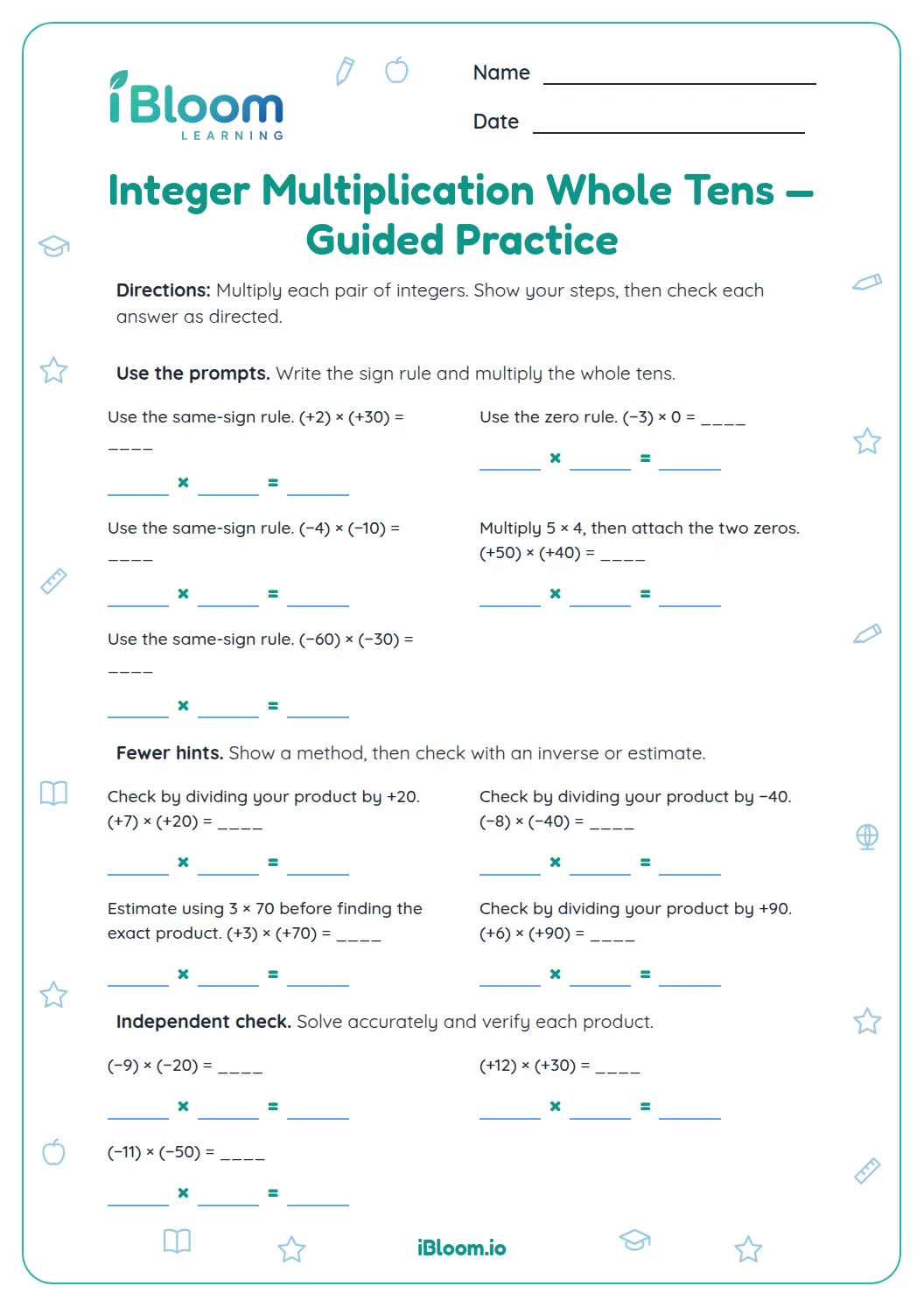
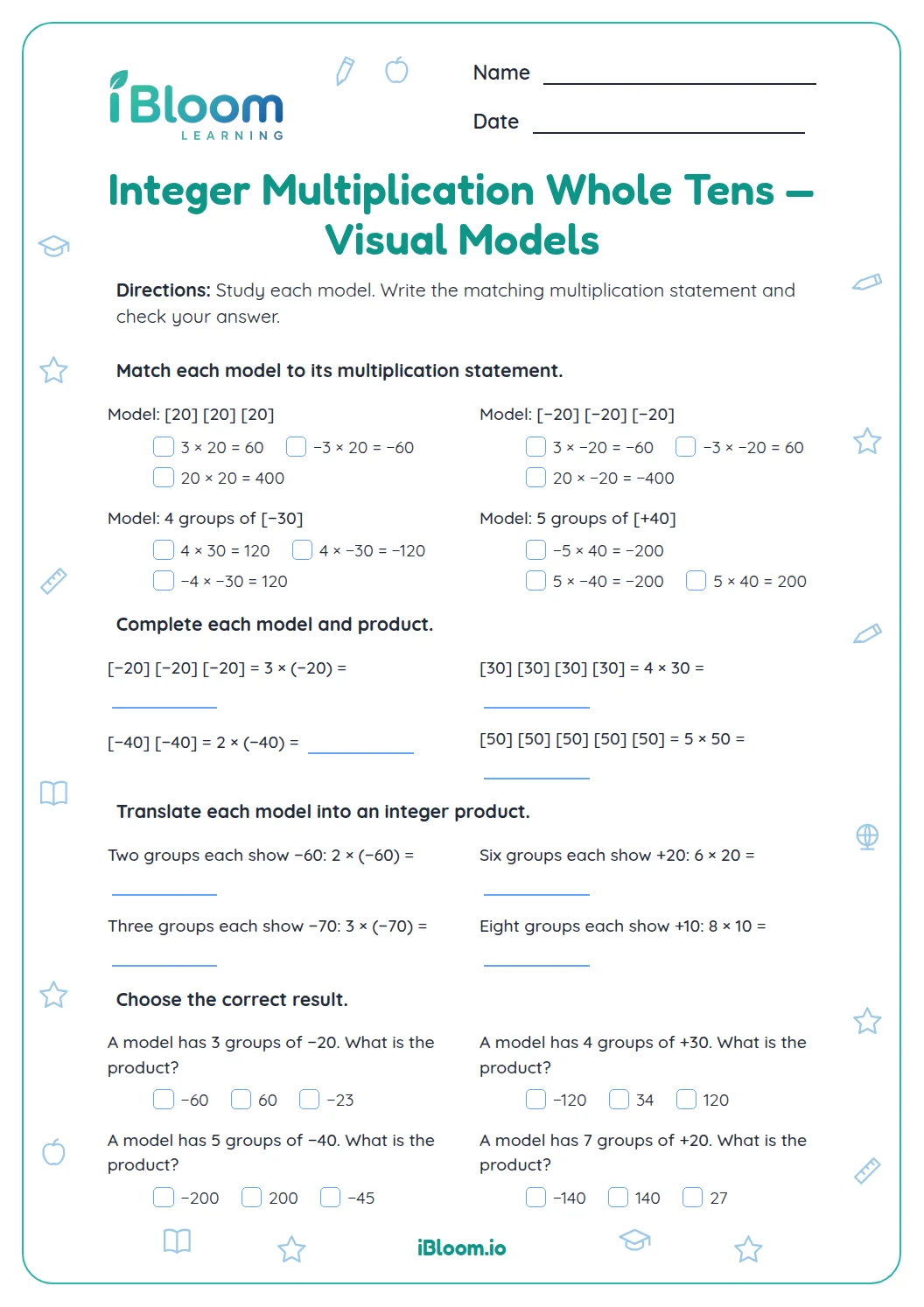
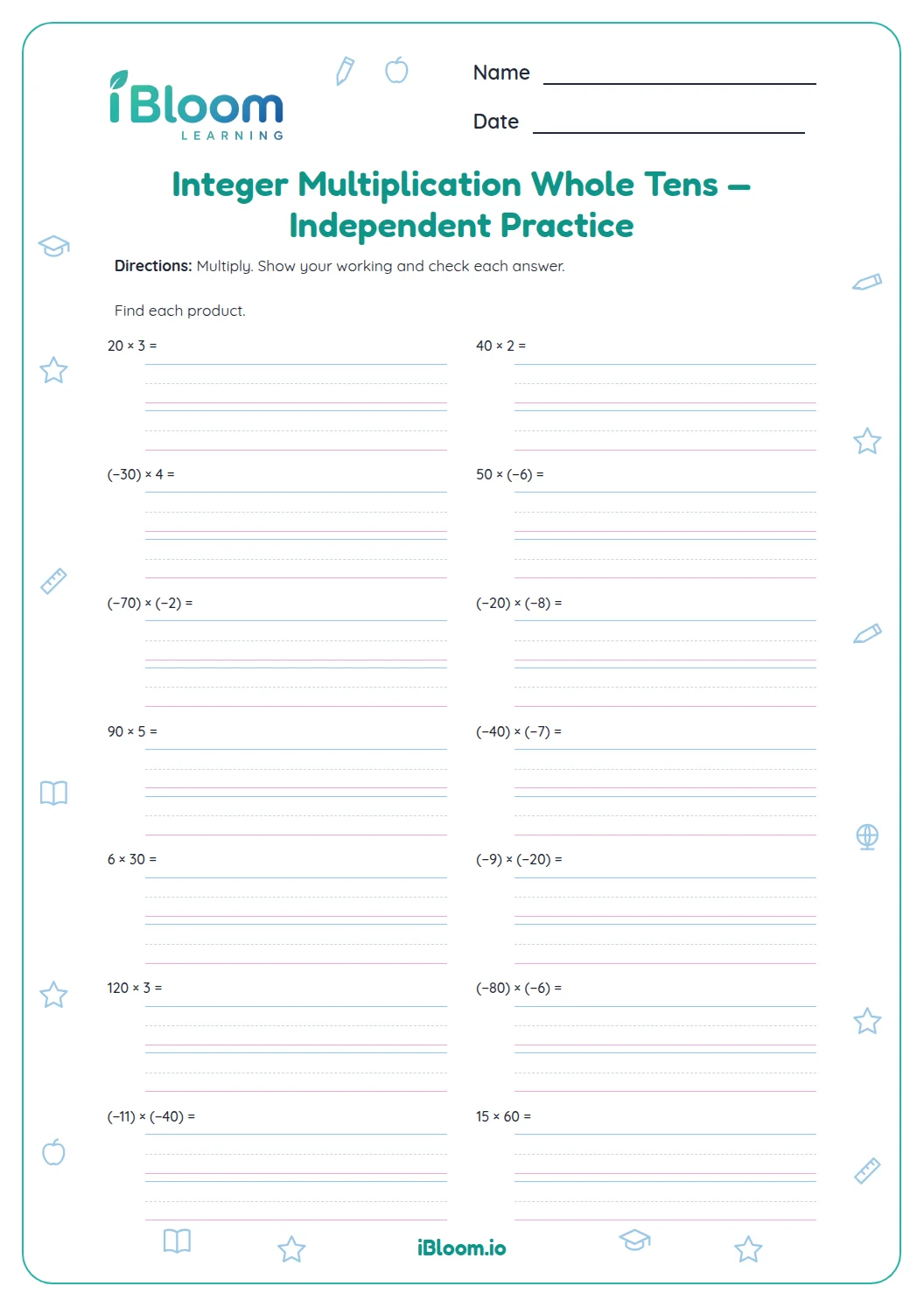
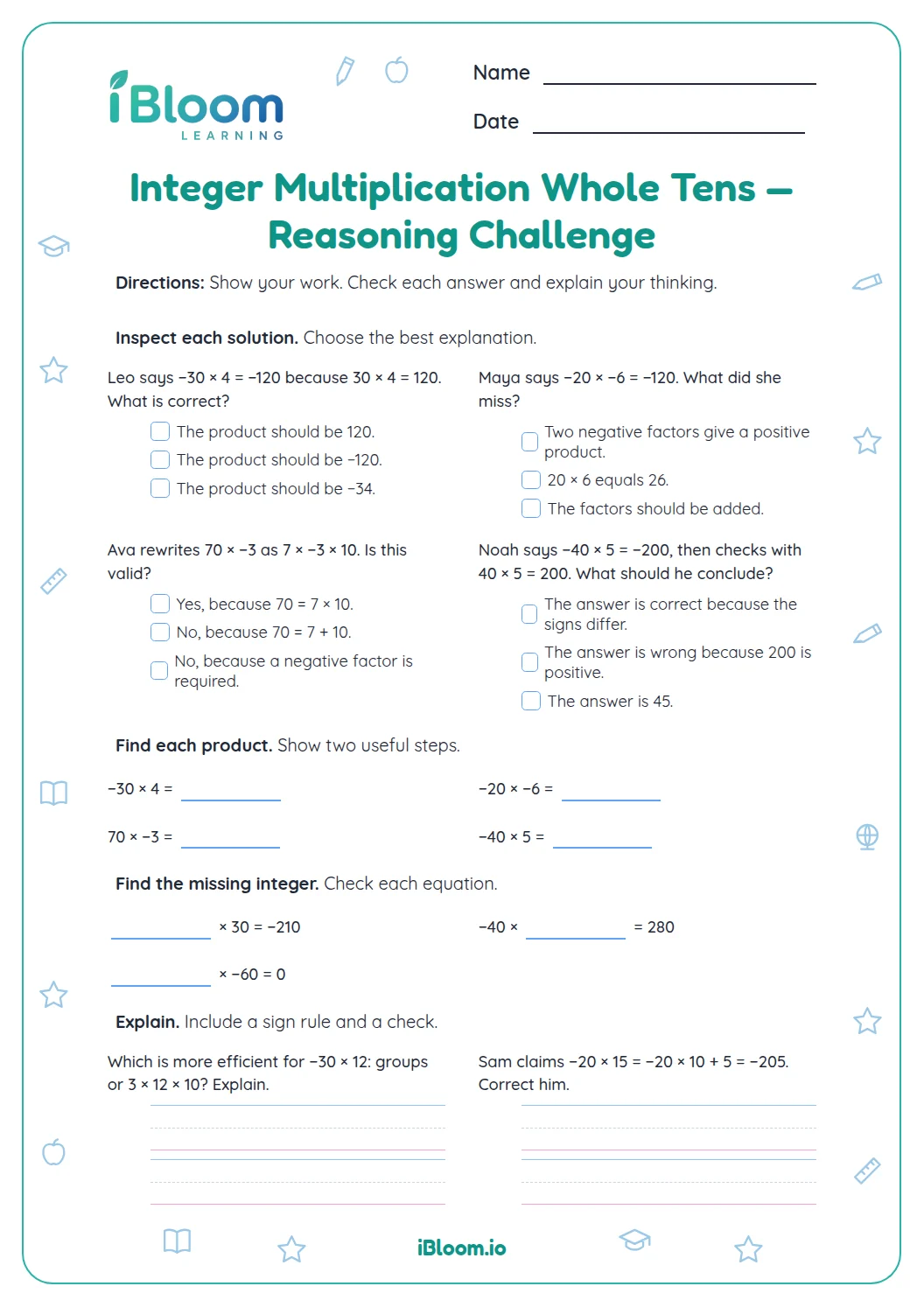
This free printable Grade 6 worksheet builds the idea behind multiplying positive and negative whole tens, such as (−8) × (−30). Children first decide whether four products are positive or negative, then make jumps of −20 and −40 on two number lines to see why a positive times a negative lands left of zero. Next they write whole tens as a number times 10, and finish with six products. It practices Common Core 7.NS.A.2.a and 7.NS.A.2.c, and a matching answer key is included.
Aligned to 7.NS.A.2.a and 7.NS.A.2.c
What is the sign rule for multiplying integers?
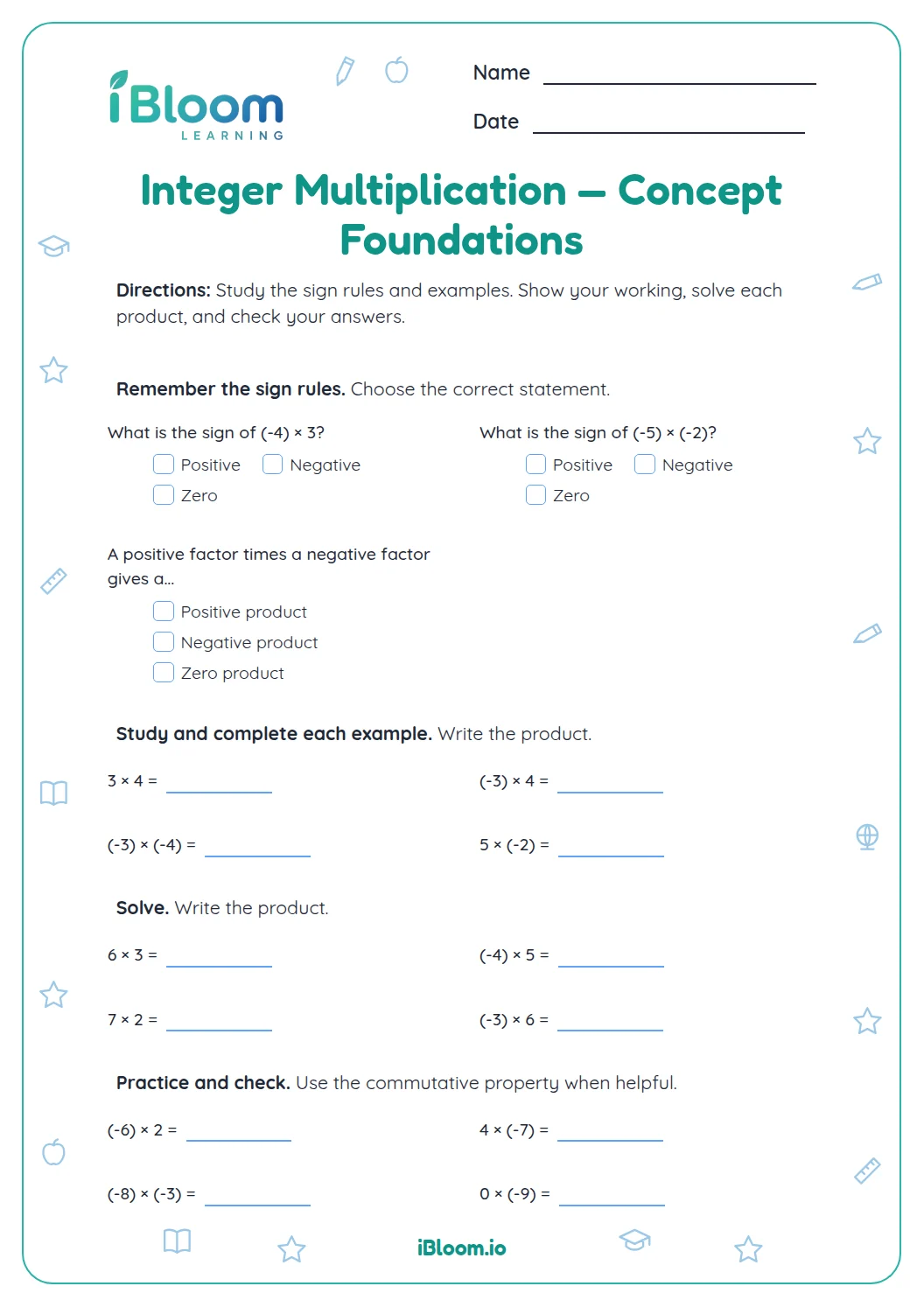
When two integers have the same sign, both positive or both negative, the product is positive. When the signs are different, the product is negative. Part A asks only about the sign, so children can see the pattern before any number work gets in the way.
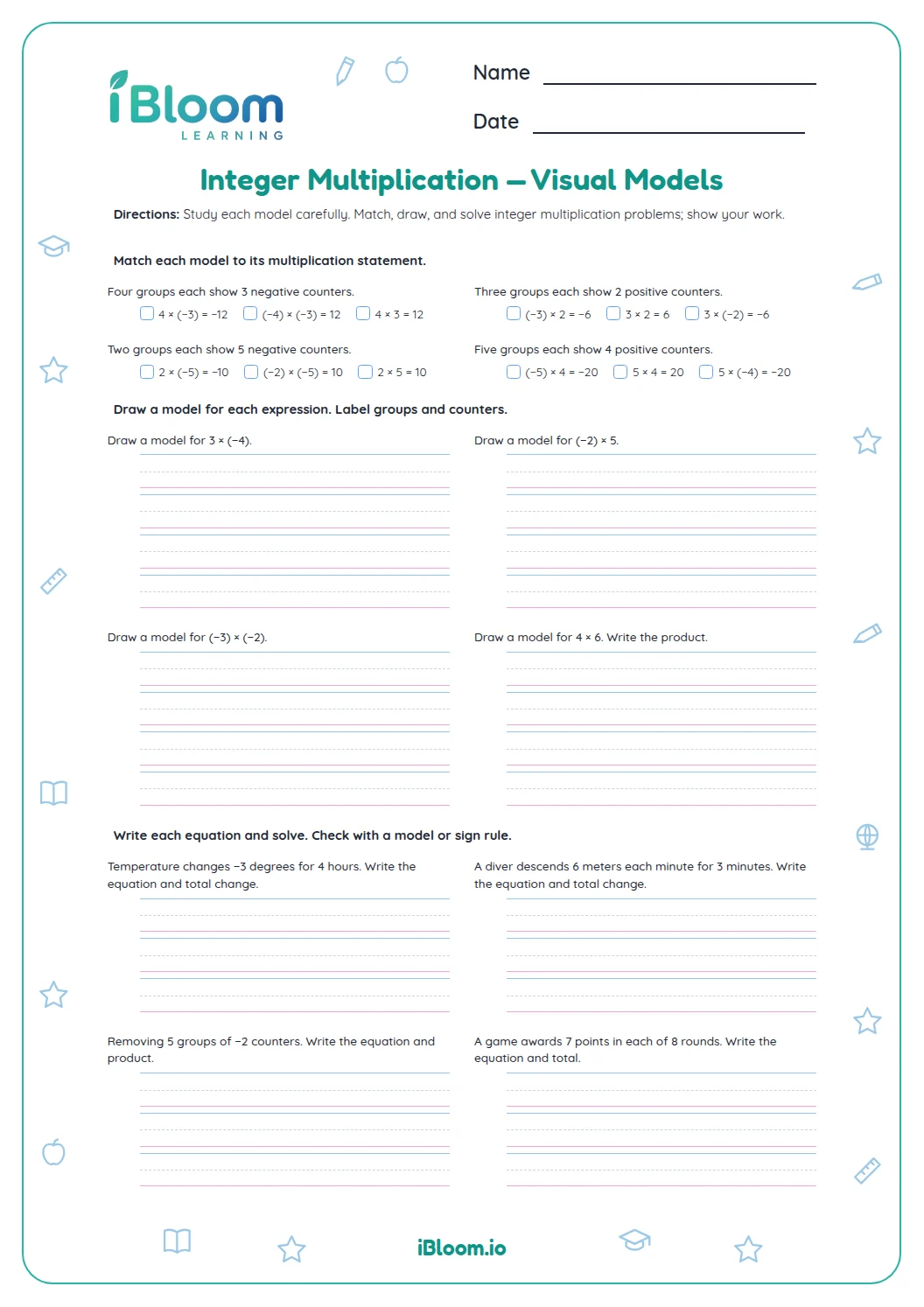
Part B shows the different-signs case on a number line. In question 5, 3 × (−20) means three jumps of −20 starting at 0. Each jump moves 20 to the left, so the end point is −60. Question 6 does the same with two jumps of −40, landing on −80.
- 1(−8) × (−30) = ___
- 2Signs: both negative, so the product is positive
- 3Factors: 8 × 3 = 24
- 430 is 3 × 10, so 24 × 10 = 240
- 5(−8) × (−30) = 240
Why write a whole ten as a number times 10?
Thirty is 3 × 10, and 40 is 4 × 10. Pulling the 10 out lets children multiply the small numbers first and then multiply by 10. For 7 × 40, they find 7 × 4 = 28 and then 28 × 10 = 280.
In Part C children fill in the factor of 10 in sentences such as 2 × 30 = 6 × ___ and (−3) × (−20) = 6 × ___. Both products are 60, which is 6 tens, so the missing factor is 10 each time.
What is on this worksheet?
Sixteen questions on two pages, in four parts that build from the sign to full products.
- Part A, Sign first: four positive-or-negative choices, such as 4 × (−50)
- Part B, Jump on the number line: 3 × (−20) and 2 × (−40) as jumps to the left from 0
- Part C, Pull out the 10: four blanks that write a whole ten as a number times 10
- Part D, Multiply: six products, from 7 × 40 to (−11) × (−40)
- Answer key, two pages, in the same layout
How to use this worksheet at home or in class
- 1Start with the sign rule on its own: ask “What sign does 4 × (−50) have?” before any multiplying.
- 2In Part B, have your child trace the three jumps of −20 on the number line with a finger, saying “−20, −40, −60.”
- 3Do question 7 together and say it aloud: “Thirty is three tens, so 30 = 3 × 10.”
- 4Have your child do Part D alone: sign first, then the small numbers, then the 10.
- 5Ask your child to check one Part D answer by sketching jumps, such as nine jumps of −20 for 9 × (−20).
- 6Mark with the answer key and ask your child to say the sign rule for any product they missed.
Common mistakes and quick fixes
The mistake
Making every product with a negative factor negative, such as (−8) × (−30) = −240.
The fix
Count the negative factors. Two negatives are the same sign, so the product is positive: 240.
The mistake
Losing a zero, such as 7 × 40 = 28.
The fix
Rewrite 40 as 4 × 10. Then 7 × 4 = 28 and 28 × 10 = 280. Ask whether the answer should be much bigger than 28.
The mistake
Jumping to the right on the number line, so 3 × (−20) lands on 60 instead of −60.
The fix
A jump of −20 is a step of 20 to the left. Start at 0, count three jumps to the left, and read −60 where you stop.
Common Core alignment
Most US states teach integer operations with the Common Core standards or a close state version. These two standards match what this sheet practices.
Understand the rules for multiplying signed numbers.
On this sheet: Part A, Part B and Part D practice the rule for the sign of a product, and Part B shows it as jumps on a number line.
Show the official wordingHide the official wording
Understand that multiplication is extended from fractions to rational numbers by requiring that operations continue to satisfy the properties of operations, particularly the distributive property, leading to products such as (-1)(-1) = 1 and the rules for multiplying signed numbers. Interpret products of rational numbers by describing real-world contexts.
Use properties of operations to multiply rational numbers.
On this sheet: Parts C and D use 10 as a factor, so (−8) × (−30) becomes (8 × 3) × 10 with the sign decided separately.
Show the official wordingHide the official wording
Apply properties of operations as strategies to multiply and divide rational numbers.
What to practice next
Make more practice
Further reading
Questions parents and teachers ask
Why is a negative times a negative positive?
Two negatives multiply to a positive because multiplying by a negative reverses direction, and reversing it twice returns it to the original direction. Children can see this with a pattern: (−3) × 2 = −6, (−3) × 1 = −3, (−3) × 0 = 0, so (−3) × (−1) continues to 3.
What is the answer to (−8) × (−30)?
The answer is 240. Both factors are negative, so the product is positive. Then 8 × 3 = 24, and since 30 is 3 × 10, the product is 24 × 10 = 240. This is question 12 on the sheet, and the worked example in the first section above walks through it.
What should my child know before this worksheet?
Your child should know multiplication facts to 10 × 10, how to multiply by 10, and that integers include positive and negative whole numbers on a number line. Seeing a negative as a distance to the left of zero is helpful. If the signs are new, begin with Part A on its own.
How does a number line show 3 × (−20)?
Start at 0 and make three equal jumps of 20 to the left, because the factor −20 is negative. The end point is −60. Question 5 prints this number line from −80 to 0, so children can mark each jump and read the product where they stop.
Why do whole tens make these products easier?
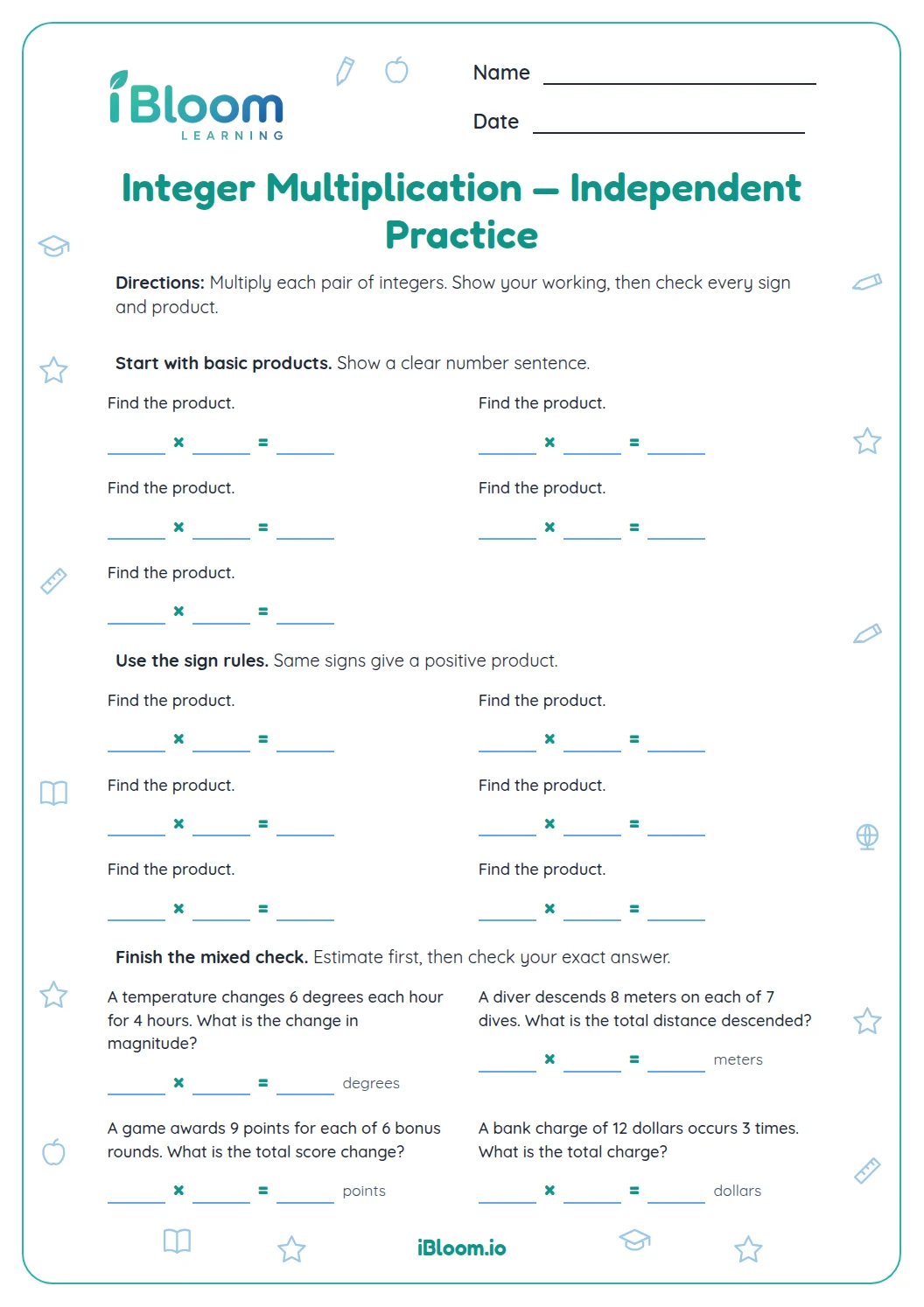
A whole ten hides a basic fact. For (−5) × (−60), children work out 5 × 6 = 30, multiply by 10 to get 300, and then add the sign. Both factors are negative, so the product is 300. Part C practices finding that hidden 10 before Part D uses it.
Is there an answer key for this worksheet?
Yes. The answer key shows the sign choice, the missing 10, the number line products and all six Part D products, in the same layout as the worksheet. Download the free PDF from this page, print the worksheet by itself and use the key to check your child's work.