
About this worksheet
This free Grade 6 worksheet uses whole tens to model repeated changes in money, position, and game scores. Students choose signed expressions, solve short situations, and interpret products with positive or negative factors. Compact choices keep practice focused on signs, tens, units, and context. The sheet practices Common Core 7.NS.A.2a and includes a separate answer key.
Aligned to 7.NS.A.2a
How do students turn a situation into signed multiplication?
A positive count of repeated losses multiplies a negative change. Twenty withdrawals of $30 are 20 × (−30). A positive count of gains multiplies a positive change, as with ten gains of 40 points. Part A focuses on building that expression before calculating.
The time questions define past times as negative. This makes the second negative meaningful: a constant downward rate multiplied by a time before now gives a position above the current reference point.
Why does multiplying two whole tens produce hundreds?
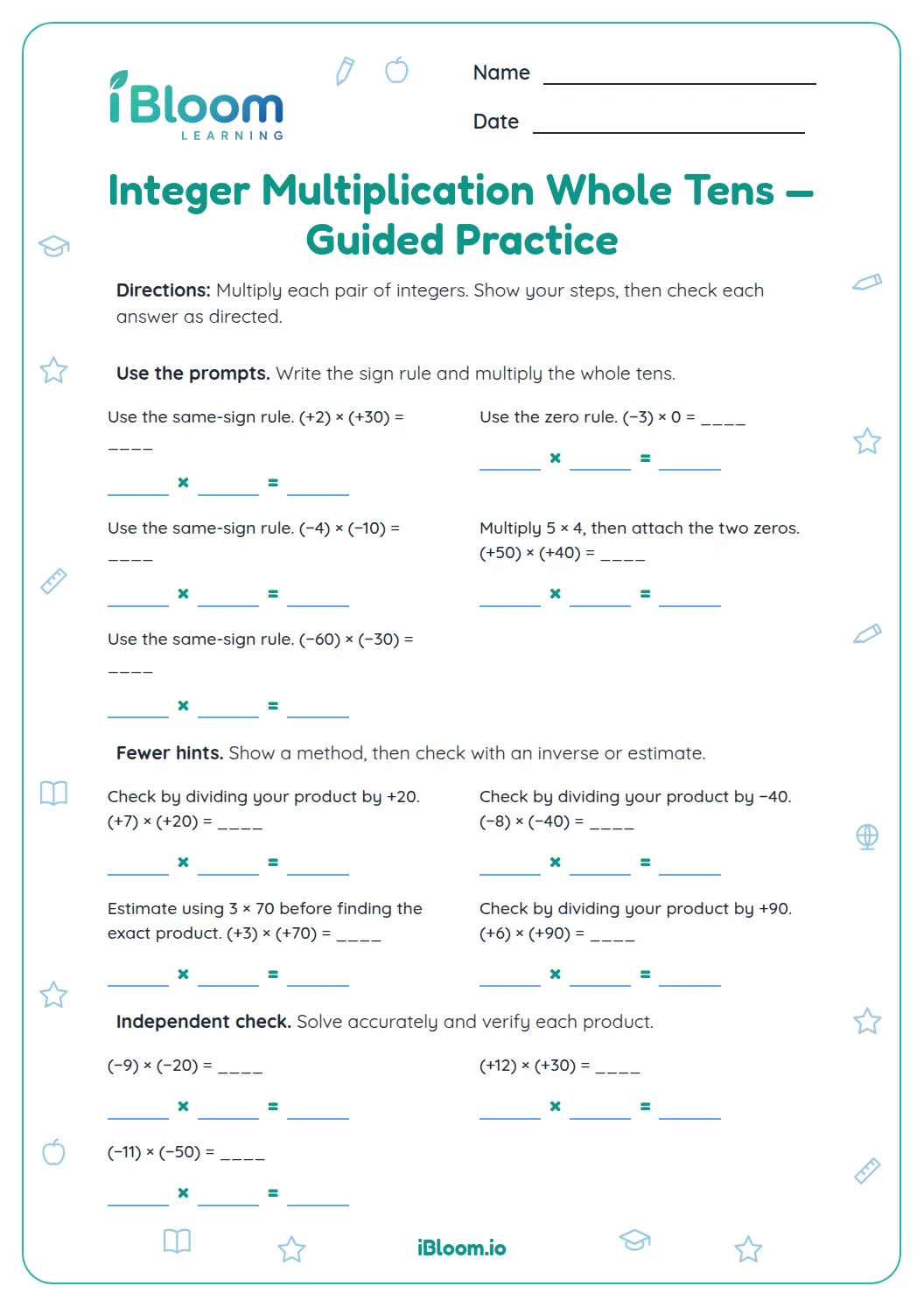
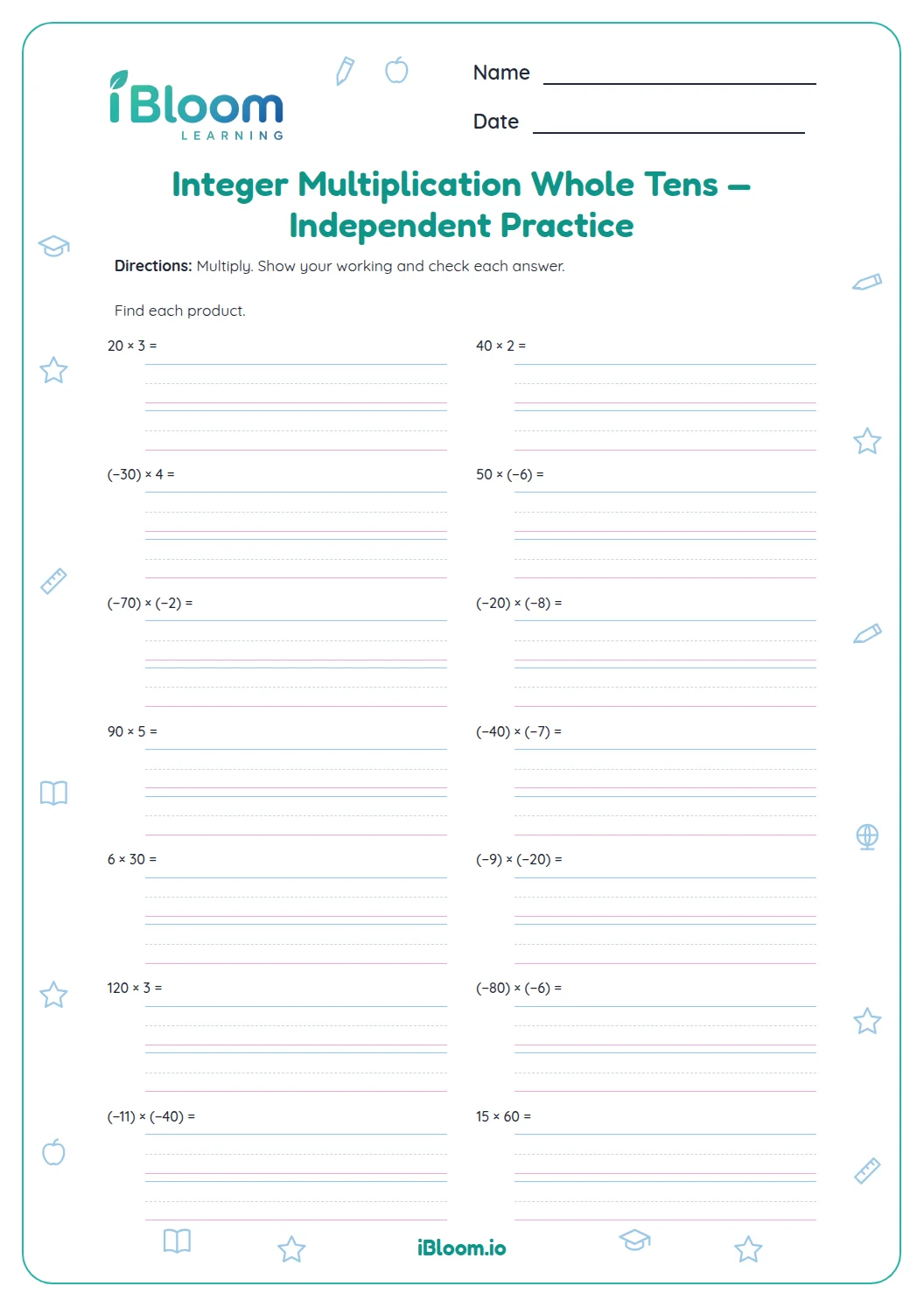
Each factor contains a factor of ten. For 20 × 30, multiply 2 × 3 and then 10 × 10: the magnitude is 600. Determine the sign separately and read the answer in context. Question 11 is 20 × 30 = 600 feet; question 12 is 20 × (−40) = −800 points.
- 120 withdrawals, each changing the balance by −$30
- 220 × (−30) = −600
- 32 × 3 = 6 and 10 × 10 = 100
- 4The signed change is −$600, a $600 decrease.
Why can two negative factors describe a positive change?
A rate of −20 feet per minute means a position decreases as time moves forward. At time −30 minutes, the change from the current reference is (−20) × (−30) = 600 feet. The earlier position was higher.
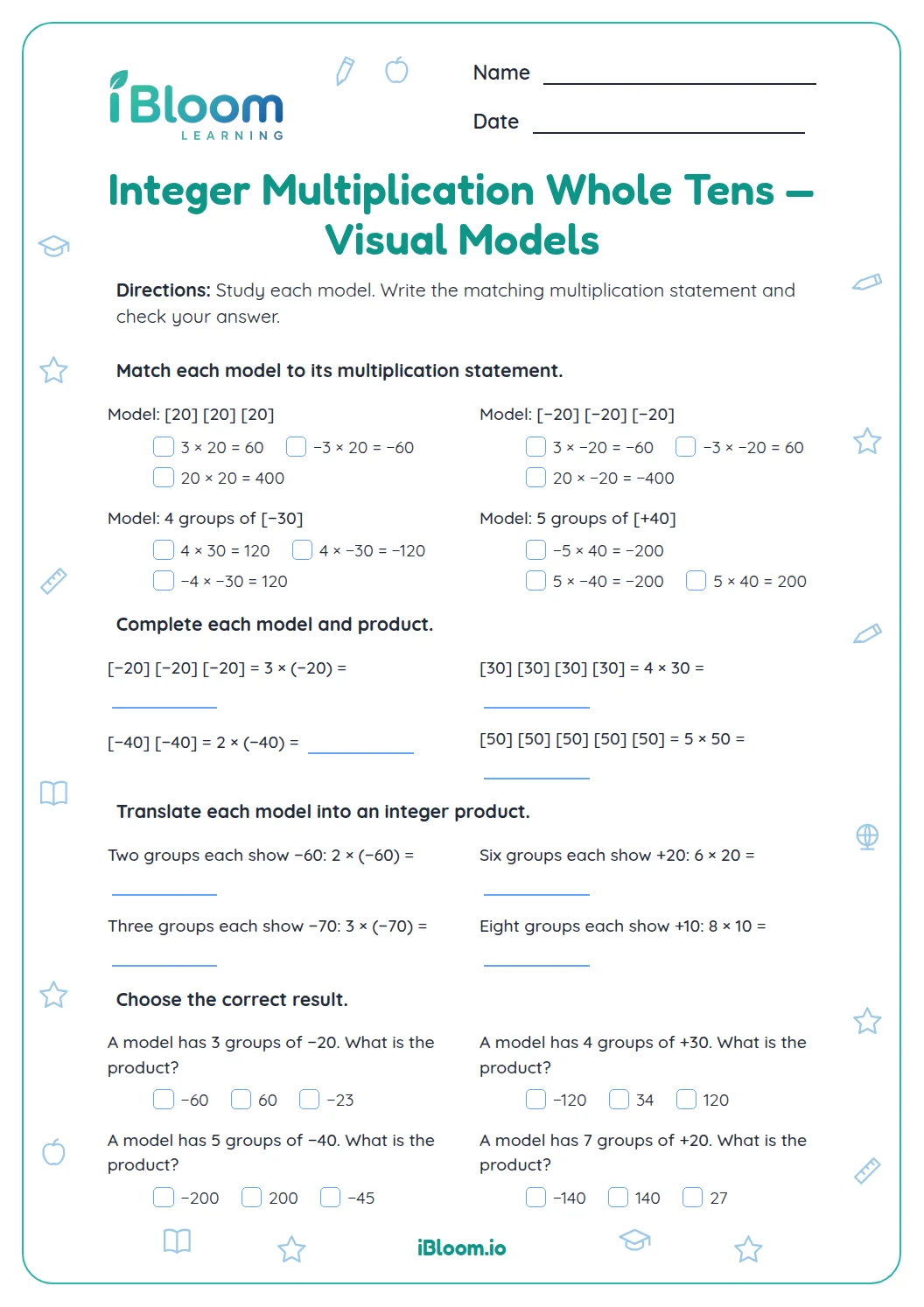
Question 14 uses canceled penalties instead. Removing ten penalties of −40 points raises the score by 400 points. The prompt explicitly defines a negative count as removals, so students can interpret the model (−10) × (−40).
How to use this worksheet
- 1Underline the amount of each change and the number of times it happens.
- 2Decide whether each factor represents a gain, loss, forward time, backward time, or removal.
- 3In Parts A and C, choose the expression or product that matches each situation.
- 4In Part B, write the multiplication, multiply the magnitudes, and attach the correct sign and unit.
- 5In Part D, explain what each positive result means in the situation.
Mistakes to discuss
The mistake
Writing 20 × (−30) = −60.
The fix
Account for both tens: 2 × 3 × 10 × 10 = 600, so the signed answer is −600.
The mistake
Making every answer with a negative factor negative.
The fix
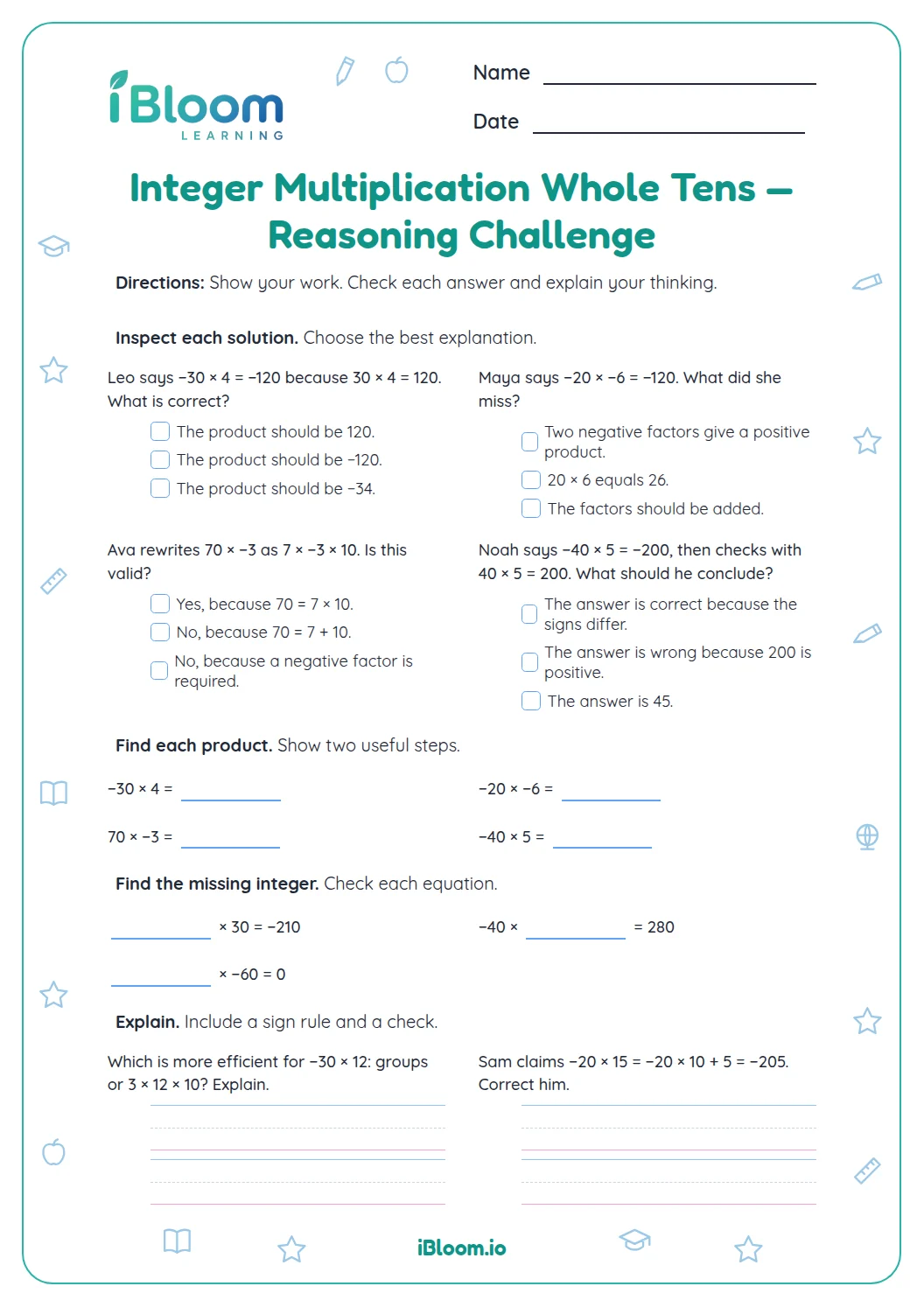
Check both factors. Two negative factors give a positive product, as in the backward-time example.
The mistake
Calling −$600 a final balance when no starting balance is given.
The fix
Label it a change. The account decreases by $600; the ending balance would also require the starting amount.
Common Core alignment
Multiply signed whole tens and interpret gains, losses, and reversed changes.
On this sheet: Students choose signed products for situations, compute changes using whole tens, and explain positive products of two negatives.
Show the official wordingHide the official wording
Understand that multiplication is extended from fractions to rational numbers by requiring that operations continue to satisfy the properties of operations, particularly the distributive property, leading to products such as (-1)(-1) = 1 and the rules for multiplying signed numbers. Interpret products of rational numbers by describing real-world contexts.
What to practice next
Make more practice
Further reading
Questions parents and teachers ask
What does “whole tens” mean here?
Both multiplication factors are multiples of ten, such as 20, −30, or 40. Students multiply the nonzero parts and account for a factor of ten from each number. They also decide the sign of the product and explain what that sign means in the situation.
Why are some times written as negative numbers?
The worksheet defines time before now as negative. A descending elevator has a negative rate, but thirty minutes earlier is also a negative time. Their positive product tells how far above its current reference position the elevator was, assuming the same rate throughout that interval.
How does canceling penalties make a positive product?
The last question defines a negative count as removing penalties. Each penalty was worth −40 points, so removing ten of them is modeled by (−10) × (−40) = 400. The positive result means the score increases by 400 points compared with keeping those penalties.
Should students include units and a plus sign?
Students should include the relevant unit, such as feet, points, or dollars. A minus sign is essential for a negative change. Positive answers may be written with or without a plus sign. Read each result aloud as an increase, decrease, or position to check its meaning.
What should I check besides the final product?
Check the multiplication expression and the interpretation. A student might calculate 600 correctly but use the wrong sign for withdrawals. In Part C, look for words explaining why the result is positive. The key supplies numerical results and sample explanations for comparing both the computation and the meaning.