









About this worksheet
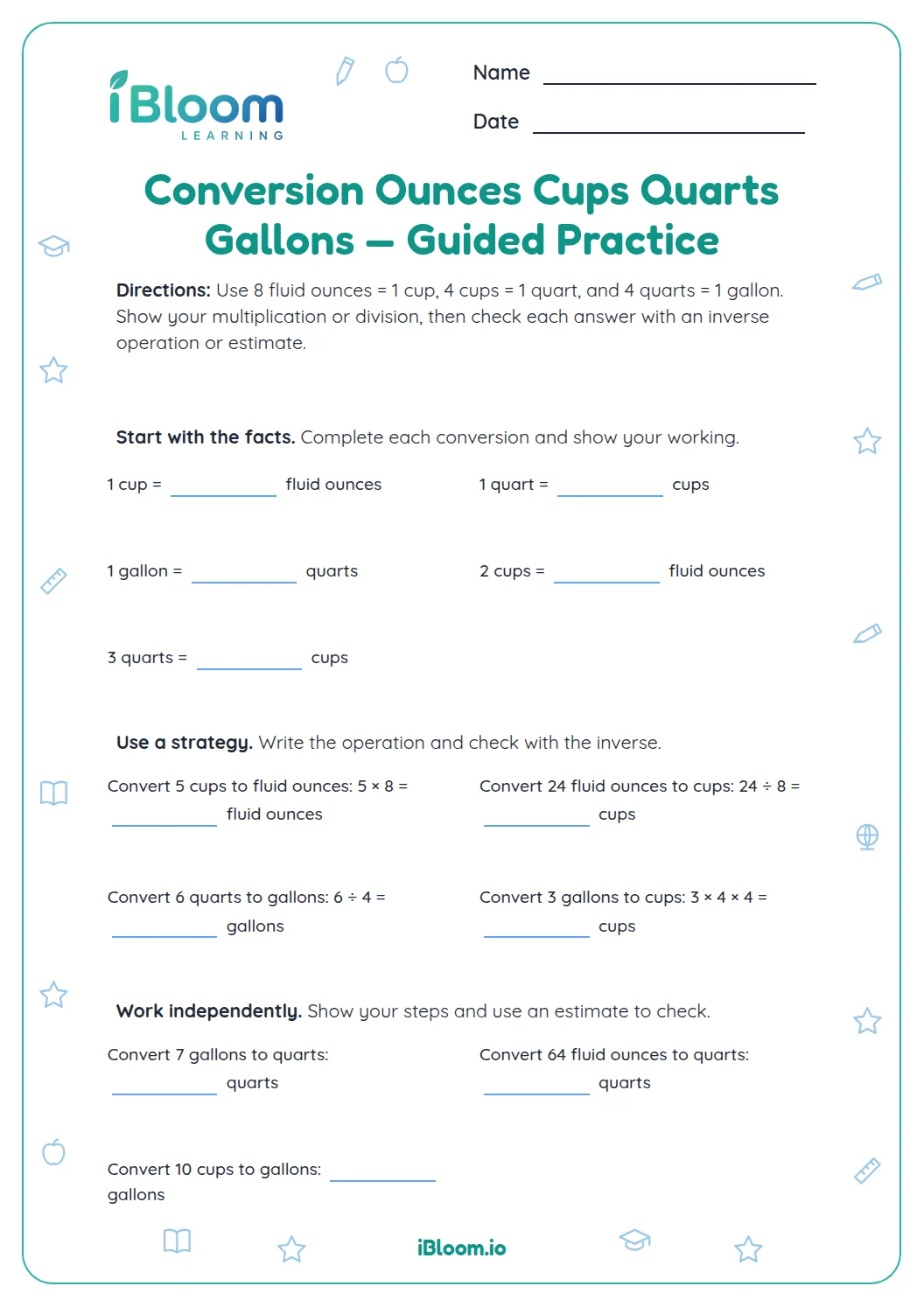
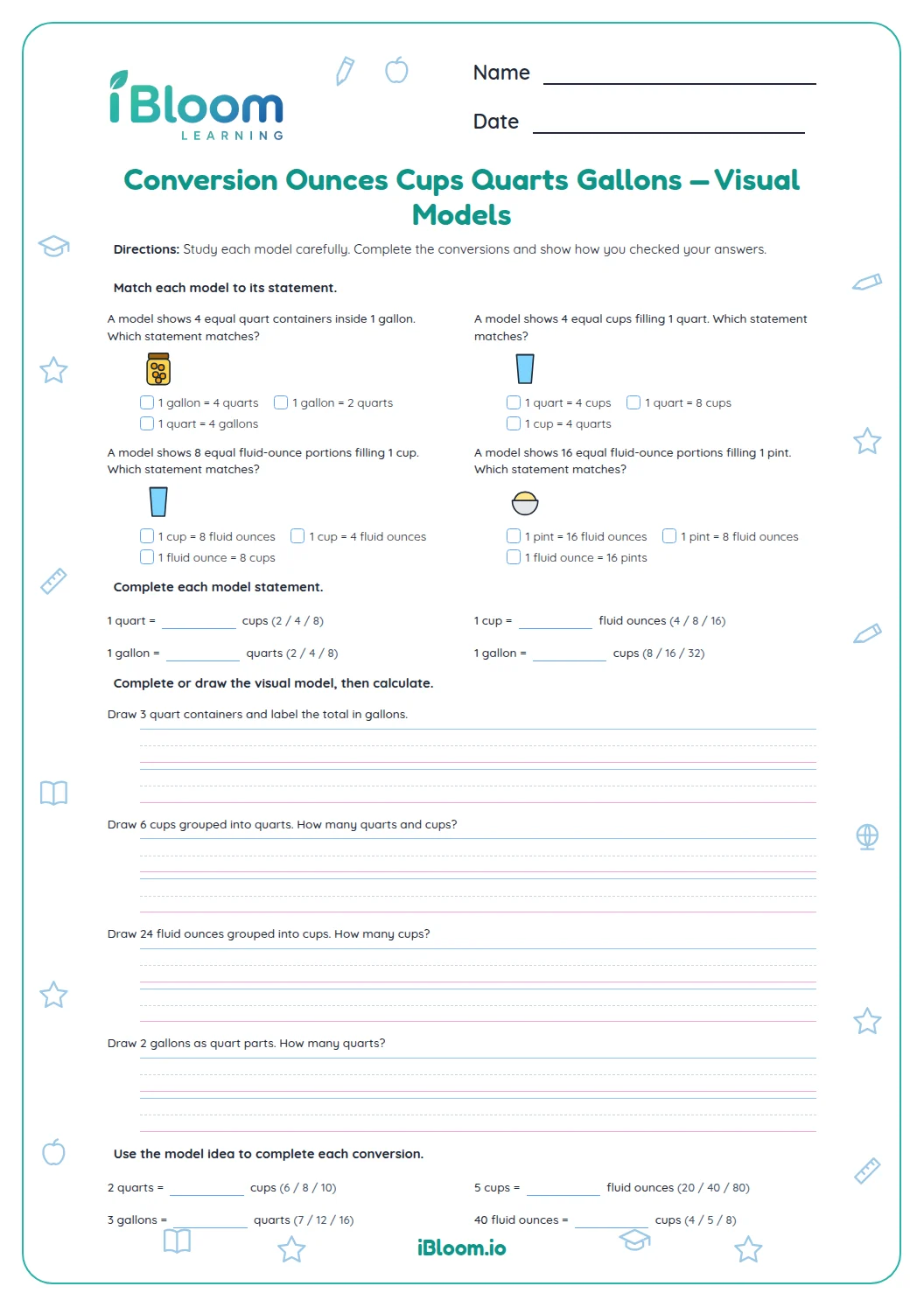
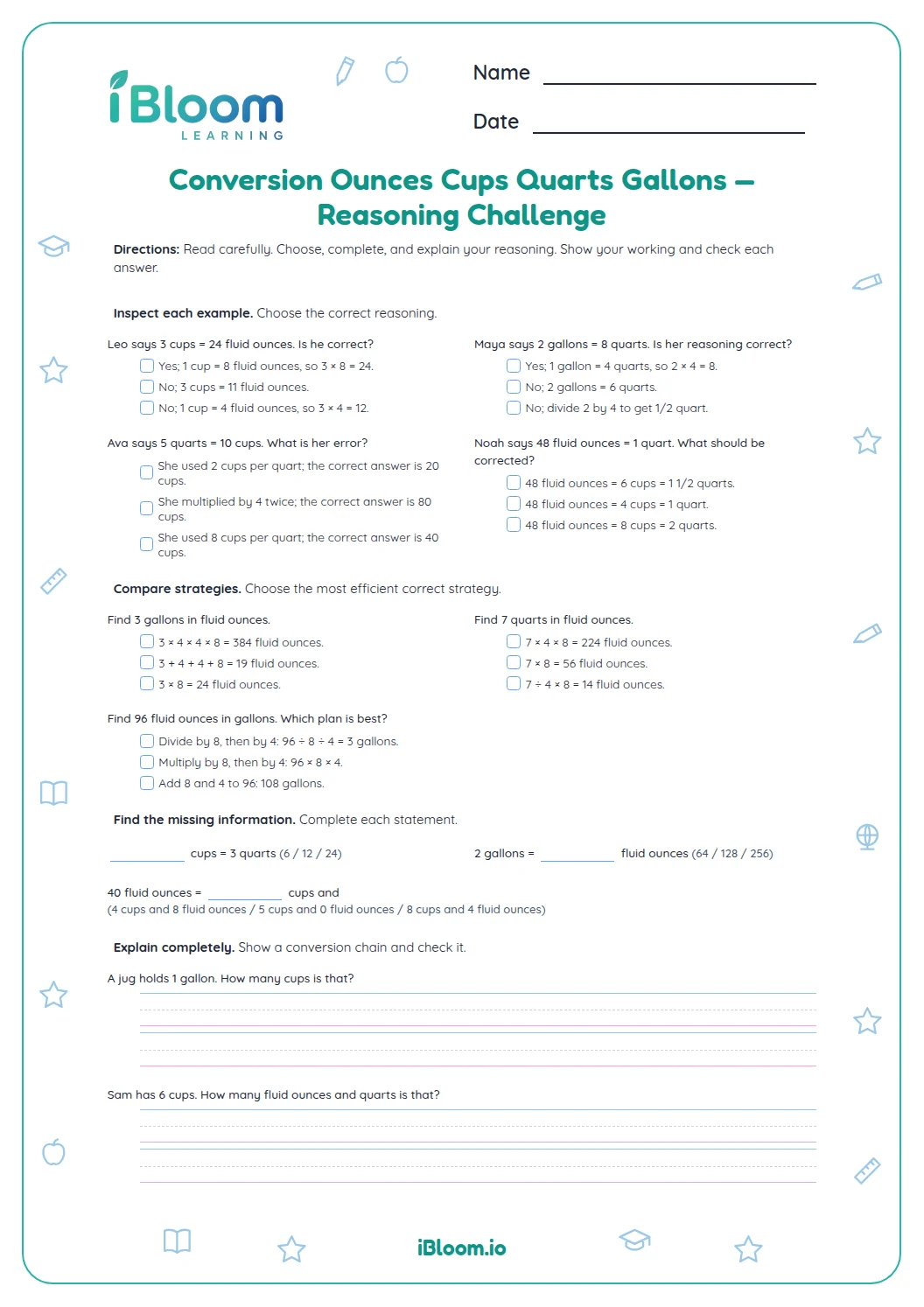
This free Grade 6 worksheet practices converting US liquid measures. The reference line gives 8 fluid ounces per cup, 4 cups per quart, and 4 quarts per gallon. Parts A and B have eight direct conversions with whole numbers, fractions, and decimals. Part C has four real-world problems with working space for multistep calculations. Part D adds two quick conversion checks. The separate answer key lists each answer. The worksheet practices ratio reasoning under Common Core 6.RP.A.3d.
Aligned to 6.RP.A.3d
Which ounce does this worksheet use?
Every ounce amount here is a fluid ounce, written fl oz on the sheet’s reference line. It measures liquid volume. All conversions use US customary liquid measures: 8 fluid ounces in a cup, 4 cups in a quart, and 4 quarts in a gallon.
From those relationships, students can build two useful facts: 1 quart = 32 fluid ounces and 1 gallon = 16 cups. Keep the units attached while building these conversions.
How can a conversion take two steps?
Question 8 asks for the fluid ounces in a 2.5-quart pitcher. The printed ratios connect quarts to cups and cups to fluid ounces, so students can use them in sequence. Each step describes the same amount in a smaller unit.
- 12.5 quarts × 4 cups per quart = 10 cups
- 210 cups × 8 fluid ounces per cup = 80 fluid ounces
- 3Check: 80 ÷ 8 ÷ 4 = 2.5 quarts
How can students plan the multistep problems?
Read the requested unit first. In question 9, convert 2 gallons to 32 cups before subtracting the 5 cups served. In question 10, convert 6 cups to 1.5 quarts before adding the 3 quarts of broth.
Question 11 converts the punch in the jug to fluid ounces and divides by the serving size. Question 12 finds the milk for eight batches, then converts that total to quarts. Part D checks conversion between a fraction of a quart and fluid ounces, and gallons and cups.
How to use this worksheet
- 1Read the reference line and derive 16 cups per gallon and 32 fluid ounces per quart.
- 2Underline the starting unit and the requested unit in each question.
- 3Choose a ratio that turns the starting unit into the requested unit.
- 4For Part C, write the conversion and any extra calculation on separate lines.
- 5For Part C, write the conversion and the additional calculation on separate lines.
- 6Check with the key and reverse a conversion to verify any uncertain result.
Mistakes to notice and fix
The mistake
Dividing by 8 when converting cups to fluid ounces.
The fix
One cup holds eight fluid ounces, so six cups require 6 × 8 = 48.
The mistake
Adding 3 quarts and 6 cups to get 9 quarts.
The fix
Convert 6 cups to 1.5 quarts, then add 3 + 1.5 = 4.5 quarts.
The mistake
Treating 1.5 gallons as 1 gallon plus 5 cups.
The fix
The decimal is half a gallon: 1.5 × 16 = 24 cups.
Common Core alignment
Use unit ratios to convert US liquid measures in practical problems.
On this sheet: Students multiply or divide by unit ratios, including conversions within multistep contexts.
Show the official wordingHide the official wording
Use ratio reasoning to convert measurement units; manipulate and transform units appropriately when multiplying or dividing quantities.
What to practice next
Make more practice
Further reading
Questions parents and teachers ask
Are these US or imperial liquid measures?
These problems use US customary liquid measures. The reference line states the conversion facts needed for every question: eight fluid ounces per cup, four cups per quart, and four quarts per gallon. Have students use those printed ratios consistently as they move between units.
Does “ounce” mean weight on this sheet?
All ounce amounts on this sheet are fluid ounces, a unit of liquid volume. The reference line defines fl oz, and several questions use that abbreviation. Ask students to carry the unit through their work so the meaning stays clear in every conversion.
Do answers have to be written as fractions?
Equivalent fractions and decimals are both acceptable when they describe the same amount in the requested unit. For example, question 7 can be answered as 1 1/4 quarts or 1.25 quarts. The key uses mixed numbers for fractional quart answers, but students may use exact decimals.
How many servings come from the punch jug?
The 1.5-gallon jug fills thirty-two servings of six fluid ounces each. Convert 1.5 gallons to six quarts, then to twenty-four cups, and finally to 192 fluid ounces. Dividing 192 by six gives thirty-two. Students can check by multiplying thirty-two servings by six fluid ounces.
What should students show in the working space?
The four multistep problems in Part C have work grids. Students can show conversions with units and any extra calculation there, then write the number in the answer box. For question 9, convert 2 gallons to 32 cups, then subtract 5 cups to get 27 cups remaining.