





About this worksheet
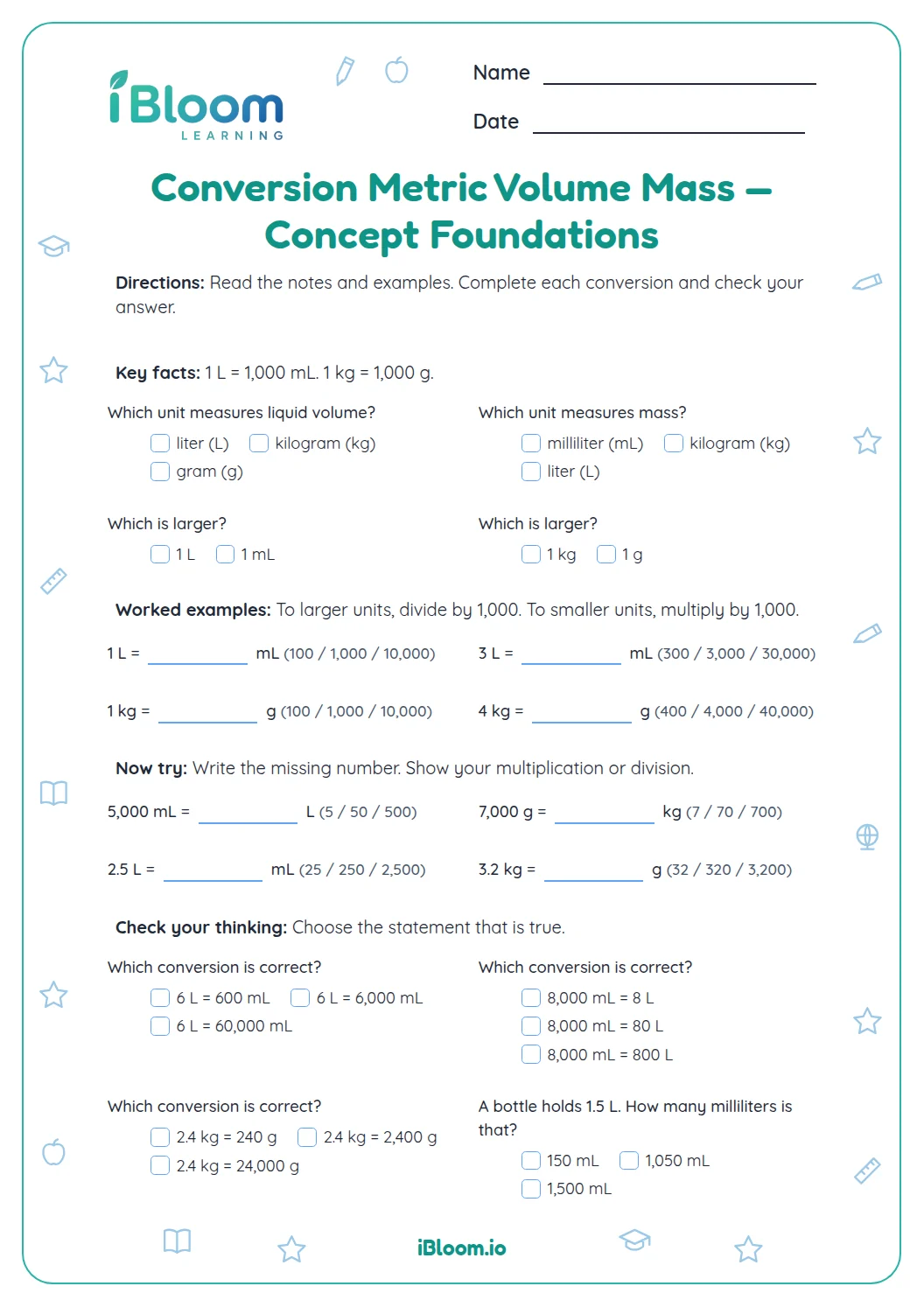
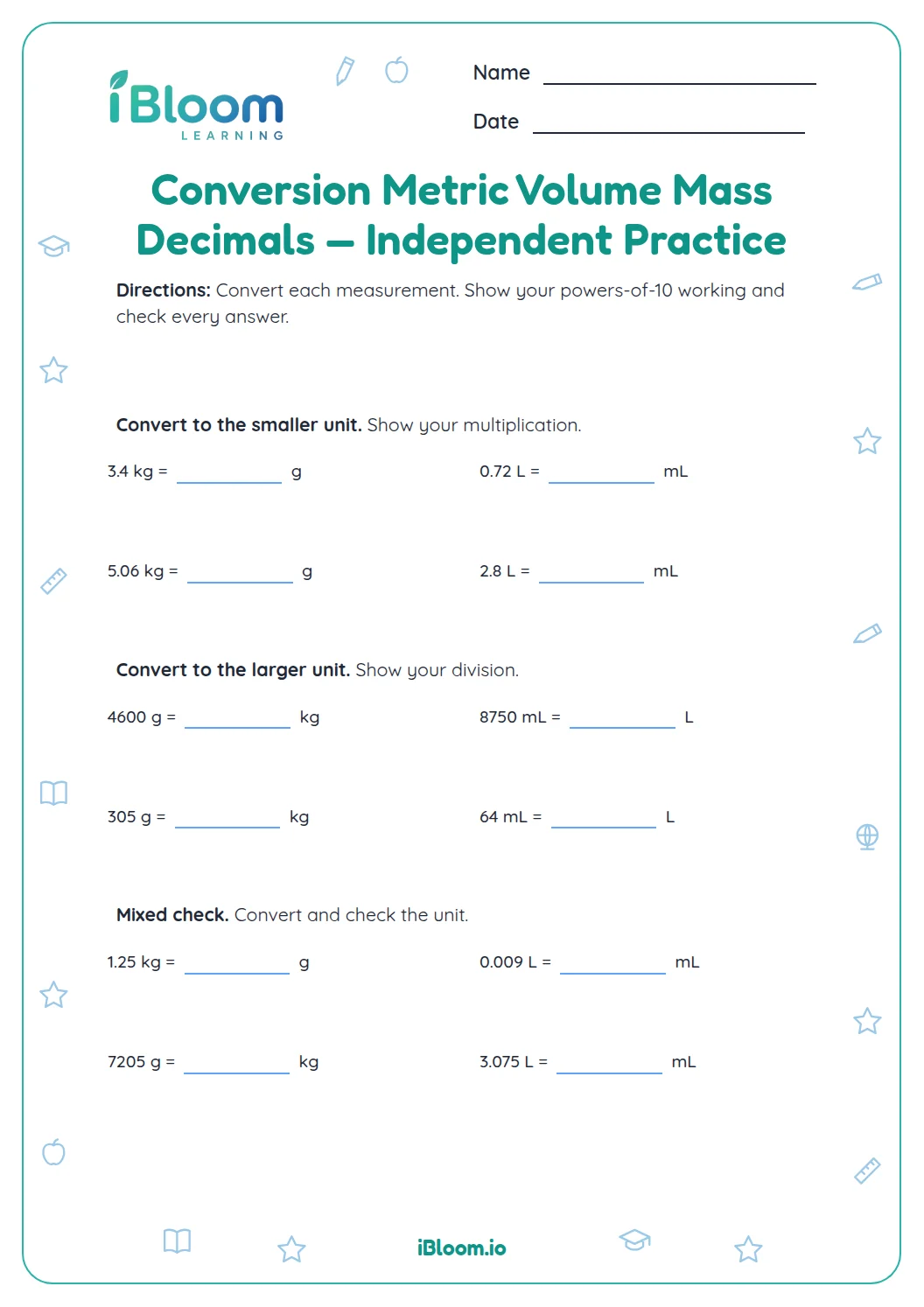
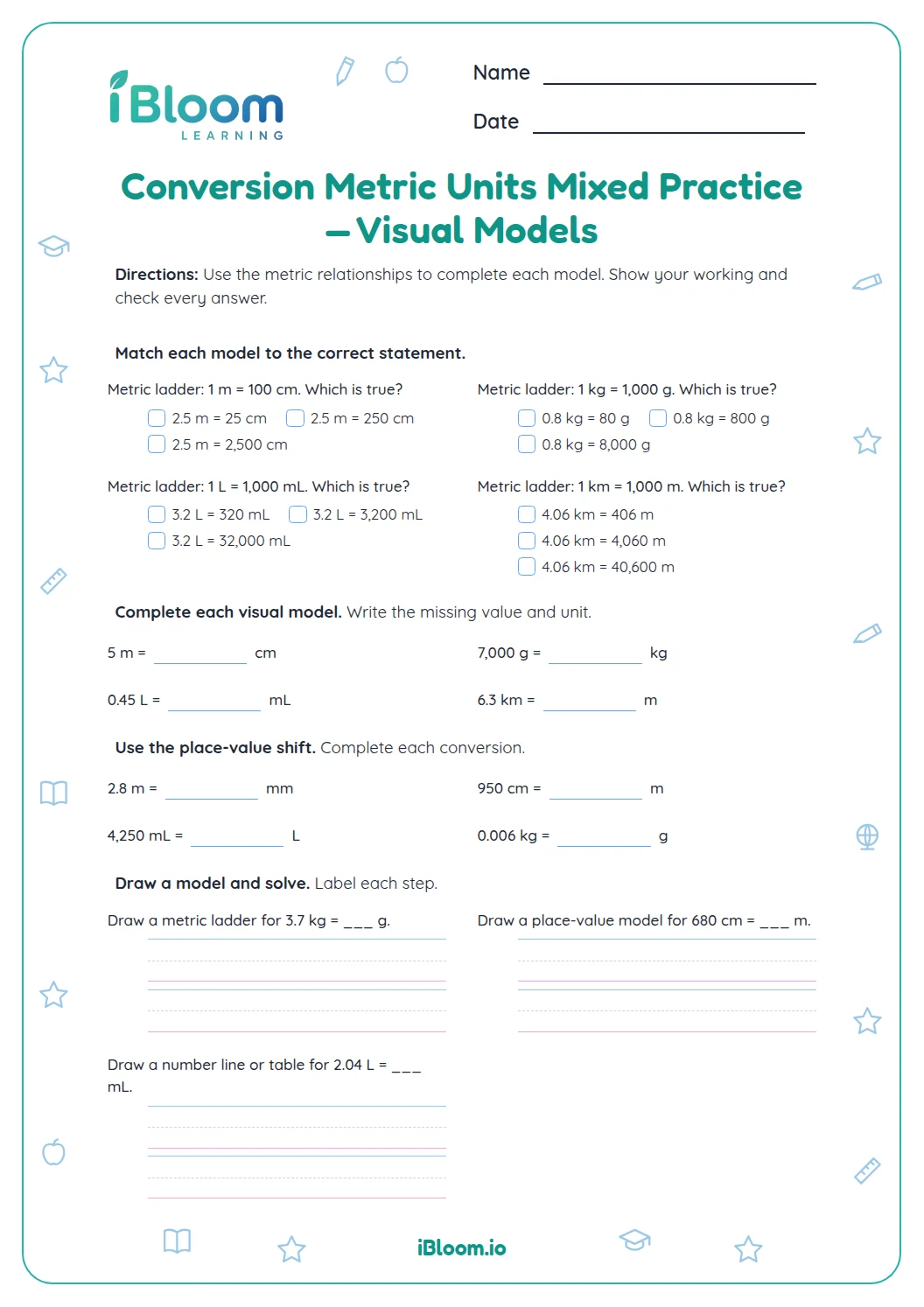
This free Grade 6 worksheet practices metric conversions for volume and mass. Children move between liters and milliliters and between kilograms and grams, using whole numbers and decimals. Direct conversions lead into word problems, a comparison, and a multistep sharing situation. Each answer includes a unit, and the separate key shows the converted values. The practice aligns with CCSS 5.MD.A.1 for converting units within a measurement system and using conversions in problems.
Aligned to 5.MD.A.1
What do the metric units have in common?
One liter is 1,000 milliliters, and one kilogram is 1,000 grams. Going from the larger named unit to the smaller unit multiplies the number by 1,000. Going back divides by 1,000.
For question 4, 2,750 g ÷ 1,000 = 2.75 kg. A quick check: 2.75 kg is a little less than 3 kg, or 3,000 g.
- 12,750 g ÷ 1,000 = 2.75 kg
- 2Check: 2.75 kg = 2,750 g
How do you use a conversion in a problem?
Convert the measurement first, then answer what the story asks. Question 15 gives 2.5 kg for 5 equal bags. Convert 2.5 kg to 2,500 g, then divide 2,500 by 5 to get 500 g per bag.
How can you compare different units?
Write both amounts in the same unit. For question 13, 1.6 L = 1,600 mL, which is greater than 1,550 mL. Do not compare the written numbers until their units match.
How to use this worksheet
- 1Write the starting unit and target unit before calculating.
- 2For liters to milliliters or kilograms to grams, multiply by 1,000.
- 3For milliliters to liters or grams to kilograms, divide by 1,000.
- 4Move the decimal three places, keeping place value in view.
- 5In word problems, convert first and then complete the other operation.
- 6Check that the size of the answer matches the unit.
Common mistakes and quick fixes
The mistake
Multiplying when changing to a larger unit, such as turning 4,500 mL into 4,500 L.
The fix
Divide by 1,000 when converting milliliters to liters.
The mistake
Dropping zeros or moving the decimal the wrong direction.
The fix
Use 1 L = 1,000 mL as a reference and estimate the size.
The mistake
Leaving off the unit.
The fix
Write L, mL, kg or g on every final answer.
Curriculum alignment
This worksheet practices the following standard.
Convert measurement units within one system and use them in problems.
On this sheet: Students convert metric units of volume and mass, including in multistep contexts.
Show the official wordingHide the official wording
Convert among different-sized standard measurement units within a given measurement system (e.g., convert 5 cm to 0.05 m), and use these conversions in solving multi-step, real world problems.
What to practice next
Make more practice
Further reading
Questions parents and teachers ask
What conversion facts does this worksheet use?
It uses 1 liter = 1,000 milliliters and 1 kilogram = 1,000 grams. Multiply by 1,000 when changing to the smaller unit; divide by 1,000 when changing to the larger unit. The practice includes whole numbers and decimals in both directions.
How do I convert 4,500 milliliters to liters?
Divide 4,500 by 1,000 to get 4.5 liters. The number becomes smaller because a liter contains 1,000 milliliters. Question 2 uses this conversion direction; question 1 goes the other way, from liters to milliliters, with a whole-number amount.
Why should answers include units?
A number by itself does not say whether it measures volume or mass, or which unit it uses. Write mL, L, g, or kg after each result. For a story about cups, include cups in the answer so the result answers the question asked.
How should students compare 1.6 L and 1,550 mL?
Convert one amount so both use the same unit. Since 1.6 L equals 1,600 mL, it is greater than 1,550 mL. The comparison question asks students to make this conversion before selecting an answer. Writing both amounts in milliliters makes their sizes easy to compare.
How many questions and pages are included?
There are 18 questions across three pages total, including a separate answer key page. The worksheet has eight direct conversions, nine measurement situations, and one comparison. Some situations require a second operation after converting, such as sharing a mass equally.