






About this worksheet
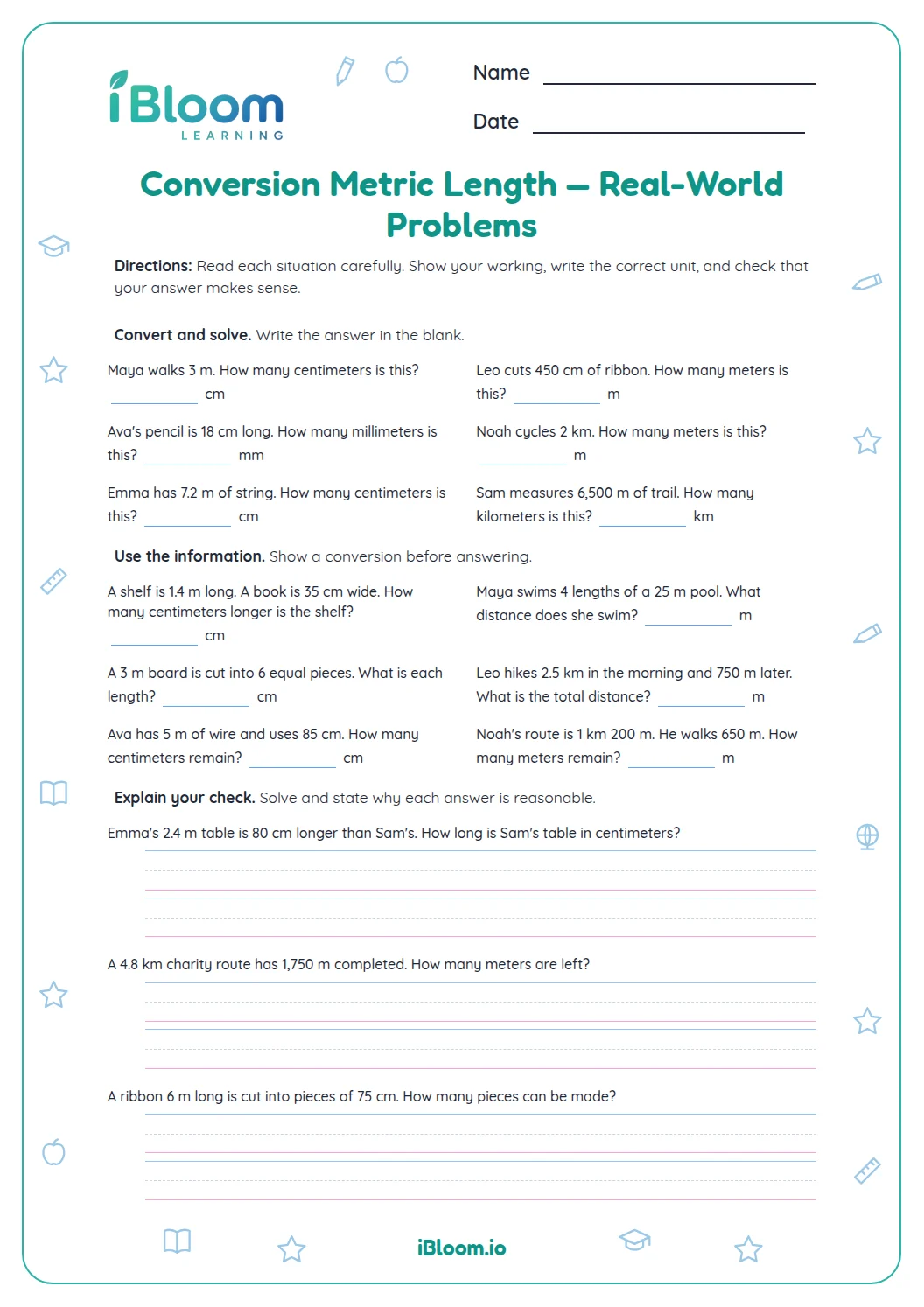
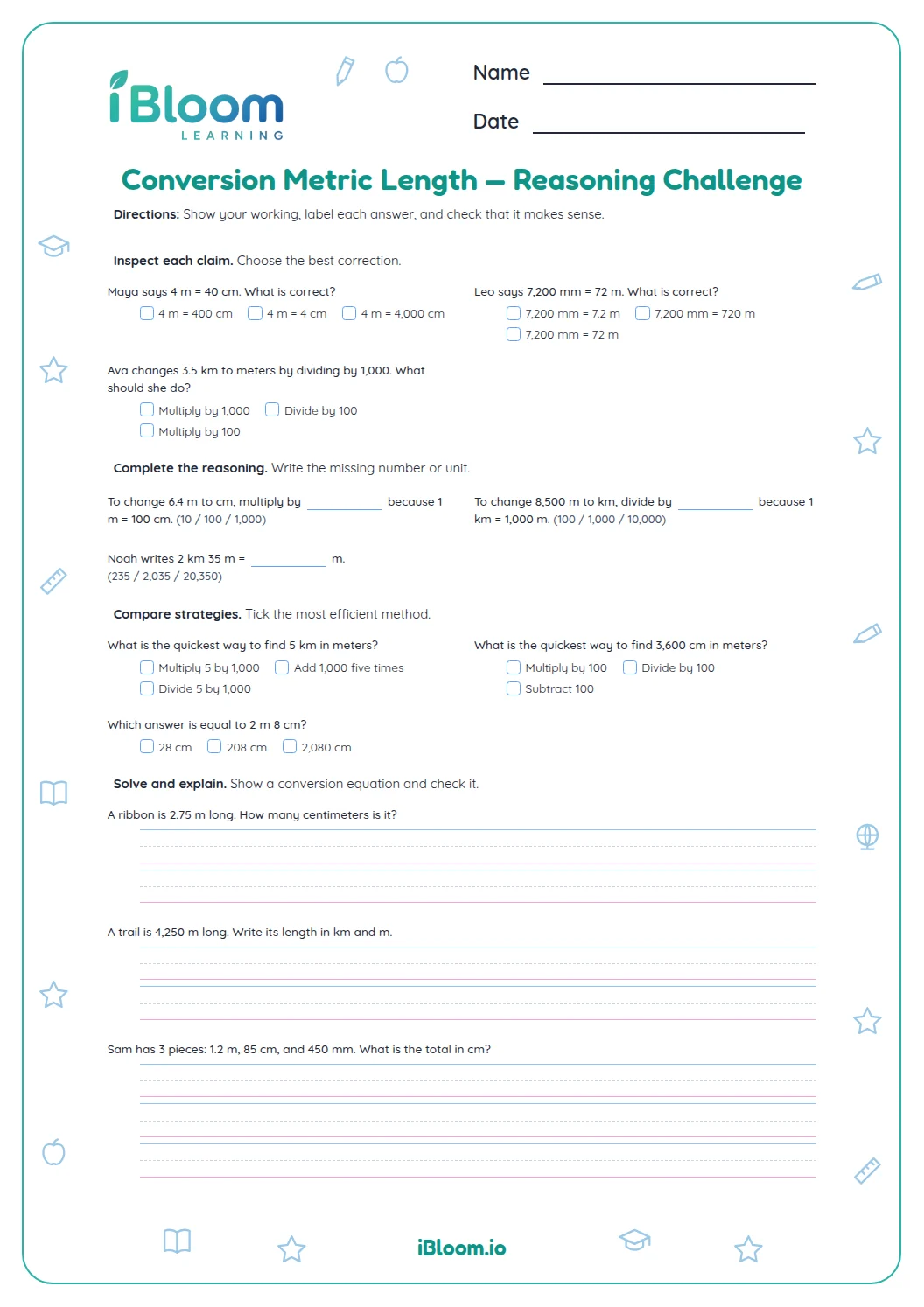
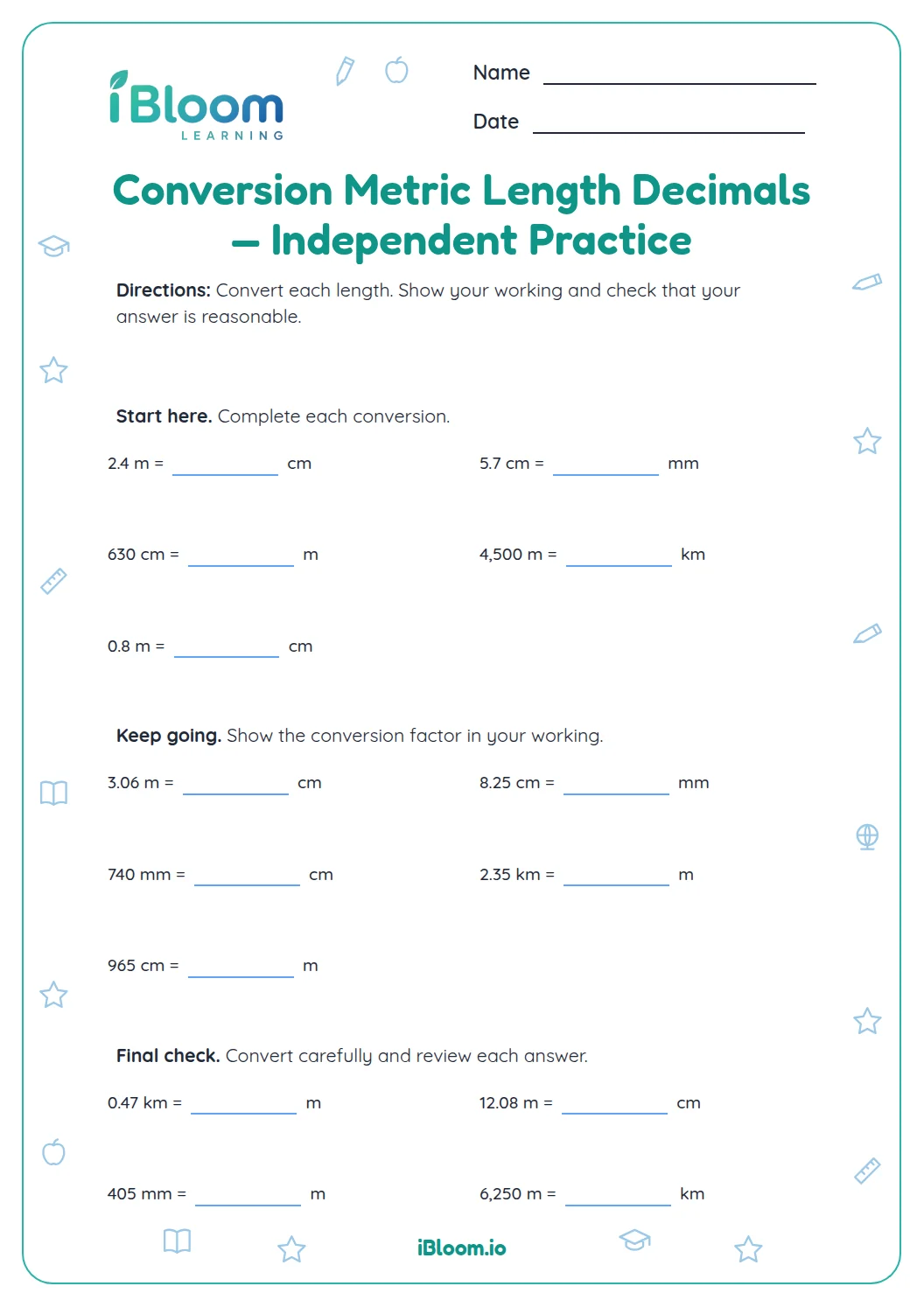
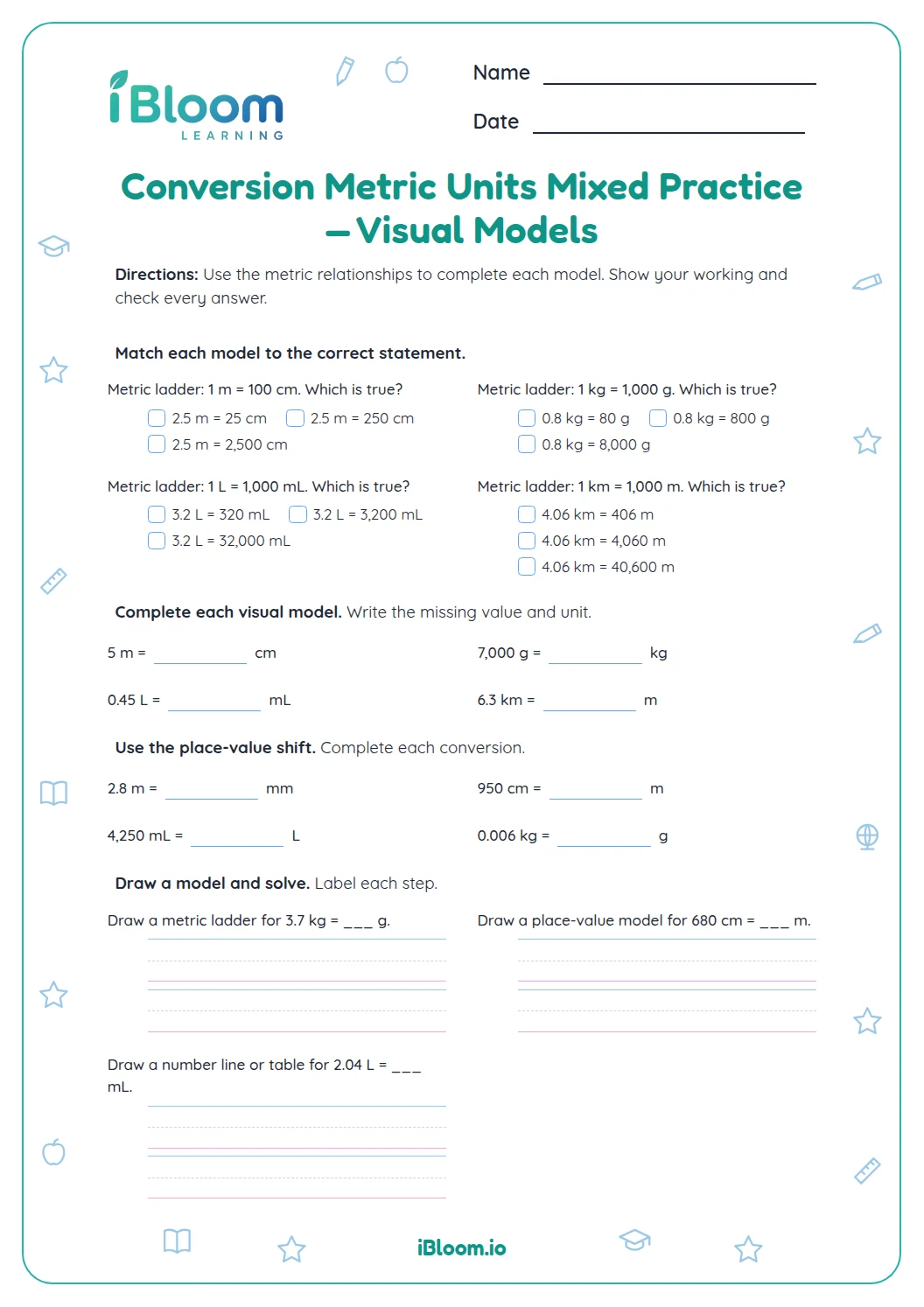
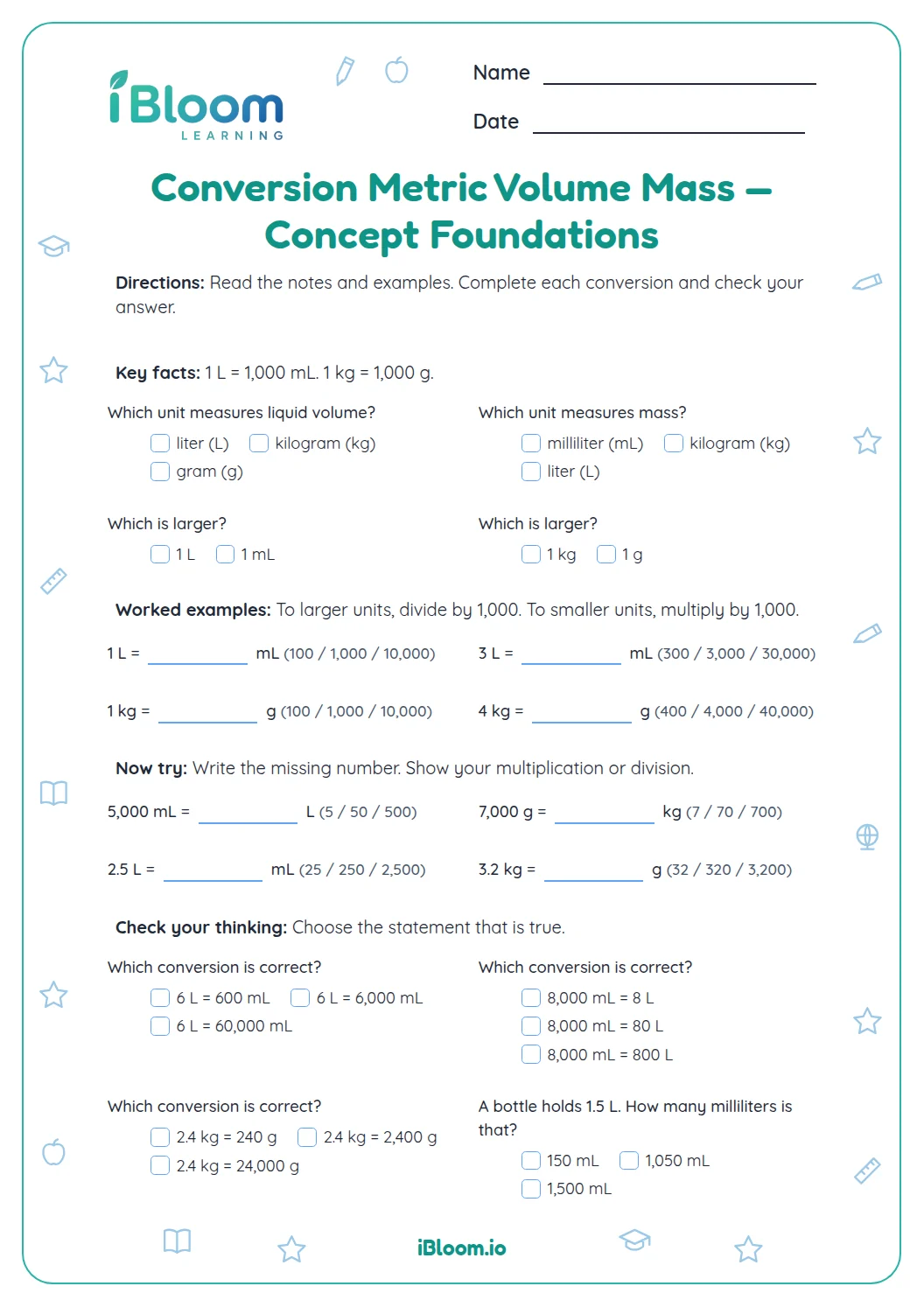
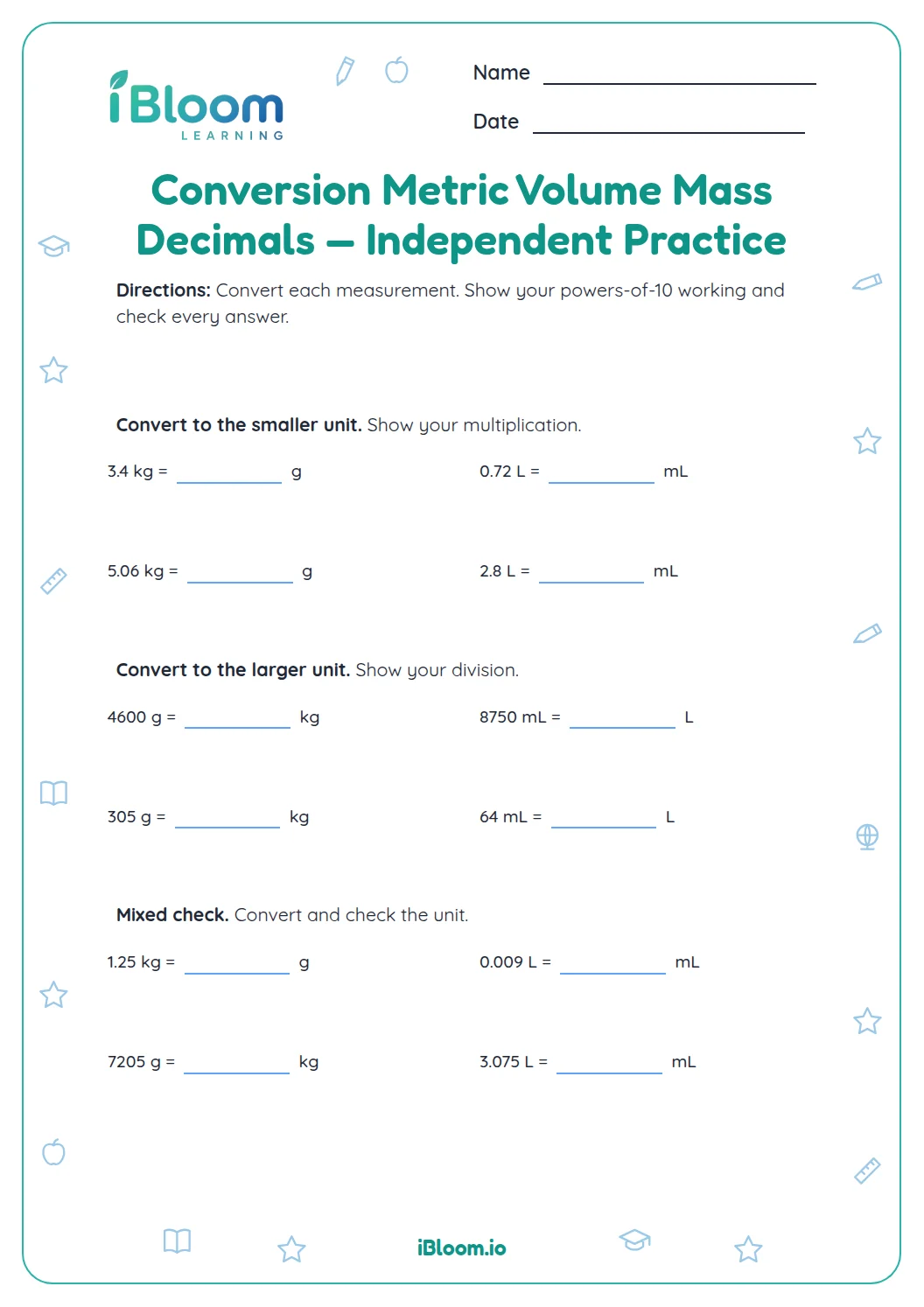
This free printable is for Grade 6 learners practicing metric length conversions. It includes 16 questions across the worksheet’s different parts, followed by a separate answer key. The items move from guided recognition to applying the skill in short tasks. Use it for independent practice, a small group, or a quick review together.
Aligned to 5.MD.A.1
Which metric relationships matter here?
The first parts review sensible units and the relationships 1 m = 100 cm, 1 cm = 10 mm, and 1 km = 1,000 m. Learners use those facts to convert in both directions.
- 1Which unit is best for measuring the length of a pencil? → centimeter
How do conversions apply to real lengths?
The final questions use ribbons, trails, boards, and wire. Some ask for a compound length such as meters and centimeters; the last item connects centimeters to millimeters as well.
How can families check a conversion?
Estimate first, then use the relevant metric relationship. For example, a length measured in centimeters will have a larger number than the same length measured in meters.
How to use this worksheet
- 1Choose a unit that fits the size of the object or distance.
- 2Recall the conversion relationship for the two units.
- 3Multiply or divide by the correct factor of 10, 100, or 1,000.
- 4Write the new unit beside the value.
- 5Check that the converted length is equivalent to the original.
Common mistakes and quick fixes
The mistake
Using the conversion factor in the wrong direction.
The fix
Estimate whether the new number should grow or shrink.
The mistake
Dropping the unit after converting.
The fix
Label the final value with the requested metric unit.
The mistake
Reading 480 cm as 4 m 8 cm.
The fix
Remember that 100 centimeters make one meter, leaving 80 centimeters.
Curriculum alignment
Convert lengths between units in the metric system.
On this sheet: Each item practices converting between metric length units.
Show the official wordingHide the official wording
Convert among different-sized standard measurement units within a given measurement system (e.g., convert 5 cm to 0.05 m), and use these conversions in solving multi-step, real world problems.
What to practice next
Make more practice
Further reading
Questions parents and teachers ask
Which metric units appear on this worksheet?
The questions use millimeters, centimeters, meters, and kilometers. Learners choose appropriate units and convert between the pairs named in the directions, including compound meter-and-centimeter lengths. The separate answer key offers a quick way to review each response. Then compare with the answer key.
How many questions are on the printable?
There are 16 questions across four parts, followed by a separate answer key. The work includes unit choices, basic relationships, conversions in both directions, and length word problems. The separate answer key offers a quick way to review each response.
How many centimeters are in a meter?
There are 100 centimeters in 1 meter. That relationship helps with items such as converting a 2-meter ribbon to centimeters or expressing a length in meters and leftover centimeters. The separate answer key offers a quick way to review each response.
How should I check a converted length?
Use the relationship between the two units and make sure the value and unit describe the same length. A larger unit usually gives a smaller number, while a smaller unit gives a larger number. The separate answer key offers a quick way to review each response.
What does 480 centimeters equal in meters and centimeters?
It equals 4 meters and 80 centimeters because 400 centimeters make 4 meters, with 80 centimeters remaining. The worksheet asks learners to put the two values in separate blanks. The separate answer key offers a quick way to review each response.