





About this worksheet
This Grade 6 visual-model worksheet practices converting metric units of volume and mass. Students use the relationships 1 liter = 1,000 milliliters and 1 kilogram = 1,000 grams, shift between whole-number and decimal forms, and solve a multi-step volume problem. It includes 15 questions and a separate answer key.
Aligned to 5.MD.A.1
What metric relationships appear on the sheet?
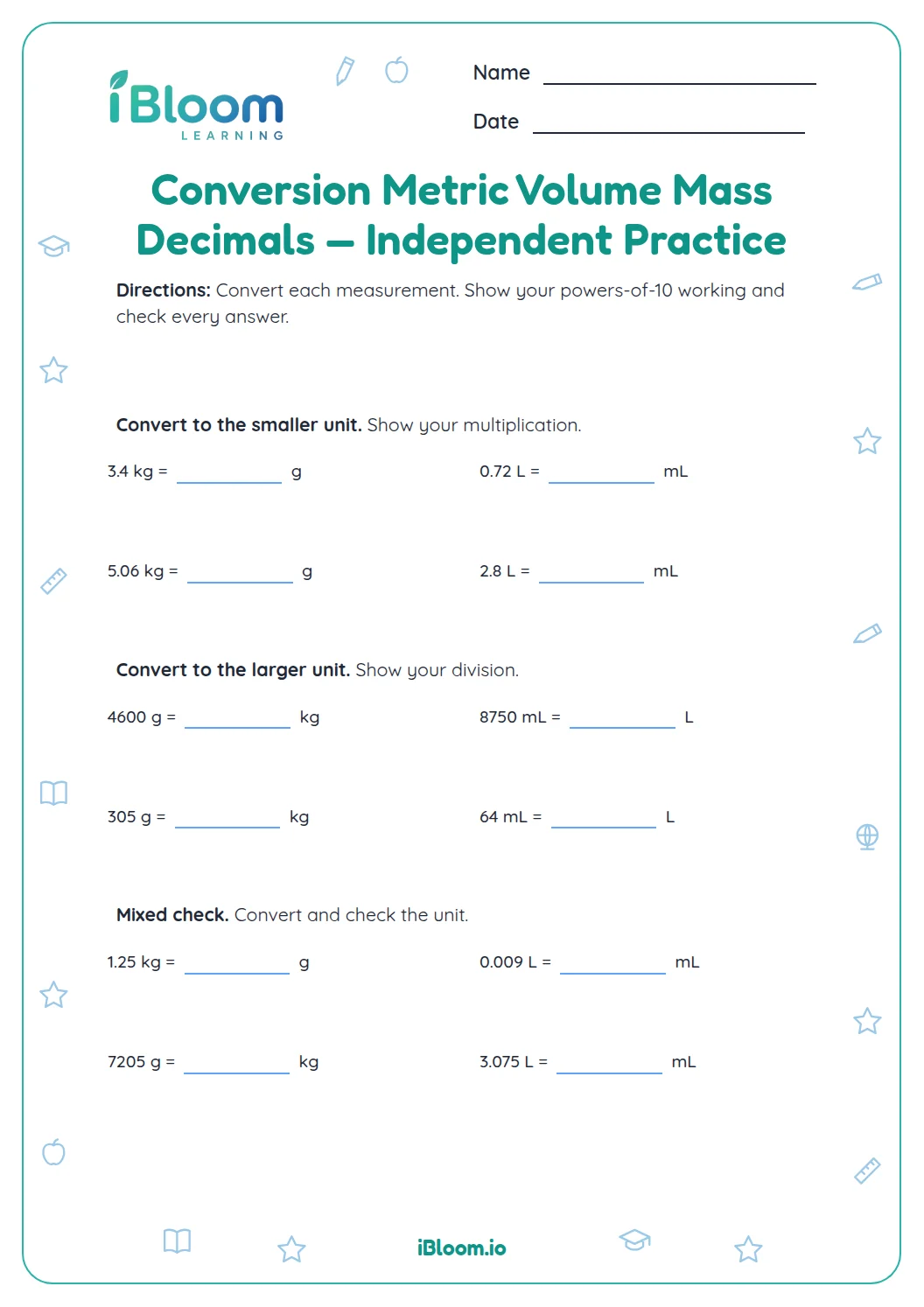
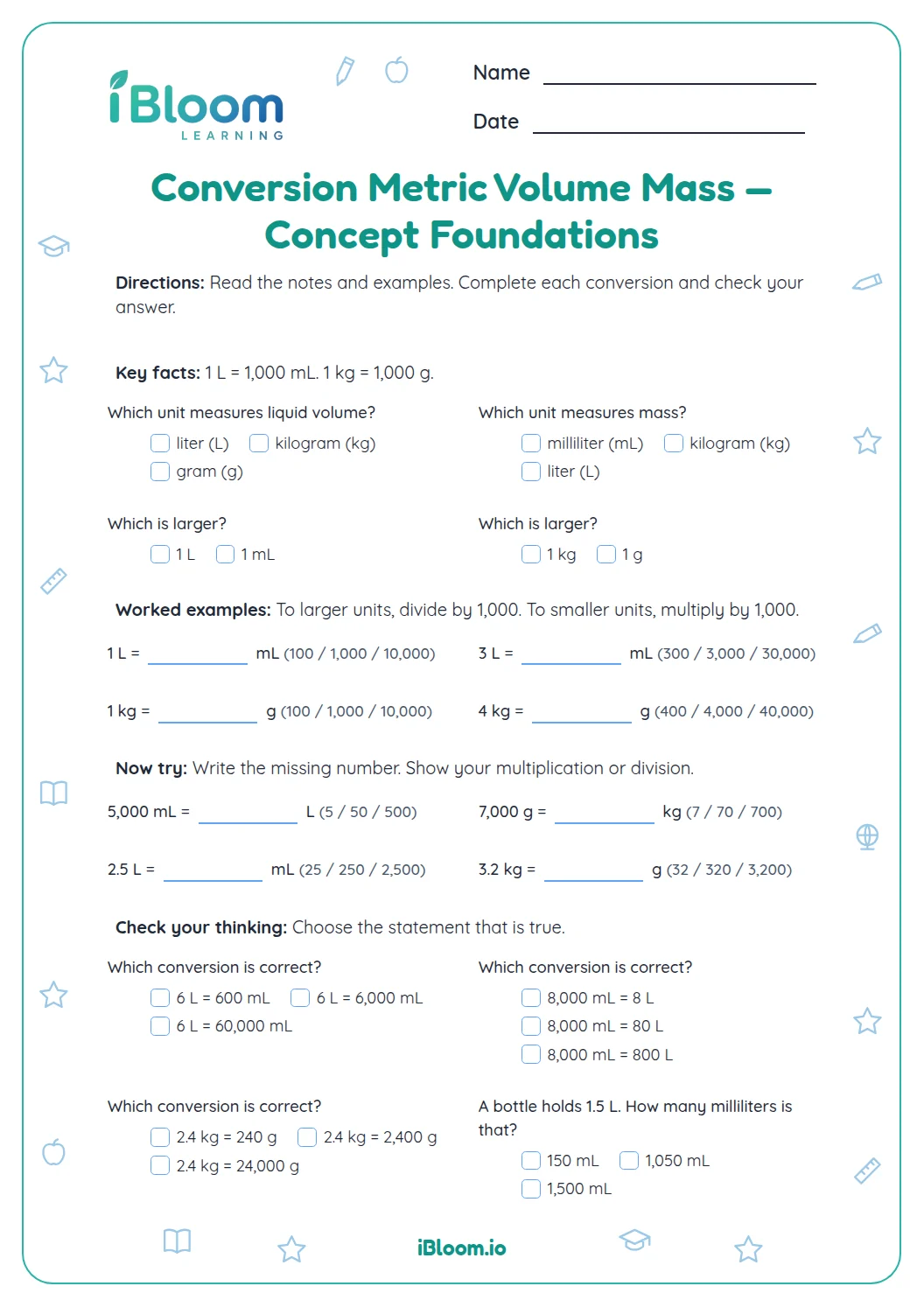
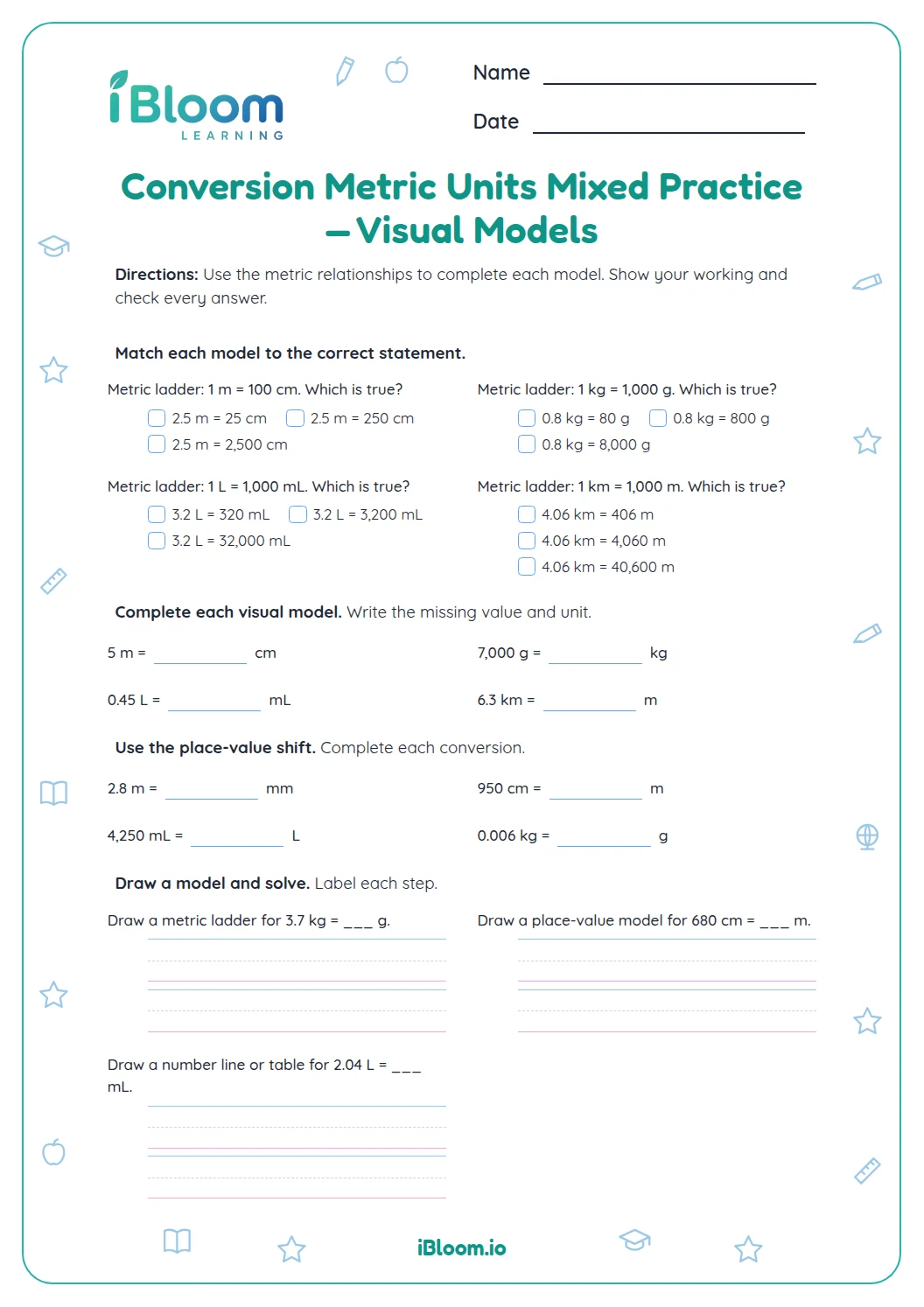
A liter contains 1,000 milliliters. A kilogram contains 1,000 grams. When converting to a smaller unit, multiply by 1,000; when converting to a larger unit, divide by 1,000.
- 12.5 L × 1,000 = 2,500 mL
- 2The amount is the same; only the unit changes.
How do decimals help with metric conversions?
Multiplying or dividing by 1,000 moves the decimal three places. For example, 750 mL is 0.750 L, or 0.75 L. Keep zeros that clarify place value, but a final zero at the end of a decimal is not needed.
How can a conversion solve a measurement problem?
First convert both amounts to the same unit. Then do the addition or subtraction. Question 15 changes 2 L to 2,000 mL before subtracting 350 mL.
How to use this worksheet
- 1Write the equivalent unit relationship before converting.
- 2Decide whether the number should grow or shrink.
- 3Move the decimal three places, or multiply/divide by 1,000.
- 4In a word problem, put both measurements in the same unit.
- 5Estimate the size and attach the requested unit.
Common mistakes and quick fixes
The mistake
Multiplying when changing to a larger unit.
The fix
A larger unit needs a smaller number, so divide by 1,000.
The mistake
Moving the decimal only one place.
The fix
Metric kilo-to-base and base-to-milli conversions use 1,000.
The mistake
Subtracting unlike units directly.
The fix
Convert both quantities to liters or both to milliliters first.
Common Core alignment
The conversion work uses place value to change between metric units.
Convert metric units within one measurement system using place value.
On this sheet: Convert metric units within one measurement system using place value.
Show the official wordingHide the official wording
Convert among different-sized standard measurement units within a given measurement system (e.g., convert 5 cm to 0.05 m), and use these conversions in solving multi-step, real world problems.
What to practice next
Make more practice
Further reading
Questions parents and teachers ask
What does the metric worksheet practice?
The 15 questions convert liters to milliliters and kilograms to grams, in both directions. Two small tables show the 1-to-1,000 relationships, followed by decimal conversions and two measurement problems. The answer key gives the converted amounts and units.
How do students decide which way to move the decimal?
Start with the unit relationship: 1 liter equals 1,000 milliliters, and 1 kilogram equals 1,000 grams. Moving from the larger unit to the smaller one multiplies by 1,000; moving back divides by 1,000. Then check whether the answer size makes sense.
How long should this worksheet take?
About 20 minutes should allow time for the 15 conversions and the final word problems. Students can use the tables to anchor each unit relationship, then work through decimal values and check whether the amount grew or shrank in the expected direction.
Can students use the worksheet for independent practice?
Yes. The conversion tables make the two relationships visible, and the later questions apply them without a table. The separate key lists the expected values. For the last question, students should first convert 2 liters to milliliters, then subtract 350 milliliters.
What is a useful way to fix a wrong conversion?
Write the equivalent unit pair beside the problem and label the starting and ending units. For example, 750 milliliters is less than 1 liter, so its value in liters should be less than 1. Rework the place-value change and include the requested unit.
Is an answer key included?
Yes. A separate two-page answer key lists the table entries, direct conversions, and word-problem results. It includes units where the prompt asks for them. Students can use the key to locate a conversion error and redo that calculation before moving on.